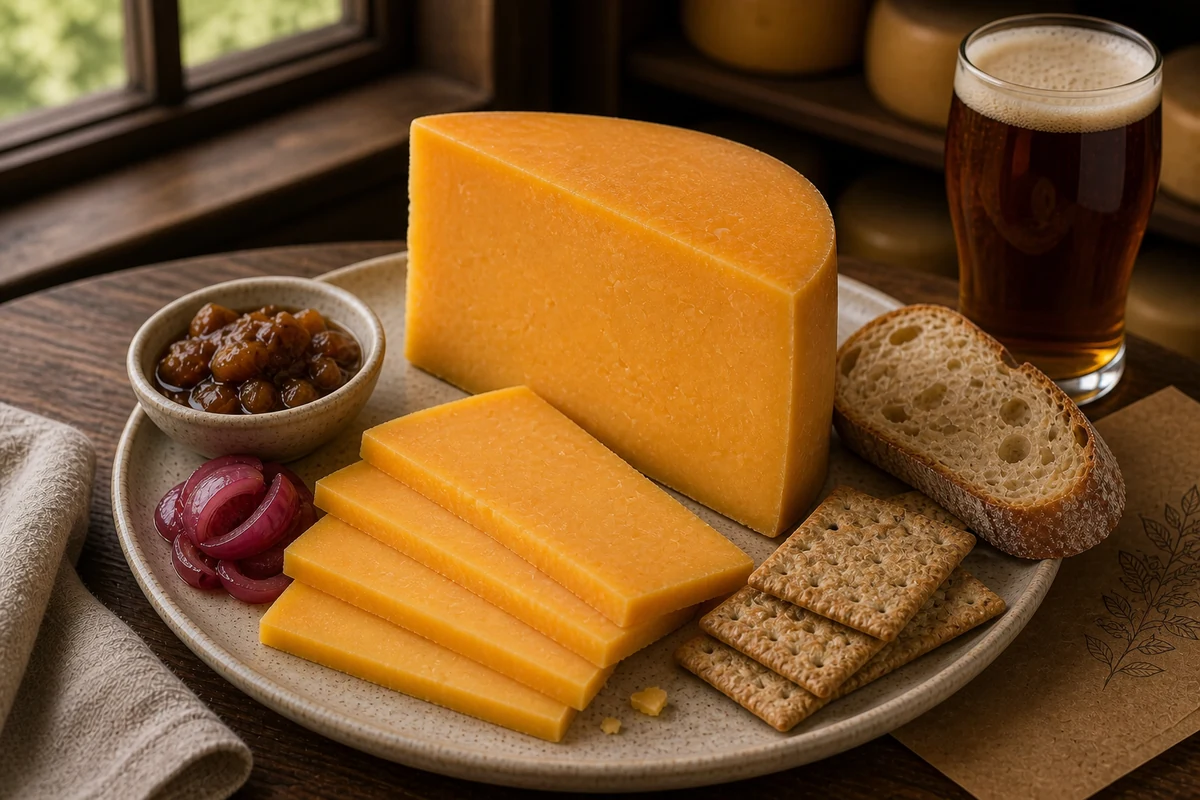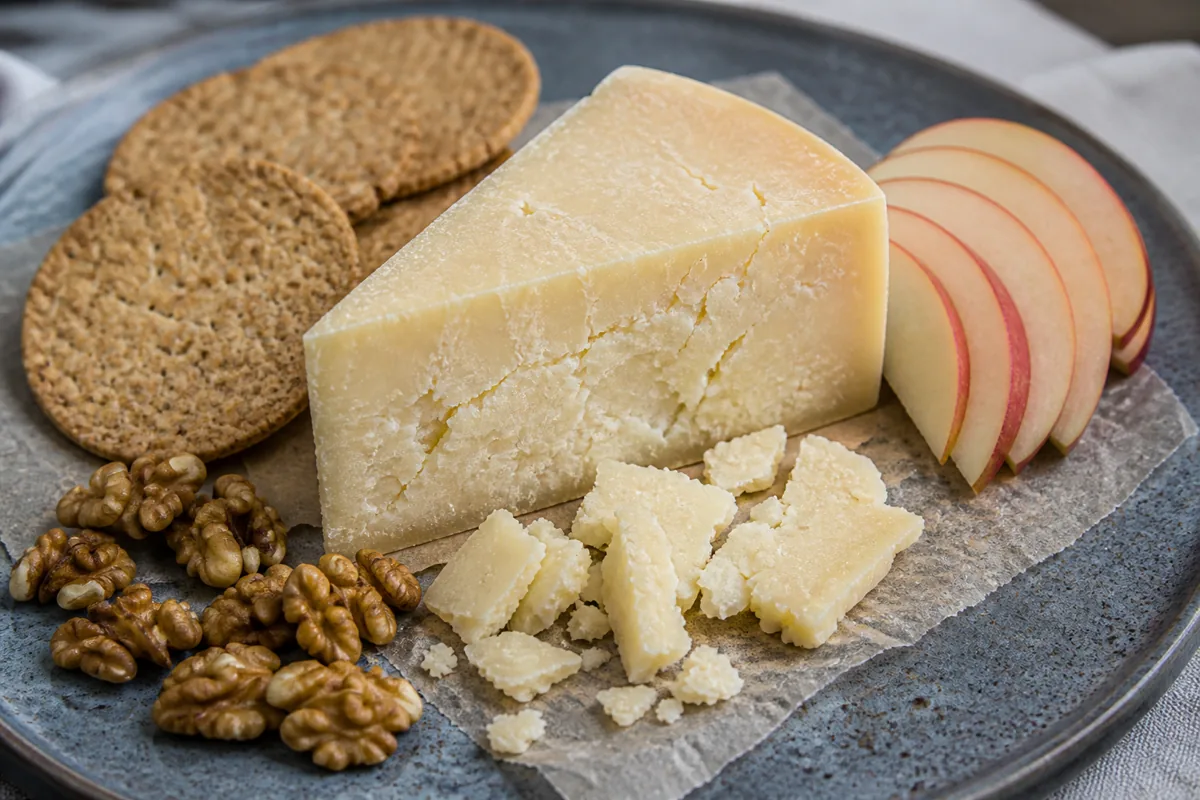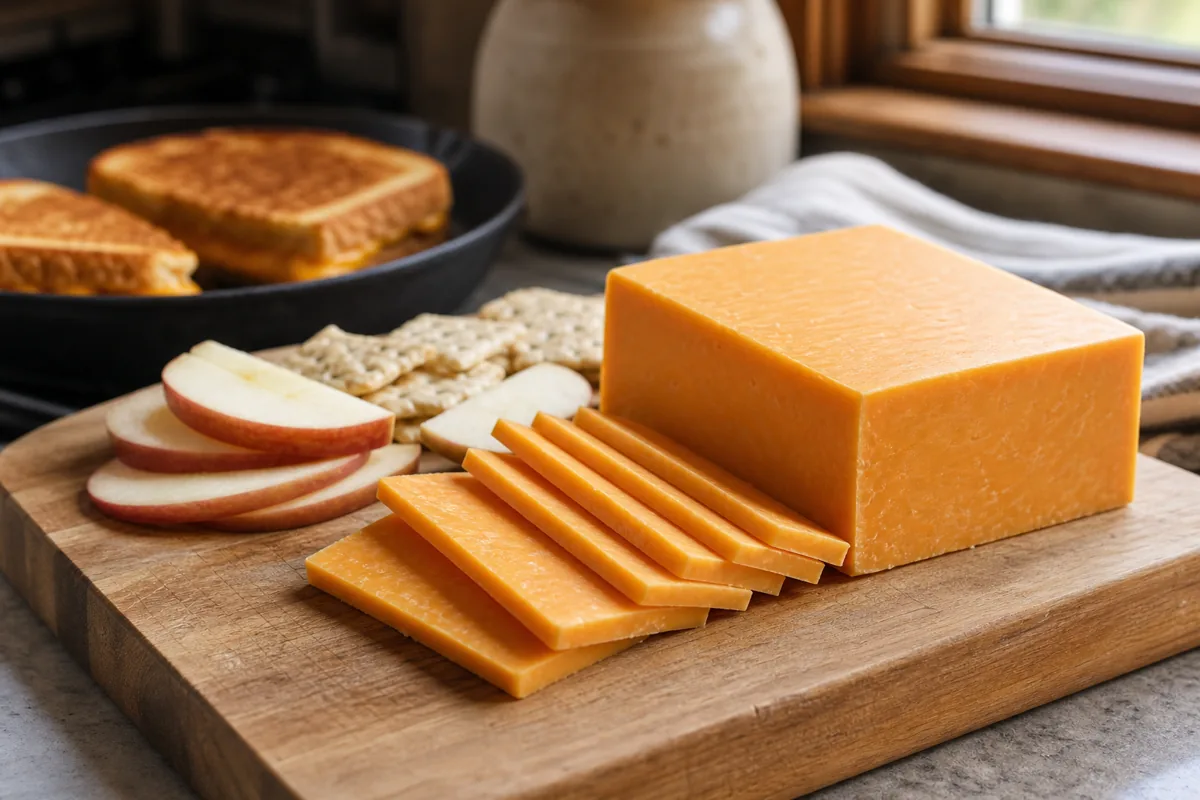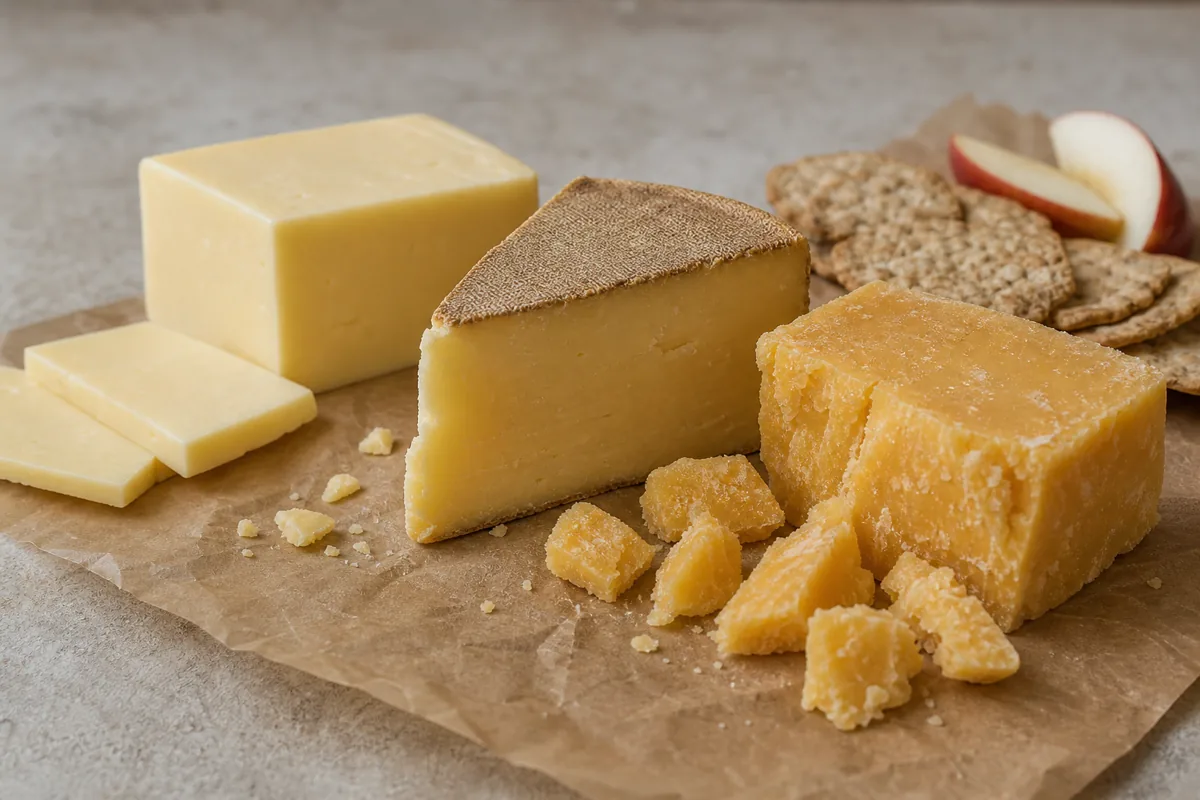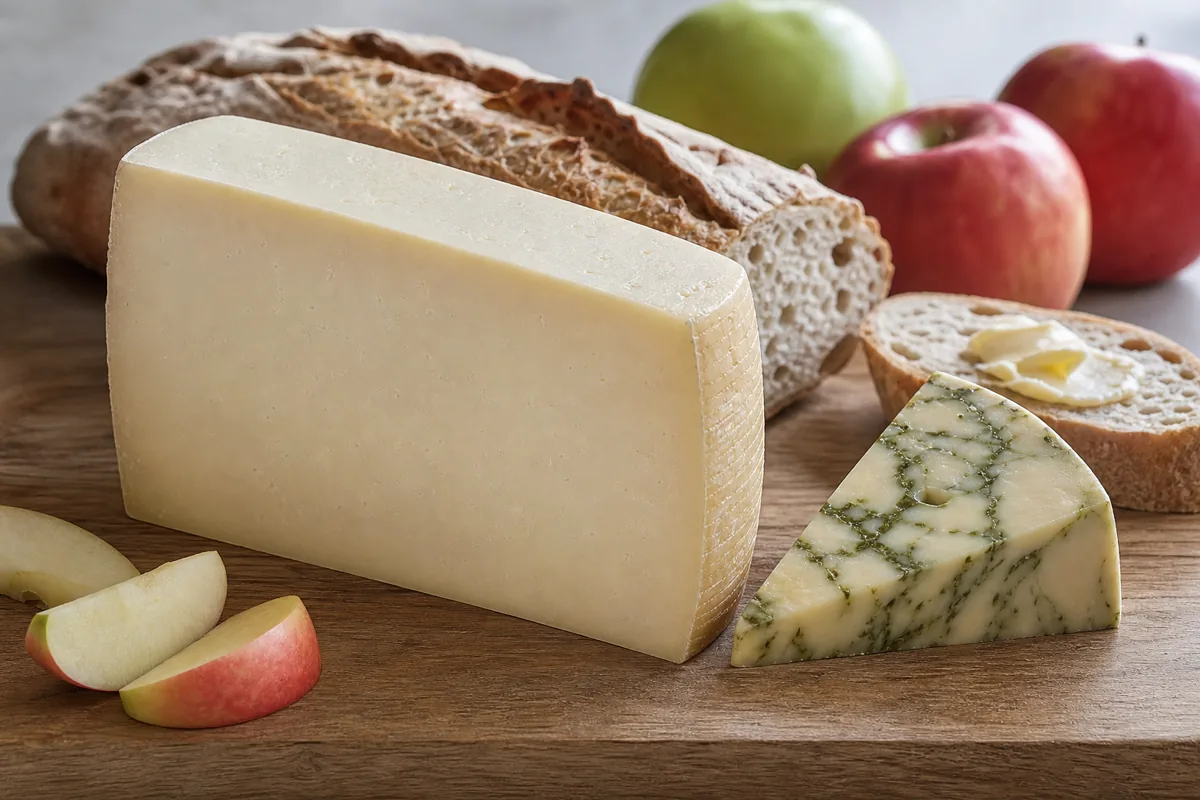
Derby is a mild, semi-firm English cow's milk cheese from Derbyshire. Cheese.com describes it as buttery, creamy and sweet, with a strong ability to melt.
Plain Derby has two flavoured variants: Sage Derby, marbled green with sage, and Port Wine Derby, marbled ruby red with port.
In This Article
What Is Derby Cheese?
Cheese.com lists Derby as a cow's milk cheese from Derbyshire with a semi-firm, creamy and smooth body, an ivory colour and a mild aroma. It files the cheese in the Cheddar family and says it has been made in Derbyshire since the 16th century, calling it England's oldest and most famous cheese.
Wikipedia describes the same cheese as mild and semi-firm, with a smooth, mellow texture and a buttery flavour. It adds that Derby was historically made only on farms and sold younger than Cheddar and its famous cousin Cheshire.
Cheese.com says only a few farms in England still make Derby the time-honoured way.
Derby has no protected name: Wikipedia's list of Derbyshire cheeses gives that status only to Stilton, Dovedale and Derbyshire's Buxton Blue.
How Old Is Derby, and How Long Is It Aged?
The sources give different ages and colours, so the table keeps each claim with the source that made it.
| Point | Source | What it says |
|---|---|---|
| History of Derby | Cheese.com | Made in Derbyshire since the 16th century, England's oldest cheese |
| History of Derby | Wikipedia (list) | Produced since the 16th century, one of England's oldest cheeses |
| History of Sage Derby | Belton Farm | Production believed to have started in the seventeenth century |
| Ageing, plain Derby | Cheese.com | Traditional Derby is matured for nine months |
| Ageing, plain Derby | Wikipedia | Ripens at between one and six months |
| Ageing, Sage Derby | Fromi | Hartington's version is matured for 4 months in the creamery cellars |
| Colour | Cheese.com | Ivory, with a rich yellow paste |
| Colour | Wikipedia | Pale, golden orange interior |
| Colour, traditional Derby | Wikipedia (Varieties) | Light ivory/yellow colour |
Ageing figures run from one month to nine, so the name alone does not tell you how mature a wedge is. A label that gives the age or the maker settles it.
Wikipedia adds that the texture becomes firmer as Derby matures, and Cheese.com ties the nine-month figure to the traditional Derby with an open texture and a smooth, creamy body.
Read together, the sources put the springy end of Derby at the young end of the range and the firmer end toward nine months.
What Does Derby Taste Like Next to Cheddar?
Cheese.com calls Derby buttery, mild and sweet, and says traditionally matured versions have a nutty flavour. Wikipedia says young Derby is springy and mild, with subtle sweet flavours developing as it matures.
Cheese.com says Derby's texture is sometimes compared with mild cheddar, but that Derby is milder, with a more buttery, creamy flavour.
Wikipedia calls Derby similar to Cheddar in taste and texture, but with a softer body and slightly higher moisture.
Why Is Derby Softer Than Cheddar?
Wikipedia explains the softer body and slightly higher moisture by a skipped step: unlike Cheddar, Derby does not go through the cheddaring process.
Fromi describes Hartington Creamery's Sage Derby as made entirely by hand with cheddarised curds, and says its texture is similar to cheddar.
Both descriptions can hold if Wikipedia is describing Derby in general and Hartington follows its own method. For a buyer, the maker's own description is then the better guide to body, since Hartington's Sage Derby is described closer to Cheddar than Wikipedia's softer Derby.
Wikipedia traces Derby's claim to fame to the first creamery in the UK, set up by a group of farmers in Longford, Derbyshire, who pooled their milk to have the cheese made on a larger scale with techniques developed in the US.
How Does Derby Melt?
Cheese.com credits Derby with a strong melting ability and says that is why it is used in many dishes.
Belton Farm makes a similar claim for its Sage Derby, which it says has smooth melting characteristics.
Belton Farm also names the specific dishes, suggesting that you grate its flavoured versions into pasta dishes, cheese sauce and scones.
| Use | How It Works |
|---|---|
| Pasta dishes | Belton Farm suggests grating Sage Derby into them. |
| Cheese sauce with pasta | Belton Farm suggests grating Port Wine Derby into the sauce. |
| Savoury cheese scones | Belton Farm lists them as a use for Sage Derby. |
What Is Sage Derby?
Sage Derby is Derby with sage worked through it. Belton Farm describes its version as smooth, creamy Derby marbled with a delicate sage infusion, with an open texture and a nutty flavour.
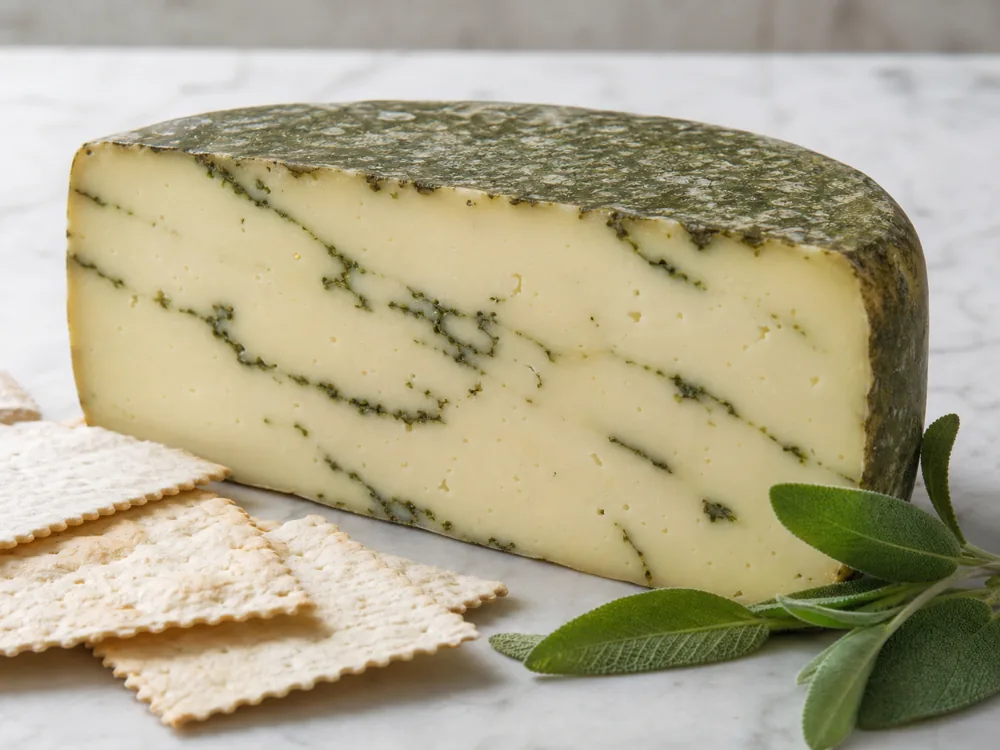
Belton Farm's ingredient list for it gives pasteurised cow's milk, salt, starter culture, sage leaves, rennet and chlorophyll, which the page labels as colour.
The Guild of Fine Food adds that sage has antimicrobial properties that stopped these cheeses from cracking and blowing during maturation. Belton Farm says sage first went in for the medicinal properties 17th-century makers believed it had, not for flavour.
Belton Farm and Fromi both say Sage Derby was traditionally made for harvest and Christmas.
Who Makes Sage Derby Now?
Fowlers of Earlswood, which traces its history to 1670, closed in 2023, and its Sage Derby was sold to Hartington Creamery, a Derbyshire Stilton maker, according to the Guild of Fine Food.
Adrian Fowler told the Guild it was "going home to Derbyshire, where it was first made in the 1600s." Fromi adds that Hartington Creamery now makes Sage Derby in the traditional way in Derbyshire for the first time in over 125 years.
The Guild says Fowler stays on as a consultant, helping Hartington develop the cheese.
Belton Farm makes its Sage Derby and Port Wine Derby in Whitchurch, Shropshire, so a cheese sold as Sage Derby can come from outside Derbyshire.
How Does Sage Derby Differ Between Makers?
Belton Farm, Fowlers and Hartington each describe a different way of getting sage into the cheese, so two wedges sold as Sage Derby can be built differently.
| Maker | How the sage goes in | What is described of the cheese | Source |
|---|---|---|---|
| Belton Farm | Vat-made: sage added to the cheese-make, with chlorophyll listed as colour | Marbled, with an open texture and a nutty flavour | Belton Farm |
| Fowlers | A layer of dried sage through the middle and on the rind | The layer only; no flavour or texture is given | Guild of Fine Food |
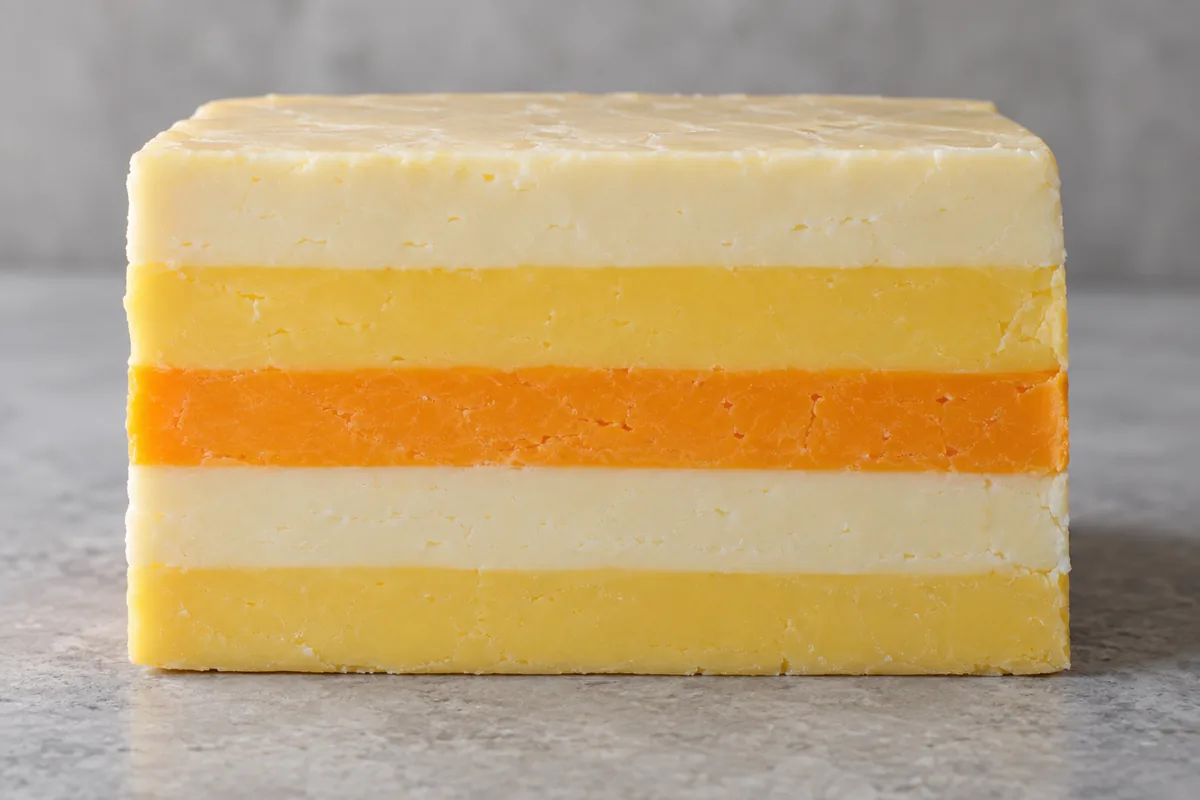
| Hartington Creamery | Sage added by hand to part of the curd and kneaded in, then moulded in alternating layers with and without sage | Cheddarised curds, a texture similar to cheddar, a mild flavour with subtle notes of sage, 4 months of maturing | Fromi |
Belton Farm explains vat-made as the sage being added to the cheese-make itself and describes the result as marbled, while Fowlers and Hartington are described as keeping the sage in layers.
Because the descriptions differ, the cut face is a clue to the method: marbling matches Belton Farm's description, one layer with sage on the rind matches Fowlers', and alternating layers match Hartington's. The maker's name on the label settles it.
What Is Port Wine Derby?
Belton Farm makes a second flavoured Derby, Port Wine Derby, and Wikipedia also lists a port wine Derby among the varieties. Belton describes smooth, creamy Derby with a deep ruby red marbled effect where the port blends into the maturing cheese.
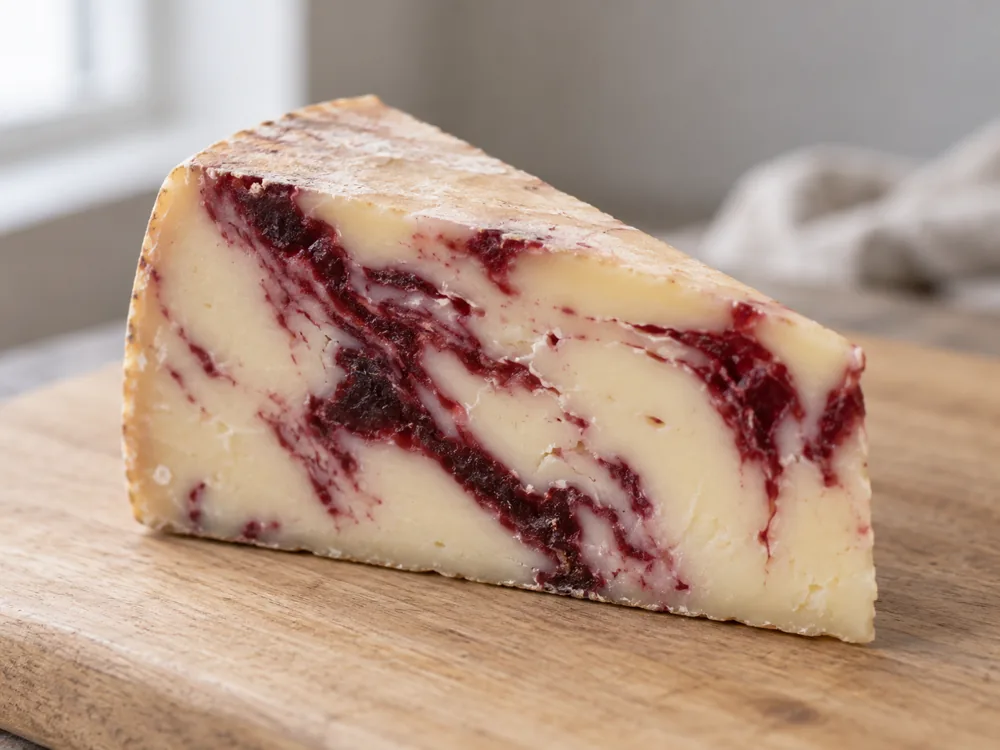
Belton Farm describes a slightly sweet berry aftertaste with real blackcurrant undertones. The ingredients are pasteurised cow's milk, salt, starter culture, natural colour, natural port flavour, rennet and port wine.
Like its Sage Derby, Belton Farm calls Port Wine Derby vat-made, with the port wine added to the cheese-make.
What Goes With Derby?
Cheese.com names two white wines and fresh fruit for plain Derby, while Belton Farm gives separate lists for Sage Derby and Port Wine Derby.
| Pairing | Type | Why It Works |
|---|---|---|
| Chenin Blanc or Sauvignon Blanc | Wine | Cheese.com names both for plain Derby. |
| Fresh fruit | Food | Cheese.com says plain Derby goes well with it, and Belton Farm serves Port Wine Derby with fruit. |
| Chardonnay or Beaujolais | Wine | Belton Farm names crisp, dry Chardonnay or Beaujolais for Sage Derby. |
| Pale ale | Drink | Belton Farm names India Ale or Pale Ale, including Sierra Nevada Pale Ale, for Sage Derby. |
| Soave, Zinfandel or wheat beer | Drink | Belton Farm names all three for Port Wine Derby. |
Belton Farm picks a crisp, dry Chardonnay for Sage Derby because it brings out the sage flavour rather than overwhelming it, says the same of Beaujolais, and offers India or Pale Ale to anyone who avoids wine.
Belton Farm says Sage Derby suits chicken, whether cold in salads and sandwiches or melted into stuffing, because sage is often used alongside poultry. Its product page widens the range to everything from fresh fruit and vegetables to poultry dishes.
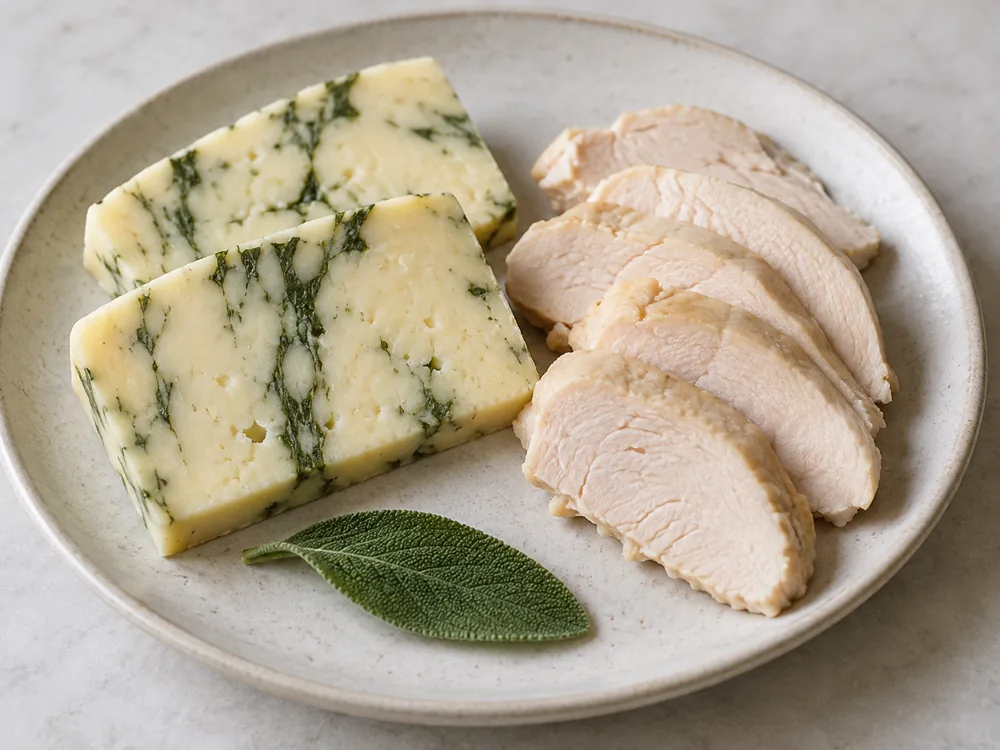
The company also calls Sage Derby a snack for a cheeseboard or with crackers, because the sage adds a further dimension of flavour that lets it stand on its own. For Port Wine Derby it recommends an after-dinner cheeseboard with a glass of port and lists a Fruity Cheese Salad recipe.
Which Derby Should You Buy?
Derby is sold plain, with sage and with port, and Wikipedia calls Sage Derby the most common variety available, with port wine Derby another common one. Check the label to confirm which you are holding.
Belton Farm lists a Gold Award for its Sage Derby from the International Cheese Awards 2023 and one for its Port Wine Derby from the International Cheese and Dairy Awards 2023.
Is Derby Safe During Pregnancy?
The NHS sorts cheese in pregnancy by hardness: pasteurised or unpasteurised hard cheeses such as cheddar, gruyère and parmesan are safe, and so are pasteurised semi-hard cheeses such as edam. The CDC calls hard cheese made with pasteurized milk safer and says pregnant women are 10 times more likely to get a Listeria infection.
Cheese.com calls Derby semi-firm and Wikipedia's list calls it semi-hard. Belton Farm and Fromi state pasteurised milk for the Sage and Port Wine versions, so check the label for any other maker, and ask a midwife or doctor if you are unsure.
What Can Replace Derby Cheese?
Cheese.com is the only cited source that points to a stand-in, and the cheese it names is mild cheddar.
- Mild cheddar: the comparison Cheese.com makes for plain Derby
- Sage Derby and Port Wine Derby: flavoured versions of Derby, not stand-ins; no source offers either as a replacement
For Sage Derby or Port Wine Derby, no documented stand-in exists.
SOURCES & REFERENCES
What Else Should You Know About Derby?
Cheese.com files Derby in the Cheddar family and compares its texture to mild cheddar, but says Derby is milder, with a buttery, creamy flavour.
Cheese.com credits Derby with a strong melting ability. Belton Farm suggests grating Sage Derby into pasta dishes and Port Wine Derby into a cheese sauce.
Sage Derby is Derby marbled with sage. Belton Farm describes it as smooth and creamy, with an open texture and a nutty flavour.
Belton Farm's ingredient lists for Sage Derby and Port Wine Derby include rennet without specifying animal or microbial. Check the maker's label to confirm whether a Derby is vegetarian.
Cheese.com names Chenin Blanc, Sauvignon Blanc and fresh fruit for plain Derby. Belton Farm names chicken, Chardonnay and pale ale for Sage Derby.