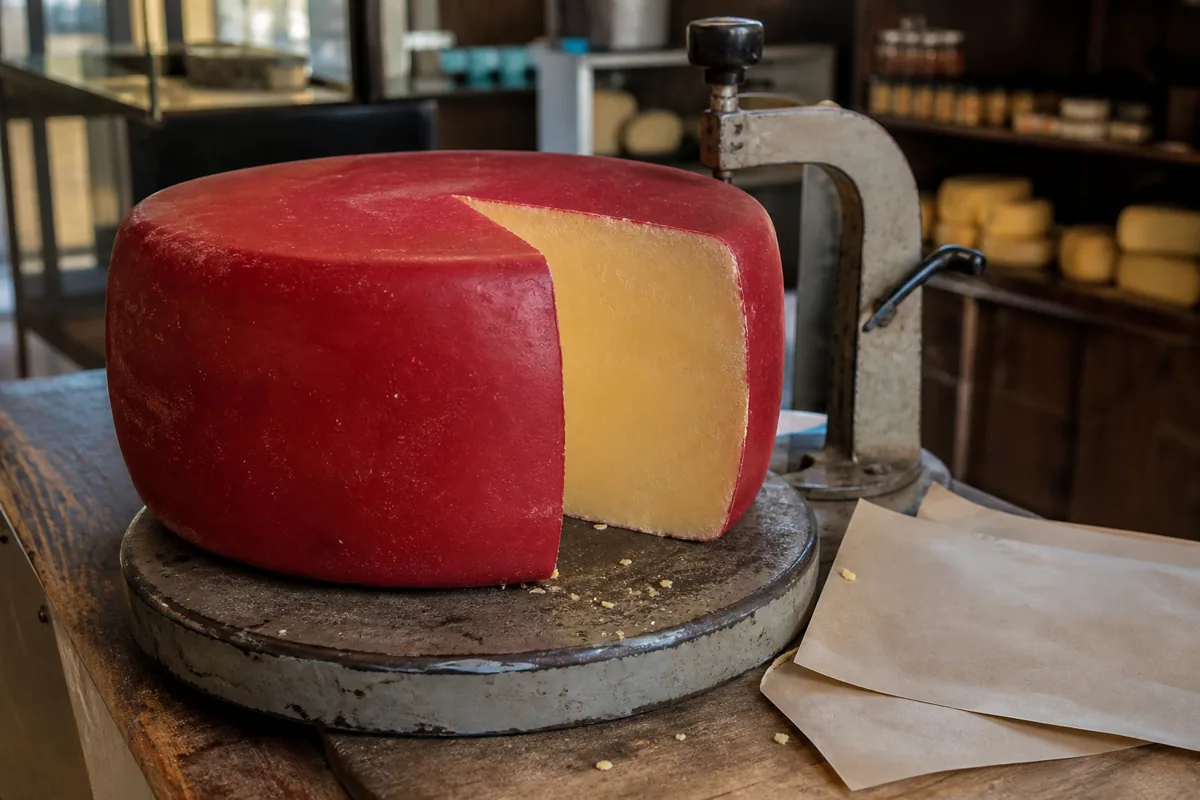
Hoop cheese is a regional name for two different cow's milk cheeses. Across much of the South, it means a yellow wheel covered in red or black wax and sold in wedges.
California's dairy code gives the same name to pressed dry-curd cottage cheese. Cooksinfo describes the waxed wedge as Cheddar-like, while the white crumbly curd adds creaminess without much flavor, so the color and the label decide which one belongs in your recipe.
In This Article
What Is Hoop Cheese Made Of?
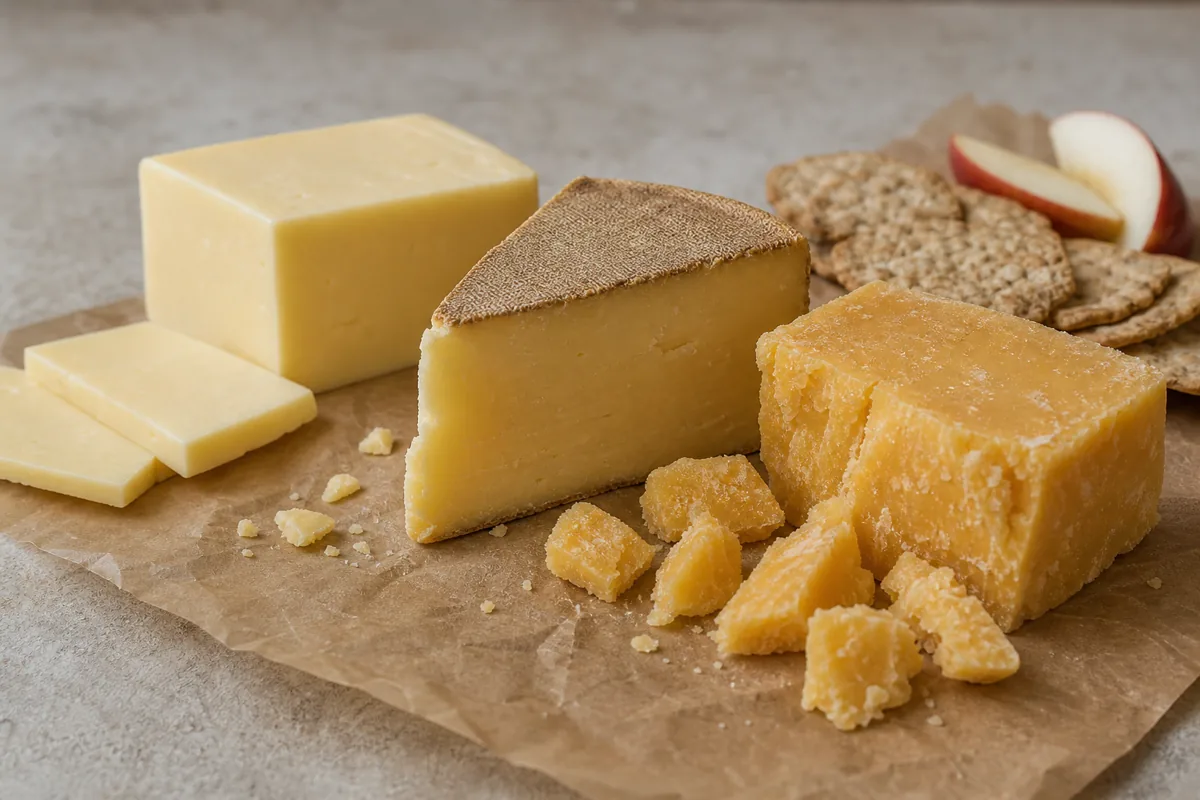
Southern waxed hoop cheese is a Cheddar-like cow's milk cheese with a short ingredient list. The Amish Country red-wax wedge sold by Walnut Creek Foods names cultured pasteurized milk, salt, enzymes, and annatto for color.
Tasting Table describes the method as heating the milk, setting it with rennet or cultures, cutting the curd, draining the whey, and pressing the curds in round molds lined with cheesecloth before the wheel is sealed in wax. The red or black belongs to the coating, not to the milk or the curd.
Sources disagree on aging. Cooksinfo says the curd could be pressed into a form and aged or used fresh like dry-curd cottage cheese, while Tasting Table calls hoop cheese fresh and unaged, so only the seller or the label can say how long a particular wheel was held.
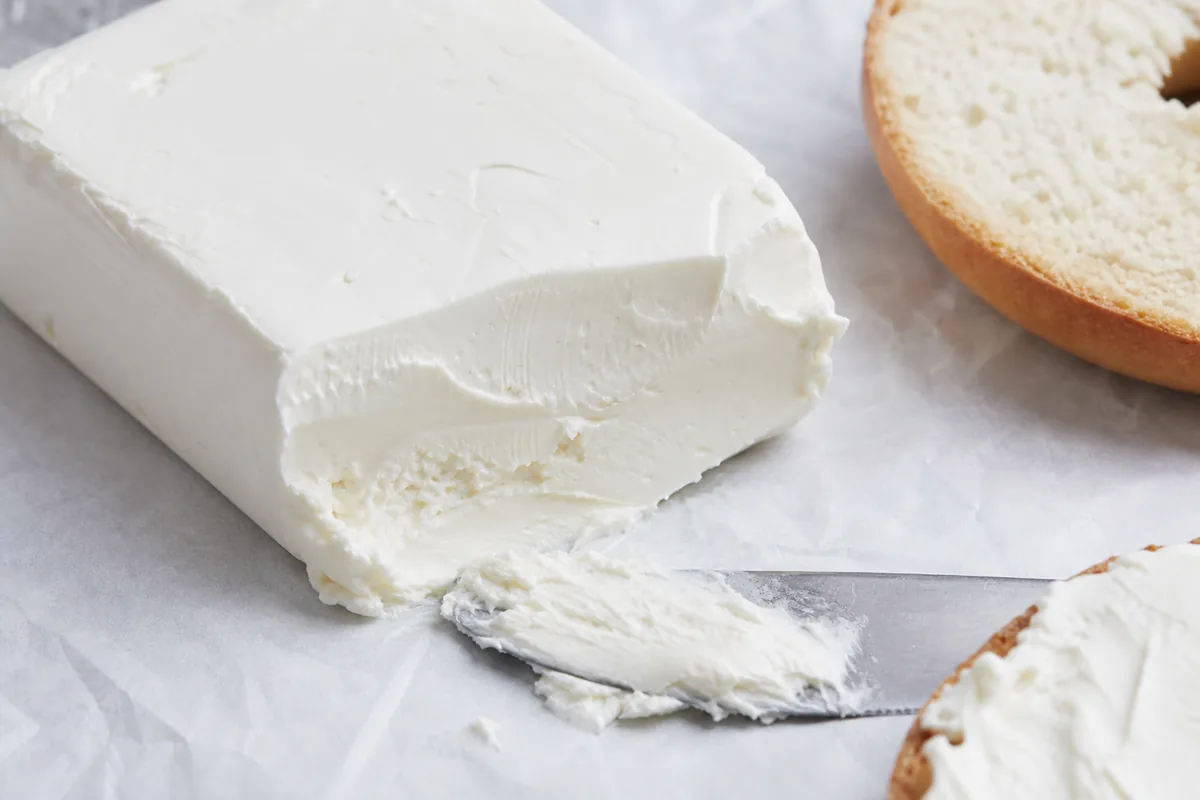
The other product begins as dry-curd cottage cheese. California regulation defines hoop cheese as that curd pressed into forms and caps its moisture at 80 percent when sold.
Cooksinfo describes that white form as crumbly, low in fat and calcium, and made with no salt added. Salt is where the sources split, since Tasting Table also says hoop cheese contains none while the Walnut Creek label for the waxed wedge lists it.
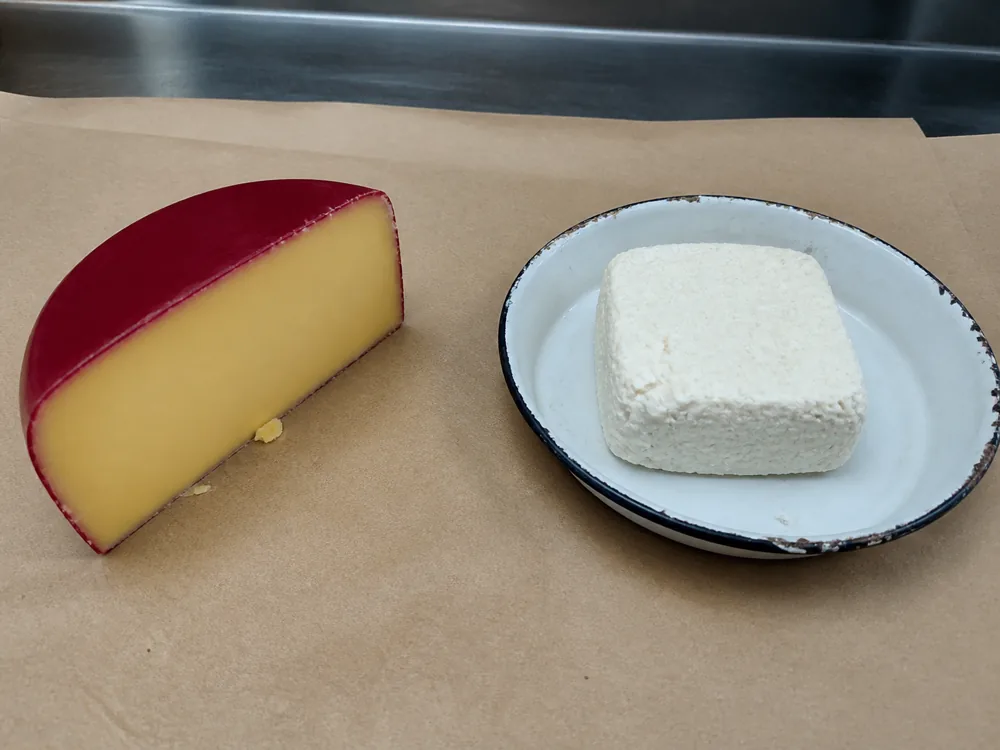
| What You See | Likely Product | Texture | Uses Sources Name |
|---|---|---|---|
| Yellow wheel with red or black wax | Southern Cheddar-style hoop cheese | Semi-firm, shreddable | Melting, grating, snacking, and sandwiches |
| White pressed block with no wax | Pressed dry-curd cottage cheese | Crumbly and fresh, up to 80 percent moisture | Recipes that need creaminess without strong flavor |
The name alone cannot confirm pasteurization, salt, or fat. Only the ingredient list on the package settles which product, and which recipe, is in hand.
Why Is It Called Hoop Cheese?
A hoop is a round mold that holds curds while whey drains out, and Cooksinfo says the name appears to come from cheesecloth tied over a hoop with the whey strained off through it. Tasting Table adds that early cheesemakers shaped cheese in whatever was at hand, even wooden hoops, until the hoop became synonymous with the cheese.
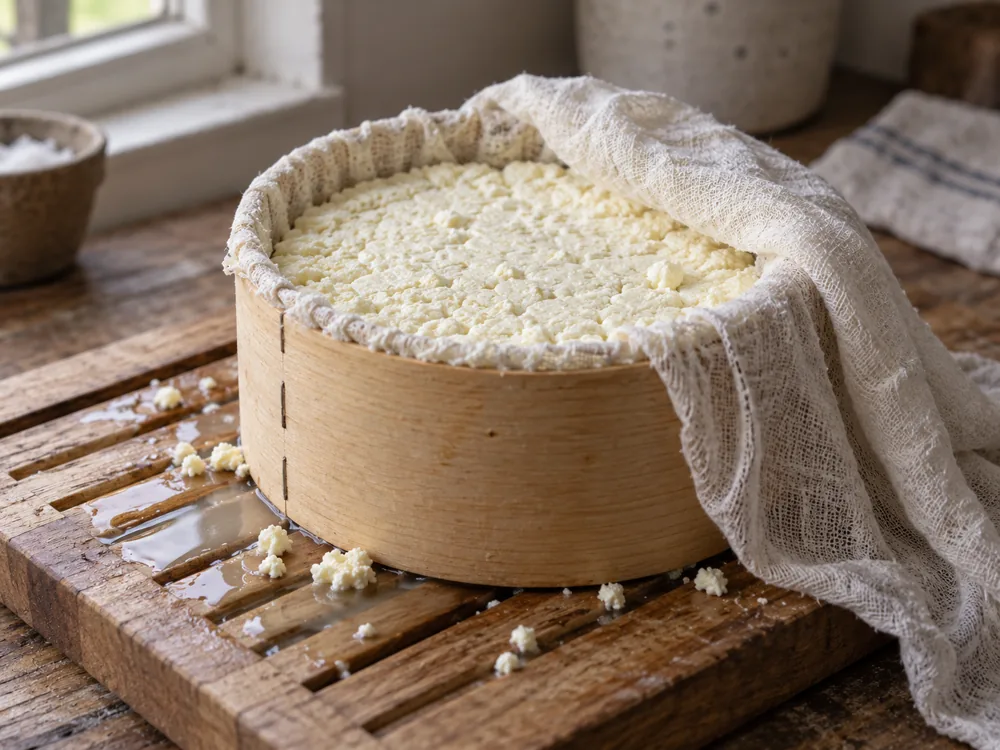
The wide round also suited general stores. Cooksinfo says the waxed wheels weigh about 20 pounds and sat in a cutter made for that size, where store staff cut off the wedge a customer wanted.
Modern pieces are much smaller. Walnut Creek lists its red-wax hoop cheese as 8 ounce pieces packed 12 to a case, so the name describes a forming method rather than a weight.
Sources also disagree on where the waxed wheels come from: Tasting Table says most hoop cheese is still produced in the South, while Cooksinfo says most of the hard version comes from Wisconsin. Where a wheel is sold therefore does not settle where it was made.
Is Hoop Cheese the Same as Cheddar?
Not by name alone. Tasting Table puts hoop cheese in the cheddar family and notes that some wheels are labeled “hoop cheddar cheese” or “mild cheddar hoop cheese,” yet it says the two are not the same thing.
The difference Tasting Table names is in the curd. Cheddar is made by pressing stacked curds to squeeze out as much whey as possible, which makes it dense, while hoop cheese is described as neither pressed nor aged, which the article credits for a milder flavor and a soft, crumbly texture.
That description sits oddly beside the same article's method, which presses the curds in a cheesecloth-lined hoop, so “not pressed” most plausibly means not pressed as hard as Cheddar's stacked curds. Either way, the source expects a softer, crumblier wedge than Cheddar.
Cooksinfo pictures something firmer, calling the waxed wheels hard and mostly medium to sharp, which sits closer to Cheddar than Tasting Table's soft, mild description. Both may describe real products, so the label's wording and the firmness of the paste at the counter say more than the wax does.
If the label says mild Cheddar and the paste is yellow and semi-firm, you have the Southern style.
If it says dry curd or pressed cottage cheese, you have a fresh cheese rather than a Cheddar-style one.
What Do Red and Black Hoop Cheese Mean?
Red wax usually marks the milder version, and black wax a sharper one. Tasting Table calls red rind the most common variety, somewhat salty and mild with a slightly sharp, understated nutty tone.
Black rind, the same article says, has a stronger, more vibrant flavor and a firmer texture than red, so the choice changes how the cheese feels as well as how it tastes.
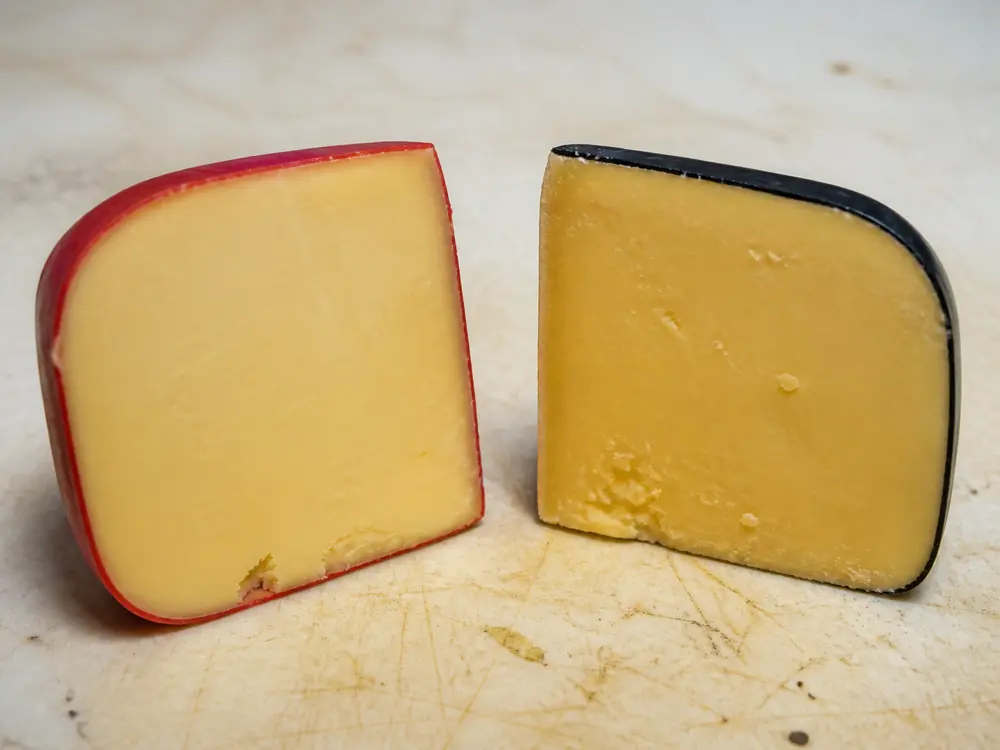
These colors are store conventions. Tasting Table says wax color largely sets the two varieties apart and that flavor varies somewhat, so one maker's black rind may not taste like another's and the flavor description on the package outranks the wax.
If it can be found, Tasting Table says black rind will elevate a pimento cheese spread, and red fits a cook who wants mildness.
What Does Hoop Cheese Taste Like, and Does It Melt?
Tasting Table describes the waxed style as mild, fresh, and milky, more dairy-forward than most cheeses, which it ties to a short ingredient list and the absence of aging.
The white curd tastes different. Cooksinfo calls the soft version very bland with a mild tang, which is why it adds creaminess to a recipe without adding much flavor or fat.
Tasting Table calls the waxed style an excellent melting cheese and names grits, scrambled eggs, yellow squash casserole, and the cheese biscuits of eastern North Carolina, where chunks of hoop cheese are wrapped in biscuit dough and baked.
Its reasoning for the squash casserole is that squash has little flavor of its own and hoop cheese is mild enough to leave the squash in front.
The sources that describe melting all describe the waxed wedge. None of them describes heating the white pressed curd, so a recipe that needs a cohesive melted layer calls for the waxed style.
How Do You Serve Hoop Cheese?
Tasting Table says hoop cheese is best served at room temperature, like many other cheeses, and traditionally sliced thinly for sandwiches or cut into cubes for snacking.
It credits the mild, slightly salty flavor for the cheese's place on a cheese and charcuterie board, and it also serves hoop cheese as a dessert cheese.
| Pairing | Type | Why It Works |
|---|---|---|
| Crackers | Food | Tasting Table's author describes the cheese's slightly salty taste when stacked on a cracker. |
| Hearty bread | Food | Slices of hearty bread sit on Tasting Table's board list, and thin slices of hoop cheese are the traditional sandwich cut. |
| Apples and pears | Fruit | Tasting Table names both as board fruit for the mild, slightly salty cheese. |
| Melon and fresh berries | Fruit | Tasting Table serves hoop cheese as a dessert cheese with melon and berries for a balanced bite. |
Which Hoop Cheese Does a Recipe Mean?
A recipe that only says hoop cheese leaves the cook choosing between a Cheddar-like wedge and a crumbly white curd, and Cooksinfo gives two cues for telling which.
| What the recipe says | Which hoop cheese it means |
|---|---|
| Shred or grate the cheese | The hard, Cheddar-like waxed wedge |
| Seems to imply low fat, or gives a measure easier to take from a wet cheese | The soft white curd |
The grater cue works because the two foods differ in structure: the waxed wedge is firm enough to shred, while Cooksinfo describes the white form as crumbly and sliceable only if you are careful.
Why Did Hoop Cheese Become Part of Southern Pimento Cheese?
Early pimento cheese recipes, such as a 1908 Good Housekeeping version, paired minced pimentos with cream cheese. The Levine Museum of the New South records that Southern cooks later adapted the recipe, using hoop cheese to replace Cheddar and mayonnaise to replace cream cheese.
The museum places that change after World War II, when packaged pimento cheese lost popularity and home cooks began making the spread themselves.
It also reports a theory from Kathleen Purvis, a former food editor of The Charlotte Observer, that hoop cheese became popular in the spread because it does not spoil as quickly and could take summer heat, without saying what it is being compared with.

Today, the museum says, Cheddar is the most common cheese in Southern pimento cheese, and the simplest form is Cheddar, mayonnaise, pimentos, and basic seasonings such as salt and pepper.
Where Can You Buy Hoop Cheese?
Tasting Table names three online sources of the waxed style: Stripling's General Stores in Georgia, which makes it, Ashe County Cheese in North Carolina, and Gourmet Foods International, which ships it from New Bridge Cheese. In the South, the same article says, wheels turn up in country stores, mom-and-pop shops, and some gas stations.
Tasting Table says the techniques are very specific and hard to standardize for mass production, so only a handful of producers appear to offer it outside the South.
The white pressed curd is the harder of the two to find. Cooksinfo says the soft version is not really made any more, and that Friendship, the one dairy that revived it, discontinued production in 2004.
Online results mix the two meanings. Adding “red rind,” “black rind,” or “mild Cheddar” points to the Southern style, and “pressed dry curd” points to the white product.
Search for red rind, black rind, or mild Cheddar to find the waxed style and for pressed dry curd to find the white product. The ingredient list on the package then settles salt and milk treatment.
Is Hoop Cheese Pasteurized, and Is It Safe in Pregnancy?
The name does not say, so the milk line on the label decides. The Amish Country red-wax listing names pasteurized milk.
Tasting Table instead describes heating raw milk to make it, so the pasteurized listing cannot speak for every wheel. The FDA warns that some cheeses, especially ones produced and sold locally, are not necessarily made with pasteurized milk, so a wheel cut at a counter without a label is worth a question to the seller.
Cooksinfo calls the waxed wheels hard and Tasting Table describes a soft, crumbly cheese, so advice on cheese in pregnancy depends on which description fits your wheel. The NHS lists pasteurised or unpasteurised hard cheeses, pasteurised semi-hard cheeses and pasteurised soft cheeses as safe to eat and says foods made from unpasteurised milk must be thoroughly cooked.
The CDC lists hard cheese, when made with pasteurized milk, such as Cheddar, as safer, and unpasteurized (raw) milk and dairy products made from raw milk as riskier. Served cold, hoop cheese described as a pasteurized soft, crumbly or semi-firm cheese is a type the CDC list does not cover, so ask a midwife or doctor.
California's definition makes the white pressed curd cottage cheese, but neither agency says a pressed block counts as cottage cheese. The NHS counts pasteurised cottage cheese as safe, and the CDC lists cottage cheese made with pasteurized milk among its safer choices, and served cold, a pasteurized white curd described only as fresh, soft and crumbly is a type the CDC list does not cover, so ask a midwife or doctor.
The CDC puts soft cheese made from unpasteurized milk, any queso fresco-type cheese or similar fresh, soft cheese, and unheated cheese sliced at a deli among its riskier choices. The NHS says any cheese cooked until steaming hot is safe, and the CDC lists pasteurized soft cheeses heated to an internal temperature of 165°F or until steaming hot and deli-sliced cheeses heated to 165°F or until steaming hot as safer.
Does Hoop Cheese Need Refrigeration?
The CDC advises keeping a refrigerator at 40°F or below, and the FDA tells shoppers to keep milk products refrigerated at 40°F, so a cut wedge or a block of white curd belongs in the refrigerator.
Sources do not agree on where hoop cheese sits. Cooksinfo splits it into a hard waxed version and a soft white curd with a short storage life, and Tasting Table says the wax on a whole wheel protects it from excess air.
USDA draws its line by class: soft cheeses such as cottage cheese must be refrigerated for safety, while, as a general rule, hard cheeses such as Cheddar do not require it for safety but last longer cold. California's definition puts the white curd with cottage cheese, and no source places the waxed wedge in either USDA group.
The CDC's general rule is to refrigerate perishable food, dairy included, within 2 hours, or within 1 hour when the food is exposed to temperatures above 90°F.
Tasting Table ties the short life of an opened piece to the missing salt, saying hoop cheese lasts much less time than other cheeses once sliced, and it says a vacuum-sealed wedge stays fresh for months while the seal holds.
The Walnut Creek wedge lists salt and a 270 day shelf life, so the gap between 270 days and one to two weeks may come from salt, from sealing, or from both. That is a reading of two sources that never compare the products directly, so the date on the package is the safer guide for a given wedge.
For an opened piece, Tasting Table advises wrapping it in parchment or wax paper and then loosely in plastic wrap or an unsealed bag, kept in the crisper drawer away from strong-smelling food. Its reasoning is that cheese needs some air, but too much dries it out or leaves it exposed to bacteria.
Can You Freeze Hoop Cheese?
USDA says ricotta, cottage, and cream cheeses do not freeze well. Pressed dry-curd hoop cheese is cottage cheese by California's definition, so it is a poor candidate.
For other cheeses, USDA says they may be frozen for 6 months. None of the hoop cheese sources covers freezing, so that window is general guidance and nothing in these sources says how a thawed waxed wedge eats.
What Can You Substitute for Hoop Cheese?
Cooksinfo names Cheddar as the substitute for the hard waxed version. A mild Cheddar suits the red rind and a sharper one the black.
For the white curd, Cooksinfo names pressed dry cottage cheese. If that is not available, it suggests regular cottage cheese or ricotta, drained well, with other moisture in the recipe cut back a little because those two cheeses hold far more moisture than the soft hoop cheese did.
Farmer cheese is a different product, since Tasting Table says hoop cheese leaves out the salt and added cream that distinguish it. A recipe that relies on hoop cheese's neutral taste will therefore pick up salt and richness from farmer cheese.
The cooking job settles the choice. A sandwich needs a cohesive melt, while a recipe built around white curd needs a fresh cheese that stays contained.