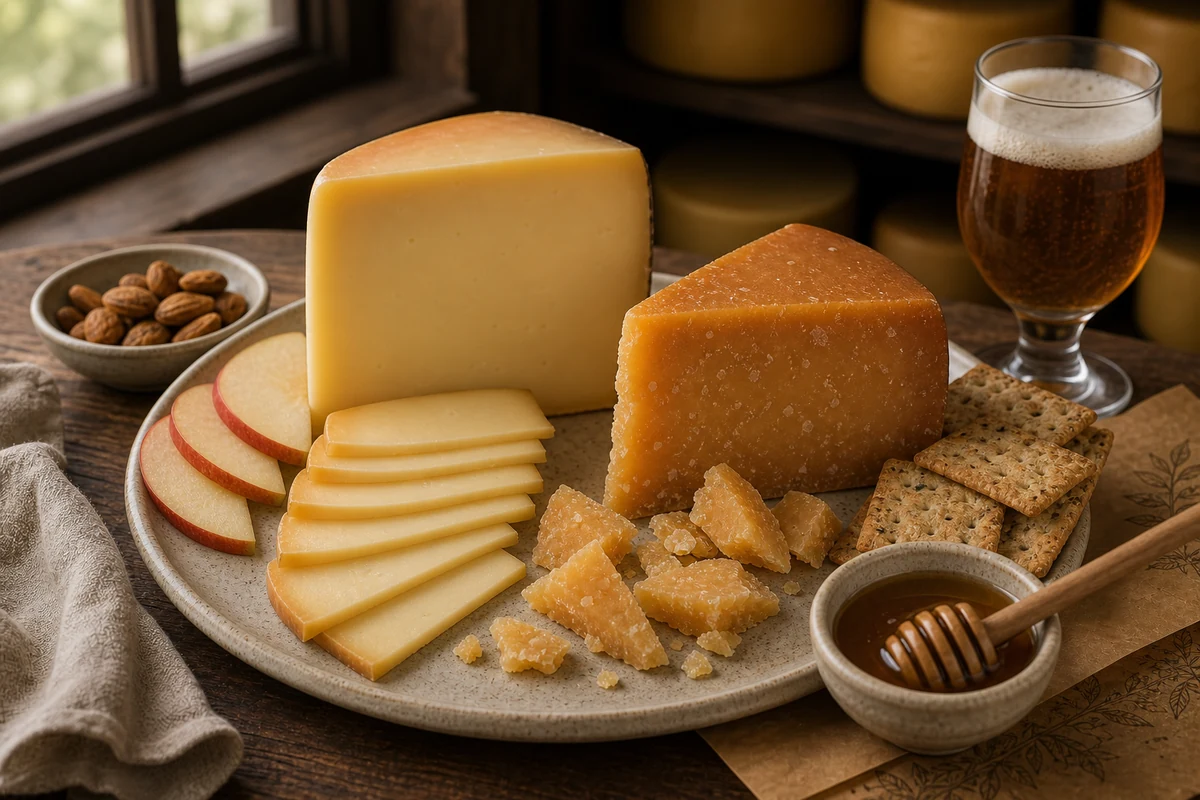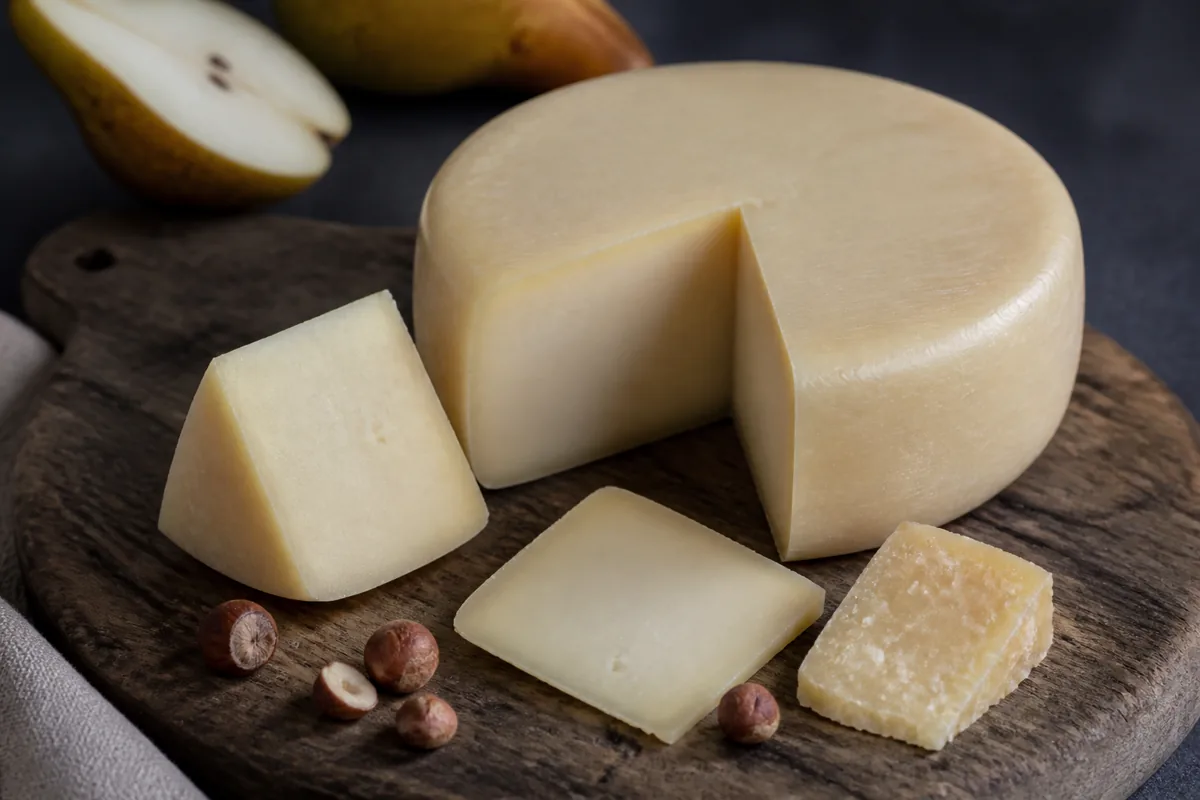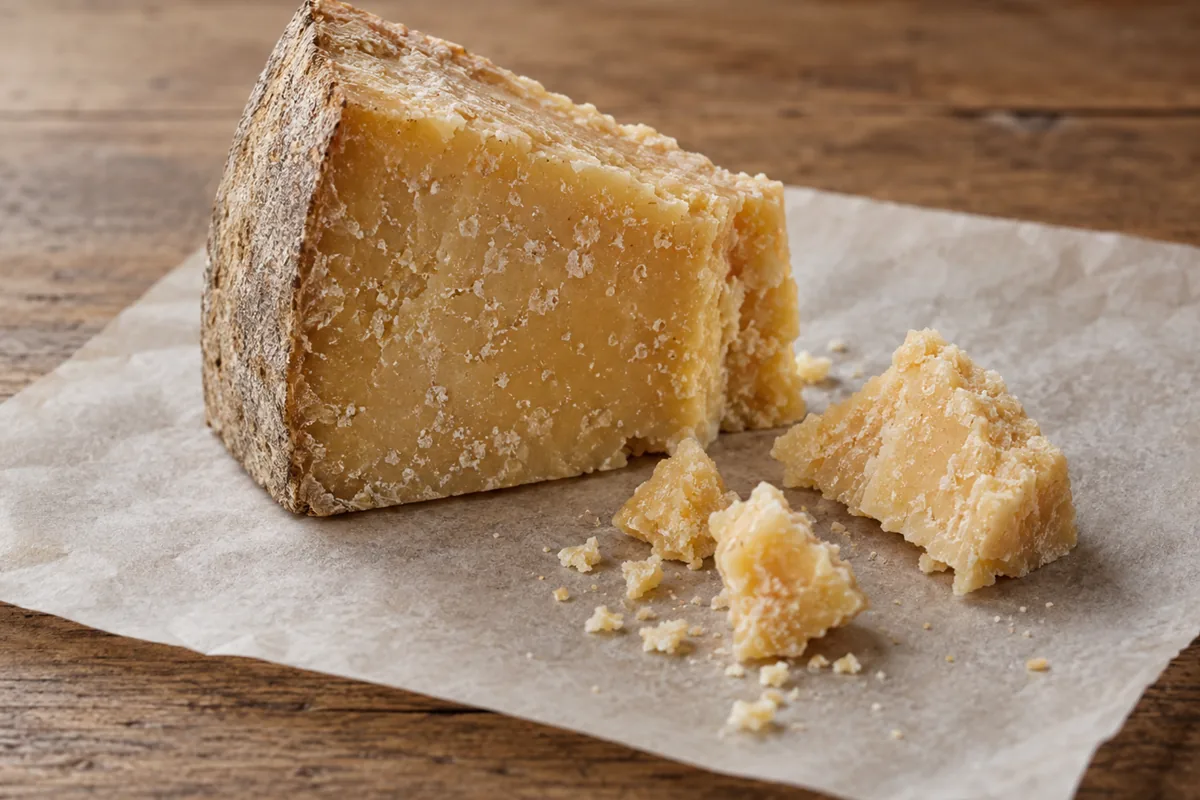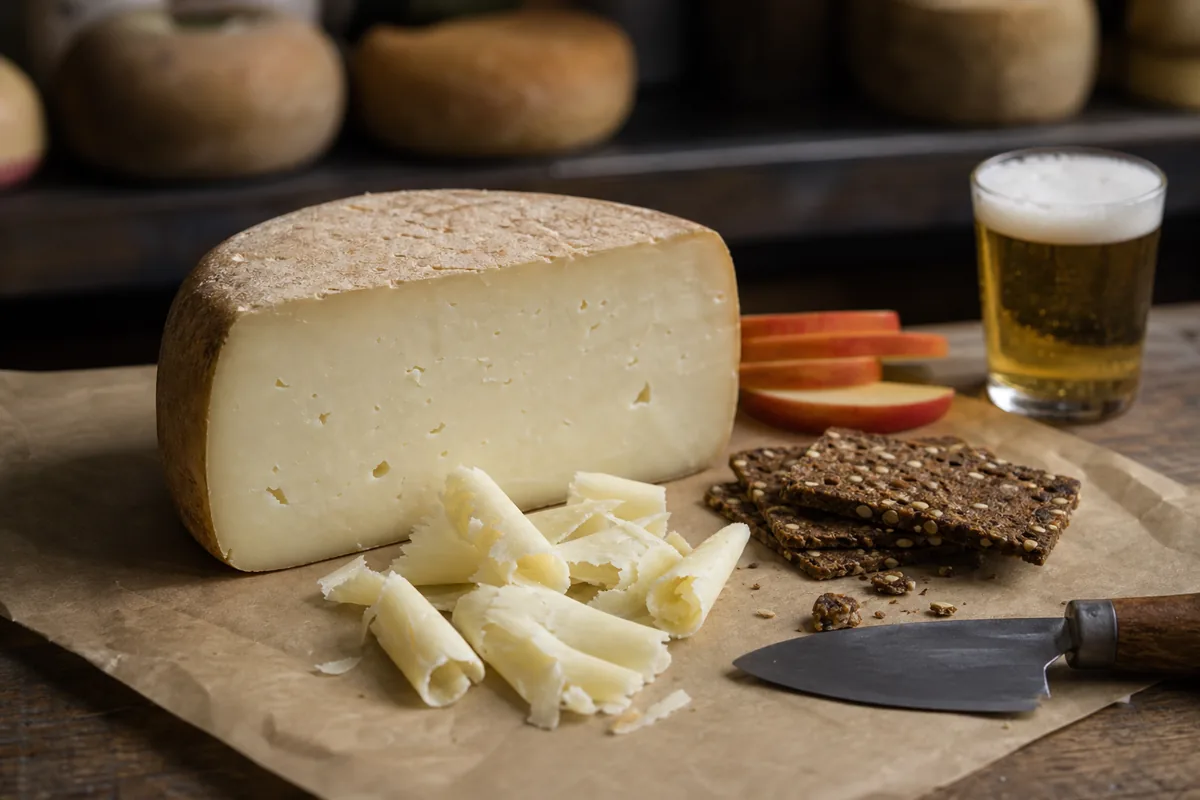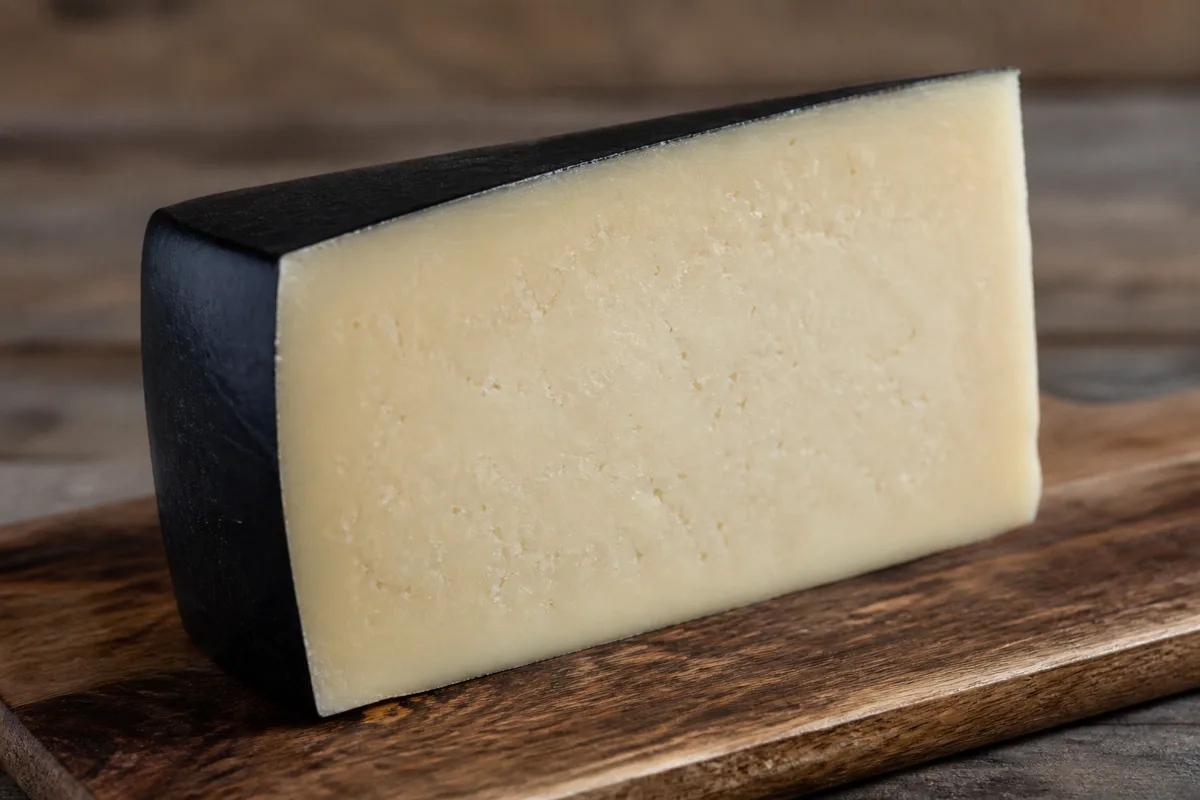
Midnight Moon is a pasteurized goat's milk cheese made in Holland exclusively for Cypress Grove of Arcata, California, and aged six months or more.
Cypress Grove calls it similar to a gouda, with a dense, smooth paste that carries protein crystals and a long caramel finish.
The wheel comes from Holland and the label belongs to California, which is why retail pages disagree about where the cheese is from.
In This Article
What Does Midnight Moon Taste Like?
Cypress Grove describes it as nutty and brown buttery up front, with a long caramel finish.
Culture magazine lists butterscotch and browned butter, with savory notes and a sweetness "not normally associated with an aged goat's cheese."
Di Bruno narrows the sweetness down. It calls it a lactic sweetness rather than the caramel sweetness of cow's-milk goudas, with brown butter tones and a clean finish.
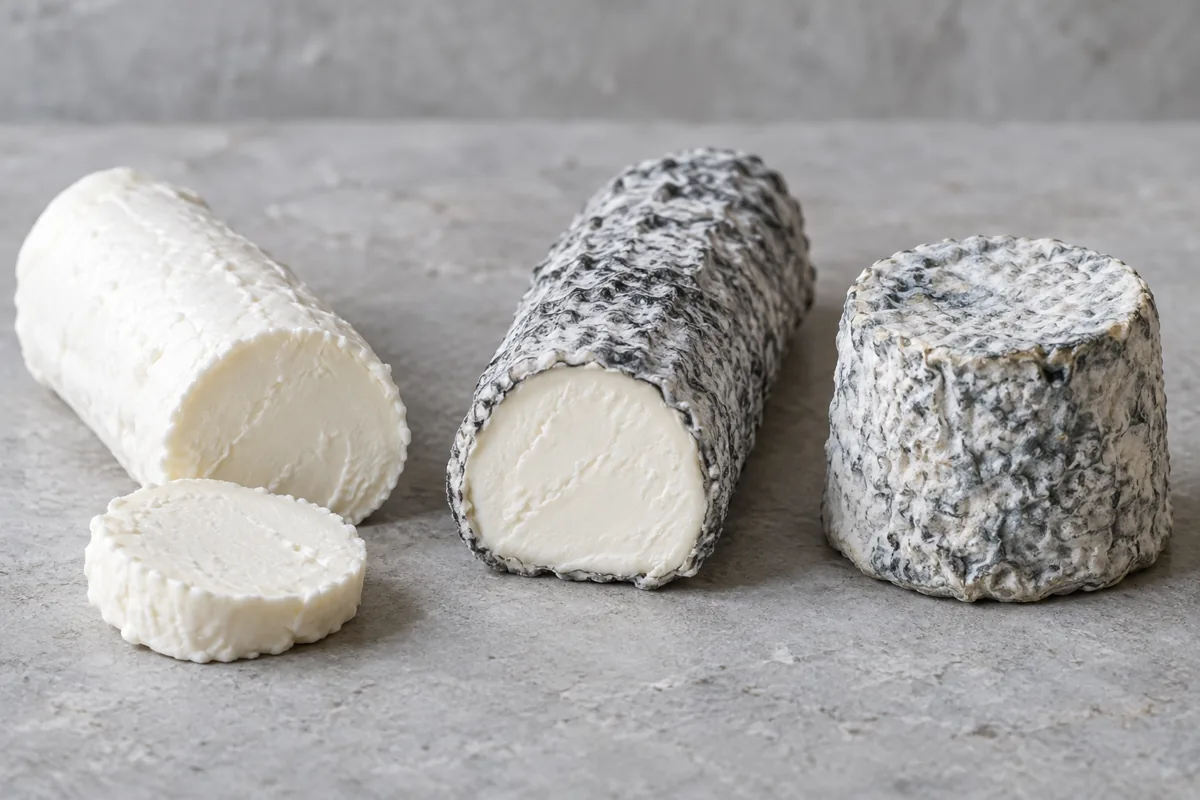
That contrast with fresh goat cheese is how the cheese gets sold. Di Bruno recommends it to customers who say they dislike goat cheese, because it is so different from the fresh, tart flavor they expect from chèvre.
Cypress Grove makes the same pitch, saying the cheese is "known to convert even the staunchest of goat cheese critics."
Its half-wheel trade sheet adds that many consider it the "gateway goat cheese." All three lines come from the seller side, and they describe taste rather than measure how much goat flavor is left.
Where Is Midnight Moon Made?
Midnight Moon is made in Holland. Cypress Grove's product page calls it "Aged Goat Milk Cheese Made Exclusively For Cypress Grove in Holland," and the company's trade spec sheets list the Netherlands as the country of origin.
Retail listings mix the maker with the brand, so the country field changes from page to page.
| Source | What it lists |
|---|---|
| Cypress Grove product page | Made exclusively for Cypress Grove in Holland |
| Cypress Grove trade spec sheets | Country of origin: Netherlands |
| Culture magazine | Country: United States, region: Northern California, with the gouda-style wheels produced in the Netherlands |
| Di Bruno Bros | Country of origin: California, with the description saying it is produced in Holland for Cypress Grove |
Cypress Grove itself says only that Midnight Moon is similar to a gouda, while its half-wheel trade sheet and Culture call it gouda-style, and Di Bruno sells it as an aged goat gouda. Di Bruno's product story says the cheese unites the Dutch expertise of gouda-making with Cypress Grove's goat cheese.
Why Is Midnight Moon Made in Holland?
Midnight Moon was developed with a Dutch cheese master, in a story that starts at the New York Fancy Food Show more than 20 years ago.
That cheese master approached founder Mary Keehn with an aged goat cheese his mother had made from the milk of his goats, and over the years the two worked on a recipe of their own.
The cheese was aged longer, the cultures were adjusted, and lysozyme, a preservative present in most cheeses of this type, was removed.
There was also a milk reason: few aged goat cheeses were made in the United States at the time, and the US milk supply sat in "very limited, isolated pockets," which Cypress Grove says made the cheese impossible to produce here.
Culture gives a second reason and dates the matured line to 1998. Making the matured cheeses in the Netherlands avoids cross-contamination between different kinds of cheese and covers the extra space that ageing needs.
That matured line holds two cheeses, Midnight Moon and Lamb Chopper, and Cypress Grove created Lamb Chopper, an aged sheep's milk cheese, with the same cheesemakers.
Cypress Grove was founded in 1983, and Keehn found no acquisition offer a fit until Emmi, a Swiss company, proposed one in August 2010 and committed to keep the employees and headquarters in Humboldt County.
So the Cypress Grove name on your label tells you who sells the cheese, while the wheels themselves are made in Holland.
What Are the Crunchy Crystals in Midnight Moon?
Cypress Grove says that as Midnight Moon ages, protein crystals form and lend a slight crunch to an otherwise dense and smooth cheese.
Culture explains that as a cheese ages, its protein chains begin to unravel and leave small crunchy deposits behind. It adds that the crunch is neither sugar nor sodium, even though crystals can make a cheese seem sweeter or saltier.
Whether crystals form at all depends on the types and concentration of protein in the cheese, so not every aged cheese has them. Proteins moving through the paste collide and form a nucleation site, which attracts more protein and lets the crystal grow.
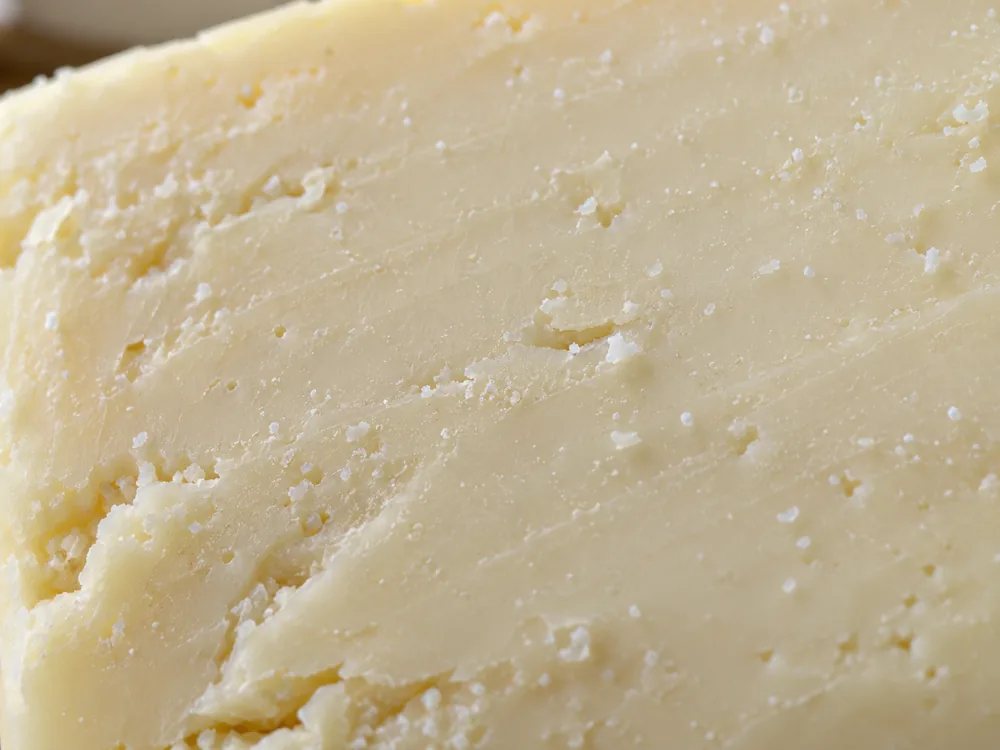
Cheese crystals come in two kinds: firm, bright white tyrosine crystals that form only inside the cheese, and softer, paler calcium lactate crystals that can form inside or on the surface. Both can appear together in aged gouda.
Many people confuse crystals with mold or yeast growth, and cheesemakers once tried to avoid crystallization for that reason.
Midnight Moon's stated age depends on which statement you read: Cypress Grove's product page gives the age as six months or more, and Culture says wheels are aged at least six months before release. A trade sheet for half wheels repeats the six-month line in its description and says in its marketing text that the cheese is aged at least one year, so the producer's own materials carry two figures.
The same sheet credits the longer ageing for a nutty, brown-buttery flavor with prominent caramel notes. If the age of your wedge matters to you, ask the seller how old it is.
What Should a Wedge of Midnight Moon Look and Feel Like?
Look for an ivory paste: Cypress Grove calls the cheese blushing and ivory-colored, and Culture describes a warm ivory paste that turns slightly darker toward the rind.
On texture, Culture says firm, smooth and dense with a slightly granular mouthfeel, Di Bruno says dense and smooth with a satisfying crunch, and the half-wheel sheet says smooth with the slight graininess that long-aged cheeses have.
Since a crunch is expected, look at how the crystals sit: Culture says American Cheese Society judges of crystallized cheeses look for an even distribution of crystals and a pleasant crunch.
At the counter, the cues the sources give are an ivory paste that darkens slightly toward the rind, a firm and dense body, and a crunch from crystals spread evenly through the cheese.
Is Midnight Moon Pasteurized?
Yes. Cypress Grove's ingredient list reads pasteurized cultured goat milk, salt and enzymes, and Culture and Di Bruno also list pasteurized goat milk.
The rennet is microbial and non-animal, according to Cypress Grove, and Di Bruno lists it as vegetarian rennet, so the cheese suits vegetarians.
Culture lists Midnight Moon as a firm cheese, which matters because pregnancy guidance from the NHS and CDC sorts cheeses by type and milk treatment.
The NHS lists pasteurised or unpasteurised hard cheeses, pasteurised semi-hard cheeses such as edam, and pasteurised soft cheeses, including goats' cheese that does not have a white coating on the outside, as safe to eat. Served cold, Midnight Moon is described as a pasteurized firm cheese, a type the CDC list does not cover, so ask a midwife or doctor.
How Many Calories Are in Midnight Moon?
Cypress Grove's trade spec sheet for the 3.75 oz wedge prints 130 calories per 1 oz serving, with 12 g of fat and 8 g of protein.
A second sheet, for half wheels, prints the same calories but lower fat, sodium and protein.
| Nutrient | 3.75 oz wedge sheet (1 oz serving) | Half-wheel sheet (serving size blank) |
|---|---|---|
| Calories | 130 | 130 |
| Total fat | 12 g | 10 g |
| Saturated fat | 7 g | 7 g |
| Cholesterol | 30 mg | 34 mg |
| Sodium | 270 mg | 170 mg |
| Total carbohydrate | 0 g | 0 g |
| Protein | 8 g | 7 g |
| Calcium | 242 mg | 286 mg |
Both sheets list 0 g of carbohydrate and 0 g of sugar. Because the two panels already differ, go by the panel printed on your pack for the wedge you have.
How Should You Store Midnight Moon, and Can You Eat the Wax?
Cypress Grove says to keep it cold at 32°-44.6°F and, once it is cut, to wrap it tightly in plastic wrap to prevent drying.
The producer's own figures differ: the half-wheel sheet says 33-45°F, both trade sheets print a storage temperature field of 35-37.5°F, and the FAQ says to keep all its cheeses at 33-35°F.
The CDC advises keeping a refrigerator at 40°F or below, so the top of the 32°-44.6°F range runs warmer than that general guidance.
Whole wheels have an optimal shelf life of 12 months uncut. For 1 lb wedges bought from its web store, Cypress Grove gives 180 days, counted from the date the wedge was cut rather than the date it shipped, so days in transit count against it.
The trade sheets print a shelf life of 124 days for the 3.75 oz wedge and 137 days for the half wheel, so the producer's numbers differ by pack. None of them is for a wedge cut at a retail counter, so for a counter-cut piece, ask the shop how long it keeps.
Cypress Grove says to take the cheese out of the refrigerator at least one hour before serving. Its FAQ adds that cheese belongs in the coldest part of the refrigerator and that only the portion to be served should come to room temperature, so its full flavor emerges.
That tempering hour counts toward the CDC limit for perishable food left out, which is 2 hours, or 1 hour above 90°F, so the time on your board comes out of the same allowance.
The rind is wax. Culture lists the rind as waxed, and Cypress Grove says not to eat man-made rinds such as wax or cloth.
A wedge cut from a waxed wheel carries that rind along its outer edge, so trim the wax edge away before you eat the cheese.
What Sizes Does Midnight Moon Come In, and Where Can You Buy It?
Cypress Grove says retailers cut and wrap Midnight Moon from large wheels, and if you want a whole wheel, you can ask a cheesemonger to order one.
To find it, use the store locator on Cypress Grove's site, or ask for the cheese at grocery stores, restaurants, wine shops and markets with a good selection of specialty foods.
- 3.75 oz wedge: the size on a Cypress Grove trade sheet, packed 12 to a case
- 8 oz wedge: sold singly by Di Bruno, which also sells a case of twelve
- 1 lb wedge: sold on the Cypress Grove web store
- 5 lb half wheel: listed on a Cypress Grove trade sheet
- Whole wheel: 12 inches across and 5 to 6 inches high at 9 to 11 lb per Culture, and listed as 10 lb by Di Bruno
For an appetizer board, Cypress Grove's own estimate is about 1.5 oz per person, doubled for a main-meal board with a lot of other food and tripled when there is not.
At that rate an 8 oz wedge covers roughly five guests as an appetizer, and a 3.75 oz wedge two to three. On a main-meal board at 3 to 4.5 oz per person, the same 8 oz wedge covers about two guests, while a 5 lb half wheel at the appetizer rate stretches past 50 portions.
What Should You Serve and Pour with Midnight Moon?
Cypress Grove names Belgian dark ale, stout and tripel on the beer side, and ice wine, sweet sherry, Syrah and Zinfandel on the wine side.
| Pairing | Type | Named by |
|---|---|---|
| Belgian dark ale, stout or tripel | Beer | Cypress Grove |
| Ice wine or sweet sherry | Wine | Cypress Grove |
| Syrah or Zinfandel | Wine | Cypress Grove |
| Rhône-style wine or dry sherry | Wine | Culture |
| Fig jam with seeded crackers or bread | Food | Cypress Grove trade sheet |
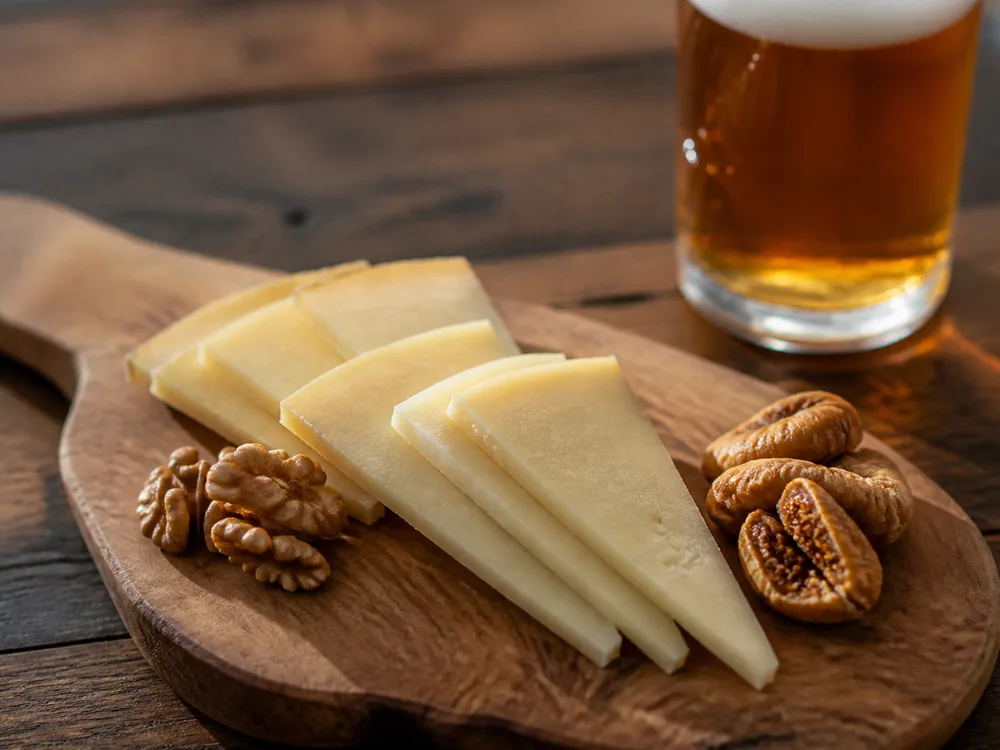
Sherry appears on both lists in opposite styles, sweet from Cypress Grove and dry from Culture, so the producer and the magazine point to different ends of the sherry range.
Can You Melt or Cook with Midnight Moon?
Yes. Try it melted between slices of rustic bread or added to macaroni and cheese, the two uses a Cypress Grove trade sheet suggests.
Cypress Grove's own mac and cheese recipe, listed on its Midnight Moon page, stars the cheese in a rigatoni sauce blended with Monterey Jack and sharp cheddar for depth and creaminess, finished with paprika and cracked black pepper.
How Is Midnight Moon Different from Humboldt Fog?
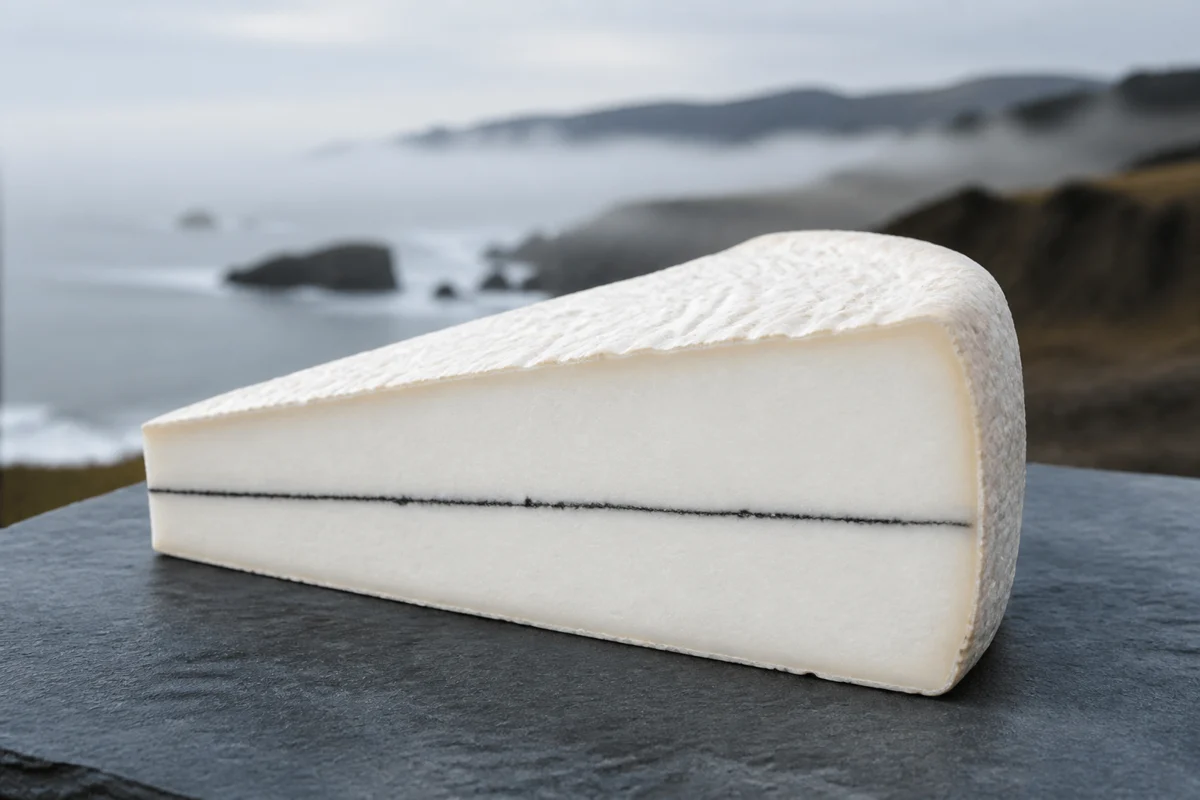
Humboldt Fog is the top-selling cheese in Cypress Grove's line and sits at the opposite end of it: soft-ripened with a ribbon of vegetable ash, against Midnight Moon's firm paste and wax rind.
Both are goat's milk cheeses sold under the Cypress Grove name, but Cypress Grove says to wrap them differently.
| Detail | Midnight Moon | Humboldt Fog |
|---|---|---|
| Texture | Dense and smooth with a slight crunch | Creamy |
| Rind | Wax, not eaten | Edible mold rind with a ribbon of vegetable ash |
| Wrap | Tightly in plastic wrap | Waxed paper |
The ash does a job as well as marking the cheese: Cypress Grove says goat cheese is quite acidic, and the ash raises the pH so that mold grows, which becomes the rind.
The wrap rule follows the rind. Cypress Grove says ripened cheeses such as Humboldt Fog need waxed paper so they can breathe, while Midnight Moon and its fresh cheeses go in tightly wrapped plastic.
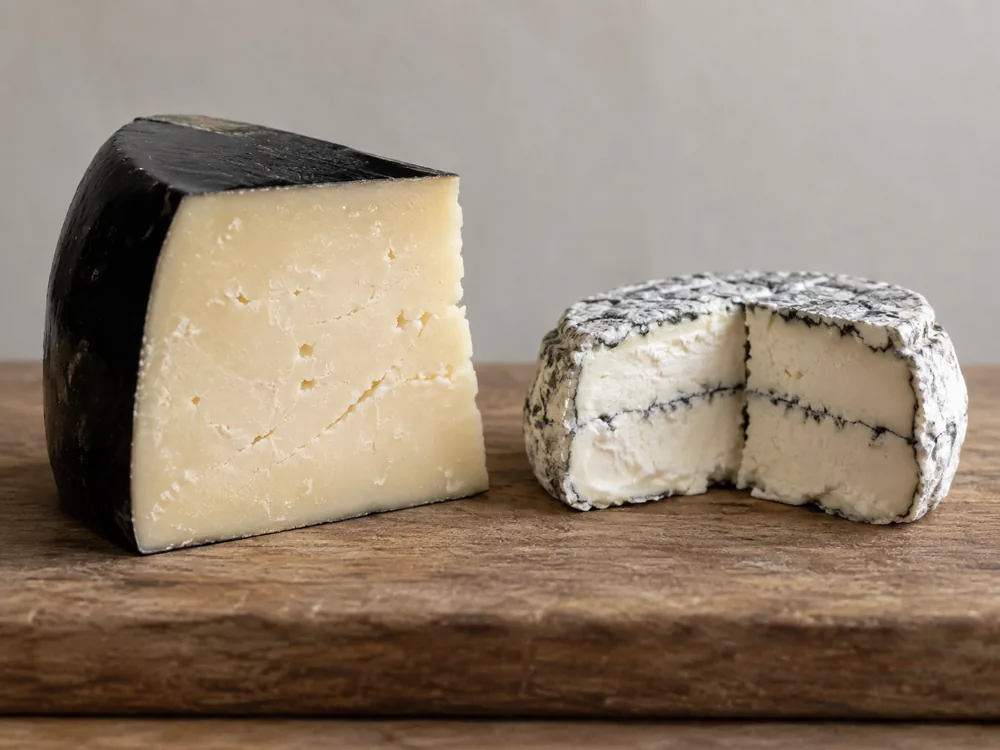
Keehn's successful creation of Humboldt Fog dates to 1992, years before the matured Dutch-made line.
What Can You Use Instead of Midnight Moon?
The other cheese in the producer's Dutch-made line is Lamb Chopper, created with the same cheesemakers from sheep's milk, and it takes the same tightly wrapped plastic as Midnight Moon.
An aged cow's-milk gouda can carry crystals too, since both crystal types can appear in aged gouda. Di Bruno puts the difference in the sweetness: cow's-milk goudas typically carry caramel sweetness where Midnight Moon is lactic.
Fresh chèvre points the wrong way, because Di Bruno contrasts Midnight Moon directly with the fresh, tart flavor expected from chèvre.
If you avoid animal rennet, check each replacement's label, since the microbial rennet Cypress Grove names is a fact about its own cheeses.