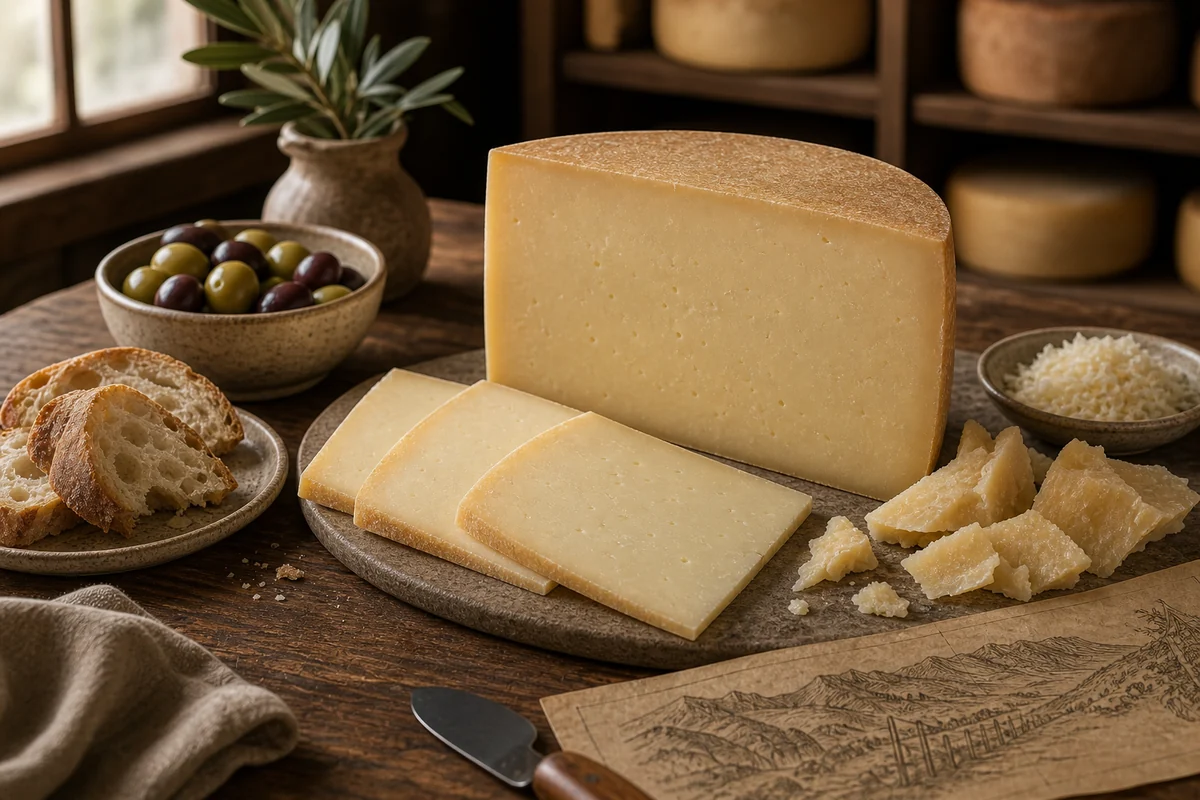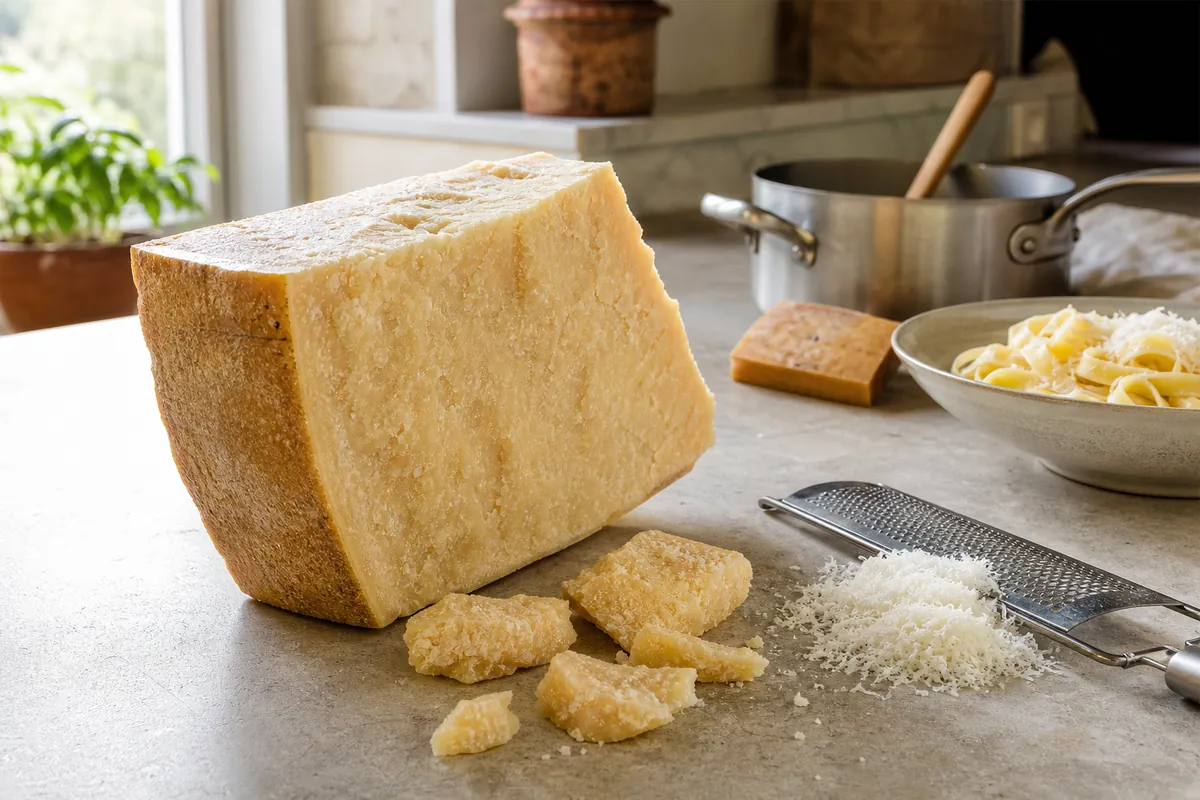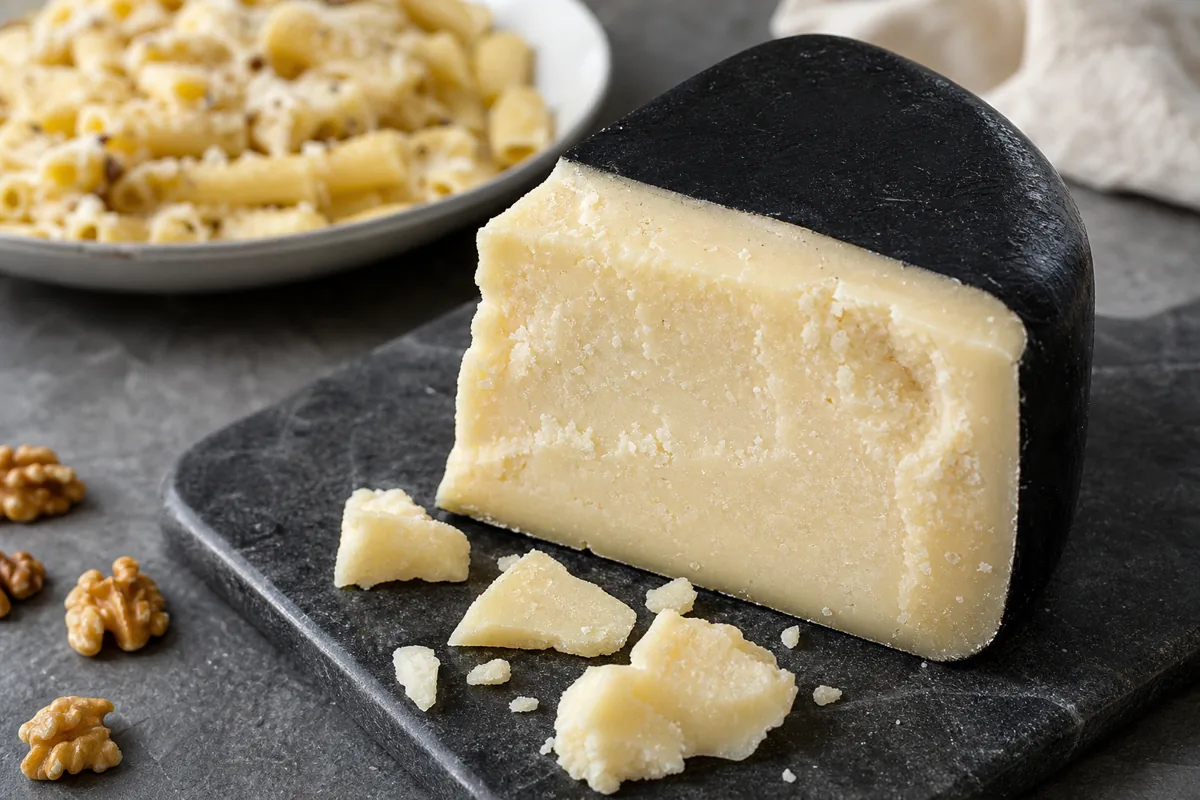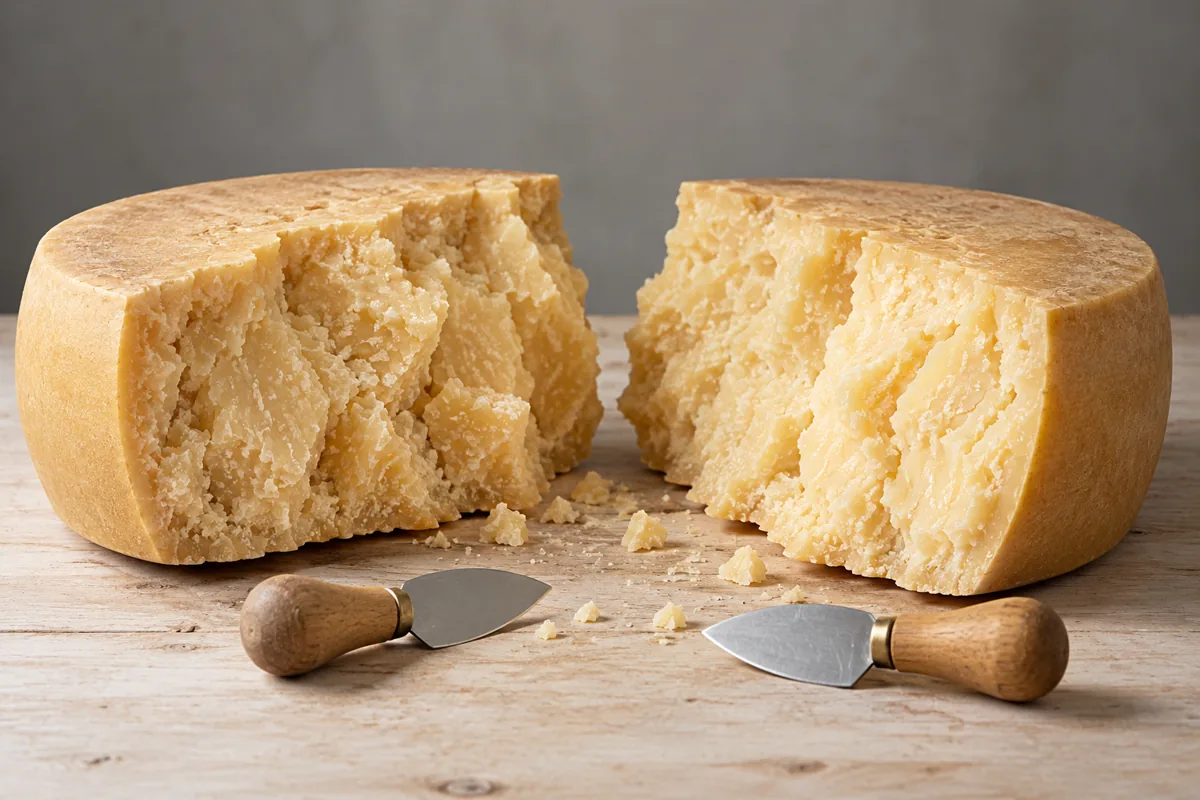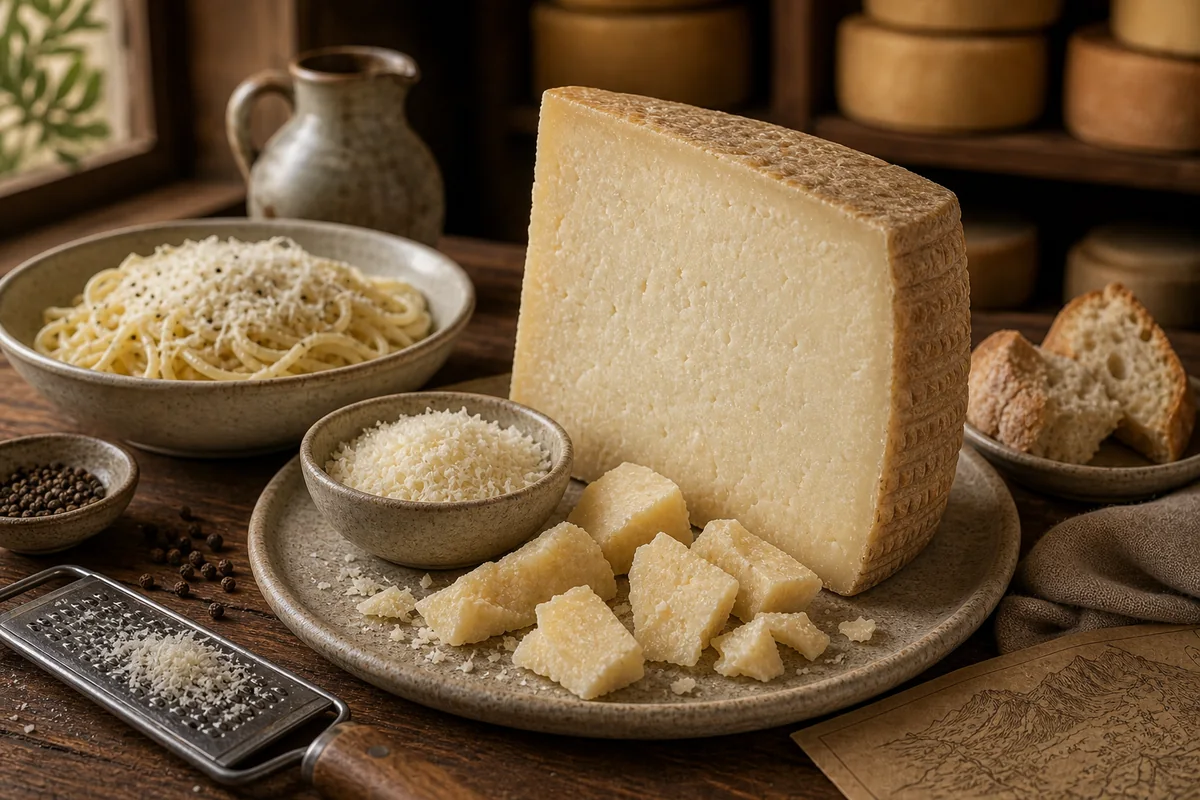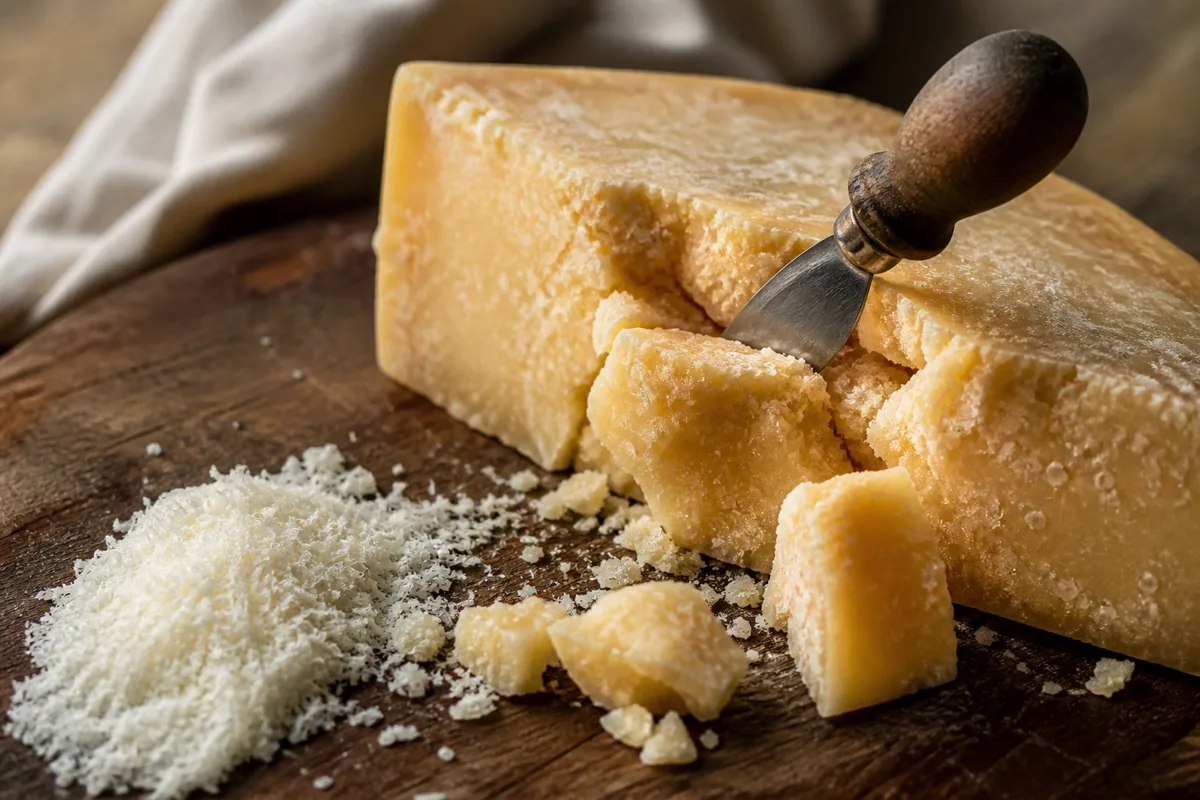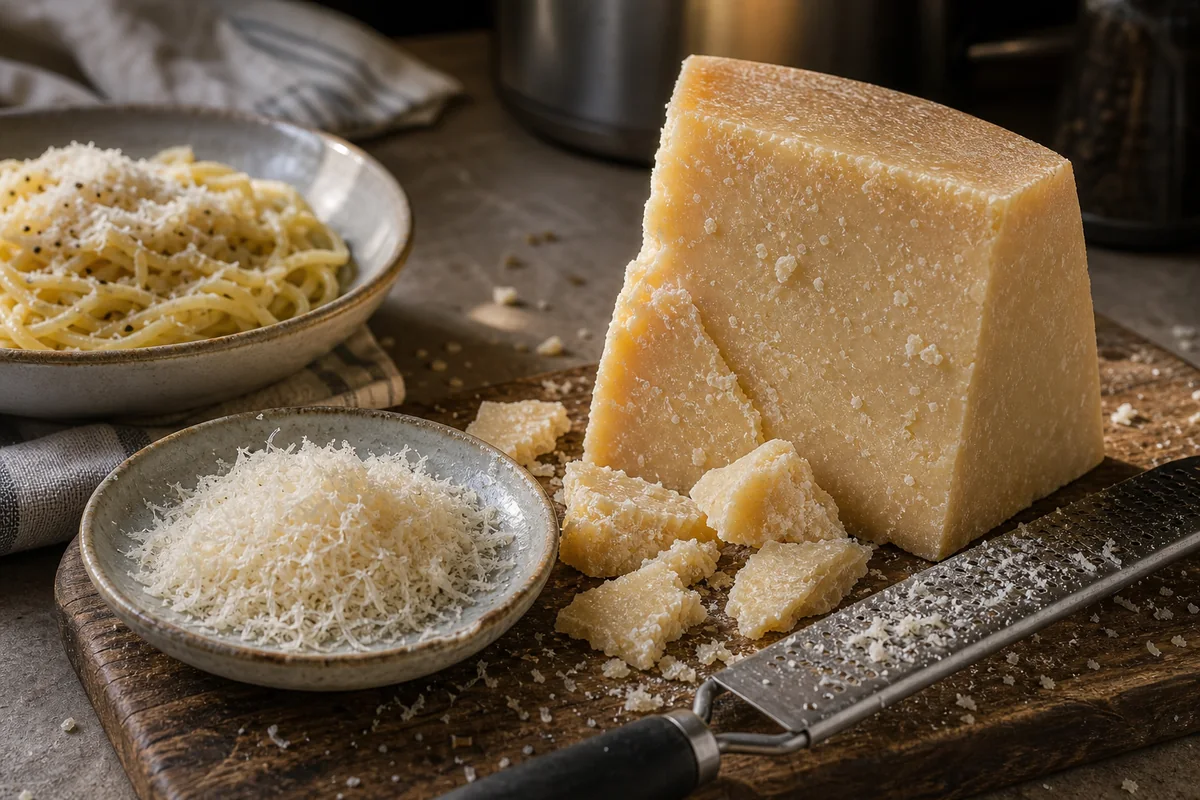
Grana Padano is a PDO hard cheese made from raw, partly skimmed cow's milk across the Po Valley in northern Italy, and it cannot be sold under that name before 9 months of ageing. The consortium sorts it into three age bands, and the band you buy decides whether you get a delicate, milky cheese or a grainy, full-flavoured Riserva.
The consortium rates every band for the table and for grating, but it calls the youngest, at 9 to over 14 months, ideal for everyday cooking and the Riserva, sold at over 20 months after an extra check, ideal for special occasions.
In This Article
What Is Grana Padano?
The October 2022 PDO specification defines Grana Padano as a cooked-curd, hard, slow-maturing cheese made all year from untreated cow's milk that is partly skimmed by letting the cream rise. It is eaten as a table cheese or grated.
The consortium traces the recipe to 1135 and the Benedictine monks of Chiaravalle Abbey, south of Milan, who developed it to keep surplus milk for long periods.
The production zone is wide, since the consortium counts 32 provinces across five regions: Piedmont, Lombardy, Veneto, Emilia-Romagna and Trentino-South Tyrol.
Inside that zone the specification ties the cows to local land. Forage must supply at least half of the daily ration's dry matter, and at least 75% of the fodder's dry matter must come from the production area.
The cows are milked twice a day or through a robotic system they enter freely, which the consortium says was introduced in October 2019, and the milk has to be collected within 24 hours of the first milking.
| Point | Requirement |
|---|---|
| Shape | Cylinder with slightly convex or nearly straight sides and flat faces |
| Diameter | 35 to 45 cm |
| Side height | 18 to 25 cm |
| Weight | 24 to 40 kg |
| Rind | Hard and smooth, 4 to 8 mm thick, dark or natural golden yellow, no artificial colouring |
| Paste | White or straw coloured, finely grained, with radial flaky cracking and barely visible holes |
| Fat in dry matter | 32% minimum |
| Aroma and flavour | Sweet-smelling and delicate |
The specification accepts lysozyme in the milk but excludes it from Trentingrana, the Grana Padano made in the Autonomous Province of Trento from cows fed without silage all year.
Trentingrana also carries its own rind band, which the specification describes as dotted lozenges crossed by the word TRENTINO and set around stylised mountains.
How Is Grana Padano Made?
The consortium's production page starts with raw milk from local farms, left to stand so the cream rises and the milk is partly skimmed by natural surfacing.
The specification sets the goal as a ratio rather than a particular milking: the milk settles at 8 to 20°C until the fat-to-casein ratio in the vat falls between 0.80 and 1.05. It allows milk from one milking or a mix of several, and even a batch where only part of the milk has been left to settle.
- Copper vats: the milk goes into bell-shaped copper cauldrons of 1,000 litres, and each one makes two wheels.
- Starter and rennet: whey from the day before adds lactic bacteria, and calf rennet goes in once the milk reaches 31 to 33°C.
- Curd: the curd is broken into grains as small as rice, heated to a maximum of 56°C, then left in the whey for up to 70 minutes.
- Moulding: the curd sets in a plastic mould called the fascera, and after 12 hours a band engraved with the marks of origin is fitted to print them on the rind.
- Brine and ageing: the wheels are salted in brine and then aged for at least nine months.
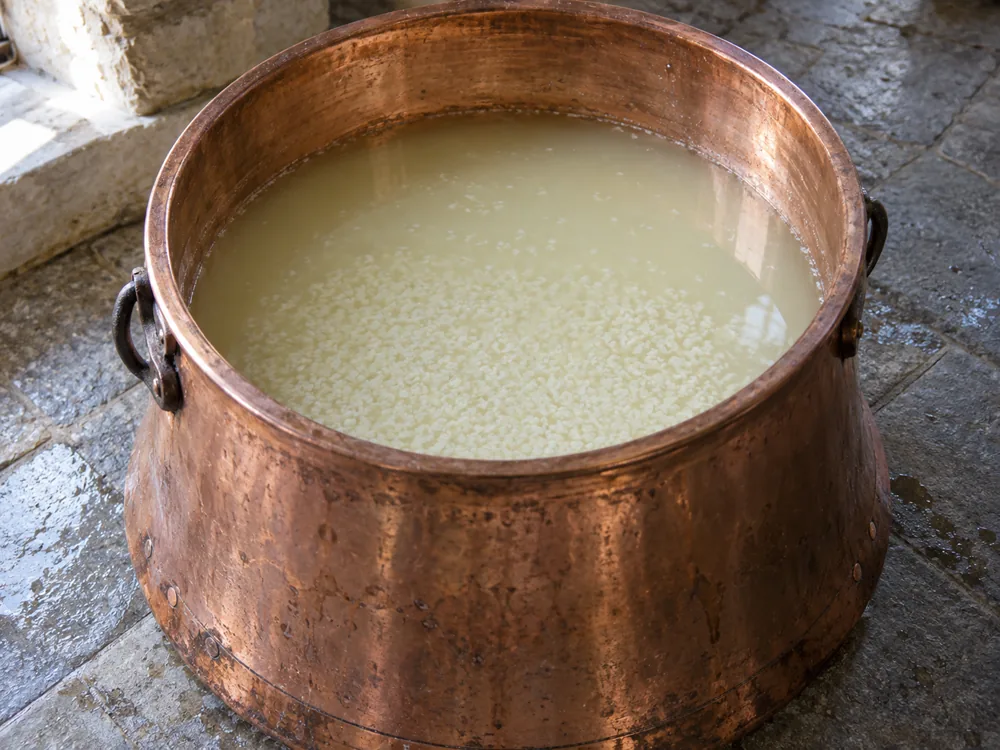
A 1,000-litre vat cut into two equal wheels leaves roughly 500 litres of milk behind each one. At 24 to 40 kg a wheel, that is about 12 to 21 litres for every kilogram of cheese (our arithmetic from the consortium and specification figures).
The two official sources give different brine times. The production page says 12 to 25 days, while the specification says 14 to 30 days.
The production page adds that the time depends on the saline solution and the size of the wheel, and wheels run from 24 to 40 kg, so the two ranges may reflect different mixes of wheels, although neither source reconciles them.
Out of the brine, the production page has the wheels dry for a few hours in a hot room, and the specification allows them to be rinsed and kept at 25 to 60°C for up to 24 hours.
The specification sets ripening at 15 to 22°C for nine months after moulding, and a wheel cannot be sold as Grana Padano until it is fully nine months old. Until then it may not leave the production area, so no PDO wedge on a shelf is younger than that.
Why Does Grana Padano Allow Silage and Lysozyme?
Grana Padano cows can eat fresh grass or hay, and the consortium says they may also be fed silage, mainly ensiled corn.
The consortium says silage makes lysozyme necessary, because the natural protein prevents abnormal fermentation by Clostridium tyrobutyricum bacteria during the long maturing period.
Where silage is banned, lysozyme goes too: the consortium says Trentingrana and Parmigiano Reggiano both exclude silage and therefore lysozyme.
The specification limits how much lysozyme may go into the milk and requires the level measured in the finished cheese to correspond to the amount declared and verified during cheese-making.
The consortium says Italian law counts lysozyme as a cheese preservative, but that a May 2018 Italian Ministry of Health note classes it in Grana Padano as a technological adjuvant. It adds that lysozyme is the only preservative-type substance permitted, so it calls claims that Grana Padano may contain other preservatives inaccurate.
On a rind, the TRENTINO band therefore marks the version that excludes lysozyme, while for other wheels the specification only accepts its use, so the rind alone cannot show whether a given wheel contains it.
How Is a Grana Padano Wheel Checked and Graded?
Only wheels that show the alkaline phosphatase level the specification describes, measured one centimetre below the rind at mid-height on the side, and that meet the wheel description go on to expert checks.
The specification lets those checks begin eight months after moulding, and the consortium's comparison page says the quality inspection takes place after nine months of ageing.
The checks end in one of two ways: the wheel is branded, or its mark impressions are deleted by crosshatching or bleaching, so the wheel no longer carries the marks of origin.
Wheels that pass are classed as scelto sperlato, zero or one, and scelto sperlato is the class with no internal or external defect.
Zero keeps a top-quality structure but has minor rind defects the specification calls corrections. One, also called sottoscelto, has slight corrections in the rind or structure, slightly enlarged eyes and does not quite give the proper sound under the testing hammer.
Which Grana Padano Aging Band Should You Buy?
The consortium's ageing page gives each band its own colour, crystals and flavour. Our own suggestion is the youngest band for everyday cooking and the Riserva when you eat the cheese on its own, though the consortium rates all three for both the table and grating.
| Band | Paste | Crystals | Flavour and aroma | Consortium's use |
|---|---|---|---|---|
| 9 to over 14 months | Soft textured, pale straw | Calcium lactate and tyrosine crystals absent | Delicate, markedly milky; aroma of milk and cream | Table cheese; excellent grated |
| Over 16 and over 18 months | Marked straw colour, grainy | Calcium lactate crystals in the rind, fewer in the middle | Tasty but not overpowering; butter and broth, hay and dried fruit | Excellent table cheese; ideal for grating |
| Riserva over 20 and over 24 months | Intense, uniform straw; flaky | Calcium lactate crystals throughout the wheel | Rich and full; butter, hay and dried fruit | Superb as a table and grated cheese |
Read across the consortium's tasting grid and the bands move in one direction: sweetness falls from strong to low while strength climbs from mild to strong.
| Descriptor | 9 to over 14 months | Over 16 and over 18 months | Riserva |
|---|---|---|---|
| Sweetness | Strong | Medium | Low |
| Strength | Mild | Medium | Strong |
| Springiness | Strong | Present | Weak |
| Crumbliness | Low | Medium | High |
Texture follows the same path, with springiness fading from strong to weak and crumbliness rising from low to high. Our reading is that a young wedge holds its shape when cut into cubes or slices while a Riserva breaks into flakes, which fits the flake structure the ageing page gives it.
The consortium writes the first band's upper edge two ways. Its ageing page says 9 to over 14 months and starts the next band at over 16, while its wine page says 9 to 16 months, and neither page explains the difference.
The Riserva name takes more than time. The specification requires at least 20 months, a wheel graded scelto sperlato, the defect-free class, a very grainy structure with a clear radial flaky texture, and a white or pale straw colour.
The producer then has to ask for the second fire brand, a circle reading RISERVA with OLTRE 20 MESI, or over 20 months, around it.
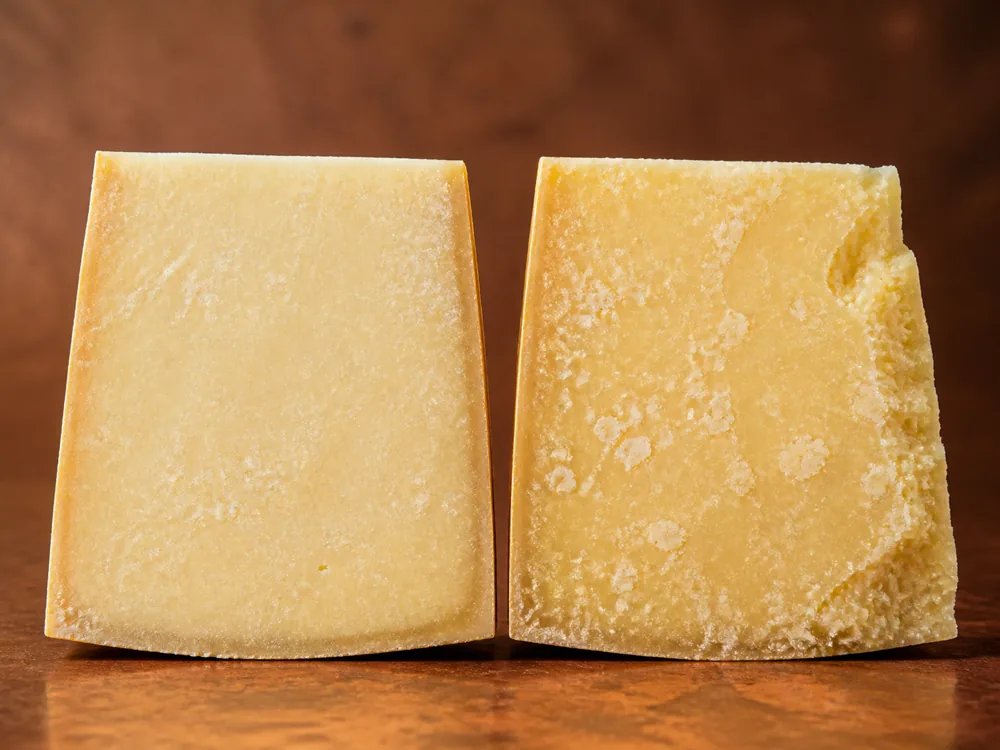
On packs, the specification allows the real age to be printed from 12 months onward as over X months, in yellow figures on black. A Riserva pack may also state over 24 months when the wheel carries the Riserva brand.
On a Riserva pack the RISERVA OLTRE 20 MESI logo is gold on black, and the optional over 24 months version reverses it to black lettering on gold.
The age figure is optional under the specification, so a Grana Padano pack with no month figure only tells you the cheese passed the 9-month minimum.
How Do You Read the Marks on a Grana Padano Rind?
The specification describes the marks that identify a wheel, and its dashed lozenge band runs continuously round the whole edge apart from one empty space left for the fire brand.
| Four-leaf clover | At the centre of the rind band, with the province's two letters, the dairy's three-digit number and DOP |
| Lozenges | Dashed diamonds reading GRANA and PADANO in turn, repeated around the edge |
| Casein plate | A disc on the top face with GRANA PADANO and a code for each wheel |
| Fire brand | Applied when the wheel passes the expert checks |
| Riserva brand | A second fire brand that only Riserva wheels receive |
The specification also has the production year and month moulded beside the clover, as two numbers and three letters. A wedge whose rind includes that spot shows when its wheel was made.
Below and to the left of the clover sits the EC stamp, which the specification says identifies the producer's establishment for health purposes.
Grated Grana Padano follows its own rules. The specification says it must come from certified wheels, be grated and packed inside the production area with nothing added, and contain no more than 18% rind and 25 to 35% moisture.
The grated type must also look non-powdery and consistent, with no more than 25% of particles smaller than 0.5 mm in diameter.
Packers may grate trimmings left from cutting and packing wedges, but only if the source wheels can be traced to a dairy and production month, and the trimmings may not be sold as a product on their own.
Rindless pieces, slices and flakes count as grated under the specification, so on those packs the Grana Padano logo on the packaging takes the place of the rind marks. Cheese packed at the point of sale is the one case that needs no consortium packaging authorisation, so if you buy a wedge wrapped in the shop, the rind marks are your check.
How Is Grana Padano Different From Parmigiano Reggiano?
The Grana Padano consortium's own comparison sets out the rule differences, and the two a shopper meets first are age and additives. Grana Padano can be sold at 9 months and may contain lysozyme, while the Parmigiano Reggiano rules start at 12 months and exclude it.
| Point | Grana Padano | Parmigiano Reggiano |
|---|---|---|
| Area | 32 provinces in five regions | Parma, Reggio Emilia, Modena, Bologna left of the Reno, Mantua right of the Po |
| Cattle feed | Silage allowed, mainly corn | No silage |
| Lysozyme | Up to 2.5 g per 100 kg of milk | Not allowed |
| Skimming | Milk from both daily milkings | Usually only the evening milking |
| Milk fat | About 2.6% | About 2.8% |
| Minimum age | 9 months | 12 months |
The consortium also lists what the two cheeses share: a grainy structure that breaks into flakes, twice-daily milking, rennet of exclusively animal origin and specifically of veal, and wheels that are practically identical in shape, size and weight.
According to the consortium, the lower fat means Grana Padano matures more quickly, and its wheels are inspected after nine months while Parmigiano Reggiano's are inspected after twelve.
At the top of the age range, the longest age the rules name explicitly is Riserva over 20 months for Grana Padano and over 30 months for Parmigiano Reggiano, though the consortium says both are sometimes aged longer.
That makes Grana Padano a workable substitute for Parmesan when a dish needs grated hard cheese, since structure, rennet and wheel size match.
How Do You Cook With Grana Padano Rind?
Chef Danilo Cortellini's rind recipes for the consortium begin with cleaning: he polishes the outside with a wet cloth or scrapes off a very thin outer layer, then rinses and dries it if needed.
His five uses sort by what the rind has to do. In tomato sauce and minestrone it goes in early and flavours the pot, while for the cheese sauce, grilled rind and puffed rind he first soaks or dries it so that it melts, chars or puffs.
| Use | How It Works |
|---|---|
| Tomato sauce | About 100 g of rind for 600 g of sauce, simmered about 30 minutes. |
| Minestrone | About 100 g for 600 g, simmered about 30 minutes, then drained, chopped and stirred back in. |
| Cheese sauce | About 200 g of soaked, chopped rind for 700 ml of double cream, blended once melted. |
| Grilled rind | Soaked overnight, patted dry and charred on a griddle pan; the chef says a barbecue works too. |
| Puffed rind | Very dry rind, 2 minutes at maximum power on baking parchment in a microwave, then 30-second steps if needed. |
In the tomato sauce the softened rind can be eaten in chunks, though he calls it a little chewy, and he says the same method suits other pasta sauces such as ragù Bolognese, while the minestrone method suits other soups.
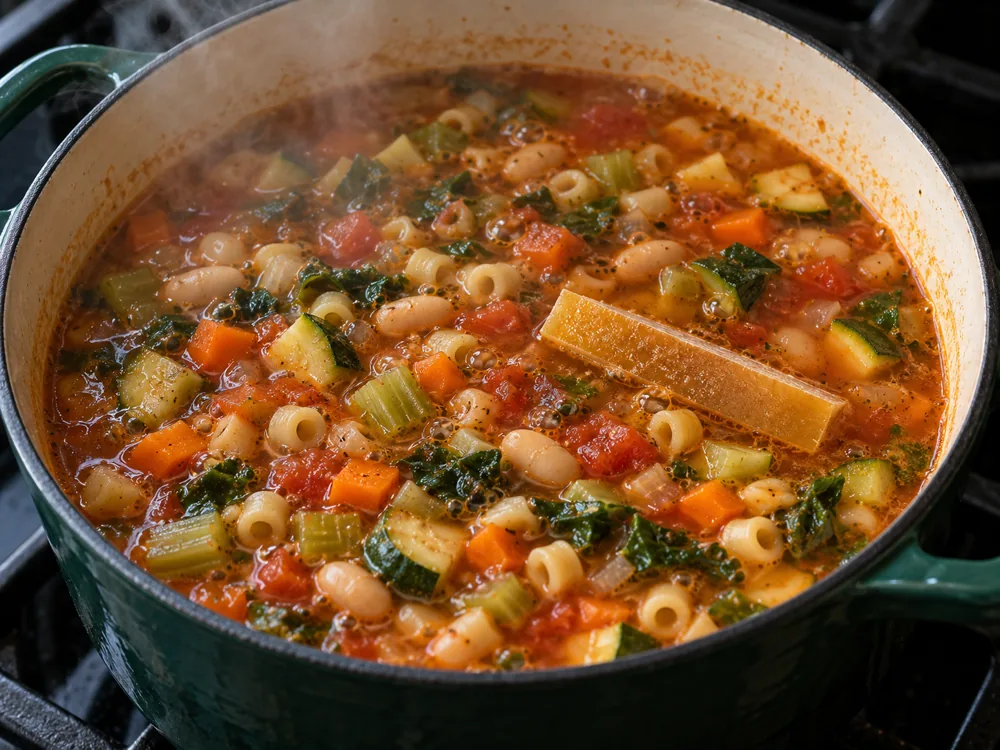
The soak is what lets rind melt: for the cheese sauce he soaks it in water in the fridge a day ahead, then trims off the outer layer if it is still very dry.
He chops the rind and simmers it in double cream until it melts, and he says the sauce dresses pasta, roast beef or vegetables.
Grilled rind gets the same overnight soak, then goes onto a griddle pan over constant medium heat. Cortellini says not to pull at pieces that stick, because once the rind is golden and caramelised and the surface water has evaporated, it releases on its own.
Puffed rind starts with rind dried very well, and the microwave step should at least double its size and turn it golden.
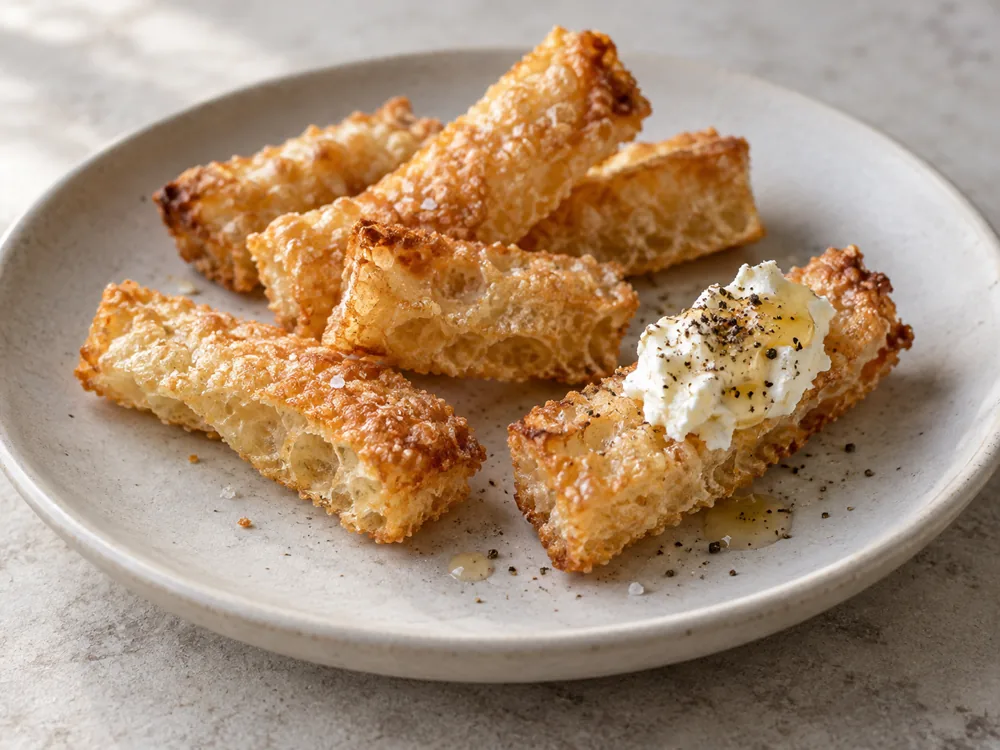
He cuts the puffed rind into small crostini and serves it with cream cheese, honey and black pepper, and for very hard, old rind he soaks it in water for a few hours before using it.
What Wine Goes With Grana Padano?
The Italian Sommelier Association (AIS) created the pairings that the consortium publishes, with a different set of Italian wines for each age band. They move from sparkling and rosé wines for young cheese to big reds and a sweet passito for the oldest.
| Pairing | Why It Works |
|---|---|
| 9 to 16 months | Lambrusco Grasparossa di Castelvetro, Conegliano Valdobbiadene Prosecco Superiore, or Cerasuolo d'Abruzzo rosé. |
| Over 16 months | Greco di Tufo, Franciacorta Brut Satèn, or Dolcetto d'Alba. |
| Riserva over 20 months | Sicilia Nero d'Avola, Primitivo di Manduria, or Castelli di Jesi Verdicchio Riserva. |
| Extra-mature | Trento Brut Rosé Riserva, Ramandolo, or Brunello di Montalcino. |
The AIS notes describe the youngest cheese as still sweet with just a trace of saltiness, which is the stage they give the lighter sparkling and rosé wines. For the Riserva, the ageing page adds a broader rule: dessert wines, fortified wines and full-bodied aged reds.
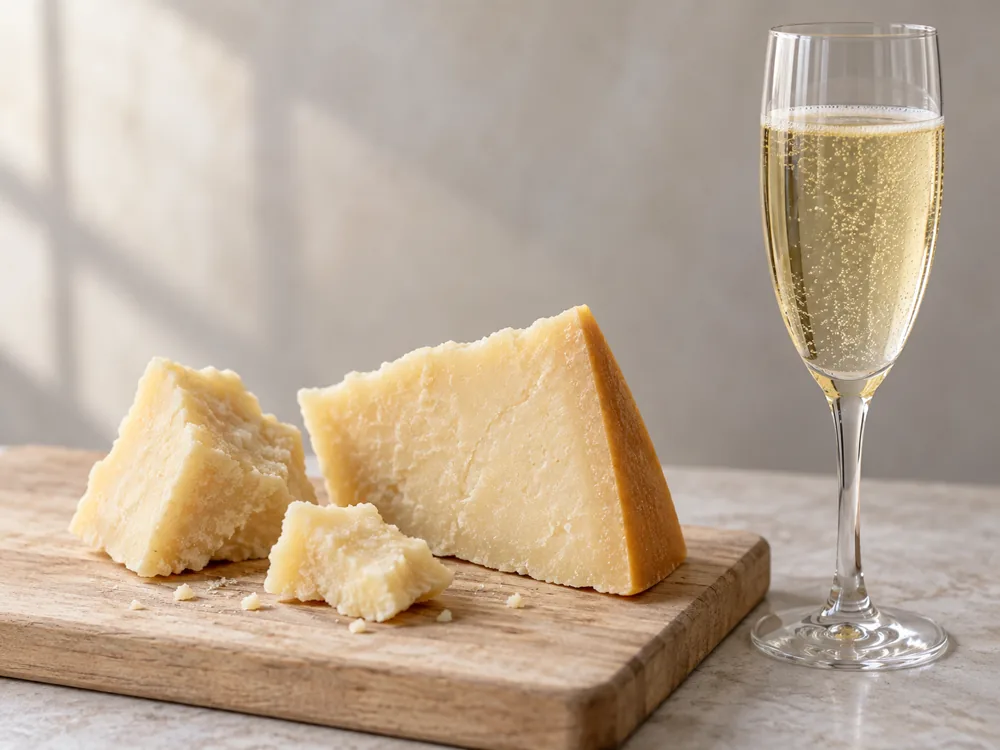
For the over 16 month band the AIS notes mention a light fattiness that lingers in the mouth and a savoury flavour that stimulates salivation. They match it with slightly tannic reds of medium intensity or young, crisp wines whose grape aromas show.
For the Riserva the AIS asks for full-bodied, complex wines with roundness, velvety texture and a mouth-filling feel, able to match the cheese's marked savoury notes and its long-lasting flavour.
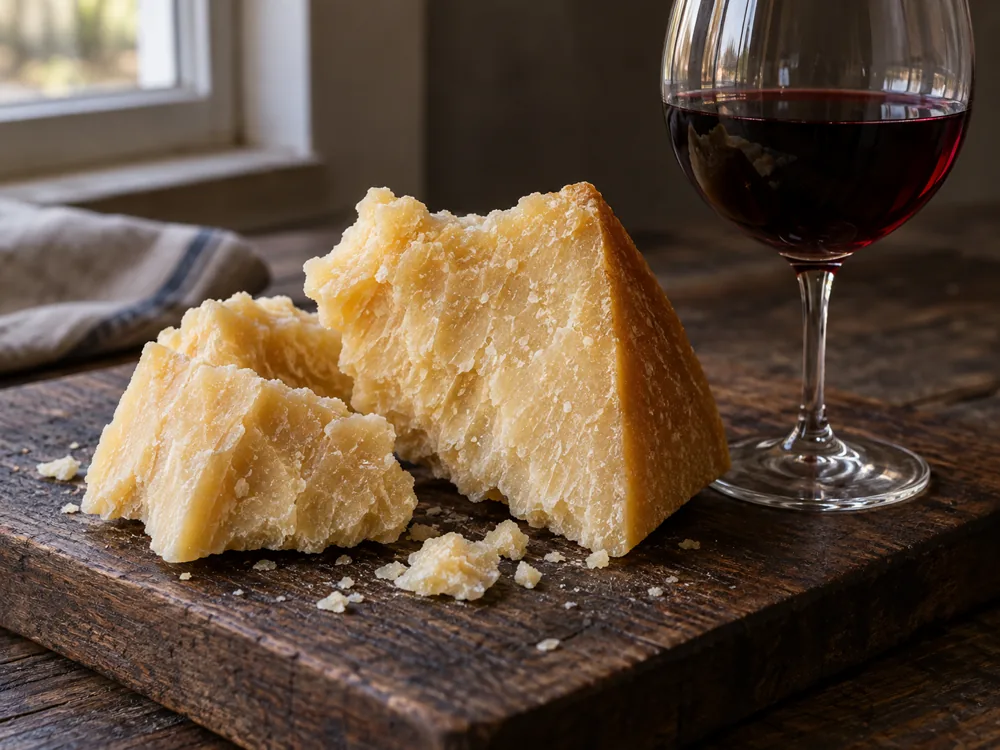
Beyond 20 months the AIS gives two routes: an intense, long-lasting aged wine that echoes the cheese's own maturing, or a raisined-grape wine such as Ramandolo that softens a slightly aggressive vein in the cheese.
How Do You Buy and Store Grana Padano?
The specification governs the wheel, not a cut wedge at home.
Keep your refrigerator at 40°F (4°C) or below, the CDC advises.
The date printed on the pack is your guide for a cut piece.
Is Grana Padano Lactose Free and Vegetarian?
The consortium says Grana Padano is naturally free of lactose because of how it is made and aged, and that it is substantially lactose free once it passes the 9-month minimum. It gives the remaining galactose as less than 10 mg per 100 g.
The lactose page credits the galactose figure to an Italian Ministry of Health memo of June 2016 and to a 2017 Food Chemistry paper. That paper, by Lucia Monti and colleagues, validated a method for measuring lactose, galactose and glucose in naturally lactose-free hard cheese.
Grana Padano is not vegetarian, because the specification coagulates the milk with calves' rennet after the whey starter goes in. The consortium calls any claim of vegetal or bacterial rennet totally false and says the specification can be checked directly.
Egg is the other ingredient to know about: it enters through the lysozyme described above, which is extracted from hen egg whites and excluded from Trentingrana.
Is Grana Padano Safe During Pregnancy?
Grana Padano is a hard cheese made from raw milk, and the two health agencies we checked treat that combination differently. The NHS lists "pasteurised or unpasteurised hard cheeses, such as cheddar, gruyère and parmesan" as safe to eat in pregnancy.
The CDC puts hard cheese on its safer list only when it is made with pasteurized milk, naming pasteurized Asiago, Cheddar, Parmesan and Swiss. It also warns that "Pregnant women are 10 times more likely to get a Listeria infection."
Neither agency names Grana Padano, so it fits the NHS hard-cheese rule but sits outside the CDC's listed safer group, and your clinician can say which advice applies.
SOURCES & REFERENCES
What Else Do People Ask About Grana Padano?
No. Grana Padano and Parmigiano Reggiano are separate PDO cheeses, and the Grana Padano consortium lists different rules for area, feed, lysozyme, skimming and minimum age, which is 9 months against 12.
No. The specification requires calves' rennet, and the consortium calls claims of vegetal or bacterial rennet false.
It can. The consortium says its lysozyme is extracted from hen egg whites, and Trentingrana is made without it.
The consortium's rind recipes clean the rind and cook it in minestrone, tomato sauce and a cheese sauce, and they also grill or puff it.
At least 20 months, and the wheel also has to pass an extra check.