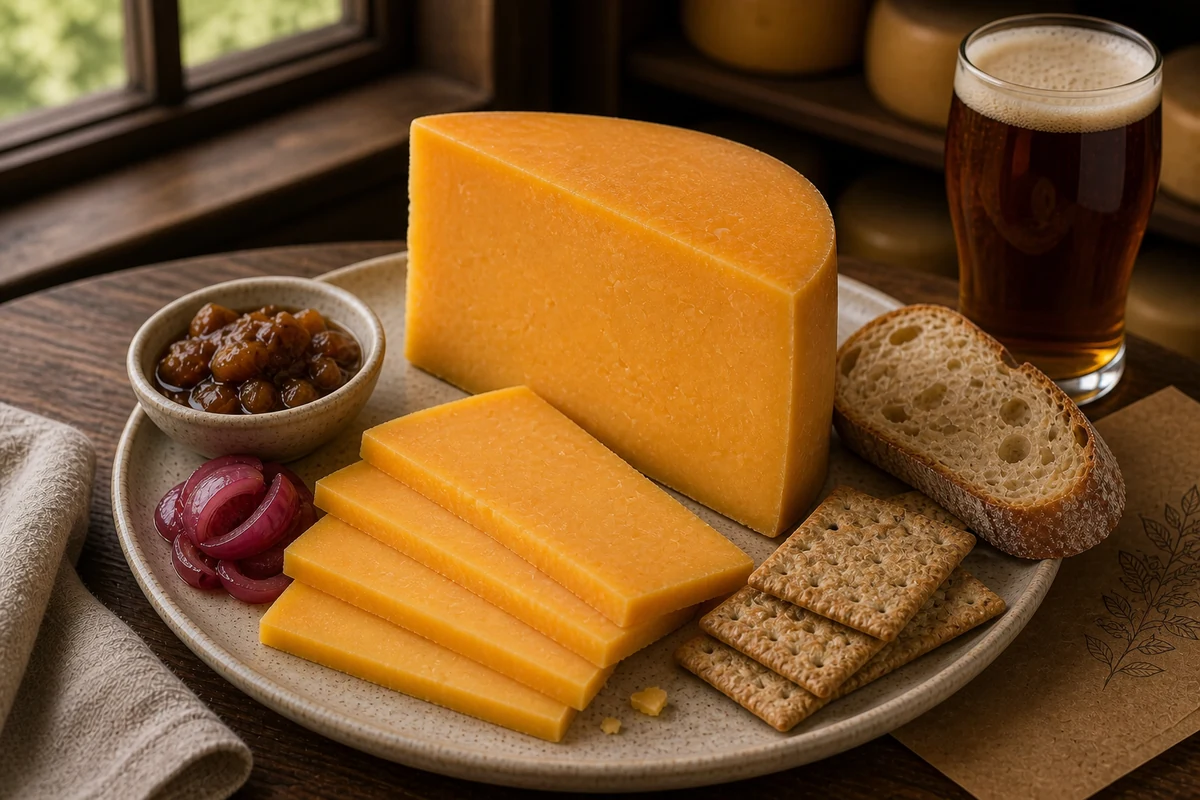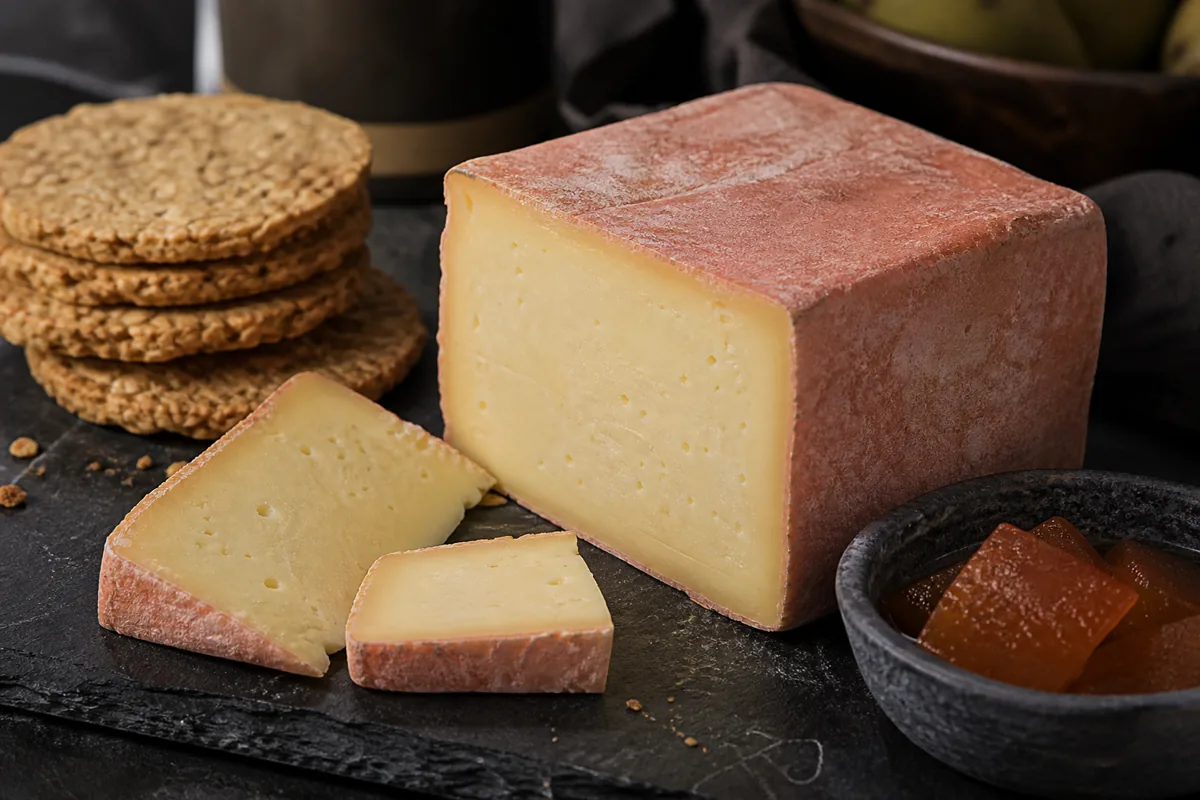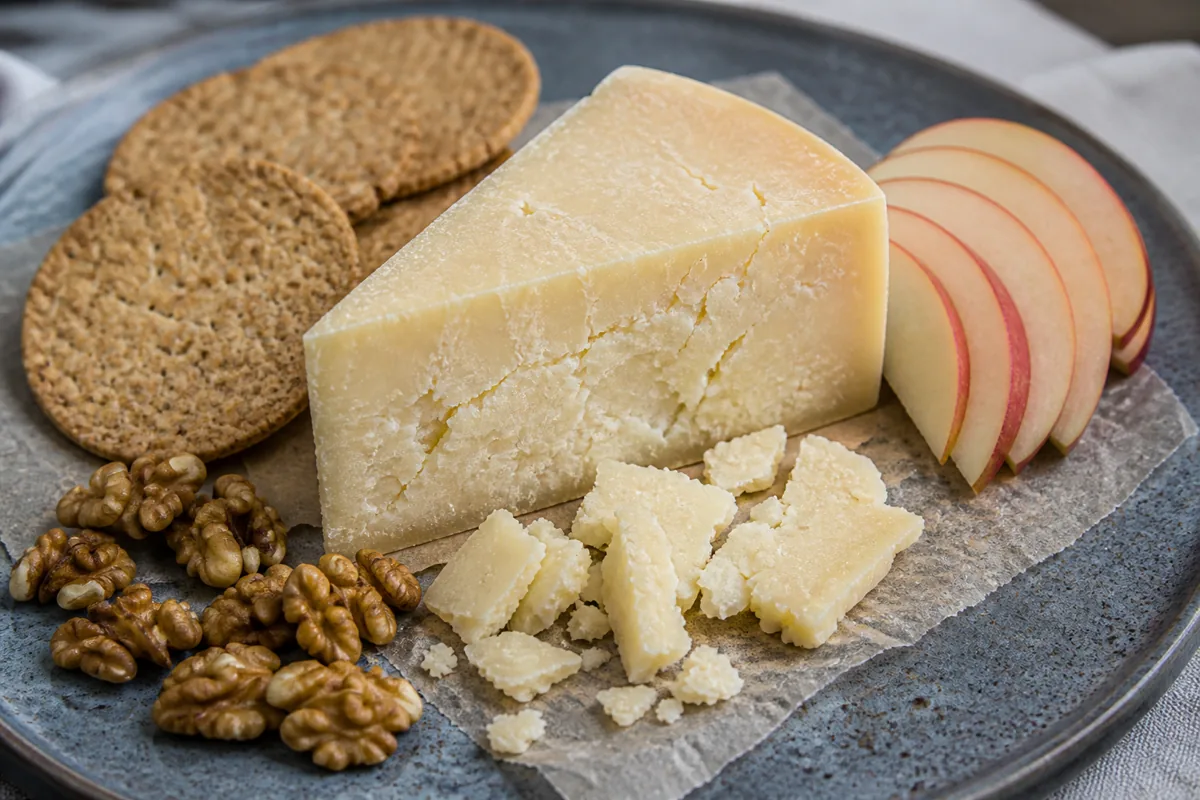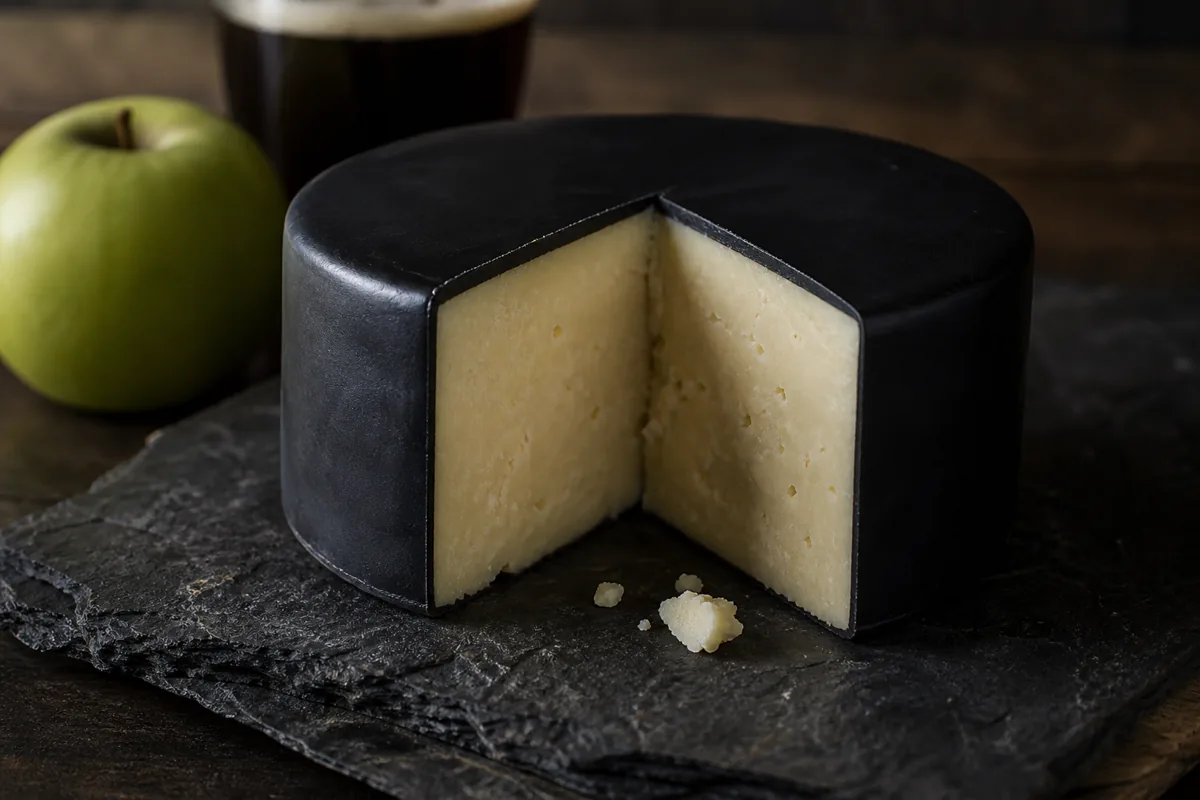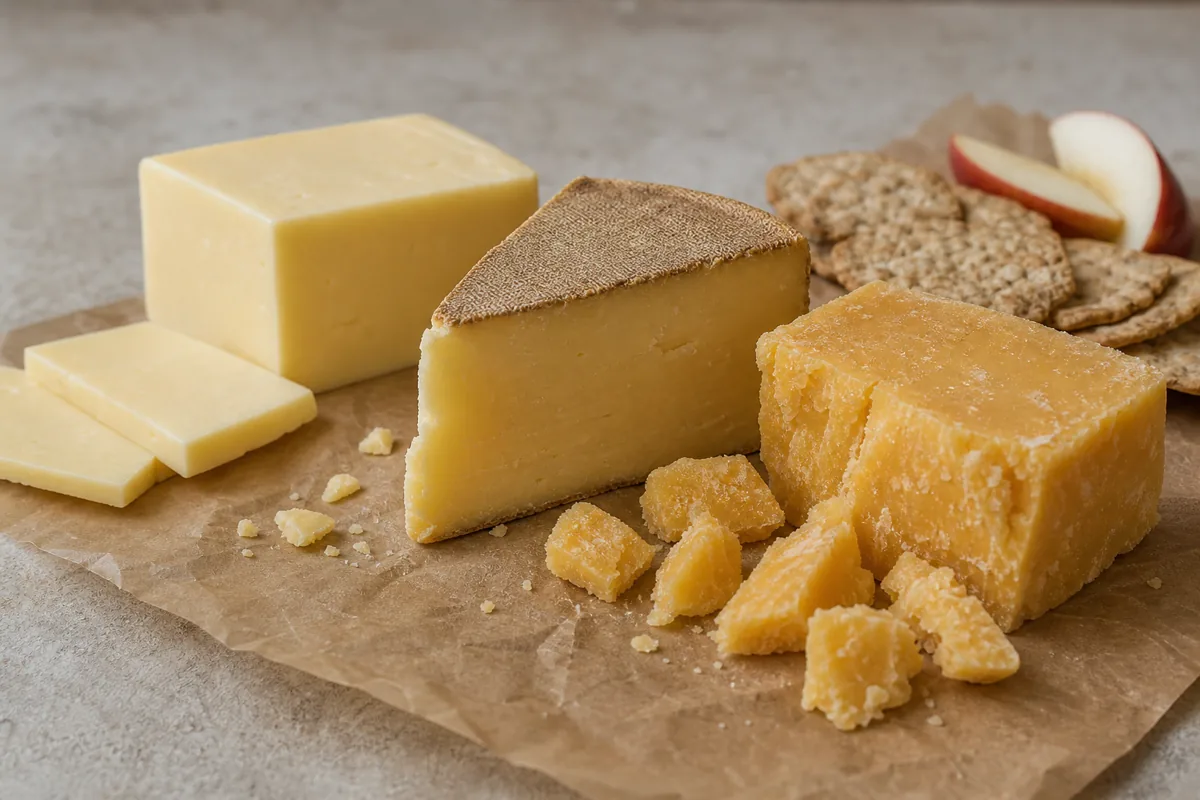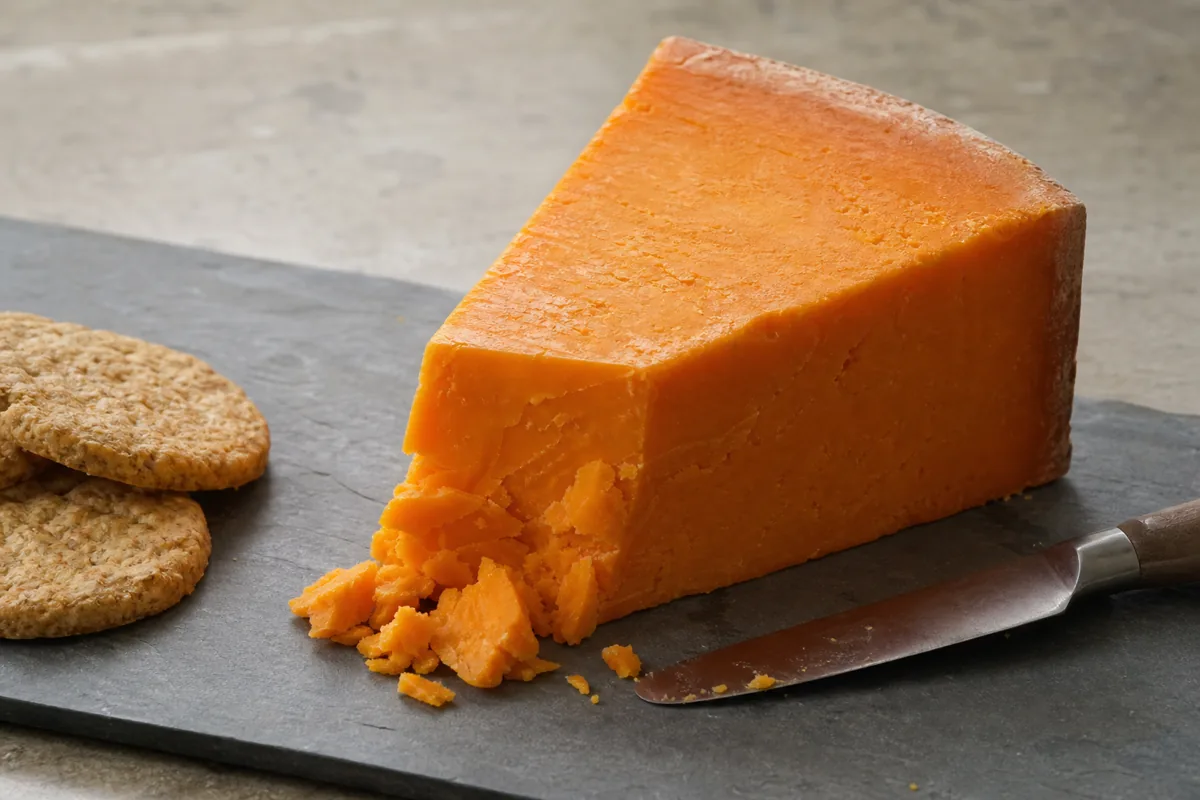
Red Leicester is a hard English cheese made from cow's milk and coloured orange with annatto. It is named after the city of Leicester or the county of Leicestershire, and its older names are simply Leicester or Leicestershire cheese.
The cheese on sale runs from a cloth-matured farmhouse wheel to a vacuum-packed creamery block, and the sources describe those two quite differently.
In This Article
Where Red Leicester Comes From and Why It Is Orange
Red Leicester began on Leicestershire farms as a use for milk left over from Stilton making. Wikipedia and Neal's Yard Dairy both say the surplus went into a long-lasting cheese once farms had made all the Stilton they wanted.
The colour came first from carrot or beetroot juice, according to Wikipedia, and annatto extract has been added during the make since the 18th century.
Neal's Yard Dairy describes annatto as a natural plant dye from a South American bush that has coloured cheeses for almost 300 years. The Leicestershire Handmade Cheese Company says it comes from the seeds of achiote trees.
The colour is still optional. Wikipedia says Red Leicester without annatto can be found, and the Dairy UK code of practice for named British cheeses lets a Leicester be anything from white to deep orange-red.
The word "Red" came later. Wikipedia says it was added to tell the cheese apart from White Leicester, which was made to a national wartime recipe during 1940s rationing.
Farm making was already fading by then. The Leicestershire Handmade Cheese Company says Red Leicester was made on its farm from 1745 until 1875 and that traditional Red Leicester had died out in England by the early 1950s.
Neal's Yard Dairy links the loss to Stilton's rising popularity, which left less surplus milk in Leicestershire.
Factory-made cheese filled the gap, and the Leicestershire Handmade Cheese Company says it first dismissed the idea of reviving Red Leicester because the cheese had a reputation for being boring and rubbery. What remained on sale, it says, bore little resemblance to the great farmhouse cheeses of the past.
David and Jo Clarke brought the raw-milk clothbound cheese back in 2005, working from an old recipe on their farm. Neal's Yard Dairy says that form of Red Leicester had been extinct for 50 years, and the result is Sparkenhoe, their raw-milk farmhouse wheel.
The name no longer ties a cheese to the county, since Neal's Yard Dairy says more Red Leicester is now made outside Leicestershire than inside it.
The Dairy UK code treats Leicester as a customary name, with limits for water, fat and character but no place where it must be made.
How Red Leicester Is Made, Step by Step
Wikipedia lists six steps for Red Leicester: acidification, coagulation, cutting, cheddaring, pressing and ageing. The only maker whose steps we found described in detail is the Leicestershire Handmade Cheese Company, which makes raw-milk Sparkenhoe on its farm.
The maker's own account of the Sparkenhoe make runs in this order.
- Raw milk is pumped from the milking parlour to the cheese room at 5am.
- Animal rennet goes in first and sets the curd.
- Annatto is poured into the milk to give the cheese its orange colour.
- The curds and whey are gently scalded and separated.
- The curd is cut into blocks, which the team turns by hand.
- The blocks go through the mill and are salted.
- The curds go into moulds, where they are pressed and turned for 24 hours.
- The wheels are bound with cloth and lard.
- The wheels go to the cheese store to mature.
Culture magazine differs from the maker on two details. It says the milk comes from the previous day's milking at 4am, and that the moulded cheeses are pressed for 24 hours, turned and pressed for another 24.
The pages do not say which account is current. Both describe raw milk from the farm's own cows, and Neal's Yard Dairy says the herd is Holsteins, 150 cows when the Clarkes began.
The maker says binding the wheel in cloth and lard lets the cheese form a natural rind and breathe. It credits that rind with adding flavour and complexity.
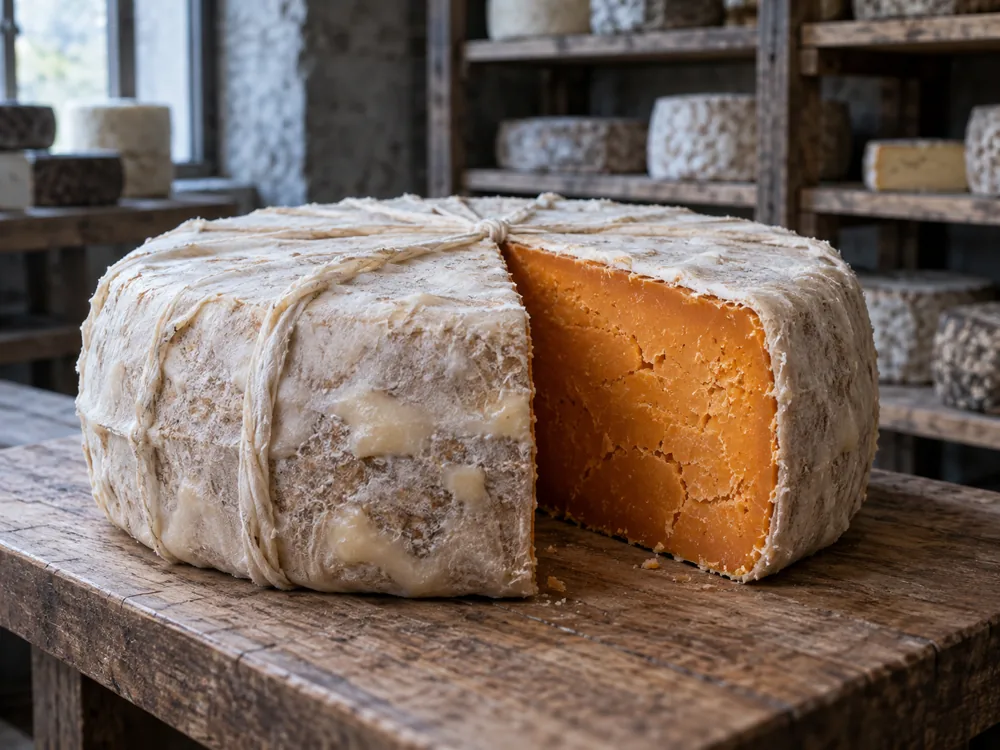
Culture magazine lists Sparkenhoe wheels at 22 and 44 pounds, 16 to 18 inches across and 6 inches high. Neal's Yard Dairy sells a whole wheel at 9,595 to 10,542 grams, close to the 22-pound size.
The same retailer also sells fractions, from a smallest piece of 295 to 329 g and a sixteenth of 595 to 659 g up to a half wheel, each listed as a weight range rather than a single weight.
Farmhouse Wheel or Creamery Block: What Changes
The wheel and the block mature in different ways. Wikipedia says the modern industrial method ages Red Leicester in vacuum packing, while smaller farmhouse makers still mature it in cloth for better flavour development.
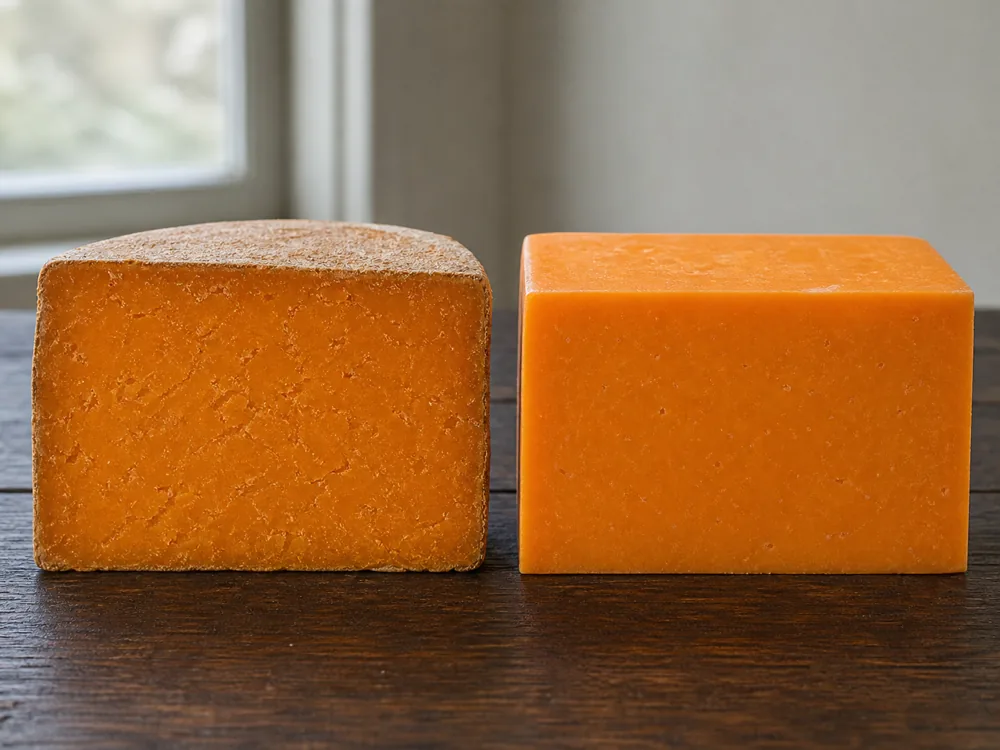
That difference in maturing shows up in the texture and the outside of the cheese.
| Point | Cloth-matured wheel | Creamery block |
|---|---|---|
| How it matures | In cloth (Wikipedia) | In vacuum packing (Wikipedia) |
| Texture | Fairly firm and dry, friable (Wikipedia) | Moister and creamy (Wikipedia) |
| Flavour | Slightly sweet and mellow, stronger with age (Wikipedia) | Slightly sweet aftertaste (Wikipedia) |
| Outside | Reddish-orange rind with a powdery mould, which Wikipedia and Cheese.com give for Red Leicester in general | No rind needed; any rind may be coated (Dairy UK) |
Texture is where the sources part ways, even for wheels matured in cloth. The table's texture row comes from Wikipedia, while Culture magazine calls Sparkenhoe firm and smooth with relatively high moisture spread evenly through the wheel, and Neal's Yard Dairy calls it chewy and moist.
Neal's Yard Dairy also says the texture dries as the wheel matures, so the age of the wheel each source describes may explain part of the gap.
The Dairy UK code leaves room for the spread: it calls Leicester generally loose and rather flaky, and adds that some recipes can be closer textured. A crumbly wedge and a chewy one can therefore both carry the name.
How Long Red Leicester Is Aged, and What Age Changes
No single ageing window holds across the sources, and Wikipedia even gives two.
| Source | What it says |
|---|---|
| Wikipedia, article text | 4 to 9 months; a Leicester usually counts as old after about 6 months |
| Wikipedia, opening summary, and Cheese.com | Around 6 to 12 months |
| Neal's Yard Dairy (Sparkenhoe) | Average age 5 to 6 months |
| Leicestershire Handmade Cheese Company | 6 to 8 months for traditional, 12 to 14 months for vintage |
| Culture magazine (Sparkenhoe) | About 4 months in a store at 50F |
| The Courtyard Dairy | Stocks a vintage Sparkenhoe aged 14 months or more |
Wikipedia says young Leicesters at the start of the range are very mild. A Leicester usually develops enough tang to be called old after six months.
The Courtyard Dairy puts the same six-month mark differently, calling around six months the traditional age and the mellow one. A label that says mature or old therefore tells a buyer less than a stated number of months.
Neal's Yard Dairy says Sparkenhoe's texture dries and its flavour moves from savoury, smooth and mellow to nutty and rich as it matures. The Dairy UK code likewise says Leicester's slight nutty flavours become more intense in more mature variants.
The Courtyard Dairy calls its vintage, aged 14 months or more, strong, powerful and full flavoured. It stocks that version because it packs more punch than a younger wheel.
Age is also a retailer's decision. Neal's Yard Dairy visits the farm once a month, tastes the cheeses with the Clarkes and picks batches with nutty, rich, complex flavours, no aggressive acidity and a succulent but chewy texture.
It then matures them at its Bermondsey arches, turning and brushing them weekly, and keeps some wheels for up to a year to sell as Sparkenhoe Mature.
Tasting words vary by source. Cheese.com calls the flavour sweet and caramel-like with earthy undertones, and Culture magazine notes a citrus tang in Sparkenhoe that lasts into the finish.
Red Leicester vs Cheddar and Double Gloucester
Cheese.com files Red Leicester in the Cheddar family and says it is moister, crumblier and milder than Cheddar.
The Dairy UK code of practice puts numbers on that. In the UK, a cheese may only be labelled with one of these names when its water and fat stay inside the limits and its character matches the description.
| Measure | Leicester | Cheddar | Double Gloucester |
|---|---|---|---|
| Maximum moisture | 42% | 39% | 44% |
| Average fat | 33.6% | 34.9% | 35.0% |
| Minimum fat in dry matter | 48% | 48% | 48% |
| Colour | White or bright orange-red to deep orange-red | White to yellow | Pale straw to pale tangerine and orange |
| Texture | Generally loose and rather flaky | Generally waxy, breaks down smoothly | Close and firm, some recipes flakier |
| Flavour | Clean, creamy, mellow, delicately sweet, slightly nutty | Clean, creamy and mellow when young, more pronounced with age | Full, clean and mellow with a nutty character and slight tang |
Leicester may hold up to 42% water against Cheddar's 39%, which matches Cheese.com's point that Red Leicester is the moister cheese. Its loose, flaky texture also sets it apart from Cheddar's waxy body.
Of the two, orange Double Gloucester shares the most with Leicester in the code, with a colour range up to orange and a mellow, nutty flavour. Its texture is the main difference, since the code calls it close and firm.
Neither source names a substitute, so treat that overlap as a description rather than a swap rule.
The only other cheese in the code with the same 42% water limit is light yellow Derby, and its mild, buttery young flavour puts it further from Red Leicester.
Crumbly Cheshire is the only variety in the code whose description sets crumbliness against Cheddar, calling it firm and crumbly. Its white to pale yellow colour and milky, slightly tangy young flavour still separate it from Leicester.
What the Fat and Moisture Figures Mean
Red Leicester carries two fat figures that answer different questions. Wikipedia puts fresh Red Leicester at 33 to 34% fat in the whole cheese, while the minimum the cheese must meet is stated as fat in dry matter, generally 48%.
Wikipedia gives the reason: moisture levels fall as cheese ages, so fat measured against the whole piece drifts upward as a wedge dries, while fat measured against the solids holds steady.
The water limit and the fat floor fit together. In the Dairy UK code, Leicester's 42% water leaves 58% dry matter, and 48% of that is about 28%, the minimum fat the code lists.
The same sum works for the others: Cheddar's 39% water gives about 29% and Double Gloucester's 44% about 27%, so a moister variety is allowed less total fat for the same fat-in-dry-matter floor.
For a 30 g serving, Wikipedia lists about 120 calories, 7 to 8 g of protein and 10 g of fat, of which 6 to 7 g is saturated. That 10 g in 30 g is the same one-third fat share as the fresh-cheese figure.
The code also lets a maker keep the Leicester name on a lower-fat cheese. The label must carry a descriptor such as reduced fat or half fat, the cheese must meet that grade's limits, and the name is not allowed below the half-fat values.
A reduced-fat claim itself needs at least 30% less fat than a representative similar product, under the Nutrition and Health Claims Regulation the code cites.
| Grade | Maximum moisture | Fat in the cheese | Fat in dry matter |
|---|---|---|---|
| Standard | 42% | 28% minimum, 33.6% average | 48% minimum |
| Reduced fat (30% less) | 47% | 16.8% to 23.5% | 32% to 45% |
| Half fat (50% less) | 53% | 12.9% to 16.8% | 27% to 36% |
As the fat limit falls, the water limit rises, so a lower-fat Leicester is allowed to be moister than the standard cheese.
Cooking With Red Leicester
Cheese.com lists Red Leicester for sandwiches and grated toppings, and Sparkenhoe's maker David Clarke has a dish of his own.
| Use | How It Works |
|---|---|
| Soups, salads and casseroles | Grated over the top, as Cheese.com suggests. |
| Cheese on toast | David Clarke's favourite way to cook Sparkenhoe, set out below. |
The Courtyard Dairy says David Clarke's favourite way to cook Sparkenhoe is cheese on toast. His recipe serves two with 4 slices of farmhouse bread, 3 tomatoes, 200 g of grated cheese and one medium onion.
- Toast the bread on both sides.
- Lay thinly sliced tomato on the toast and cover it with the grated cheese.
- Scatter thinly sliced onion over the cheese.
- Bake at 180C until the onions start to brown.
The recipe works out to 50 g of grated cheese on each slice.
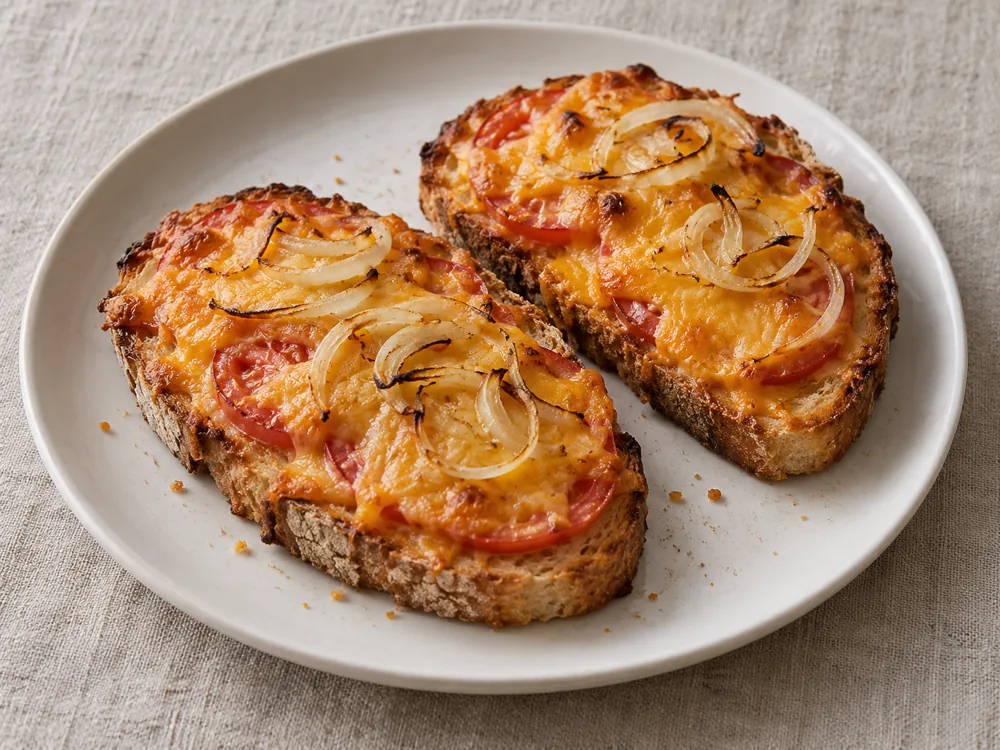
For more bite, a 2013 note from the shop suggests the vintage Sparkenhoe, which it then aged to 18 months; the shop's current page gives 14 months or more.
What to Drink and Serve With Red Leicester
Ale is the drink that turns up in more than one source, so beer is the most repeated match for Red Leicester.
| Pairing | Type | Why It Works |
|---|---|---|
| Amber ale | Drink | Named by Cheese.com. |
| Brown ale | Drink | Culture magazine's match for Sparkenhoe. |
| Full-bodied white wine | Wine | Named by Cheese.com. |
| Muscadet | Wine | Also named by Cheese.com. |
Cheese.com is the only source we read that names wine for Red Leicester, and both of its picks are white.
Each match belongs to a different age. Culture magazine's brown ale goes with its profile of Sparkenhoe at about four months, so it describes a younger cheese than the Courtyard Dairy's vintage, and Cheese.com's picks come with its 6 to 12 month range.
Milk, Rennet and Shelf Life on the Label
Red Leicester is frequently made with pasteurised milk, as Wikipedia lists it.
Raw milk is the exception, and Sparkenhoe is the example. The Courtyard Dairy calls it the only unpasteurised farmhouse Red Leicester made, while Neal's Yard Dairy sells it in both a raw-milk and a pasteurised version.
Neal's Yard Dairy says each piece is labelled with its milk treatment, and its ingredient list reads raw or pasteurised cow's milk, salt, animal rennet, annatto and cheese cultures.
The sources disagree on rennet. Cheese.com marks Red Leicester as vegetarian, but Neal's Yard Dairy and the Leicestershire Handmade Cheese Company both list animal rennet in Sparkenhoe, so the label on the piece you buy is the answer.
Not every list names the type: the Courtyard Dairy's list for the same Sparkenhoe says only rennet, while the maker, Culture magazine and Neal's Yard Dairy each say animal rennet.
The Courtyard Dairy gives its vintage Sparkenhoe two weeks' shelf life from the delivery date.
Is Red Leicester Safe in Pregnancy?
The NHS says "pasteurised or unpasteurised hard cheeses, such as cheddar, gruyère and parmesan" are safe to eat in pregnancy. It does not name Red Leicester.
The CDC lists hard cheese made with pasteurized milk, such as Cheddar, as a safer choice and soft cheese made from unpasteurized milk as riskier. It adds that pregnant women are 10 times more likely to get a Listeria infection.
A block labelled as made with pasteurised milk matches both lists, while a raw-milk wheel such as Sparkenhoe fits only the NHS one.
SOURCES & REFERENCES
Red Leicester Cheese FAQ
Dairy UK describes it as clean, creamy, mellow and delicately sweet with slight nutty flavours that grow stronger as the cheese matures.
Annatto, a plant dye, has been added during the make since the 18th century. Wikipedia says carrot or beetroot juice was used before that.
No. Cheese.com says it is moister, crumblier and milder, and the Dairy UK code allows Leicester 42% water against 39% for Cheddar.
It depends on the maker. Cheese.com marks it as vegetarian, but Sparkenhoe is made with animal rennet, so check the label.
Often, but not always. Wikipedia lists it as frequently pasteurised, and Sparkenhoe is sold in both raw-milk and pasteurised versions.