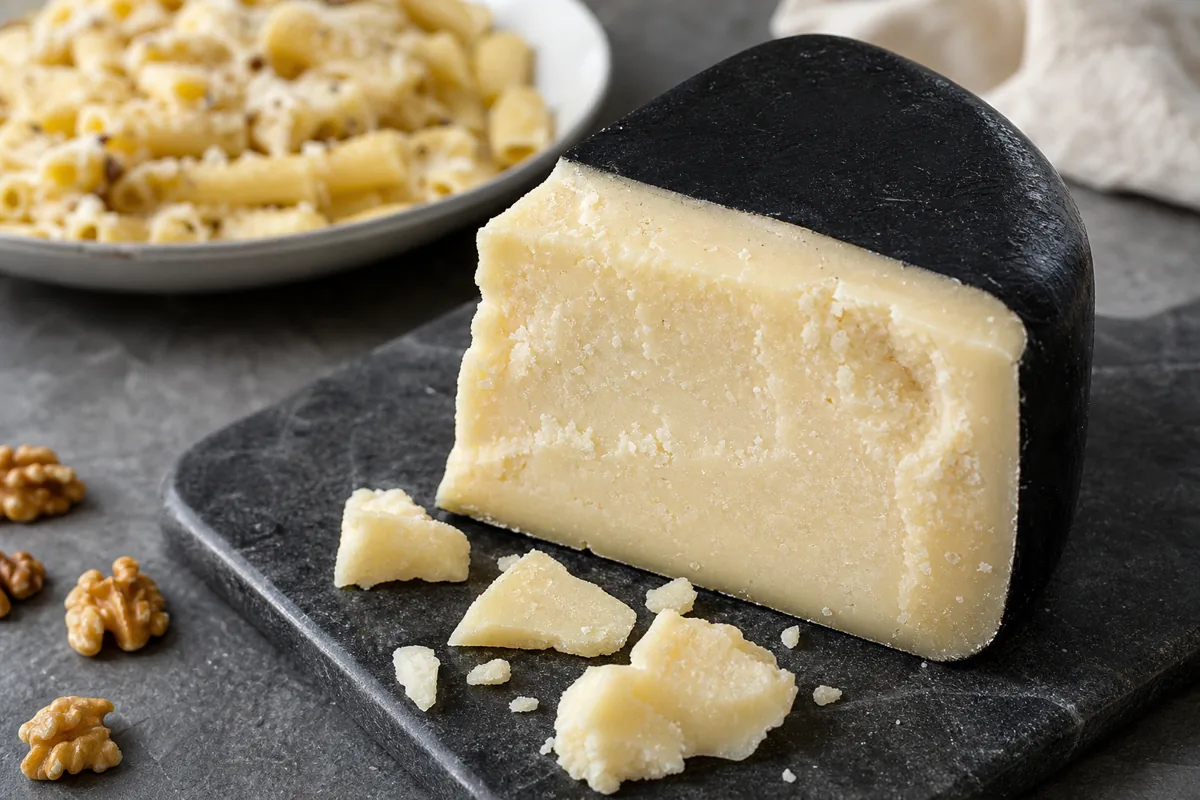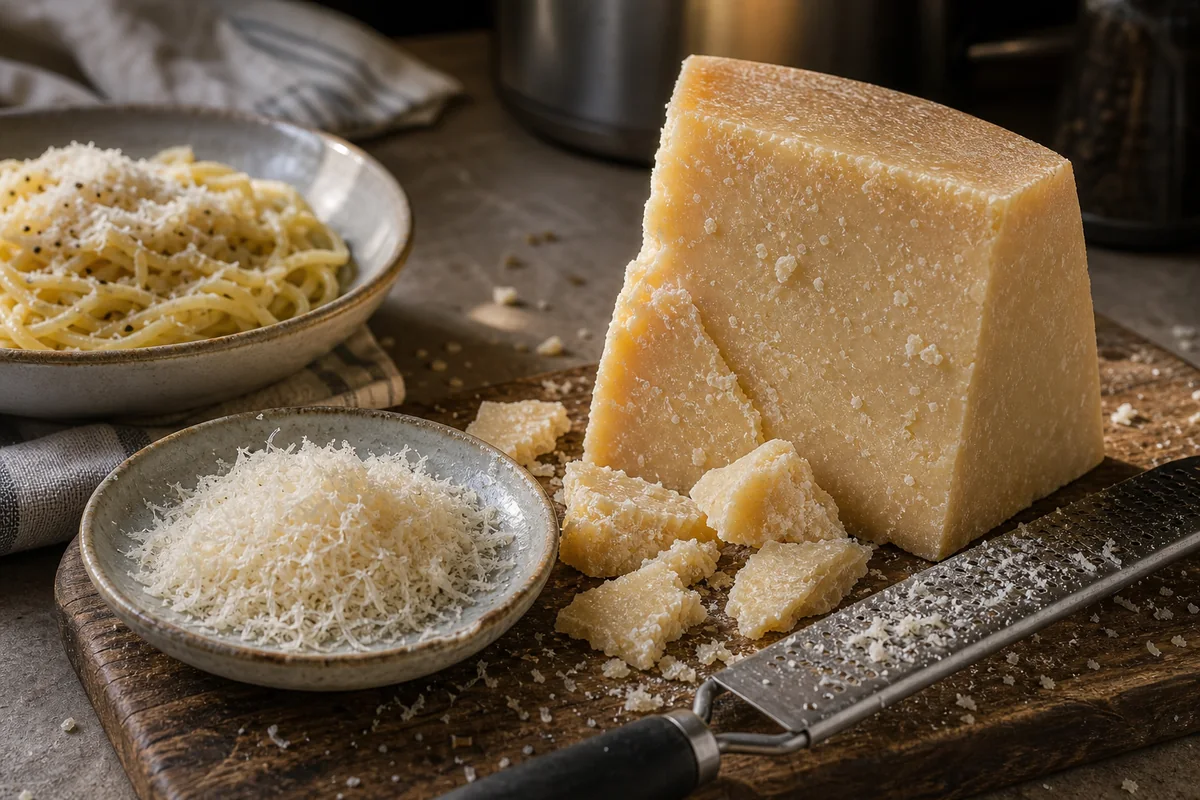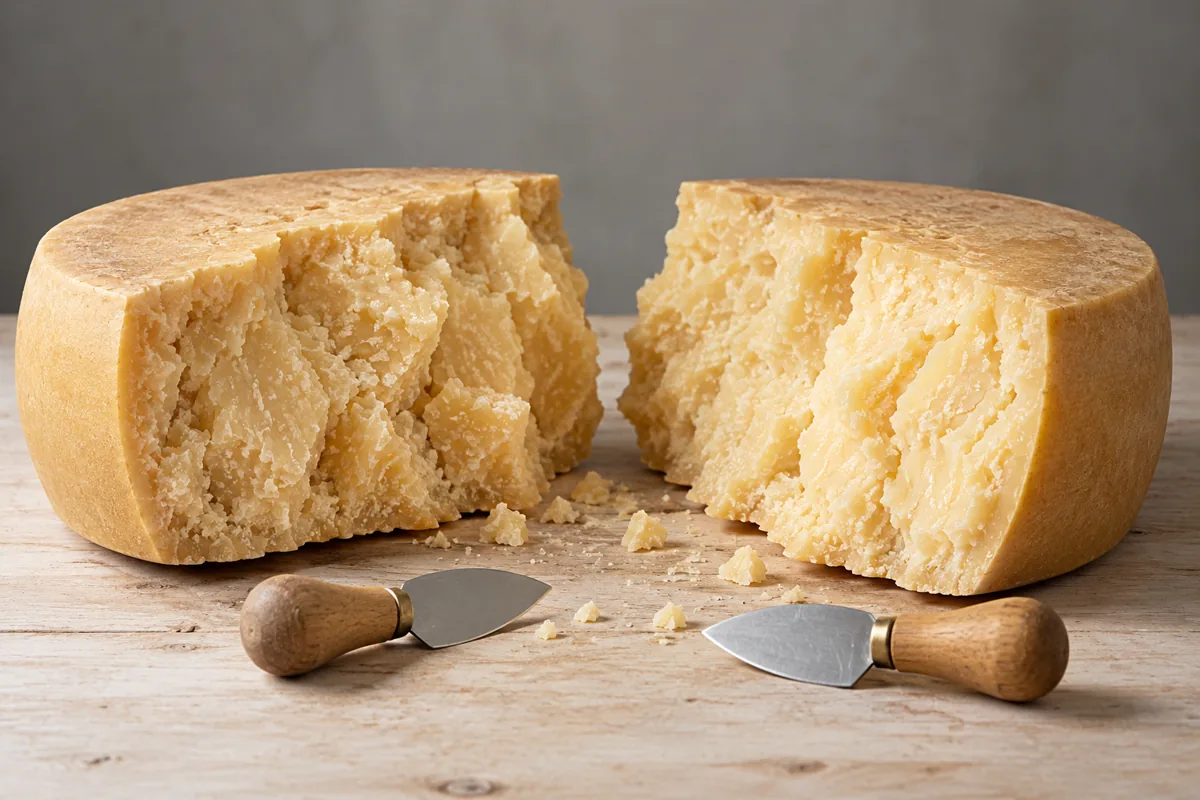
Parmigiano-Reggiano is a hard, cooked, slowly matured cheese made from raw, partially skimmed cow's milk in five provinces of northern Italy. The Consortium lists only three ingredients, milk, salt and rennet, with no additives or preservatives.
Every wheel matures for at least 12 months before it can carry the name, and the Consortium says most cheese on the market is 24 to 36 months old.
Outside the European Union, the word Parmesan can name a local imitation, so the full Italian name and the marks on the rind are what identify the protected cheese.
In This Article
What Is Parmigiano-Reggiano?
The product specification defines the cheese as hard, cooked and slowly matured, made from raw, partially skimmed milk from cows fed mainly on forage from the area of origin. The milk may not be heat-treated, centrifuged, bactofugated or microfiltered, and no additives are allowed.
The area covers the provinces of Parma, Reggio Emilia and Modena, the part of Bologna west of the River Reno, and the part of Mantua south of the River Po.
The Consortium's FAQ says every step takes place inside that area, from cow breeding to cheesemaking and packaging. Under the specification, grating, portioning and packaging of pieces and grated cheese must happen there too.
| Measure | Product specification | Wikipedia, typical wheel |
|---|---|---|
| Diameter | 35 to 43 cm | 40 to 45 cm |
| Height | 20 to 26 cm | 18 to 24 cm |
| Weight | 30 kg minimum | About 38 kg |
| Rind | Natural straw colour, about 6 mm thick | Not given |
The two sources overlap without matching. Wikipedia's 45 cm diameter and 18 cm height fall outside the specification's 43 cm and 20 cm limits, and Wikipedia tags that line as needing a citation, so the specification's ranges are the ones a wheel must meet.
A 38 kg wheel is well above the 30 kg minimum. Wikipedia puts the milk at 1,100 litres per vat making two cheeses, so about 550 litres go into each wheel, or roughly 14.5 litres for every kilogram of a 38 kg wheel by our arithmetic.
The specification describes the paste as light straw-coloured to straw-coloured, fine-grained and flaky, with an aroma and taste it calls fragrant, delicate and flavoursome without being strong.
A wheel has slightly convex or almost straight sides and a slightly raised edge on each flat face. The specification adds that the natural straw colour of the rind may evolve over time.
How Is It Different From Parmesan?
Inside the EU, Parmesan is a protected word: the Consortium says the Court of Justice of the European Union ruled on 26 February 2008 that the term evokes the PDO and may be used only for true Parmigiano-Reggiano.
Outside the EU, Wikipedia says the name is legally used for locally made Parmesan that imitates the original. Only the full Italian name refers unambiguously to the PDO cheese.
Wikipedia adds that these imitations, chiefly from the US and Argentina, often carry names meant to evoke the original, such as Parmigiana, Parmesana, Parmabon, Real Parma, Parmezan and Parmezano.
In the United States, federal rule 21 CFR 133.165 sets a standard for "Parmesan and reggiano cheese" that departs from the Italian specification on several points.
| Point | Parmigiano-Reggiano specification | US 21 CFR 133.165 |
|---|---|---|
| Milk | Raw cow's milk with no heat treatment | Cow's milk that may be pasteurized or clarified |
| Coagulant | Calf rennet only | Rennet or another safe milk-clotting enzyme |
| Minimum age | 12 months | 10 months |
| Additives | None | Artificial colouring allowed; rind may be coated or coloured |
| Fat | At least 32% fat in dry matter | At least 32% milkfat in the solids |
| Moisture | 25 to 35% for grated PDO cheese | No more than 32% |
Grated US Parmesan can also contain an anticaking agent, and Wikipedia cites a 4 percent cellulose limit under 21 CFR 133.146. The Italian specification allows grated Parmigiano-Reggiano only from whole PDO wheels, packed straight away with nothing added.
Wikipedia says some American generic Parmesan is sold already grated after less than 12 months of aging, and that Canadian regulations set moisture and fat levels but no minimum aging time.
What Do the Cows Eat, and Why Does It Matter?
Mostly hay and fresh forage grown in the production area. The specification requires hay to supply at least half of the forage dry matter in the daily feed, and at least 75 percent of all forage dry matter to be grown inside the area.
Other feeds are capped, because their dry matter may not exceed the dry matter from forage. The permitted fresh forage starts with natural meadows, stable mixed meadows and lucerne and clover meadows, alongside cut crops such as ryegrass, oat and barley.
Silage is banned outright, and farms may not even keep it, including grass silage in wrapped bales, trenches or stacks. The specification gives the reasons as keeping the cattle housing free of silage contamination and letting the cows' rumens adapt to a silage-free diet.
The forbidden list also covers fruit, vegetables, beet, brewery residues, all dairy-industry by-products and any food of animal origin. The rules separately bar any feed that could give the milk an unusual aroma or flavour or alter its cheesemaking properties.
The Consortium's account of why feed matters is that bacteria travel from the grass to the cow to the milk, which then passes its flavour on to the cheese.
How Is Parmigiano-Reggiano Made?
The make starts the evening before. The specification has the evening milk rest in open steel tanks so the cream rises naturally, and the dairy mixes it with the morning milk on delivery.
Each milking must reach the dairy raw within two hours of finishing, and any chilling before then may not take the milk below 18°C.
A natural whey starter from the previous day's cheesemaking goes into the milk, and calf rennet is the only coagulant allowed. Coagulation happens in bell-shaped copper vats, each making up to two wheels.
The specification defines that starter as sweet whey left over from the previous cheesemaking and allowed to ferment spontaneously at a controlled temperature, and it bars added cultures meant to adjust or strengthen it.
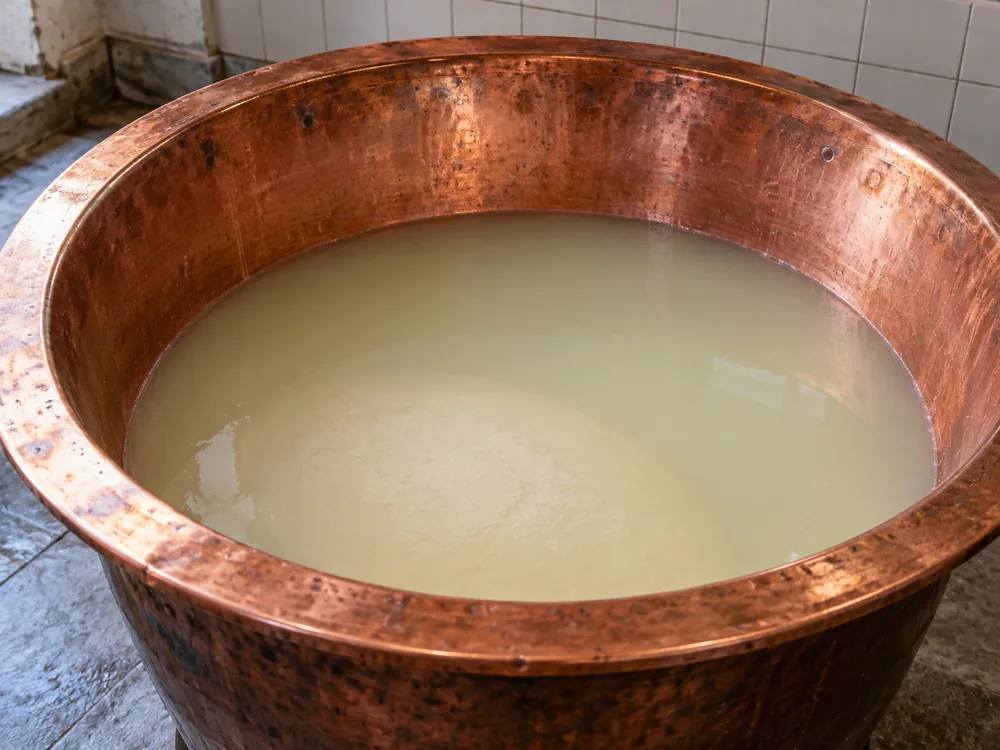
Wikipedia says the vats are copper-lined, which heats the milk evenly and adds copper ions, and that the milk is warmed to 33 to 35°C before the calf rennet goes in and sets it in 10 to 12 minutes.
Wikipedia says the cheesemaker breaks the curd into pieces about the size of rice grains and raises the heat to 55°C. The specification says the granules then settle on the bottom of the vat into one solid mass, which Wikipedia says takes 45 to 60 minutes.
The mass is wrapped in cloth, cut in two and set in moulds, which gives twin wheels. Wikipedia describes a steel form held tight by a spring buckle.
After a day or two, Wikipedia says, a plastic belt imprinted with the name, plant number and month and year of production goes around each wheel, and the imprints take hold on the rind in about a day.
After a few days the specification has the wheels immersed in brine. Wikipedia gives 20 to 25 days there in one passage and 20 days in another, in a bath saturated almost to its limit with Mediterranean sea salt.
Maturation then lasts at least 12 months from moulding, and in summer the maturation room may not fall below 16°C. The specification allows the wheels to sit on wooden-shelved racks.
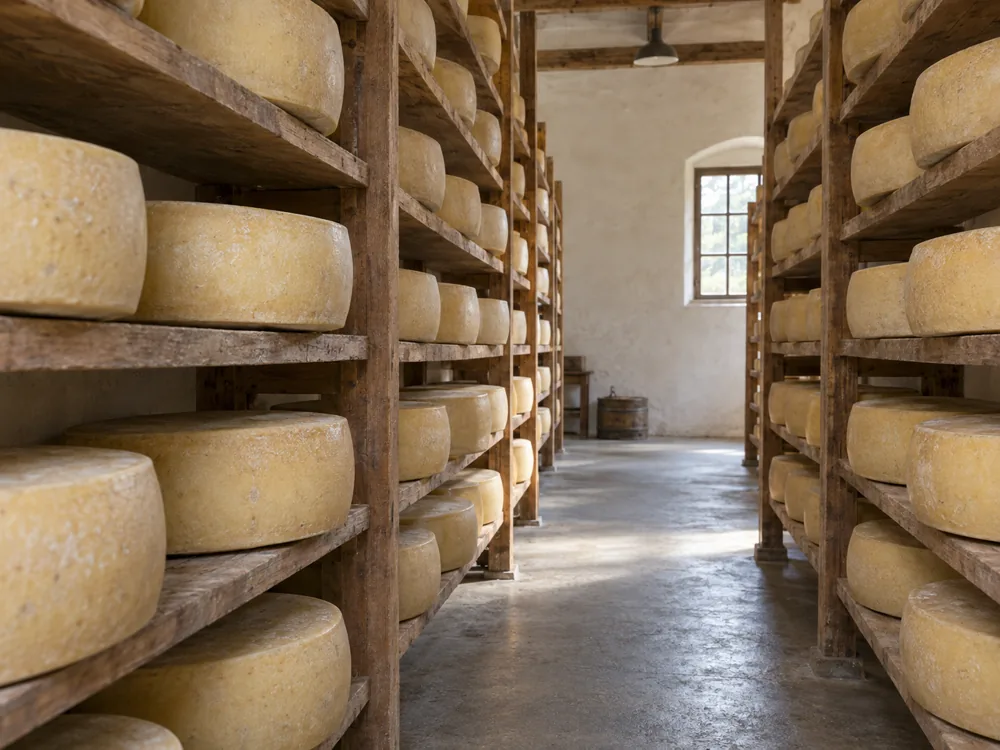
Wikipedia describes shelves 24 wheels high and 90 long, holding 2,160 wheels to an aisle, with each wheel and its shelf cleaned and the wheel turned every seven days.
How Do You Read the Rind Marks?
A genuine wheel carries origin marks put on at the dairy and a selection mark added after inspection.
| Mark | Where and when | What it tells you |
|---|---|---|
| Pin-dot lettering | Around the side, from a stencilling band | The name, the dairy number, the month and year of production, DOP and Consorzio Tutela |
| Casein plate | On the wheel, applied at the dairy | CFPR, a unique letter-and-number code for that wheel and a Datamatrix code |
| Oval fire-brand | After inspection | The wheel passed; the oval reads Consorzio Tutela Parmigiano-Reggiano with the production year |
| Parallel grooves | All along the side that carries the pin dots | Second category, sold as mezzano, or medium grade |
| Rind scraped bare | After inspection | Downgraded cheese that may not refer to the PDO |
| Export or Premium | On the wheel, added by the Consortium on request | First-grade cheese chosen again at the holder's request |
A wedge without pin dots is not necessarily fake. The Consortium explains that the stencilling band has a set length, so part of a large wheel's side can stay blank, and pieces cut from the flat faces show no lettering.
A holder can request an Export mark from the 18th month and Premium from the 24th, both only on first-grade cheese. A Premium wheel must also earn a sensory rating above the Parmigiano-Reggiano average for its batch, so the mark points to cheese that is at least 24 months old and scored better than the typical wheel.
What Does the Quality Inspection Check?
Every wheel goes before a Consortium inspection panel. The panel taps it with a percussion hammer to hear defects inside, probes it with a screw-needle, judges the outside and the smell of the paste, and cuts open at least one wheel per production batch.
The specification divides each dairy's output into three batches and schedules inspection by batch. Cheese made from January to April is inspected from 1 December of that year, May to August cheese from 1 April of the next year, and September to December cheese from 1 September of the next year.
The Consortium's FAQ describes the brand as going on 12-month-old wheels, while the schedule opens inspection earlier for some batches. Either way, the specification lets cheese reach the market under the name only once the wheel carries the oval and has reached 12 months.
What separates the categories is mostly structure, and for holes and sponge areas the specification adds the condition that the needle finds no off smell.
| Category | Flaws the specification tolerates | Marks on the wheel |
|---|---|---|
| First category, first-grade | None: no external or internal defect by eye, hammer or needle | Origin marks and the oval brand |
| First category, "zero" and "one" | Zero: surface splits on the rind, small erosions, slightly worn edges or limited mending. One: one or two holes up to 3 to 4 cm across, a small sponge area, a few oblong holes or thin slits, or a hollow-sounding wheel | Origin marks and the oval brand |
| Second category, medium-grade (mezzano) | Holes wider than 3 to 4 cm, sponge areas, small holes spread through the wheel, horizontal slits and splits, or visible corrections | Oval brand plus parallel grooves around the side, per the Consortium |
| Third category, downgraded or reject | Swollen faces, spongy paste with large holes, a large central cavity, folded or widespread slits, deep mending or an evident off smell | Origin marks removed from the side |
The Consortium's tasting method accepts a few holes under 2 mm across in the paste, far smaller than the 3 to 4 cm cavities the specification tolerates in a "one" wheel.
Minor or moderate defects that leave the flavour intact put a wheel in the second category. Wheels with major defects lose their marks when a few millimetres of rind are scraped off, and the Consortium's FAQ says that cheese goes into grated mixtures or is used for melting.
How Does It Change With Age?
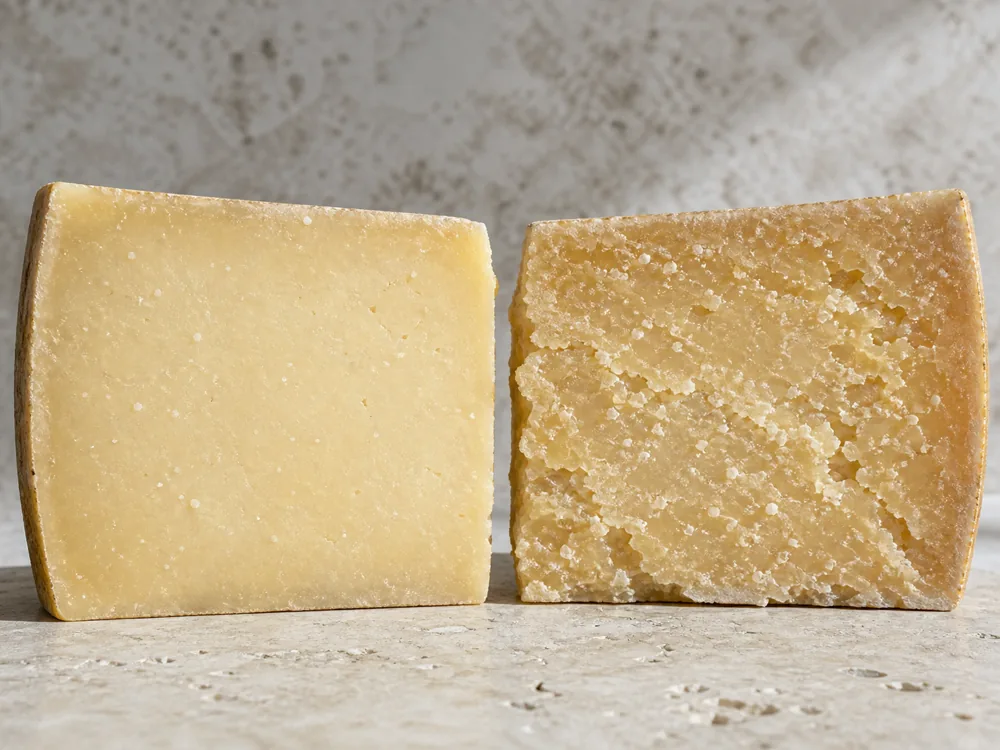
The Consortium says the cheese reaches its full character at about 24 months, though it can mature to 36 or 48 months and beyond. Its FAQ adds that there is no maximum age and that pieces over 100 months old are sold.
The change comes from proteolysis: enzymes released by lactic bacteria break the proteins into smaller pieces, free peptides and amino acids, and the Consortium says this breakdown sets the cheese's structure, its sensory properties and its digestibility. The specification sets a floor for it, requiring free amino acids above 15 percent of total protein.
Texture tracks age closely. The Consortium's tasting guide says graininess, crumbliness and solubility all increase with ageing, and the colour deepens from light straw toward intense straw yellow.
The Consortium adds that consistency alone lets a taster tell almost at once whether a piece is 12, 24 or 36 months old, and that a sliver of very mature cheese already tends to break into very small slivers under the knife.
The white dots in older cheese are tyrosine crystals: tyrosine is one of the amino acids freed in that breakdown, and it crystallises when it is free and concentrated enough. The Consortium says the crystals grow in number and size with longer maturation, which makes them good evidence of maturation.
Taste shifts too: sweetness is stronger in younger cheese, saltiness rises with age, bitterness stays a weak and often herbaceous note, and a spicy sensation should increase without becoming excessive.
Wikipedia says the cheese can hold as much as 1.2 g of glutamate per 100 g, which it links to the strong umami taste.
Labels can carry an age word as well as months. The specification allows delicato for 12 to 19 months, armonico for about 20 to 26, aromatico for about 27 to 34 and intenso for about 35 to 45 months.
Wikipedia lists two older trade terms, vecchio for 18 to 24 months and stravecchio for 24 to 36 months, and neither is among the four label adjectives in the specification, so the months on the label are the comparable figure.
How Should You Cut and Taste It?
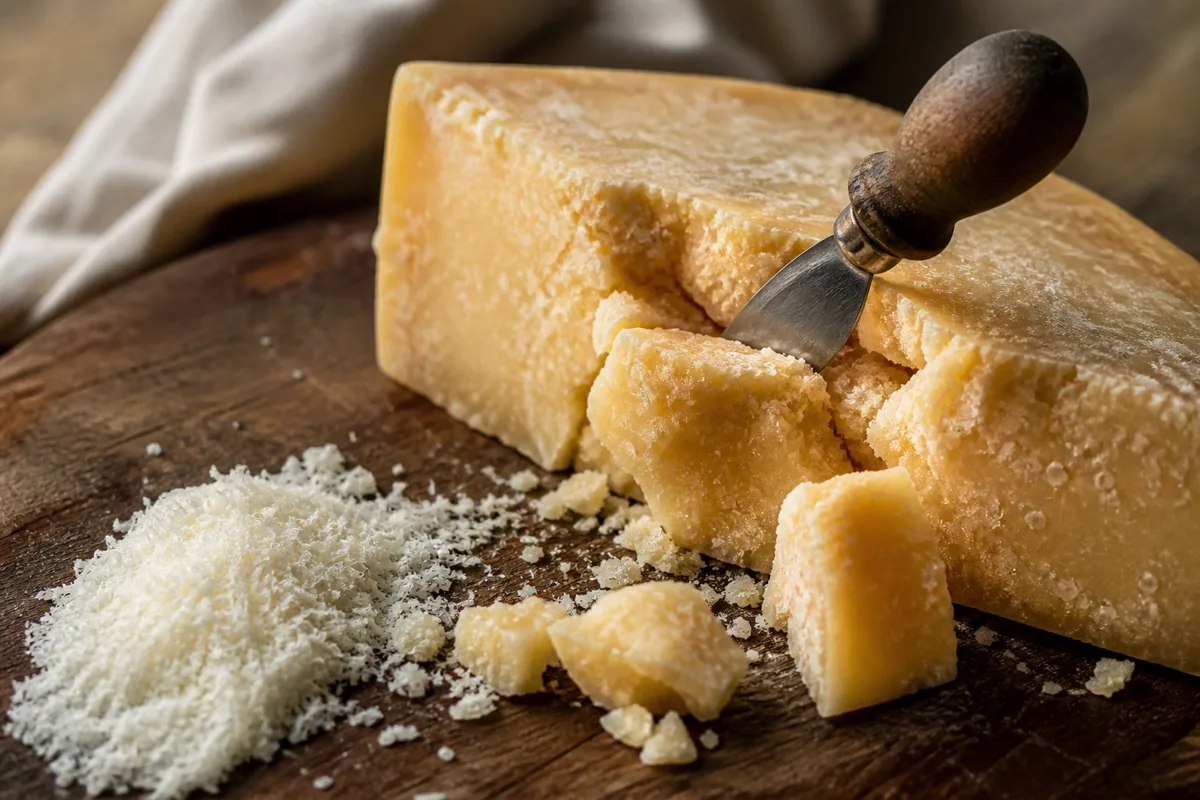
Parmigiano-Reggiano is not sliced. The Consortium says to press the tip of the short almond-shaped knife into the paste and use it as a lever to break off small pieces.
Whole wheels open the same way: a line is scored across both faces, then two almond knives go in at the ends of the diameter and, working as wedges, split the wheel in half.
For tasting, the Consortium recommends 16 to 17°C. It says to take the cheese out of the fridge at least an hour ahead and to open a vacuum pack at least 30 minutes before.
Its tasters smell the cheese right after breaking it, then let the piece touch every part of the mouth while breathing out through the nose.
The Consortium sorts smells into lactic, plant-based, floral, fruity, toasted, animal and spiced families, and says the overall intensity of smell and aroma increases with ageing.
How Do You Use It and What Goes With It?
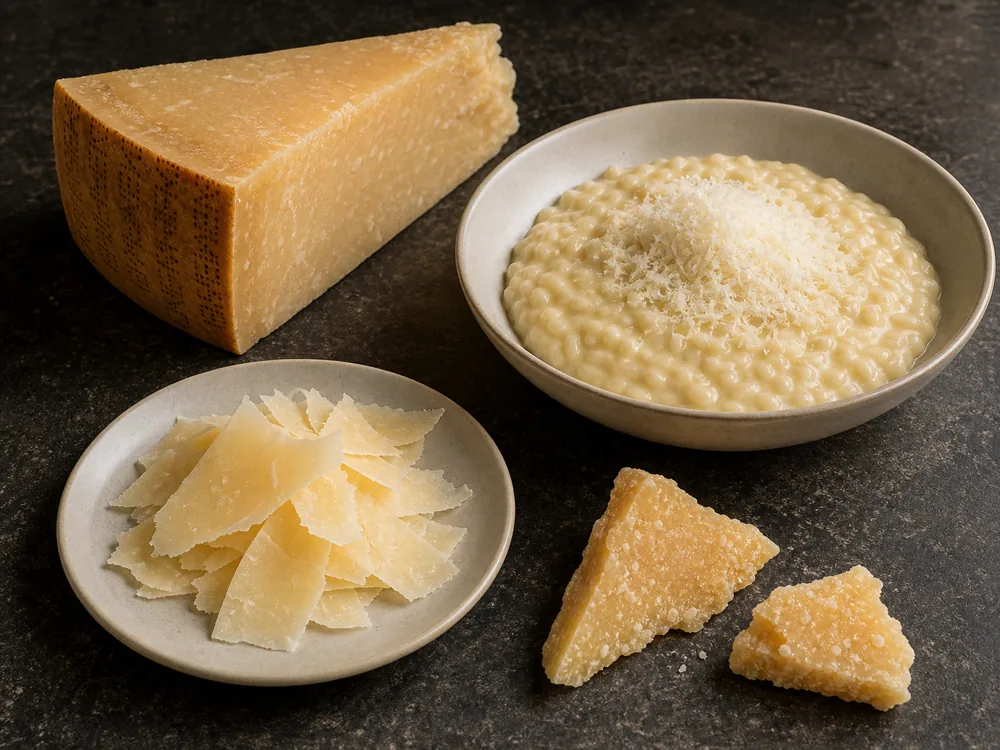
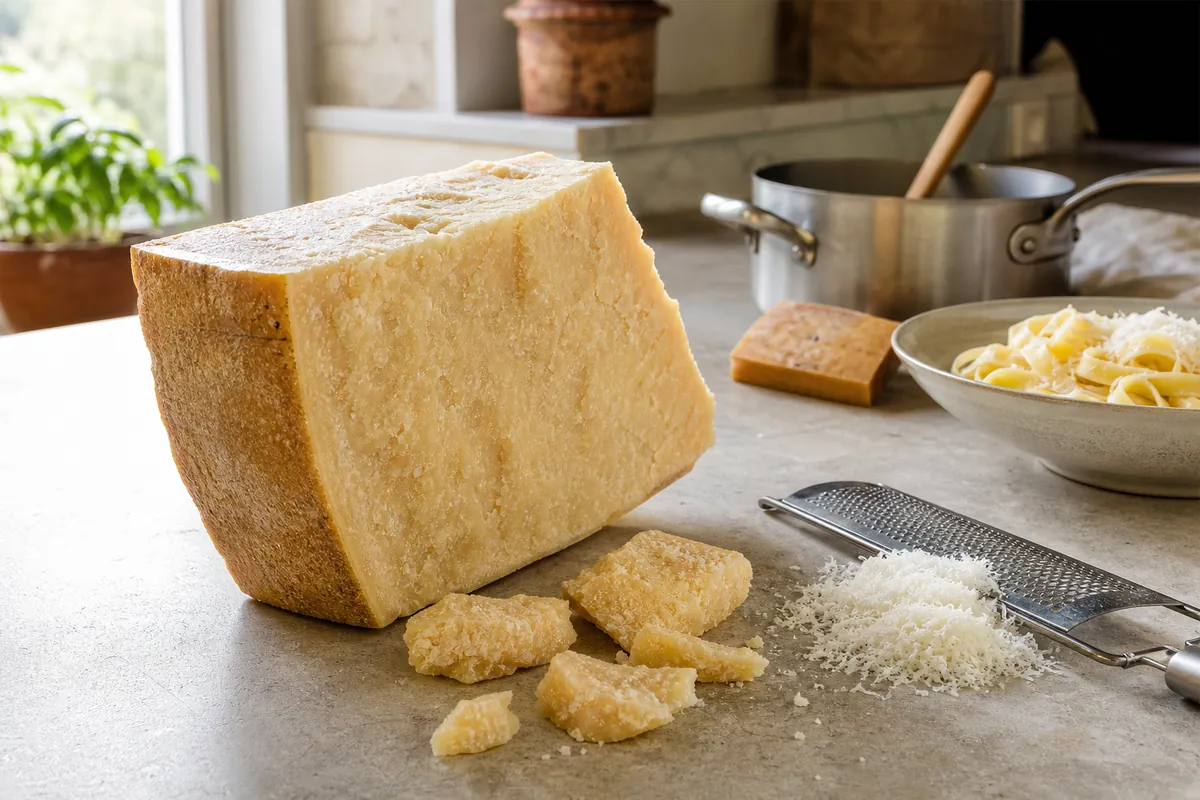
Wikipedia lists the common uses: grated over pasta dishes, stirred into soups and risottos, shaved over salads and eaten on its own.
The Consortium matches each age to a job. It suggests 12 to 18 months for aperitifs, salads and cold dishes, 22 to 24 months for the dishes of the Italian tradition, and 30 to 36 months for filled and baked pastas or the end of a meal.
| Pairing | Type | Why It Works |
|---|---|---|
| Sparkling white wine | Wine | The Consortium's match for 12 to 18 month cheese served as an aperitif. |
| Medium-bodied wine | Wine | Suggested by the Consortium for 22 to 24 month cheese. |
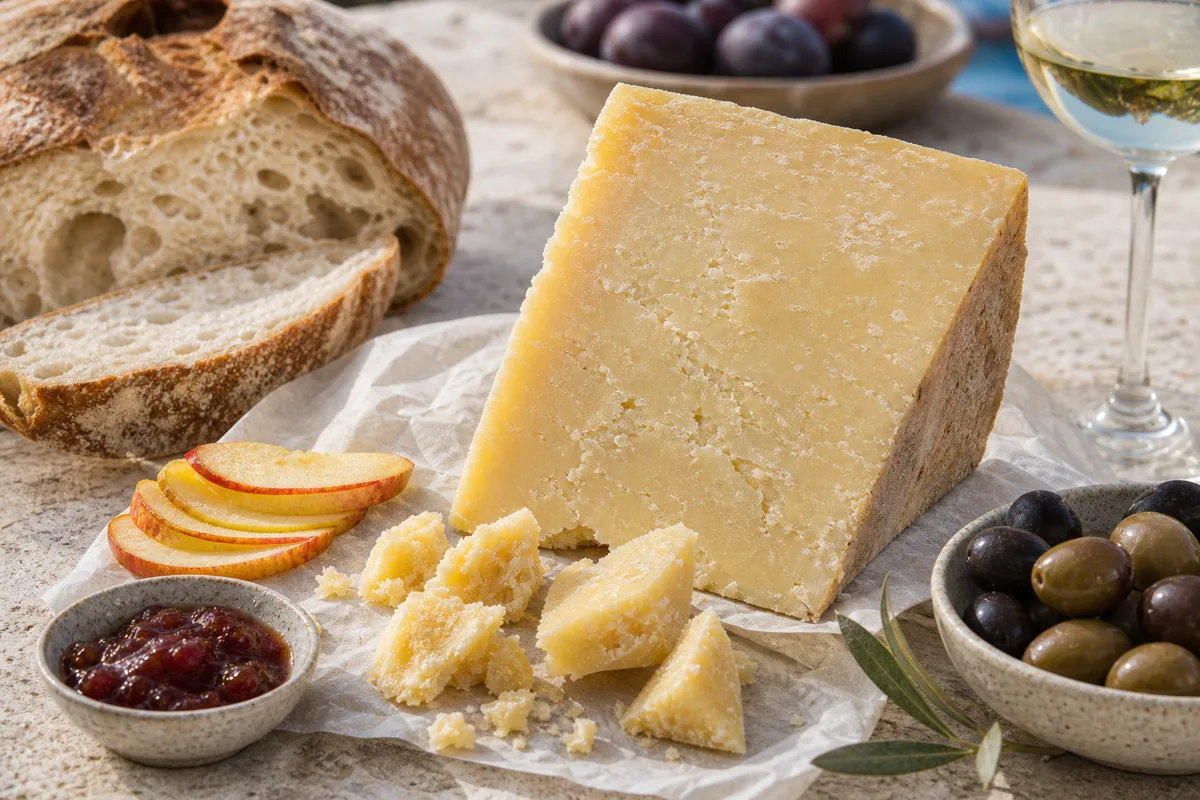
| Fruit | Food | Named by the Consortium for 30 to 36 month cheese at the end of a meal. |
| Honey | Food | Served with fruit alongside 30 to 36 month cheese, per the Consortium. |
| Structured and meditation wines | Wine | The Consortium's pairing for cheese aged 40 months or more. |
The Consortium names wine styles rather than grapes or regions, so the bottle within each style is your choice.
Can You Eat the Rind?
Yes. The Consortium says the rind is edible because the cheese contains only milk, salt and rennet and the rind gets no preserving treatment; it forms as the outer layer dries naturally.
Clean it carefully before use, since the Consortium notes it can carry impurities from the maturation room.
Wikipedia describes rind pieces simmered in soups, broths and sauces for flavour, grilled as a snack when there is no wax on them, infused in olive oil or used in a steamer basket while steaming vegetables.
How Should You Store It?
Keep Parmigiano-Reggiano in the refrigerator; the CDC says a refrigerator should be at 40°F (4°C) or below.
| Format | Storage time |
|---|---|
| Sealed vacuum pack | Several months, generally 6, with the best-before date set by the packer |
| Opened or freshly cut, 12 to 18 months old | About 15 days |
| Opened or freshly cut, 24 months or older | About 1 month |
The Consortium ties the shorter time for 12 to 18 month cheese to its higher moisture content.
Once the pack is open, keep air away from the cheese in a glass or plastic container or in food-grade plastic film. The Consortium says air dries and hardens the outside and can lead to mould, especially on younger cheese.
Store it away from other foods as well, because the Consortium says the fat in the cheese absorbs smells from the refrigerator.
The Consortium advises never to freeze the cheese. Its FAQ says freezing, especially in pieces, changes the structure of the paste so it loses its crumbliness.
What Should You Check When Buying?
A rind-on piece is the easiest to verify, because it can show the pin dots, the fire-brand or the grooves of the second category.
Pre-packed pieces carry their own proof. The specification requires the wedge-and-wheel logo on every pack, and pieces over 15 g must state the minimum age.
The dairy's number or name must appear on the label only for grated cheese or portions that come from Premium wheels. The specification separately lets a retail outlet grate, portion and pre-package cheese for direct sale to the final consumer.
Grated cheese has further limits under the specification: no more than 18 percent rind by weight, and a non-powdery, homogeneous texture in which at most 35 percent of the particles are finer than 0.5 mm.
Offcuts with more than 18 percent rind may not carry the name at all, except as trimmings used by firms inside the control system.
How Does It Compare With Grana Padano and Other Substitutes?
Grana Padano is the nearest PDO relative, and the Parmigiano-Reggiano Consortium publishes a point-by-point list of where the two PDO rulebooks differ.
| Point | Parmigiano-Reggiano | Grana Padano |
|---|---|---|
| Production area | 5 provinces | 33 provinces in 5 regions |
| Additives | None allowed | Lysozyme from hen's egg white allowed |
| Feed | Hay and grass, no silage | Silage allowed |
| Age | 12 months minimum, 24 on average | Marked at 9 months, eaten at 15 on average |
| Starter | Natural fermented whey only | Lab-isolated bacteria allowed up to 12 times a year |
| Inspection | Every wheel at 12 months | Some wheels at 9 months |
The list comes from the Parmigiano-Reggiano side, so the Grana Padano consortium may describe the same points in its own terms.
Wikipedia describes Reggianito as an Argentine cheese developed by Italian-Argentine cheesemakers, made in smaller wheels and aged for less time but otherwise broadly similar.
Wikipedia describes cheese made outside the EU as a family of hard grating cheeses from cow's milk, generally pale yellow and mostly grated over dishes such as American pizza and Caesar salad.
Is It Lactose Free, and Is It Safe in Pregnancy?
The Consortium's FAQ calls the cheese naturally lactose free, because lactic bacteria turn all the lactose into lactic acid in the first 48 hours after making, and says this holds whatever the maturation time.
The cheese is still high in milk protein, so the lactose result says nothing about a milk allergy.
The NHS lists pasteurised or unpasteurised hard cheeses, parmesan among them, as safe to eat in pregnancy. The CDC's safer list names hard cheese only when it is made with pasteurized milk, such as Parmesan.
Its riskier list covers unpasteurized (raw) milk and dairy products made from raw milk, so raw-milk Parmigiano-Reggiano falls on the riskier side of the CDC's list. The CDC also says pregnant women are 10 times more likely to get a Listeria infection.
SOURCES & REFERENCES
What Do Buyers Most Often Ask About Parmigiano-Reggiano?
Inside the EU, yes: a 2008 court ruling reserves the word Parmesan for the PDO cheese. Outside the EU the name can be used for local cheeses made under other rules, such as the US standard with its 10-month minimum age.
At least 12 months. The Consortium says it reaches full character at about 24 months and that most cheese sold is 24 to 36 months old.
Yes. The Consortium says the rind is natural and gets no preserving treatment, and it advises cleaning the rind carefully before use.
The Consortium says it is naturally lactose free whatever its age, because lactic bacteria turn all the lactose into lactic acid in the first 48 hours after making.
The Consortium advises against it, because freezing changes the structure of the paste and it loses its crumbliness.