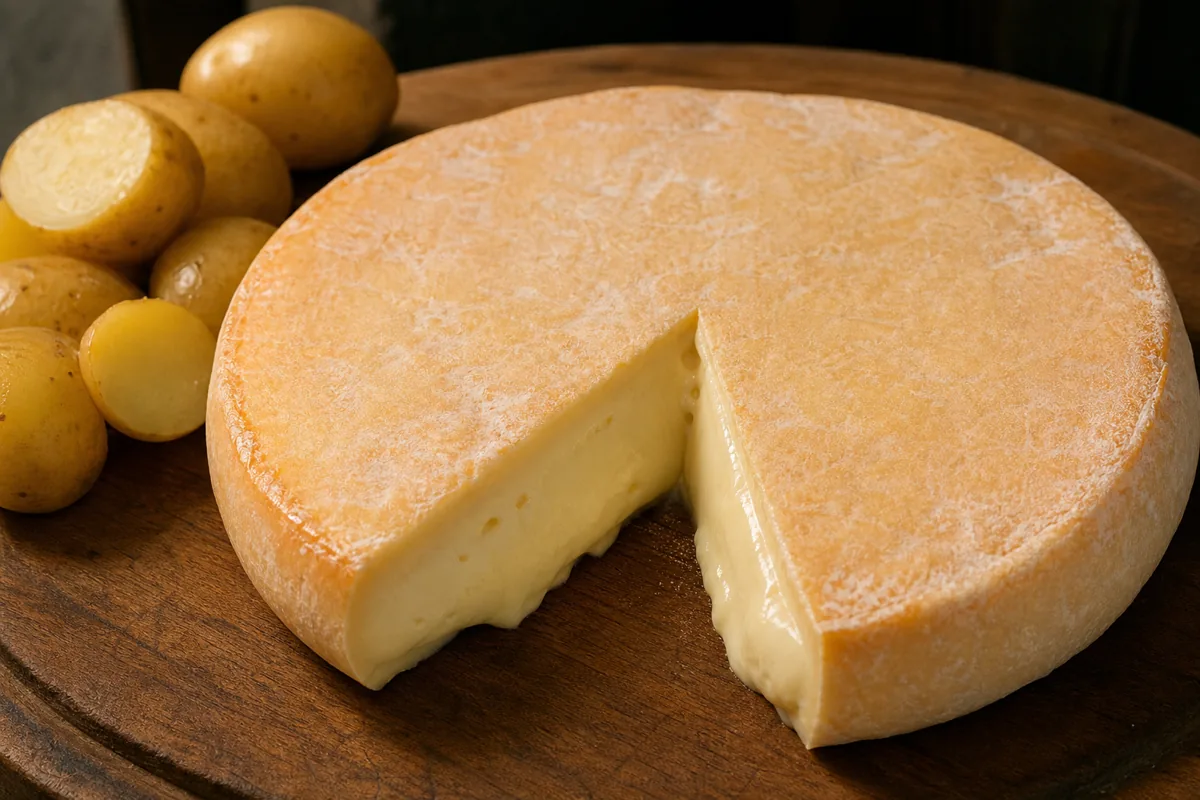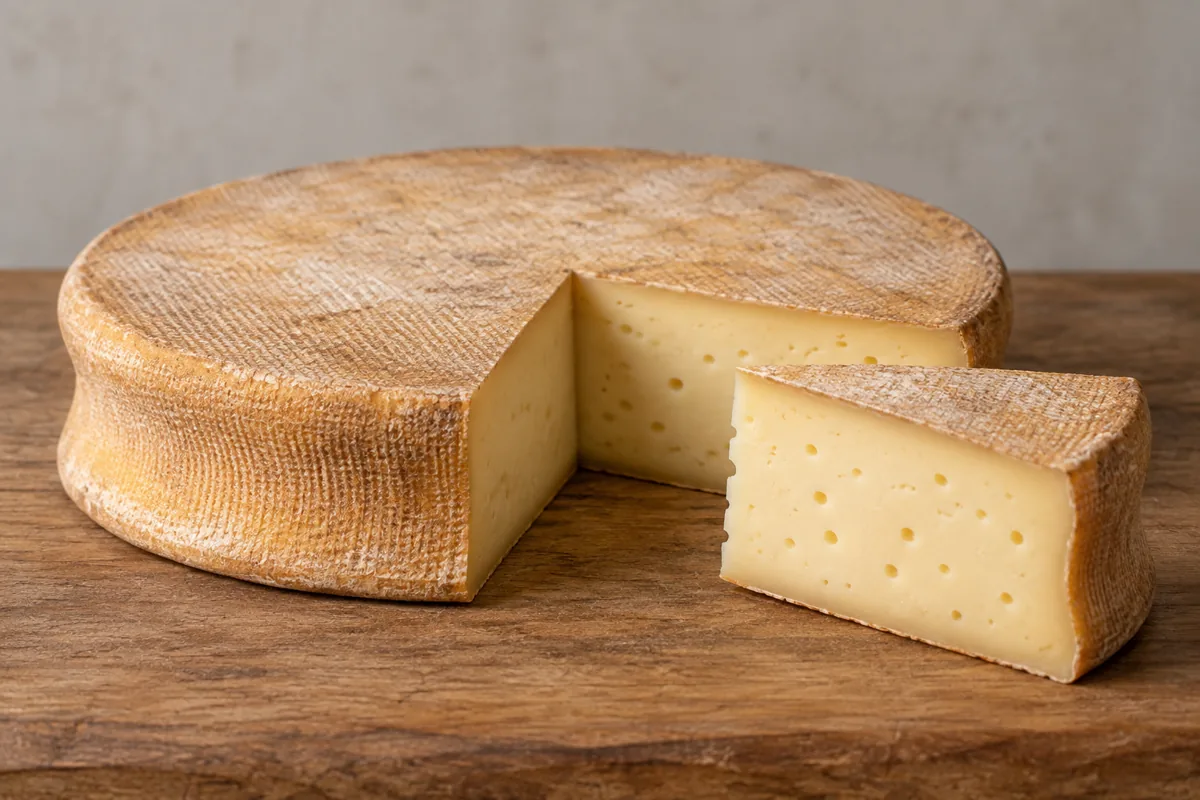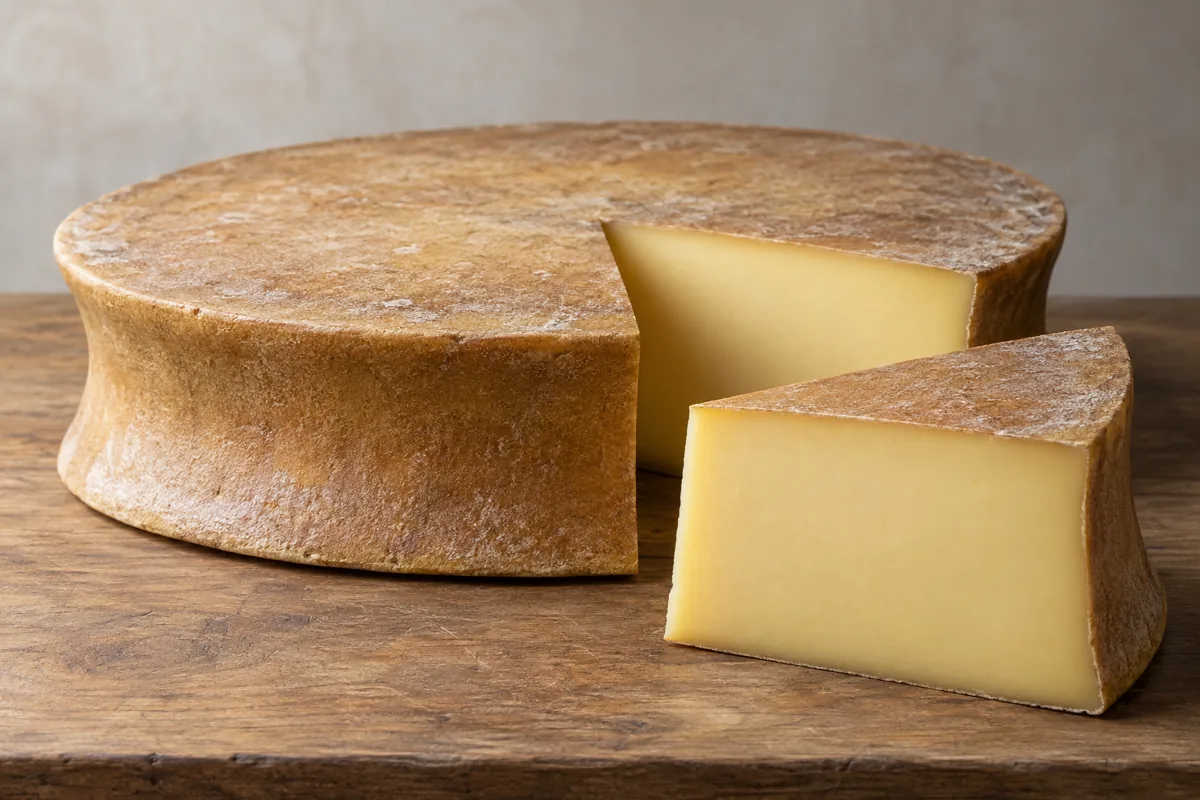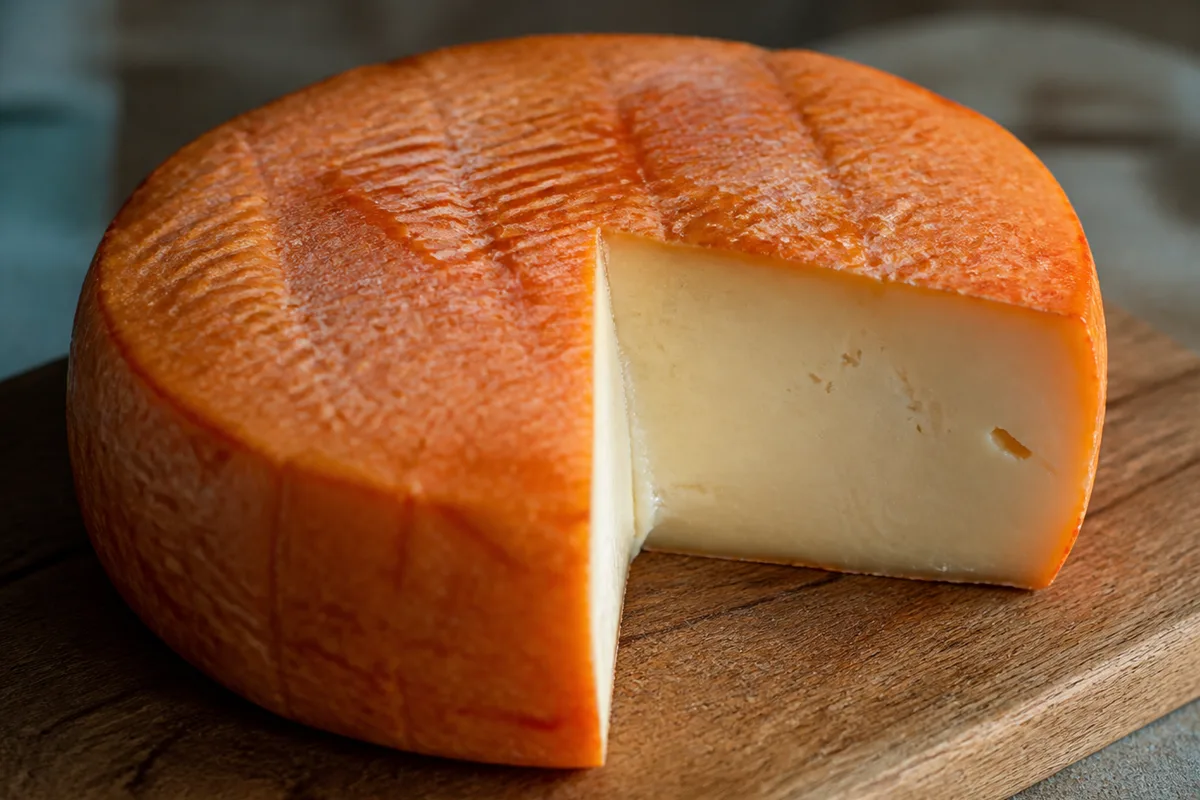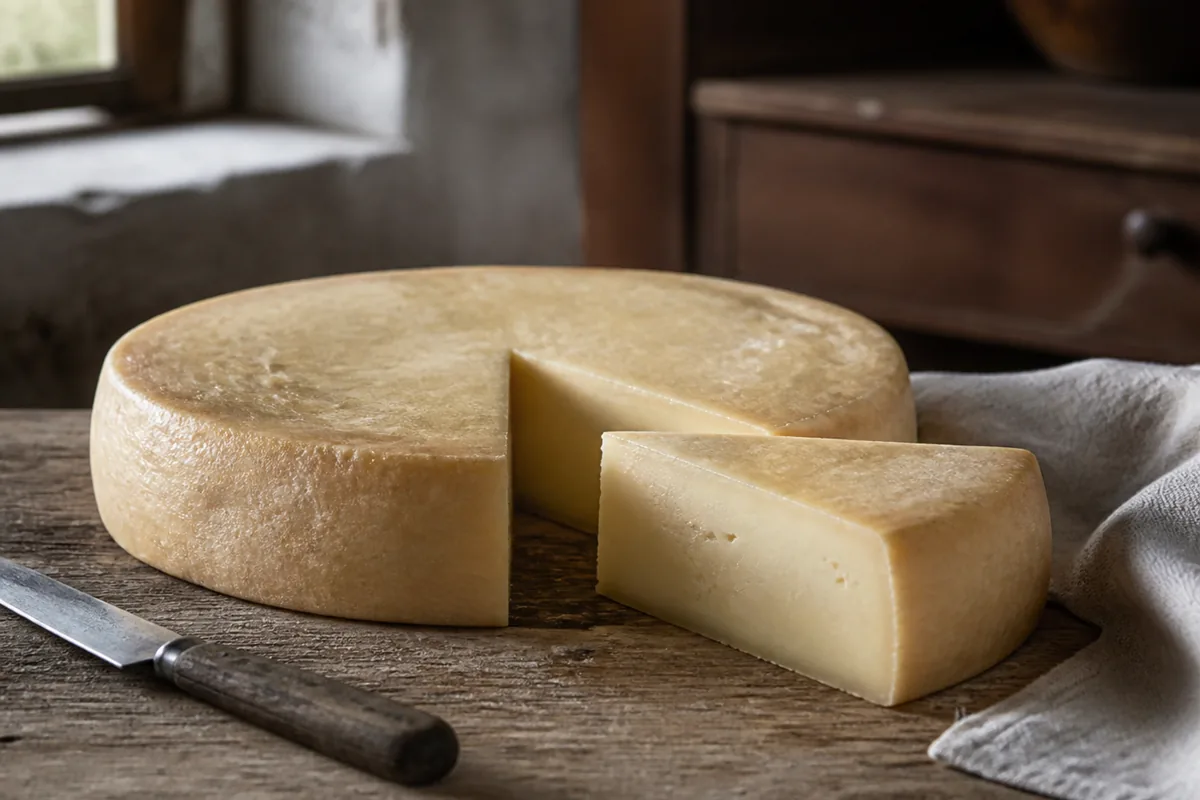
Beaumont is a mild cow's milk French cheese from Haute-Savoie, created in 1881 by Jérémie Girod at Saint-Julien-en-Genevois. The version described by Androuet and Wikipedia is a flat, pasteurised disc of about 1.5kg.
If you see Beaumont de Savoie on a label, it may be a second cheese, a raw-milk wheel of 50kg sold under that name.
In This Article
What Is Beaumont Cheese?
Androuet, the French cheese retailer, describes Beaumont as a pasteurised cow's milk cheese with a pressed, uncooked paste and a pale yellow washed rind. It is a flattened disc 20cm across and 4 to 5cm thick that weighs 1.5kg.
Wikipedia's French entry, which cites Marie-Thérèse Hermann's Dictionnaire de la cuisine de Savoie for the format, gives 4cm for the thickness. It places production in the Faucigny and Genevois areas of Haute-Savoie and lists tomme de Beaumont as a second name.
Time in the cellar is short. Androuet gives six weeks in humid, cool cellars, and Wikipedia gives one and a half to two months.
After ageing, the regional dairy body CRIEL says, the rind is slightly yellowed and the paste is tender, creamy and a brighter yellow than the rind.
Why Are There Two Cheeses Called Beaumont?
Pochat & Fils sells a second cheese as Beaumont de Savoie: a wheel of raw whole cow's milk that its product page calls a pressed, cooked paste, although the glossary on the same page lists Beaumont de Savoie among uncooked pressed cheeses. It matures for at least five months in the company's caves at Minzier, and a Vieille Réserve version has a stated minimum of six to eight months.
Wikipedia's entry makes the same split, noting that raw-milk, cooked-paste cheeses aged six months are also found under the Beaumont de Savoie name.
| Point | Beaumont disc | Beaumont de Savoie wheel |
|---|---|---|
| Curd | Pressed, uncooked | Cooked on Pochat's product page, uncooked in its glossary |
| Weight | About 1.5kg | 50kg |
| Size | 20cm across, 4 to 5cm thick | 55 to 65cm across, 16 to 19cm high |
| Rind | Washed, pale yellow | Natural, described as morgée |
| Described taste | Mild and creamy | Tender texture, fruity taste, rich aromas |
| Maker named | Not named; ask the seller | Pochat & Fils, at Eteaux |
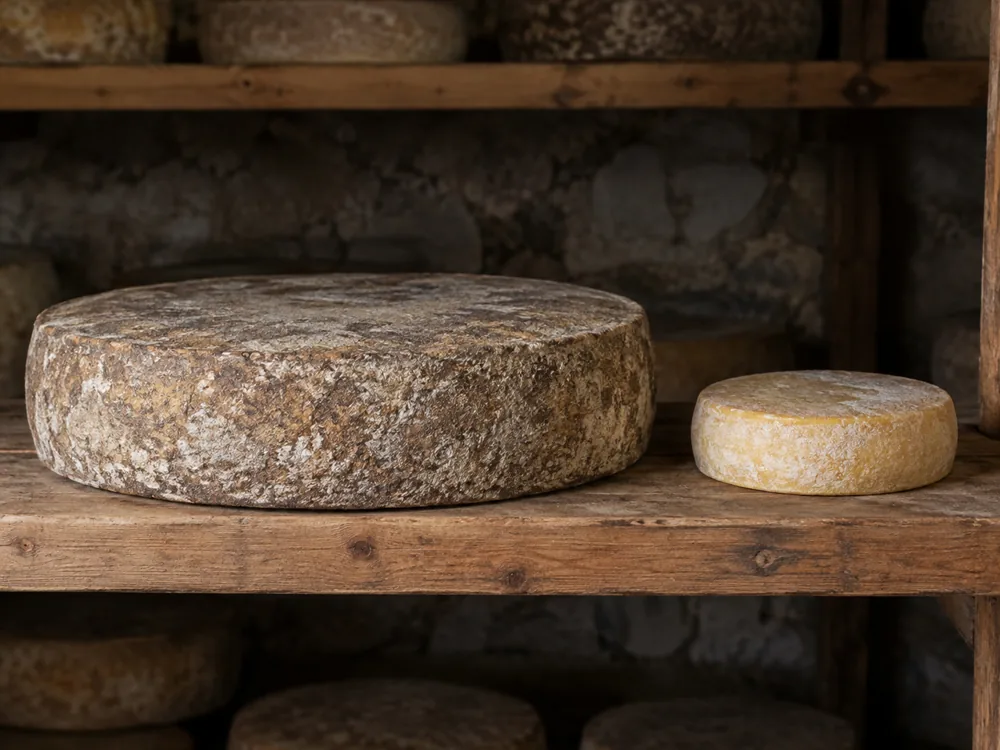
Even the name Beaumont de Savoie does not tell you which cheese you have: CRIEL uses it for the 1.5kg disc, while Wikipedia and Pochat use it for the raw-milk wheel. The sources also disagree on the milk and the age, so a label that says only Beaumont settles little.
| Source | Milk | Ageing | Format described |
|---|---|---|---|
| Androuet | Pasteurised cow's milk | Six weeks | 1.5kg disc |
| Wikipedia (French) | Pasteurised; raw-milk versions listed under Beaumont de Savoie | 1.5 to 2 months; six months for the raw version | 1.5kg disc |
| CRIEL | Raw or pasteurised whole cow's milk | 1.5 to 2 months, up to 9 in a humid cellar | 1.5kg disc |
| Pochat & Fils | Raw whole cow's milk | At least 5 months; Vieille Réserve 6 to 8 | 50kg wheel |
| Cheese.com | Unpasteurised cow's milk | Six months | Flattened disc, 50% fat |
| French Click (UK retailer) | Pasteurised, in the description text | 1.5 to 2 months | 200g Pochat & Fils Beaumont Grand Affinage |
French Click, the UK retailer in the last row, shows what that looks like on a shop listing. Its description text matches the disc, yet it sits on a Pochat & Fils product, and Pochat's own page describes raw milk and at least five months for its wheel.
Androuet and Wikipedia describe the disc as pasteurised, while CRIEL says raw or pasteurised and Cheese.com says unpasteurised. Check the milk statement and the weight on the pack rather than the name alone.
What Does Beaumont Taste Like?
Androuet's tasting notes for the disc are short: a mild, creamy flavour, no special smell, and a thin, supple rind to the touch.
CRIEL disagrees on the smell. It describes fruity and floral aromas, says the cheese shows more character when you eat it from July to November, and adds that longer-aged cheeses give stronger aromatic notes when they leave the cellar.
Cheese.com's notes fit the older, raw-milk description better than the six-week disc. It lists mild, nutty, barnyardy, earthy and rich aromas for an unpasteurised cheese aged six months.
For the 50kg wheel, Pochat & Fils gives a tender texture, a fruity taste and rich aromas, and Le Guide du Fromage repeats that description.
How Does Beaumont Compare to Other Savoie Cheeses?
Le Guide du Fromage calls Beaumont de Savoie less well known than Savoie cheeses such as Reblochon or Abondance.
Pochat & Fils marks one difference on its own product pages: Reblochon de Savoie and Beaufort carry AOP in the name, while Beaumont de Savoie carries no protected label. The appellation field in Wikipedia's Beaumont entry is empty as well.
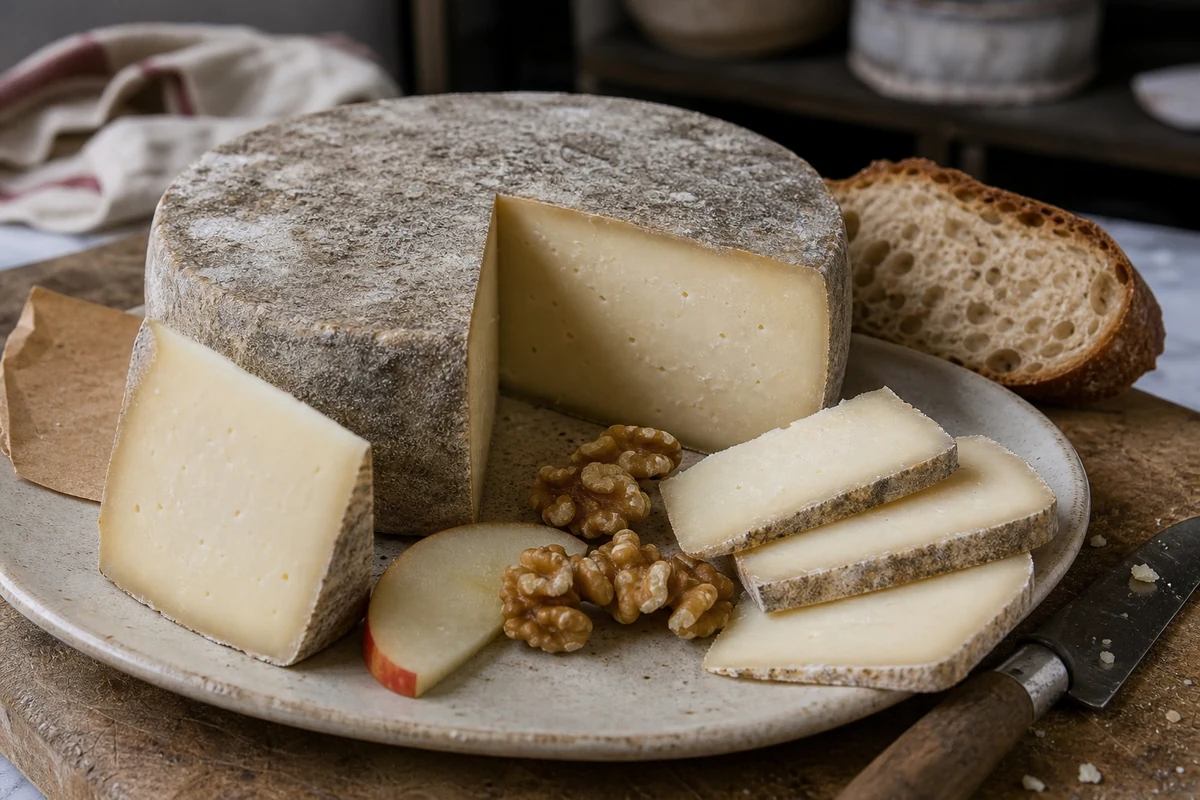
The alternate name tomme de Beaumont invites a comparison with Tomme de Savoie. Culture describes Tomme de Savoie with a suede-like grey to brown natural rind dotted with yellow, red and white mould and an ivory paste with numerous holes, where Androuet gives the Beaumont disc a regular, pale yellow washed rind.
Who Makes Beaumont de Savoie?
Pochat & Fils runs six dairies across Haute-Savoie, and its own site says it makes Beaumont de Savoie at Eteaux, its largest site, and matures the wheels in its caves at Minzier.
Its other dairies include Féternes, where it makes Abondance AOP, and Frangy, which makes Raclette de Savoie IGP and Tomme de Savoie IGP.
If it is the wheel you want, Pochat's product page lists it as sold in supermarkets, packaged or by the slice. For a disc, ask the seller who made it: CRIEL says only that Jérémie Girod was the founder of the Girod cheese dairies.
What Should You Serve and Drink with Beaumont?
Where the disc goes in your meal depends on whose advice you follow. Androuet serves it at the end of a meal, while CRIEL suggests putting it early on a cheese board, because tasting it after a stronger cheese loses some of its aroma.
Away from the board, CRIEL says its creamy flavour and texture suit a summer composed salad.
| Pairing | Type | Why It Works |
|---|---|---|
| Crépy | Wine | Androuet names this Savoie white for the disc, and CRIEL lists it among dry Savoie whites to drink in moderation. |
| Roussette | Wine | Named by both Androuet and CRIEL as the other regional white for the disc. |
| Summer composed salad | Food | CRIEL says the creamy flavour and texture complete a fresh composed salad. |
| Croûte au fromage | Food | A Savoie dish of bread and baked cheese that Androuet names as a use for Beaumont. |
Can You Bake Beaumont in Croûte au Fromage?
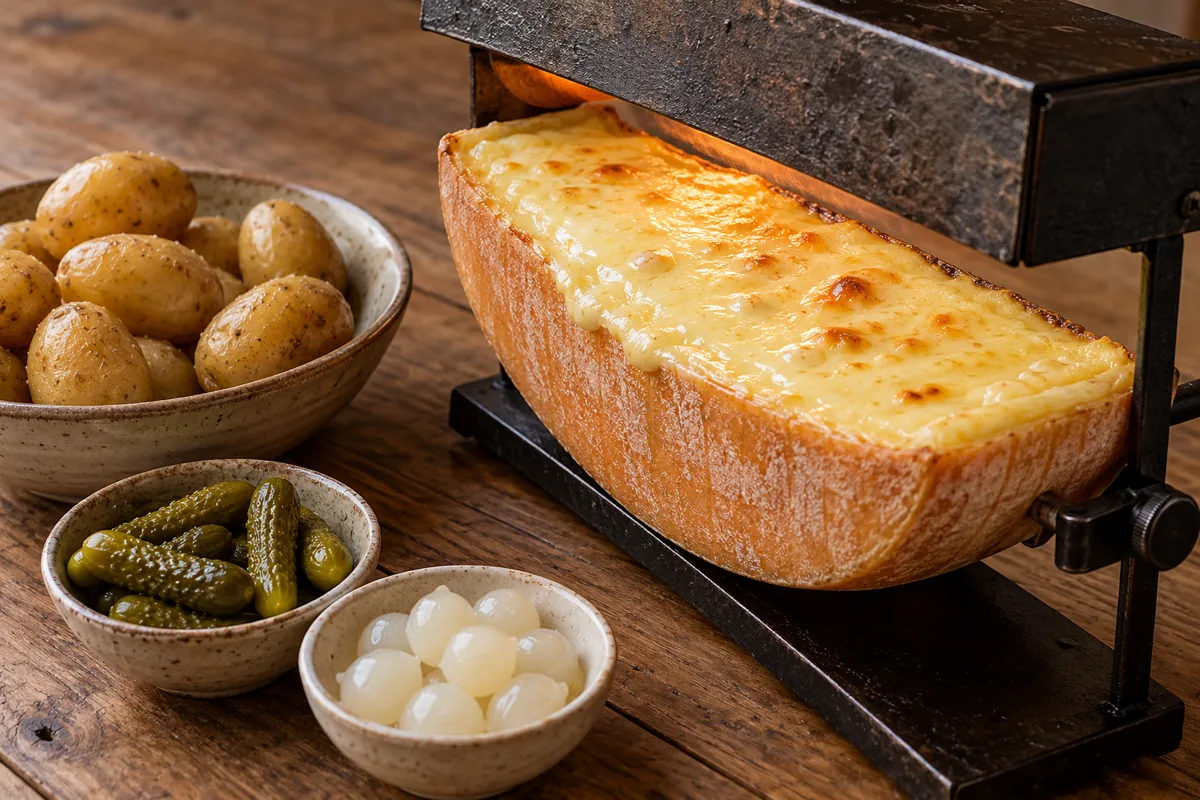
Androuet says Beaumont can go into croûtes au fromage, a dish from Savoie and Switzerland. Wikipedia's French entry on the dish describes bread soaked in local white wine, covered with grated cooked pressed cheese such as Abondance, Gruyère or Raclette, baked, and served with pickled pearl onions and cornichons.
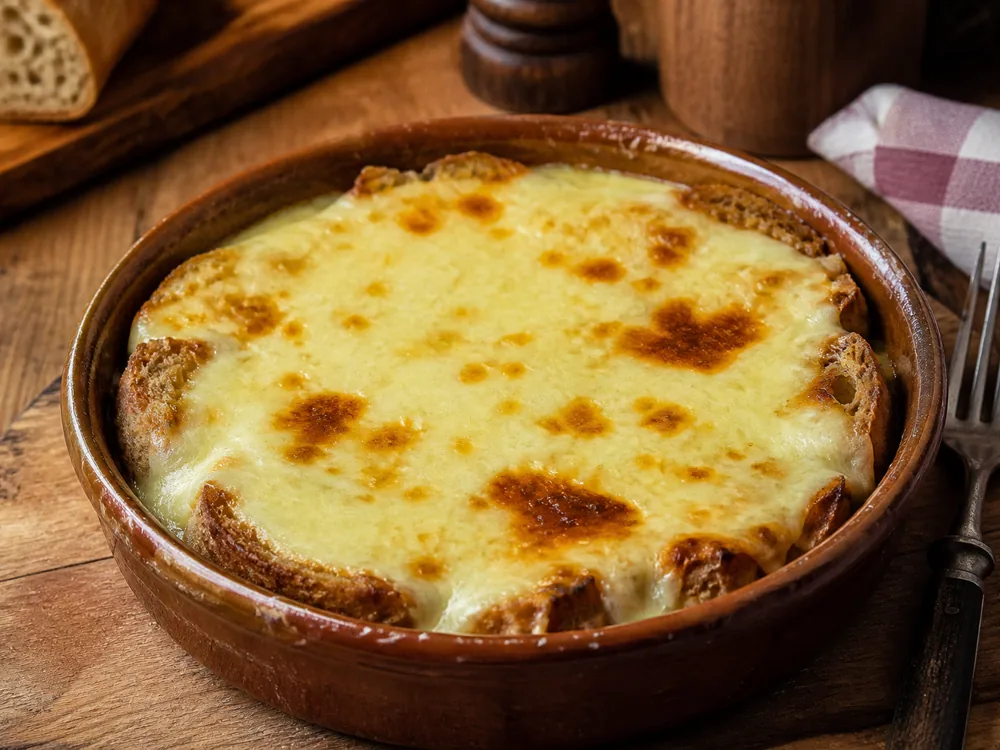
Androuet and CRIEL both class the disc as an uncooked pressed cheese, so it does not fit that description. If you bake croûtes with Beaumont, you are following Androuet's mention alone.
How to Pick the Right Beaumont
For the disc, look for the rind Androuet describes: regular and pale yellow, thin, and supple to the touch.
Can You Eat Beaumont During Pregnancy?
Neither the NHS nor the CDC names Beaumont. Androuet and Wikipedia describe the disc as pasteurised, CRIEL says raw or pasteurised, Cheese.com says unpasteurised, and Pochat's wheel is raw milk.
The NHS says pasteurised or unpasteurised hard cheeses such as cheddar, gruyère and parmesan are safe. It says pasteurised or unpasteurised mould-ripened soft cheeses with a white coating, such as brie, camembert and chèvre, must be thoroughly cooked.
The CDC lists soft cheese made from unpasteurised milk among the riskier choices and hard cheese made with pasteurised milk among the safer ones. It adds that pregnant women are 10 times more likely to get a Listeria infection.
If you are pregnant, ask a clinician whether a raw-milk Beaumont counts as a hard or a soft cheese, and follow the local rules on cheese during pregnancy.
SOURCES & REFERENCES
What Else Do People Ask About Beaumont?
Androuet and Wikipedia describe the 1.5kg disc as pasteurised cow's milk. Pochat & Fils describes its 50kg Beaumont de Savoie wheel as raw whole milk, and CRIEL and Cheese.com give other descriptions, so read the milk statement on the pack.
Androuet gives six weeks and Wikipedia gives 1.5 to 2 months for the disc. Pochat & Fils gives at least five months for the wheel, and six to eight months for its Vieille Réserve.
Check the pack for an AOP or PDO mark. Pochat & Fils puts AOP in the names of its Reblochon and Beaufort but not in the name Beaumont de Savoie.
Pochat & Fils and Le Guide du Fromage use the name for a 50kg raw-milk wheel. CRIEL uses it for the 1.5kg disc as well.