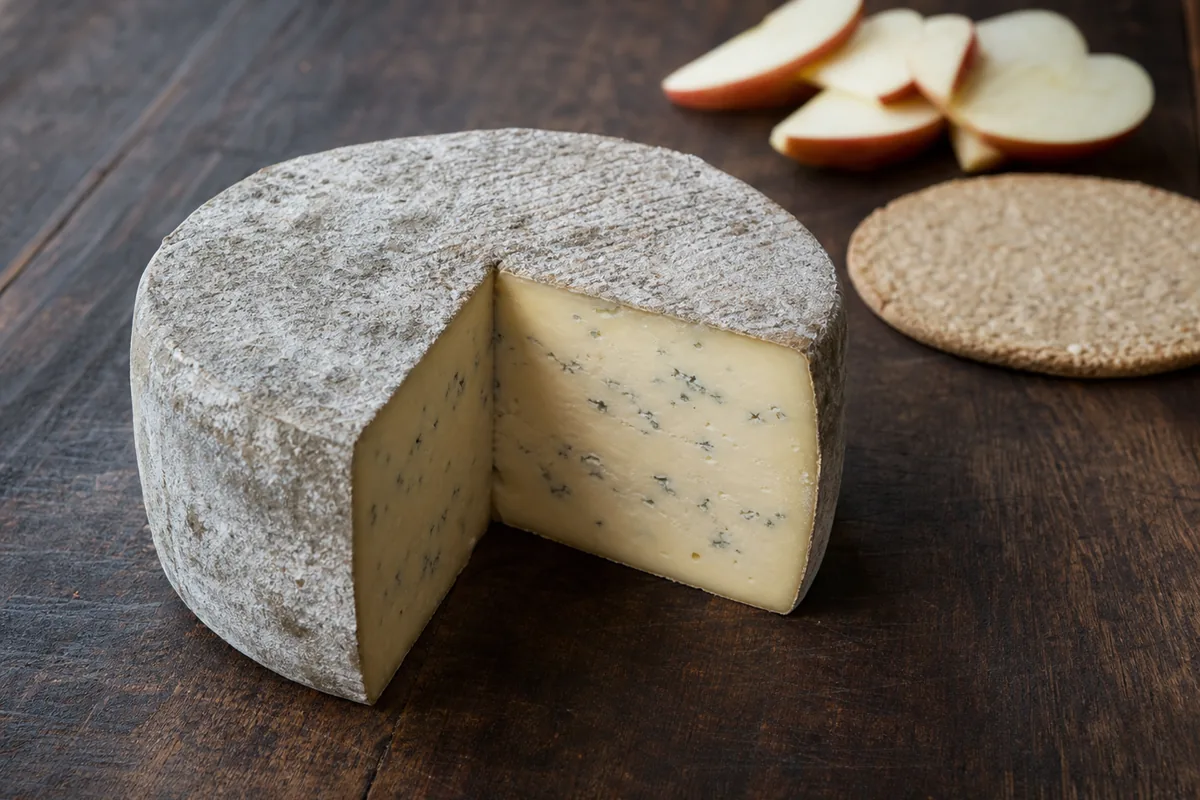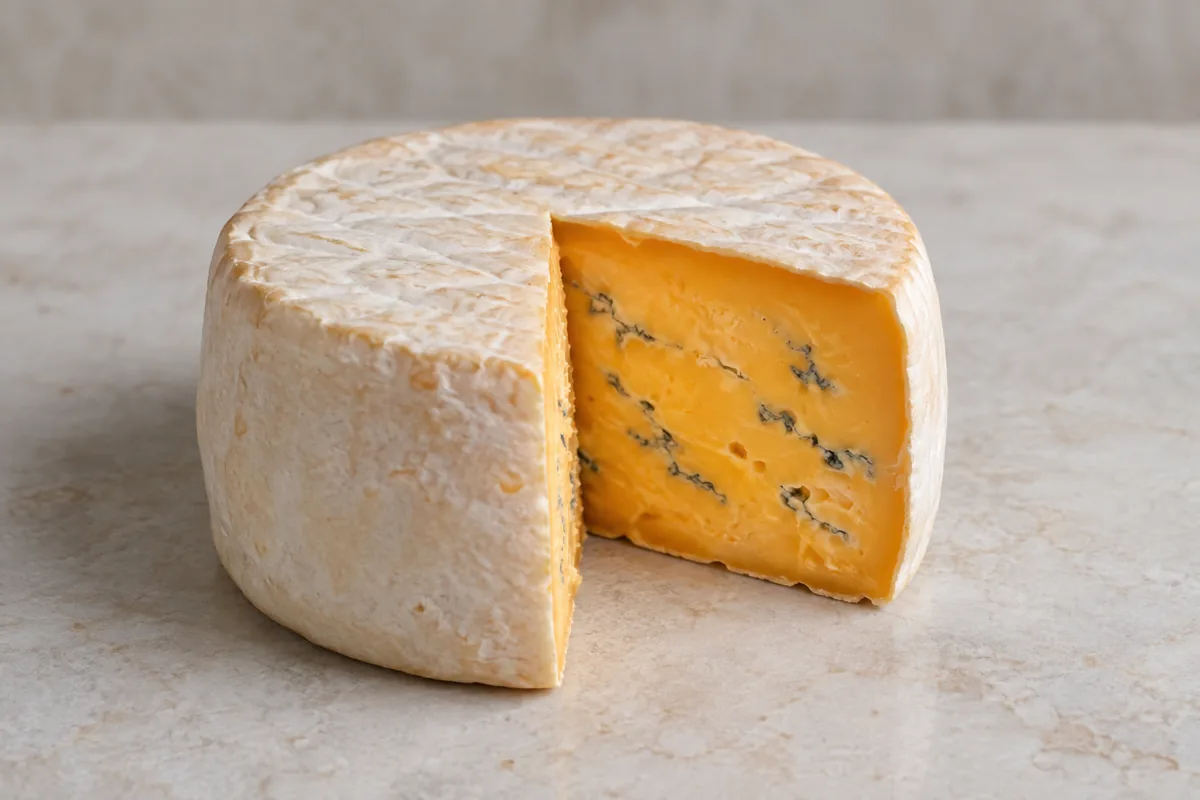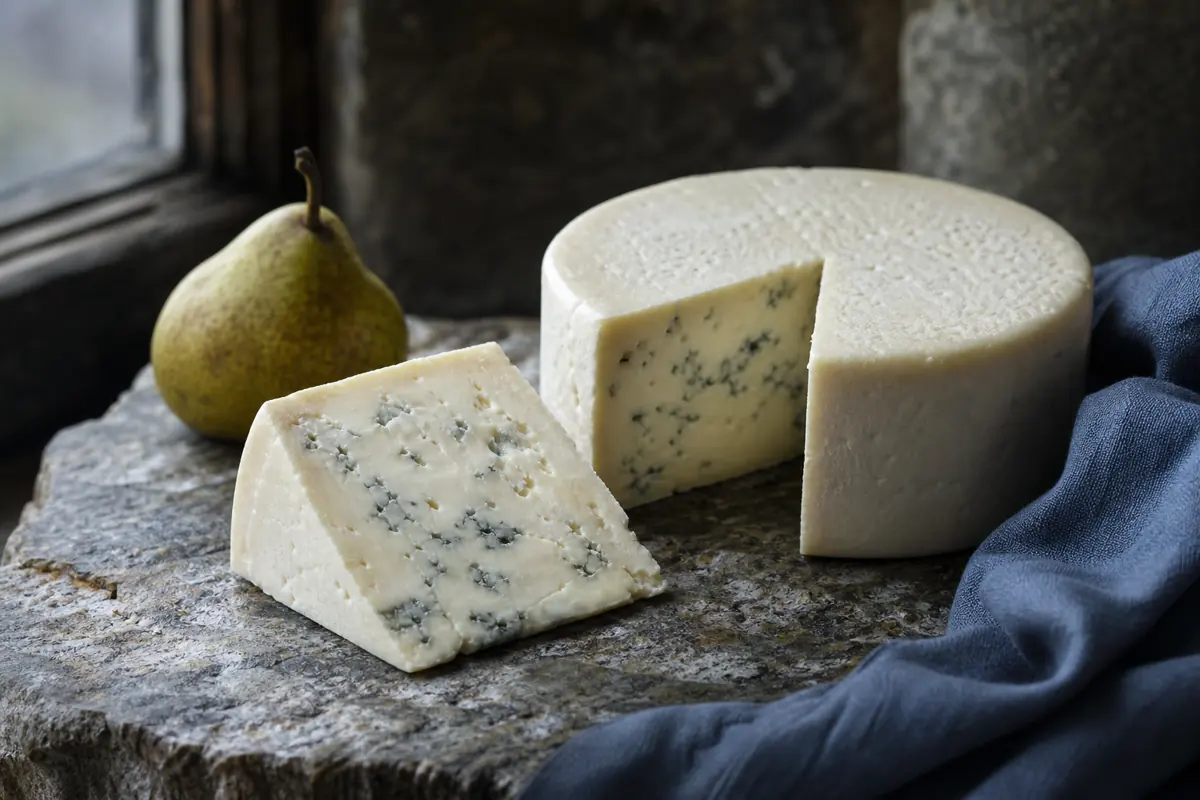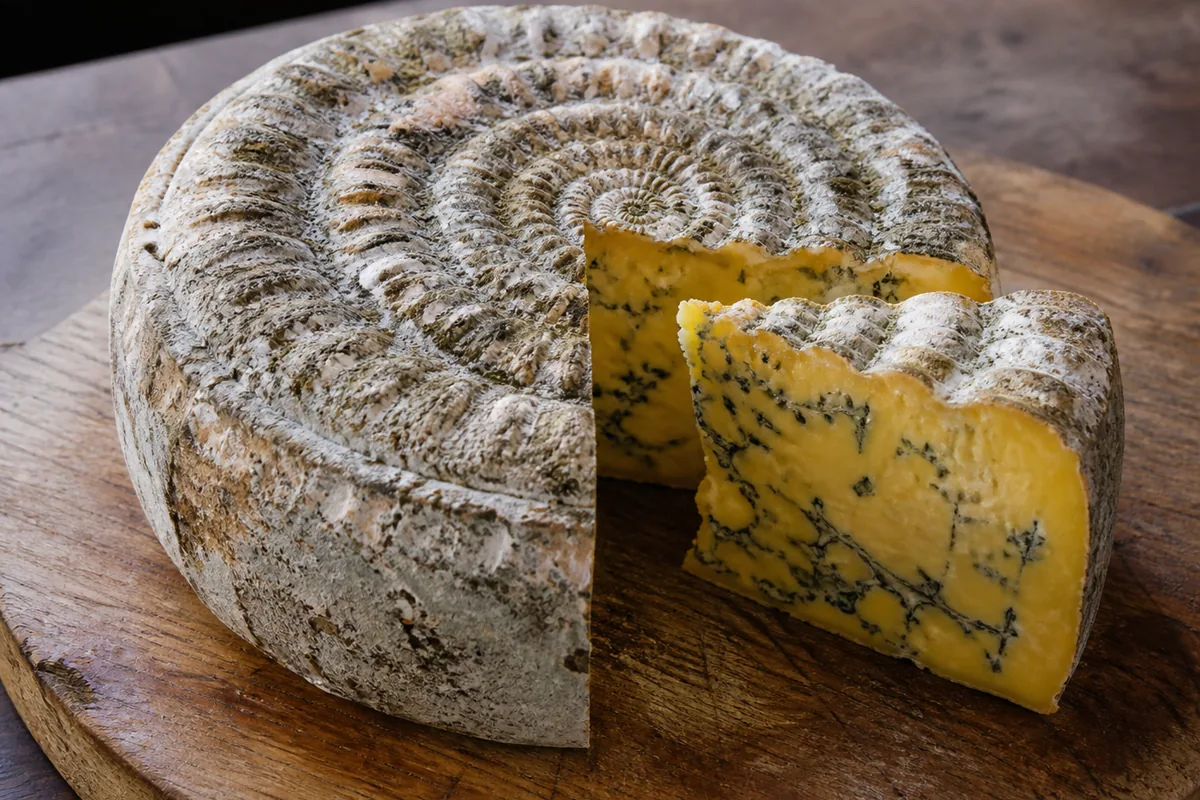
Barkham Blue is a pasteurised blue cheese in an ammonite-shaped round, made today by Village Maid Cheese in Riseley, Berkshire. Sandy Rose created it at Two Hoots Cheese in 2003, and Village Maid bought that business in February 2024.
At the counter you can pick it out by its spiral shape and its deep yellow paste with dark blue-green veins.
In This Article
What Is Barkham Blue?
Barkham Blue is a semi-soft blue made with pasteurised Guernsey milk and vegetarian rennet.
Village Maid says the cheese won Best Blue Cheese at the 2024 Artisan Cheese Awards, and Peter's Yard lists two titles from the Two Hoots years: Best New Cheese at the 2003 World Cheese Awards and Best Blue at the 2016 Great British Cheese Awards.
Fromage Homage says it was crowned best cheese in Britain in 2008, and Cheese Etc credits it with Supreme Champion performances at the British Cheese Awards.
Who Makes Barkham Blue Now?
Village Maid Cheese makes it now: it bought Two Hoots Cheese in February 2024, and Village Maid's Anne Wigmore is Sandy Rose's cousin.
Speciality Food magazine reported in spring 2024 that the Roses' two children, both in their 30s, did not want to take over the business, so it was going to be sold. Anne Wigmore told the magazine that Village Maid did not want the cheese to leave the family.
At first Village Maid sectioned off a dedicated area of its existing premises for Barkham Blue, and its purpose-built Barkham Blue dairy next to its existing dairy in Riseley was ready for production in October 2024.
Village Maid still makes it with the same local Guernsey milk, from Lacey's Family Farm, a supplier the two businesses had shared for many years.
By Rennet & Rind's account, the recipe and method are unchanged, apart from a slightly heavier wheel under Village Maid, while Anne Wigmore told Speciality Food that Village Maid had made over a dozen batches by spring 2024 and was always tweaking and improving.
Sandy Rose started the cheese at Two Hoots in 2003 because she found many blues metallic and over-salted, and she describes hers as peppery rather than metallic and not over-salted.
She chose a blue at all because everyone around her seemed to be making brie or hard cheeses, and as a tiny family business the Roses needed a cheese they could make and sell quite quickly.
The 2003 award brought calls from wholesalers, but Andy Rose says the family were still making only around twelve cheeses a day, and that their own pasteuriser did not arrive until 2008.
Peter's Yard's undated profile puts output at around 500 cheeses a week, with Barkham Blue making up the vast majority alongside Rosethorn Blue (Jersey milk), Loddon Blewe (ewe's milk) and Baby Barkham, a smaller version of the flagship. If you are after one of those three, ask Village Maid whether it still makes it.
Why Does Guernsey Milk Matter in a Blue?
Jersey and Guernsey milk carry more butterfat than standard cow's milk, and Village Maid ties that high butterfat to Barkham Blue's smooth, indulgent paste.
Cheese Etc credits the same milk with the creamy texture, and says it makes Barkham quite different from many traditional British blues and that using it for a blue is not necessarily the easiest route.
Sandy Rose chose Channel Islands milk for its higher fat content, even though older cheesemakers told her she was mad to try a blue with it. Their warning, in her account, was that with this milk it is hard to know which starter cultures to use, and a lot can go wrong.
| Milk named | Named by | Other detail given |
|---|---|---|
| Guernsey milk | Village Maid Cheese (current maker); Speciality Food (2024); Rennet & Rind | Pasteurised (Village Maid, Rennet & Rind) |
| Channel Island milk | Peter's Yard (Two Hoots profile, "Channel Islands milk"); Fromage Homage (2014); Cheese Etc | Chosen for higher fat (Peter's Yard); Jersey and Guernsey milk named as higher in butterfat than standard milk (Cheese Etc) |
Rennet & Rind describes Guernsey milk as rich in flavour and high in milk-fat and milk protein, and its product page for the cheese lists these values per 100 g.
| Nutrient | Per 100 g |
|---|---|
| Energy | 1634 kJ / 394 kcal |
| Fat | 32.8 g, of which saturates 25.6 g |
| Carbohydrate | 4.2 g, of which sugars 0.1 g |
| Protein | 20.5 g |
| Salt | 2.4 g |
Why Is the Paste Golden?
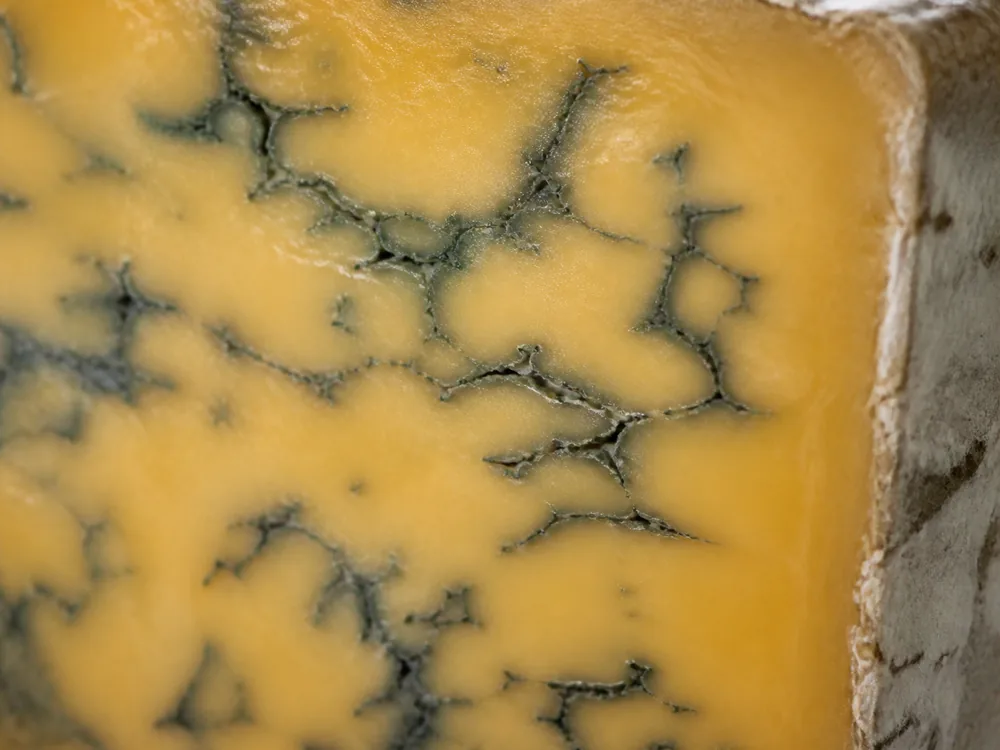
Village Maid puts the golden colour down to carotene, a pigment naturally high in Guernsey milk, and Rennet & Rind names the pigment as beta-carotene, which it says gives the milk a golden-yellow tinge.
Village Maid calls Heckfield, its semi-hard Guernsey cheese matured for 8 to 10 months, naturally golden from the carotene in the milk as well.
The 2014 Fromage Homage post also puts the colour down to the rich Channel Island milk, and its author says, from an online check, that annatto is not added.
Anne Wigmore told Speciality Food that the colour is brighter with summer milk.
Cut open, the paste is a moist, deep yellow interior punctuated with dark blue-green veins in Rennet & Rind's words and deep golden-yellow in Cheese Etc's.
Cheese Etc's listing gives an ingredient list of milk, salt, starter cultures, rennet and Penicillium roqueforti, and Rennet & Rind lists pasteurised Guernsey cows' milk, salt, vegetarian rennet and starter culture. Neither includes a colouring, and the label on a particular piece is still the check.
How Is the Round Shaped and Pierced?
The ammonite shape comes from the moulds: the cut curd is scooped into moulds that are colanders, and these give the cheese its shape. The cheeses are drained and flipped over before they go into the brine.
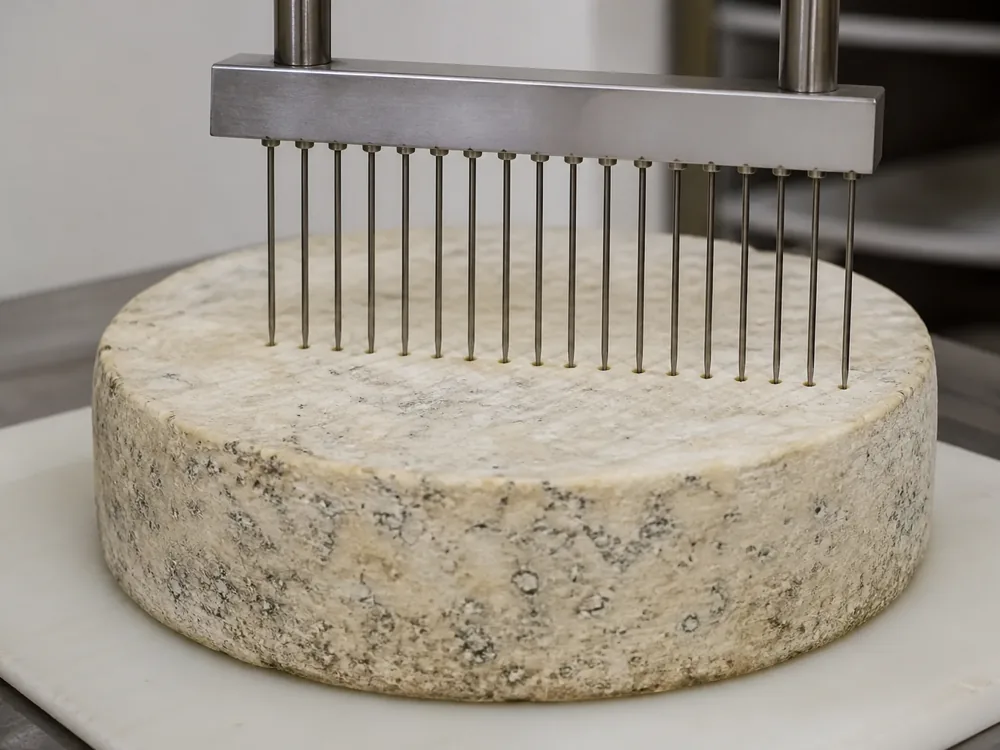
Village Maid then salts the round in brine and pierces it to introduce oxygen, a step it calls crucial to maturation. Fromage Homage adds that the brine contributes to the flavour and to the blueing that follows.
The piercing is done by a machine that drives needles into the cheese so that oxygen can enter and help the blue spread. In the cheese pictured in the Fromage Homage post, one of the needles left a horizontal groove.
Before any of that, the milk is pasteurised, as Village Maid's product page states, and Rennet & Rind explains pasteurisation as heating milk to 71.7°C for at least 15 seconds and then cooling it quickly to less than 3°C.
The milk is then heated before starter cultures go in, including Penicillium roqueforti, the mould that causes the blueing, and is left to ripen before rennet is added. Once the curd has set, it is cut with two long knives, one working horizontally and one vertically, into little cubes, and the whey is drained off.
Rennet & Rind gives the maturing time as 5 to 8 weeks and adds that many sellers list 6 to 8 weeks as standard.
During that time a natural rind forms that combines white and blue moulds and often shows various moulds, and the paste beneath the rind softens.
What Does Barkham Blue Taste Like?
In its maker's and two retailers' words, Barkham Blue is buttery or sweet and creamy, with a peppery or sharp note.
If you dislike the cheek-tingling of a strong blue, the Fromage Homage author suggests this one, and Anne Wigmore told Speciality Food that the cheese is not too strong.
Village Maid describes a buttery paste with a measured sharpness from the veining that lets buttery sweetness through, and Rennet & Rind calls it rich and buttery, with a gentle peppery tickle from the veins.
Cheese Etc puts sweet and creamy first, then gentle peppery spice and savouriness, and Rennet & Rind adds that it has none of the metallic harshness of some blues.
On salt, Sandy Rose set out to make a blue that was not over-salted, and Anne Wigmore told Speciality Food that Village Maid tries not to make the cheese too salty. Rennet & Rind's product page gives 2.4 g of salt per 100 g.
Village Maid describes earthy notes on the rind, and Cheese Etc says flavours near the rind are slightly earthier, with perhaps a little more bitterness.
Cheese Etc says the smooth, melting texture is very different from its more crumbly British blues, and the Fromage Homage post calls the cheese buttery rather than crumbly, with a subtle tang.
What Goes with Barkham Blue?
Cheese Etc says Sauternes suits the salty-rich cheese and that a fruity Malbec complements both the milk's sweetness and the blue's character.
Rennet & Rind suggests Kopke 10 Year Old Tawny Port and calls it a classic sweet-meets-salt match. Of the three, Sauternes and the port are the sweet wines, and the Malbec is the red.
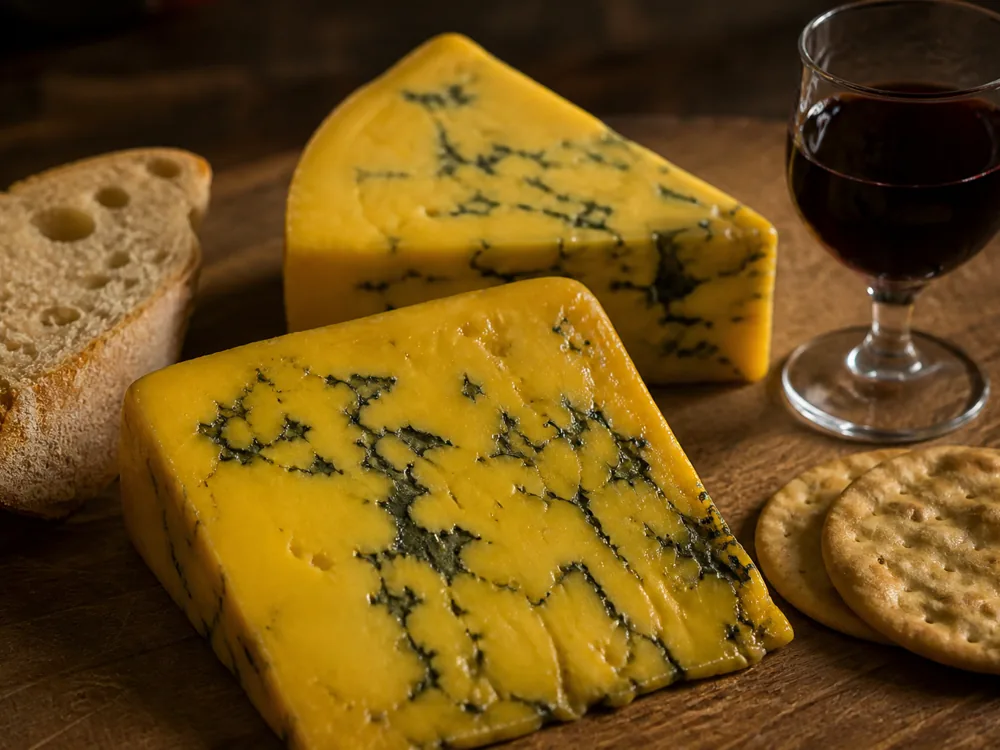
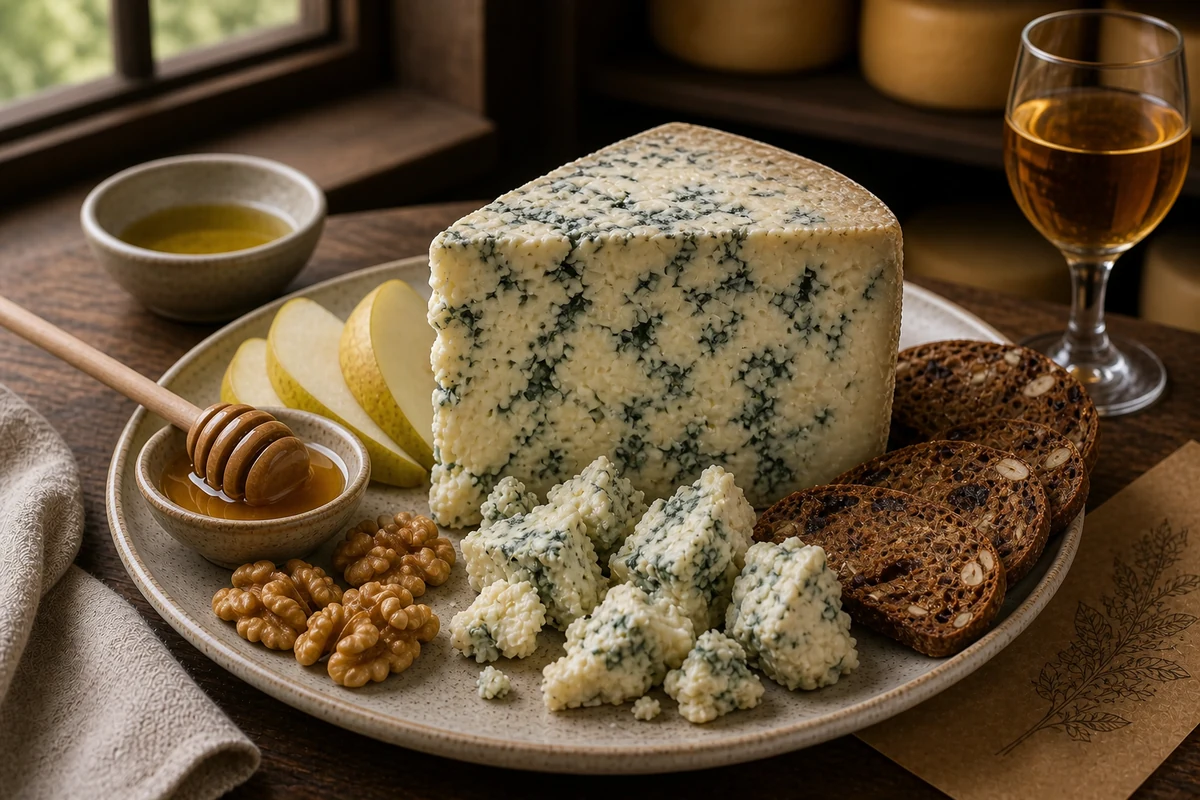
For food, pears, figs and walnuts are on both retailers' lists: Cheese Etc says pears are particularly good, as are fresh figs or crisp apple, with a handful of walnuts, and Rennet & Rind's FAQ adds honey and rustic bread.
| Pairing | Type | Why It Works |
|---|---|---|
| Sauternes | Wine | Named by Cheese Etc as the classic choice. |
| Fruity Malbec | Wine | Named by Cheese Etc. |
| Tawny port | Wine | Rennet and Rind suggests Kopke 10 Year Old Tawny Port. |
| Pears, figs, apple, walnuts | Food | Cheese Etc names all four, and Rennet and Rind names pears, figs and walnuts. |
| Honey and rustic bread | Food | Named in the Rennet and Rind FAQ. |
| Mushrooms | Food | Named by Cheese Etc among its cooking uses. |
How Should You Serve Barkham Blue?
Cheese Etc and Rennet & Rind both say to let it sit at room temperature for about an hour before serving, and Rennet & Rind says this lets the flavours open.
The CDC counts dairy as perishable food and says to never leave perishable food out for more than 2 hours (or 1 hour if exposed to temperatures above 90°F). An hour on the counter sits inside the 2-hour limit and uses up the whole 1-hour limit in a room above 90°F.
Rennet & Rind suggests crumbling it over salads or melting it into a sauce, and Cheese Etc's list of uses adds pasta sauce, mushrooms and a blue cheese sauce.
Sandy Rose says the shape helps it stand out on the cheese counter and look good on a cheeseboard, and the Fromage Homage author reports that chefs are apparently enamoured with it for boards and cooking alike.
How Big Is It and How Long Does It Keep?
A whole Barkham Blue is a 1 kg wheel in Village Maid's and Rennet & Rind's listings and usually 1 to 1.2 kg in Cheese Etc's, and Village Maid says weights vary because each cheese is handmade.
| Question | Answer | Listed by |
|---|---|---|
| How heavy is a whole cheese? | 1 kg; usually 1 to 1.2 kg, listed at about 1.2 kg | 1 kg wheel: Village Maid Cheese, Rennet & Rind. 1 to 1.2 kg: Cheese Etc |
| Which smaller pieces are listed? | 100 g, 250 g and 500 g | 100 g wedge: Cheese Etc. 250 g: Village Maid Cheese, Rennet & Rind. 500 g: Rennet & Rind, and a 500 g wedge at Cheese Etc |
| What does a cut share of a whole cheese weigh? | An eighth about 125 to 150 g, a quarter 250 to 300 g and a half 500 to 600 g | Cheese Etc |
Rennet & Rind says to use it within a week of cutting, while Cheese Etc says to eat it within 10 to 14 days of opening.
Cheese Etc says to keep it refrigerated, and the CDC says to keep your refrigerator at 40°F (4°C) or below.
Cheese Etc says to wrap it in waxed paper or cling film, while Rennet & Rind says to use waxed or parchment paper, not to wrap the cheese tightly in cling film so the cheese can breathe, and to keep the rind intact where possible so the paste does not dry out. Waxed paper is the wrap both retailers name.
Is Barkham Blue Safe During Pregnancy?
Village Maid makes Barkham Blue with pasteurised milk, but for a blue-veined cheese, pasteurisation alone does not settle whether you can eat it while pregnant.
The NHS says pasteurised or unpasteurised soft blue-veined cheeses, such as Danish blue, gorgonzola and roquefort, must be thoroughly cooked. Village Maid calls Barkham Blue semi-soft, so this soft blue-veined line is the NHS line that applies to it.
The NHS also lists any cheese that's been cooked until steaming hot, including soft or blue cheese, as safe to eat.
The CDC lists soft cheese made from unpasteurized (raw) milk, for example blue-veined cheese, as riskier, and pasteurized soft cheeses heated to an internal temperature of 165°F or until steaming hot as safer. It also says pregnant women are 10 times more likely to get a Listeria infection.
Eaten cold, Barkham Blue is described as a pasteurized semi-soft blue, a type the CDC list does not cover, and Cheese Etc marks it as not suitable for pregnancy. If you are pregnant and follow NHS advice, cook it until steaming hot before eating it, and under US advice, cook it the same way or ask a midwife or doctor before eating it cold.
SOURCES & REFERENCES
What Else Do People Ask About Barkham Blue?
Village Maid Cheese makes it in Riseley, Berkshire. Sandy Rose created it at Two Hoots Cheese in 2003, and Village Maid bought Two Hoots in February 2024.
Village Maid makes it with pasteurised Guernsey milk from Lacey's Family Farm. Peter's Yard, Fromage Homage and Cheese Etc say Channel Island milk, and Cheese Etc says Jersey and Guernsey milk carry more butterfat than standard cow's milk.
Village Maid credits carotene, which it says is naturally high in Guernsey milk. The ingredient lists on the Cheese Etc and Rennet & Rind pages include no added colouring.
Anne Wigmore of Village Maid told Speciality Food it is not too strong, and Rennet & Rind describes a gentle peppery tickle without the metallic harshness of some blues.
Yes. Village Maid lists it as vegetarian and says it is made with vegetarian rennet.