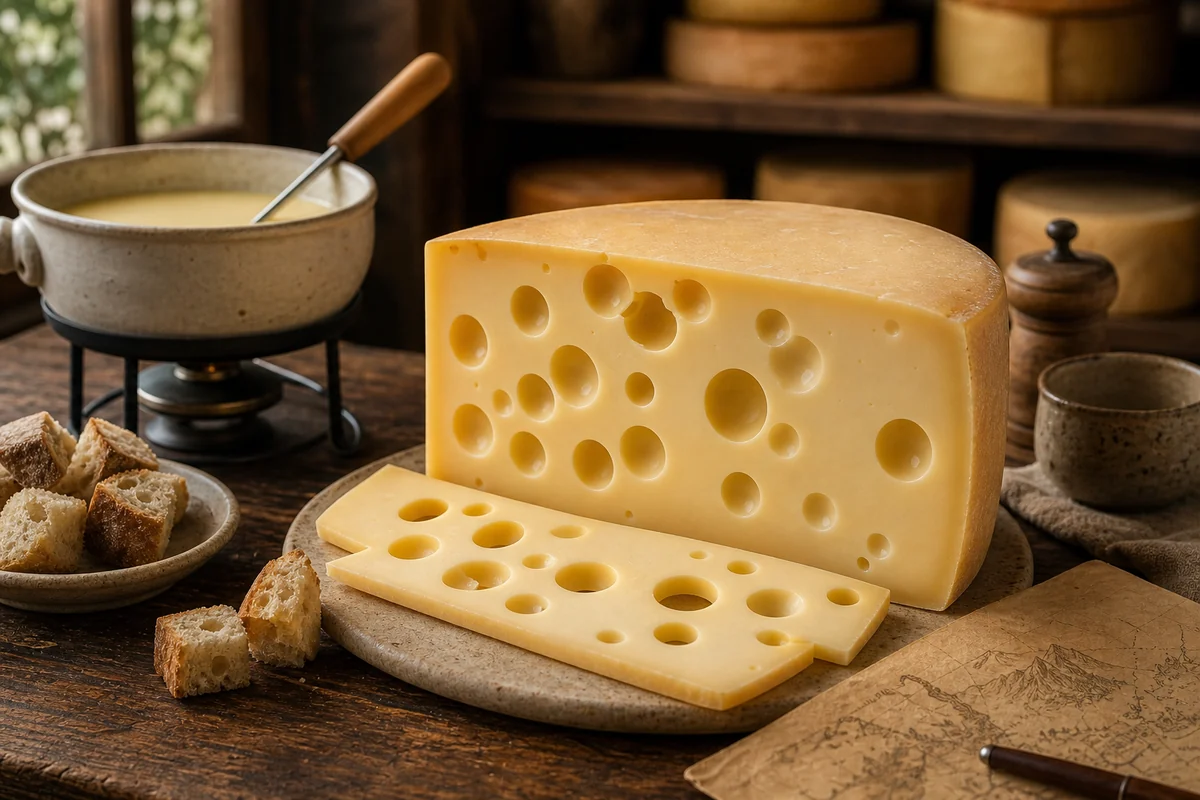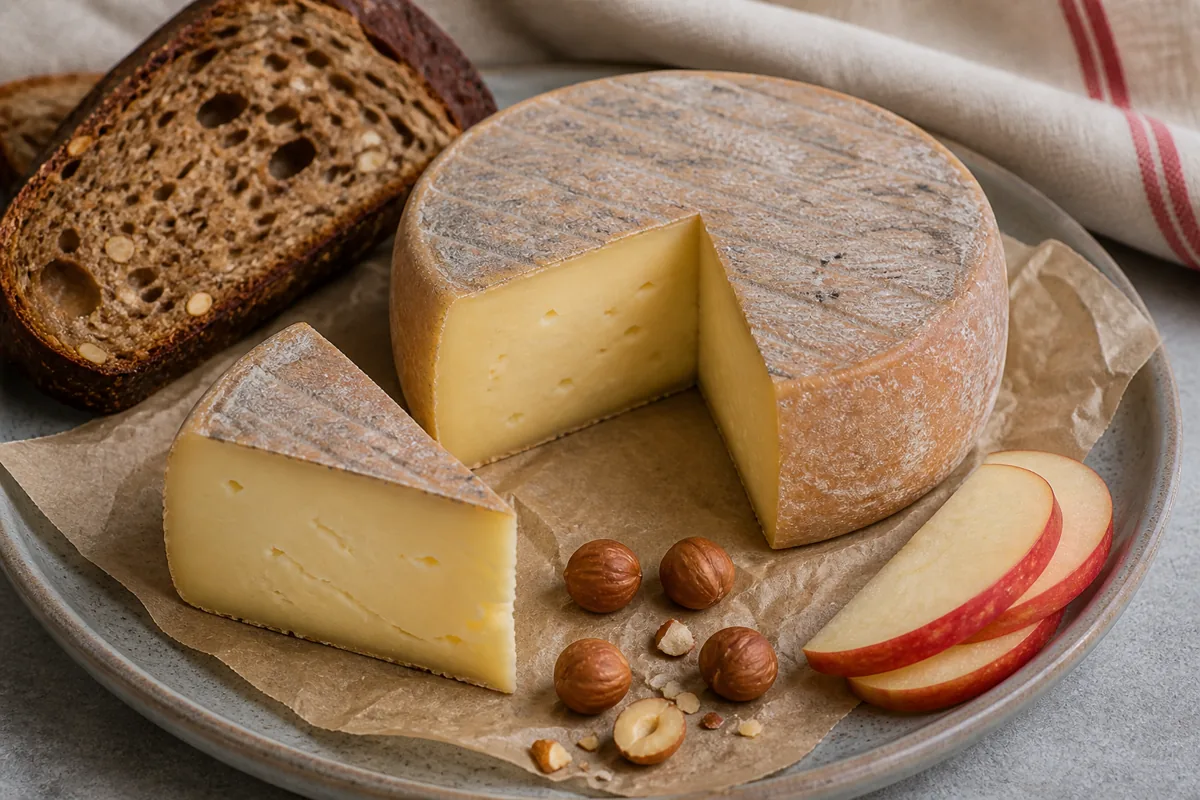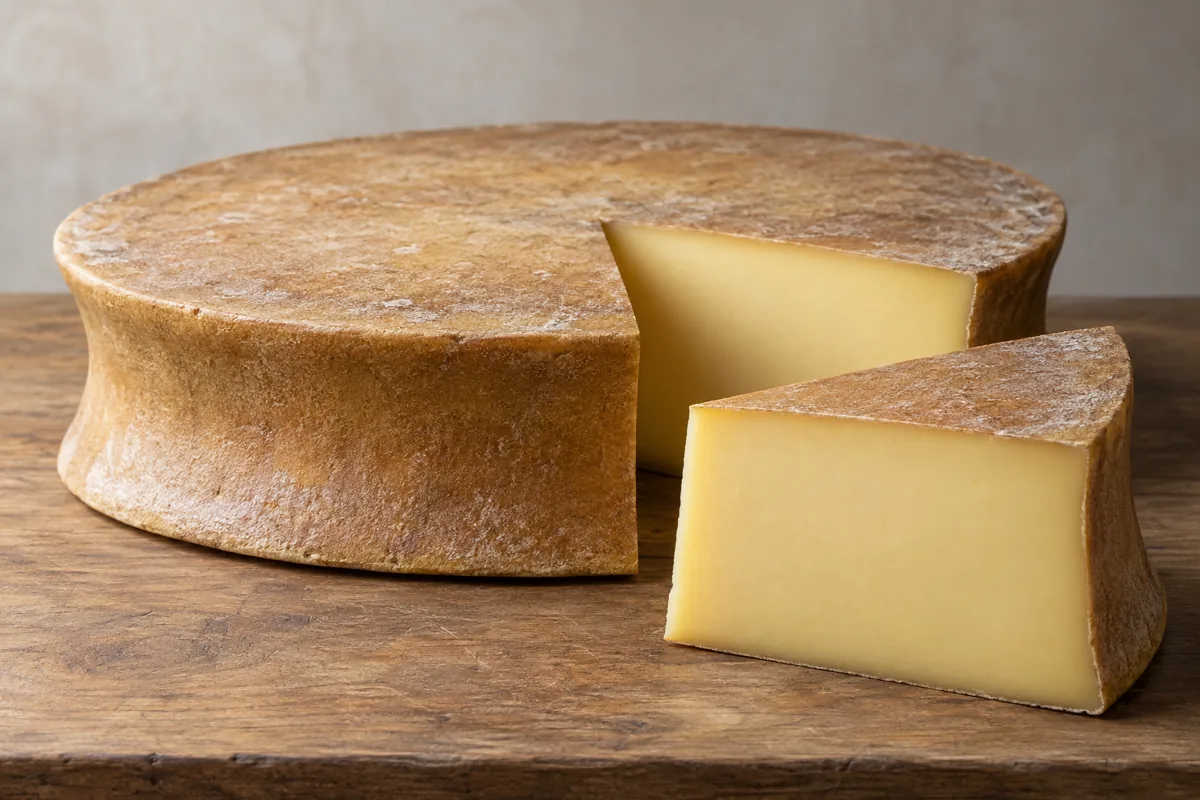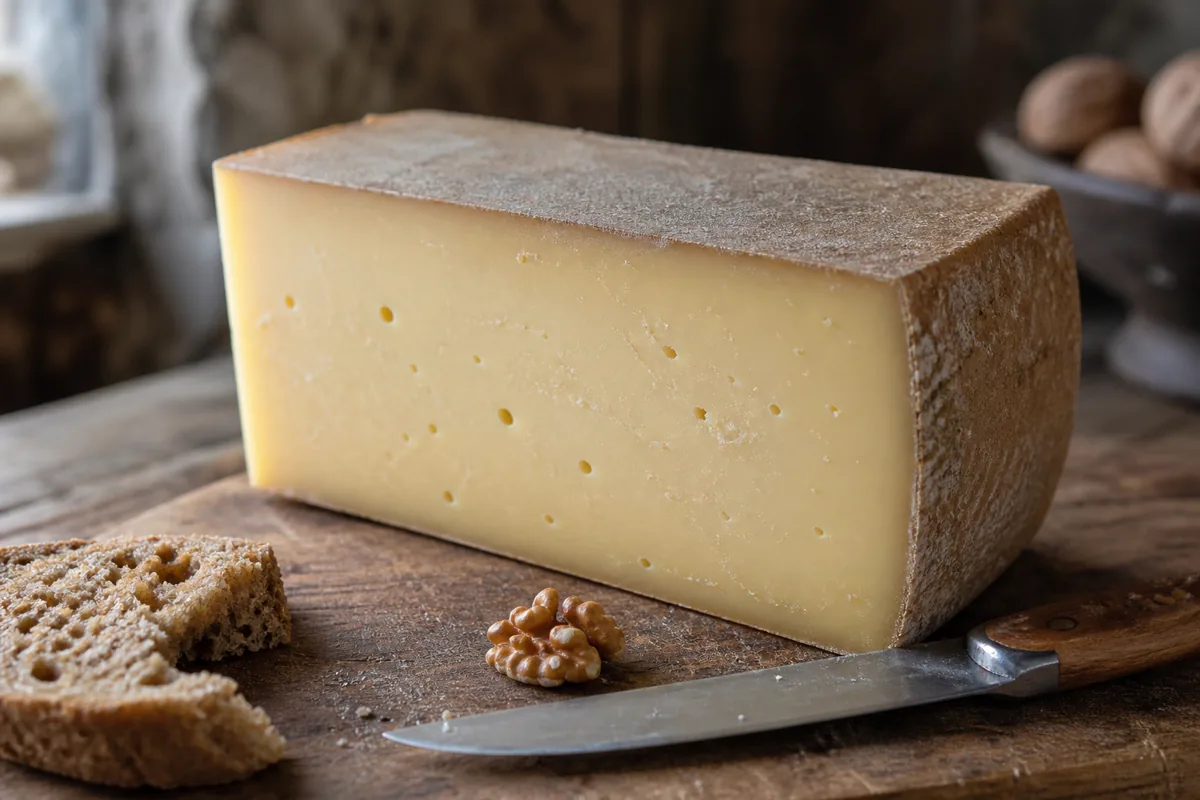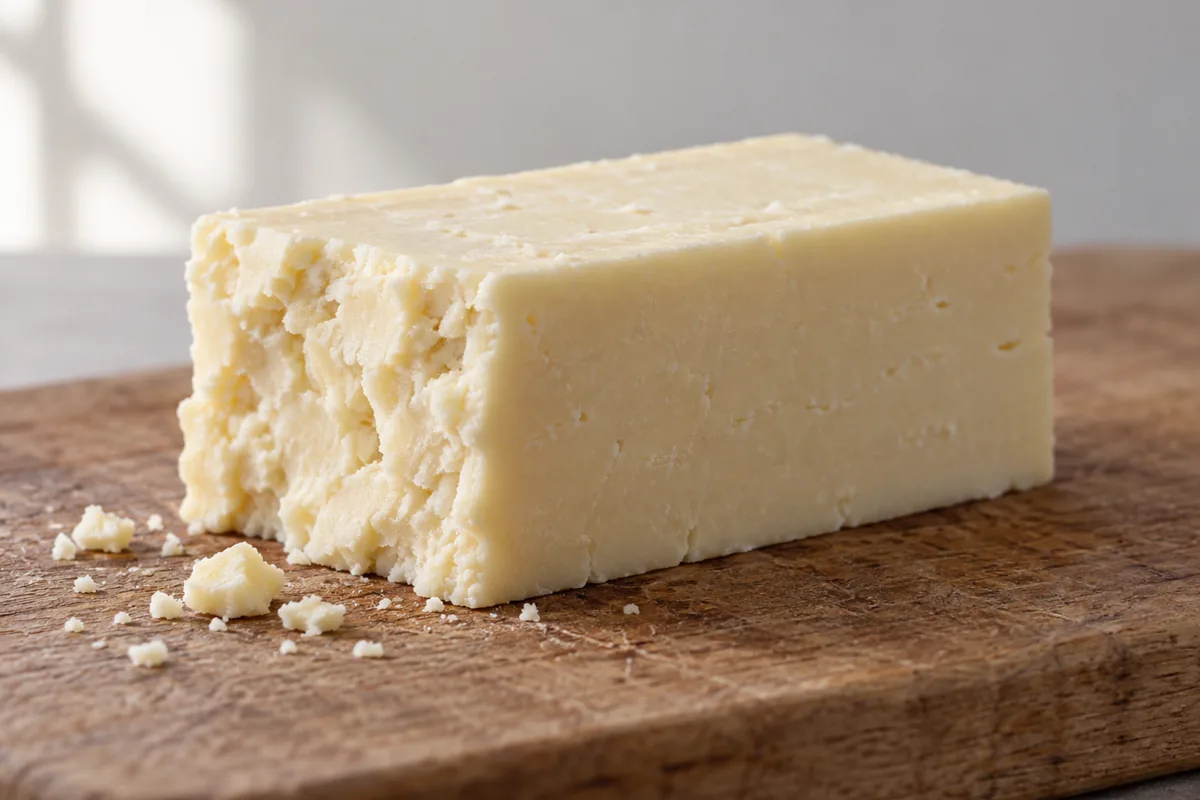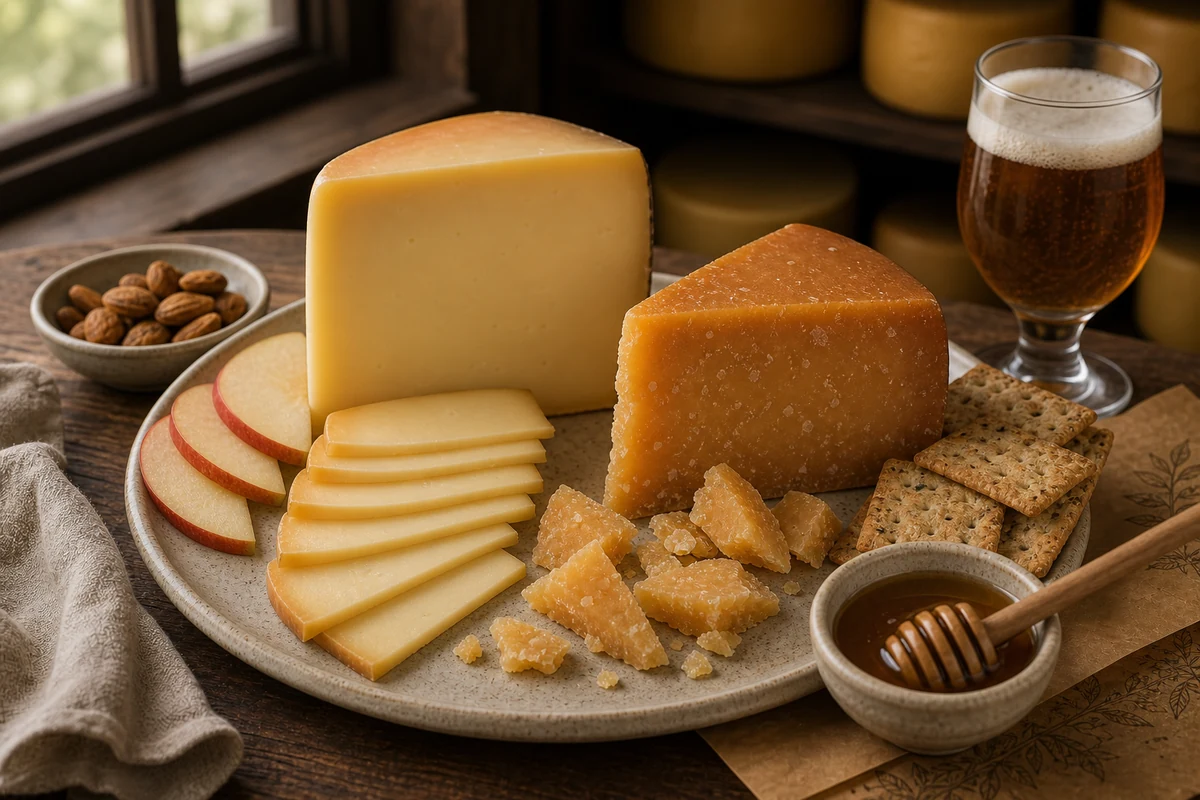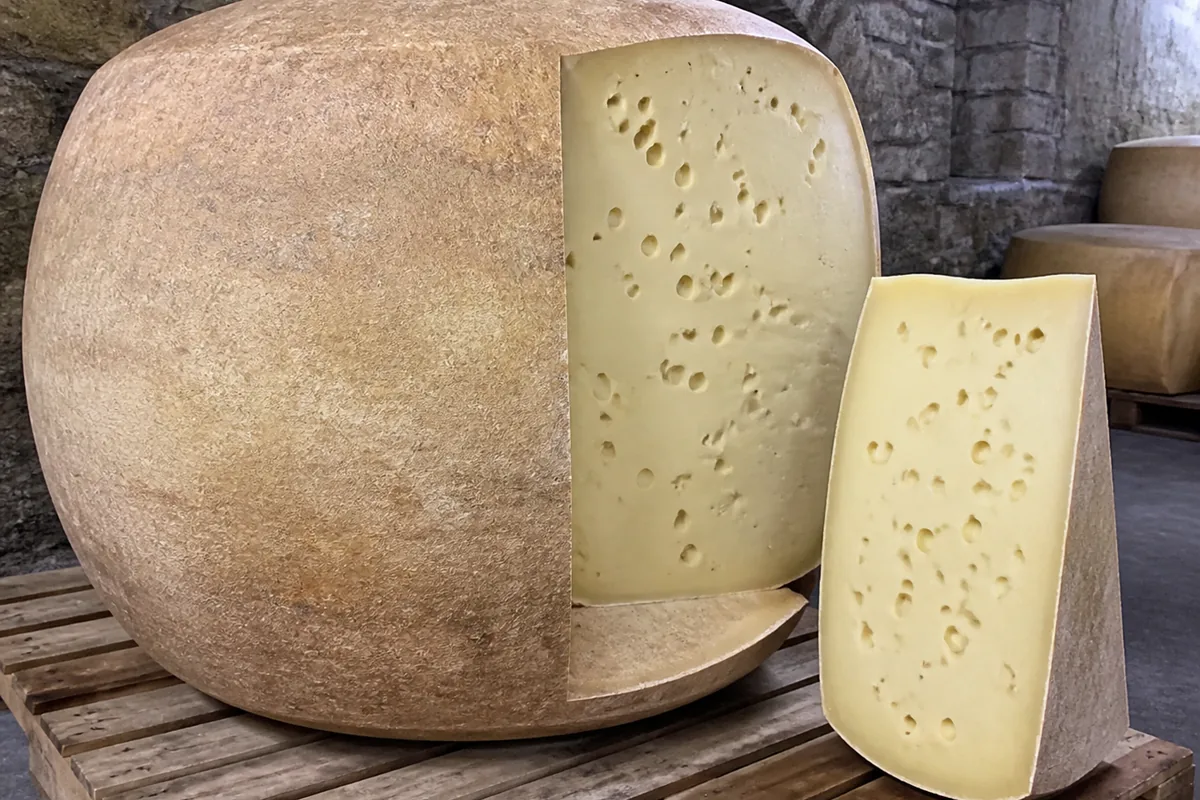
Allgäuer Emmentaler is a German protected-origin cheese made from raw cow's milk, with a nutty flavour and rounded holes called eyes. It shares the Emmental tradition with Swiss Emmentaler AOP, but has its own production area and a three-month minimum age, compared with the Swiss product's four months.
The words on the label tell you more about that distinction than the size of the holes.
In This Article
What Do the Three Emmentaler Labels Mean?
Look for the complete name Allgäuer Emmentaler and the protected designation g.U., the German abbreviation for PDO. “Emmentaler,” “hay milk” or an Allgäu address on its own does not establish that the cheese is this protected product.
| Label | Milk | Age | What it identifies |
|---|---|---|---|
| Allgäuer Emmentaler g.U. | Raw cow's milk | At least 3 months | German protected-origin cheese |
| Swiss Emmentaler AOP | Raw cow's milk | At least 4 months | Separate Swiss protected-origin cheese |
| Allgäuer Hof-Milch Emmentaler slices, 100 g | Pasteurized hay milk | About 2 months, maker's description | A specific Emmentaler product labelled with hay-milk g.t.S., not the PDO name |
The third row is a real product example, not a rule that every ordinary Emmentaler uses pasteurized milk. The maker's name and regional address can resemble the protected name without making the two products interchangeable.
Hay milk's traditional-speciality designation concerns a production method; PDO also ties the cheese to a defined origin. That is why checking only the hay-milk wording misses a useful distinction.
The German protected cheese can be made as a round weighing at least 60 kg or a rectangular block of at least 40 kg. A shop may sell a small wedge from either format, so a portion's size does not disqualify it.
How Is Allgäuer Emmentaler Made?
Production begins with raw cow's milk, then develops a firm cheese through curd cutting, heating, pressing and brining. Bavaria's product account describes heating the curds to about 50 C before pressing, followed by a salt bath and a warm fermentation cellar.
Heating curds during cheesemaking is not the same statement as using pasteurized milk.
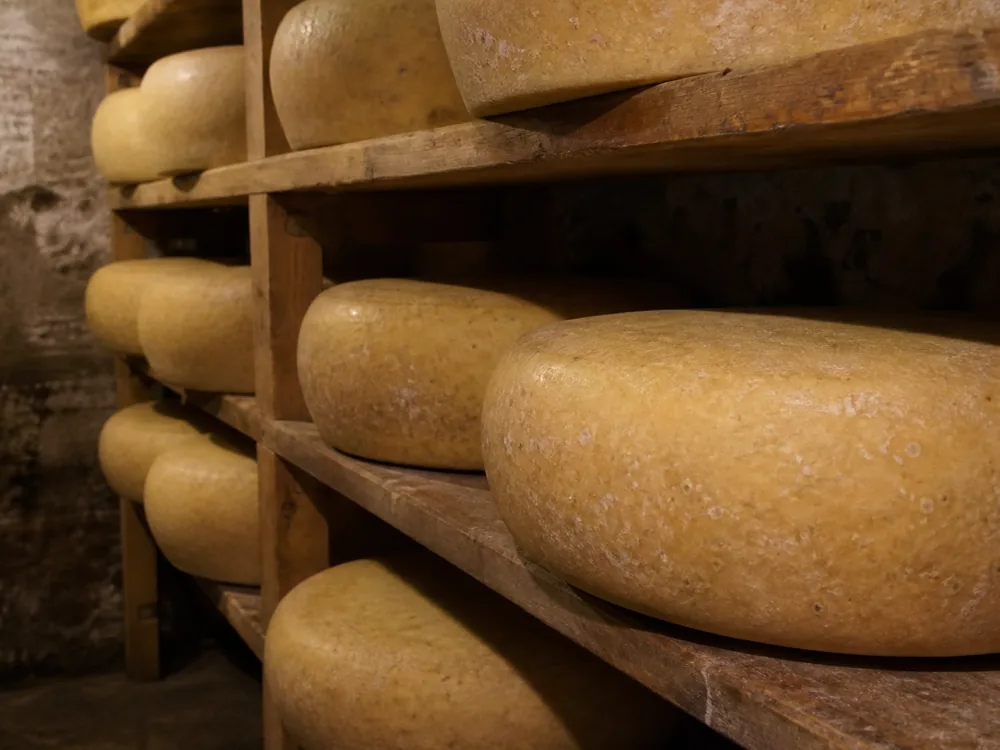
Gas produced during fermentation forms the eyes within the cheese. The regional PDO description specifies mostly rounded holes about 1–3 cm across, regularly distributed through the paste.
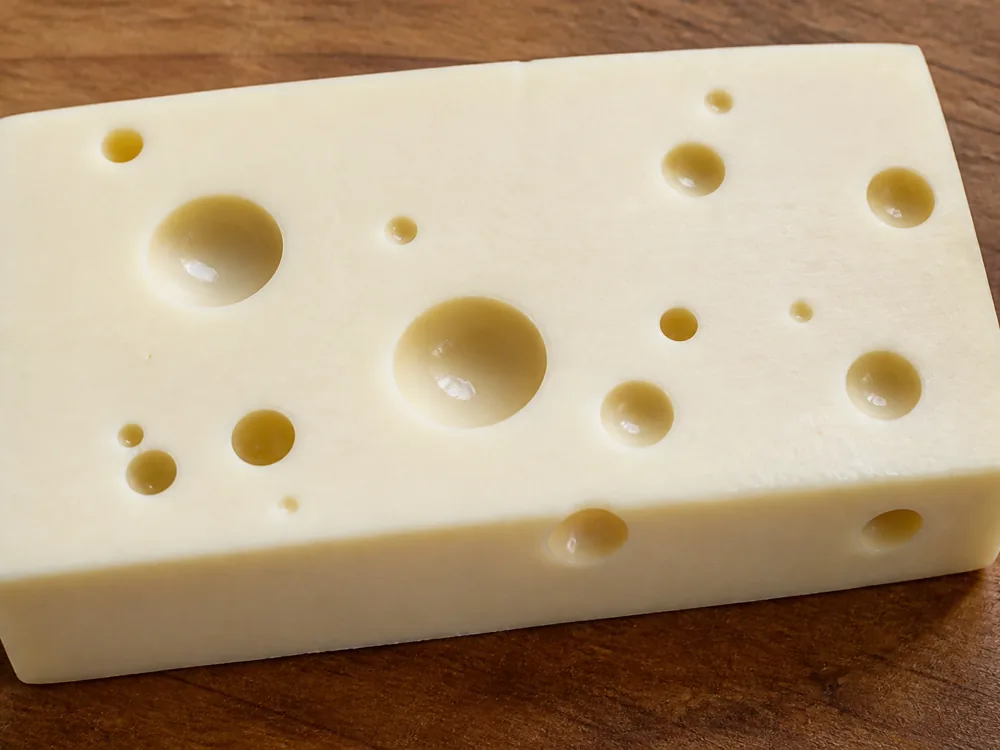
A photograph cannot establish a wheel's age, milk treatment or geographical origin. Those details come from the product's identification and producer records, even when its cut face looks familiar.
Why Does Hay Affect the Holes in Emmentaler?
Bacteria supply the carbon dioxide that expands the eyes, while tiny starting points help determine where the gas collects. In a 2015 study, Swiss researchers at Agroscope and EMPA showed how microscopic hay particles could provide those starting points.
The particles do not produce the gas themselves.
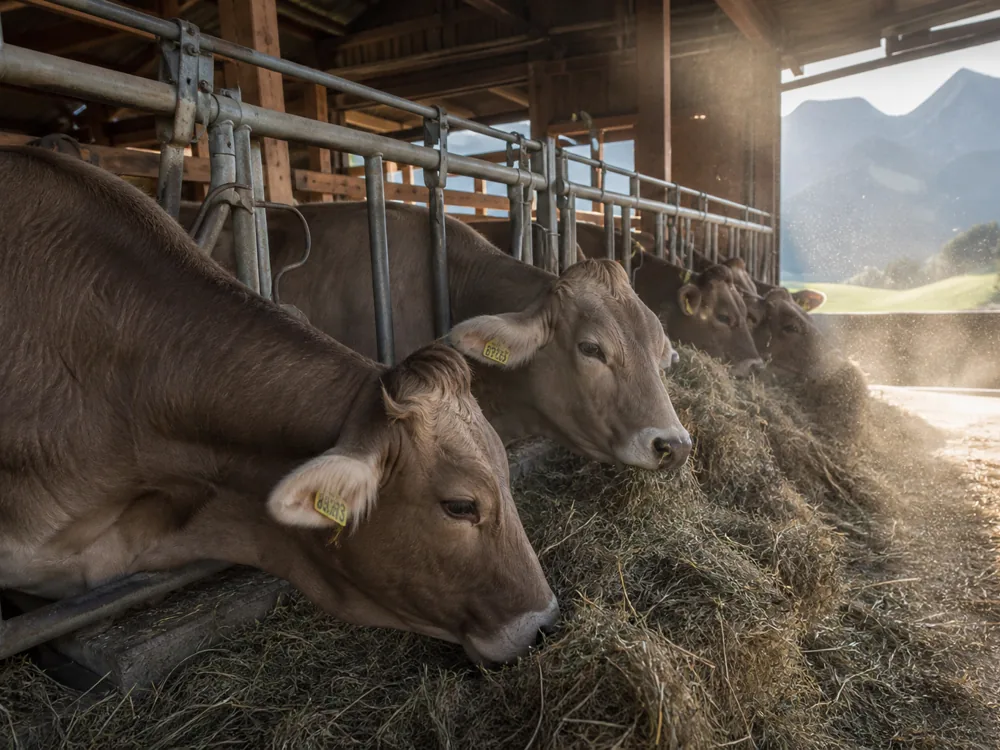
Agroscope's clarification explicitly separated the role of particles from bacterial gas production. Calling the particles dirt, or suggesting that dirty milk makes better cheese, misrepresents that finding.
The Swiss research explains eye formation; it does not measure the hay content of the German wedge in your shopping basket. Nor does it make a larger hole a simple score for flavour or quality.
How Should You Slice and Cook Allgäuer Emmentaler?
The nutty character works in a cold bread-and-cheese meal as well as in hot dishes. Slice it thinly for bread or a sandwich when you want an even layer rather than thick pieces that dominate the filling.
Allgäuer Käsespätzle is a regional use identified in Bavaria's product account: cheese is combined with the small cooked noodles. Follow the chosen recipe's cheese mixture rather than assuming every version uses Emmentaler alone.
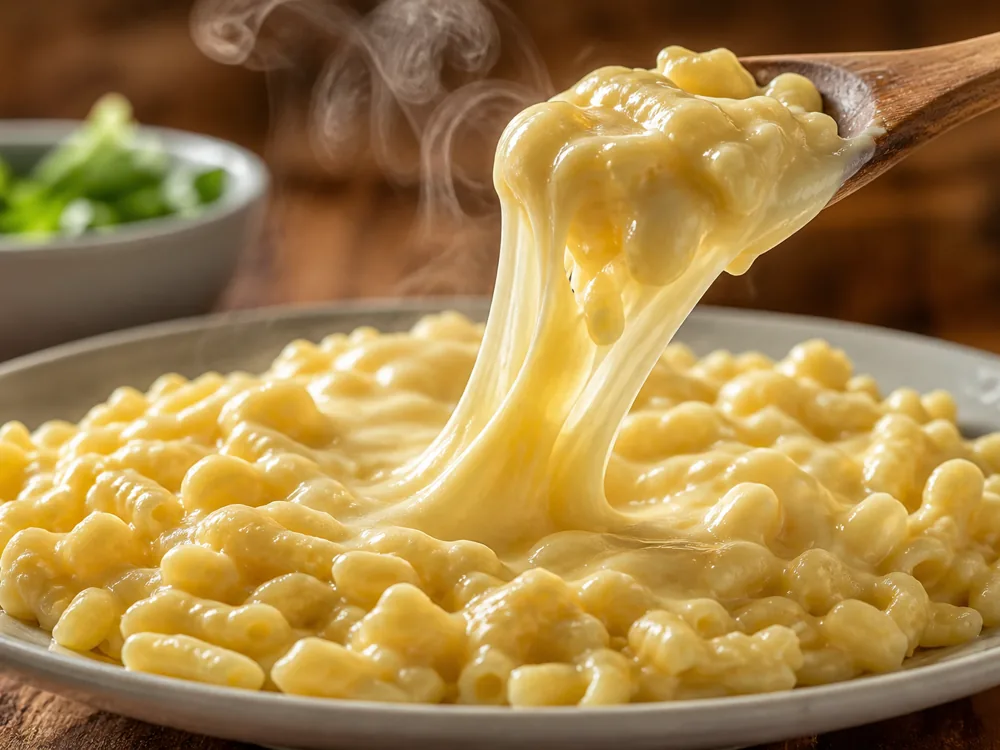
For a sauce, grate the cheese so it can disperse through the warm liquid and follow the recipe's heat instructions. High heat or too little liquid can leave an oily mixture; PDO status cannot make a sauce immune to its cooking conditions.
Swiss Emmentaler AOP is a close alternative when you want the same broad cheese style, though an older wedge can change the flavour. For a cold plate, compare the actual age and maker's description rather than choosing solely by country.
Why Is Fat in Dry Matter Different from Fat per 100 g?
The Albert Herz Allgäuer Emmentaler listing on Heumilch states 45% fat in dry matter and 28.5% actual fat. Those numbers use different bases: the first excludes water, while the second corresponds to 28.5 g fat per 100 g of cheese.
They are not conflicting nutrition results.
Use the actual-fat line when comparing portion sizes or two nutrition panels. That one product's figure is an example, not a fixed panel for every Allgäuer Emmentaler producer.
The same listing identifies that Albert Herz product as lactose-free; check your own pack before extending the claim to another maker. Milk remains an ingredient, and rennet suitability for vegetarians needs its own ingredient or producer confirmation.
Is Allgäuer Emmentaler Safe During Pregnancy?
For pregnancy, advice differs by jurisdiction. The UK NHS allows hard cheeses made with either pasteurized or unpasteurized milk; Allgäuer Emmentaler is a raw-milk hard cheese.
US CDC guidance instead lists pasteurized hard cheese as the safer choice and treats raw-milk cheese as a riskier option. A three-month PDO maturation period does not override that recommendation.
For home storage, follow the wedge's label and after-opening instructions, keep it covered, and refrigerate at 4 C / 40 F or below. The FDA's household limit for perishable food outside refrigeration is two hours, or one hour above 32 C / 90 F.
Neither a natural rind nor a normal smell proves that a poorly stored piece is safe.