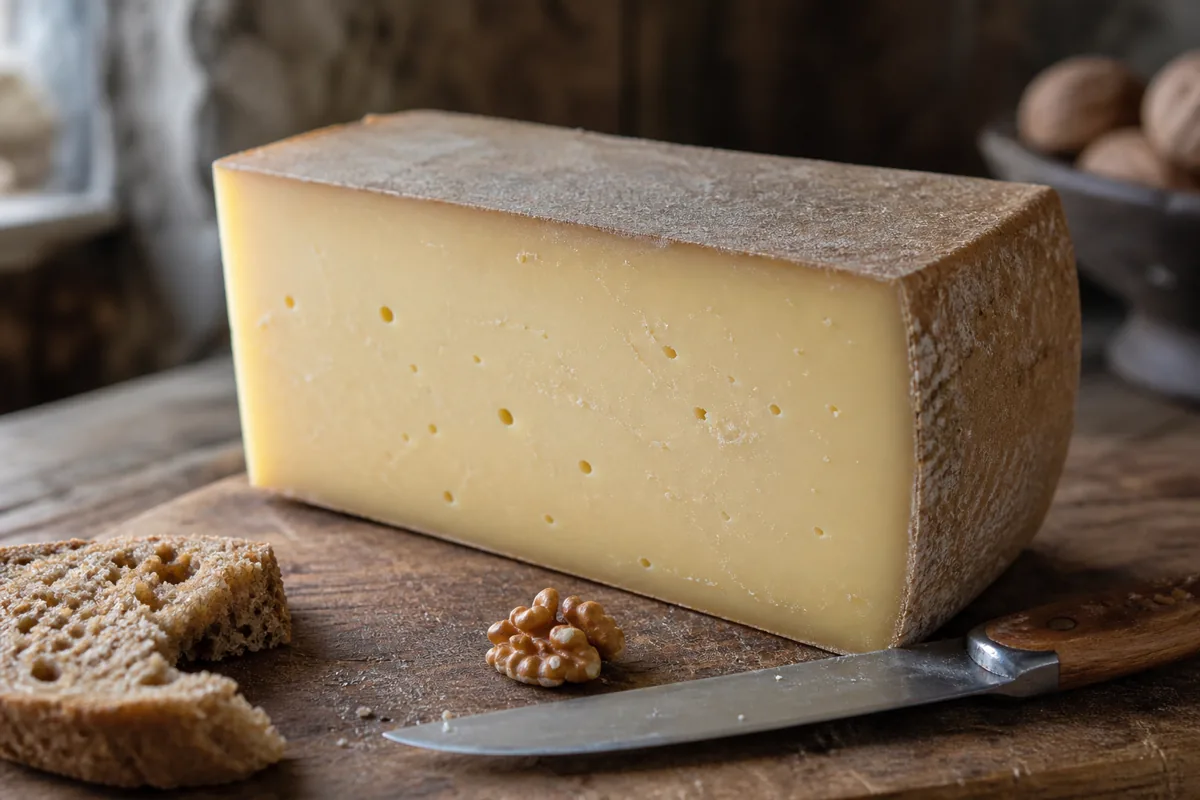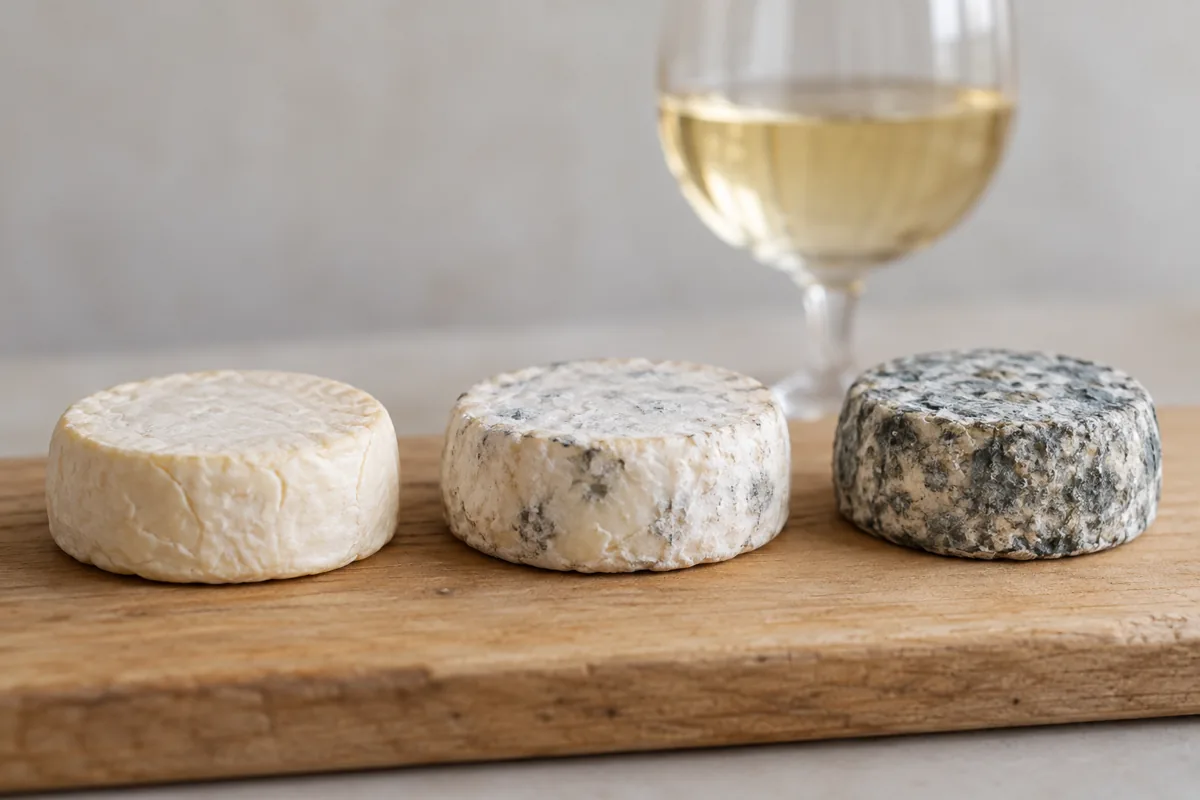
Choose Arômes au Gêne de Marc by base cheese, milk and curing medium on the actual piece.
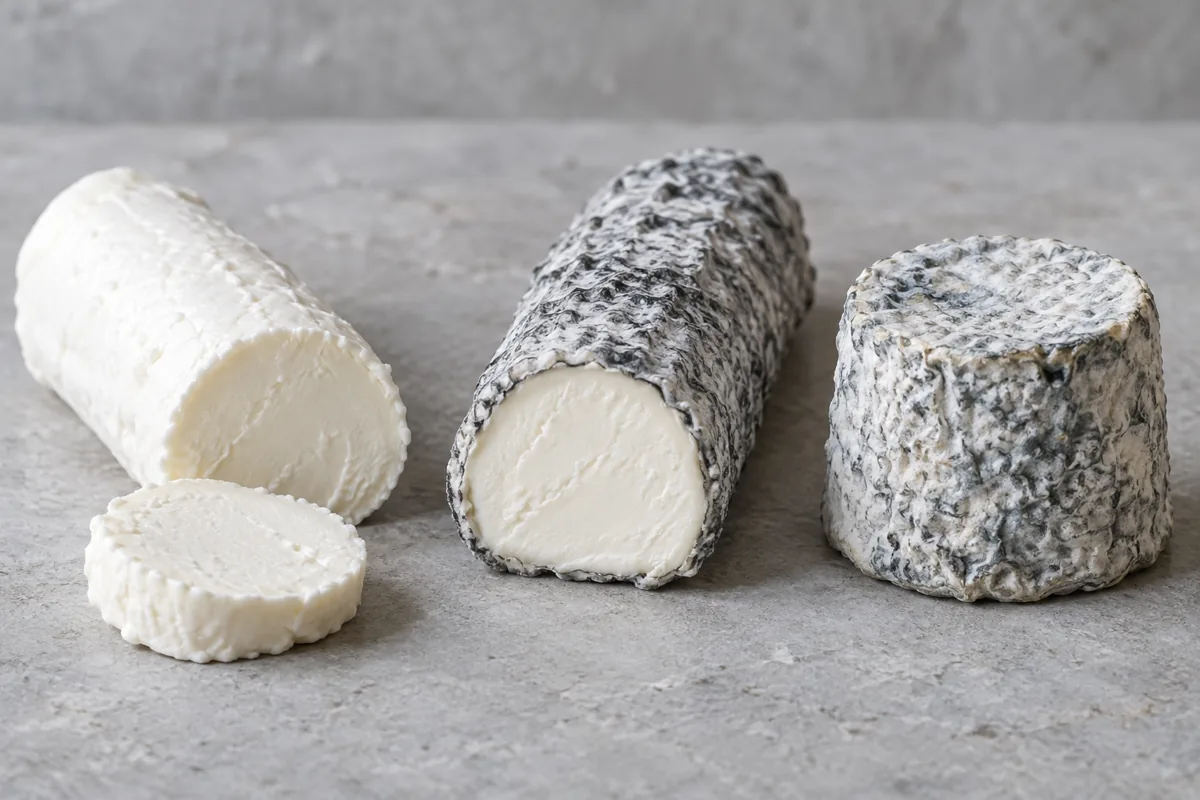
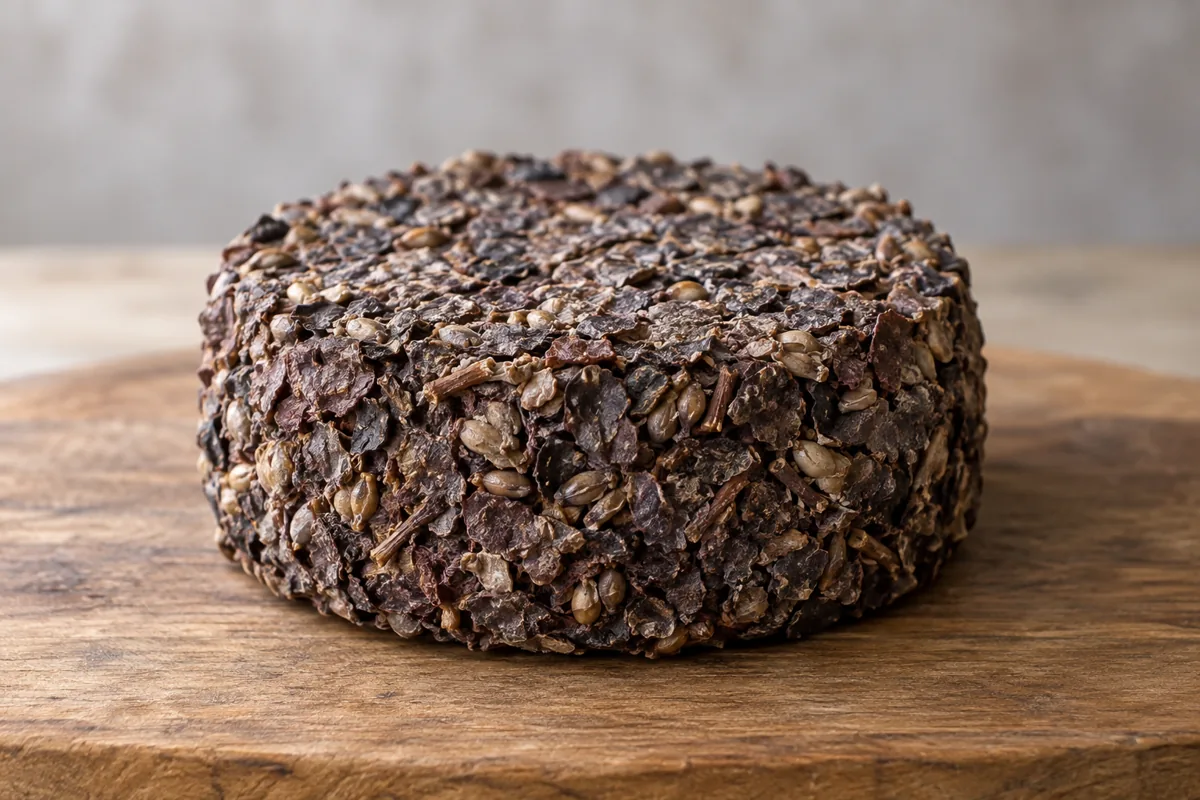
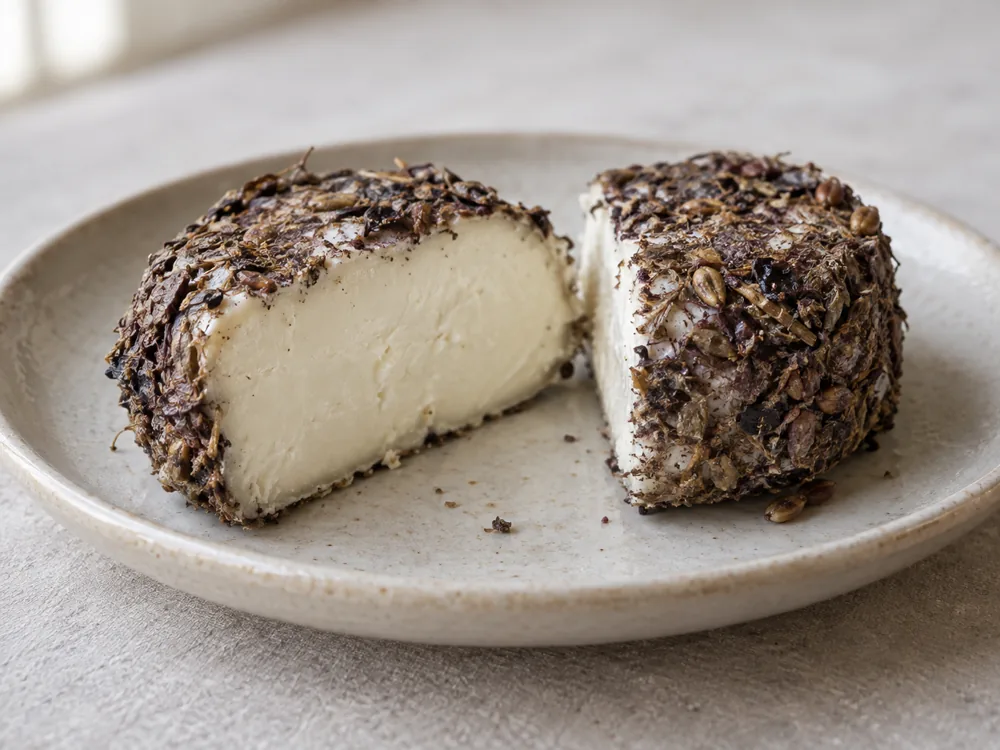
This small French cheese from the Lyon area is coated in grape marc: the pressed grapes' skins, seeds and woody stalk fragments.
It uses cow's milk and sometimes goat's milk. The same unprotected appellation covers arôme de Lyon, arôme de gêne de marc, arôme lyonnais and arôme au vin blanc, in the Auvergne-Rhône-Alpes wine country, and producers can choose different bases, containers and ageing times.
In This Article
Compare the actual piece before paying for it
Compare two different raw-cow products below, a Saint-Marcellin aged in marc and a cheese aged in grape must, without treating their names or similar appearance as proof of pasteurisation.
| Question | Saint-Marcellin aged in marc | Piece aged in grape must |
|---|---|---|
| Who listed it, and under which name? | Les Alpages, as Arôme de Lyon affiné au marc de raisin | Fromagerie du Château, as Arômes de Lyon aux gènes |
| Base cheese and milk | A Saint-Marcellin of raw cow's milk | Raw cow's milk |
| How is it aged? | Steamed with white wine, then aged in barrels of grape marc | 3 weeks with white wine (under 1% of the ingredients) and grape must |
| Weight and listed price | 100 g for €3.45 | 80 g for €3.80 |
| Price per 100 g | €3.45 | About €4.75 |
| How is it described? | Tender and slightly sweet, with powerful aromas, and marked a rare product | Creamy, fruity and slightly vinous, medium to bold |
The prices are the October 2026 record, and stock and prices may have changed since. Les Alpages' 100 g at €3.45 is €3.45 per 100 g, and Château's 80 g at €3.80 works out to about €4.75 per 100 g.
Other records range from 80 g to 150 g, with about 100 g the common figure. Fat is listed at 25% or 28% on the respective records, so the figure varies by base.
Ask which cheese went into the marc
The starting point can be an immature cheese such as Rigotte or St Marcellin, and Picodon and Pélardon are also cheeses that go through the marc treatment. All four are small soft cheeses of south-eastern France made from a lactic curd.
The curds are ladled into moulds, lightly pressed, drained, salted, dried and then aged before the final treatment. A change in base or ageing stage changes what you buy, even under the same unprotected name.
Across the eight descriptions, five give raw or unpasteurised milk and three omit the treatment. Cow's milk alone appears in three, while the other descriptions include goat, so use your pack's milk line rather than an average of those records.
| Question | Answer |
|---|---|
| Which milk? | Cow's, sometimes goat's: sometimes goat's in four descriptions, cow's and goat's in one, and cow's alone in three |
| Raw or pasteurised? | Raw in five descriptions (unpasteurised in one), and no milk treatment given in the other three, so the label of your piece decides |
| How heavy? | 80 to 150 g, about 100 g in most: 80 to 120 g, 100 to 150 g, about 100 g, 100 g |
| What shape and size? | A small flat disc or round, 6 to 7 cm across and 3 cm thick or 6 cm across and 3 cm high |
Separate the marc, wine and grape-must methods
Young cheeses are macerated or cured in fermenting grape skins and pips, then rolled in marc before they are sold. The marc coating gives the finished cheese its rind and its aromas, and the treatment is part of both the finished surface and its flavour.
For historical preservation, marc packed around cheese in barrels or crates excludes oxygen and surrounds it in alcoholic juice. The method is said to have protected unsold summer cheeses against bacterial growth, but do not use that history to assume sterility or extend a package date.
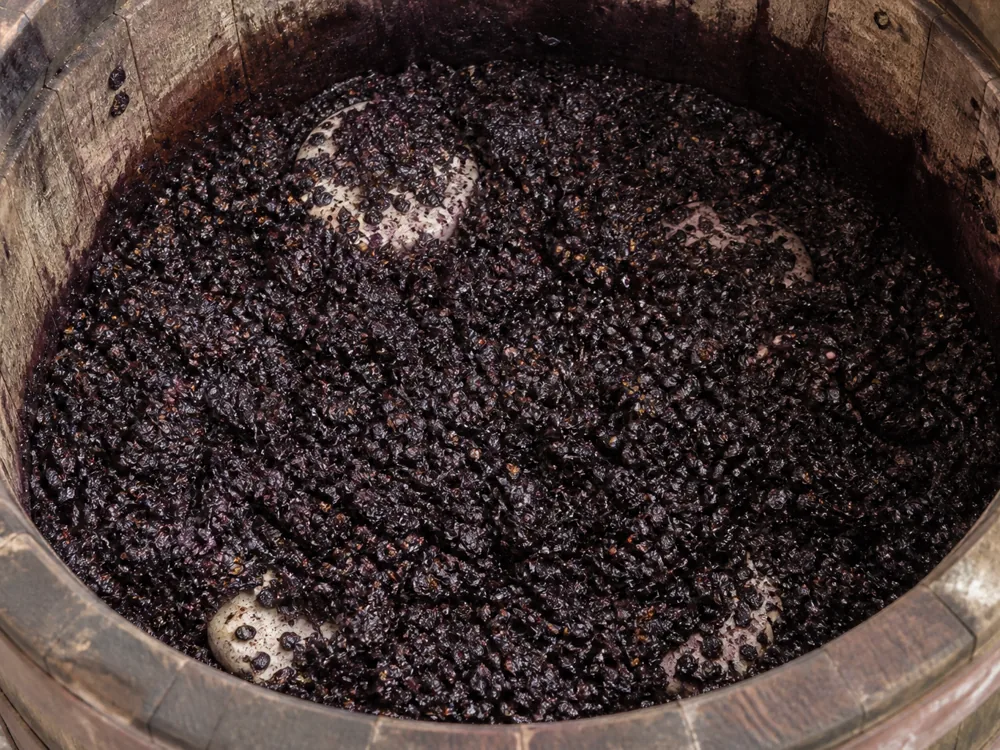
For the jar method, cheeses sit on small racks in jars so they take up the wine vapour. Other accounts describe maceration in white wine or in grape stalks sprinkled with red wine.
The Château piece spent 3 weeks with white wine and grape must, and its label says grape must rather than marc. Les Alpages' Saint-Marcellin is steamed with white wine and then aged in barrels of grape marc, a separate method rather than the same three-week instruction.
| Question | Answer |
|---|---|
| How long in the marc or wine? | 3 weeks to 2 months: 1 to 2 months, 4 to 8 weeks, or 3 weeks for one retail piece |
| How long is the fermentation, then the maceration? | In one account, 2 to 3 weeks of fermentation, then 3 weeks to 1 month of maceration |
| In what? | Grape marc in most accounts, white wine, or grape stalks sprinkled with red wine, or white wine and grape must for one retail piece |
| In which container? | Barrels filled with marc, oak barrels or wooden crates covered with marc, vats or jars, on small racks |
Ask the seller for the ageing time of the actual piece: the records range from three weeks to two months. Keep the separate fermentation and maceration durations in the table attached to their own account.
For availability, there is no single agreed production calendar: French Wikipedia says it is made all year and sells far more in winter, whereas the directory says produced several months after the last of the vintage. Check the seller's piece and stock rather than treating those as one continuous schedule.
Choose young cheese for the creamy texture
For a young, soft creamy paste, ask for the age and base before choosing. The older flaky-hard and firm descriptions below concern texture, and they do not independently confirm a hard-cheese class.
| Question | Answer |
|---|---|
| How does it taste? | Strong, bittersweet and yeasty, or pungent, also fruity milk notes with slightly vinous notes from the marc |
| How does it smell? | Fermented and pungent, or a strong smell of fermenting must |
| What is the texture like? | Creamy and moist when young, flaky and hard when aged, also a creamy melting paste, a firm consistency or a supple texture |
| What is the rind like? | Viscous |
| What colour is it? | An ivory paste under a rind from brown to grey, white, or beige, more or less dark depending on how it is kept |
The directory's flavour word is strong, while the Lyonnais tourism description gives fruity milk notes and slightly vinous notes from the marc. For smell, Androuet's wording is strong, with a fermentation edge, and those attributed profiles can differ between products.
The paste can be ivory or white beneath a brown to grey rind. The darker marc coating contrasts with the paste on a cut disc, and white paste is not the same observation as white mould on the rind.
Serve a small portion with the accompaniments you want
The traditional service is eaten as it is, at room temperature, at the end of a meal, with wine from the region also served at room temperature. For its particular cheese, Château recommends removing it from the fridge 20 to 30 minutes before tasting, but keep that short serving step separate from storage.
Saint-Joseph appears in both Androuet's and the Lyonnais tourism office's suggestions. Other choices are Sancerre blanc and Vacqueyras or Condrieu and a light red Beaujolais, rather than a single required bottle.
| Pairing | Type | Why It Works |
|---|---|---|
| Sancerre blanc | Wine | Suggested by Androuet. |
| Saint-Joseph | Wine | Suggested by both Androuet and OPT, the Lyonnais tourism office. |
| Vacqueyras | Wine | Suggested by Androuet. |
| Condrieu | Wine | Suggested by OPT, which also lists Beaujolais as a light red. |
| Dried fruit and nuts | Food | Suggested by OPT, along with salads and fresh berries. |
For food, try dried fruit and nuts, salads and fresh berries. The same serving account covers an aperitif, a main-course salad, or red fruits or honey for dessert, and a few slices suit the stronger flavour profile.
Keep the seller's storage window with that product
For Château's grape-must piece, the listed cold storage is 4 to 8 °C with eating within five to seven days. These are that retailer's product instructions, which set no general refrigerator setting and guarantee no keeping time for other cheeses aged in marc.
Follow the actual pack's storage and date instructions without turning the warm-up before serving or historic marc-preservation story into an extended keeping period.
Keep milk safety separate from the unmeasured wine treatment
The source set includes raw milk or unpasteurised in five of eight descriptions, including both named retail products, and three give no treatment. Château marks its raw-cow piece not recommended for pregnant women, so the retail description is not a pregnancy clearance.
For raw or unlabelled cheese without a confirmed hard class, follow the NHS rule for unpasteurised foods by cooking thoroughly until the centre is steaming hot. In the US, raw or unlabelled cheese has no CDC safer route even cooked, and the CDC lists raw-milk soft cheese as riskier, and its safer soft-cheese heating line is pasteurised-only.
For confirmed pasteurised soft cheese without white mould, NHS advice permits eating it on milk/class grounds. In the US, heat that pasteurised soft product to an internal 165°F or until steaming hot.
A pasteurised piece with only firm or aged flaky-hard texture wording and no confirmed class can be cooked until steaming hot under NHS advice, and the CDC table has no line for it. A texture word does not establish the hard-cheese permission or a pasteurised-soft heating route.
These milk/class actions do not settle the alcohol question: in one account the cheeses are macerated in white wine, and Château lists white wine at under 1%. That is an ingredient proportion with no measured residual alcohol level, and heating is not proof the cheese becomes alcohol-free.
Check the ingredient list for alcohol, since no source measures how much stays in this wine/marc-treated cheese, and drinking alcohol in pregnancy can cause long-term harm to your baby, in the NHS's words.