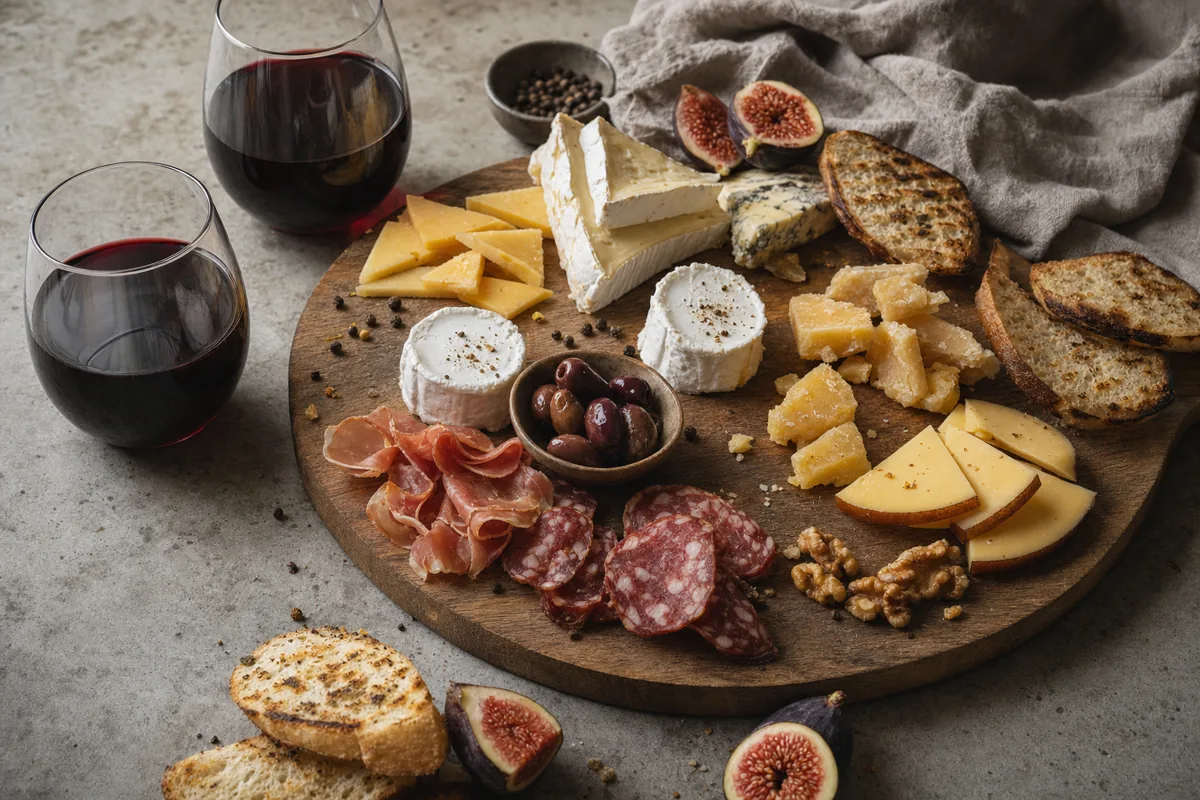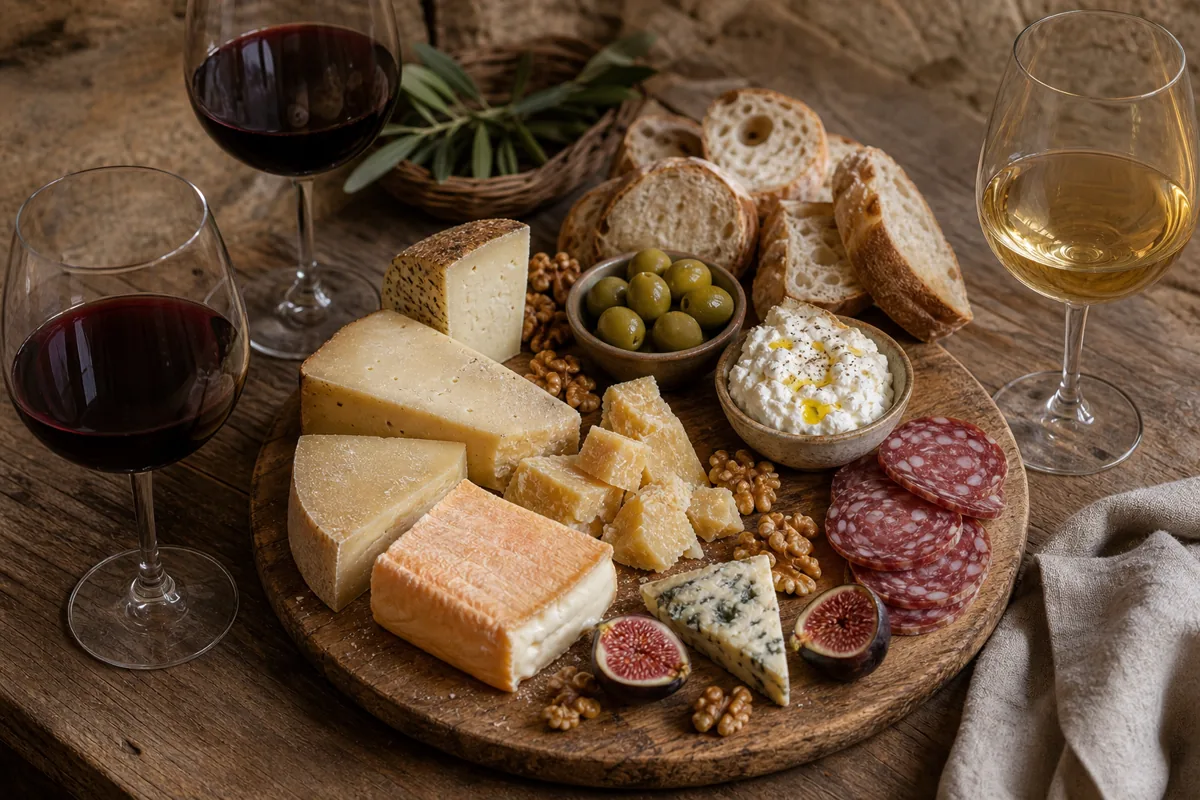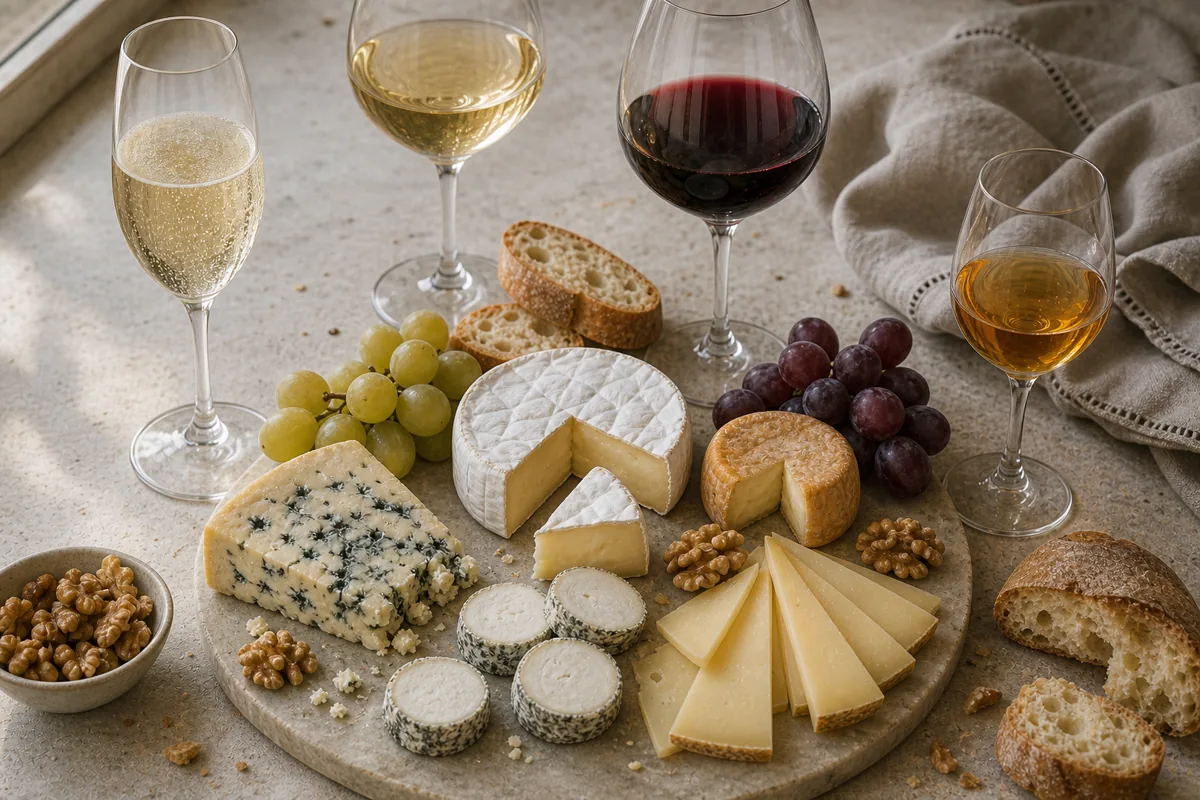
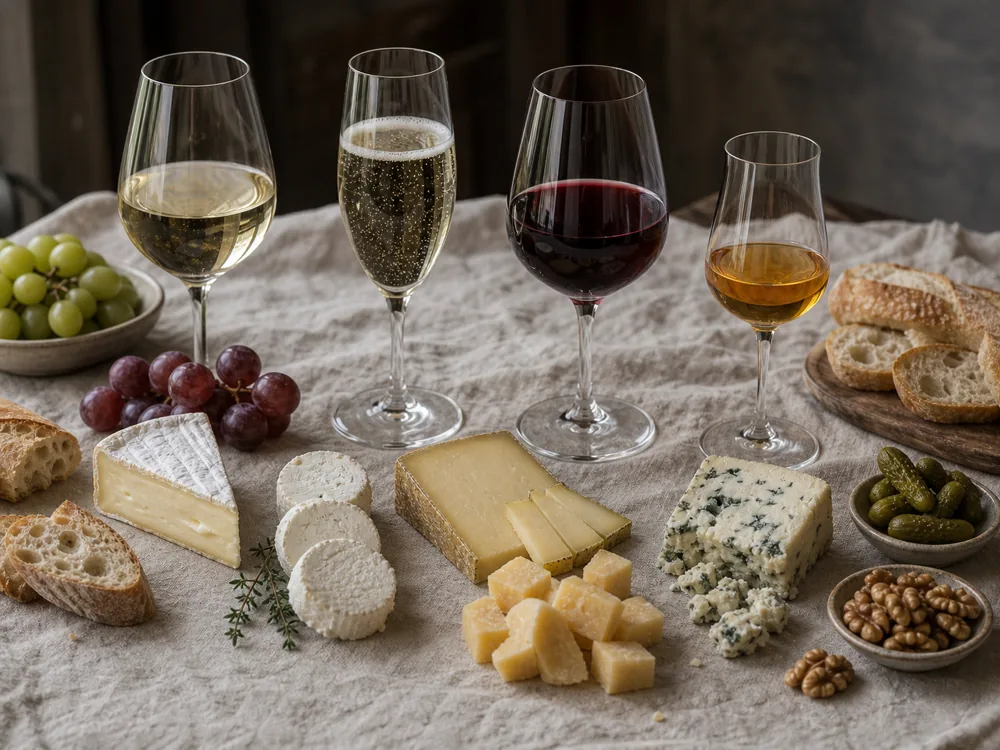
French cheese does not pair as one flavor: a Loire goat cheese, a Jura mountain cheese, a Normandy bloomy rind, and Roquefort each call for a different bottle. Seven published pairing guides and reports name the matches below, and they contradict each other on Camembert, Époisses, and Roquefort.
Two ideas run through them. Cheese and wine from the same region tend to suit each other, which Taste France sums up as "what grows together, goes together."
The second idea is opposition, as taught in a Paris cheese-shop class reported by The Cheese Professor: salt against sugar, fat against acid, and bitter cheese against fruity wine.
In This Article
What Wine Goes With French Cheese?
Taste France calls red-by-default a common misconception: many French cheeses pair better with sparkling, white, or sweet wine, which often has the acidity to balance richness and salt.
Romain Ricciardi, co-owner of the Paris cheese shop Paroles de Fromagers, told his two-hour pairing class that red is the usual French choice but white is quite often the better one, according to The Cheese Professor. He added that the white should not be extremely cold.
| Pairing | Type | Why It Works |
|---|---|---|
| Loire goat cheese + Loire Sauvignon Blanc | White wine | Taste France pairs Loire goat cheese with Sauvignon Blanc-based whites from the same valley. AFAR's fromager says the match works for Sancerre because a high-acid wine meets a high-acid cheese. |
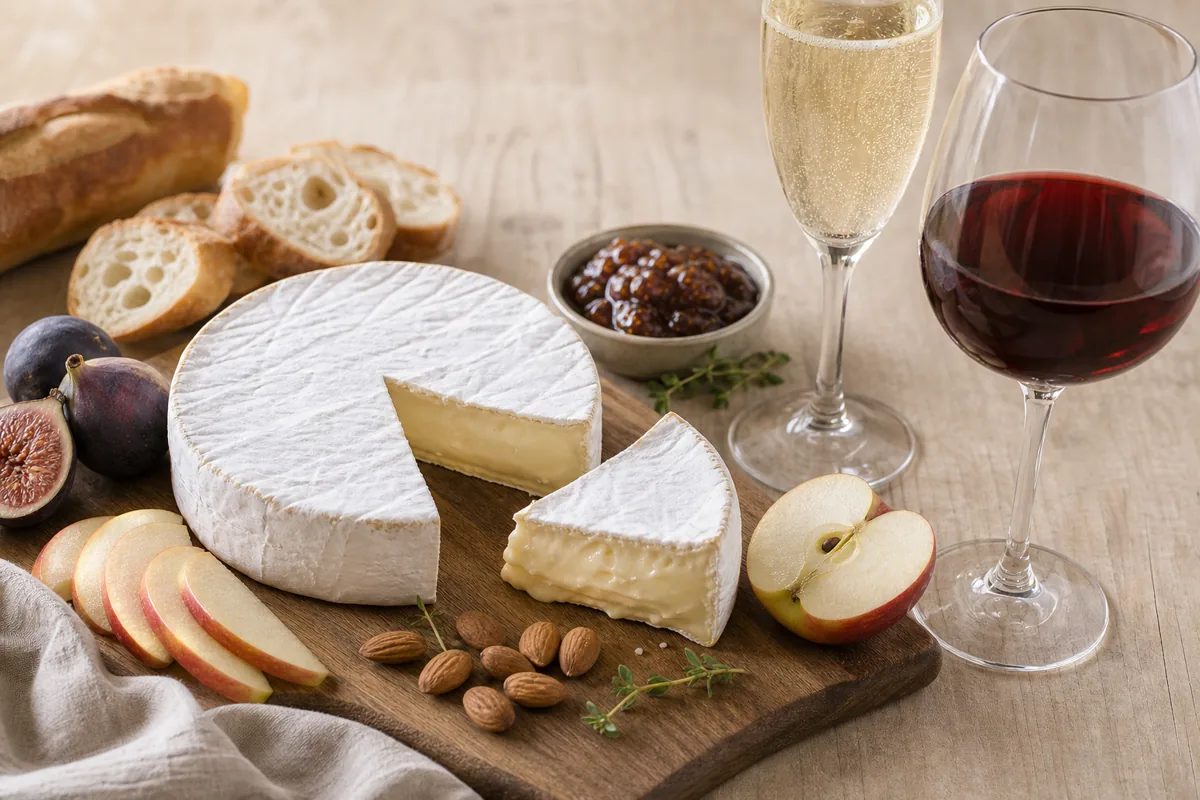
| Brie de Meaux + Champagne | Sparkling wine | Taste France matches Champagne's yeasty flavors and texture to Brie's buttery texture. Cheese.com and Snippets of Paris also name Champagne for Brie. |
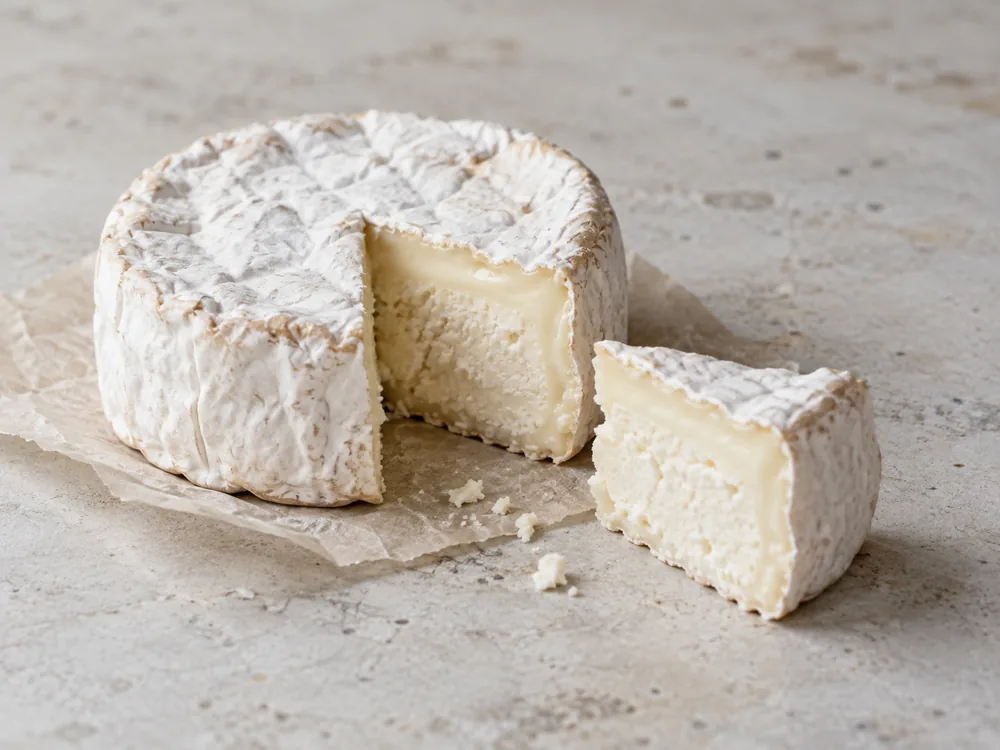
| Camembert + Crémant de Loire | Sparkling wine | Taste France says the acidity and bubbles of Crémant suit Camembert's soft texture and earthy, mushroom-like flavors, and prefers the Chenin Blanc-based Crémant de Loire. |
| Comté + vin jaune | White wine | Taste France says vin jaune's nutty, oxidative character mirrors the nuttiness of Comté. Wikipedia pictures the two with walnuts as a typical Jura combination. |
| Roquefort + Sauternes | Sweet wine | Taste France calls it a contrast pairing, with the cheese's pungency set against the wine's residual sugar. AFAR's fromager says blue cheese is generally salty and a sweet wine balances it. |
| Reblochon + Vin de Savoie | White wine | Taste France says the high acid of Apremont and Chignin whites cuts through the cheese's creamy texture. |
| Raclette de Savoie + white Bourgogne | White wine | Taste France says Chardonnay's bright acidity and creaminess match the similar texture and flavors of the melted cheese. |
| Mimolette + Beaujolais | Red wine | Taste France calls Mimolette a hard cheese that can handle the body and low tannins of a chilled, fruit-forward Gamay. |
Seven of those eight matches are white, sparkling, or sweet, and the one red is a light Beaujolais with a hard cheese.
Why Do Loire Goat Cheese and Sauvignon Blanc Work Together?
Both sides are high in acid, and the match works by echoing that. AFAR's master fromager James Ayers describes Sancerre with goat cheese as a high-acid wine meeting a high-acid cheese, and Taste France points to Sauvignon Blanc from Touraine, or a Vin de France bottling from the same region, for Valençay and Sainte-Maure de Touraine.
In the Paris class, a Pouilly-Fumé went with Selles-sur-Cher, a Loire goat cheese with an ashy grey rind and a short ageing of 10 to 15 days. The class writer found the wine became less acidic, and what could have been a battle between wine and cheese turned into a balanced bite.
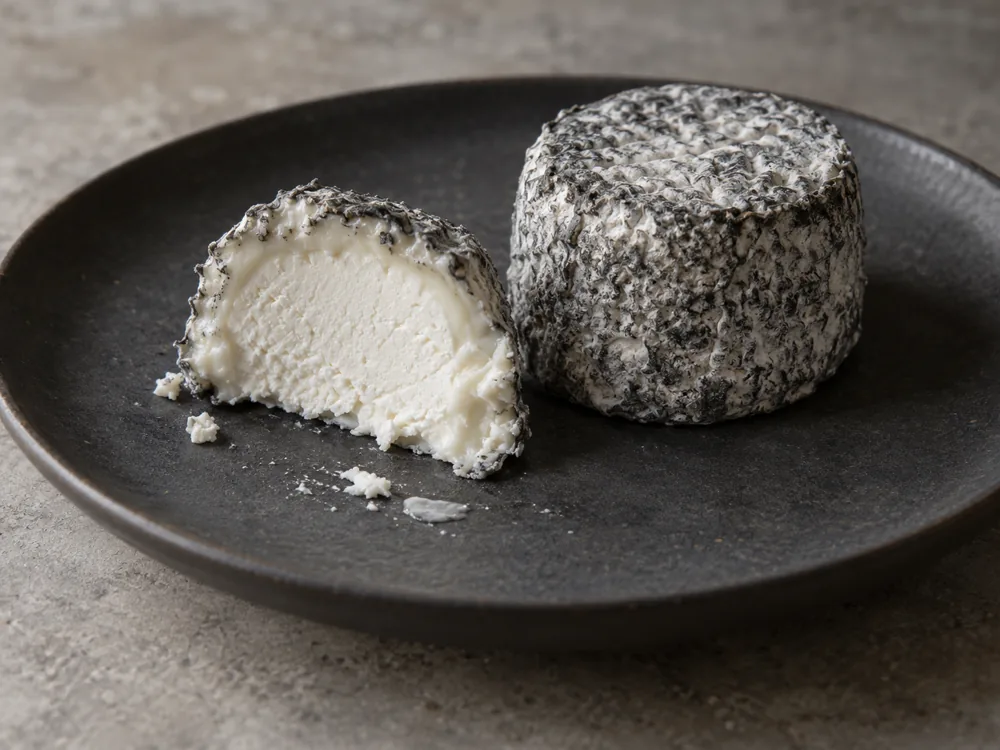
Pong Cheese adds a detail for the plate: the white-grey ash coating on Selles-sur-Cher is edible and has a considerably stronger flavour than the creamy paste inside. It pairs the cheese with a Sancerre from Château de Crezancy, which it describes as crisp citrus and peach with a mineral finish.
Snippets of Paris describes Valençay as a pyramid-shaped goat cheese usually aged around 3 weeks, with a nutty taste from its fine charcoal coating, and pairs it with Sancerre as well.
For a soft bûche de chèvre the same guide prefers an Alsace Riesling, which it says has high acidity and a cleansing aftertaste. That gives a second route to the same acid-for-acid logic when Loire Sauvignon Blanc is not on the shelf.
Why Is Vin Jaune the Classic Wine for Comté?
Vin jaune is a Jura white made from Savagnin grapes and matured in small barrels that are not topped up, so a film of yeast called the voile forms on the surface.
Wikipedia says slight oxidation while the film forms creates compounds that contribute to the wine's flavors, and that the wine takes on nutty flavors as it ages, which Taste France says mirror the nuttiness of the cheese.
Wikipedia gives the time that must pass between harvest and bottling as six years and three months, after which only about 62% of the original wine remains and it goes into squat 62 cl bottles called clavelins. It adds that vin jaune is often served at cellar temperature, 13 to 15°C (55 to 60°F).
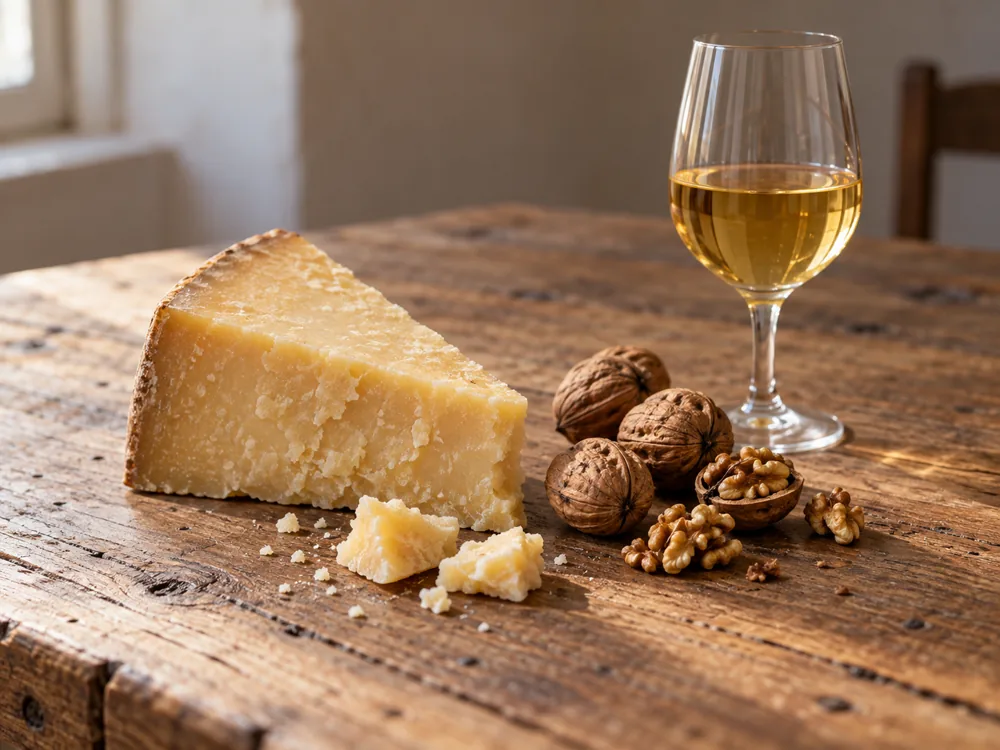
Comté does not depend on vin jaune. In the Paris class, an 18-month Comté that smelled buttery, nutty, and sweet, and was crunchy with crystals, made a good pairing with Sauvignon Blanc.
Pong Cheese serves Comté with a dry white or Champagne, calling the cheese mild, slightly sweet, and nutty.
Other alpine cheeses move the bottle toward Burgundy. Snippets of Paris pairs Beaufort, a Savoie cheese in the Gruyère family with a slightly stronger taste, with Chablis, a white Burgundy made from Chardonnay that it calls rather acid and sometimes mushroomy.
What Wine Goes With Brie and Camembert?
Taste France and The Cheese Professor agree on the direction: Champagne for Brie de Meaux and Crémant de Loire for Camembert de Normandie, or a white or sparkling wine in Ricciardi's class. For Brie de Meaux he said a light red could be okay but a heavy red could be a very bad pairing.
The mechanism is acid against fat. Taste France says Champagne's acidity cuts through creaminess and its bubbles cleanse the palate, and Ricciardi's rule in the class was that fat cheese goes with acidic wine.
AFAR's tasting shows the same effect with a Burgundian triple cream and a Crémant de Bourgogne, where Ayers said the bubbles bounce the fat off the tongue, and the writer found the cheese brought out the almond-powder, doughy notes in the wine.
Cheese.com asks for a Champagne that is dry and low in sugar, and Snippets of Paris says to look for brut.
Champagne is not the only route to bubbles. Taste France says crémants from other French regions would work very well, and AFAR describes Crémant de Bourgogne as made with the same techniques and grape varieties as Champagne, from neighboring Burgundy.
Two lists go the other way and pair Camembert with Bordeaux red, which the table in the next section sets against the white and sparkling answers.
Can You Drink Red Wine With French Cheese?
Yes, with conditions. Taste France says prominent tannins can make cheese taste metallic, so it limits light, low-tannin reds such as Gamay and Pinot Noir to hard cheeses.
Not every guide follows that rule, and the split is sharpest on the cheeses people buy most.
| Cheese | Sparkling, white, or sweet wine | Red wine |
|---|---|---|
| Camembert | Crémant de Loire (Taste France) | Saint-Émilion or Graves (Snippets of Paris); Saint-Émilion with Merlot or Cabernet Sauvignon (Cheese.com) |
| Brie | Champagne (Taste France, Cheese.com, Snippets of Paris); white or sparkling (Paris class) | Light red at most (Paris class); Gevrey-Chambertin with the Brie-style Le Fougerus (AFAR) |
| Roquefort | Sauternes (Taste France, AFAR, Snippets of Paris); sweet white (Paris class) | Saint-Émilion Grand Cru (Pong Cheese) |
| Époisses | None named by the three guides that cover it | Bordeaux red (Paris class); red Bourgogne (Pong Cheese); red Burgundy ruled out (AFAR) |
| Reblochon | Vin de Savoie white (Taste France); Savoie white or Gewürztraminer (Snippets of Paris) | Red Burgundy or Pinot Noir (Cheese.com) |
The disagreement comes from two different theories of balance. Snippets of Paris argues that tannins counter the fat in creamy cheeses like Brie and Camembert, while Taste France and Ricciardi treat tannin as the problem and acid as the fix.
Taste France's rule of thumb: many French cheeses suit sparkling, white, or sweet wine better than red, and the light low-tannin reds, Gamay or Pinot Noir, belong with hard cheese only.
Reds are least disputed with firmer cheeses. Beyond Taste France's chilled Gamay with Mimolette, the Paris class served a Merlot-based Graves with Morbier, a yellow, grassy, spicy cheese with a stripe of charcoal through the middle.
Cheese.com and Snippets of Paris both pair the semi-soft Tomme de Savoie with a Côtes du Rhône red, and Cheese.com adds Shiraz.
AFAR's writer asked for a cheese to go with a Northern Rhône Cornas, and Ayers chose Souréliette du Fédou, a semi-hard sheep's-milk cheese from the south of France. The writer notes that sheep's-milk cheeses are richer in fat than cow's or goat's and often have funkier, meaty flavors, and Ayers called this one "gamy, but then it goes by."
What Wine Goes With Époisses, Munster, and Other Washed-Rind Cheese?
Époisses is where the guides give three different answers. The Paris class describes it as soft, gooey, intense, and salty, washed with salted water and alcohol, and served it with a Bordeaux red.
Pong Cheese says Époisses is washed in brine and Marc de Bourgogne brandy, and pairs it with a red Bourgogne for its earthiness.
AFAR's Ayers says Époisses and red Burgundy are not a pairing for the ages and suggests the Brie-style Le Fougerus instead. Two guides therefore choose a red for Époisses, one of them the Burgundy that a third rules out, and none of the three names a white.
Cheese.com warns that Reblochon's strong flavor and pungent aroma can easily taste bitter without a suitable wine, and Snippets of Paris describes its soft washed rind, mildly fruity taste, and nutty aftertaste.
For Pont-l'Évêque, whose light yellow rind comes from a brine wash and whose paste Pong Cheese calls creamy, slightly sour, and mushroomy, that retailer picks a sparkling wine or a rosé.
A different thread runs through the Alsace and Savoie washed rinds: Gewürztraminer. Snippets of Paris pairs it with Reblochon, Pong Cheese with Morbier, and Matching Food & Wine's Fiona Beckett reported it with Petit Munster at a dinner with the Alsace producer Famille Hugel.
That dinner served the Munster matured but not over-ripe, with a touch of sweetness in the accompaniments to match the wine's opulence, so it shows one chef's execution rather than a rule.
What Wine Goes With Roquefort?
A sweet one, by most accounts, because Roquefort is salty and sugar answers salt. Ricciardi's class rule was that salt and sugar make a good opposition, AFAR compared the balance to a chocolate-covered pretzel, and Snippets of Paris says the cheese is so salty that it wants Sauternes or an Alsace Muscat.
Wikipedia describes Sauternes as a Bordeaux sweet wine from Sémillon, Sauvignon Blanc, and Muscadelle grapes affected by noble rot, with sweetness balanced by acidity and flavors such as apricot, honey, and peach.
The cheese changes with age. AFAR's Roquefort, a sheep's-milk cheese aged in the natural caves of Mont Combalou, had a peppery finish that the Sauternes tempered, and its crystallization from age brought out cashew-butter and dried-coconut notes in the wine.
When there is no sweet bottle, the Paris class matched a cow's-milk blue, Bleu d'Auvergne, with a fruity, spicy Viognier from the Rhône, and the writer said the fruit counteracted the strong, salty cheese.
How Do You Build a French Wine and Cheese Flight?
Two of the guides describe a tasting in pour order. The Paris class poured seven cheeses against three wines, starting with a Loire Sauvignon Blanc through four cheeses, then a Bordeaux red, then a Viognier, and AFAR's five pairings ran from sparkling wine to Sauternes.
| Order | Paris class (The Cheese Professor) | Napa tasting (AFAR) |
|---|---|---|
| 1 | Selles-sur-Cher with Pouilly-Fumé | Crémeux des Cîteaux (triple cream) with Crémant de Bourgogne |
| 2 | Tomme Corsoise with Pouilly-Fumé | Couronne de Fontenay (goat) with Sancerre |
| 3 | Comté, 18 months, with Pouilly-Fumé | Le Fougerus (Brie-style) with Gevrey-Chambertin |
| 4 | Brie de Meaux with Pouilly-Fumé | Souréliette du Fédou (sheep) with Cornas |
| 5 | Morbier with Graves red | Roquefort with Sauternes |
| 6 | Époisses with Graves red | No sixth pairing |
| 7 | Bleu d'Auvergne with Viognier | No seventh pairing |
Both flights move from light and acidic toward rich, salty, and sweet, and both end on a blue cheese. Neither opens with a red.
The Paris class also shows a pairing that fell short. The salty Tomme Corsoise, a sheep's-milk cheese aged 3 months, made the Sauvignon Blanc taste different and sweeter, and the writer judged it a weaker match than the goat cheese.
Ricciardi's reason for keeping to white there was that many reds are too sharp for sheep's-milk cheese.
His method for judging a match is to swallow the cheese, sip the wine and swallow, then inhale through the mouth and exhale through the nose, and never to sip while cheese is still in the mouth.
For travelers he gave a shortcut: when you find a good cheese in France, look for a nearby winemaker, because products from the same terroir pair well.
What Should You Check at the Cheese Counter?
Three cues from the guides show what to ask for at the counter before choosing a bottle.
- Season of make for Comté: Ricciardi says milk from spring, summer, and autumn is better than winter milk, because in winter the cows stay on the farm and their food is not as good as the mountain grasses and flowers.
- Fillet or none for Brie: AFAR reports that in France you are asked whether you want Brie with a fillet. The cut face shows a slick, gooier perimeter around a chalkier, matte interior, the older the Brie the wider the shiny band grows, and Ayers prefers his Brie fresher.
- Which Gruyère: Cheese.com pairs Gruyère with Beaujolais and calls it a Swiss cheese, while Snippets of Paris says there is a Swiss Gruyère and a French one from the Jura, so check which one is on the counter before treating the match as French.