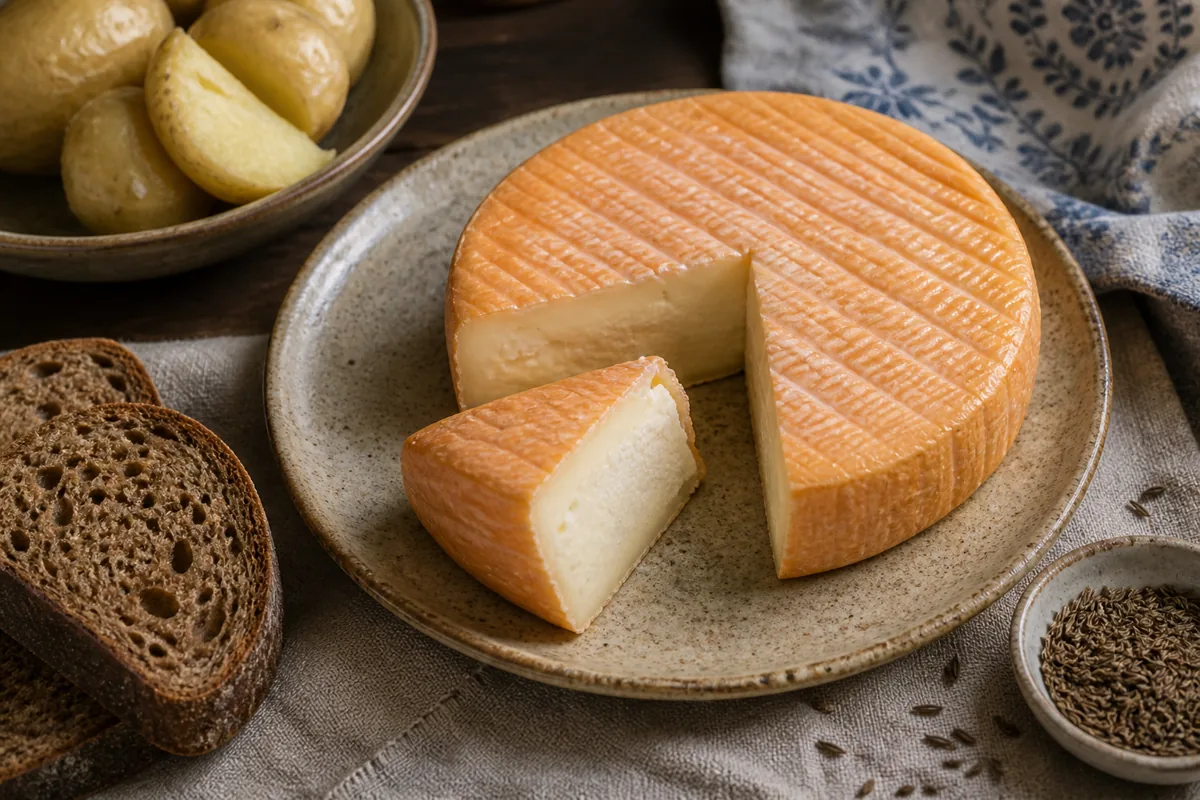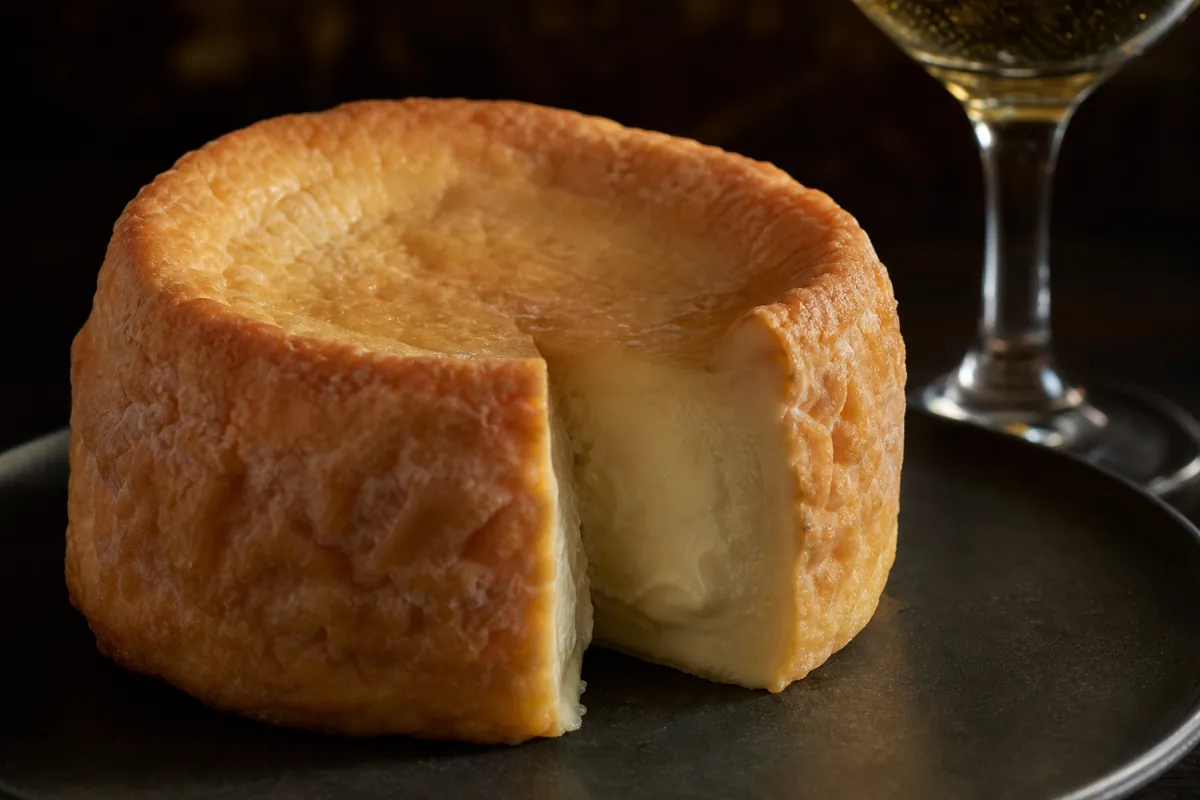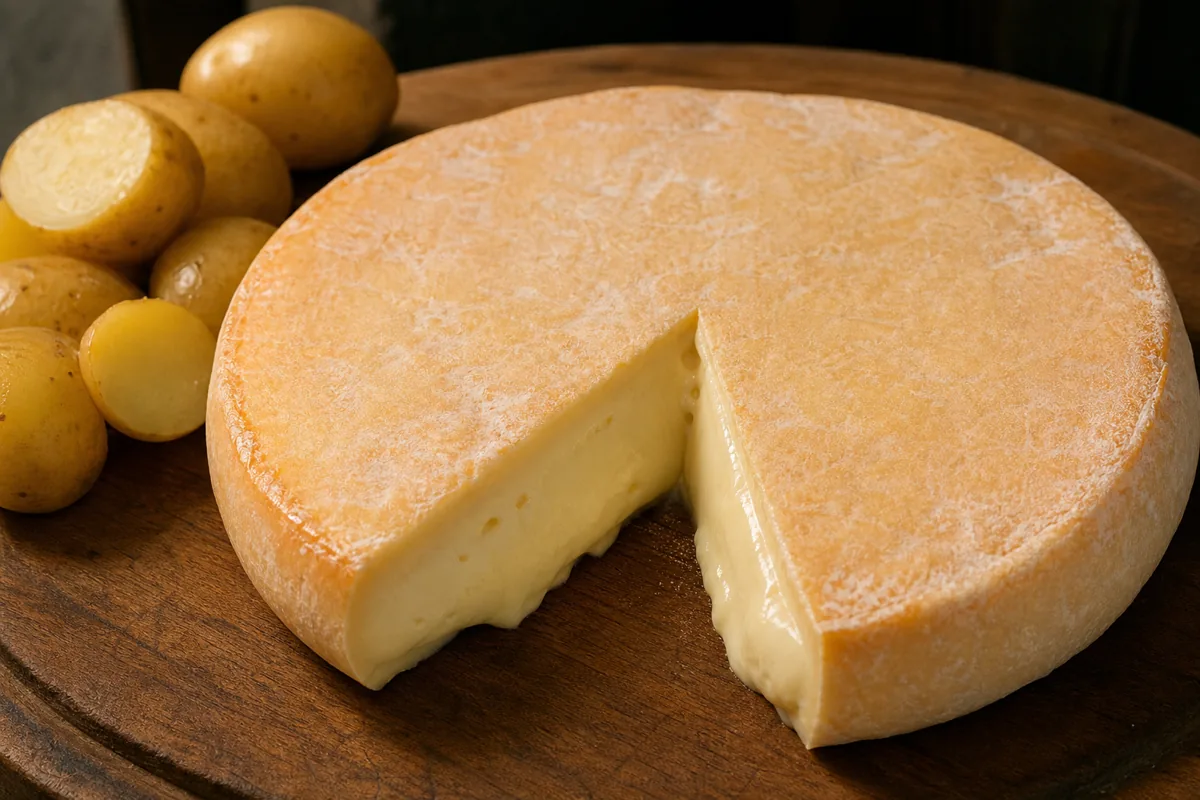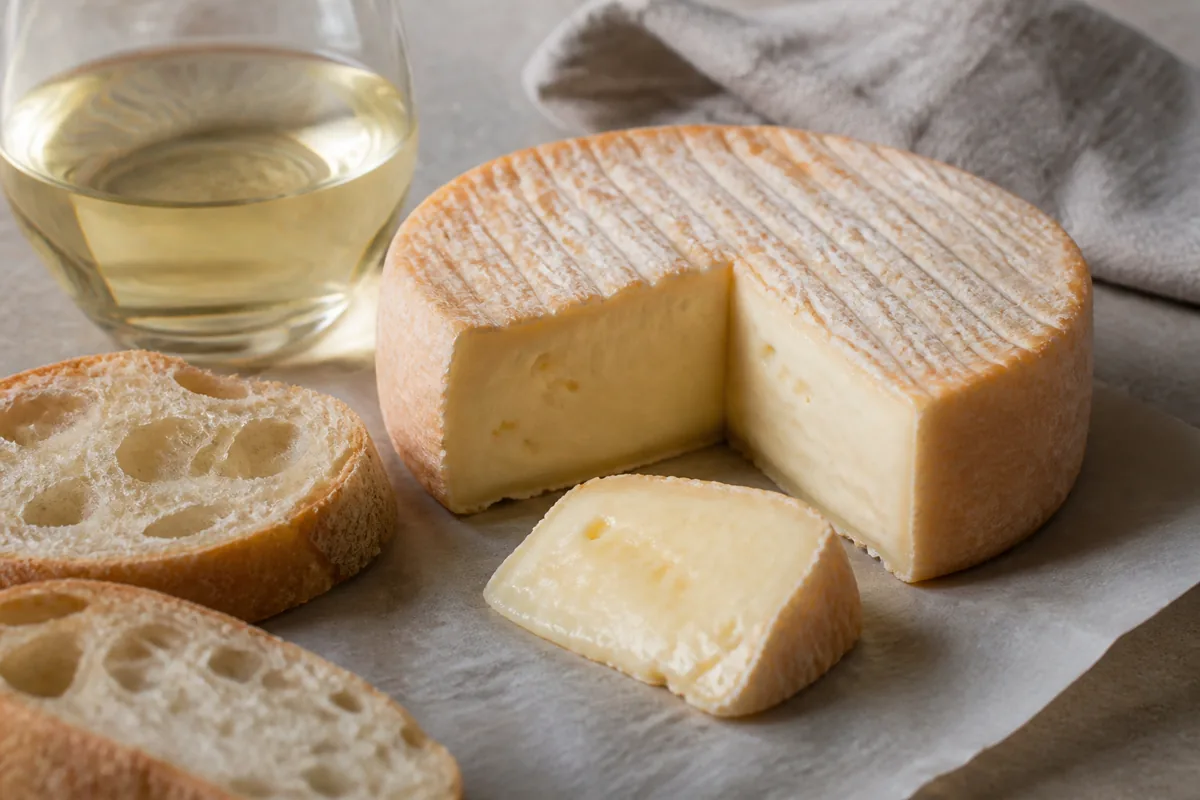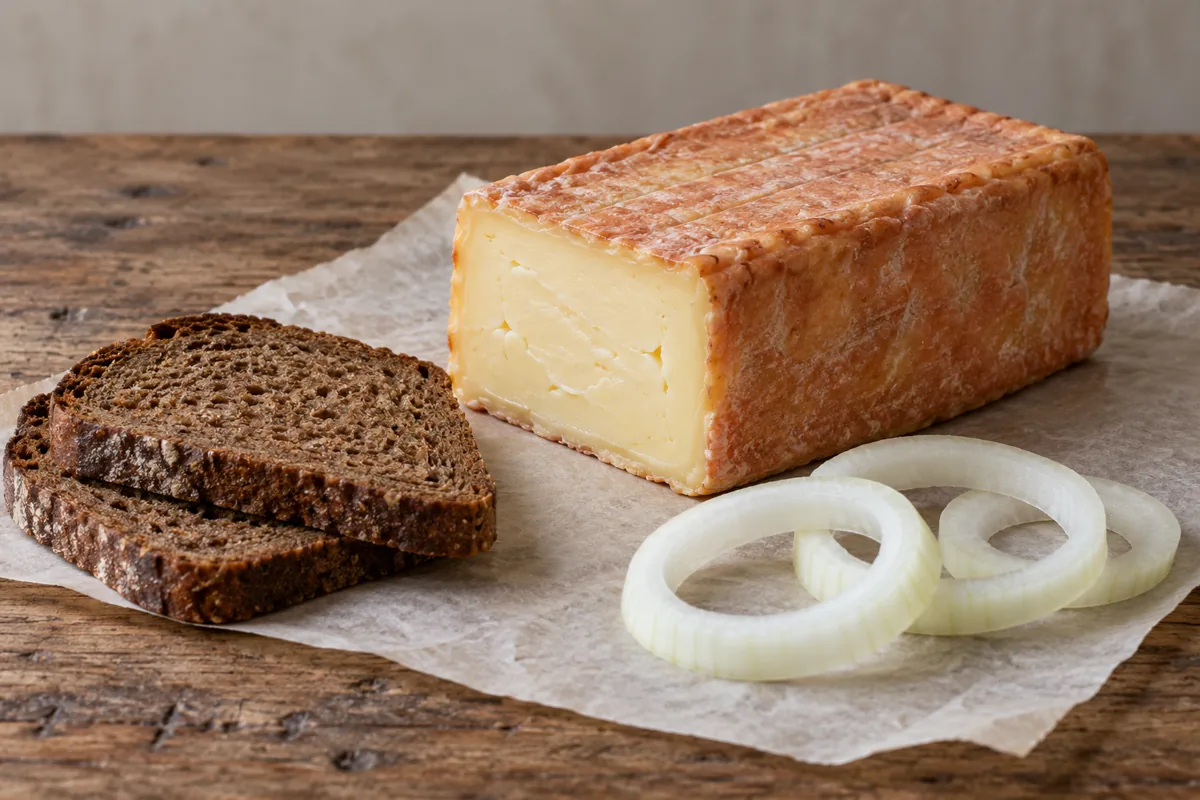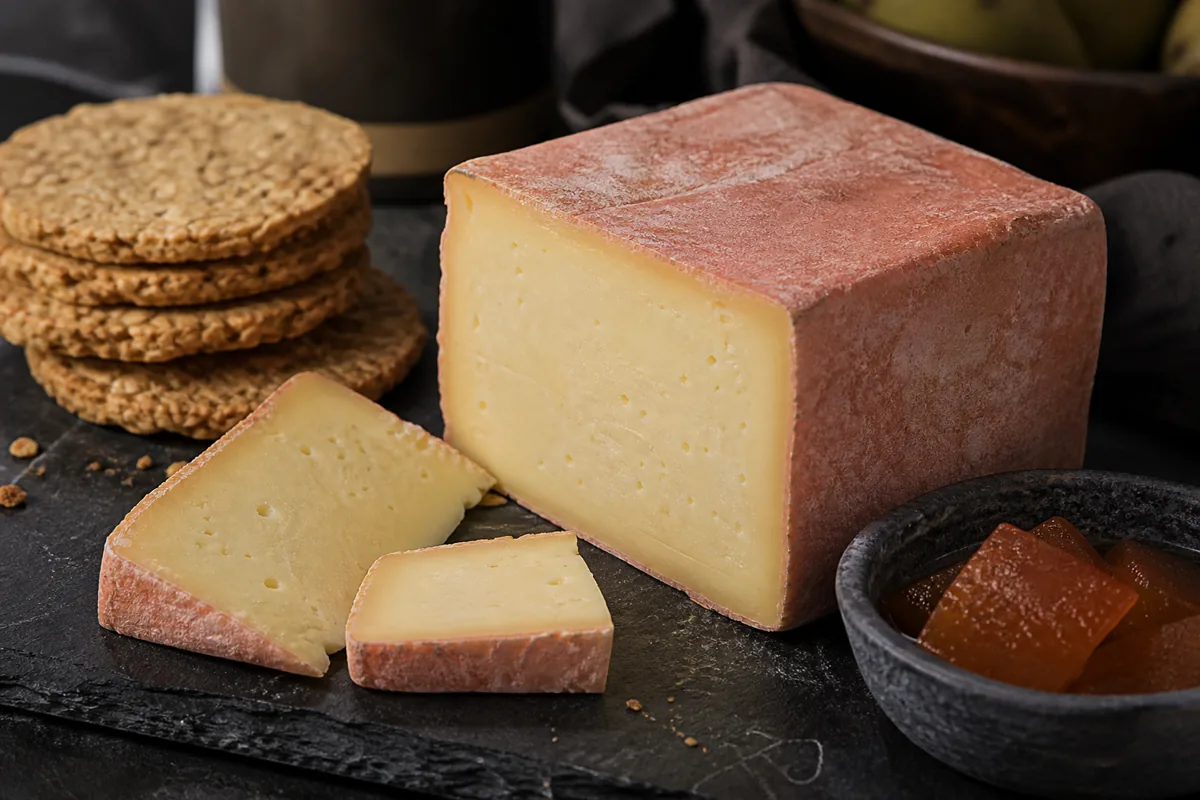
Epoisses is a soft French cheese from Burgundy, made from whole cow's milk and washed with water and Marc de Bourgogne for at least four weeks.
Its smell arrives long before its taste. The dairy Berthaut calls its Epoisses frank in taste and far more balanced than its smell suggests, while the producers' syndicate describes a powerful, penetrating animal nose followed by fruity sweetness and a creamy feel.
In This Article
What Does the Epoisses AOP Guarantee About Milk and Method?
The French specification, published with decree no. 2010-50 of 12 January 2010, defines Epoisses as a cheese of whole cow's milk with a soft paste and a washed rind. Both the milk and the cheese must come from listed communes in Côte-d'Or, Haute-Marne and Yonne.
Only Brune, Montbéliarde and Simmental française cows may supply the milk, and at least 85% of their yearly feed, counted as dry matter, must grow inside the area.
The syndicate adds that grass must make up at least 50% of the ration until 15 June, and that feeds giving milk a taste, such as cabbage and leek, are banned along with feeds that artificially raise yield. It says milk from these breeds, fed on forage from the area and free of GMOs, is rich in protein and suits a lactic cheese like Epoisses.
| Point | What the specification says |
|---|---|
| Milk | Whole cow's milk from Brune, Montbéliarde or Simmental française cows |
| Curd | Mainly lactic set lasting at least 16 hours, curd cut roughly and not broken up |
| Draining and salt | Drains on its own; salted with dry salt only |
| Ripening | At least 4 weeks from the day of making, washed one to three times a week |
| Small format | 95 to 115 mm across, 30 to 45 mm high, 250 to 350 g |
| Large format | 165 to 190 mm across, 30 to 45 mm high, 700 to 1,100 g |
| Composition | At least 40 g dry matter per 100 g of cheese and 50 g fat per 100 g of dry matter |
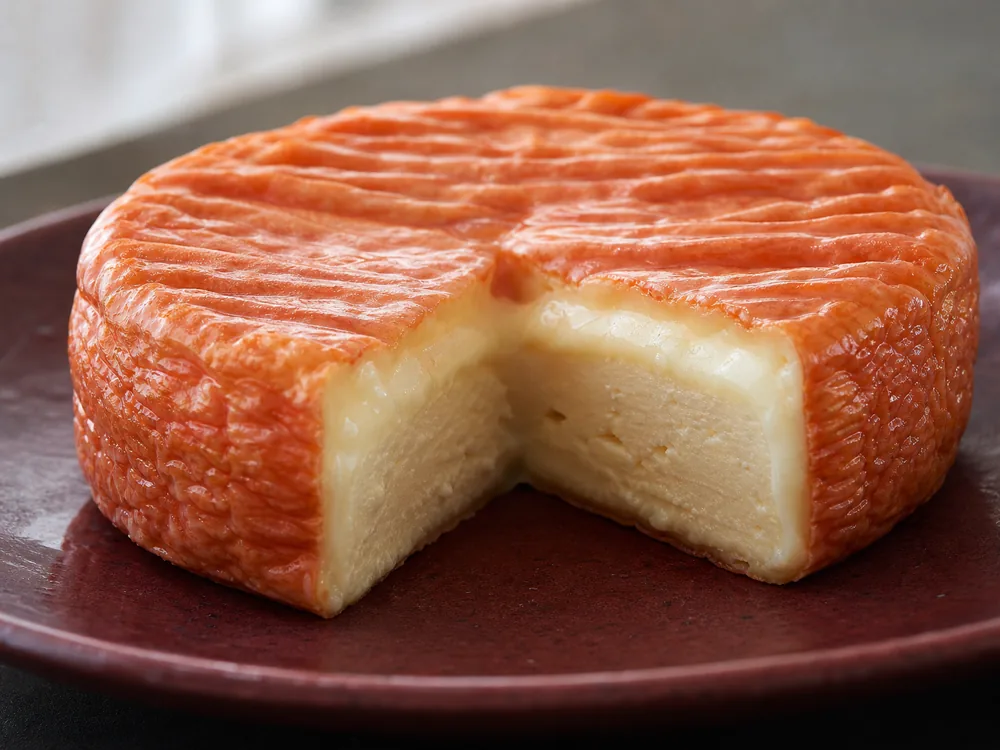
| Rind | Smooth or slightly wrinkled and shiny, ivory-orange to brick red; added coloring banned |
French Wikipedia gives 250 g as the usual weight, inside the small format's range.
Both formats are 30 to 45 mm high, so the large wheel is wider rather than thicker, and English Wikipedia's figures of about 10 cm and 18 cm across match the two diameters.
The syndicate says its own agents audit half of the farms and dairies each year, and that the certifier Bureau Veritas audits the syndicate, half of the dairies and about 20% of the farms.
The syndicate adds that Bureau Veritas runs the official tastings, at least 4 times a year, with a panel of about 15 accredited people. They judge the dairies' Epoisses on shape and color, smell, aroma and paste texture, and a cheese needs at least 14 out of 20 to count as AOP Epoisses.
The name therefore vouches for how the cheese tastes as well as where the milk came from.
The specification traces a farmhouse cheese sold at local markets around Epoisses to accounts dated 1386. Produits Laitiers AOP and the producers' syndicate credit a religious community in the 16th century, and English Wikipedia adds that the monks of Cîteaux Abbey are named only by oral legend.
Production faded after the First World War and had almost stopped by the 1950s, according to English Wikipedia, which credits Robert and Simone Berthaut with the relaunch in 1956.
Epoisses gained French AOC status in 1991 and European PDO status on 21 June 1996, according to French Wikipedia. The syndicate counts 40 farmers with about 3,000 dairy cows and 21 million litres of milk behind 1,457 tonnes of cheese a year, while Produits Laitiers AOP gives 1,409 tonnes sold in 2020.
French Wikipedia dates the 1,457 tonnes to 2024 and gives 361 tonnes for 1992, so sales are about four times what they were in the year after the AOC.
How Marc de Bourgogne Shapes the Rind
The specification says the cheese is washed with water, salted or not, and then with water holding more and more Marc de Bourgogne until it is ripe. English Wikipedia describes Marc de Bourgogne as the local pomace brandy.
The orange color comes only from pigments made by bacteria on the surface, the red-smear ferments in particular, and the specification bans added coloring.
French Wikipedia names Brevibacterium linens as the bacterium the washing encourages, and says it synthesizes the carotene behind the orange-red rind color as well as the strong aromas.
French Wikipedia adds that the same bacterium is used for Munster, Maroilles, Fourme de Montbrison, Limburger, Herve, Tilsiter and Appenzeller, so an orange rind and a strong smell alone do not identify an Epoisses.
The syndicate calls Epoisses the last appellation cheese in France that pairs a lactic curd with a washed rind, and says its original method has barely changed.
On arrival the milk is warmed to 25 to 30 °C for a light ripening, then lactic bacteria and rennet are added, and the syndicate says the slow set of 16 to 24 hours is the mark of the cheese. A lactic set therefore still includes rennet, a point that matters to readers avoiding animal rennet.
After the set the syndicate lists curd cut into cubes of 1 to 2 cm, natural draining in perforated molds with the cheeses turned twice in about 24 hours, and drying at about 12 °C and 90% humidity.
Dry salting follows after about 48 hours of drying, and Berthaut says it takes 2 to 3 seconds per cheese, one face and then the other, with the same dose each time.
Berthaut says the first rub comes before any rind has formed and uses lightly salted water with ripening ferments, among them the red-smear ferment that colors the cheese. The cheese is wetted sparingly, never dipped in the bucket, and smoothed with the fingertips and then the palm, according to the same article.
Berthaut then gives 7 to 9 rubs with water that gets more and more marc over close to five weeks, which it says goes beyond the AOP requirements.
| Source | Ripening time given |
|---|---|
| AOP specification | At least 4 weeks from the day of making |
| Producers' syndicate | At least 4 weeks |
| Berthaut (Qui veut du fromage article) | Close to five weeks, with 7 to 9 rubs of water enriched in Marc de Bourgogne |
| English Wikipedia | Around six weeks |
Four weeks is the legal floor. The longer figures describe one producer's practice or a reference site's summary, so a four-week wheel is still genuine Epoisses.
What Does Epoisses Taste Like?
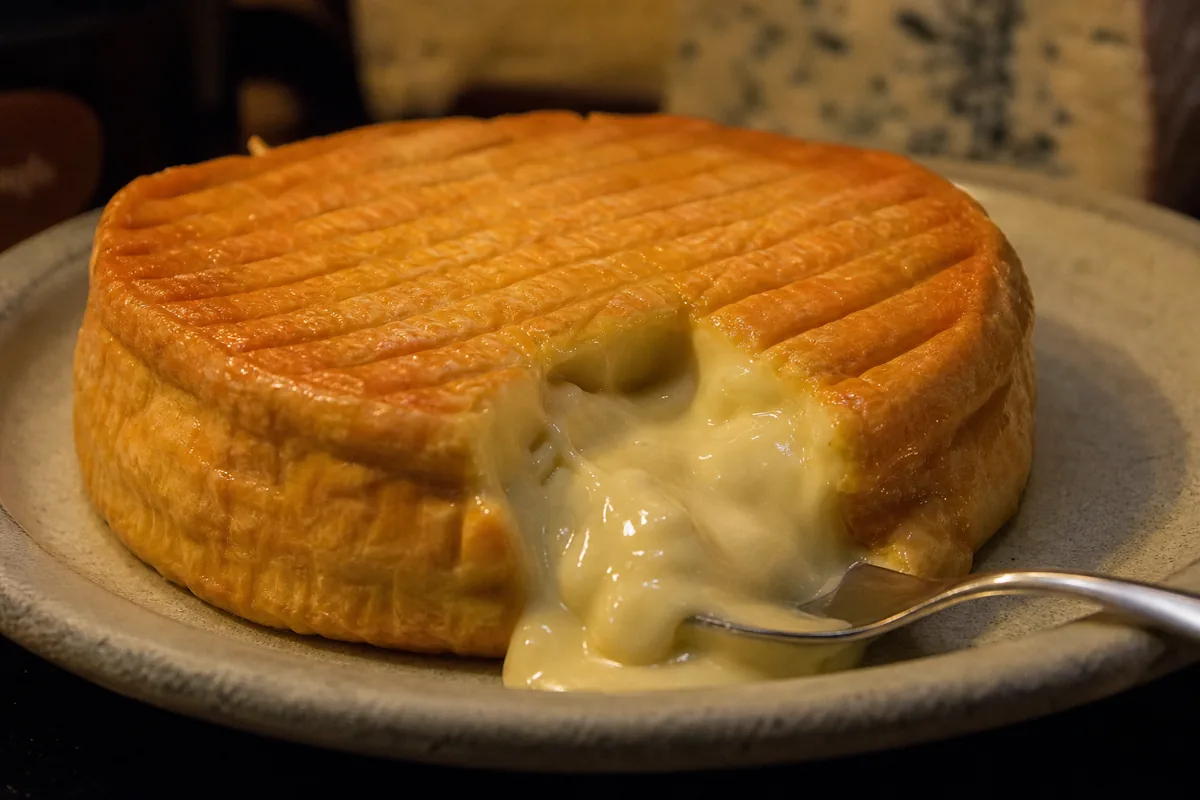
Berthaut describes a melting paste and a frank taste, which makes a strong smell at the counter a poor guide to the flavor in the mouth.
Produits Laitiers AOP describes a distinct animal fragrance with undergrowth aromas. It calls the taste subtle, fruity, clear and balanced, with flavors of undergrowth and dried fruit.
The syndicate's own tasting line joins the two sides: a powerful, penetrating animal nose, then a fruity sweetness and a creamy feel.
Produits Laitiers AOP describes a creamy paste that melts in the mouth, and the specification adds that the paste is light beige, supple and slightly salted. Mon Marché rates the intensity as very powerful, with salty, animal and milky notes.
How Ripeness Changes Epoisses
The specification ties the rind color to maturity, ranging from ivory-orange to brick red as the cheese ripens. Other sources add cues from the paste and the taste.
- Less ripe: the middle is slightly crumbly, per Produits Laitiers AOP.
- Fully ripe: the paste turns runny, per the Mon Marché listing for Berthaut's 250 g cheese.
- Flavor with age: notes move toward barnyard and cows as the cheese ripens, per Produits Laitiers AOP.
The specification words the paste cue differently: the core is partly proteolysed depending on maturity, meaning its milk proteins are only partly broken down.
Packing is not allowed before day 29 after the milk is set, the syndicate says, so a boxed AOP wheel is always past the four-week minimum. Rind color and paste texture then show how far past it the wheel has gone.
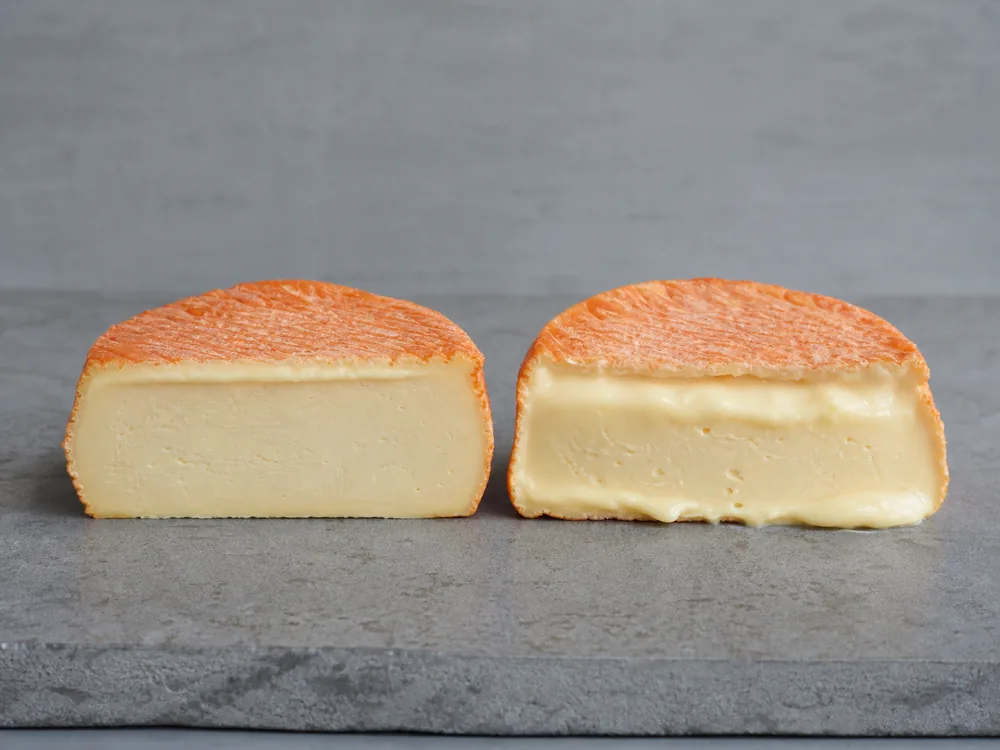
French Wikipedia's text names May to November, the grazing season, as the best time to eat Epoisses, though it is eaten from December to April as well; its introduction says May to October.
Mon Marché lists the season as March to December with the core between May and October, so May to October falls inside every window these sources give.
Is Epoisses Made from Raw or Pasteurized Milk?
Produits Laitiers AOP says Epoisses may be made from raw, thermised or pasteurized milk. French Wikipedia puts the raw-milk share at just 11.3% of the 1,094 tonnes made in 2009.
The Berthaut 250 g cheese sold by Mon Marché is labelled a pasteurized cow's milk cheese, with milk, salt, rennet, lactic ferments and Marc de Bourgogne as its ingredients.
That label names rennet without saying what kind, so a reader avoiding animal rennet needs to ask the maker.
| Nutrient | Per 100 g |
|---|---|
| Fat | 24 g |
| Saturated fat | 17 g |
| Protein | 18 g |
| Salt | 1.8 g |
The label's 24 g of fat and the specification's 50 g minimum measure different things. The specification counts fat against dry matter only, while the label counts it against the whole cheese, water included.
Is Epoisses Safe During Pregnancy?
Neither the NHS nor the CDC names Epoisses or washed-rind cheese, so the answer turns on the milk printed on the label and on whether the cheese is cooked until steaming hot.
The CDC lists soft cheese made from unpasteurized (raw) milk, such as brie made from raw milk and blue-veined cheese, as a riskier choice.
It also lists any queso fresco-type cheese as riskier, whether made with pasteurized or unpasteurized (raw) milk, and says pregnant women are 10 times more likely to get a Listeria infection. It lists pasteurized soft cheeses heated to an internal temperature of 165 °F or until steaming hot as safer.
Served cold, Epoisses is described as a pasteurized soft washed-rind cheese, a type the CDC list does not cover, so ask a midwife or doctor.
The NHS says pasteurised or unpasteurised mould-ripened soft cheeses with a white coating, such as brie and chèvre, must be thoroughly cooked. It says the same of pasteurised or unpasteurised soft blue-veined cheeses.
The NHS also warns that unpasteurised or soft ripened dairy foods may contain listeria, and it counts any cheese cooked until steaming hot as safe. Both agencies sort cheese in pregnancy by milk and cheese type: the NHS lists pasteurised soft cheeses as safe to eat and says foods made from unpasteurised milk, which includes raw or thermised Epoisses, must be thoroughly cooked.
What Should You Serve and Pair with Epoisses?
Mon Marché advises taking Berthaut's Epoisses out of the refrigerator at least one hour before eating so the paste softens fully.
The CDC says perishable food, dairy included, should go back in the refrigerator within 2 hours, or within 1 hour above 90°F, so that softening hour uses up half of the 2-hour limit before the first slice.
Produits Laitiers AOP says to cut wedges from the middle outwards. On a cheese board, that cut gives each wedge a share of rind and center.
Mon Marché calls the rind entirely edible and part of the flavor, and recommends eating it for the full experience.
| Pairing | Type | Why It Works |
|---|---|---|
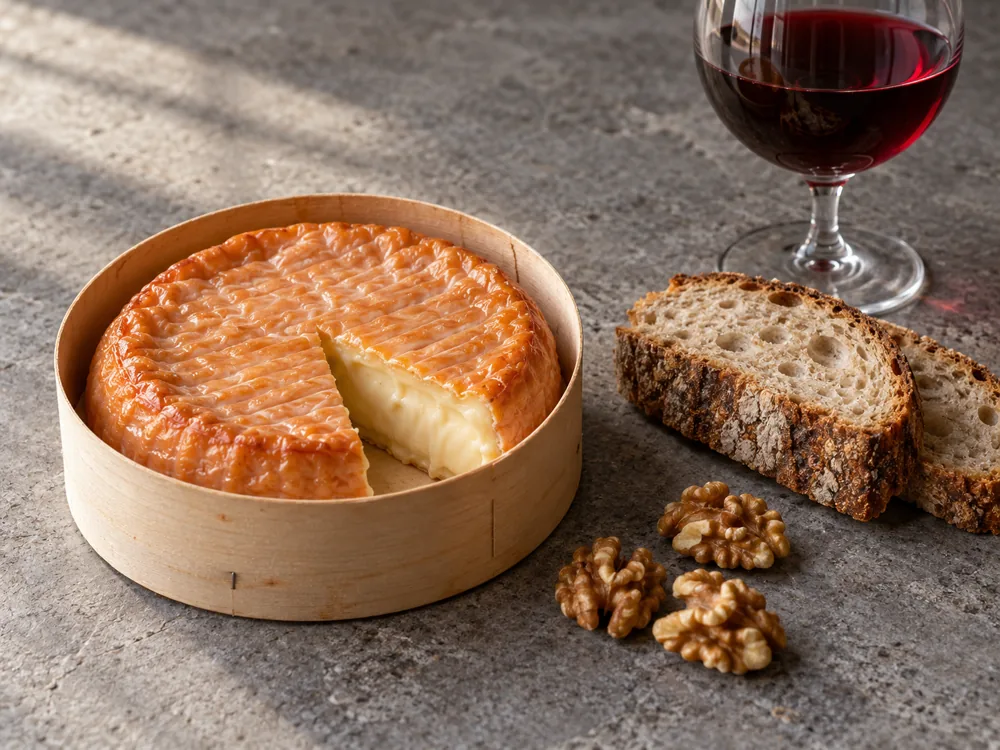
| Breads | Food | Wholemeal, rye or gingerbread per Produits Laitiers AOP; sourdough with a generous crust per Berthaut; country bread per Mon Marché. |
| Whites | Wine | Burgundy, Alsace or Savoie dry white per Produits Laitiers AOP; a Touraine white per Mon Marché. |
| Reds | Wine | Burgundy, Jura, Loire, Bordeaux or Rhône reds per Produits Laitiers AOP; Gevrey-Chambertin or a Saumur red per Mon Marché. |
| Sparkling | Wine | Sparkling rosé, per Produits Laitiers AOP. |
| Beer, juice and tea | Drink | Amber beer, apple and pineapple juice, or red tea from China, per Produits Laitiers AOP. |
Berthaut also puts Epoisses in an endive salad with soft, sweet fruit such as pear and grapes. Mon Marché suggests rustic country bread or walnuts to counterbalance the cheese's character.
The syndicate's own tartine recipe puts a medium-ripe Epoisses on toasted country bread with Morvan ham, basil and optional strawberries dressed with balsamic vinegar.
Mon Marché gives a reason for each wine: a Gevrey-Chambertin to bring out the cheese's complex aromas, a Saumur red to stand up to its character, and a Touraine white for a fresher touch.
What Can You Cook With Epoisses?
Berthaut says Epoisses melts into a creamy sauce for roast or braised meat, goes into endive and ham gratins, quiches and savory cakes, and can be melted in a fondue pot or the oven. Mon Marché adds that its pronounced flavor holds up well to heat.
| Dish | What happens to the cheese | Amounts and timing |
|---|---|---|
| Croque-monsieur loaf | Sliced into a thick béchamel until it melts, then layered with ham between puff pastry | Half a cheese; baked 40 minutes at 200 °C |
| Croquettes | Cut into discs, frozen, breaded twice and deep-fried | Fried 10 minutes at 180 °C |
| Curry shortbread | Blended raw with butter, flour and curry | 200 g cheese to 300 g flour; baked 30 minutes at 180 °C |
| Brioche | A piece sealed inside each ball of dough | 25 g in a 100 g ball; baked 20 minutes at 180 °C |
| Crème brûlée | Melted into hot cream, mixed with egg yolk and baked in a water bath | 200 g cheese in 250 g cream; 1 hour at 120 °C |
| Yellow tomato gazpacho | Pieces placed in the bowl before the chilled soup is poured over | Soup chilled at least 1 hour |
Two of the syndicate's recipes keep the heat low: the risotto takes the cheese in off the heat, and the squash tempura is topped with pieces of it for 5 minutes in the oven, long enough to melt it slightly.
Mon Marché's own ideas are simpler: a piece melted slowly into well-buttered mashed potato, ready in about 10 minutes, beside grilled meat, or melted into a well-seasoned sauce for red meat.
Who Makes Epoisses, and Does the Maker Matter?
French Wikipedia lists three dairies in 2018, Gaugry at Brochon, Berthaut at Époisses and Germain at Chalancey, plus one farm producer at Origny, the Gaec des Marronniers.
French Wikipedia puts farm-made Epoisses at 34 of the 1,457 tonnes sold in 2024, about 2%, though farm output grew 70% from 2014 while the total grew 4%.
All four work to the same specification under the syndicate's checks, and only Berthaut's method is described in detail.
How Should You Buy and Store Epoisses?
The CDC says to keep a refrigerator at 40°F (4°C) or below. The Mon Marché listing, advice from one retailer for one producer, says to keep Berthaut's cheese in its original packaging, ideally in the vegetable drawer, and to avoid cling film so the washed rind can breathe.
English Wikipedia says Epoisses is sold in a circular wooden box, and French Wikipedia adds that the box eases transport and storage and that cheesemongers and market traders also sell it by the wedge.
Which Burgundy Cheeses Are Washed Like Epoisses but Are Not Epoisses?
French Wikipedia warns that the Epoisses name should not be confused with neighboring Burgundy cheeses that borrow its technique. Soumaintrain, a cow's milk cheese with its own IGP, is washed in brine, and the raw goat's milk poiset au marc is washed with marc de Bourgogne, as Epoisses is.
Ami du Chambertin is a commercial Burgundy creation washed with marc, according to French Wikipedia.
Affidélice is another commercial Burgundy creation, washed with chablis wine, according to the same source.
A marc wash alone therefore does not make an Epoisses: the name also needs the listed area, the three breeds and the lactic set that the specification requires.
Which Other French AOP Cheeses Have a Washed Rind?
Produits Laitiers AOP files Epoisses under soft cheese with washed rinds, and four other French AOP cheeses share that label.
| Cheese | Area | Milk | Rind detail |
|---|---|---|---|
| Langres | Around Langres | Raw, thermised or pasteurized | Light yellow or reddish brown; a dip on top for drops of Champagne or Marc de Bourgogne |
| Maroilles | Thiérache, Nord and Aisne | Raw cow's milk | Natural orange; brushed and washed with salty water for 3 to 5 weeks |
| Munster | Mainly Lorraine and Alsace | Raw, thermised or pasteurized | Washed regularly in a damp cellar |
| Livarot | Pays d'Auge, Normandy | Normande cow's milk, raw, thermised or pasteurized | Yellowish-orange and sandy to the touch |
The dip on top of a Langres cheese can take the same Burgundy spirit: Produits Laitiers AOP says a few drops of Champagne or Marc de Bourgogne can go into it.
Square Maroilles measures 13 cm a side and 6 cm thick, and Produits Laitiers AOP credits a monk of Maroilles Abbey with making it in the 10th century.
Livarot from the Pays d'Auge is nicknamed the Colonel for the five strips of reedmace around it, which Produits Laitiers AOP says were first meant to stop it sagging during ageing.
Munster made in Lorraine and Alsace also takes its name from a monastery, according to the same source. None of our sources ranks these cheeses as substitutes for Epoisses; they share the washed rind and the PDO category.
SOURCES & REFERENCES
Yes. English Wikipedia describes the rind as edible, and it is where the washing with Marc de Bourgogne builds the color and the smell.
Some is. Produits Laitiers AOP allows raw, thermised or pasteurized milk, and French Wikipedia put the raw-milk share at 11.3% in 2009.
The rind is washed one to three times a week with water and Marc de Bourgogne, which encourages surface bacteria that give the orange color and the strong aroma.
The AOP specification requires at least four weeks from the day of making. Berthaut says close to five weeks for its cheese, and English Wikipedia says around six.
It depends on the milk and on cooking. The CDC lists raw-milk soft cheese as riskier, and the NHS says any cheese cooked until steaming hot is safe, so ask a doctor or midwife.