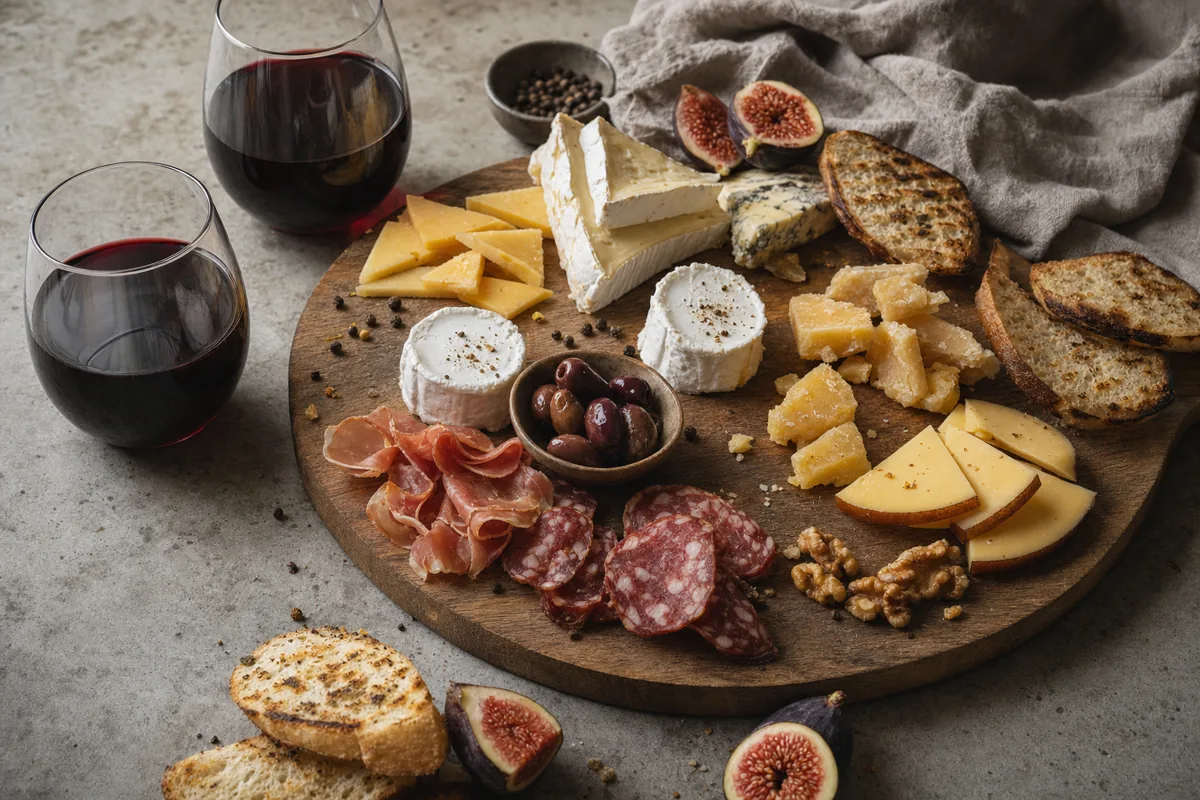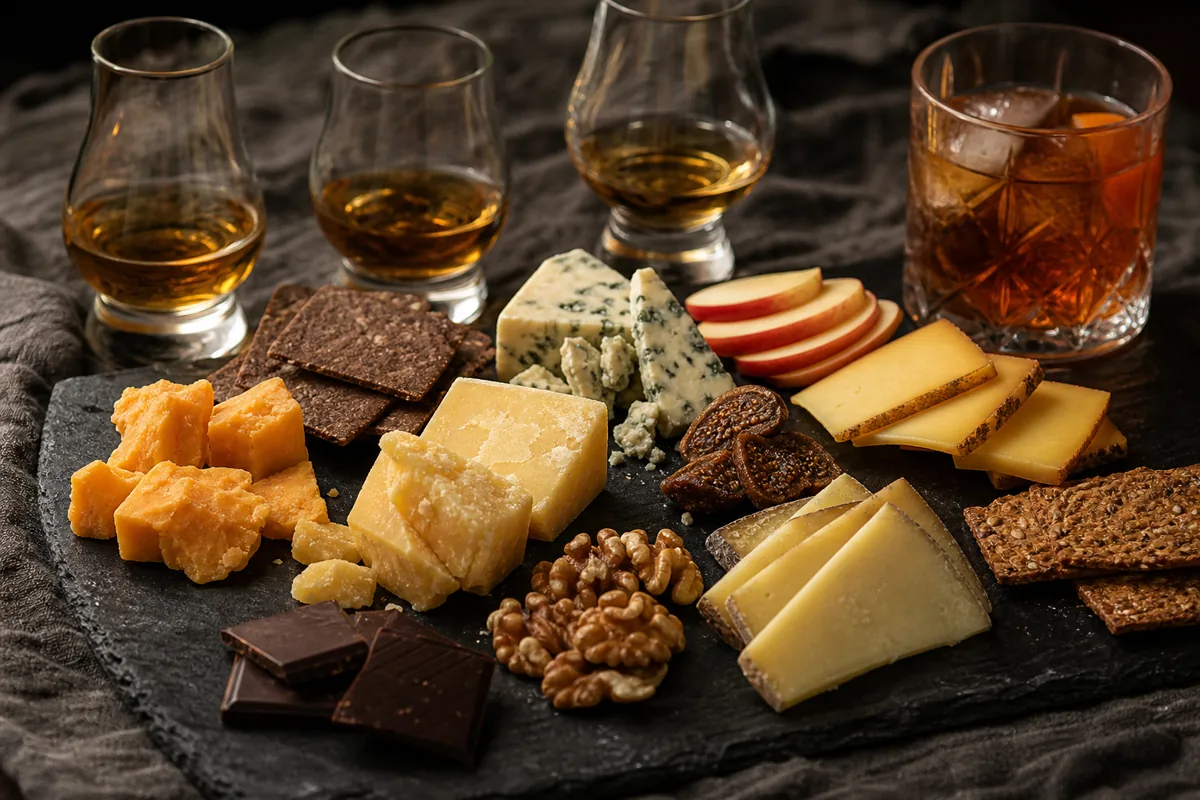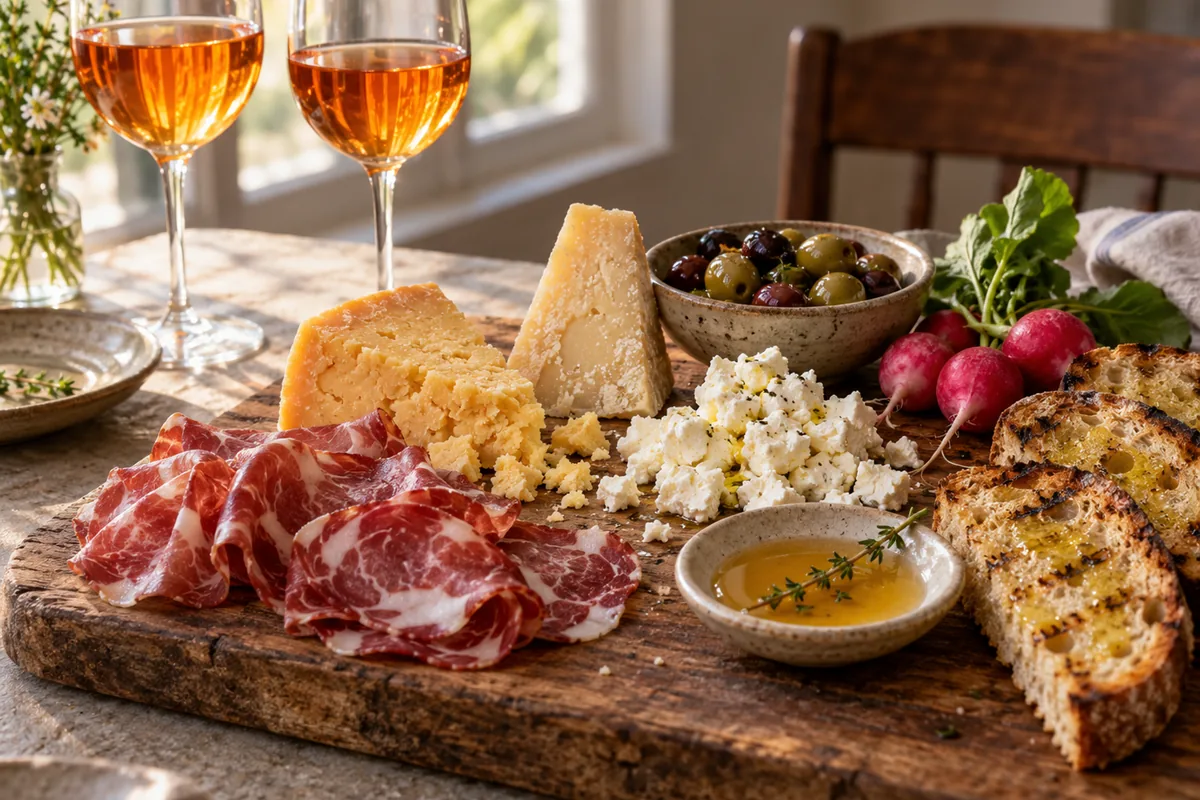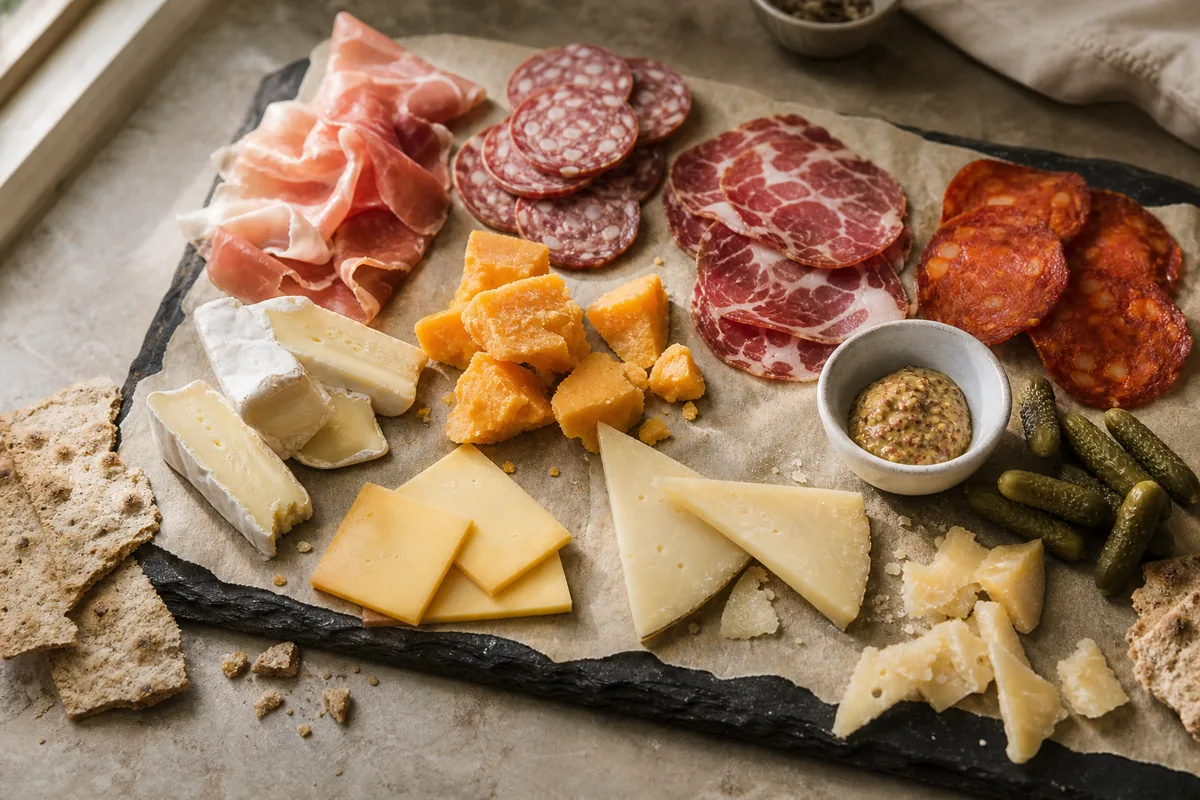
A label that says salami can mean a sausage seasoned with garlic and black pepper or one made with chilies and cayenne, and each asks for a different cheese.
This guide starts from the meat and names the publisher behind every pairing: Cheese.com, Wisconsin Cheese, The Cheese Professor, Saxelby Cheesemongers, and Tasting Table. Where they disagree, the sections below say so and give each side's reasoning.
In This Article
Which Cheese Goes With Which Meat?
Each line below is a pairing that one or more of those publishers names, with the publisher in the text.
| Pairing | Why It Works |
|---|---|
| Prosciutto + Parmesan | Named by Cheese.com, Wisconsin Cheese, The Cheese Professor, Tasting Table, and Saxelby Cheesemongers. Thin, soft ham against hard, crumbly cheese. |
| Salami + Gouda | Wisconsin Cheese pairs Gouda with salami. Cheese.com and The Cheese Professor pair it with Calabrese, a spicy salami, and The Cheese Professor specifies aged Gouda. |
| Soppressata + Havarti | Named by Cheese.com and Wisconsin Cheese. |
| Chorizo + Manchego or tangy goat cheese | The Cheese Professor names Manchego or Mahón. Saxelby Cheesemongers names a tangy goat cheese. |
| Ham + Etorki | Cheese.com pairs Etorki, a French sheep's-milk cheese, with ham, and The Cheese Professor specifies jamón serrano. |
| Bresaola + Gorgonzola Dolce | The Cheese Professor pairs the lean cured beef with sweet, mild blue cheese. |
| Ground beef + Pepper Jack | Cheese.com pairs Pepper Jack with cooked ground beef in a queso dip. |
| 'Nduja + Alpine-style cheese or fresh chèvre | Wisconsin Cheese names Alpine-style cheese. Saxelby Cheesemongers names fresh chèvre. |
Cheese.com and Wisconsin Cheese write Parmesan for the prosciutto match, while Tasting Table, The Cheese Professor, and Saxelby Cheesemongers write Parmigiano Reggiano, so this guide counts the two names as one cheese.
Chorizo and 'nduja get a different cheese from each publisher that covers them, so each has its own section below.
What Kinds of Cured Meat Are at the Deli Counter?
Two families matter before any cheese is chosen. Salumi are whole pieces of meat that are salted and air-dried, often sliced thin, and The Cheese Professor describes them as lean, salty, and mild, with some smoked.
Salame are sausages: ground meat stuffed into a casing, with textures from hard to soft and from lean to fatty. Their flavor comes from the meat, which can be pork, beef, duck, boar, or venison, and from aromatics such as wine, garlic, fennel, herbs, chili, or truffle (The Cheese Professor).
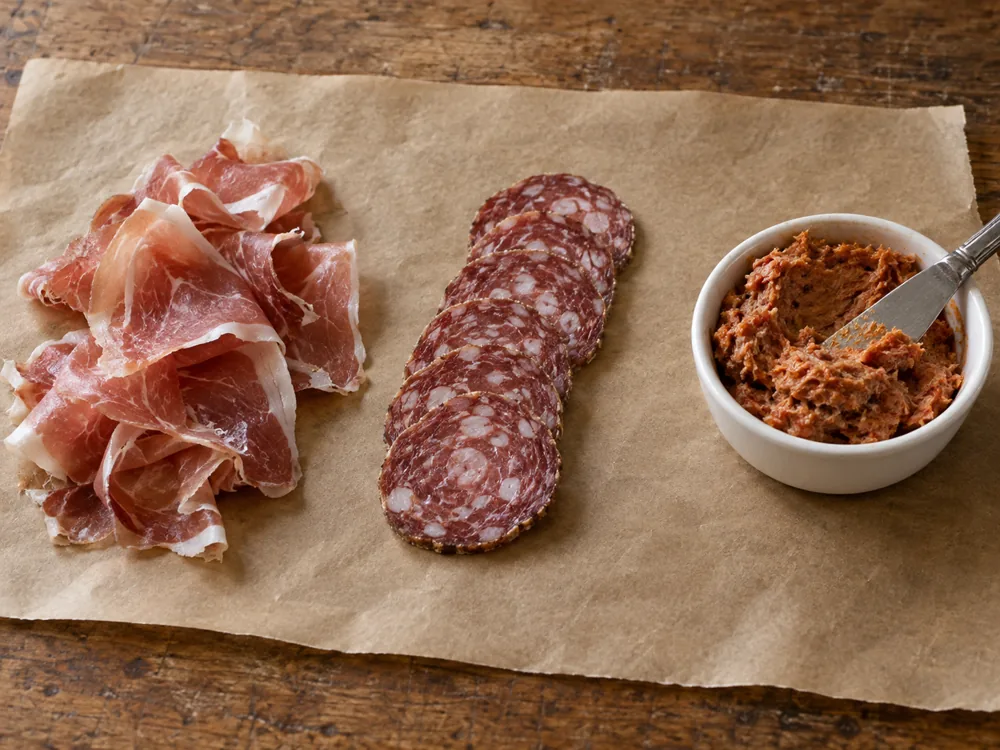
Spreadable meat is a third kind. Wisconsin Cheese describes 'nduja as a soft, spicy pork spread and a Calabrian specialty.
Names add confusion. In English-speaking countries, prosciutto means dry-cured prosciutto crudo.
The Consorzio del Prosciutto di Parma confirms its PDO product is cured with sea salt alone, no added preservatives, and aged until the ham loses more than a quarter of its weight.
Every prosciutto pairing in this guide refers to the dry-cured kind: Wisconsin Cheese calls it dry-cured, Tasting Table calls it air-cured, and Cheese.com pairs it as ultra-thin sliced and matured.
How Do Similarity, Contrast, and Region Decide a Pairing?
Saxelby Cheesemongers, a cheese shop that also sells charcuterie, sorts pairings into three approaches. The Cheese Professor names two of the same ideas, shared provenance and opposites, so the three work as a key for reading everything below.
One pairing can sit in two categories. Saxelby says its prosciutto pairings use both similarities and contrasts, and Tasting Table adds the regional layer, since prosciutto di Parma and Parmigiano Reggiano both come from the area around Parma.
Both guides also treat the rules as a starting point. Saxelby says to trust your intuition, and The Cheese Professor closes by advising readers to pick meats and cheeses they like to eat.
The meat's seasoning narrows the field first. Whether the cheese then echoes that seasoning or contrasts with it is the second decision, and the publishers show both working.
What Cheese Goes With Prosciutto?
Tasting Table gives the fullest reasoning for Parmigiano Reggiano with prosciutto di Parma. It describes the ham as rich and meaty, with a funk from the long cure, sliced thin with enough fat to taste almost buttery, and a salt level offset by surprising sweetness.
The cheese is sharper and more acidic, earthy and nutty, so the ham supplies fat and aged complexity while the cheese supplies umami and tang.
Texture adds a second layer. Aged Parmigiano is sturdy and crumbly with a little crunch from crystallized amino acids, and prosciutto melts in the mouth (Tasting Table).
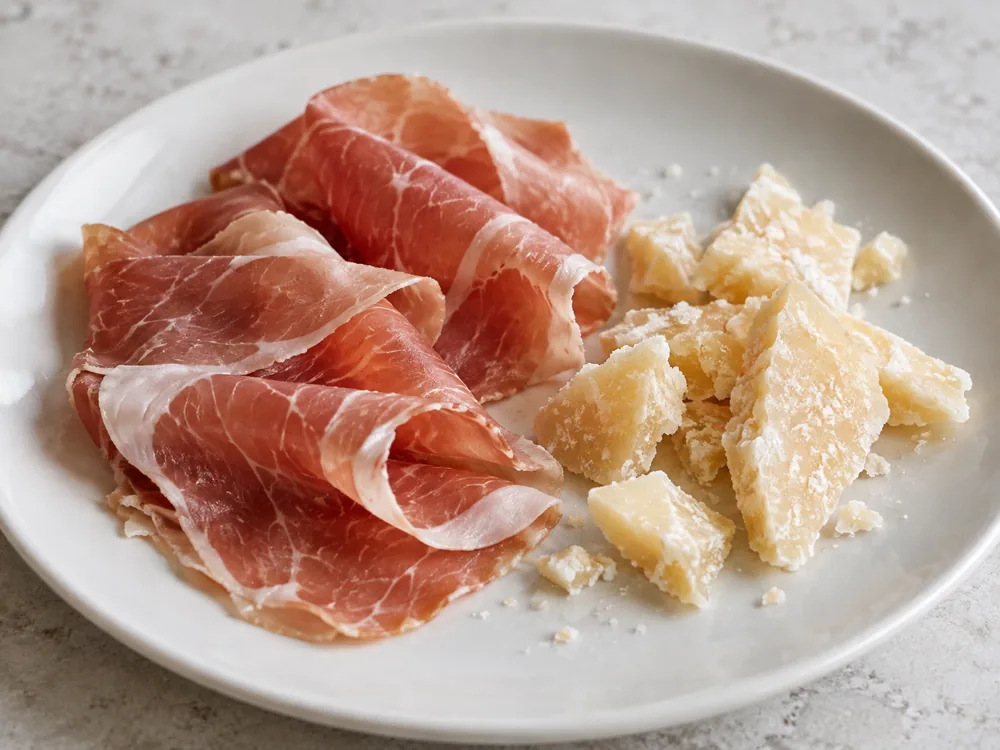
Tasting Table also points to geography. Both foods come from Emilia-Romagna, and the whey left over from making the cheese is fed to the local pigs that become prosciutto di Parma.
Saxelby Cheesemongers takes a quieter route. It calls raw salt-cured prosciutto-style hams mellow, with sweet and salty flavors and a nutty umami, and prefers mellow cheeses low in salt that give the ham room: mozzarella, burrata, and mild Alpine-style cheeses, with Parmigiano Reggiano as the classic choice.
Cheese.com and Wisconsin Cheese enjoy the doubled saltiness instead. Cheese.com calls Parmesan with ultra-thin prosciutto a pairing for "salt and sweet," and Wisconsin Cheese calls the two salty-sweet.
Duck changes the answer. Saxelby describes duck prosciutto as bold and meaty with an ample slab of fat, and pairs it with lean Parmigiano Reggiano, which it notes is made in part with skim milk, so the cheese adds no extra fat.
What Cheese Goes With Salami and Soppressata?
Seasoning separates one salami from the next, so the cheese follows the spices more than the word on the label.
Wisconsin Cheese pairs salami with Gouda, a semi-hard Dutch cheese sold aged, smoked, or flavored. Cheese.com and The Cheese Professor narrow the match to Calabrese, a spicy salami that Cheese.com says is made with chilies, cayenne, and ground pepper.
Cheese.com describes the Gouda as earthy, smoky, and slightly nutty. The Cheese Professor pairs the medium-grind, crushed-pepper salami with aged Gouda for its smooth caramel notes.
Havarti is the cheese for soppressata at Cheese.com and Wisconsin Cheese. Cheese.com calls it soft, creamy, and buttery sweet, and Wisconsin Cheese says that supple, buttery taste lets the herbs and spices in the sausage show while drawing out the cheese's own nutty, earthy notes.
Saxelby Cheesemongers answers whether spicy meat can take spicy cheese with one salame. For its poblano salame, made with smoky green chiles and garlic, the cheese can match the boldness or step back and let the charcuterie lead.
Flavored versions complicate the choice. Wisconsin Cheese notes that Gouda is sold flavor-infused and Cheese.com that Havarti often comes with dill, garlic, basil, or red pepper, and neither says whether its pairing assumes the plain cheese.
Which soppressata the publishers mean is not spelled out. Soppressata di Calabria is a protected PDO product, a cured dry sausage from Calabria aged at least 45 days, with PDO certification since 1998.
Cheese.com and Wisconsin Cheese both call it a dry salami, made from pork at Cheese.com and from pork or beef at Wisconsin Cheese, and neither says which type it means.
The table gathers every salami style the five publishers pair.
| Salami style | How the publisher describes it | Cheese suggested | Suggested by |
|---|---|---|---|
| Calabrese | Spicy, made with chilies, cayenne, and ground pepper (Cheese.com); medium grind with crushed pepper (The Cheese Professor) | Gouda; aged Gouda for caramel notes | Cheese.com; The Cheese Professor |
| Soppressata | Dry salami with herbs and spices | Havarti | Cheese.com; Wisconsin Cheese |
| Saucisson sec | French dry salami with garlic and black pepper | Alpine-style cheese or a tangy cheddar; French triple crème for a texture contrast | Saxelby Cheesemongers; The Cheese Professor |
| Delicately spiced saucisson | White pepper, nutmeg, and clove; sweeter and more delicate | Sweeter Alpine-style cheese or a subtle tomme | Saxelby Cheesemongers |
| Finocchiona | Fennel and red wine, with a dense, fine grain | Fresh mozzarella; a natural-rind tomme | The Cheese Professor; Saxelby Cheesemongers |
| Poblano salame | Smoky green chiles and garlic | Mild Havarti, or a bold smoked cheddar | Saxelby Cheesemongers |
| Cider-infused salame | Fruity, wine-like notes | Washed-rind cheeses with fermented aromas | Saxelby Cheesemongers |
| Salami, style not given | Treated as one general category | Gouda | Wisconsin Cheese |
Three patterns show up. Hot salami gets a buttery or nutty cheese such as Havarti or Gouda, garlic-and-pepper saucisson gets Alpine-style cheese or a tangy cheddar, and salami flavored with fennel, wine, or cider gets a cheese that echoes the flavor.
What Cheese Goes With Chorizo?
Spanish chorizo is coarsely chopped pork and pork fat seasoned with garlic, salt, and pimentón, a smoked paprika that gives the sausage its smokiness and deep red color.
Saxelby Cheesemongers treats smoke, pork, and pungent pepper as three heavy players and answers them with a tangy goat cheese that has the acidity and mineral backbone to contrast those flavors.
The Cheese Professor offers a firm Spanish cheese instead. Charcuterie director Evan Inada pairs smoky chorizo with Mahón or Manchego for a smoky, savory, sweet contrast.
The Cheese Professor's own example, chorizo ibérico with aged Manchego, rests on strength, since a hard, salty Manchego stands up to robust, spicy chorizo.
Both picks contrast the smoke, in different ways. Inada's firm Spanish cheese answers it with sweetness and weight, while Saxelby's goat cheese answers it with acidity.
Neither guide specifies a Spanish variety or says whether its chorizo is lean or fatty, so the choice between the goat cheese and the Manchego remains open.
What Cheese Goes With 'Nduja?
'Nduja is a different problem because it is spread rather than sliced, and Saxelby Cheesemongers calls it a sausage you can spread.
Wisconsin Cheese pairs it with Alpine-style cheese, whose creaminess takes the edge off the hot red peppers and balances the other flavors.
Saxelby describes it as a bright, hot wallop of Calabrian chile and contrasts the fat, salt, and heat with fluffy fresh chèvre, served on sourdough with arugula and lemon.
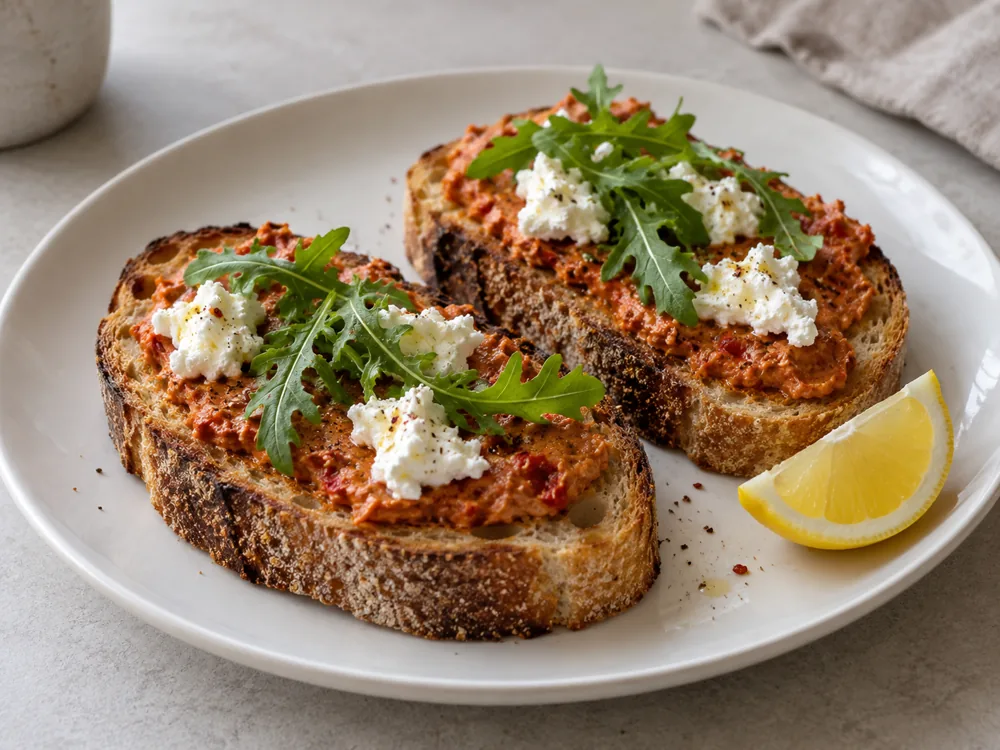
Both choices are creamy, so the two publishers agree that the heat is the problem to solve. They differ on whether the cheese should be a nutty Alpine-style one or a fresh, tangy one.
What Cheese Goes With Ham, Bresaola, and Ground Beef?
Two publishers pair ham with Etorki, though only one says which ham. Cheese.com describes it as a French cheese made from pasteurized sheep's milk, earthy and hard with a burnt caramel taste, that complements the earthy notes of ham without naming a style of ham.
The Cheese Professor pairs salty, nutty jamón serrano with the grassy nuttiness of a smooth Pyrénées sheep's-milk cheese such as Etorki.
The texture words differ: Cheese.com calls Etorki hard, The Cheese Professor calls it smooth, and Chef Dufour's classic choice for Bayonne ham is a fresh sheep cheese.
Bresaola, a lean cured beef, goes the other way. The Cheese Professor pairs it with Gorgonzola Dolce, calling beef and blue cheese a classic pairing and describing the cheese as sweet, tangy, and mild beside the mild sweetness of the beef.
Cheese.com's beef pairing is a hot dish rather than a board. It pairs Pepper Jack, which it calls spicy, creamy, and semi-soft, with ground beef in a queso dip or sprinkled over vegetables, for tangy flavor with some heat.
Which Fruit, Nuts, and Pickles Go With Cured Meat and Cheese?
Wisconsin Cheese groups accompaniments by the job they do. Fruit draws out the slight sweetness many cheeses have, crunchy items add texture to a board of similar soft textures, and savory items add salt or acidity.
- Sweet: figs with Parmesan or blue cheese (freshest in June and July), dried apricots with Gouda or cheddar, cantaloupe with prosciutto, and pears with feta.
- Crunchy: pecans with Gouda, cashews with blue cheese, and sesame sticks with asiago or Parmesan.
- Savory: cornichons with Emmental and salami, whole-grain Dijon mustard with aged cheddar, green olives with Swiss or Gouda, and cranberry chutney with cheddar.
Wisconsin Cheese says cornichons are tart and small and bring the acidity that cuts richness.
Which Wine Goes With Cheese and Cured Meat?
Wine comes up in two of the publishers' pairings. Cheese.com suggests chardonnay with Parmesan and ultra-thin prosciutto, and Wisconsin Cheese suggests prosecco with aged Parmesan and prosciutto, plus cantaloupe or fresh figs.
For salami, Wisconsin Cheese ties the wine to the cheese rather than the meat: a white such as pinot grigio for a mild brick cheese, and a red such as cabernet sauvignon for a stronger cheese like aged Gouda.
None of the five publishers matches a wine to chorizo, 'nduja, soppressata, or bresaola.
How Many Meats and Cheeses Does a Board Need?
Wisconsin Cheese suggests odd numbers, such as five cheeses and three meats. For quantity it plans 8 oz of cheese per guest when cheese is the main event and 2 to 4 oz when cheese is the appetizer or dessert.
The Cheese Professor quotes charcuterie director Evan Inada on the meats: salami in different diameters, with variety in texture and color, and a combination of salami and cured meat. He also suggests pre-slicing some sausages or partly slicing them and leaving a knife.
Wisconsin Cheese adds that cutting a few slices of one cheese before serving makes the board look less untouched. It also recommends cheeses with contrasting flavors and textures, such as a soft mascarpone with a firm cheese.
A board that mixes salami with whole-muscle cured meat puts two of the families described above on the same plate, and each family has its own cheeses in the sections above. None of the five publishers gives a weight of meat per guest.