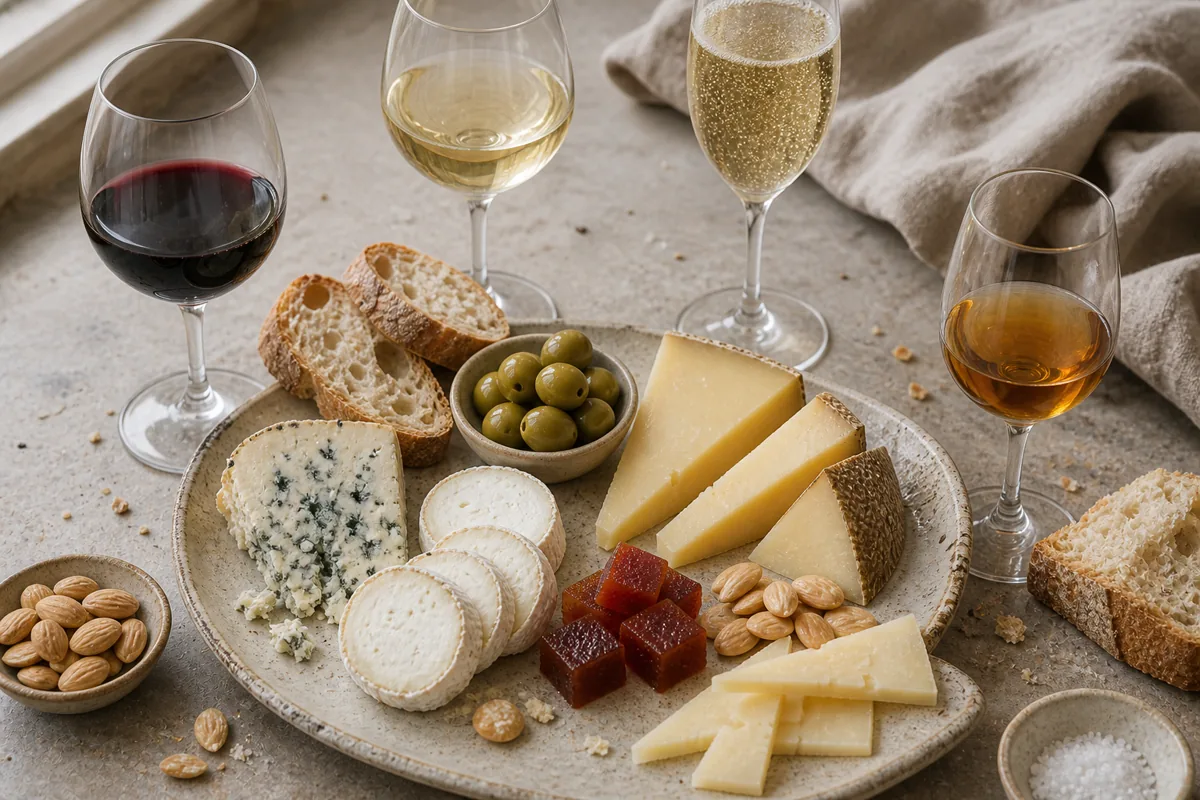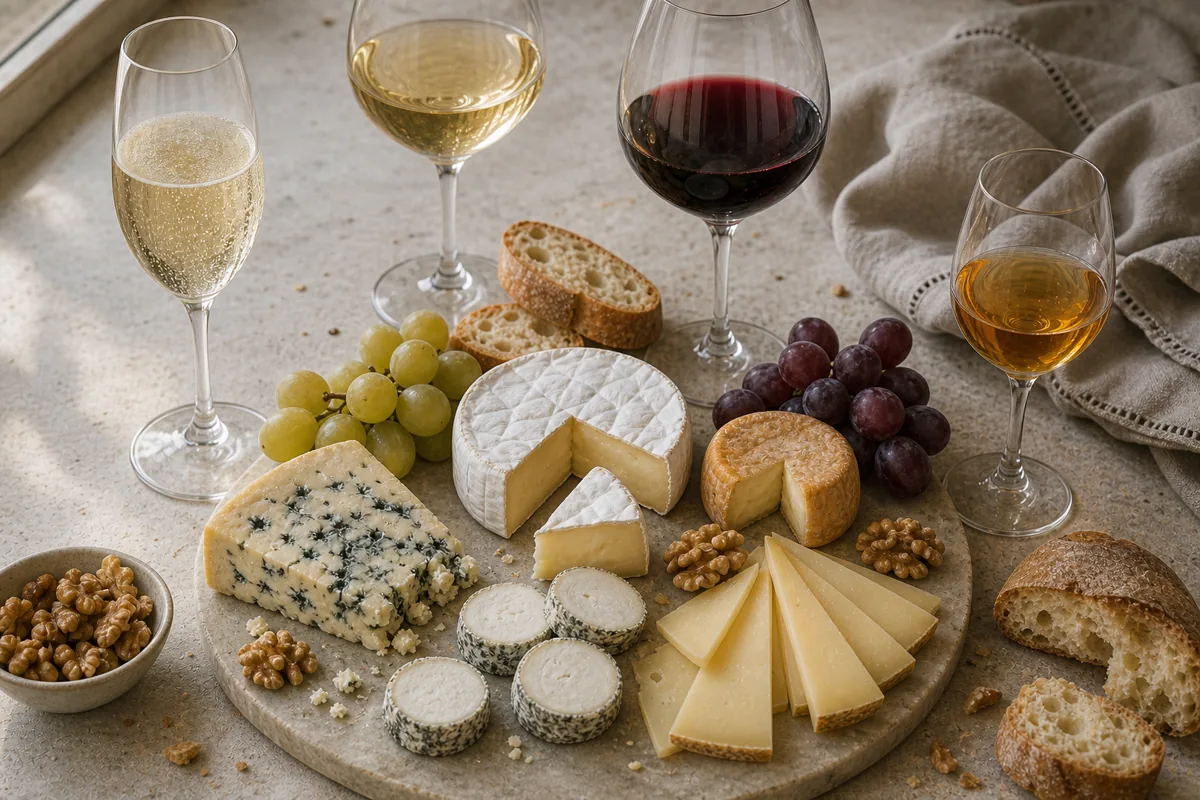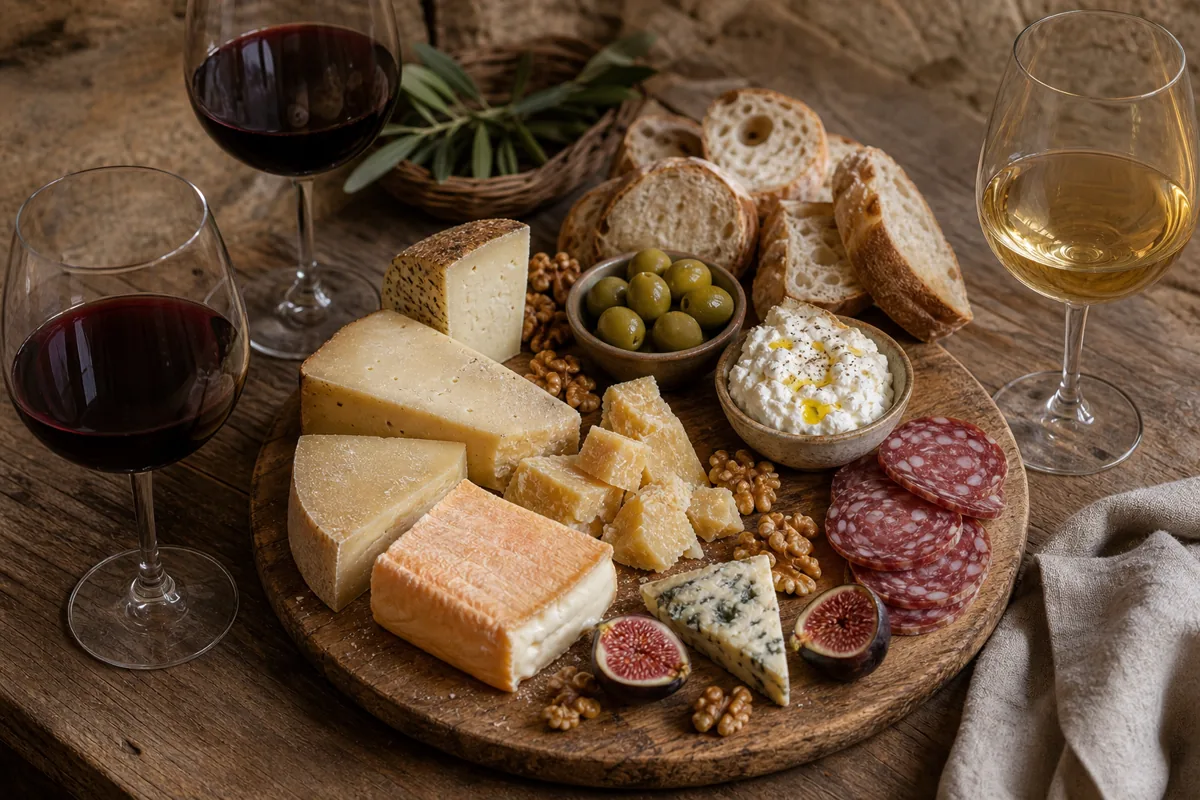
Cheese age sets most of the answer.
The sources send young, fresh cheese to light wines and aged cheese to the structured Sangiovese reds, although each describes the logic differently.
Centamore's rule of thumb is to match the characteristics of the wine and the cheese, so a powerful wine gets a cheese with power to match. Gourmetaly starts instead from the cheese and its texture.
The pairings below come from three published sources: Cheese.com's guide to Tuscan wines (which it labels a sponsored article), a July 2024 Vino Travels interview with food and wine educator Adam Centamore, and Gourmetaly's Italian cheese and wine guide. Each pairing is credited to whoever suggests it, and the places where they disagree are marked.
In This Article
Which Cheese Goes With Which Tuscan Wine?
The table lists the pairings the three sources name between a Tuscan wine and the cheeses covered here, with the source beside each. It leaves out Gourmetaly's matches for Caciocavallo, young Castelmagno and Pecorino Sardo, cheeses outside this guide that it pairs with Chianti Classico or Brunello.
| Tuscan wine | Cheese | Suggested by |
|---|---|---|
| Vernaccia di San Gimignano | Buffalo mozzarella, fresh ricotta | Cheese.com |
| Vernaccia di San Gimignano | Fresh Tuscan pecorino, Parmigiano Reggiano aged 12 months | Gourmetaly |
| Chianti | Parmigiano Reggiano, Pecorino Romano | Cheese.com |
| Chianti | Aged Tuscan pecorino | Gourmetaly |
| Chianti Classico | Parmigiano Reggiano aged 24 months, long-aged cheeses | Gourmetaly |
| Aged Chianti Classico | Pecorino Gran Riserva | Centamore |
| Rosso Toscana | Pecorino Toscano, Fontina | Cheese.com |
| Vino Nobile di Montepulciano | Taleggio, ricotta | Cheese.com |
| Rosso di Montalcino | Pecorino Romano | Gourmetaly |
| Brunello di Montalcino | Pecorino Toscano, Gorgonzola | Cheese.com |
| Brunello di Montalcino | Pecorino Gran Riserva | Centamore |
| Brunello di Montalcino | Aged Tuscan pecorino, Parmigiano Reggiano aged 36 months, long-aged cheeses | Gourmetaly |
| Vin Santo | Gorgonzola | Centamore |
Parmigiano Reggiano appears against four wines, from Vernaccia to Brunello, so the cheese's age matters more than its name. Gourmetaly is the only source that ties wine to months of ageing, and it moves Parmigiano from the lightest Tuscan wine to the heaviest across 12, 24 and 36 months.
Cheese.com attaches wines to cheeses without giving an age, and it lists Pecorino Toscano against both Rosso Toscana and Brunello. Read beside Gourmetaly's age bands, those two entries may describe different ages of the same cheese.
How Heavy Is Each Tuscan Wine, and What Does That Mean for Cheese?
The wines in the table sit at different weights, and the weight is what the cheese has to answer. Wine Folly describes Sangiovese as bone-dry, with medium-full body, medium-high tannin and medium-high acidity at 13.5 to 15% alcohol.
Vernaccia di San Gimignano sits at the other end of the range. Wine Folly lists it as dry and medium-light in body, with no tannin, medium-high acidity and 11.5 to 13.5% alcohol.
Within Sangiovese, the producer consortia set minimum rules for grapes and for time spent maturing before sale. The table puts them side by side.
| Wine | Grape rule | Minimum ageing before release |
|---|---|---|
| Chianti Classico Annata | At least 80% Sangiovese | 12 months |
| Chianti Classico Riserva | At least 80% Sangiovese | 24 months, 3 of them in bottle |
| Chianti Classico Gran Selezione | At least 90% Sangiovese, estate grapes only | 30 months, 3 of them in bottle |
| Rosso di Montalcino | Sangiovese | No minimum time in wood; released 1 September after the harvest year |
| Brunello di Montalcino | Sangiovese | 2 years in oak and 4 months in bottle; released from 1 January after the fifth year counted from harvest |
| Rosso di Montepulciano | At least 70% Sangiovese | Not released before 1 March after harvest |
| Vino Nobile di Montepulciano | At least 70% Sangiovese | 2 years; Riserva 3 years, 6 months of them in bottle |
These figures are floors, so a label that says Riserva or Gran Selezione promises more time before release and says nothing about how heavy the bottle tastes.
Centamore makes the weight point from the glass: stepping up from Chianti Classico to Brunello brings "more sophisticated flavors and richer mouthfeel", which he says suits the heavier weight of sheep's-milk pecorino.
Gourmetaly frames the cheese side of the match. It starts from texture, names the fat and compactness of the paste as the most important traits, and adds succulence, the salivation that chewing causes.
The same guide calls fresh cheeses lightly seasoned, fatty and leaning toward the sweetness of milk. For buffalo mozzarella it suggests sparkling wine, rosé or a medium-bodied red, and not the heaviest reds.
What Is Pecorino Toscano?
Pecorino Toscano DOP is made only from whole sheep's milk, and its specification allows two types: a soft one matured at least 20 days and a semi-hard one matured at least 4 months. The Lazio regional agri-food sheet that summarises the specification says it is sold as a table cheese or a grating cheese.
The name does not confine it to Tuscany. The milk may come from all of Tuscany, from listed communes in the province of Viterbo in Lazio, and from Allerona and Castiglione del Lago in Umbria.
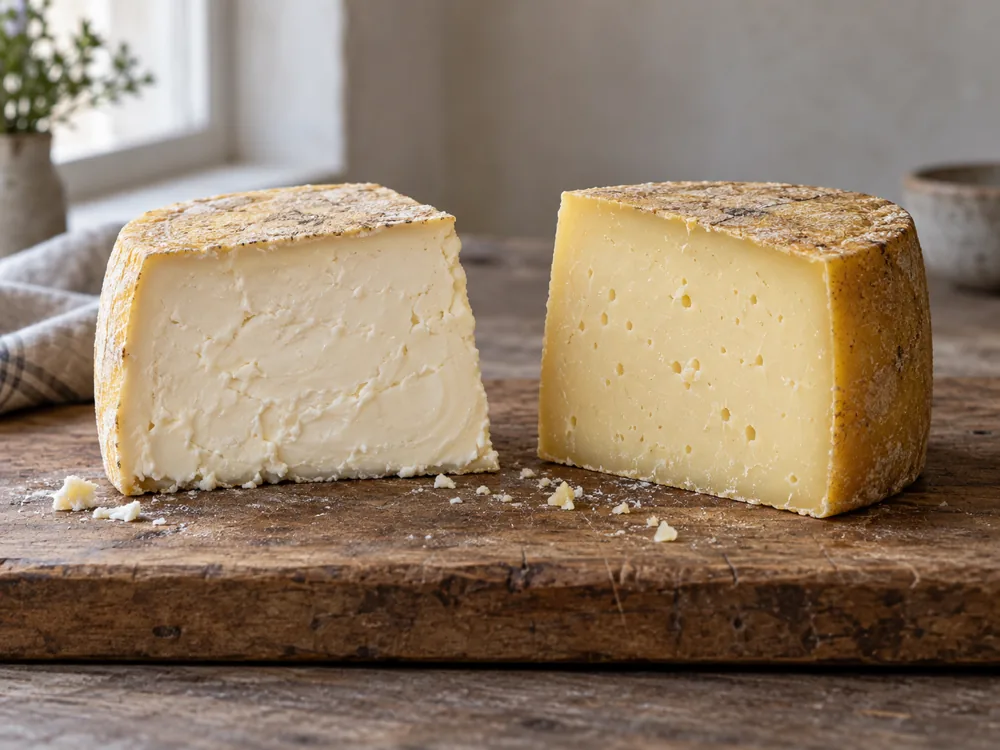
| Trait | Soft type | Semi-hard type |
|---|---|---|
| Paste colour | Whitish with a slight straw tint | Slightly straw or straw-coloured |
| Paste structure | Soft | Compact and tough under the knife, with occasional small, irregularly spread eyes |
| Minimum salting per kilogram | 8 hours | 12 hours |
The rind is yellow in tones up to deep yellow, and the specification notes that its colour can depend on treatments the cheese received.
Fat must be at least 40% of the dry matter, and the milk may be raw or heat-treated up to pasteurisation. Salting is done dry or in 17 to 19% brine, and the table shows that the older type stays in salt longer.
Pecorino Romano is a different cheese, and the sources treat it differently. Cheese.com calls Pecorino Romano sharp and salty, and it describes Pecorino Toscano as slightly mild, creamy and nutty.
Gourmetaly asks for a soft red with Pecorino Romano and names Rosso di Montalcino first. That is a lighter wine than the Brunello it gives to aged Tuscan pecorino.
Centamore notes that "pecorino" roughly means "of sheep" and covers a whole family of cheeses, so the label matters. Pecorino di Pienza Rosso is rubbed with tomato paste as it ages and Morchiato with olive must, two similar young cheeses that finish differently.
Which Wine Goes With Fresh and Aged Pecorino Toscano?
Gourmetaly splits Tuscan pecorino by age. Fresh pecorino takes fresh, medium-bodied white and red wines, with Vernaccia di San Gimignano, Refosco dal peduncolo rosso and Dolcetto d'Alba as its examples, while aged Tuscan pecorino takes red wines of great body and complexity, named as Barolo, Brunello, Chianti and Amarone.
The guide's general rules add a third answer: semi-hard cheeses such as Tuscan pecorino go with medium-bodied white wines. It does not say how that fits its fresh and aged split, so the three answers read best as a ladder of age and weight, with lighter wines for younger cheese and reds of great body for old.
Cheese.com names reds only. It pairs Pecorino Toscano with Rosso Toscana for the wine's fruity and sometimes spicy notes, and with Brunello di Montalcino for its fruitiness.
Centamore goes furthest into age. He pairs Pecorino Gran Riserva with an aged Chianti Classico or a Brunello di Montalcino, and says extensive ageing gives a drier texture that emphasises the savoury flavours.
For pecorino in general he prefers a medium or full-bodied white, such as a wine made from the Pecorino grape or a northern Chardonnay, or reds from Sangiovese and Nebbiolo. As the cheese ages he raises the wine's body.
Fresh pecorino goes with Vernaccia or a light red, and aged pecorino goes with Chianti Classico or Brunello. Every source that gives an age raises the wine's body as the cheese ages.
What Cheese Goes With Chianti Classico?
Parmigiano Reggiano is the cheese two sources put beside Chianti. Cheese.com says its nutty, savoury flavour complements the wine's acidity and fruit, and Gourmetaly specifies 24 months of ageing for Chianti Classico.
The Parmigiano Reggiano Consortium's own pairing page names no Tuscan wine at any age. At over 12 months it lists sparkling wines and Lambrusco, at over 24 months Pinot Noir, Tempranillo and Malbec among others, and at over 40 months Cabernet Sauvignon, Merlot and Barbera.
Chianti with Parmigiano therefore rests on Cheese.com and Gourmetaly, not on the cheese's own consortium.
On the pecorino side, Cheese.com pairs Pecorino Romano with Chianti because the wine's acidity helps balance the cheese's robust flavour. Centamore describes Chianti Classico as having just the right amount of development and complexity to handle the intensity of an aged pecorino.
The two guides describe the wine in similar terms. Cheese.com lists bright acidity, red fruit, cherry, plum and herbal and earthy notes, and Centamore lists tart cherry, red plum, herbs and tobacco.
In the consortium's tiers, "aged Chianti Classico" most naturally means a Riserva or a Gran Selezione. That is our reading, since Centamore does not name a tier.
What Cheese Goes With Brunello di Montalcino?
Brunello gets the heaviest cheeses in the sources. Gourmetaly puts Parmigiano Reggiano aged 36 months and its long-aged, intensely aromatic cheeses beside it.
Cheese.com's two picks are Pecorino Toscano, for nutty and creamy notes against the wine's fruit, and Gorgonzola, whose sharp and nutty flavours it sets against Brunello's richness as a contrast. Gorgonzola is the contested one and has its own section below.
The Parmigiano Reggiano Consortium does not name Brunello, but its description of the oldest stages supports the direction. Beyond 40 months it says the cheese gains astringency and calls for structured, full-bodied reds with bold tannins, and beyond 60 months it switches to sweet and fortified wines such as passito and Marsala Superiore.
What Cheese Goes With Vino Nobile and Rosso Toscana?
Cheese.com is the only one of the three sources that names cheeses for Vino Nobile di Montepulciano, and it picks two very different ones. It says the creamy texture and tangy, fruity flavour of Taleggio, a semi-soft washed-rind cheese from Lombardy, suit the wine's cherry and plum, and that mild ricotta complements the fruit.
Ricotta with a Sangiovese red is unusual in these sources. The nearest support is Gourmetaly's allowance of medium-bodied reds for buffalo mozzarella, including Dolcetto di Ovada and Lagrein, which shows a fresh cheese with a mid-weight red is not outside the guides' logic.
Rosso Toscana is a looser category. Cheese.com describes it as ranging from light and fruity to medium-bodied, often blending Sangiovese with Cabernet Sauvignon or Merlot, and pairs it with Pecorino Toscano and with Fontina, a semi-soft cheese with a creamy texture and earthy flavour whose richness suits the wine's fruit.
Which Cheese Goes With Vernaccia di San Gimignano?
Fresh, mild cheese is the consistent answer. Cheese.com pairs the wine with buffalo mozzarella and fresh ricotta, reasoning that the cheese's freshness and mildness meet the wine's crisp acidity, and Gourmetaly pairs it with fresh Tuscan pecorino and with Parmigiano Reggiano aged 12 months.
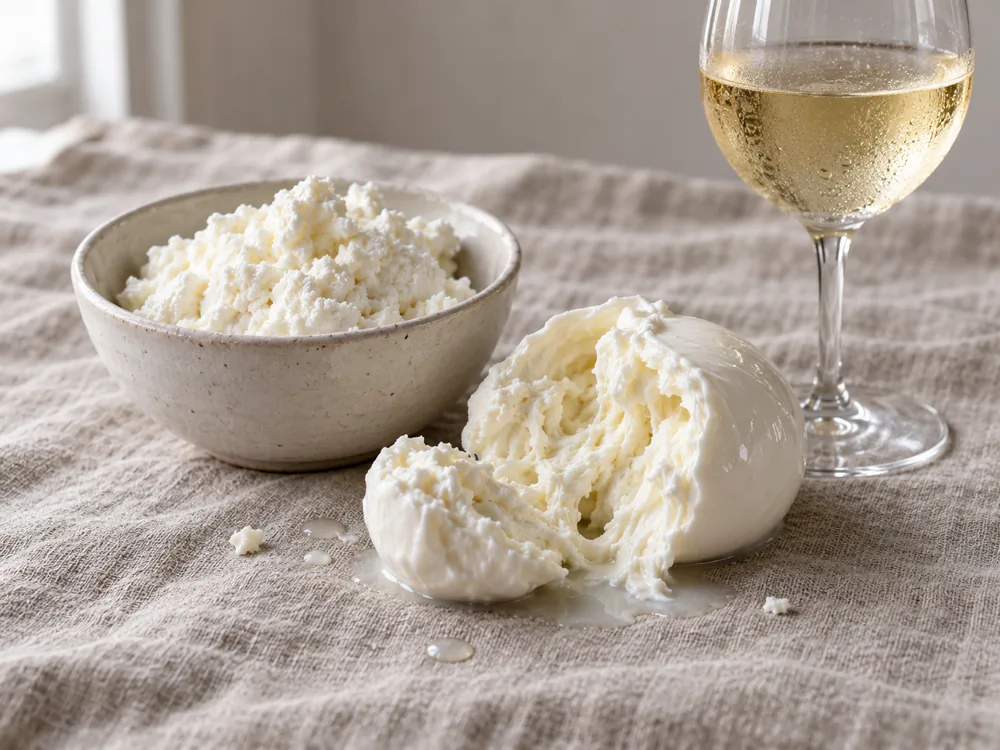
Wine Folly's profile describes what those cheeses have to leave room for: yellow apple, underripe pear, lemon, almond and saline notes, with a slight bitter note on the finish. Cheese.com also mentions almond, along with floral notes.
Wine Folly's own food advice for Vernaccia is white meats, fish and herbed sauces, not cheese. The cheese pairings here therefore rest on Cheese.com and Gourmetaly alone.
Can Blue Cheese Go With Tuscan Wine?
The sources split. Cheese.com pairs Gorgonzola with Brunello di Montalcino and calls it a delightful contrast between the wine's richness and the cheese's sharp, nutty flavours.
Gourmetaly sends blue cheese to sweet wines or to reds of great body, and the wines it names for Gorgonzola include no Tuscan appellation.
Centamore calls blue cheese his stated exception to matching like with like. He likes an aromatic, intense gorgonzola naturale set against a sweet, viscous Vin Santo, because he wants one part of the pairing to counter the other completely.
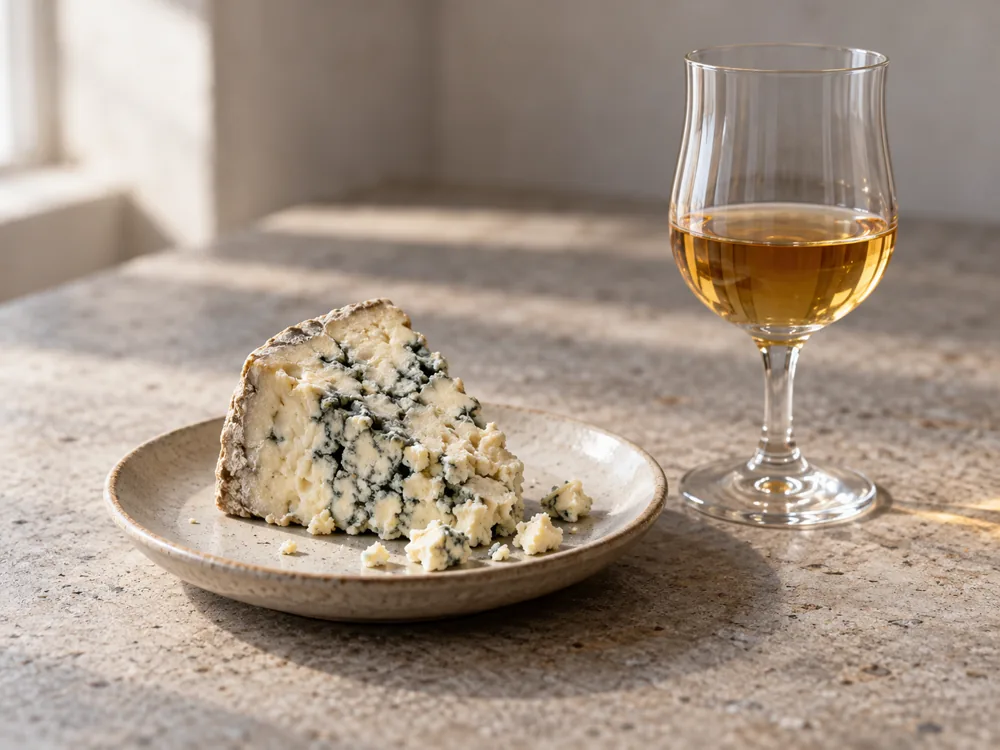
The Montepulciano consortium's rules set the sugar of the dried grapes at 28% for Vin Santo di Montepulciano, or 33% for Riserva and Occhio di Pernice, and require a total alcoholic strength of at least 17%, of which at least 2% is unconverted.
The wine then spends at least three years in wooden vessels of no more than 300 litres, or five years in casks of no more than 125 litres for the Riserva.
Our reading is that a Tuscan board with blue cheese is safer with Vin Santo, since two of the three sources route blue cheese to sweet wine and the Brunello match is Cheese.com's alone.
How Do You Build a Tuscan Wine and Cheese Board?
The cheeses the sources name most often are Pecorino Toscano, Parmigiano Reggiano, ricotta and Gorgonzola, so a board built around them follows the sources' ladder of weight. The plan below is our editorial arrangement of their pairings.
- One bottle: Chianti Classico, which Centamore pairs, aged, with Pecorino Gran Riserva and Gourmetaly pairs with Parmigiano Reggiano aged 24 months; Cheese.com adds Parmigiano Reggiano and Pecorino Romano for plain Chianti.
- Two bottles: add Vernaccia di San Gimignano for the light end, with ricotta, buffalo mozzarella or fresh pecorino.
- Three bottles: add Brunello di Montalcino for aged pecorino or 36-month Parmigiano, or a Vin Santo for Gorgonzola.
The bottles also want different temperatures. Wine Folly serves Vernaccia between 45 and 55°F (7 to 12°C) and Sangiovese between 60 and 68°F.
Centamore's advice for anyone learning Italian wine and cheese is to take one region at a time and focus on what makes its products represent that region, which is the approach a Tuscan-only board takes.