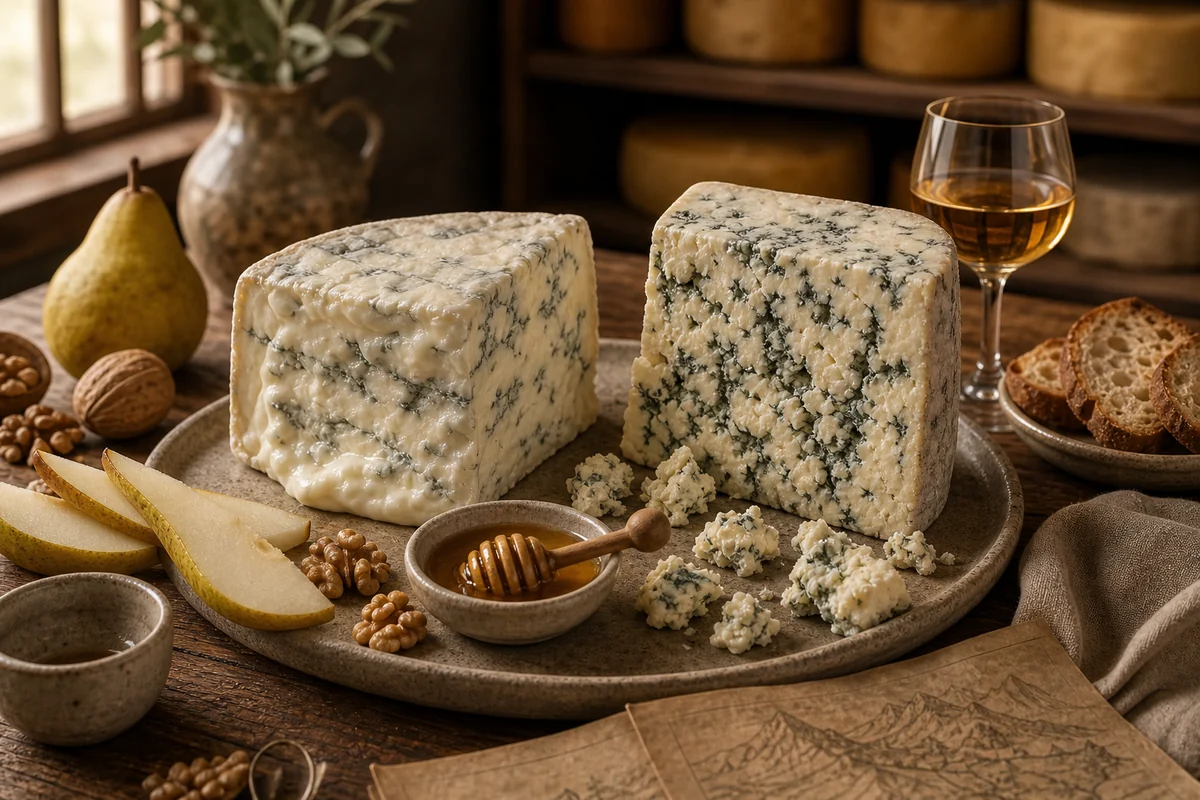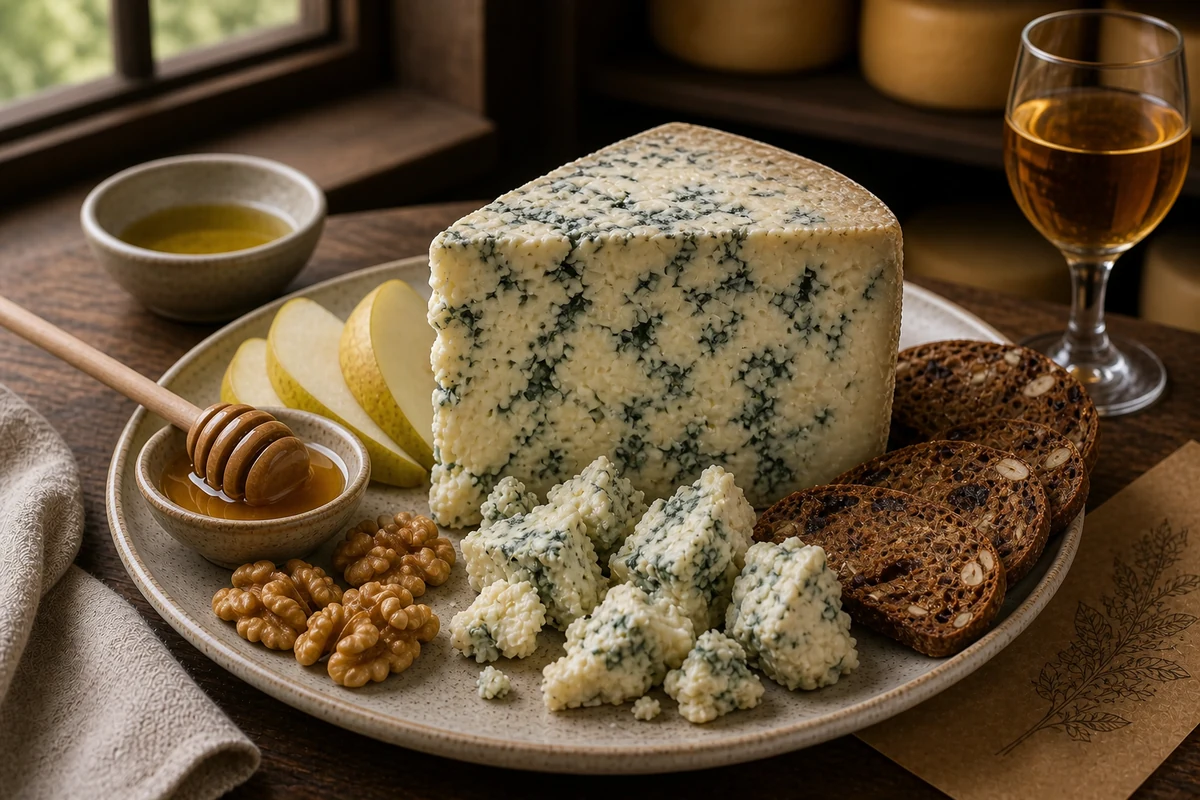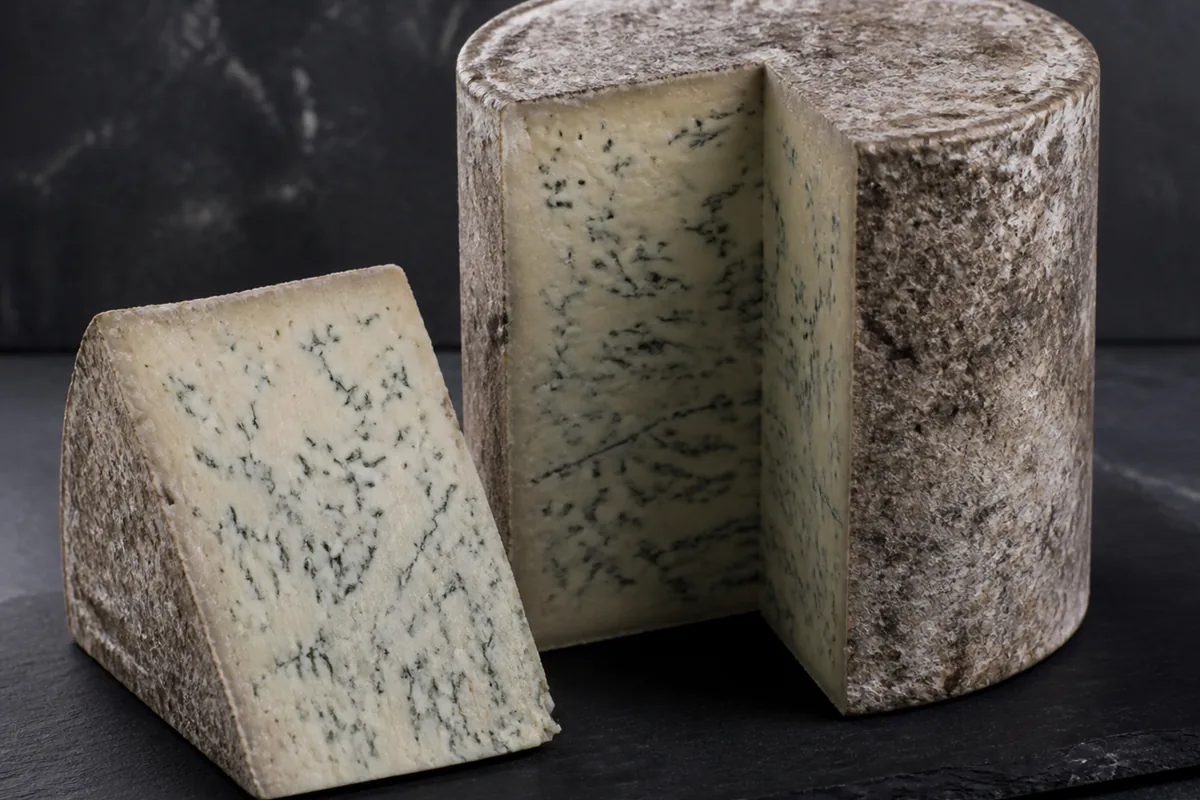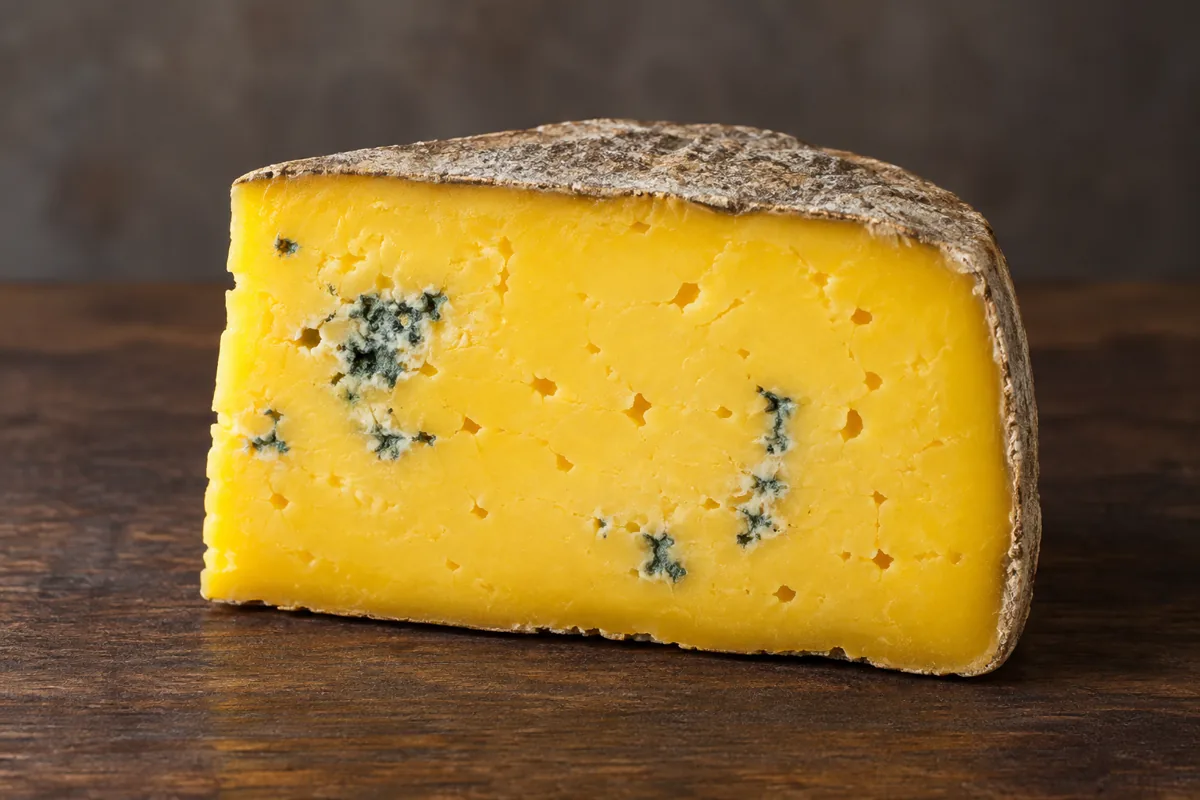
Barden Blue is a raw cow's milk blue made by Consider Bardwell Farm in West Pawlet, Vermont, and aged in New York City by Murray's Cheese.
It is a pressed blue, so the mould forms in patches along the pierce lines instead of running through the whole paste.
Its age is the figure to ask about when you buy, because it is given as two months or as about four.
In This Article
Who Makes Barden Blue, and Who Ages It?
Consider Bardwell Farm makes the cheese in its creamery in West Pawlet. The aging starts in the farm's own caves and is finished by Murray's cave team in Long Island City, New York.
The cheese began as a collaboration between the two companies, and getting Barden Blue to its current form took two years of research and development.
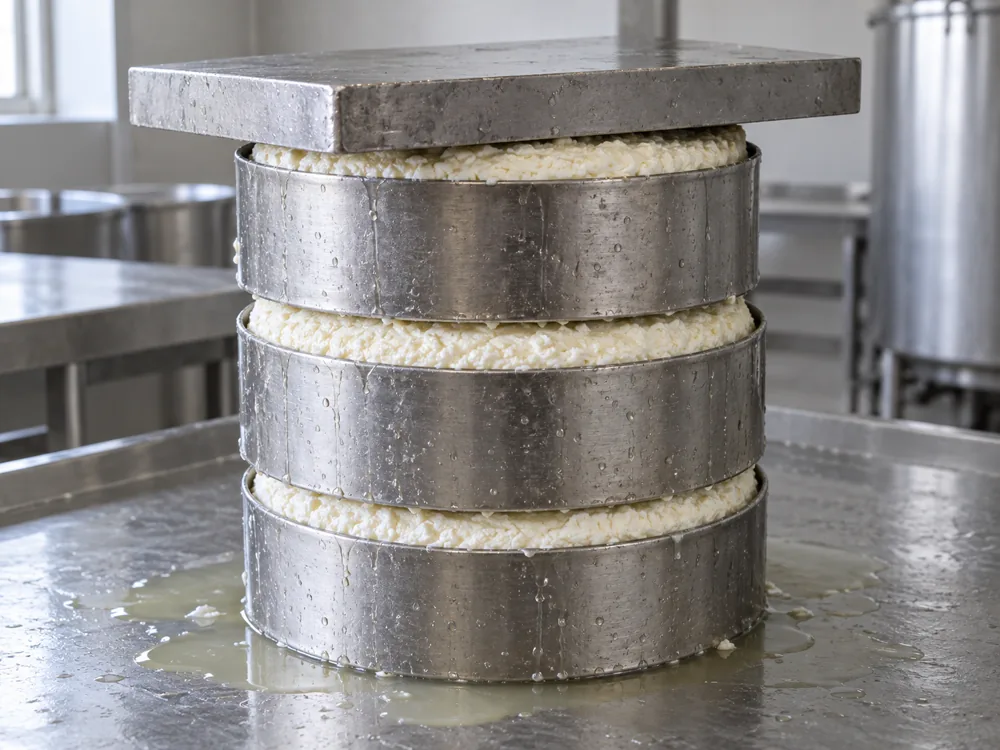
On a make day, the morning's milk goes into the vat and the curds are gathered by hand into hoops. The stacked hoops are then pressed to squeeze out whey, about four hours after the vat was first heated.
The pressed cheese still needs piercing, and it comes down to New York three weeks after it is made.
Why Is the Blue in Patches?
The patches come from pressing. With many blue cheeses, the curds are kept loosely packed on purpose, so the mould has room to grow, and a loose blue such as Rogue River or Fourme de Montbrison ends up riddled with pockets and veins.
Barden Blue is a traditional pressed cheese instead. Its curds are packed so tightly that blue can form only along the pierce lines, where oxygen gets in.
Cut open, it shows a dense, buttery, sparingly eyed yellow paste with the blue in patches.
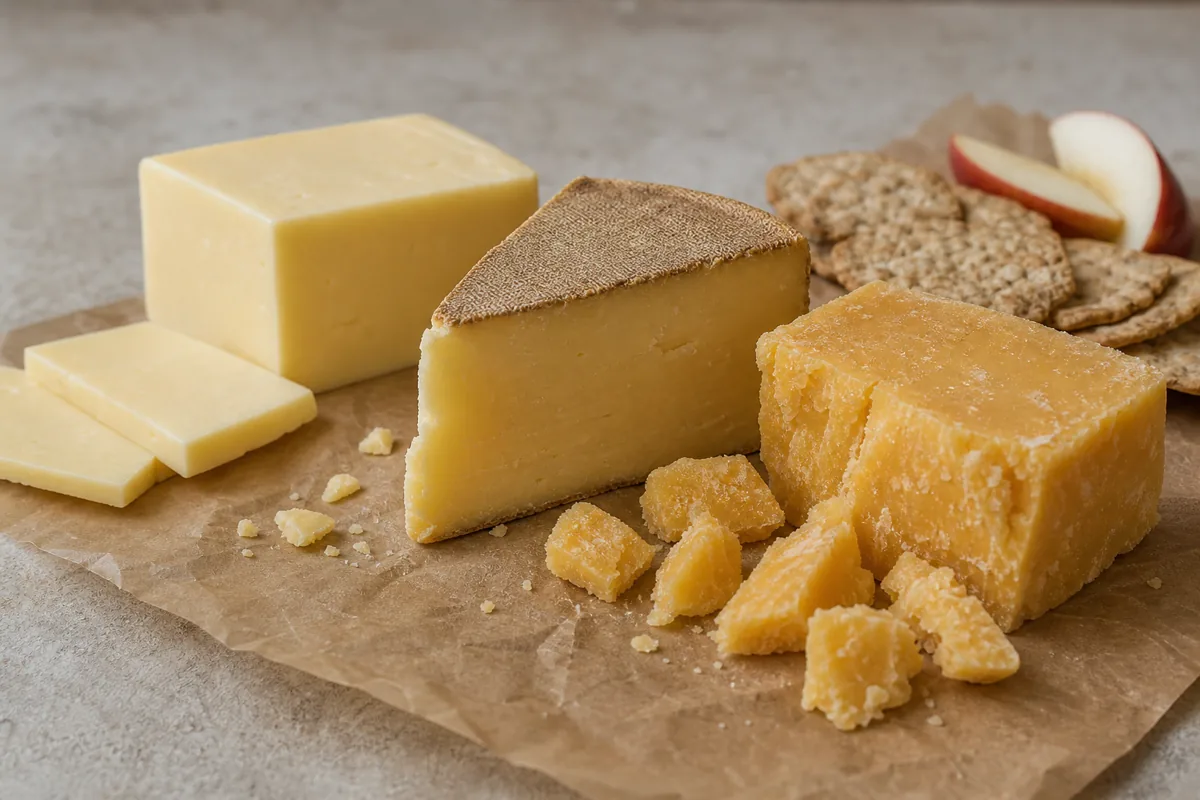
The effect resembles the accidental blue in a traditional British clothbound cheddar, where an occasional crack lets a little blue take hold. English makers often welcome that blue, while American cheesemaking has traditionally treated it as a defect.
How Old Is Barden Blue, and Is the Milk Raw?
Barden Blue is made from raw cow's milk and aged for two months or for about four. The two-month figure is the one Murray's, which finishes the aging, gave on its product page in October 2022, while cheese.com and Cheese Notes give about four.
Ask the seller how long the wheel you buy was aged. Either way the age runs to months: three weeks is when the cheese travels to New York, not how long it ages.
| Question | Value | Given by |
|---|---|---|
| Is the milk raw? | Yes, raw (unpasteurized) cow's milk | The farm, in a statement quoted by Murray's blog, 2018; Murray's product page; Murray's make-day post, 2018; Cheese.com |
| How long is it aged? | About 4 months, or 2 months | Cheese.com and Cheese Notes (about 4); Murray's product page, archived October 2022 (2) |
| When does it leave the farm? | Three weeks after it is made | Murray's make-day post, 2018 |
| What rind and texture? | Natural rind; semi-hard | Cheese.com (both); Murray's make-day post, 2018 (natural rind) |
Murray's credits the raw local cow's milk delivered each morning to the cheesemaking room with the cheese's buttery flavour and golden colour.
In 2021 the farm's Dorset Minis were pasteurized, although the creamery had traditionally made them with raw milk, so check the label on your piece of Barden Blue for the current milk treatment.
What Does Barden Blue Taste Like?
Barden Blue is a mild blue in cheese.com's and Cheese Notes' words, and mellow in Murray's.
Cheese.com credits the blue with a peppery overtone and both Murray's descriptions give the cheese a slight peppery edge, while Cheese Notes calls the blue a little extra kick that does not dominate.
| Question | Words used | Used by |
|---|---|---|
| How strong is it? | Mild; mellow | Cheese.com and Cheese Notes (mild); Murray's product page, archived 2022 (mellow) |
| Is it peppery? | An herbaceous, peppery overtone from the blue; the slightest edge of pepper; a slightly peppery edge | Cheese.com; Murray's make-day post, 2018; Murray's product page, in that order |
| Does the blue take over? | No: a little extra kick, not the dominant flavour | Cheese Notes |
| What else comes through? | Tangy, nutty, hay and barnyard notes; cheddary; buttery, with chocolaty depth and deep minerality; grassy and pleasantly full | Cheese.com and Cheese Notes (tangy, nutty, hay, barnyard); Cheese Notes (cheddary); Murray's make-day post (buttery, chocolaty, mineral); Murray's product page (grassy, pleasantly full) |
| How does it smell? | Barnyardy and herbal | Cheese.com |
If you are buying for someone who says they dislike blue cheese, Cheese Notes suggests this one could suit them, since the blue adds a kick without taking over.
To drink, Murray's suggests an understated saison as the pairing.
Where Can You Buy Barden Blue?
Murray's is the place to look, because the farm called Barden a Murray's exclusive in 2018. Murray's lists it as Cavemaster Reserve or Cave Aged Reserve Barden Blue.
In October 2022 Murray's sold it by the pound, in half-pound steps up to ten pounds, at $35.00 per pound, and marked it currently unavailable. Check Murray's current listing for today's price and stock.
Can You Eat Barden Blue During Pregnancy?
Whether you can eat Barden Blue during pregnancy turns on its raw milk: it is a blue-veined cheese made from raw cow's milk and listed as semi-hard.
The NHS lists pasteurised semi-hard cheeses, such as edam, as safe to eat, and says any foods made from unpasteurised milk must be thoroughly cooked. It says the same of pasteurised or unpasteurised soft blue-veined cheeses, such as Danish blue, Gorgonzola and Roquefort.
It counts pasteurised or unpasteurised hard cheeses, such as Cheddar, Gruyère and Parmesan, as safe, and Barden Blue is listed as semi-hard rather than hard.
The CDC lists dairy products made from raw milk, and soft cheese made from unpasteurized (raw) milk, for example blue-veined cheese, as riskier choices. It lists hard cheese made with pasteurized milk as a safer choice.
| Cheese type | NHS | CDC |
|---|---|---|
| Made from raw (unpasteurised) milk | Any foods made from unpasteurised milk: must be thoroughly cooked | Dairy products made from raw milk: riskier |
| Blue-veined soft cheese | Pasteurised or unpasteurised: must be thoroughly cooked | Soft cheese made from unpasteurized (raw) milk, blue-veined included: riskier |
| Hard cheese | Pasteurised or unpasteurised: safe | Made with pasteurized milk: safer |
| Heated cheese | Cooked until steaming hot: safe, soft or blue included | Pasteurized soft cheeses heated to an internal temperature of 165°F (74°C) or until steaming hot: safer |
The two agencies part on heating. The NHS counts any cheese cooked until steaming hot as safe, soft or blue cheese included, while the CDC's heated option is worded for pasteurized soft cheese, which raw-milk Barden Blue is not.
SOURCES & REFERENCES
What Else Do People Ask About Barden Blue?
Consider Bardwell Farm makes it in West Pawlet, Vermont, and Murray's Cheese ages it in New York City.
Yes, raw cow's milk. Check the label on your piece all the same: in 2021 the farm's Dorset Minis were pasteurized, although it had traditionally made them with raw milk.
Its curds are pressed and packed tightly, so blue forms only along the pierce lines where oxygen gets in.
About four months in cheese.com's and Cheese Notes' accounts, and two months on Murray's product page in October 2022. Ask the seller how long your wheel was aged.
Barden Blue is made from raw milk. The NHS says any foods made from unpasteurised milk, and soft blue-veined cheeses whether pasteurised or not, must be thoroughly cooked, and the CDC lists dairy products made from raw milk as a riskier choice.