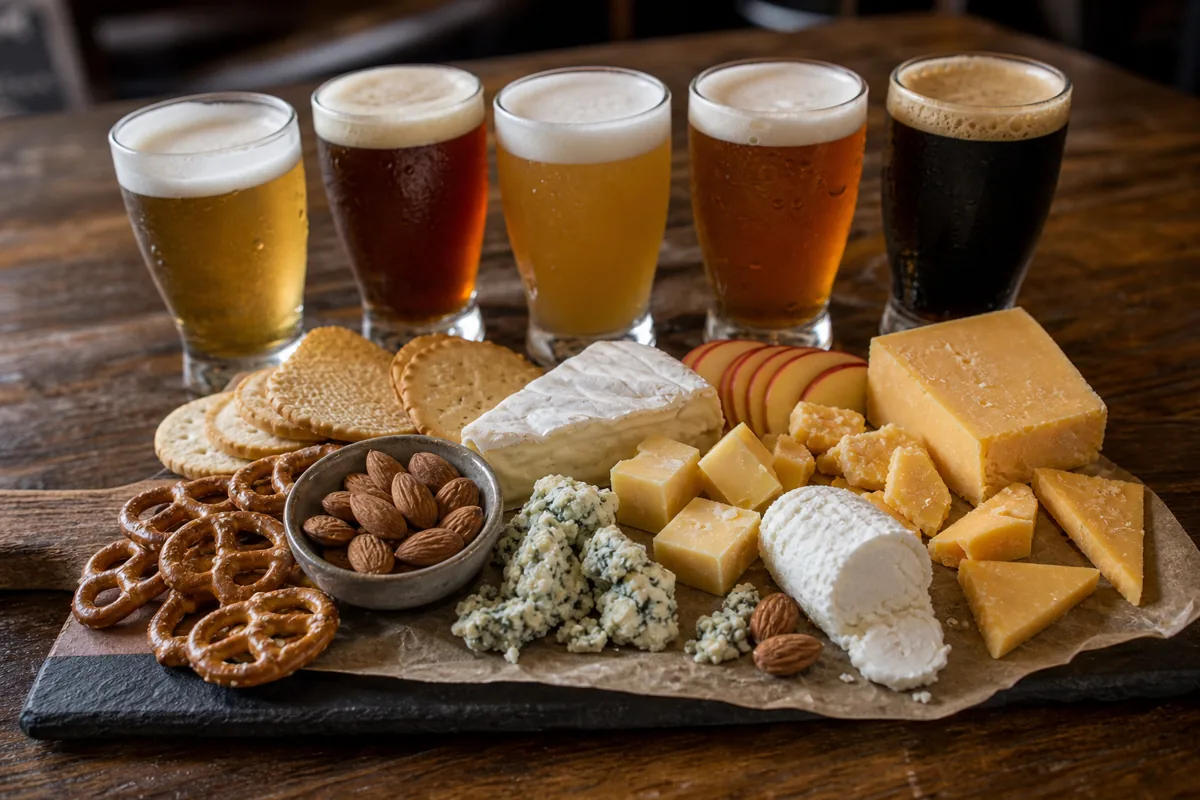
David Phillips of The Cheese Professor notes that about 95% of recognized beer styles are carbonated, while sparkling wine is a small slice of the wine world. Those bubbles, he says, lift fatty cheese and scrub the palate so the next bite tastes as good as the first.
In This Article
How Do You Match Beer to Cheese?
Match the intensity first. Jesse Vallins, a Certified Cicerone and executive chef at The Saint Tavern in Toronto, calls weight or intensity the biggest factor in any pairing, and Chris Cohen, author of The Beer Scholar Study Guides, says the flavors stop mattering once one partner overwhelms the other.
Once you have narrowed the beer to styles of similar intensity, Mark Reinwald of Shelton Brothers describes the next choice as complement or contrast. In his view, some cheeses show their best when the beer is completely different, while others shine beside a beer that shares many of the same flavors.
Michelle Tham, head of education at Labatt Breweries of Canada, and Afrim Pristine, maître fromager at Toronto's Cheese Boutique, turn this into three moves for a tasting menu. They align intensity, bridge a flavor the beer and cheese share, and use the carbonation, bitterness, sweetness or acidity of the beer to cut the salt and fat of the cheese.
Ashlyn Frassinelli of Hop Culture adds a rule of place: items from the same region tend to harmonize, in the saying she quotes, "What grows together goes together."
Age pulls beer and cheese in opposite directions. Craft Beer & Brewing, drawing on cheesemongers Cody Cook and Travis Hines of The Welsh Rabbit in Fort Collins, Colorado, says beer oxidizes and usually mellows with age, while cheese tends to become sharper, funkier, and more focused.
Ask how old your cheese is before you pick the beer, since the goat cheese, Brie, cheddar and Gouda picks below change with the age of the cheese.
What Does Each Part of a Beer Do to Cheese?
Phillips describes beer flavor as a balance between the sweet and roasted flavors of malt and the bitterness, plus herb, flower and fruit aromas, that comes from hops.
| Part of the beer | What it does to cheese | Credited to |
|---|---|---|
| Carbonation | Lifts fat and resets the palate between bites, and balances the creaminess of funky cheese | David Phillips, Mark Reinwald, Neil Witte |
| Hop bitterness | Cuts through fat and sweetness | Randy Mosher (quoted by Phillips), Neil Witte |
| Caramel and toasted malt | Matches the caramel and nutty flavors of aged cheese | Lauren Salazar, Michelle Tham and Afrim Pristine |
| Residual sweetness | Answers the salt of blue cheese | Garrett Oliver, Cody Cook |
| Acidity | Cuts the buttery richness of fresh cheese | Jesse Vallins |
| Yeast and fermentation aromas | Meet the barnyard and earthy notes of funky cheese | Jesse Vallins, Mark Reinwald, Neil Witte |
| High alcohol | Cuts through fat together with moderate carbonation, as in an English barleywine | Chris Cohen |
Beer author Randy Mosher gives the bitterness rule as "Bitter cuts sweet, and bitter cuts fat," and adds that if a cheese is sweet or fatty, bitterness is your friend.
Garrett Oliver describes what happens without carbonation in The Oxford Companion to Beer: the fat can coat the tongue and shield the taste buds from the drink, which he calls a common problem for wine and cheese pairings.
Which Beer Goes with Fresh Goat Cheese, Mozzarella, and Burrata?
For fresh and bloomy-rind goat cheeses such as a soft chèvre, Vallins likes Belgian and German wheat beers. His example is a witbier such as Blanche de Chambly, whose clean citrus flavors echo the cheese while its spritzy carbonation keeps everything fresh.
Reinwald offers two other routes. A pilsner works because its herbal hop flavors echo the floral notes of the cheese, and his personal favorite is saison, which shares the cheese's earthiness and tartness and has enough carbonation to clean and reset the palate.
Culture's Father's Day guide pairs pale ale, which it calls "arguably the default beer and cheese pairing," with fresh chèvre and young, sharp cheddar. It says the dry, bubbly beer complements the citrus and floral flavors often found in both cheeses.
Cook adds that the coriander and orange zest in a wit complement the light, clean flavors of chèvre. Craft Beer & Brewing says fresh mozzarella suits the same wheat beers, wits and pilsners, plus kölsch.
Burrata and mascarpone are buttery, so Vallins turns to fruit beer. He pairs burrata with a sour cherry beer such as New Glarus Belgian Red, where the acidity and carbonation cut the butter and the cherry turns the pairing into berries and cream.
Mosher took a different route at a tasting he held while preparing for an event in Chicago, where a hefeweizen with burrata was "literally like peach ice cream in your mouth." Phillips also lists hefeweizen with plain fresh chèvre and with burrata.
Which Beer Goes with Aged Goat Cheese?
Saison is the beer that both Culture's Father's Day guide and Garrett Oliver name for aged goat cheese. Culture describes saisons as having more fruit, funk and spice than a clean pale ale, and often more alcohol, and says fresh chèvre can be overwhelmed.
Its pick is an aged goat cheese such as Bonne Bouche or Old Kentucky Tomme, for the funk and fat to stand up to the beer, and its named bottle for Bonne Bouche is Stillwater Ales Debauched. That puts Culture at odds with Reinwald, whose personal favorite with fresh goat cheese is saison.
Oliver's reason is texture. Aged goat cheese can become very cakey and mouth-coating, he says, and very high carbonation, usually from bottle conditioning, helps the pairing, so he points to gueuze and saison.
Cook says an aged goat cheese such as Coupole can stand up to the additional hoppiness and malt character of a pilsner.
Craft Beer & Brewing goes darker for Cypress Grove Midnight Moon, a hard goat cheese with brown-butter richness and a supporting tang, which it says holds its own with stouts and porters and even smoked beers.
For a tangy ripened goat cheese like Cypress Grove Humboldt Fog, the same guide picks a light sour such as Berliner weisse or gose, as long as the beer is not so acidic that it overpowers the cheese.
Which Beer Goes with Brie, Camembert, and Triple-Cream Cheese?
For Brie, Camembert and triple-cream cheese, the choice turns on how ripe the rind is and how much bitterness you want against the butterfat. The picks run from a mild wheat beer to a bitter session IPA, a Belgian tripel, an earthy farmhouse ale or a fruited sour.
| Pairing | Why It Works |
|---|---|
| Moses Sleeper + Ayinger Bräuweisse | David Phillips of The Cheese Professor pairs this Jasper Hill Farm bloomy-rind cheese with a hefeweizen because both are mild, and the banana and clove of the beer meet the creamy mushroom flavor of the cheese. |
| Camembert or Mt. Tam + a local hefeweizen | Phillips lists Nancy's Hudson Valley Camembert and Cowgirl Creamery's Mt. Tam, or any locally made cow's milk bloomy rind, as alternates for the same hefeweizen pairing, with Widmer Brothers Hefe as one example. |
| Glengarry Figaro + Mill Street Welterweight | Michelle Tham and Afrim Pristine pair this triple-cream cheese with a session IPA, whose approachable bitterness cuts the buttery texture and whose citrus and tropical hop fruit meets the cheese's youthful tang. |
| Mt. Tam + Boont Amber Ale | Culture magazine poured this pairing at its beer-and-cheese guide launch party, where tasters praised Mt. Tam for its creaminess and spreadability. |
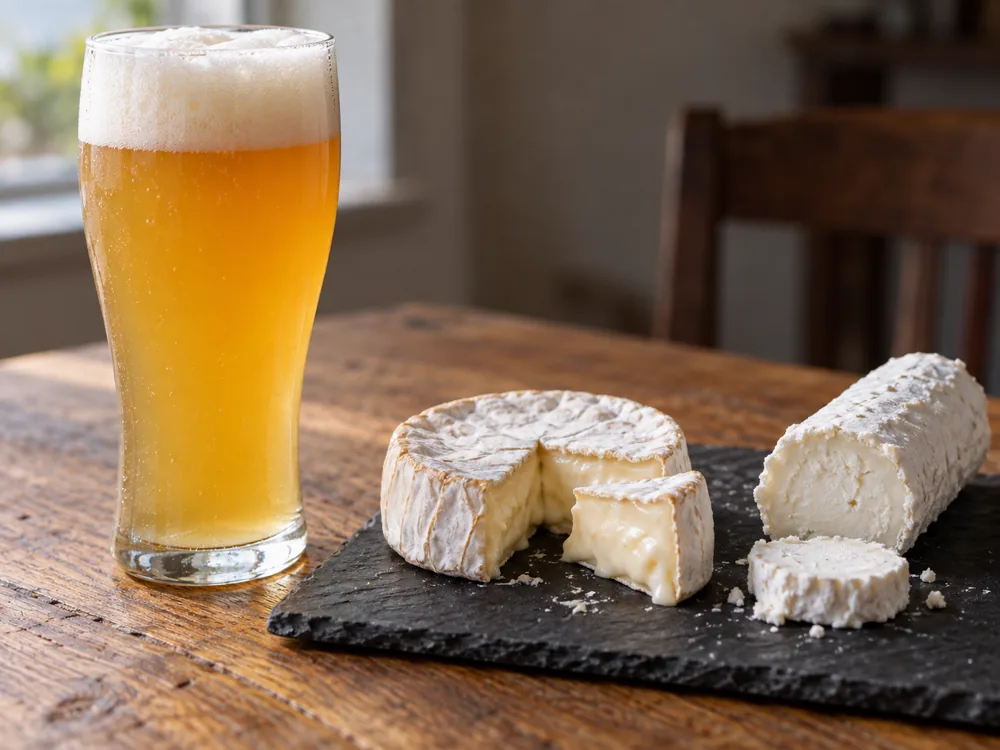
Phillips matches mildness with mildness, noting that both the small bloomy-rind cheese and the hefeweizen could be obliterated by a massive, heavily flavored partner. Tham and Pristine work the other way, using the session IPA's bitterness to cut the richness of a triple-cream cheese.
Phillips says the yeast plays a big role in a hefeweizen, mingling with the wheat and malt to give cloudy, spicy, fruity flavors. With Moses Sleeper, he says, the result might remind you of a fruited pastry.
Strength is where the IPA route can go wrong. Charles Duque, North America managing director of the French Dairy Board, gives InsideHook an example: pair a milder cheese like Brie with a strong IPA and the flavor "is going to be mostly the IPA."
Bubbles are the other tool against butterfat. InsideHook says soft, creamy cheeses that coat the mouth, such as triple crème or Brie, suit effervescent beers like pilsner or lager, because the bubbles cut through the higher butterfat content, and Duque adds, "Typically, the higher the butterfat content, the higher the chance a bubblier beer will pair well."
Belgian-style tripels work especially well with triple crème cheeses, Oliver says, and he lists St André among them.
The age of the rind changes Oliver's pick. On a young Brie or Camembert, the bloomy rind formed by white molds gives an earthy, mushroomy character that he matches with softer farmhouse ales, French bières de garde in particular.
As these cheeses age they become more pungent, and the rind can turn bitter in a way that interacts poorly with hops. For that stage Oliver suggests Belgian and German wheat beers, which match the cheese without adding bitterness.
Craft Beer & Brewing sends soft-ripened cheeses such as Brie and Camembert to earthy beers, saison and bière de garde, or to a quick sour ale aged on fruit.
Sour beer has two more backers. Hop Culture pairs Brie with a fruited sour because the tart, juicy beer balances the rich, creamy cheese in the way fruit jam does, and Culture's sour primer puts Berliner Weisse with cow's milk Brie styles.
Which Beer Goes with Cheddar?
Hoppy beers lead the picks for cheddar, from a British best bitter to an American IPA, and the beer changes with where the cheese was made, how old it is and how sharp it tastes.
| Cheddar | Beer | Suggested by |
|---|---|---|
| Classic British cheddar with earthy undertones | Best bitter such as Fuller's London Pride, or a British IPA such as Worthington's White Shield | Jesse Vallins |
| Bold new world cheddar such as Fiscalini Bandaged Wrapped | American IPA such as Dogfish Head 60 Minute | Jesse Vallins |
| Sharp or aged cheddar | Pliny, from Russian River Brewing | Natalie Cilurzo |
| PEI Clothbound Cheddar | English pale ale such as Boddington's, or Goose Island Honkers Ale | Michelle Tham and Afrim Pristine |
| Hook's Five Year Sharp | Anti-Hero IPA from Revolution Brewing | David Phillips |
| Westcombe, an English cheddar | Fresh-hopped IPA such as Comrade Superdamp | Cody Cook |
| Cabot Clothbound Cheddar | Stone Brewing Pale Ale | Culture's Father's Day guide, as its staff favorite for pale ale drinkers |
| Aged cheddar, such as Grafton Village 2 Year Aged Cheddar | Brown ale, such as Brooklyn Brown Ale | Hop Culture |
| Sharp cheddar | Malty, mellow brown ale | Cabot |
Cook's rule for IPA is to match the hop strength to the sharpness of the cheddar. In his account, the fresh-hopped IPA was a great match for the mineral character of Westcombe, but the same beer with a 4-year aged Grafton cheddar was unpleasant, because too much tanginess ended up in the beer.
The rule fits Cilurzo's choice of Pliny for sharp or aged cheddars, and Phillips's pairing of a five-year Hook's with an IPA that carries 65 IBUs of bitterness. Phillips says the cheese's sharp, acidic flavor is reflected in the beer's bitterness and piney flavor, while the carbonation lifts the cheese.
Cabot, the Vermont cooperative, offers two beers for the same cheese in its own range. It pairs its Seriously Sharp cheddar with an IPA because the crumbly texture and sharp bite hold up to the hop bitterness, and with a crisp pilsner because the dense, slightly crumbly texture and intense flavor combine easily with it.
Elsewhere in its range, Cabot pairs its short-aged Mild Cheddar with a Belgian-style wheat beer, Extra Sharp with a pale ale whose light body and subtle fruity hops suit the bite of naturally aged cheddar, and Farmhouse Reserve with the tang and pucker of a gose-style sour beer.
Brown ale is the malt route. Hop Culture's case for aged cheddar with brown ale is its same-region rule, since both come from England, and it adds that the ale's toasty, caramelly notes offset the sharp, slightly nutty flavor of the cheddar.
Cabot also pairs a sharp cheddar with a malty, mellow brown ale, as its example of pairing to complement but also to contrast.
Which Beer Goes with Aged Gouda?
Malty beer is the main answer for aged Gouda, and several of the picks change with the age of the cheese. Serious Eats reports that some call nutty aged cheeses the ultimate type of cheese for beer pairing, especially for malty brews with nutty and caramelized flavors.
Lauren Salazar of New Belgium points out that amber ales are very caramel, malt-forward beers, and that caramel is the clue to follow to cheeses that share it, like aged Gouda.
| Gouda | Beer | Suggested by |
|---|---|---|
| Moderately aged Gouda | Light to medium-bodied American brown ale or a brown porter, perhaps an Oktoberfest or Vienna lager | Neil Witte |
| Rembrandt Extra Aged Gouda, aged one year | Bière de garde, for shared sharpness | Craft Beer & Brewing |
| Beemster Classic, aged 18 months, sweeter and nuttier | Dunkels, doppelbocks and hoppy American ambers and browns | Craft Beer & Brewing |
| Aged Gouda | Amber ale | Lauren Salazar |
| Aged Gouda | Doppelbock such as Weihenstephaner Korbinian | Chris Cohen |
| Gouda aged further, with more intense character | Bock, old ale or sweet stout | Neil Witte |
| Well-aged Gouda | Saison or pilsner for contrast, barley wine for harmony | Garrett Oliver |
Cohen picks the doppelbock for its rich malt, dried dark fruit character and deep caramel flavors. Neil Witte, a Master Cicerone who works at Duvel USA, makes the cheese's age the deciding variable, stepping up from brown ale to bock, old ale or sweet stout as the cheese develops more intense character.
Oliver gives two routes for well-aged Gouda, aged farmhouse cheddar and Gruyère. A bright saison or pilsner balances the concentrated fruit and salt by contrast, while barley wine works by harmony: its residual sweetness balances the salt, and its rich malt and fruit meld with the cheese.
At Culture magazine's tasting party, guests praised Goose Island's Père Jacques with Gouda for being smooth, not too strong and not too hoppy, with a subtle sweetness. One guest said the Gouda's little caramelized bits pushed it over for them.
Which Beer Goes with Comté, Parmesan, and Other Hard or Alpine Cheeses?
Comté has the widest choice of beers in this group, from saison to a malty amber, stout or German pilsner, so start from the beer you already have.
| Cheese | Beer | Who suggests it, and why |
|---|---|---|
| Comté | Saison or another farmhouse-style beer | Hop Culture: a complex cheese from animals that grazed a varied diet on wild, high-altitude fields suits a complex beer |
| Comté | Altbier, Vienna lager or American amber | Craft Beer & Brewing: maltier beers let the natural sweetness of the cheese shine through |
| Comté or Mimolette | Cask ale, stout or porter | InsideHook: harder cheeses suit less effervescent beers |
| Comté | German pilsner | Charles Duque |
| Mimolette | Stout | Charles Duque |
| Aged Parmesan | Pilsner, Helles or golden ale | Craft Beer & Brewing: the dryness of the beer accentuates the dry, sharply intense notes of the cheese |
| Young, nutty Gruyère | German bock or dunkel | Cody Cook and Travis Hines |
| Semi-firm Gruyère-style cheese such as Gunn's Hill 5 Brothers | Belgian witbier such as Hoegaarden or Shock Top | Michelle Tham and Afrim Pristine |
| Aged hard cheeses such as Emmentaler | Belgian dubbel or tripel | Craft Beer & Brewing, citing Travis Hines |
| Tomme, Beaufort and cheddars in the semihard group | Pale ale, IPA, or German- or Bohemian-style pilsner | Garrett Oliver: notable acidity, grassy and fruity flavors and plenty of salt stand up to hops, meet ale yeast fruitiness and pick up caramel from specialty malts |
| Beecher's Flagship Reserve, a hard aged cow's milk cheese | Bear Republic Racer 5 IPA | Culture's Father's Day guide, as its pick for hop heads |
Bubbles split the advice on Comté. InsideHook keeps them low for harder cheeses such as Comté, while Duque's own quick list still matches Comté with a German pilsner.
For Emmentaler and Gruyère-style cheese, the picks lean on fruit and citrus. Hines says aged hard cheeses such as Emmentaler carry slight citrus and fruit notes that Belgian beers echo, and Tham and Pristine pick a witbier whose citrus peel and coriander bridge the fruity, spicy character of a semi-firm Gruyère-style cheese.
Which Beer Goes with Sheep's Milk Cheese?
Brown ales and porters are Garrett Oliver's picks for the sheep's milk cheeses he names. He says sheep's milk cheese is often characterized by a soft, earthy nuttiness and keeps a lanolin smell like lamb chops or damp wool.
He pairs Ossau-Iraty and Vermont Shepherd with the two styles because the nutty milk mirrors caramel and chocolate malts, and adds that the much sharper Manchego works with them as well.
Which Beer Goes with Washed-Rind and Funky Cheeses?
For a funky washed-rind cheese, the picks run from a bitter double IPA to a beer with matching funk, a sour Flanders red or a sweet saison for contrast.
If you are serving a washed rind such as Taleggio, Livarot or Epoisses, expect it to smell far stronger than it tastes, Oliver says. The aromas come from rinds washed with brine, beer, wine or sometimes brandy, while the flavors are often very mild.
For funkier, washed-rind, creamy cheeses such as Epoisses, Vacherin Mont d'Or or Cowgirl Creamery's Red Hawk, Vallins says the beer has to be big and bold. His pick is a double or imperial IPA such as Three Floyds Dreadnaught, which carries tropical and citrus fruit and, in place of high acidity, bitterness.
If big IPAs are not wanted, Vallins points to farmhouse ales. This style of cheese usually has some barnyard, earth and yeastiness, which he says are very common qualities in Belgian and French farmhouse ales such as a funky, yeasty saison or an earthy biere de garde.
Witte looks for fermentation aromas, with the creaminess of the cheese balanced by hop bitterness or higher carbonation. He finds those in some strong Belgian ales, and he offers acidity as another balance through a Flanders red or brown or a classic lambic.
Reinwald's rule is that funk needs more funk. Beers fermented with brettanomyces show earthy, leathery and barnyard flavors, and they are often bottled with higher carbonation, which scrubs the palate after each taste.
Cook goes the opposite way for Durrus, an Irish cheese with funky barnyard notes. He pairs it with a honey saison, whose sweetness balances the intense pungency of the cheese.
Which Beer Goes with Blue Cheese?
Blue cheese splits the picks between IPA, whose bitterness cuts the cheese, and sweet, strong beers such as imperial stout or barleywine, whose sweetness answers the salt.
| Blue cheese | Beer | Suggested by | Reason given |
|---|---|---|---|
| Creamy blue | IPA | Dave Engbers, Founders Brewing Co. | The texture and mild pungency of the cheese suit the hop bitterness |
| Blue cheese | American-style IPA | Mark Reinwald | Broad bitterness acts as a blade through the creaminess, and the hop fruitiness finds similar flavors in the cheese |
| Semi-soft blue such as Blue l'Etoile | American IPA, or a porter with a hint of chocolate or vanilla | Michelle Tham and Afrim Pristine | Bold intensities align, and the roasty porter against the pungent tartness brings out flavors otherwise masked |
| Blue cheese | English barleywine | Chris Cohen | Earthy, nutty malt matches the cheese while sweetness contrasts, and high alcohol with moderate carbonation cuts the fat |
| Colston-Bassett Stilton | Imperial stout such as Brooklyn Black Chocolate Stout | Garrett Oliver | Residual sugar counters the salt, and fruity, roasted malt brings out a chocolatey side of the cheese |
| Colston Bassett Stilton | Double barrel-aged stout such as On and On Pt. 4 | David Phillips | An earthy, savory, slightly salty cheese contrasts with a sweet, bold, boozy beer |
| Creamy, salty blue | Stout, such as a hazelnut stout | Cody Cook | The sweetness of the stout melds with the salty, creamy cheese |
| Drier, less salty blue | Dry stout | Cody Cook | Cook's own preference for the drier cheese |
| Heftier blue such as Stilton | Roastier stout | Craft Beer & Brewing | Roastier stouts pair well with heftier blues |
Hop Culture's example under its IPA and blue cheese pairing is Bayley Hazen Blue with Wren House Bolo Tie Rye. Garrett Oliver sets a limit on that camp: keep hoppy beer away from Roquefort and Danish blue, whose sharpness can become almost tongue-numbing bitterness that clashes with hops.
Oliver, who says he has a great many favorite pairings, singles out Colston-Bassett Stilton with a big imperial stout. He calls it "a perfect after-dinner pairing," and Cook likewise calls a stout with blue cheese the perfect dessert course.
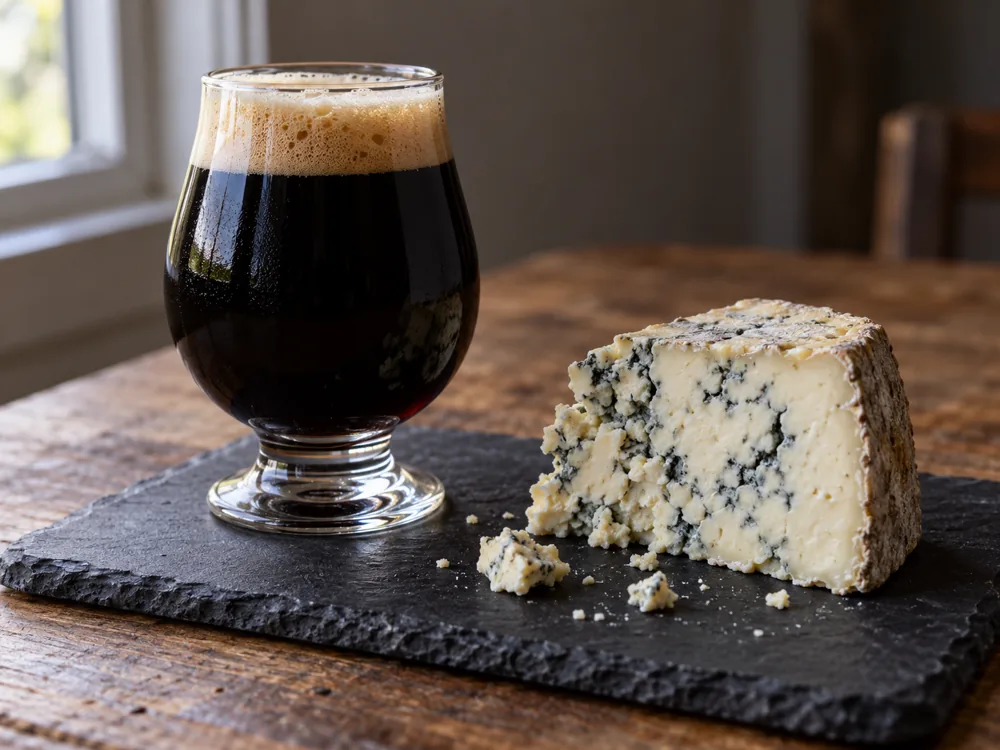
Phillips notes that the stout's big, bold flavors would trample more subtle partners. With Stilton he says they make a sweet, savory dessert, with chocolate notes mingling with buttermilk and licorice.
Cook and Hines count Point Reyes Bay Blue among their favorites for its toffee and caramel notes, and Cook describes a blue cheese with a hazelnut stout as a beautiful pairing. Craft Beer & Brewing adds that sweeter oatmeal or chocolate stouts typically pair better with creamy, salty blues than intensely bitter or roasty stouts.
Two more routes sit outside the IPA and stout camps. Culture's sour primer puts dry, ultra-fizzy gueuze with equally intense, pungent blues, and Charles Duque matches Bleu d'Auvergne with wheat beer.
Which Beer Goes with Pepper Jack and Other Strongly Flavored Cheeses?
Cabot, which makes its own spiced cheeses, pairs each with a different beer. Its Pepper Jack goes with darker, full-bodied beers such as porters, stouts and smoked beers, because the spicy kick of the cheese balances their smooth, toasted malt notes.
Culture's rule for stouts and porters points the same way: it says they suit cheeses packed with strong flavor that can stand up to their roasted, heavy notes. Its standout pair for dark beer is mushroomy Truffle Tremor with Berryessa's malty Baltic porter.
Habanero cheddar goes with an amber ale that Cabot describes as flavorful and balanced. Horseradish cheddar goes with a double IPA, since the big hop flavor of a double IPA needs a bold cheese and the horseradish adds a kick of spice that complements it.
Craft Beer & Brewing says some suggest an IPA with spicy pepper cheeses, which is a different answer from Cabot's stout or porter for Pepper Jack.
Which Cheese Goes with a Trappist Beer?
Culture's fall pairing list names three Trappist matches: Marieke Gouda Reserve with La Trappe Blond, St. André with Chimay Triple, and Morbier with Westmalle Dubbel.
In a 2011 explanation that Culture's list quotes, Joshua M. Bernstein described Trappist as a brewing rule rather than a style: the beer had to be brewed inside a Trappist abbey under the order's supervision, and most proceeds went to charity.
He also wrote that the beers covered the whole stylistic range and that many were strong, putting the typical strength at 7 to 11 percent alcohol by volume.
The International Trappist Association says eleven member abbeys brew and sell their own beer, among them La Trappe, Chimay, Westmalle, Rochefort, Westvleteren and Orval. It places La Trappe at Koningshoeven Abbey in the Netherlands, Chimay at Scourmont Abbey in Belgium and Westmalle at Our Lady of the Sacred Heart Abbey.
Are There Cheeses Made with Beer, or Beers Brewed with Whey?
Culture's fall list notes that Chimay makes its own cheese, and Craft Beer & Brewing says Chimay Grand Cru is washed in Chimay beer as it ages.
The same guide says Vermont Farmstead Cheese Company's Alehouse Cheddar has curds soaked in two beers from Harpoon Brewing, which makes it a natural for IPAs and hoppy pale ales.
InsideHook reported in September 2022 that Dogfish Head and Cabot had released The Perfect Pairing, a 5.5% ABV hazy pale ale brewed with Cabot whey to go with Cabot's Seriously Sharp cheddar. The whey gives the beer what Dogfish Head calls a compelling body and subtle sweetness that works with the saltiness of the cheese.
When Does a Beer and Cheese Pairing Fail?
The failures the experts name are almost all mismatches of strength. Vallins says a huge, high-alcohol, barrel-aged beer with a mild fresh cheese probably will not work, and Cohen says a pilsner with a powerful blue cheese fails just as badly as a barleywine with a light salad.
Mosher calls the same problem the Bambi versus Godzilla effect. His example is a Bud Light with chocolate cake, not a cheese.
Craft Beer & Brewing says complex bourbon barrel-aged imperial stouts and barleywines, aged fruit lambics and gueuzes, and older Belgian quads are best enjoyed with a clear palate, because pairing can overshadow the depths and layers of the beer.
Craft Beer & Brewing also says strong beers such as Belgian quads, imperial stouts and barleywines can stand up to older, more pungent cheeses, and that aged versions do not benefit from pairing the way younger beers do. Oliver and Cohen pair an imperial stout and an English barleywine with blue cheese, while Phillips pairs a double barrel-aged stout with Stilton, which is the kind of bottle the caution names.
How Do You Serve a Beer and Cheese Tasting?
Cabot says to pull cheese from the fridge 30 minutes before serving for the richest flavor and best consistency, and adds that beer delivers its fullest flavor when it is not ice cold. Phillips likewise wants beer chilled to the proper temperature for its style but not ice cold.
Culture's Father's Day guide goes further and says the stronger the beer, the warmer it can and should be served.
The CDC says never to leave perishable food out for more than 2 hours (or 1 hour if exposed to temperatures above 90°F). It warns that bacteria can multiply rapidly if left at room temperature or in the "Danger Zone" between 40°F and 140°F, and says to keep your refrigerator at 40°F or below.
Cabot's order for a tasting is lighter cheeses and lower-alcohol beers first, then heavier cheeses and higher-alcohol beers, which is light to heavy. One flight that follows that order, using pairings from the sections above, would run:
- Fresh goat cheese with witbier or pilsner (Vallins, Reinwald).
- Bloomy-rind cheese with hefeweizen (Phillips).
- Cheddar with pale ale (Cabot).
- Aged Gouda with amber ale or brown ale (Salazar, Witte).
- Washed-rind cheese with saison or double IPA (Vallins).
- Blue cheese with imperial stout, last (Oliver).
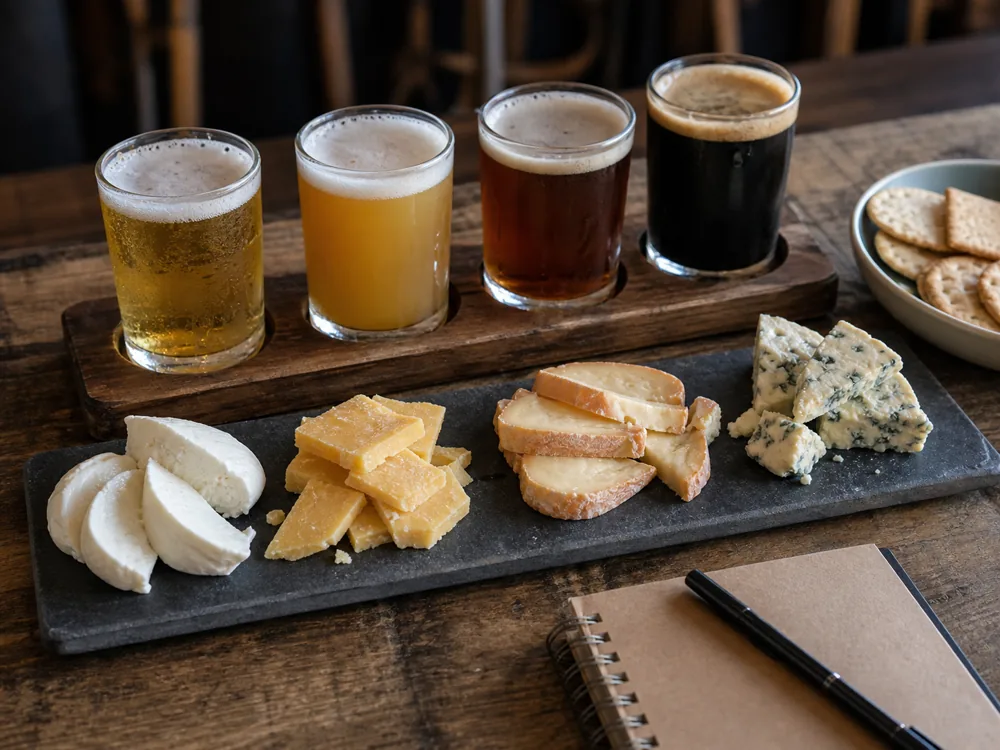
Phillips's method is to sip the beer first, then let a piece of cheese soften in the mouth, sip again, and finally take cheese and beer together. He says this is where flavors are enhanced, amplified or defeated and new notes emerge.
Between pairings he suggests plain bread or a simple cracker to clean the palate, and Craft Beer & Brewing suggests trying one cheese with several beer styles, or one beer with several cheeses.
Craft Beer & Brewing adds that the pairings its staff expect to succeed often become the group favorites, yet individuals just as often prefer an alternate pairing. Cabot goes further and says there is no right or wrong way to pair beer with cheese, and that the best pairings are the ones people find most delicious.
At Culture magazine's tasting, salami, prosciutto, baguette, strawberries, blackberries and figs sat beside the cheeses, and the writer found them perfect accompaniments. The crowd favorites were Beecher's Flagship Reserve, Hook's 10-Year Cheddar and Beemster Extra-Aged Gouda.