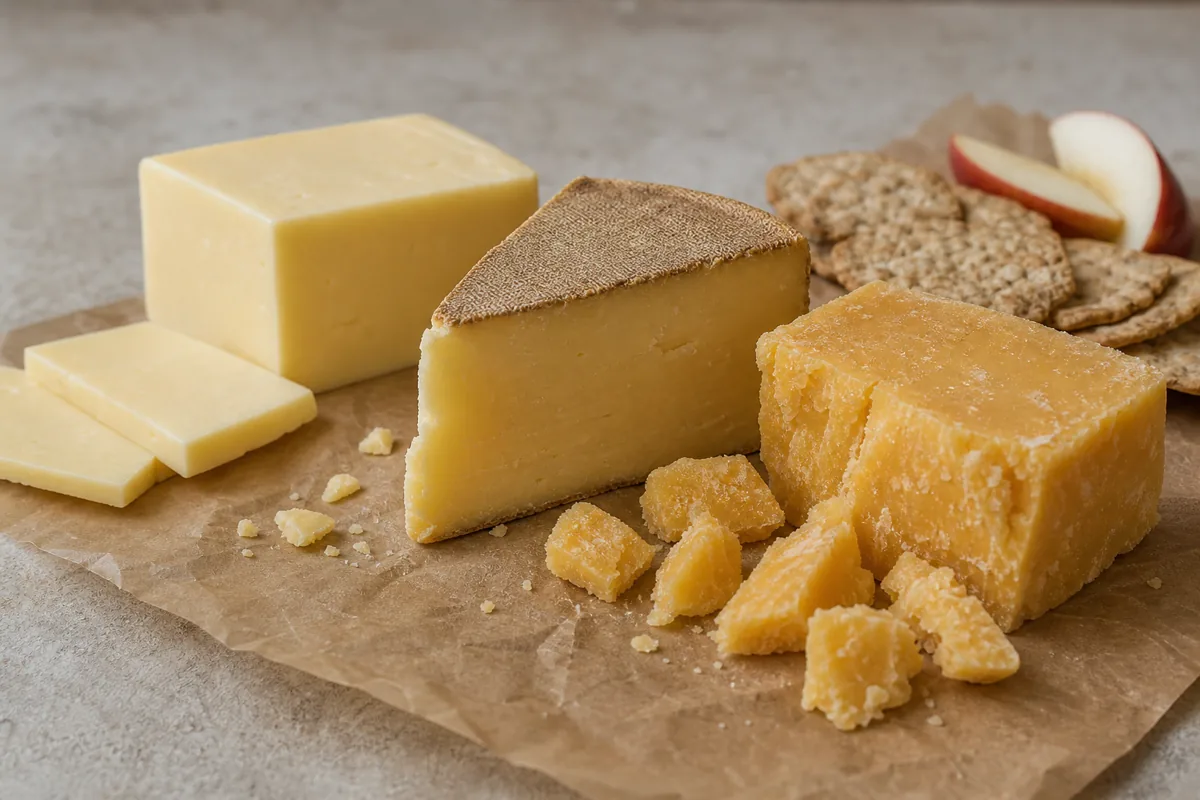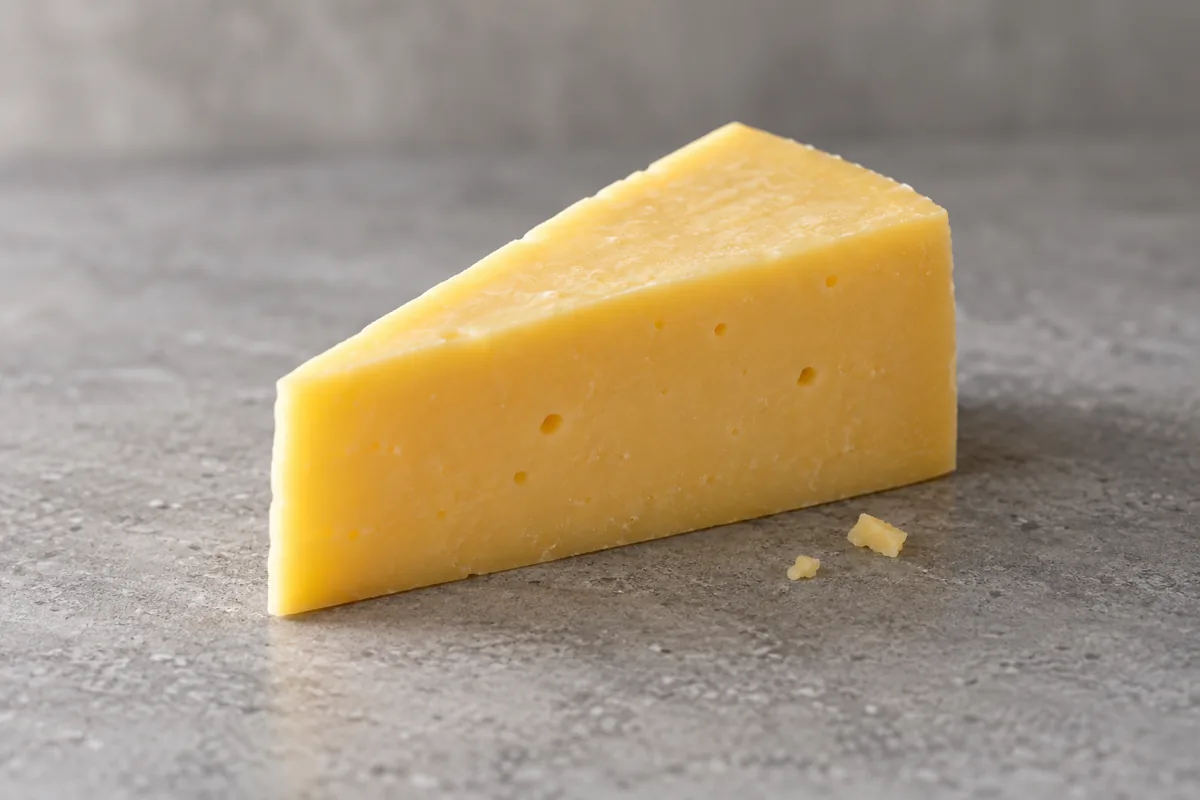
Crowley cheese is a raw-milk cheddar variant from Mount Holly, Vermont, made with a rinsed-curd recipe that leaves it moister and less acidic than ordinary cheddar.
The producer sells it at six ages, from Mild at two to five months to Unusually Sharp at three and a half years or more, and says it melts without separating or getting stringy. The same factory has made it since 1882.
In This Article
How Does Crowley's Rinsed Curd Work?
The fullest account of the step comes from a 1970 Vermont Life article by Rockwell Stephens, which says "A thorough sluicing with spring water follows, removing more whey and rendering the curd less acid." The same article has the curd worked by hand "like kneading bread" into popcorn-size pieces and salted as a final step.
The producer's pages give neither the temperature nor the amount of the rinse water.
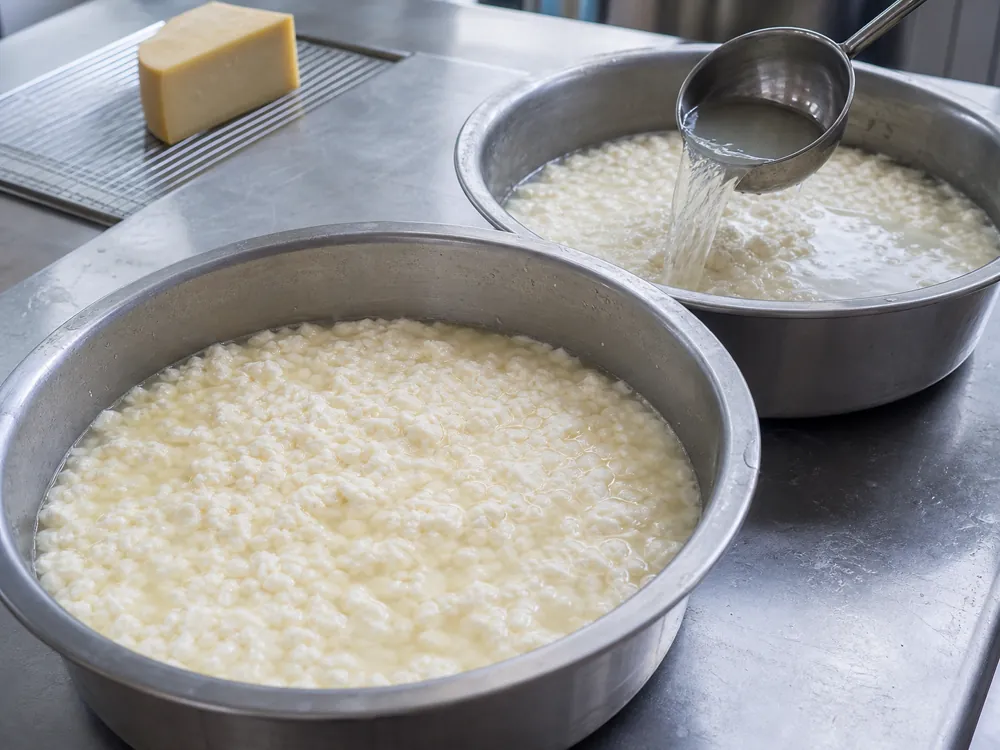
Stephens contrasts this with ordinary cheddar making, in which the drained curd is piled into a mat, cut into slabs and turned until the right acidity develops, then shredded, salted, hooped and pressed twice. He names hand kneading and the fresh-water wash as the critical differences, but says how they change ripening "may be known only to the chemists."
The federal cheddar standard (21 CFR 133.113) lets cut pieces of curd be rinsed only so briefly that "only the whey on the surface of such pieces is removed," and it caps moisture at 39 percent by weight. The producer calls Crowley moister than conventional cheddar without giving a moisture figure, so the cap shows what the standard allows but not where Crowley falls.
Writers disagree on where the rinse leaves the cheese, somewhere between cheddar and Colby.
| Source | How it places Crowley |
|---|---|
| Crowley Cheese (producer) | Sits between a conventional cheddar recipe and the Colby and Monterey Jack variants |
| National Park Service nomination form, 1979 | Calls what the make room produces the "Colby type of Cheddar cheese" |
| Vermont Life, 1970 | Classes it as a Colby, a cheddar-type variant, and notes that Colby "does have a somewhat softer and more open texture" |
The producer compares its Mild with Monterey Jack and the rest of its line with cheddar, so this page treats Crowley as a moist cheddar variant that borders on Colby-style cheese.
How Is a Crowley Wheel Made From Milk to Wax?
Vermont Life's 1970 account starts with the creamery truck, which delivered whole milk of a standard 3.6 percent butterfat at 40°F into two vats holding 4,000 and 3,500 pounds. Hot water in wooden troughs around the vats warmed the milk while a culture raised its acidity, and the milk ripened for about an hour.
A rennet test set the timing: warm milk with a little rennet leaked through a small hole in a measuring cup, and when only a third had leaked out, the cheesemaker added 4 ounces of rennet per 1,000 pounds of milk in the vat.
Wire frames cut the soft custard into half-inch cubes, and wooden rakes kept the curd moving at a little over 100°F for about an hour and a half. The cheesemaker judged the batch cooked by squeezing a handful of curd and feeling it, which Randolph Smith compared to a cook knowing when to take a cake out of the oven.
Once the curd was rinsed and salted, it went into tapered steel hoops lined with cheesecloth, shaped to dovetail into one another, and a screw-jack press squeezed out the remaining whey.
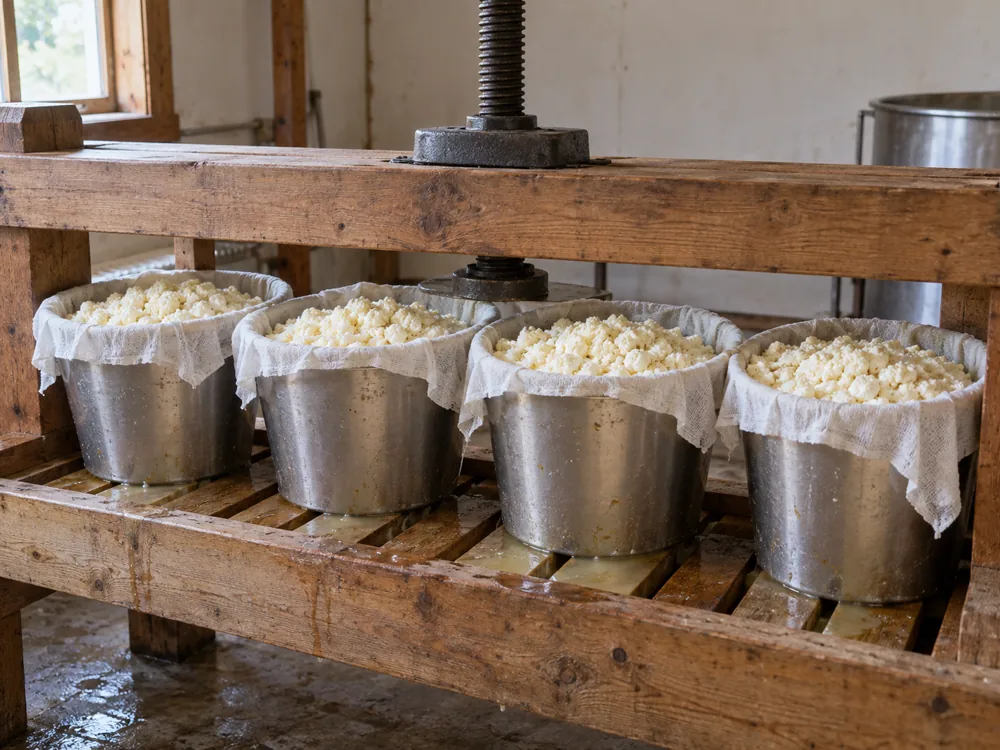
Wheels averaging 35 pounds were painted with butter and oil so they would not crack while drying, dipped in hot paraffin, and stored at about 48°F with a little ozone in the air to hold down excess surface mold.
The whole make took about five and a half hours, and the producer's history says the recipe has not changed. Some details have: the producer's largest wheel is now 23 pounds against that 35-pound average, and Culture says only a few hundred pounds of cheese are made each day, against the 500 to 750 pounds Vermont Life reported.
Where Does Crowley Cheese Come From?
The Crowley family farm in Healdville, Vermont, began in 1787, and by 1824 the family was making cheese for neighbors as well as itself, according to the producer's history page.
A. Winfield Crowley called a meeting of local farmers in May 1882 to set up a cheese factory association. The farmers agreed to sell it their surplus milk and got whey back for animal feed, the National Park Service form records.
The association's first by-law limited the season to June through September, when summer's milk surplus was hardest to keep fresh, and extended it to May in 1884. The Crowleys bought out the cooperative in 1937, and the producer's history dates year-round production to 1940.
When that form was written in 1979, the first floor held the make room and a drying room where fresh wheels sat on open racks for about a week. A wing handled waxing, and the basement and a second-floor room held the aging cheese.
A Boston-Burlington rail line opened in 1849 and gave Vermont cheese access to larger markets, the producer says. The Crowley family ran the factory for 85 years across three generations, a stretch in which the National Park Service says Vermont's cheese factories dwindled from hundreds to a handful.
Robert Crowley died in 1966 with no family member groomed to succeed him, Randolph Smith bought the business in 1967, and Galen and Jill Jones have owned it since 2009.
The milk supply changed along the way. Bulk cooling tanks ended small can deliveries in the early 1960s and cost the factory most of its patrons, so it began taking milk by tank truck from a commercial creamery in another town, the National Park Service records.
Claims about its age have widened over time. Vermont Life called it the oldest cheese factory in Vermont in 1970.
The National Park Service form of 1979 called it the oldest active factory in Vermont and among the oldest in the United States, and the producer now calls it America's oldest remaining cheese factory.
How Do Crowley's Six Age Levels Differ?
The producer sells six Holstein-milk age levels and describes each in a line of its own.
| Label | Age | Producer's description |
|---|---|---|
| Mild | 2 to 5 months | "robust flavor from the raw milk but no flavor yet from the aging process" |
| Medium Sharp | 6 to 10 months | "the cheddar profile is developing, but this is still a young Crowley" |
| Sharp | About 12 months | "flavorful cheese has begun to sharpen up" |
| Extra Sharp | About 18 months | "the fullest flavored Crowley that doesn't threaten to 'bite you back'" |
| Extra Sharp Reserve | About 2.5 years | "a notably sharp cheese that may bite back" |
| Unusually Sharp | At least 3.5 years | "Crowley's most aged cheese," sometimes aged seven or eight years |
The producer ties the long ladder to the rinse: reduced acidity speeds up ageing, so Crowley can offer six levels where most cheesemakers offer two or three.
Culture says Crowley's flavors "can be quite assertive" by one year of age, which it gives as the minimum release age for its Crowley Sharp entry. The producer sells Mild at two to five months, so Culture's minimum describes that entry and not the youngest labels.
Older sources use shorter ages for the same words. Vermont Life gave the 1970 ladder for cheddar and Colby types as two months for mild, four to five months for medium sharp and six months to a year for sharp.
The 1979 National Park Service form likewise put the run from mild to sharp at two to six months or more. Today's Medium Sharp starts at six months where Vermont Life's started at four, so the same name now covers an older cheese, and the age on the label is the figure that compares across sources.
Unusually Sharp is the label the producer says varies: depending on age and batch it can be extraordinarily sharp or show additional flavor notes, and the producer encourages sampling. Extra Sharp Reserve, by contrast, still keeps the flavor profile of the younger cheeses.
What Does Crowley Cheese Taste Like?
Culture's entry is titled Crowley Sharp, but its text says the Crowley Extra Sharp is rich, buttery and tangy with notes of apricots and pine nuts. It adds that the higher moisture makes the cheese creamier and less tangy than some cheddars, and it compares Crowley with the English-style cheddars made by some other Vermont cheesemakers.
Culture does not say which age its texture words describe, so taste a small piece before you commit to a wheel.
How Do Holstein and Jersey A2 Crowley Differ?
Most Crowley is made with Holstein milk from nearby Woodlawn Holstein Farm, which the producer says gives it a lactic character.
A small amount each year is made with grass-fed Jersey milk from Jersey Girls Dairy in Chester, Vermont, a small herd whose cows were each tested for A2 milk. The producer says Jersey milk, with its higher butterfat, makes a much richer, more buttery and generally more intense cheese.
Holstein is the predominant dairy cow today, but the producer says Crowley was made with the milk of other breeds for much of its early history, and Jersey cows were popular through the 19th century for the butterfat in their milk.
| Attribute | Holstein Crowley | Jersey A2 Crowley |
|---|---|---|
| Milk | Raw milk from Woodlawn Holstein Farm | Raw grass-fed milk from Jersey Girls Dairy |
| Rennet | Veal rennet | Vegetable rennet |
| Flavor | Lactic character | Richer, more buttery, more intense |
| Ages | Six levels, from 2 months to 3.5 years or more | About 18 months, about 3 years, and 4 years or more |
The producer's own page lists veal rennet for the Holstein cheeses, and Culture lists animal rennet.
The producer says the Jersey cheeses use vegetable rennet, so check the label on those.
Its About page describes A2 milk as having a different beta-casein protein structure from regular (A1) milk. The richer flavor it ties to butterfat, not to A2.
Jersey cheese is not sold young: the producer says it seems to take its time before release, so even the youngest A2 Crowley is aged about 18 months and every label under that age is Holstein.
With time, the producer says, the butter in the Jersey cheese comes into greater balance with the flavor from the aging rooms: the 18-month Aged Cheddar shows the most butter, while the Extra-Aged at about 3 years shows considerable complexity. Its sharpest Jersey cheese, the Extra-Aged Reserve, is aged at least 4 years.
Why Does Crowley Melt Without Separating?
The producer says Crowley's higher moisture "results in a cheddar which melts beautifully, without separating or getting stringy."
That is the maker's own case for Crowley as a good melting cheese, and the reason it gives is moisture. No cited source tests it independently.
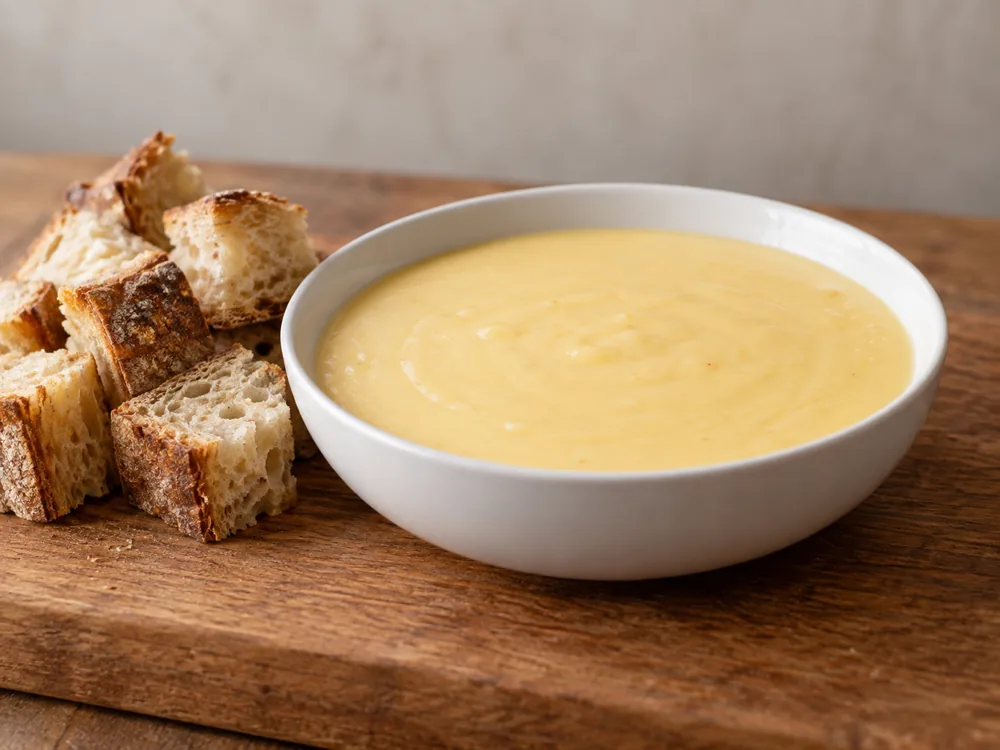
The producer's rarebit recipe heats ½ cup of beer or ale and 1 teaspoon of butter in a double boiler, then melts 4 cups of shredded sharp Crowley into it slowly while stirring. Once it is smooth, egg yolks, milk and salt go in, and the thickened rarebit is served with hot sourdough bread cubes.
That is 4 cups of shredded cheese against ½ cup of beer or ale and ¼ cup of milk, so the sauce is mostly cheese and depends on how the cheese melts.
What Pairs Well With Crowley Cheese?
The producer's pages give no wine matches for Crowley, so these pairings come only from its own recipes and About page.
| Pairing | Type | Why It Works |
|---|---|---|
| Beer or ale | Drink | Crowley's rarebit recipe melts the cheese into ½ cup of beer or ale. |
| Sourdough bread | Food | Crowley's rarebit recipe is served with hot sourdough bread cubes. |
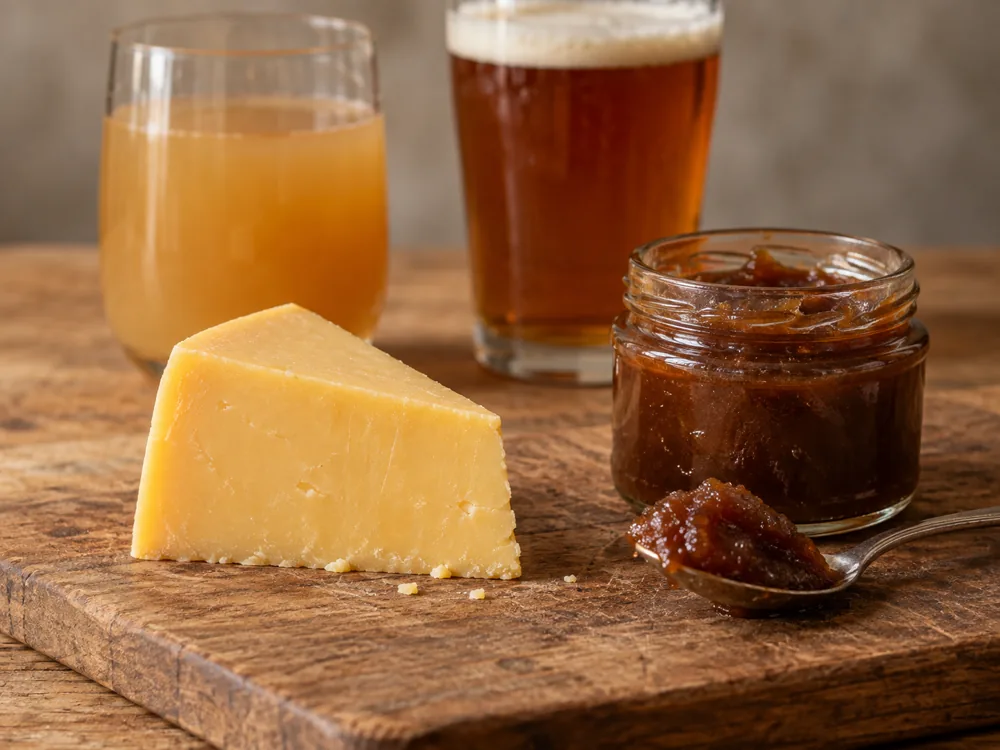
| Cider, amber ale and apple butter | Drink | The producer's About page says its Jersey A2 Aged Cheddar pairs well with Vermont cider or a malty amber ale and a dollop (or a jar) of apple butter. |
Which Flavored Crowley Cheeses Does the Producer Make?
The flavored Crowley cheeses are Holstein-milk cheeses that the producer generally ages three to eight months before release, so the cheese underneath is young, in the range of its Mild and Medium Sharp labels. It occasionally offers aged flavored cheeses in its samplers and on its special and unusual cheeses page.
| Flavor | Producer's description |
|---|---|
| Garlic | Garlic that is restrained and in balance with the cheese |
| Smoked Garlic | The Garlic cheese, maple smoked |
| Garlic Chive | The best-selling flavored cheese, suited to snacking and hors d'oeuvres |
| Fresh Chive | Shows off the simple elegance of chives |
| Muffaletta | Crowley blended with a tapenade of manzanillo olives, fresh garlic and pimentos |
| Hot Pepper | "Just the right amount of heat" |
| Sage | The go-to for a Crowley cheese omelet |
| Smoked | The Medium Sharp, maple smoked |
Two of the eight come with a reference point: the producer calls Fresh Chive "in the spirit of a Cotswold cheese" and Sage the most traditional flavoring, very popular when the factory opened.
Which Age and Format Should You Buy?
Crowley comes as 8-ounce bars in self-selected boxed samplers of 3, 6 or 9, as clothbound wheels of 2.5, 5 and 23 pounds, and as hand-cut, hand-waxed blocks in custom sizes.
The wheels are sold with the cloth on or removed and are waxed by hand, while the blocks are waxed with no cheesecloth. Hand-cut wedges from the large wheels are available by special order, and blocks are ordered by phone.
Culture's profile measures the 2.5-pound wheel at 5.5 inches across and 3.5 inches high, which gives the scale of the smallest wheel.
For a first purchase we would pick Sharp, the age in the title of Culture's entry, the one the producer's rarebit recipe calls for, and the one the producer says suits just about any cheese occasion.
What Can Replace Crowley Cheese?
None of the cited sources tests substitutes, so these follow how they place Crowley.
The producer compares its Mild with Monterey Jack, so a young Monterey Jack or Colby is the nearest stand-in for Mild.
For the Sharp ages, the producer and Culture both class Crowley as a cheddar, so a moist cheddar is the closer pick. The producer also names ageability, together with raw-milk flavor intensity, as the two qualities that set Crowley apart from Colby and Monterey Jack, which is why a young Colby does not cover the older labels.
How Should You Store Crowley Cheese?
The producer's pages give no advice on storing cut cheese, so the numbers below come from U.S. Dairy guidance for hard, aged cheeses such as cheddar.
U.S. Dairy suggests wrapping the cheese in wax paper, parchment or cheese paper and then keeping it in a loosely sealed container in the coldest stable part of the refrigerator rather than the door, where temperatures change more often. That guidance does not cover a high-moisture, raw-milk cheese like Crowley.
Is Raw-Milk Crowley Safe for Everyone?
The producer says all of its cheese, Holstein and Jersey, is made with raw milk. The federal cheddar standard requires cheese made with unpasteurized dairy ingredients to be cured at 35°F or higher for at least 60 days, and the producer's youngest label is aged two to five months.
| Source | What it says |
|---|---|
| NHS | Lists pasteurised or unpasteurised hard cheeses, with cheddar as its first example, as safe, and says foods made from unpasteurised milk must be thoroughly cooked |
| CDC | Lists hard cheese made with pasteurized milk, such as cheddar, as safer and dairy made from raw milk as riskier; says pregnant women are 10 times more likely to get a Listeria infection |
The producer calls Crowley a cheddar variant with higher moisture than conventional cheddar, and if it does not count as a hard cheese, the NHS says foods made from unpasteurised milk must be thoroughly cooked. The rules on eating cheese during pregnancy also differ by country, so ask a midwife or doctor before eating it uncooked.
SOURCES & REFERENCES
It is a raw-milk cheddar variant made in Mount Holly, Vermont, with a rinsed-curd recipe that the producer says makes it moister and less acidic than conventional cheddar.
The producer sells it at six ages, from Mild at 2 to 5 months to Unusually Sharp at 3.5 years or more, and the family has made cheese since 1824 in a factory dating to 1882.
No source calls it identical: Vermont Life classed it as a Colby in 1970, the National Park Service form calls it the Colby type of cheddar, and the producer says it falls between conventional cheddar and the Colby and Monterey Jack variants.
The producer says its higher moisture lets it melt without separating or getting stringy, and its own rarebit recipe melts it into beer or ale. That is the producer's own claim, and no cited source tests it.
The producer's page lists veal rennet for the Holstein cheeses and vegetable rennet for the Jersey A2 cheeses, so only the Jersey cheeses are made without animal rennet.
It is made with raw milk. The NHS lists pasteurised or unpasteurised hard cheeses such as cheddar as safe but says foods made from unpasteurised milk must be thoroughly cooked, and the CDC lists dairy products made from raw milk as riskier, so ask a midwife or doctor.