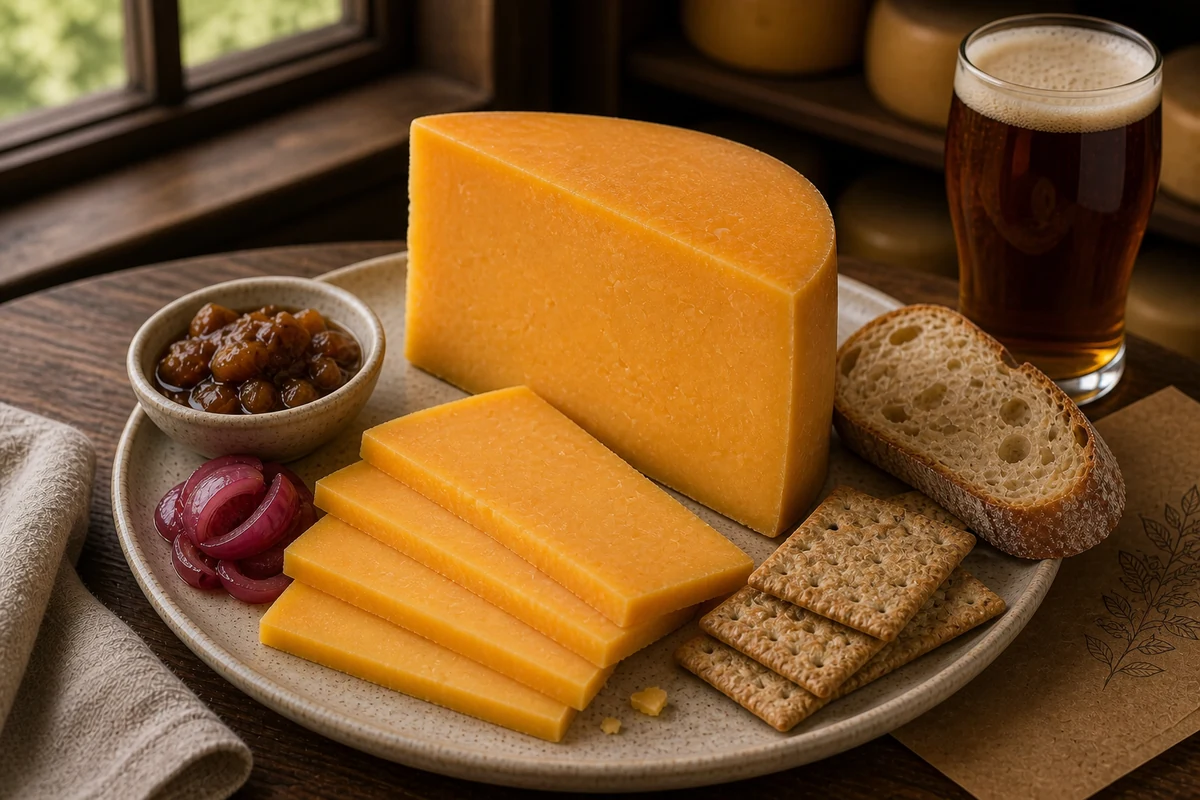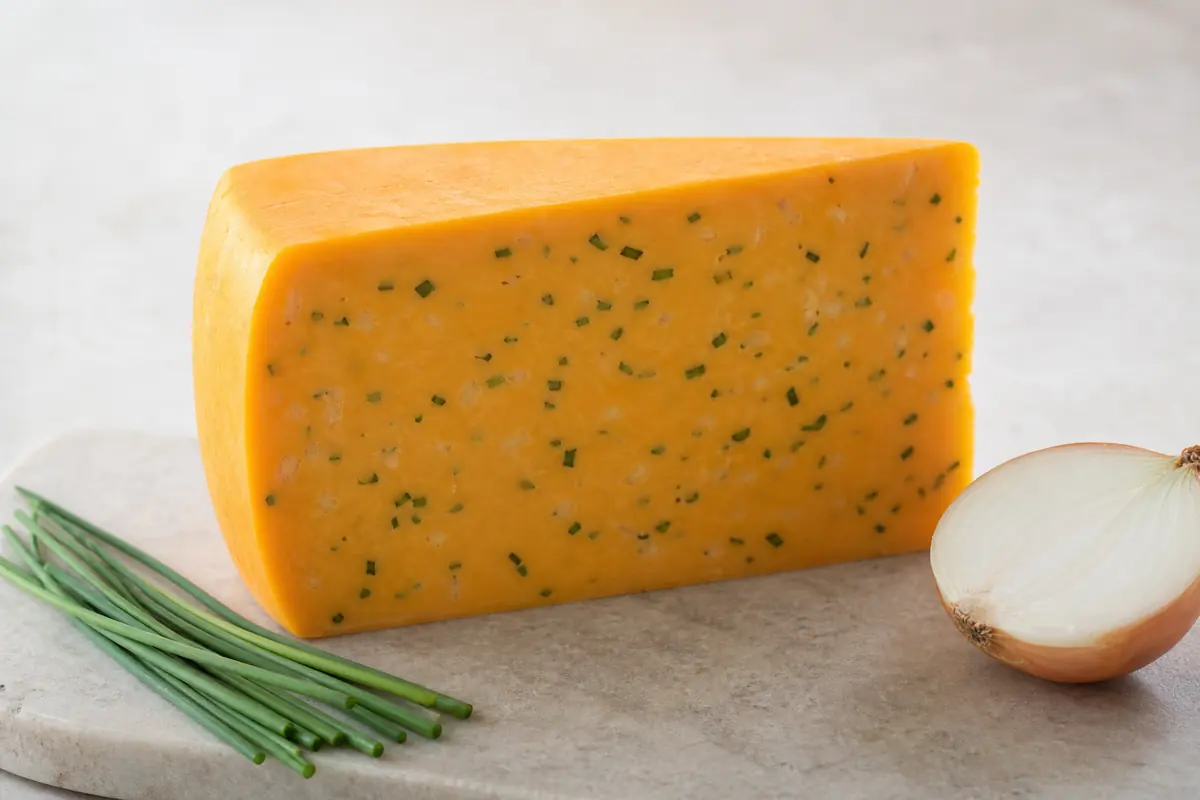
Cotswold is a flavored cheese made by blending onions and chives into a Double Gloucester base, and Long Clawson Dairy says it invented the blend in the 1960s.
It is a cheese from England made with pasteurized cow's milk. The name sounds like a place, but Cotswold is not a traditional English cheese name.
In This Article
What Is Cotswold Cheese?
Long Clawson Dairy describes Cotswold® as its smooth, rich, traditional Double Gloucester combined with sweet roasted onions and a touch of chive. The dairy lists Cotswold, the layered Huntsman and fruit-studded White Stiltons among its inventions of the 1960s, when it began experimenting with blended and flavoured cheeses.
The Long Clawson half wheel sold by the distributor Gourmet Foods International (GFI) is made from Double Gloucester (pasteurized milk, salt, enzymes, dairy cultures, annatto extract as a color), reconstituted minced onions at 2 percent, and dried chives.
Cotswold also goes by other names, including Double Gloucester with Onion and Chives and English Cotswold. Cheese.com ties its nickname, Pub Cheese, to its popularity in English pubs.
Is Cotswold a Traditional or Protected Cheese?
Cotswold is a brand name: it is a registered trade mark of Long Clawson Dairy, which writes it as Cotswold®.
Wikipedia describes the blend as Double Gloucester with chives and spring onions, marketed as Cotswold, which is not a traditional English cheese name. Of the Gloucester cheeses, it names PDO status only for Single Gloucester.
| Question | Answer and who gives it |
|---|---|
| Where was it first made? | Long Clawson Dairy, in the village of Long Clawson, lists Cotswold among its 1960s inventions. |
| Which region is it from? | The Cotswold region in South Central England in Cheese.com's description; Gloucestershire in Cheese.com's Region field. |
| Is Cotswold a traditional cheese name? | No, says Wikipedia: Double Gloucester blended with chives and spring onions has been marketed as Cotswold, which is not a traditional English cheese name. |
| Who owns the name? | Long Clawson Dairy, which writes it as Cotswold®. GFI's record for the Long Clawson wheel calls it a registered trade mark. |
| Is a similar blend sold under another name? | Cheese.com gives Double Gloucester with Onion and Chives as a synonym, and GFI sells a similar blend as Cooper's Hill, a Double Gloucester with chive and onions. |
A label reading Cotswold, Cooper's Hill, or Double Gloucester with onion and chives points to the same kind of blend, though the onion in it is worded differently from one record to the next.
One explanation of the name is that the cheese is supposedly colored similarly to Cotswold stone.
Cooper's Hill is two different things: the Gloucestershire hillside where a wheel of Double Gloucester is chased down a steep 200-yard slope each spring, and the brand on a Double Gloucester with chive and onions that GFI distributes.
Wikipedia describes the rolled wheel only as Double Gloucester, so the cheese in the race is Double Gloucester, not a confirmed Cotswold.
What Does the Double Gloucester Base Contribute?
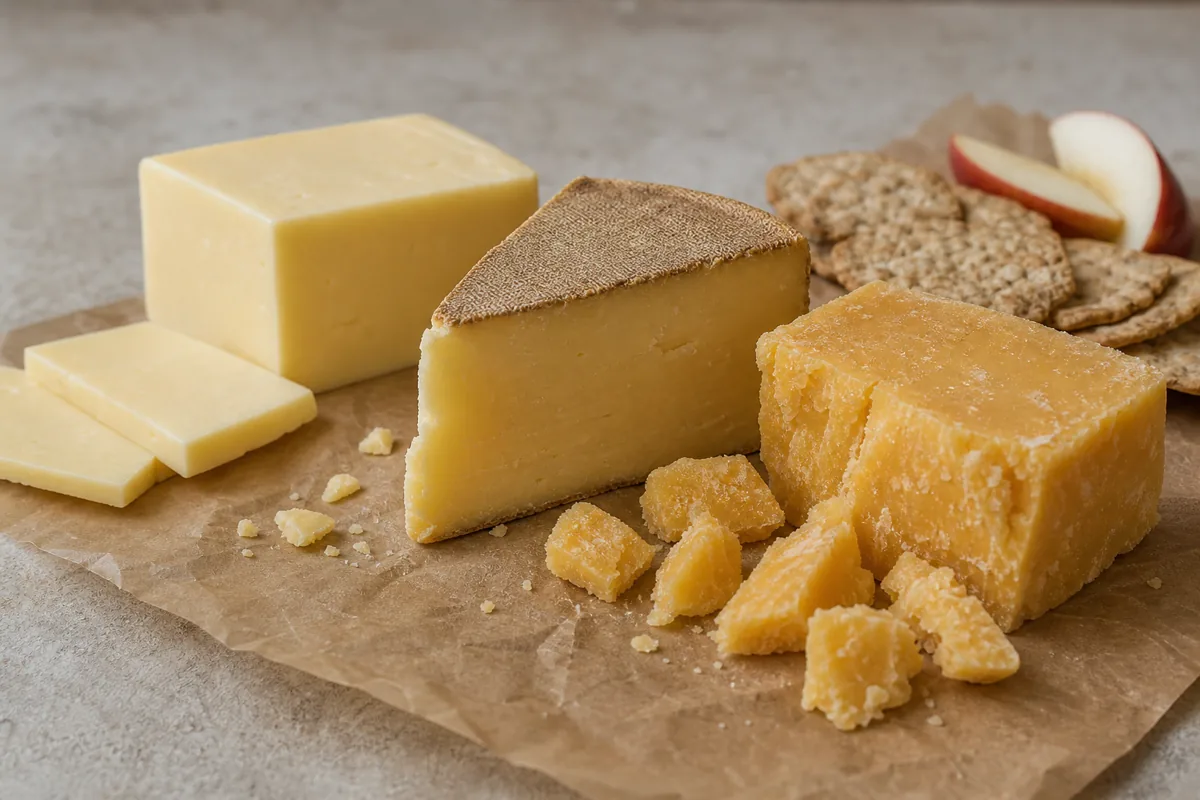
Cotswold's base is Double Gloucester rather than Single, the Gloucester style that is allowed to age for longer and is slightly firmer, with a stronger and more savoury flavor.
| Trait | Single Gloucester | Double Gloucester |
|---|---|---|
| Ageing | Aged for less time than Double | Allowed to age for longer |
| Texture | More crumbly, lighter, and lower in fat | Slightly firmer |
| Flavor | Not described in the entry | Stronger and more savoury |
| Round size | Smaller | Larger |
Cotswold's rind is natural, and Wikipedia gives both Gloucester types a natural rind and a hard texture.
Both GFI ingredient lists name annatto: annatto extract as a color for Long Clawson and annatto norbixin for Cooper's Hill. The wild flower lady's bedstraw was originally responsible for the yellow of Double Gloucester.
Long Clawson describes annatto as an extract from the berry of the achiote tree and says it gives the dairy's Shropshire Blue its golden orange hue.
Long Clawson says its milk is collected within 30 miles of the dairy, and Walt Churchill's Market lists its Clawson Cotswold as made in the UK with UK milk. GFI's Cooper's Hill record says the cows mostly graze on grass in summer and eat silage in winter.
What Do the Onion and Chives Change?
In the cut, the onion and chives show as visible green specks in a pale yellow to orange paste.
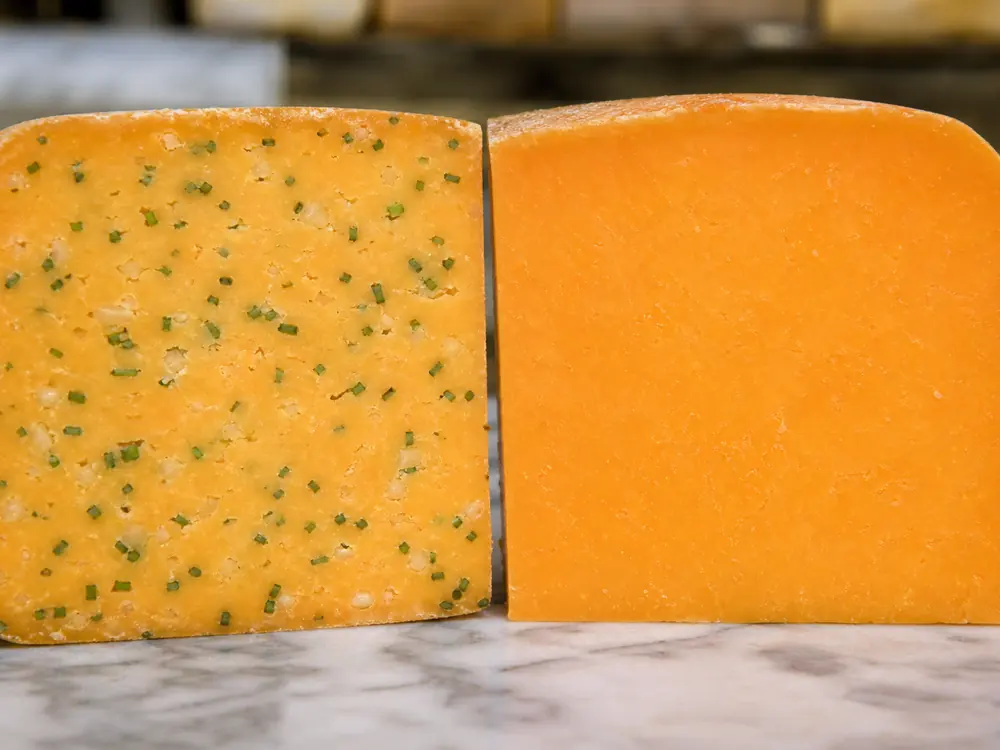
Each record words the onion differently, and the GFI record for the Long Clawson half wheel puts its reconstituted minced onions at 2 percent.
| Product | Onion | Chive | Given by |
|---|---|---|---|
| Long Clawson Cotswold | Sweet roasted onions | A touch of chive | Long Clawson Dairy, cheese range page |
| Long Clawson Cotswold, 2.5 lb half wheel | Reconstituted minced onions, 2% | Dried chives | GFI record |
| Clawson Cotswold, 5.29 oz piece | Rehydrated minced onion | Freeze dried chives | Walt Churchill's Market record |
| Cotswold, as an encyclopedia entry describes it | Spring onions | Chives | Wikipedia, Gloucester cheese |
| Cooper's Hill, a similar blend | Dried onion | Chives | GFI record |
Two 1978 descriptions quoted in Wikipedia's footnotes name chives and no onion. Richard Widcombe's The Cheese Book called it Double Gloucester with chives added, and a New Scientist piece called it a cheese with chives in it.
To know which onion went into your wedge, read the ingredient list on its own package.
What Does Cotswold Taste Like?
Cheese.com calls the flavor sweet and tangy with a creamy, smooth texture, and Long Clawson describes the familiar taste of cheese and onion.
For the similar Cooper's Hill blend, GFI's record lists mild and savory notes, creamy and buttery notes, a close texture with visible chives, and a firm body, all punched up by the onion.
Cotswold's texture is described two ways: Cheese.com calls it typically semi-firm to firm, saying it slices easily and crumbles well, while Walt Churchill's Market files the Clawson cheese as a full fat hard cheese.
The 1978 Cheese Book text that Wikipedia quotes described a smooth, mellow Gloucester taste with the chives adding a fragrant, delicate flavor.
Where Does Cotswold Melt Best?
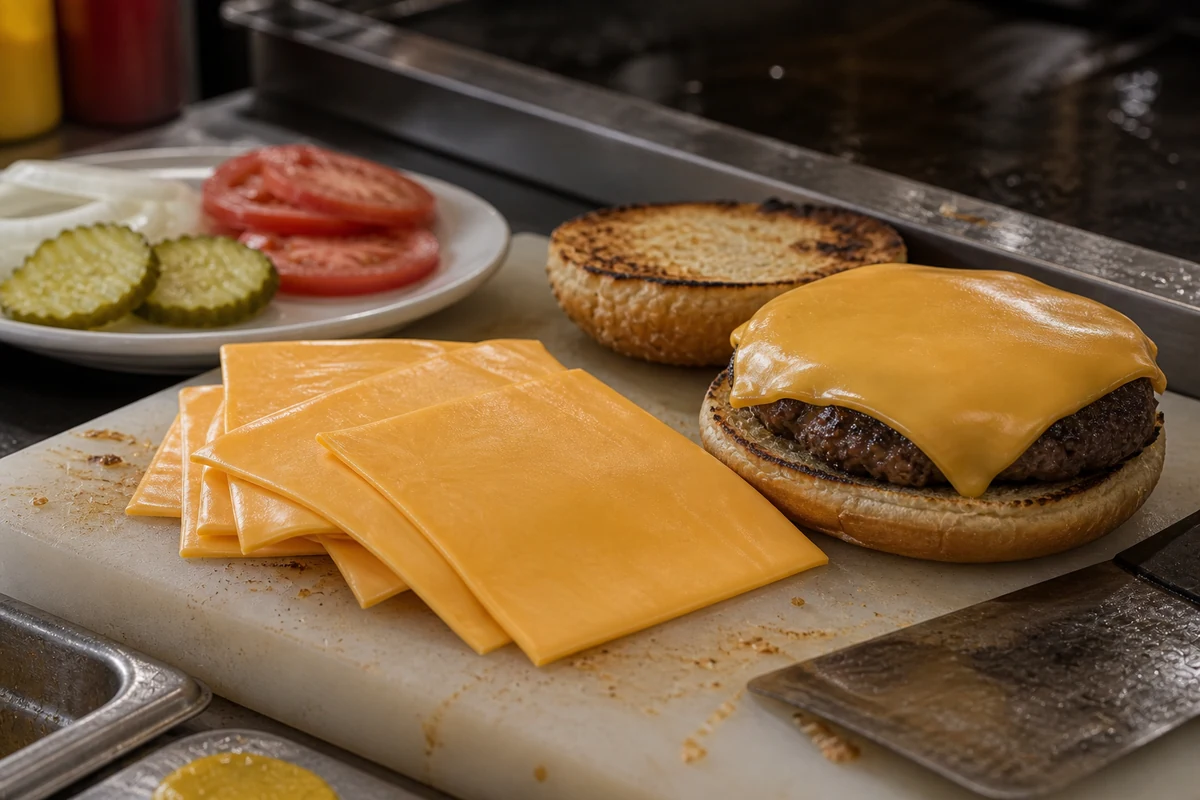
Cheese.com says Cotswold melts effectively and suits sandwiches and burgers.
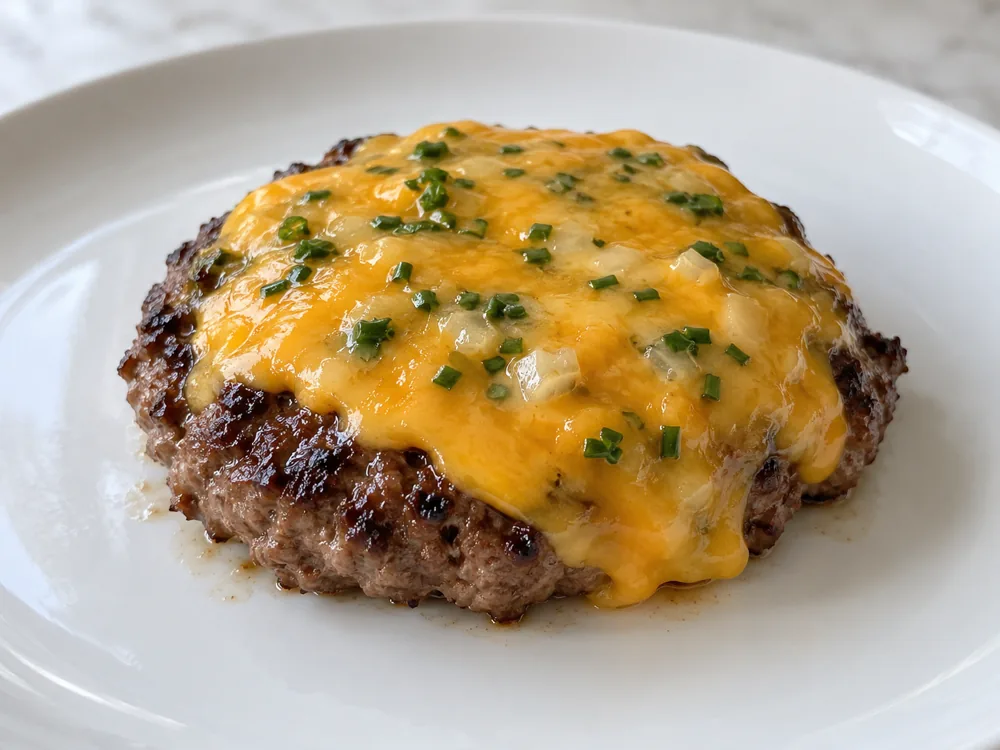
- Burgers: named by Cheese.com, the GFI record for Long Clawson, and the GFI record for Cooper's Hill.
- Steaks, nachos, and omelets: named in the GFI record for Long Clawson.
- Sandwiches: Cheese.com names sandwiches, and the Cooper's Hill record adds roast beef sandwiches.
- Baking: Long Clawson says the cheese bakes beautifully.
How Should You Pair It?
Cheese.com pairs Cotswold with crusty bread, crackers and fresh fruit, and GFI suggests a gin and tonic with the similar Cooper's Hill blend.
| Pairing | Type | Why It Works |
|---|---|---|
| Crusty bread | Food | Named by Cheese.com as a pairing for Cotswold. |
| Crackers | Food | Named by Cheese.com as a pairing for Cotswold. |
| Fresh fruit | Food | Named by Cheese.com, with no particular fruit specified. |
| Gin and tonic | Drink | Suggested in the GFI record for Cooper's Hill, a similar blend, not for Cotswold itself. |
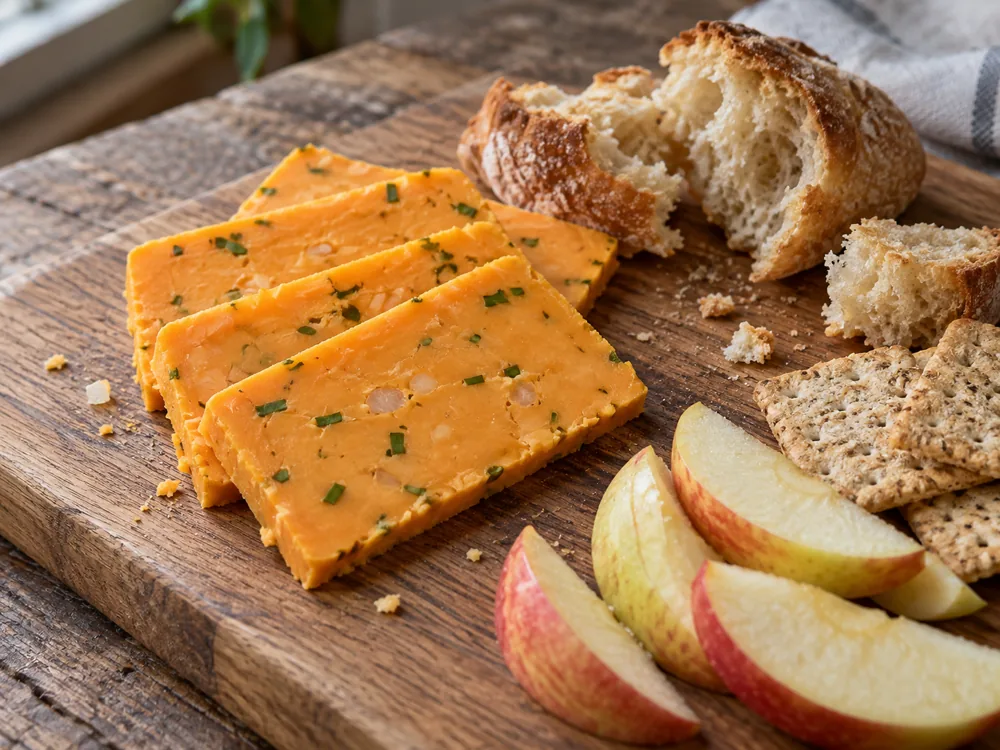
Long Clawson adds that Cotswold is always a talking point on a cheese board.
How Does Cotswold Differ from Huntsman and Innkeepers Choice?
Two other Long Clawson savoury blends share part of Cotswold's recipe: Huntsman uses the same Double Gloucester, and Innkeepers Choice uses onion and chive.
| Cheese | Base | What goes in |
|---|---|---|
| Cotswold | Double Gloucester | Sweet roasted onions and a touch of chive, blended in |
| Huntsman | Double Gloucester | Blue Stilton, hand layered between the Double Gloucester |
| Innkeepers Choice | Mature Cheddar | Chunky pieces of pickled onion and snips of chive |
Huntsman shares only the base: Long Clawson hand layers Blue Stilton between the Double Gloucester, in alternating layers of the two, so a Huntsman wedge shows a Stilton layer where a Cotswold wedge shows green flecks.
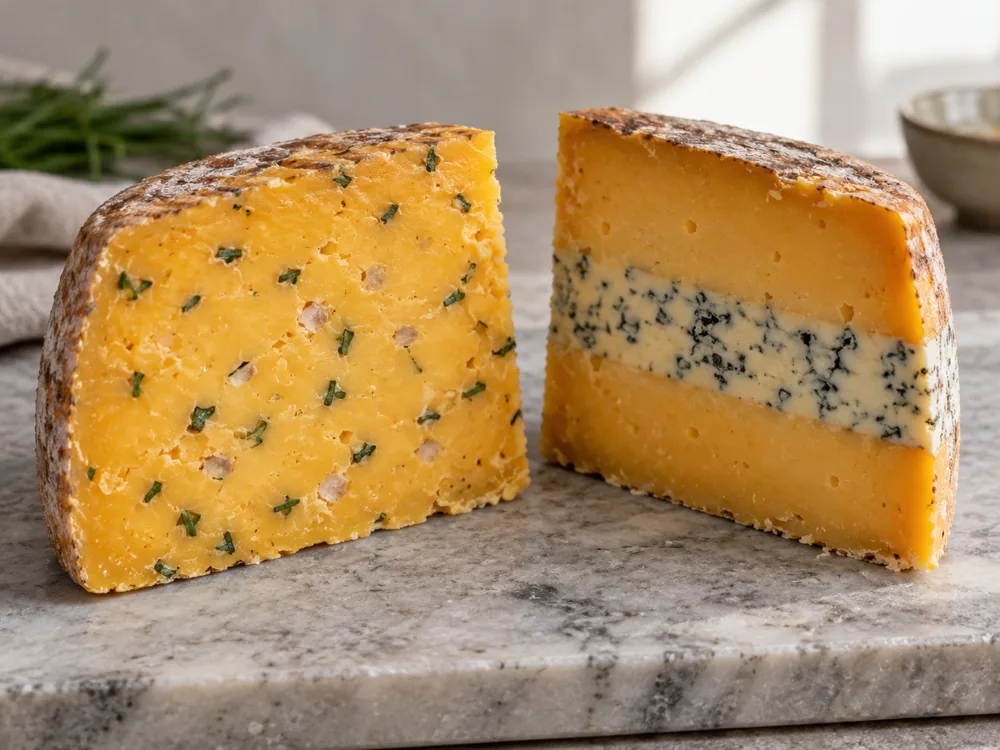
Innkeepers Choice changes both the base and the onion. Long Clawson builds it on mature Cheddar with pickled onion in place of Cotswold's sweet roasted onions, and it suggests apple slices, piccalilli, and perhaps a Melton Mowbray pork pie.
Is Cotswold Vegetarian?
Long Clawson says all its cheeses use vegetarian rennet except Windsor Red, and Walt Churchill's Market lists Clawson Cotswold as suitable for vegetarians. Cheese.com marks Cotswold as not vegetarian.
| Question | Answer | Given by |
|---|---|---|
| Which rennet does Long Clawson use? | Vegetarian rennet in all its cheeses, except Windsor Red because of its colouring | Long Clawson Dairy FAQ |
| Is Clawson Cotswold listed as suitable for vegetarians? | Yes | Walt Churchill's Market record |
| What does the half-wheel ingredient list call the coagulant? | Enzymes, with no source of the enzymes given | GFI record, Long Clawson half wheel |
| Is Cotswold vegetarian? | No | Cheese.com |
For Clawson's Cotswold, the dairy's own FAQ is the statement to go by. For another maker's blend, such as Cooper's Hill, check the package.
Can You Eat Cotswold During Pregnancy?
Cotswold is made with pasteurized milk, and its texture is described two ways: Walt Churchill's Market files Clawson's Cotswold as a hard cheese, while Cheese.com calls Cotswold semi-firm to firm.
The NHS lists pasteurised or unpasteurised hard cheeses, pasteurised semi-hard cheeses and pasteurised soft cheeses as safe to eat in pregnancy.
The CDC lists hard cheese, when made with pasteurized milk, as a safer choice. Served cold, Cotswold is also described as a pasteurized semi-firm or firm cheese, a type the CDC list does not cover, so ask a midwife or doctor whether Cotswold counts as a hard cheese.
The CDC lists unheated cheese sliced at a deli as riskier and deli-sliced cheeses heated to 165°F or until steaming hot as safer, which matters if your Cotswold was sliced at a deli.
What Are the Nutrition Facts, Allergens, and Storage Rules?
Per 1 oz serving, GFI's records for Long Clawson's Cotswold and the similar Cooper's Hill blend differ on calories, fat, protein, sodium and calcium.
| Per 1 oz serving | Long Clawson Cotswold | Cooper's Hill |
|---|---|---|
| Calories | 110 | 90 |
| Total fat | 9 g | 10 g |
| Protein | 6 g | 7 g |
| Sodium | 162 mg | 200 mg |
| Calcium | 194 mg | 203 mg |
The Long Clawson record lists saturated fat as 0 g beside an 18% daily value, so that line contradicts itself, while the Cooper's Hill record lists 6 g with a 30% daily value.
Cooper's Hill also lists fewer calories (90) than Long Clawson (110) next to more fat (10 g against 9 g). GFI says its figures come from the manufacturers and can vary, so read these records as rough guides and go by the pack you receive.
The Cooper's Hill ingredient list names salt twice, inside the Double Gloucester and again after the chives. Its record shows 200 mg of sodium per ounce against 162 mg for Long Clawson.
The ingredient list names pasteurized milk, so Cotswold contains milk and is unsuitable for anyone with a milk allergy.
Walt Churchill's Market lists Clawson's Cotswold as a 5.29 oz retail piece.
GFI, which describes itself as supplying professional kitchens, lists the Long Clawson cheese in 2.5 lb half wheels, four to a case with repack labels, and the Cooper's Hill blend in 5 lb wheels, two to a case.
The GFI record says to take the cheese out of the refrigerator 30 minutes before serving. The date and storage advice on your own package is the guide.
SOURCES & REFERENCES
What Do Buyers Often Ask About Cotswold Cheese?
Cheese.com's text calls it a cheese from the Cotswold region, but its Region field says Gloucestershire, and Wikipedia says Cotswold is not a traditional English cheese name. Long Clawson Dairy lists it among its 1960s inventions in the village of Long Clawson.
Cotswold is Double Gloucester with onions and chives blended in. Long Clawson calls it its traditional Double Gloucester with sweet roasted onions and a touch of chive.
Cheese.com says it melts effectively and suits sandwiches and burgers.
Long Clawson says all its cheeses use vegetarian rennet except Windsor Red, and a retail record lists Clawson's Cotswold as suitable for vegetarians. Cheese.com says no, and for any other maker's blend, check the package.
Cotswold is made with pasteurized milk, and the NHS lists pasteurised or unpasteurised hard cheeses, pasteurised semi-hard cheeses and pasteurised soft cheeses as safe to eat. Served cold, it is described as a pasteurized semi-firm or firm cheese, a type the CDC list does not cover, and the CDC lists unheated cheese sliced at a deli as riskier, so ask a midwife or doctor.
Wikipedia describes the rolled wheel only as Double Gloucester, not as Cotswold. Cooper's Hill is also the brand name on a distributor's Double Gloucester with chive and onions.