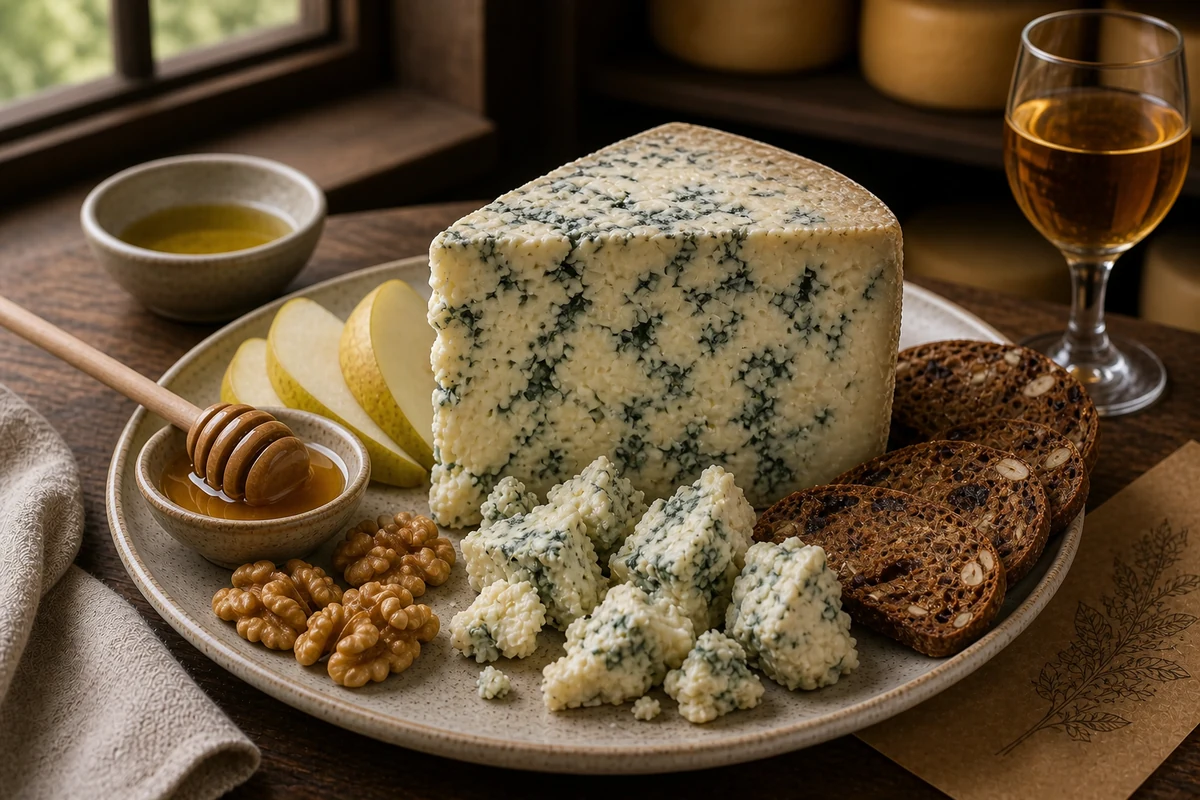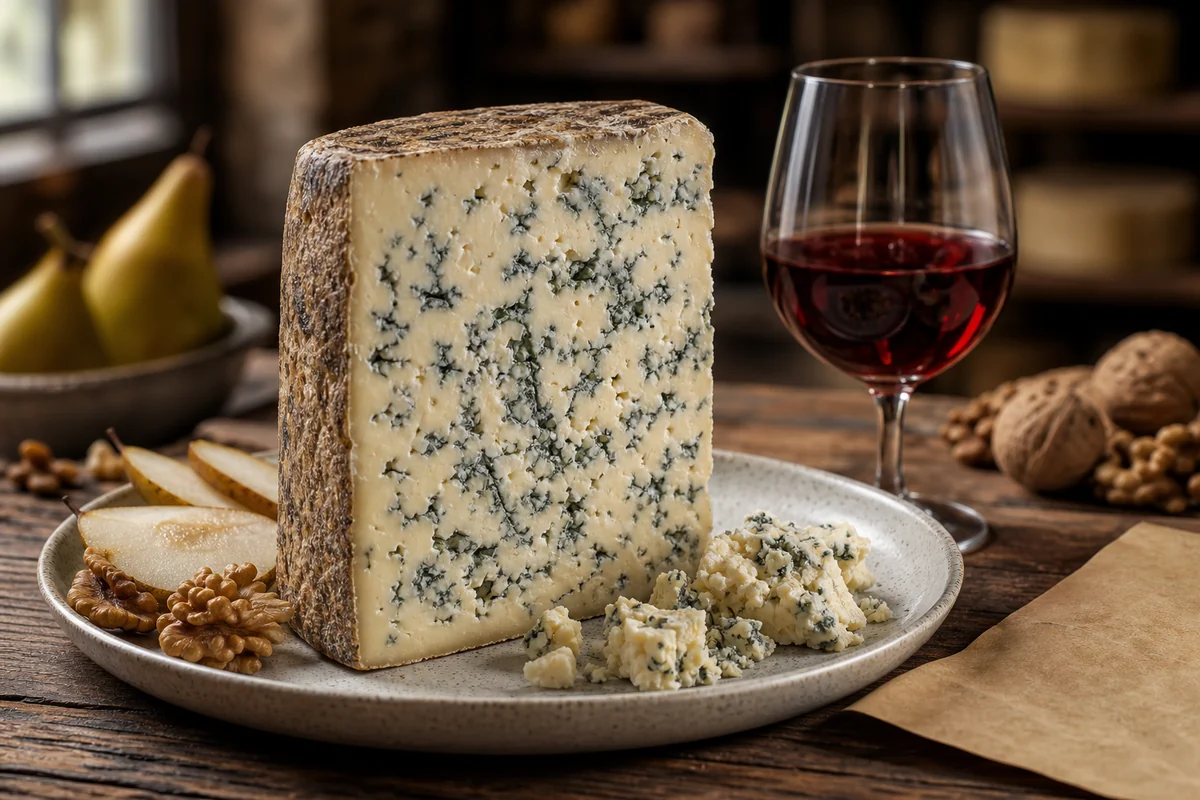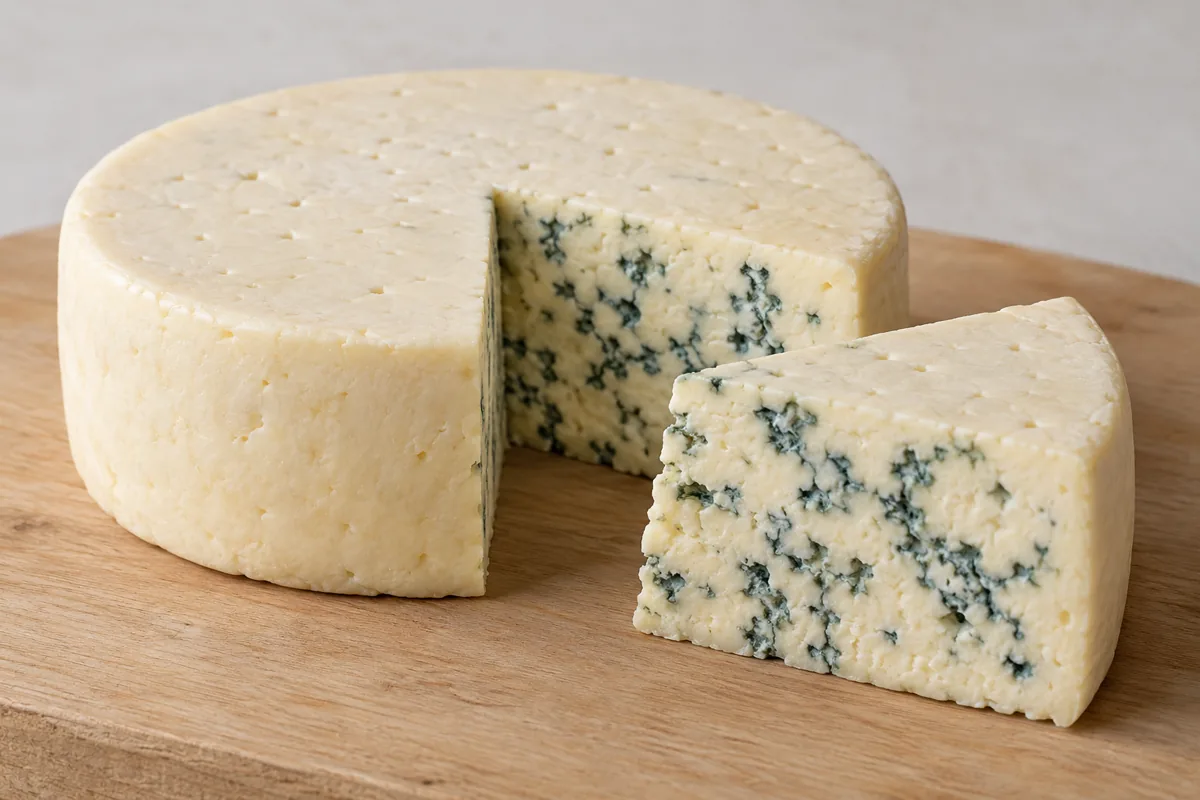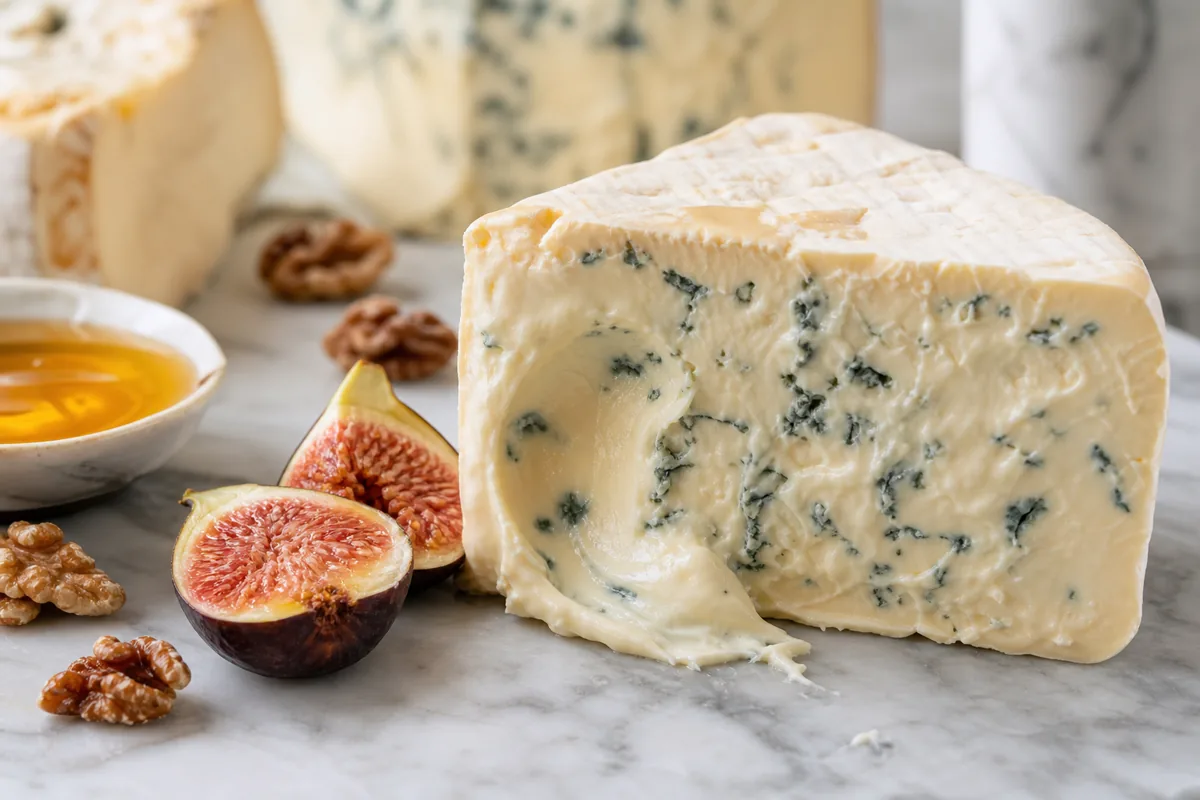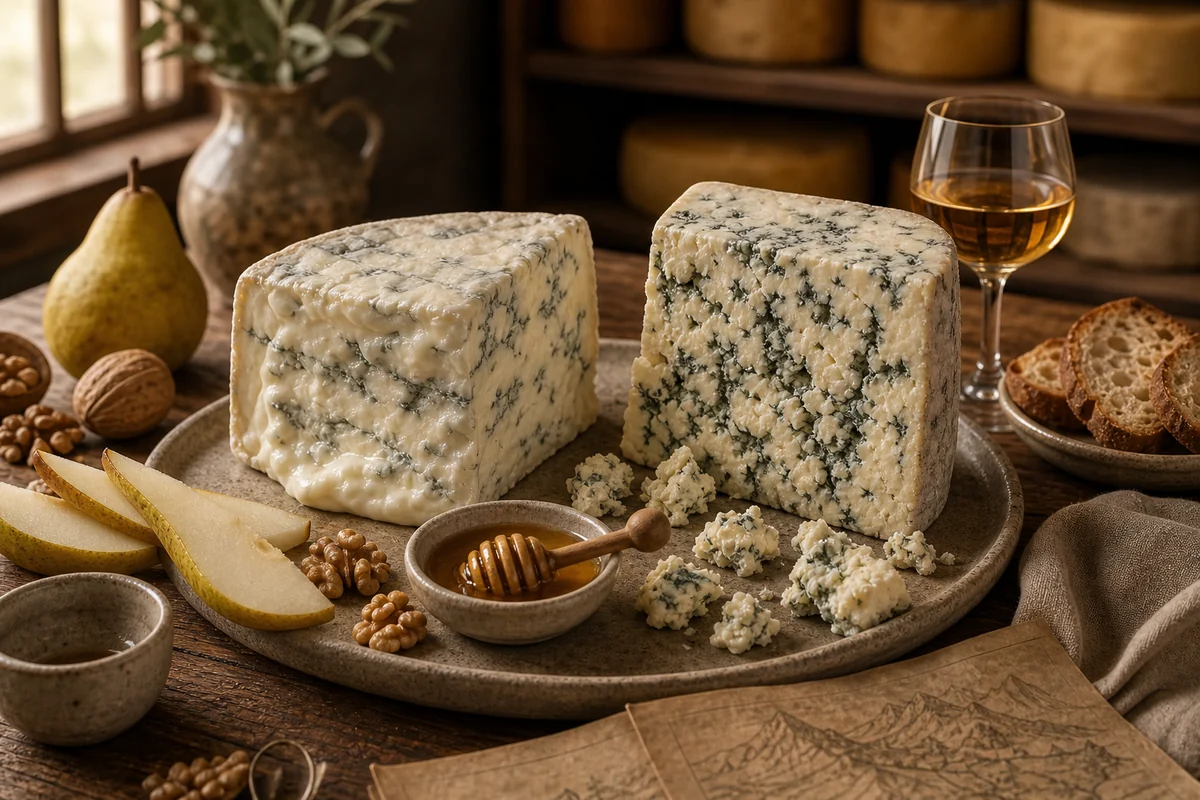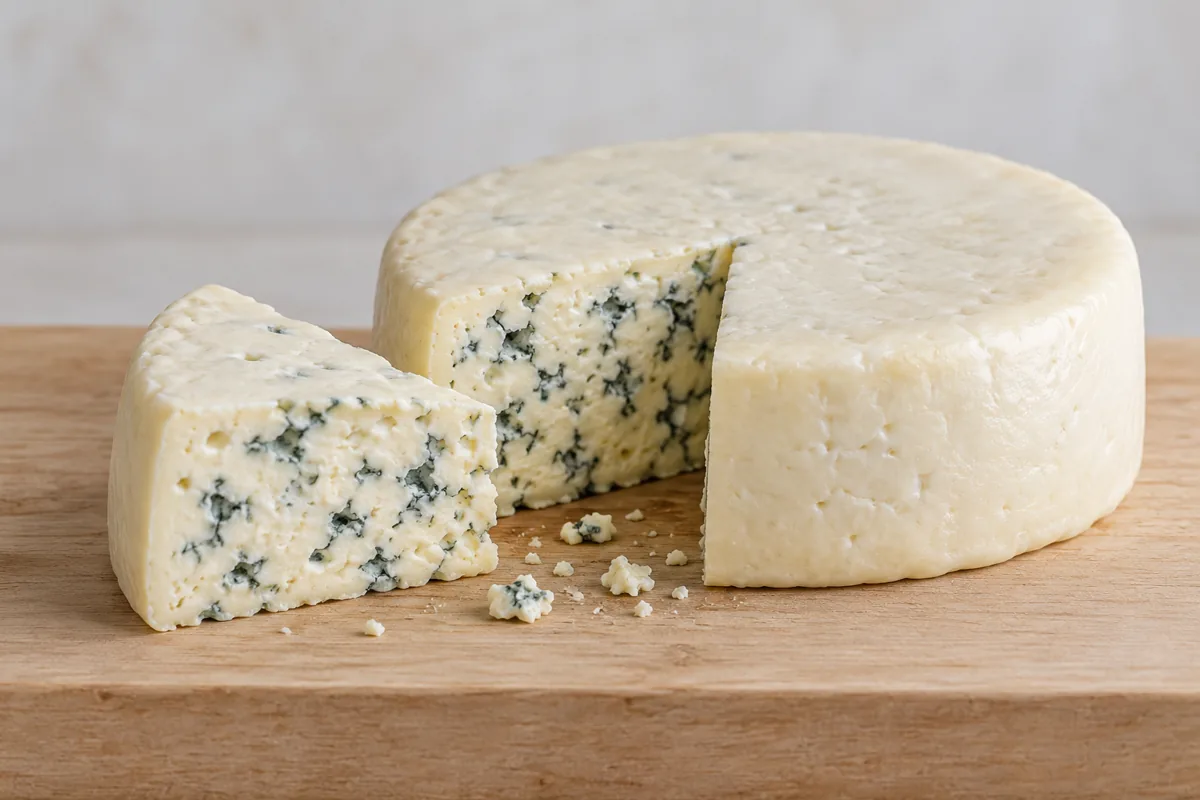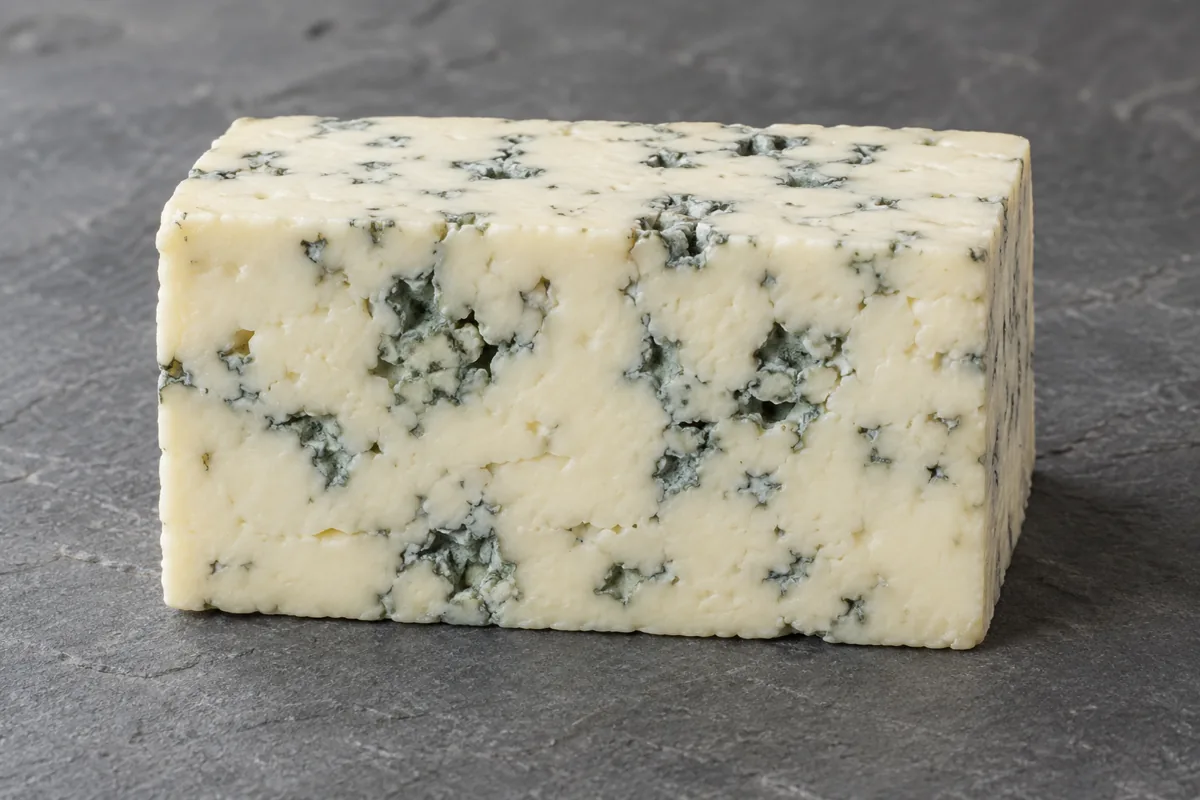
Dorblu is a blue cheese from the Allgäu in Germany, made by Käserei Champignon from pasteurized cow's milk. Cheese.com lists it as soft and blue-veined, with a smooth, cream-colored paste and a creamy, spicy flavor.
It is sold in three lines, Classic, Royal Blu and Grand Noir, which differ in fat and flavor. Within the wider blue cheese family, AzureAzure.com describes Dorblu as designed for people who like moderately strong blues.
In This Article
What Is Dorblu Cheese?
The name, D'or blu, is French for blue gold. Its maker, Käserei Champignon, is a dairy in Lauben in the Allgäu that dates to 1908.
The 1908 date belongs to the dairy and not to this cheese: AzureAzure.com places the origins in early 20th-century Lauben, says the company then built a new blue recipe from the original, and adds that blue cheese became popular in German shops only in the 1990s.
Why Dorblu was made depends on the account: Käse Süchtig calls it one of the youngest premium blues, made to fill a shortage of imported blues in Germany, while the 2016 tasting by the Austrian magazine A la carte describes a trade blue from the Allgäu dairy, made from pasteurized cow's milk and produced specially as an export brand.
The mold behind the veins is Penicillium roqueforti in the producer's list of cultures for Classic and in the Käserei Champignon Hofmeister recipe AzureAzure.com describes, while Käse Süchtig says the exact mold is kept strictly secret. Käse Süchtig also puts the brand's ripening at 3 to 5 months.
What Does Dorblu Taste Like?
Dorblu's salt and firmness are where the descriptions split: the 2016 A la carte panel found it very firm and salty, while AzureAzure.com calls it semi-soft and not too salty or spicy, and Cheese.com calls it soft.
| Source | Texture | Flavor |
|---|---|---|
| Cheese.com | Soft, smooth, cream-colored | Creamy and spicy, with a buttery, fresh aroma |
| Dorblu, Classic line | Creamy consistency | Delicate-tangy |
| Champignon trade range | Soft consistency | Spicy character, piquant, uniform blue veining |
| AzureAzure.com | Semi-soft, creamy, white with blue veins | Not too salty or spicy |
| Käse Süchtig | Soft to semi-firm | Creamy and mildly spicy, with dried herb, fruit, and mushroom notes that vary by line |
| A la carte tasting, 2016 | Very firm | Salty |
The paste is cream in Cheese.com's fact box, white-yellow in its description and white at AzureAzure.com. Every account puts the blue veins through the whole paste, and the producer's trade range calls the veining uniform.
Käse Süchtig says the herb, fruit and mushroom notes vary by line, so read the line name on the pack before you match a description to your wedge.
Is Dorblu Good, and How Did a 2016 Blue Cheese Panel Rank It?
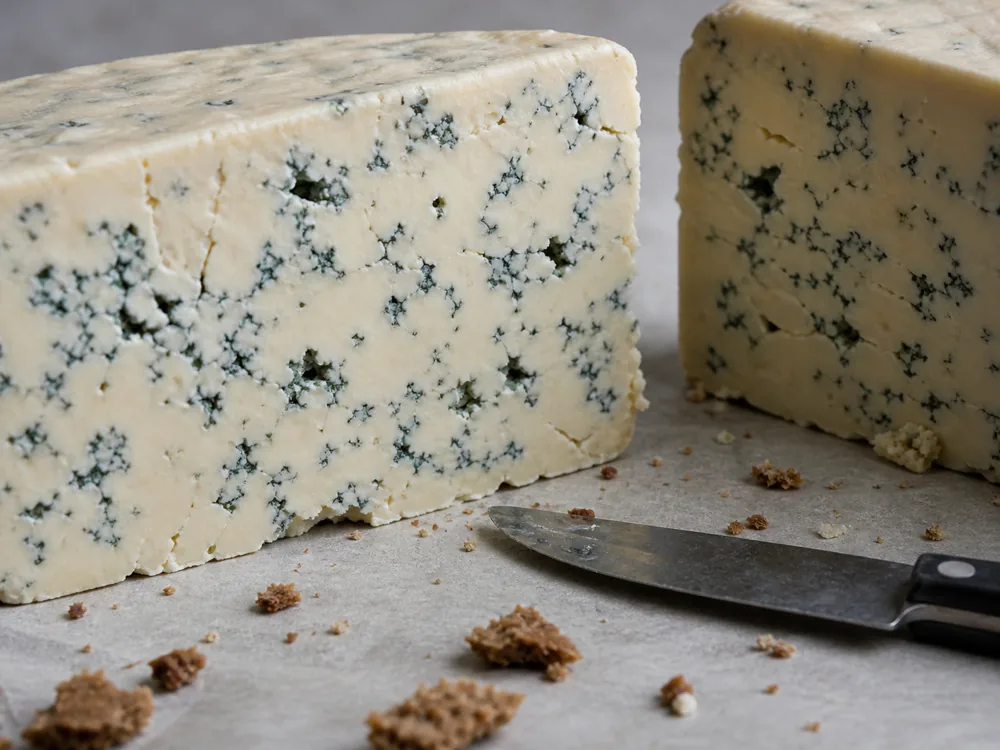
A five-person panel at the Austrian food magazine A la carte tasted 23 blue cheeses from seven countries in Vienna and ranked Dorblu 22nd with 3 points. Roquefort Le Vieux Berger won with 9.8 points, and a trade Gorgonzola intenso came last with 2.1.
The panel's notes on Dorblu called it an industrial base product, very firm, salty, and sticky on the tongue.
Those 3 points mark the weak end of a strong group: the magazine said none of its tests in 14 years had produced such high scores or so crowded a top.
The panel tasted each cheese on its own. It also left out cheeses given extra finishing by an affineur, apart from one, so that each cheese's own character could be judged.
Dorblu cost 1.39 euros per 100 g at Merkur, the lowest price listed in the tasting. A Roquefort from the same supermarket cost 2.95 euros per 100 g and placed 4th with 8.9 points.
Both are 2016 Vienna shelf prices, so they show relative value in that year and not a current price.
Käse Süchtig takes the opposite view of quality, saying Dorblu is much cheaper than traditional Italian and French blues but has reached a similar standard.
What Is the Difference Between Dorblu Classic and Royal Blu?
Royal Blu carries 55% fat in dry matter against Classic's 50%, and the producer describes a full creamy taste with piquancy for Royal Blu where Classic is delicate-tangy and creamy.
| Attribute | Dorblu Classic | Dorblu Royal Blu |
|---|---|---|
| Fat in dry matter | 50% | 55% |
| Flavor | Delicate-tangy, creamy | Full creamy taste, rich notes, piquancy, mildly savory |
| Suggested use | Salads and snacks | Cheese platters, sauces, and soups |
| Formats | 2.5 kg wheel, 3 kg block, 100 g portions | 2.5 kg wheel, 100 g portions |
Fat in dry matter measures fat against the cheese without its water, so 50% and 55% are not the same as fat per 100 g of cheese as sold.
The producer's Royal Blu text says it matures over time and gains individuality, and Käse Süchtig calls it a matured cheese.
Cheese.com's entry covers Dorblu as a whole, so its soft and spicy wording may describe Classic, Royal Blu, or both. If the line matters for your dish, buy by the name on the pack and the use the producer gives it in the comparison above.
What Is Dorblu Grand Noir?
Grand Noir is the producer's third line, which it says is ripened in unique conditions by a method it calls Affinage Noir, with distinctive dark blue marbling and a smooth melt. The Cheese Store, a US online retailer, describes a black wax coating that is inedible around a semi-soft, pale ivory paste, so cut the wax away before you serve it.
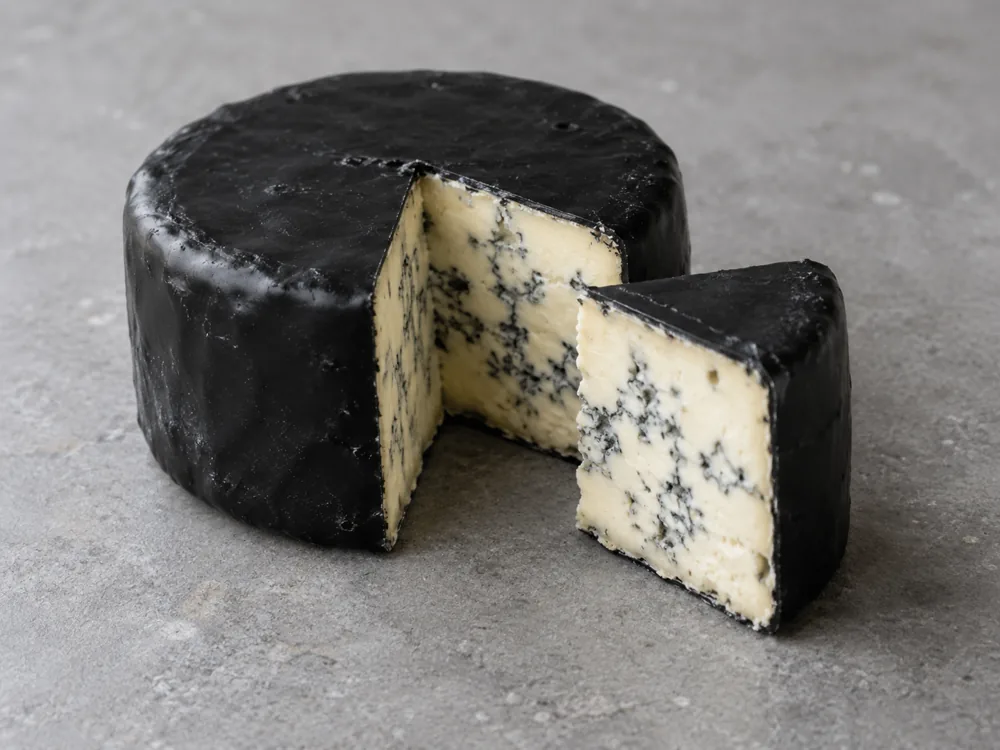
The wax holds moisture in so the paste stays buttery while the blue develops, in The Cheese Store's account, while Käse Süchtig says it keeps light away and so protects the flavor.
The Cheese Store lists Grand Noir as pasteurized and aged around 3 months, and describes sweet cream and butter first, then a savory, slightly tangy lift and a peppery bite at the back. The producer's trade range lists a 2.5 kg Grand Noir at 60% fat in dry matter and says it has a stronger blue character.
Käse Süchtig gives 46 to 60% fat for the family as a whole, which spans the producer's 50% for Classic, 55% for Royal Blu, and 60% for Grand Noir.
The line travels under several names: dorblu.com lists Grand Noir among its Dorblu products, the trade range gives it its own heading beside Dorblu and Cambozola, and The Cheese Store sells it as Champignon Grand Noir.
Cheese.com has a separate entry named Cambozola Grand Noir, so the wording on the pack is what settles which cheese a black-wax wedge is.
How Does Dorblu Compare with Cambozola?
Both come from Käserei Champignon, and Cambozola Classic and Cambozola Black Label carry 70% fat in dry matter and Cambozola Balance 55%, against 50% for Dorblu Classic and 55% for Royal Blu. That puts Cambozola Classic 20 points above Dorblu Classic.
The dairy invented Cambozola as a cross of French Camembert-style soft ripening and Italian-style blue veining.
The producer calls Cambozola Classic a creamy soft cheese with mild but refined blue mold notes that grow with age. It describes Black Label as a stronger-blue version with a natural gray mold exterior whose blue notes turn slightly sweet with age.
The Cheese Store says the dairy's soft-ripened blues carry Penicillium roqueforti veining plus a white or gray surface mold for a bloomy rind, while the producer's Dorblu Classic pages describe veining and a blue culture.
How Do You Use Dorblu in Salads, Sauces, and Boards?
Classic is suggested for salads and snacks, and the producer says Royal Blu can add piquancy to different sauces and soups and widen the palette of a cheese platter.
AzureAzure.com names salads and sandwiches, and the 2016 magazine panel called Dorblu a cooking cheese for sauce.
The label record lists 3.44 g of salt per 100 g, so taste your sauce before adding salt.
Dorblu's wine match depends on who you ask: AzureAzure.com says it pairs with Riesling, while Käse Süchtig says most lines suit a strong red wine or a dry or semi-dry sparkling wine, and lists nuts, grapes, honey, and sandwiches as food partners.
| Pairing | Type | Why It Works |
|---|---|---|
| Riesling | Wine | Named for Dorblu by AzureAzure.com; The Cheese Store also lists it for Grand Noir. |
| Port | Wine | Listed for Grand Noir by The Cheese Store. |
| Walnuts and honey | Food | Käse Süchtig lists nuts and honey for Dorblu; The Cheese Store lists walnut halves and acacia honey for Grand Noir. |
| Grapes | Food | Käse Süchtig lists grapes; The Cheese Store lists red grapes for Grand Noir. |
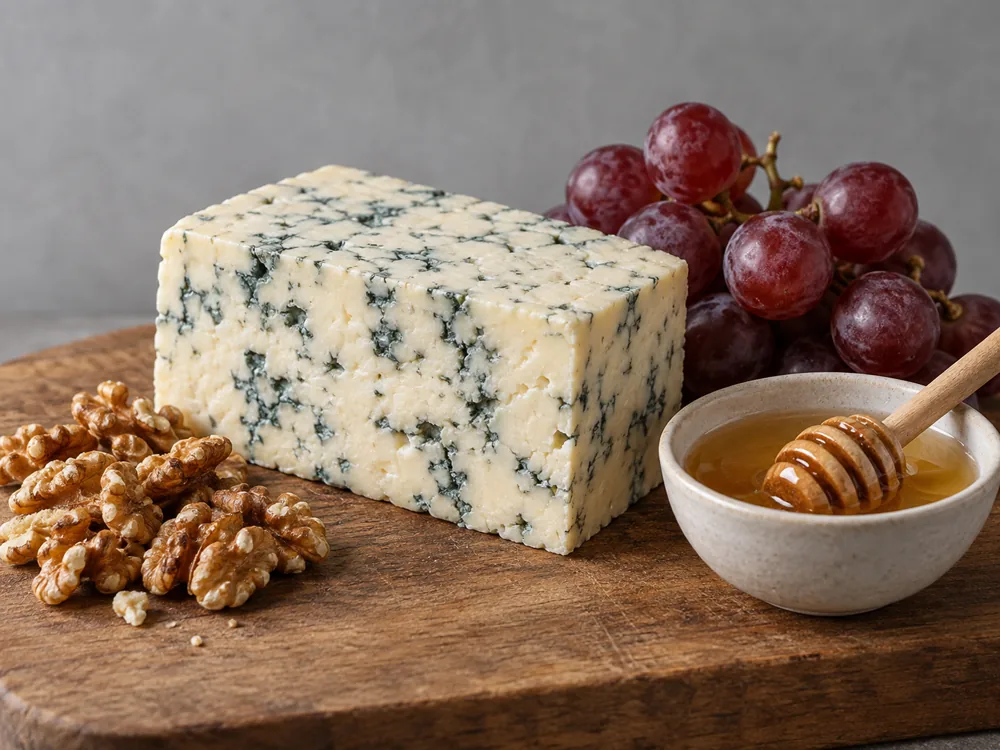
The Cheese Store, writing about Grand Noir, gives the reasoning: sweet wines such as a late-harvest Riesling or Port balance the salty bite of the blue, and a dark stout matches the richness of the paste. It adds that sweet partners such as fresh figs, red grapes, and Bartlett pears play against the salt, while walnuts pick up the savory side.
The Cheese Store's top recipe for Grand Noir, the black-wax line, is blue cheese butter melted over grilled steak.
How Much Fat and Salt Does Dorblu Have?
Per 100 g, Dorblu Classic carries 3.44 g of salt and 29 g of fat by the label of an 80 g pack that a contributor transcribed to Open Food Facts, while Käse Süchtig's profile lists 24.7 g of fat, 21.4 g of protein and 350 kcal per 100 g.
| Nutrient | Per 100 g |
|---|---|
| Energy | 1,396 kJ (337 kcal) |
| Fat | 29 g, of which saturated 19 g |
| Carbohydrate | 0 g |
| Protein | 19 g |
| Salt | 3.44 g |
Putting the two together, 29 g of fat per 100 g against the producer's 50% in dry matter implies roughly 58 g of dry matter and 42 g of water in 100 g of Classic. That is our arithmetic, and it assumes the label and the producer's figure describe the same cheese.
Open Food Facts also sets the pack against its average for cheeses: salt at 3.44 g against 1.38 g, which is 150% higher, while fat is 14% higher (29 g against 25.5 g) and protein 6% lower (19 g against 20.1 g).
That figure, from one pack, sits closer to the magazine panel's salty verdict than to AzureAzure.com's not-too-salty wording. If you are watching salt, a 30 g piece of Classic carries about 1 g at that label's 3.44 g per 100 g.
Can You Eat Dorblu During Pregnancy?
Dorblu is pasteurized, but pasteurization alone does not clear it. The NHS wording for soft blue-veined cheeses applies whether the milk was pasteurised or not, and it asks for thorough cooking.
The CDC says pregnant women are 10 times more likely to get a Listeria infection, and lists pasteurized soft cheeses heated to an internal temperature of 165°F or until steaming hot as safer. Served cold, Dorblu is described as a pasteurized soft, semi-soft, semi-firm or very firm blue-veined cheese, a type the CDC list does not cover, so ask a midwife or doctor.
If you are pregnant, a dish where the cheese itself is cooked until steaming hot is the choice that fits both agencies' wording.
What Can Replace Dorblu?
Dorblu is pasteurized cow's milk with a creamy paste, so the nearest blue cheese swaps share both traits. The blues below are the ones the 2016 A la carte panel scored beside Dorblu, with its notes and its 2016 Vienna prices.
Österkron, a pasteurized Styrian cow's milk blue, is the closest match on milk. It scored 5.9 points, nearly double Dorblu, at 1.65 euros per 100 g, and the panel called it buttery but too young.
Saint Agur, which the panel describes as pasteurized Auvergne milk seeded with Roquefort mold, scored 4.4 at 2.19 euros, and tasters called it creamy but too salty.
Italian Dolcelatte is a creamy blue the panel described as unripened and without a protected name. It scored 6 points at 2.19 euros, with tasters noting a sweet-salty paste and a well-defined mold.
The panel's Gorgonzola Classico, a trade type known from cheese sauces and pizza, scored 3.3 points, close to Dorblu's 3, with tasters noting little mold and a paste that was too firm.
At the other end, a supermarket Roquefort placed 4th with 8.9 points at 2.95 euros per 100 g, about twice Dorblu's price, and tasters called it creamy, intense, and a classic Roquefort.
For a cheaper blue with a similar job, the panel's nearest trade types were Österkron at 5.9 points and Gorgonzola Classico at 3.3. For a blue that scored well beside Dorblu, Dolcelatte reached 6 points and a supermarket Roquefort 8.9.
Where Can You Buy Dorblu, and How Is It Sold?
The producer's trade range lists Classic as a 3 kg loaf, a 2.5 kg wheel, and a 100 g portion, with round and rectangular loaves for specialty counters and foil-wrapped wedges for self-service. Royal Blu comes in 2.5 kg wheels and 100 g portions.
Open Food Facts records an 80 g Classic pack sold in Latvia, and Käse Süchtig says the cheese is so established in Russia that many people use its name for any blue.
For Grand Noir, a US online shop is one route: The Cheese Store says it hand-cuts the cheese to order the day it ships.
Follow the date and storage line printed on the pack.
SOURCES & REFERENCES
What Else Do People Ask About Dorblu?
Dorblu is a German blue cheese made by Käserei Champignon in the Allgäu from pasteurized cow's milk. Cheese.com lists it as soft and blue-veined.
It depends on who describes it: AzureAzure.com calls it designed for moderately strong blue fans and not too salty, while the 2016 A la carte panel called it salty and very firm.
The producer positions Royal Blu for sauces and soups, and the 2016 panel called Dorblu a cooking cheese for sauce.
Käse Süchtig lists animal rennet, so check the rennet on your pack before serving it to a vegetarian.
The NHS says pasteurised or unpasteurised soft blue-veined cheeses must be thoroughly cooked, and the CDC lists pasteurized soft cheeses heated to an internal temperature of 165°F or until steaming hot as safer. Served cold, Dorblu is described as a pasteurized soft, semi-soft, semi-firm or very firm blue-veined cheese, a type the CDC list does not cover, so ask a midwife or doctor.