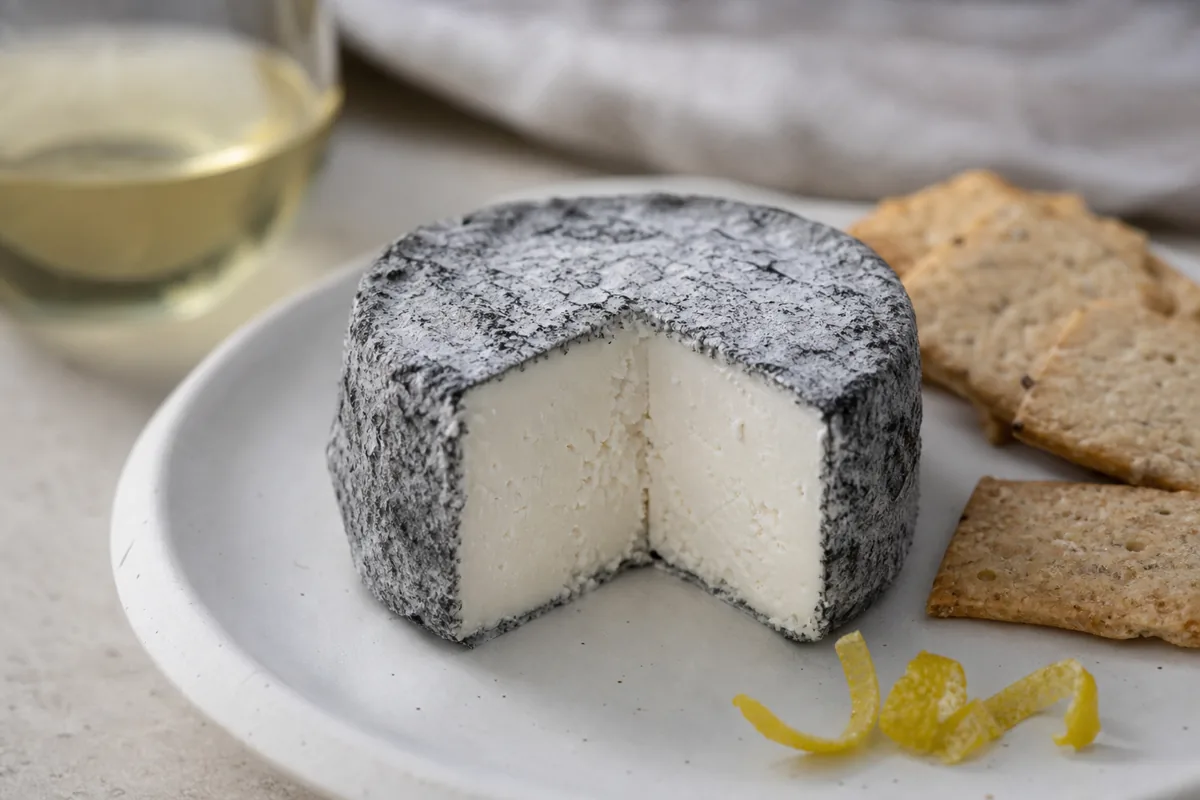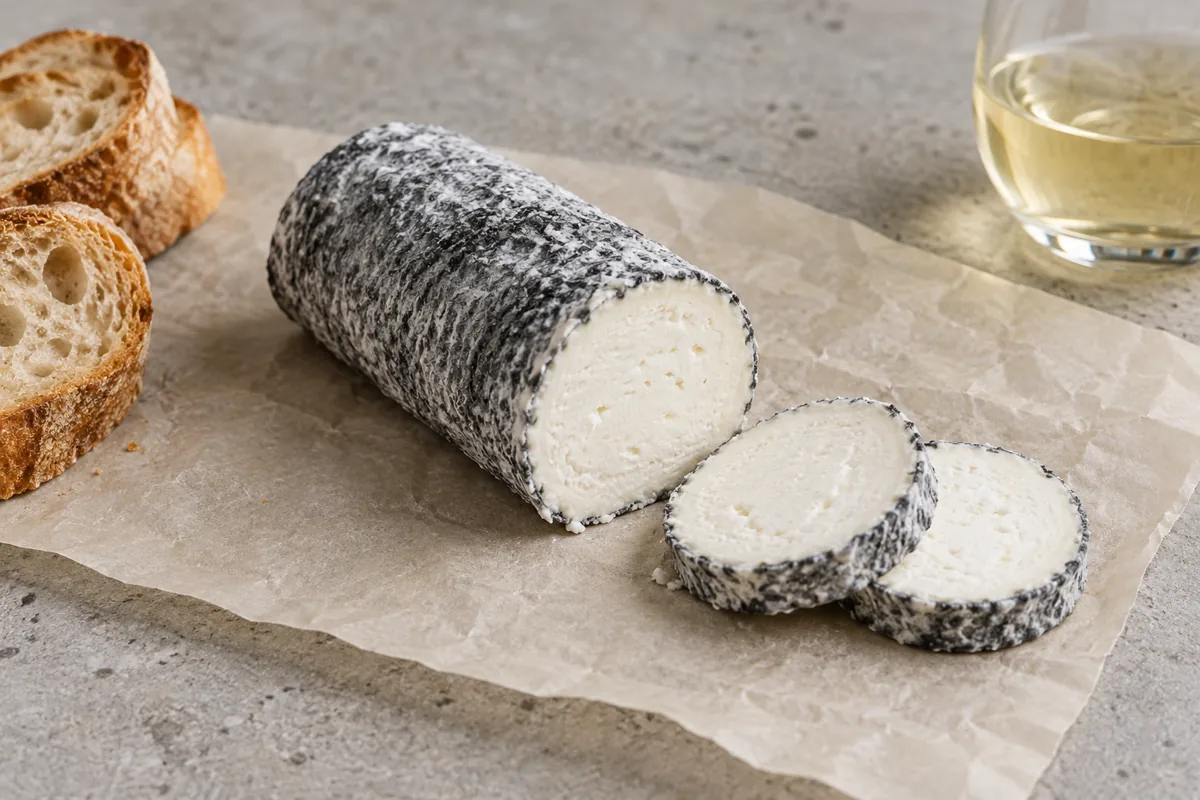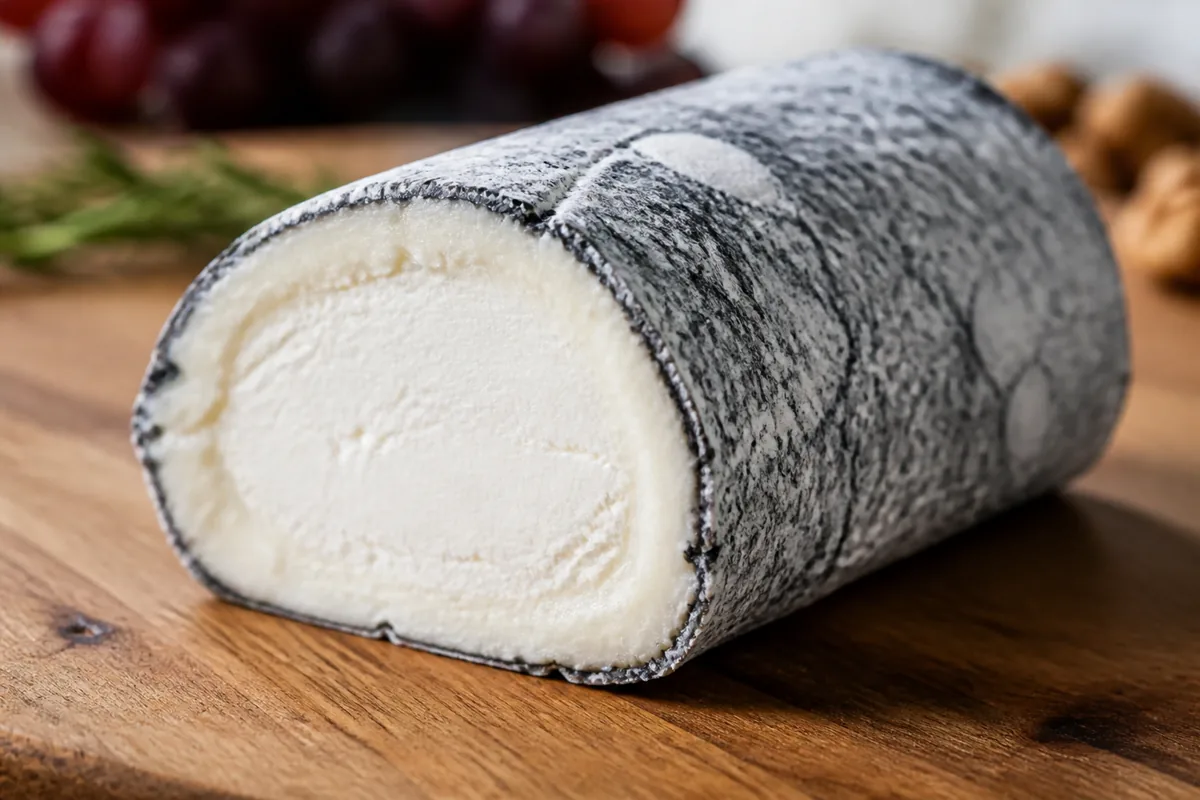
Golden Cross is a log-shaped goat's cheese made from raw milk at Greenacres Farm in East Sussex, England, dusted with charcoal and covered with a white Penicillium candidum mould. Kevin and Alison Blunt make it from a recipe that came with the goats and equipment they bought from a Frenchman who was selling up, and it won Best British Cheese at the 2018 World Cheese Awards.
The recipe is loosely based on Sainte-Maure de Touraine, the French goat's cheese log.
In This Article
Who Makes Golden Cross, and Where Did the Recipe Come From?
Kevin and Alison Blunt met at university, where he took a degree in biochemistry and she one in human biology with a nursing option, and neither was born into a farming family or planned a farming life.
In 1984 they bought a six-acre smallholding at Golden Cross with little more than a few small barns and a caravan. They lived in the caravan for five years while they waited for planning permission for a farmhouse, which came in 1989.
The turning point was a meeting with Regis Du Sartre, a Frenchman who was selling his goat farm and cheesemaking business. The Blunts bought his goats, milking parlour and cheesemaking equipment, and the deal included a couple of his recipes, one of them the goat log that they have refined since.
Kevin Blunt says they had already been going for five years and had the farmhouse when the recipe arrived, which puts it in 1989 or later. Culture magazine's 2017 profile calls the recipe 25 years in the tweaking, which by that count points to about 1992.
Getting the recipe and the outlets let them expand the herd and grow the business, Kevin Blunt says. They bought young stock from Regis as well as milkers and have kept a closed herd ever since.
In 2021 Kevin, Alison and their son Matthew ran the farm, and its output was about 20 tonnes of cheese a year.
Counts of the herd differ by year and by account: South East Farmer put it at around 180 British Saanen, Toggenburg and British Alpine goats in 2021, down from 240 earlier, La Fromagerie counted around 220 goats on a visit in 2022, and The Fine Cheese Co gives 300 goats.
The Fine Cheese Co tells the start another way: the couple changed career in 1989, five years after the 1984 purchase, first sold their goat's milk to a local cheesemaker and took over the cheesemaking when he retired. La Fromagerie calls the man who sold the recipe a local Frenchman.
How Is Golden Cross Made?
Golden Cross starts as raw goat's milk, which the farm never pasteurises, and spends about four to five days in the stages below before the charcoal goes on.
- 24 hours setting: a starter culture, vegetarian rennet and Penicillium candidum go into the milk in the vat, and the milk sets in a warm room.
- 24 hours draining: the curd is ladled by hand into the log moulds and turned.
- 24 hours drying: the cheeses come out of the moulds the next morning and dry on mats and then racks.
- 1 to 2 more days: each log is salted by hand and dried again.
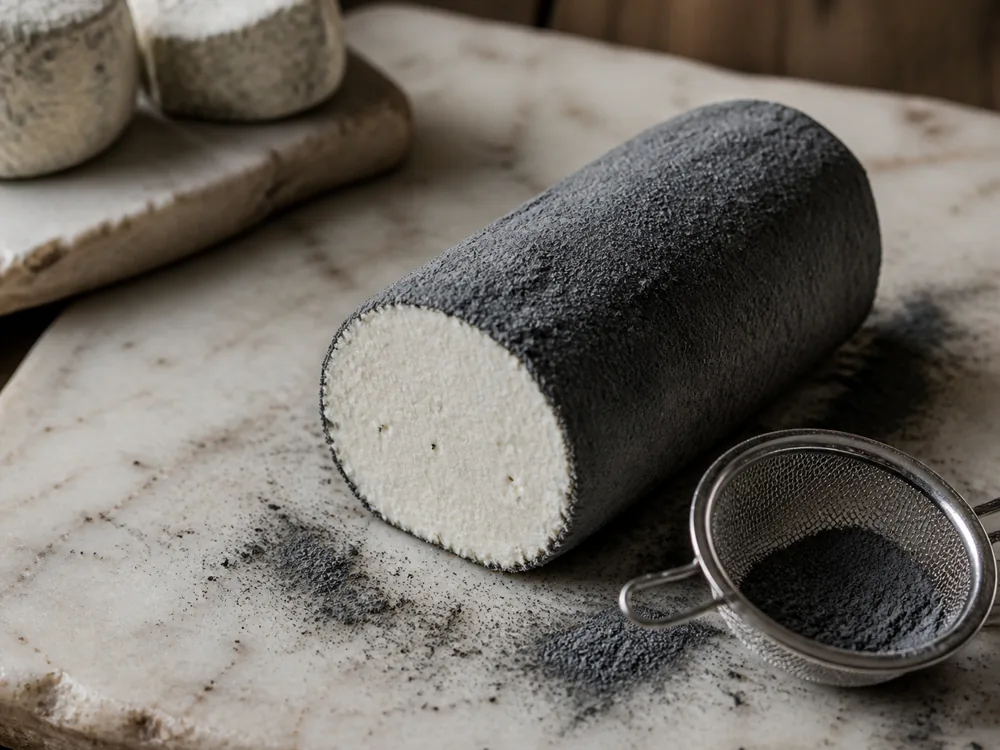
- Charcoal: the logs are lightly charcoaled by hand before maturing.
The charcoal goes on with a sifter, the way icing sugar is dusted onto a cake. It gives a dark contrast to the white curd and changes the acidity at the surface, which helps the mould grow and the cheese mature.
While the logs mature, the rinds are lightly patted down so they do not become too fluffy. Depending on the time of year, 80 to 100 litres of milk make 40 cheeses, roughly 2 to 2.5 litres in each log.
The length of the whole make depends on whose count you take. Kevin Blunt gives 11 days from liquid milk to finished product, La Fromagerie counts 11 days of maturation in the drying room after the charcoal goes on, and The Fine Cheese Co and Culture magazine say the cheese is matured for a couple of weeks.
Added to the four to five days before the charcoal, La Fromagerie's 11 days would bring the whole process to about 15 to 16 days, close to a couple of weeks, while Kevin Blunt's 11 days for the whole make would leave about 6 to 7 days of maturing.
What Does the Herd Eat, and How Does the Season Shape the Make?
In 2021 the goats ate mostly hay and grazed the main field from March to October, with an 18% dairy goat nut through the parlour at about 1.5 to 2 kg a head a day. On that diet Kevin Blunt put milk production at an average of 2.5 to 3 litres a head a day.
No silage is fed. The goats get home-grown hay all year with summer grazing, or pasture and hay all year, which The Fine Cheese Co says "results in high quality milk".
To avoid peaks and troughs in the milk supply, the herd kids in a spring block and an autumn block. Because it is a closed herd, the farm on average keeps back about 30 females as replacements and rears the remaining 150 or so kids as meat goats.
Goat's cheese is made every other day, since the 2,000-litre vat the farm installed to scale up allows it, and the sheep's cheese Flower Marie is made on the days between.
The cheese room's whey goes back to the herd, which in 2021 drank roughly 2 litres a head a day. The farm tried it after a neighbouring pig farmer stopped taking the whey, and South East Farmer calls the experiment a big success.
What Does Golden Cross Taste Like?
The Fine Cheese Co, Hamish Johnston and Pong Cheese call Golden Cross sweet, and Hamish Johnston adds a slight citrus tang, which The Fine Cheese Co gives to the young cheese. La Fromagerie describes it as buttery, mushroomy and nutty, with very low acidity for a goat's cheese.
| Question | Descriptions, with who gives each |
|---|---|
| How sweet and how goaty? | Sweet and delicately goaty and grassy (The Fine Cheese Co); "subtly sweet" (Hamish Johnston); creamy, "a bit sweeter than others", with a delicate flavour (Pong Cheese); goaty and creamy (Culture magazine, 2017) |
| Is there citrus? | Fresh citrus when young (The Fine Cheese Co); "slight citrussy tang" (Hamish Johnston) |
| What other notes? | "Buttery, mushroomy and nutty (almost sesame-like)", with very low acidity for a goat's cheese (La Fromagerie, 2022) |
| How does it change with age? | Fresh citrus flavour and a firm, silky paste when young; denser, creamier and deeper in flavour, and denser and creamier in texture, as it matures (The Fine Cheese Co) |
| What is the texture? | "Ice-cream like" (The Fine Cheese Co); "a fine soft texture" (Pong Cheese); dense and chewy in the middle (La Fromagerie, 2022) |
| Where is the paste softest? | Firm, becoming creamier toward the edges (Hamish Johnston); often breaking down around the rind (La Fromagerie, 2022) |
| Firmer than Sainte-Maure? | Slightly firmer paste (The Fine Cheese Co); interior firmer than the French Sainte-Maure (Culture magazine, 2017) |
The Fine Cheese Co ties the flavour to age, from fresh citrus when young to denser, creamier and deeper as the cheese matures. If you want one end of that range, ask the seller how old the log is.
Texture descriptions differ: The Fine Cheese Co calls the paste "ice-cream like" and La Fromagerie dense and chewy in the middle, while Hamish Johnston and La Fromagerie both place the softest paste near the rind.
What Goes Into Golden Cross, and Can You Eat the Rind?
The Fine Cheese Co's ingredient list reads raw goats' milk, salt, microbial rennet and charcoal, and Pong Cheese calls the white mould rind that grows over the ash edible.
The make also uses a starter culture and Penicillium candidum, the mould behind the bloomy white coat over the charcoal, while Hamish Johnston's sheet describes the outside as a grey ash rind.
If you avoid animal rennet, Golden Cross is made with vegetarian rennet, listed as microbial rennet on the ingredient list. The Fine Cheese Co tags the cheese vegetarian, and Pong Cheese puts it in its vegetarian boxes.
Why Is It Called Golden Cross?
Golden Cross is the place in East Sussex where the farm sits, and the cheese is named for the rooftop cross of a local pub.
The maker trades under the same name, as the Golden Cross Cheese Company.
What Awards Has Golden Cross Won?
At the 2018 World Cheese Awards, Golden Cross won the title of Best British Cheese, and Kevin Blunt says it finished in the top 16 of more than 3,000 cheeses from around the world. It also took Super Gold at the 2018 to 2019 World Cheese Awards.
Its other results include a Gold at the 2017 Artisan Cheese Awards and, at the 2025 British Cheese Awards, the titles Best Soft White Cheese, Best Export Cheese and Reserve Champion.
Kevin Blunt also names the Specialist Cheesemakers' Association's James Aldridge Memorial Trophy for The Best British Raw Milk Cheese among the awards the farm is proudest of, and says the Blunts were the first cheesemakers to win it. Besides Golden Cross, the farm makes Chabis and a sheep's cheese called Flower Marie.
How Do You Serve Golden Cross?
Hamish Johnston gives grilling as the cheese's best use, because its firm texture means that it grills well.
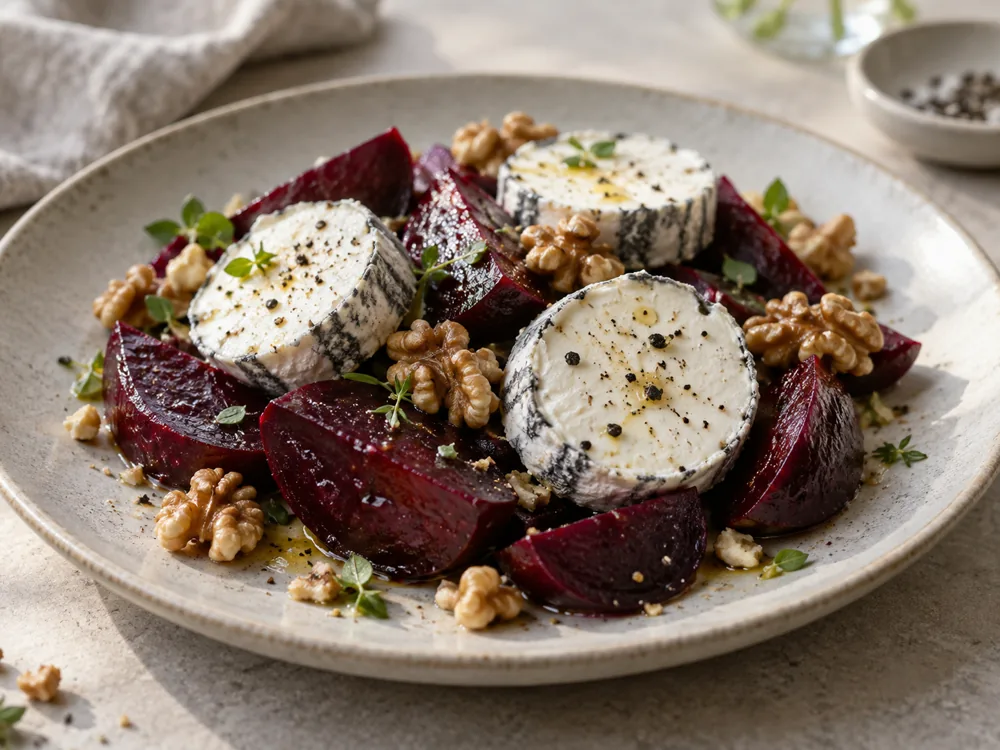
Pong Cheese suggests it in a beetroot and walnut salad, in goat's cheese tarts, wrapped in bresaola as canapés, rolled into pistachio balls and in a warm pumpkin salad.
Pong Cheese pairs the salad with French bread and the tarts with a smear of olive paste or balsamic reduction and sun-ripened tomatoes, and says the creamy cheese complements the savoury, salty, nutty pistachio flavours in the pistachio balls.
It also ties two of the dishes to the season: the tarts to spring, and the pumpkin salad to the time when sweet, velvety pumpkins are available.
Which Cheeses Come Closest to Golden Cross?
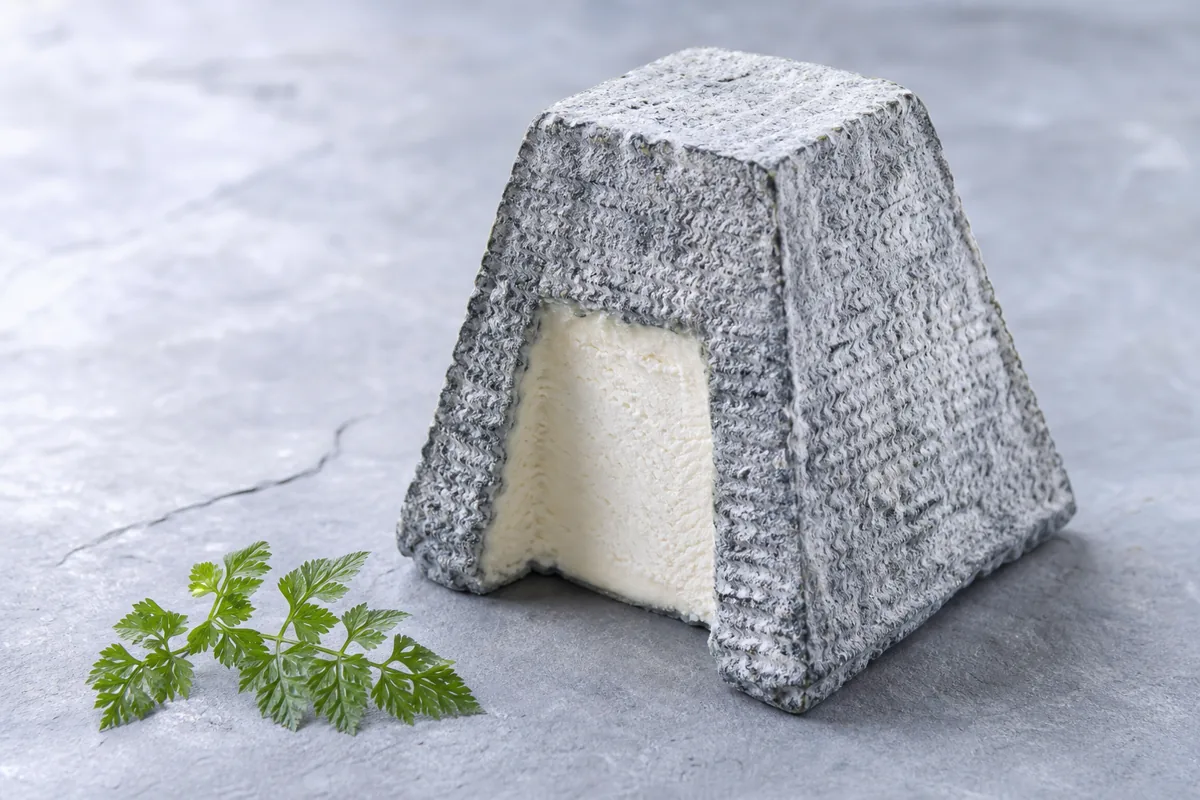
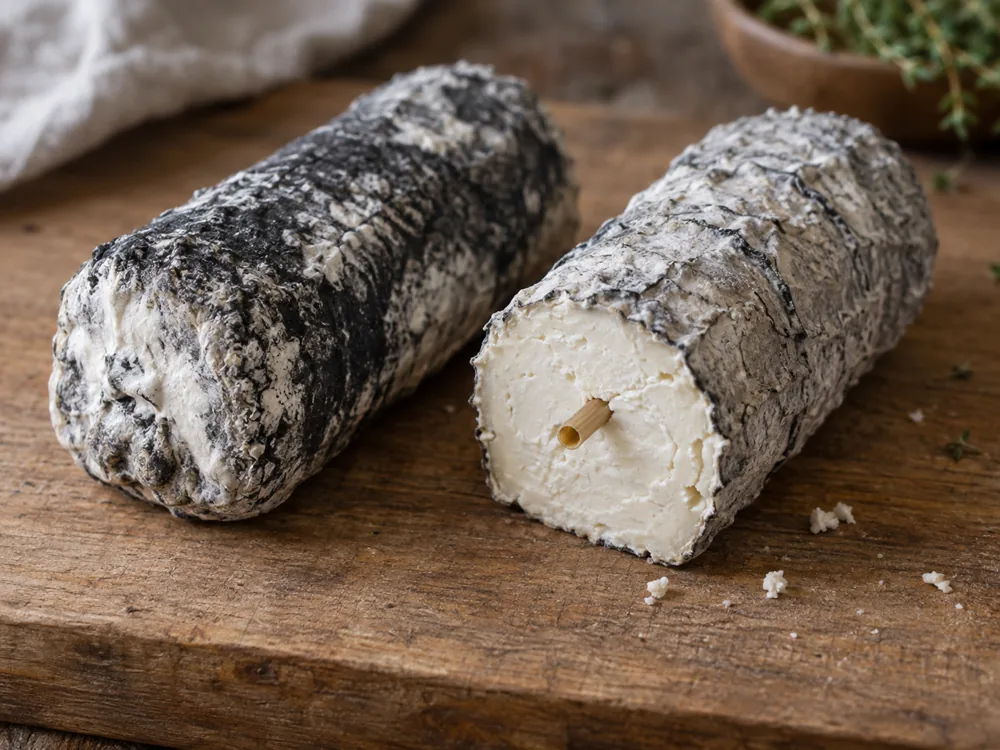
Sainte-Maure de Touraine, the log the recipe is loosely based on, is an unpasteurised goat's milk log of at least 250 g with a greyish mould rind rolled in wood ash and a straw through the centre, protected by an AOC since 1990.
The Fine Cheese Co says Golden Cross differs from it in its bloomy Penicillium candidum coat and slightly firmer paste, and Culture magazine also puts its interior firmer than the French log.
If you buy Sainte-Maure de Touraine, look at the straw: on the AOC cheese it is marked with the AOC seal and a number for the producer, while "Sainte-Maure", the industrial version also made in Touraine, has a straw with no seal.
The two are made on very different scales. Sainte-Maure de Touraine came to 1,065 tons in 2003, 42% of it from farms, and is the second-largest goat's cheese AOC in France behind Crottin de Chavignol, while the Blunts' output of all their cheeses was about 20 tonnes a year in 2021.
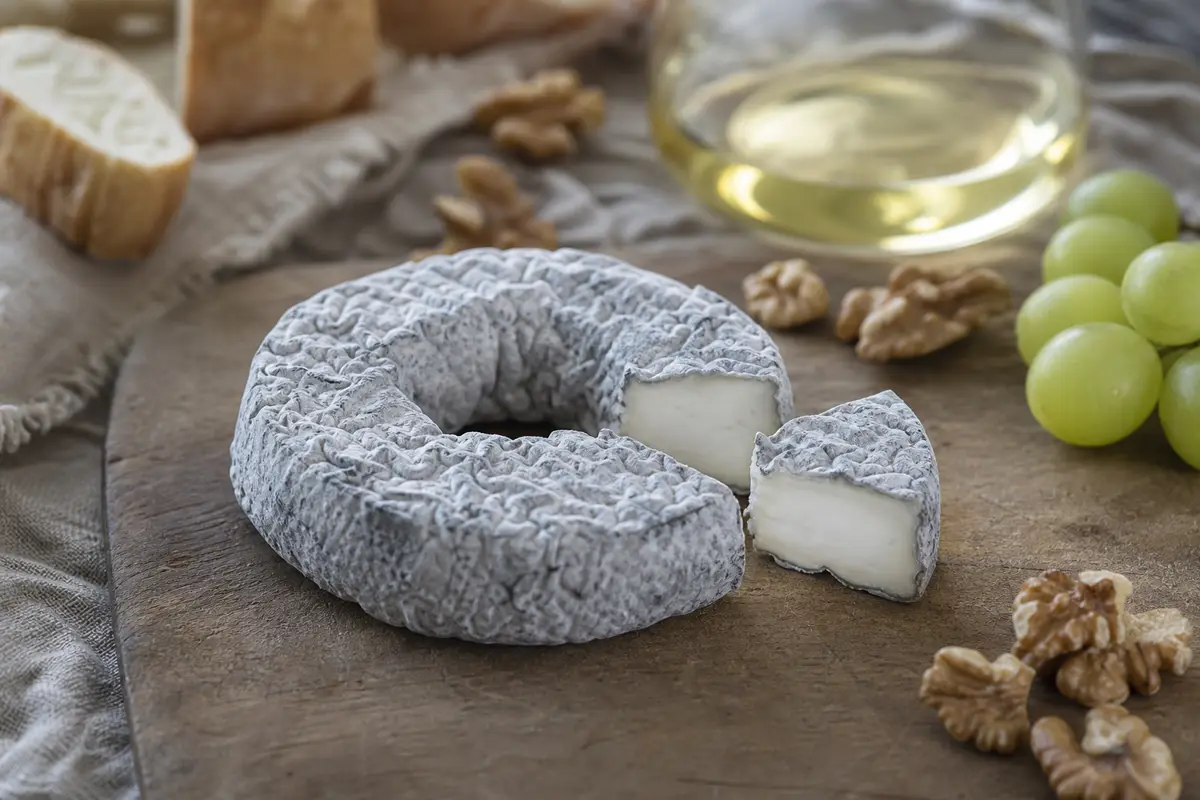
Closer to home, La Fromagerie compares Golden Cross with the farm's other bloomy-rind cheese, Flower Marie, a cube made from unpasteurised ewe's milk, whose paste is similarly dense and chewy with some of the same nuttiness and a slight citrus tang.
La Fromagerie ties Flower Marie's more pronounced mushroom note to its thicker rind. Its curd sets for about 14 to 16 hours against 24 for Golden Cross, with a few hours in brine where Golden Cross is salted by hand, and it takes 12 days to maturity against 11.
Where Can You Buy Golden Cross, and What Does It Cost?
In the UK it is sold by specialist cheesemongers and online cheese shops. On 1 October 2026 The Fine Cheese Co listed a 225 g pack at £12.50, and Pong Cheese listed a log of about 225 g at £13.95, although its packaging line says 250 g.
The same Pong Cheese page lists two other goat's cheeses under "You may also like", Valençay AOC from Indre and Rosary Ash Log, and on the listed weights Golden Cross costs the most per 100 g of the three.
| Cheese | Pong's description | Weight | Price | Per 100 g |
|---|---|---|---|---|
| Golden Cross | Creamy goat's cheese, ash-coated | approx. 225 g | £13.95 | £6.20 |
| Valençay AOC | Goat's cheese from Indre | 220 g | £11.95 | £5.43 |
| Rosary Ash Log | Smooth goat's cheese coated in ash | 275 g | £12.95 | £4.71 |
Counted at the 250 g in Pong's packaging line instead, Golden Cross would still come to about £5.58 per 100 g, above Valençay AOC.
The Fine Cheese Co's buying guide, written for all its cheeses, suggests 70 to 120 g a head: 70 g after a large meal or at a buffet, at least 100 g when the cheese is the main part of the meal, and up to 120 g for hungry guests. At those rates a 225 g log serves about two to three people.
In 2021 the farm sold to around 30 wholesale and retail customers, and Kevin Blunt named Eastside Cheese, H&B Fine Foods and Neals Yard among the wholesalers that promoted the cheese.
How Long Does Golden Cross Keep?
Keep Golden Cross below 8°C and eat it within 7 days of receipt or by the date shown, and within 5 days after cutting, The Fine Cheese Co advises.
The CDC's general advice is a refrigerator at 40°F (about 4°C) or below, so a fridge at or under that temperature sits within the retailer's limit as well.
The CDC also lists dairy among the perishable foods to refrigerate within 2 hours, or within 1 hour if the food is exposed to temperatures above 90°F, so put a log back in the fridge within 2 hours of setting it out on a board, or within 1 hour if it is exposed to temperatures above 90°F.
Is Golden Cross Safe During Pregnancy?
Golden Cross is made from raw goat's milk and has a white mould coat, and the NHS lists "any foods made from unpasteurised milk, such as soft ripened goats' cheese with a white coating on the outside" among the foods that "must be thoroughly cooked" in pregnancy.
Kevin Blunt calls Golden Cross a soft cheese with a fast turnaround, and The Fine Cheese Co and Pong Cheese file it under soft cheese, while Hamish Johnston's sheet lists it as fresh.
The NHS also lists "any cheese that's been cooked until steaming hot" among the cheeses that are safe to eat, so a grilled slice cooked until steaming hot all the way through meets the condition and a cold slice does not.
The CDC lists soft cheese made from unpasteurized (raw) milk among its riskier choices and says pregnant women are 10 times more likely to get a Listeria infection. Its safer choices include pasteurized soft cheeses heated to an internal temperature of 165°F or until steaming hot.
The CDC's heated entry names pasteurized soft cheeses, so if you follow US advice, ask a midwife or doctor before eating Golden Cross even when it is cooked.
What Is in 100 g of Golden Cross?
Per 100 g, Golden Cross has 309 kcal, 26 g of fat and 1.62 g of salt, by its typical values.
| Nutrient | Per 100 g |
|---|---|
| Energy | 1310 kJ / 309 kcal |
| Fat | 26 g, of which saturated 17.6 g |
| Carbohydrate | 4.14 g, of which sugars 2.72 g |
| Protein | 17.5 g |
| Salt | 1.62 g |
Scaled to a whole 225 g pack, those values come to about 58 to 59 g of fat and 3.6 g of salt.
At 70 to 120 g a head, a portion holds about 216 to 371 kcal and 1.1 to 1.9 g of salt.