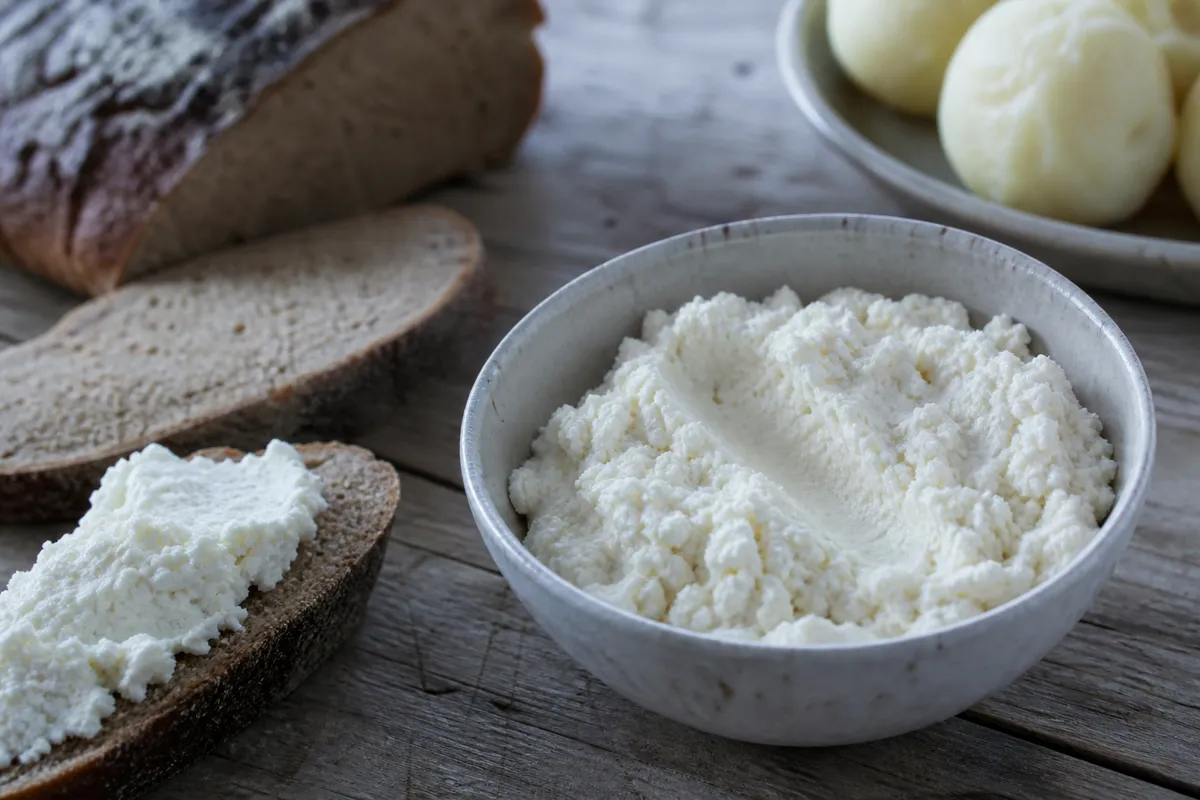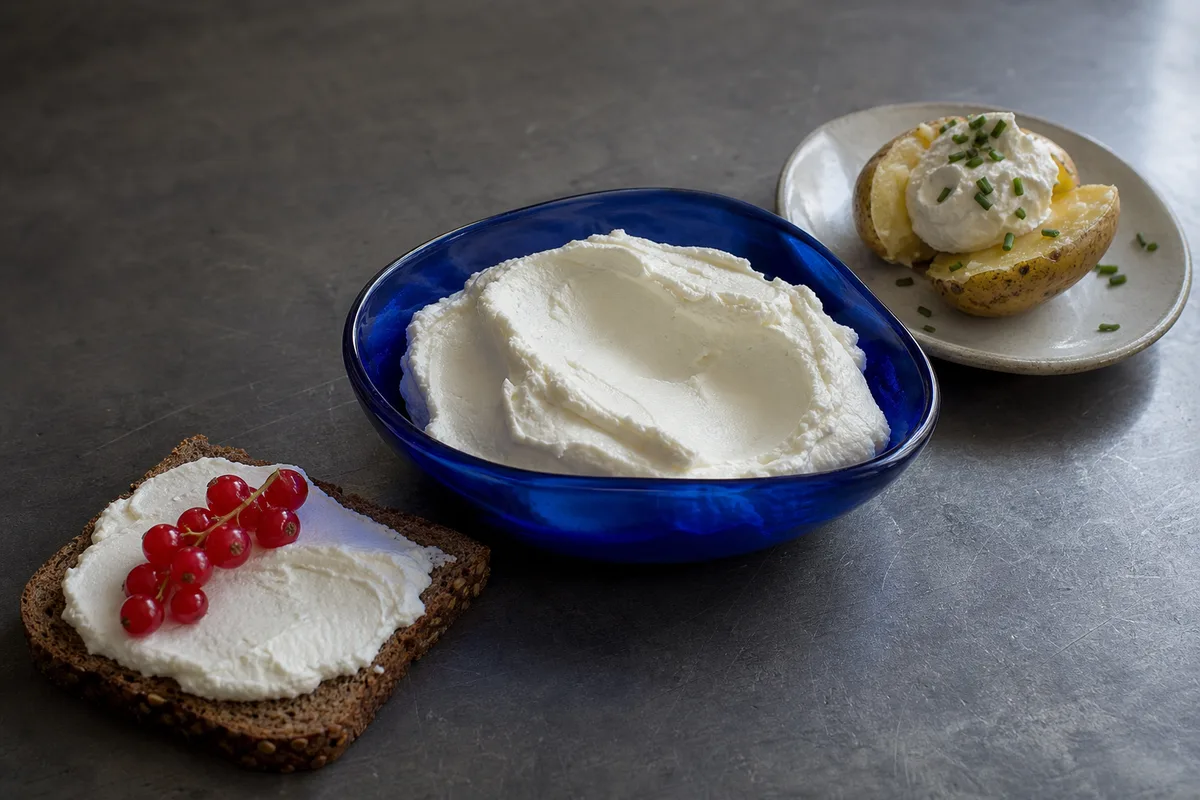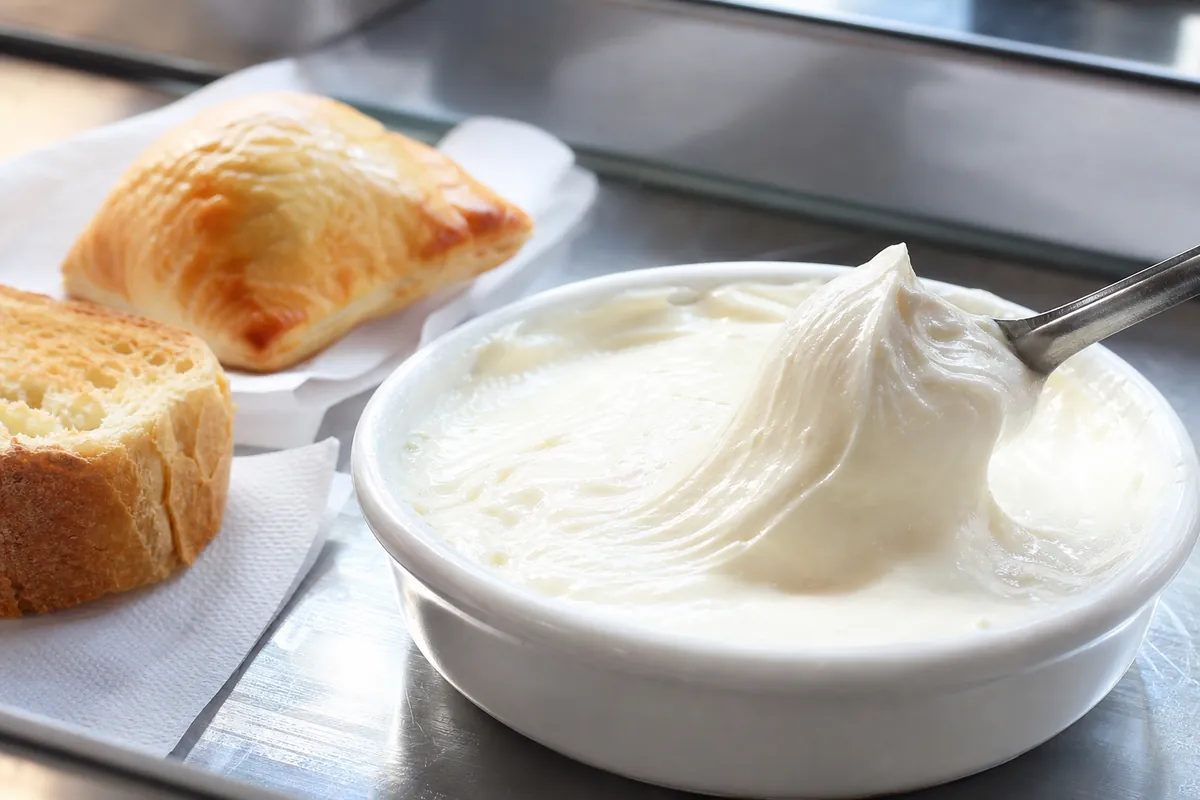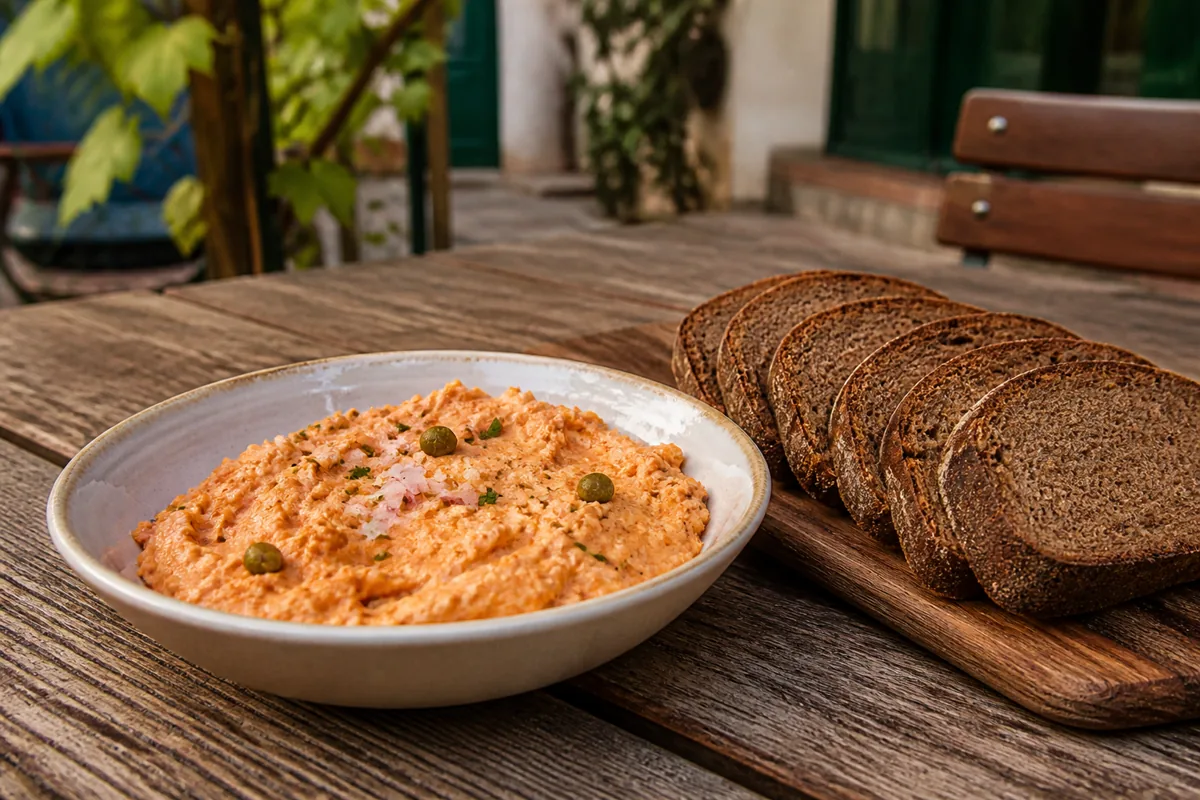
Liptauer is a savory cheese spread from the Slovak-Austrian tradition, made by mixing a fresh cheese base with paprika, onion and other seasonings.
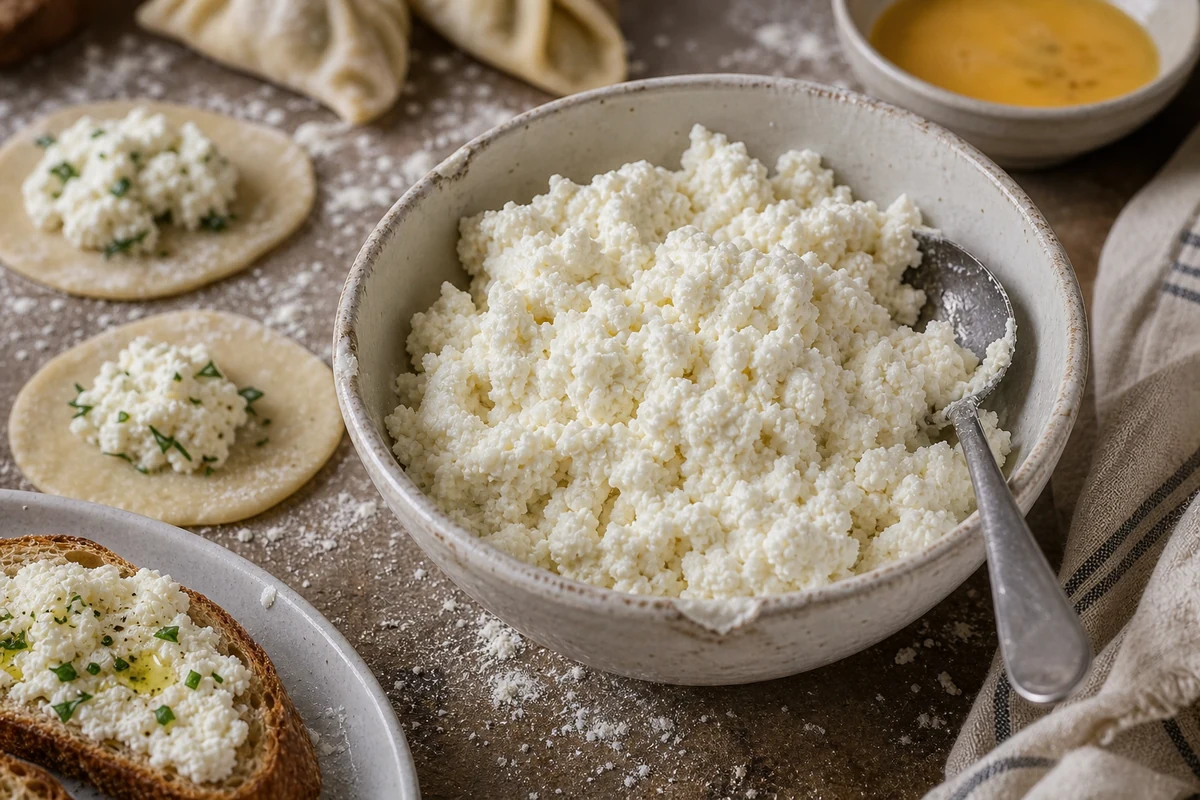
The base is either Brimsen, a salted fresh sheep's milk cheese, or more often quark today, and ORF says the quark version comes out milder than the Brimsen one.
In This Article
What Is Liptauer Made Of?
The name comes from Liptau, a region of northern Slovakia that Slovak calls Liptov. Hungarian kitchens call the spread Körözött or Liptói túró, and in Slovakia it is Liptovská nátierka, officially bryndzová nátierka (Brimsen spread), or šmirkás, from the German Schmierkäse.
Austria's food code, as German Wikipedia quotes it, defines Liptauer as a spread cheese made from curd cheese with butter or cream and flavoring ingredients. That describes a family of spreads rather than one fixed cheese, so recipes differ by base, fat and seasoning.
Liptauer became a staple of Austrian Heuriger wine-tavern buffets, where ORF reports that taverns once made their own Liptauer and guarded each recipe as a secret.
Three published versions show how far the formula stretches.
| Version | Cheese base | Fat added | Paprika | Other seasonings |
|---|---|---|---|---|
| Austrian National Tourist Office | 250 g smooth farmer's cheese | 1 tablespoon mayonnaise | 1 tablespoon sweet; hot paprika for a spicier version | Gherkin, half an onion, capers, 3 garlic cloves, parsley, mustard |
| ORF Niederösterreich (Andrea Karrer) | 125 g Brimsen and 125 g Topfen | 100 g butter, 2 tablespoon sour cream, 1 tablespoon mayonnaise | 1 teaspoon sweet and 1 teaspoon rose | 50 g onion, 50 g gherkins, capers, garlic, anchovy paste, tarragon mustard, ground caraway |
| German Wikipedia, citing the Duden cooking dictionary (farmstead form) | Brimsen pressed through a sieve; Topfen or quark as a substitute | An equal part of whipped butter | Rose paprika | Caraway, pepper, grated onion |
Fat runs from one spoon of mayonnaise for 250 g of cheese in the tourism-board recipe, through 100 g of butter plus sour cream and mayonnaise for 250 g of cheese in ORF's, to an equal part of butter in the farmstead form.
Caraway appears in the ORF and farmstead versions but not in the tourism recipe, and anchovy paste only in ORF's, which is the kind of variation the Austrian definition leaves open.
What Went into Farmstead Liptauer Before Capers and Anchovy?
German Wikipedia, citing the Duden cooking dictionary, describes the original farmstead form as Brimsen pushed through a sieve and beaten into an equal part of whipped butter, seasoned with nothing more than rose paprika, caraway, pepper and grated onion.
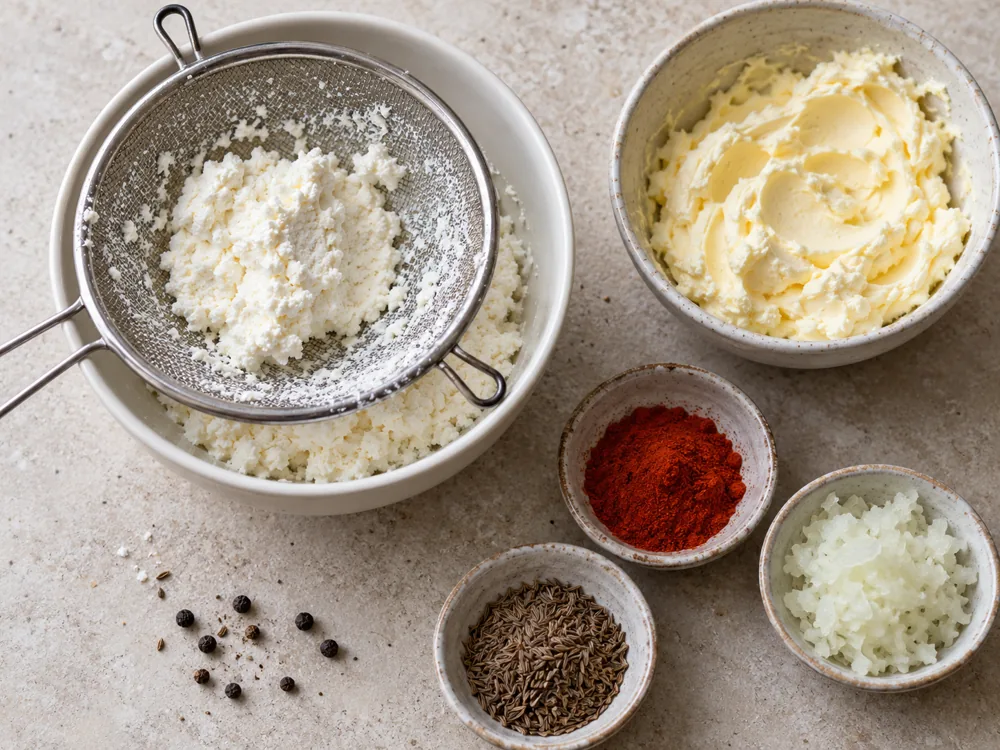
Capers, mustard, anchovies or anchovy paste and diced salted gherkins came later, German Wikipedia says, as a middle-class refinement of the recipe. The tourism-board and ORF recipes, with their gherkins, capers and mustard, therefore belong to the fuller later tradition rather than to the plain original.
Older recipes also stir in bitter beer, and German Wikipedia reports, citing George Lang's cookbook of classic Hungarian cuisine, that aristocratic circles in Hungary and the grand restaurants of the monarchy garnished the spread with sturgeon caviar.
ORF adds that cookbook authors crowned Liptauer the king of spreads and that some recipes list 25 or more ingredients, though in ORF's view the balance of the ingredients matters more than their number.
Is Liptauer Made with Sheep Cheese or Quark?
The traditional base is Brimsen, the German name for bryndza, a salted fresh sheep's milk cheese that ORF calls crumbly. In the days of the monarchy, ORF adds, the Brimsen from the Hungarian county of Liptau, made from the milk of Zackel sheep, was especially famous.
English Wikipedia's bryndza entry says Slovak entrepreneurs who founded bryndza workshops in the late 18th century sold it across the Habsburg monarchy, where it was called Liptauer after the Liptov region.
The same entry says the Viennese spread switched to cows' milk cottage cheese after the Slovak original disappeared from the Austrian market once Austria-Hungary dissolved. ORF gives a seasonal reason instead: quark, which Austrians call Topfen, is available all year, while Brimsen is sold only in summer.
ORF also says many cooks prefer the milder taste of the quark version, and heute.at presumes that quark replaced Brimsen in Austria because it is easier to get and cheaper.
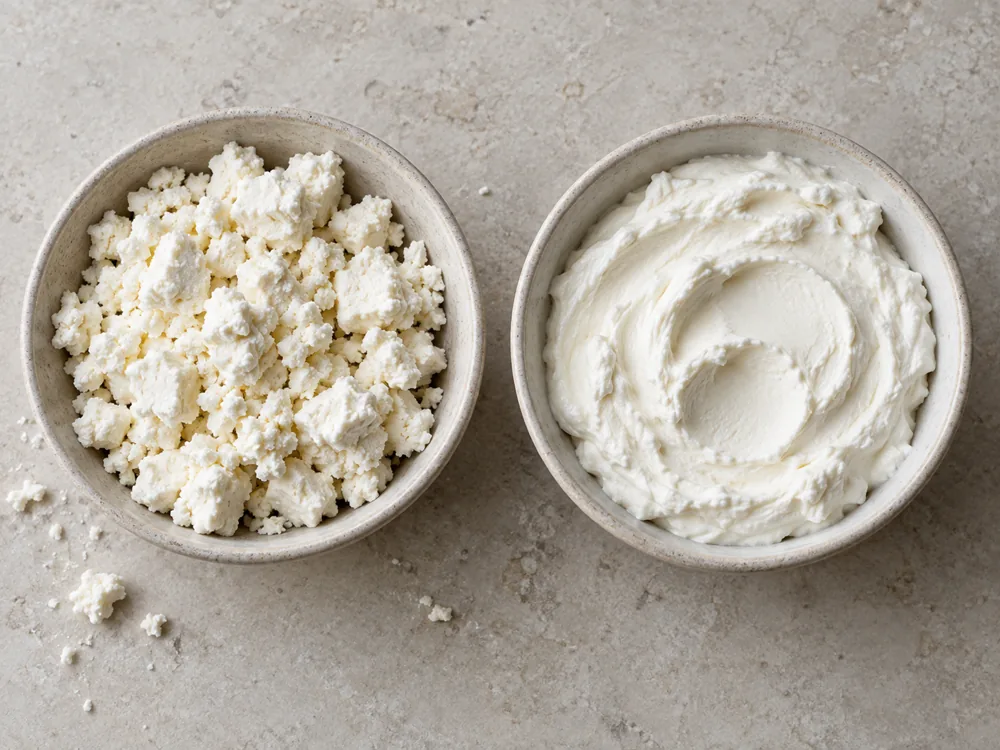
Quark now dominates what is sold. In the 2026 taste test of ten Liptauer products by Austria's consumer association VKI (Verein für Konsumenteninformation), as heute.at reports it, only two of ten contained sheep fresh cheese, and most makers used quark.
Mixed bases exist as well, since the ORF recipe uses 125 g each of Brimsen and Topfen.
How Is Brimsen Made and What Does Its Label Promise?
German Wikipedia says Brimsen is made much like quark: the milk is set with rennet, the curd is balled up and hung in cloths to drain, and the mass is then kneaded, salted and broken up.
The salted mass goes into small wooden barrels kept in a damp, cool room, and it counts as ripe once it has turned spreadable, like an ointment, and taken on its typical piquant taste.
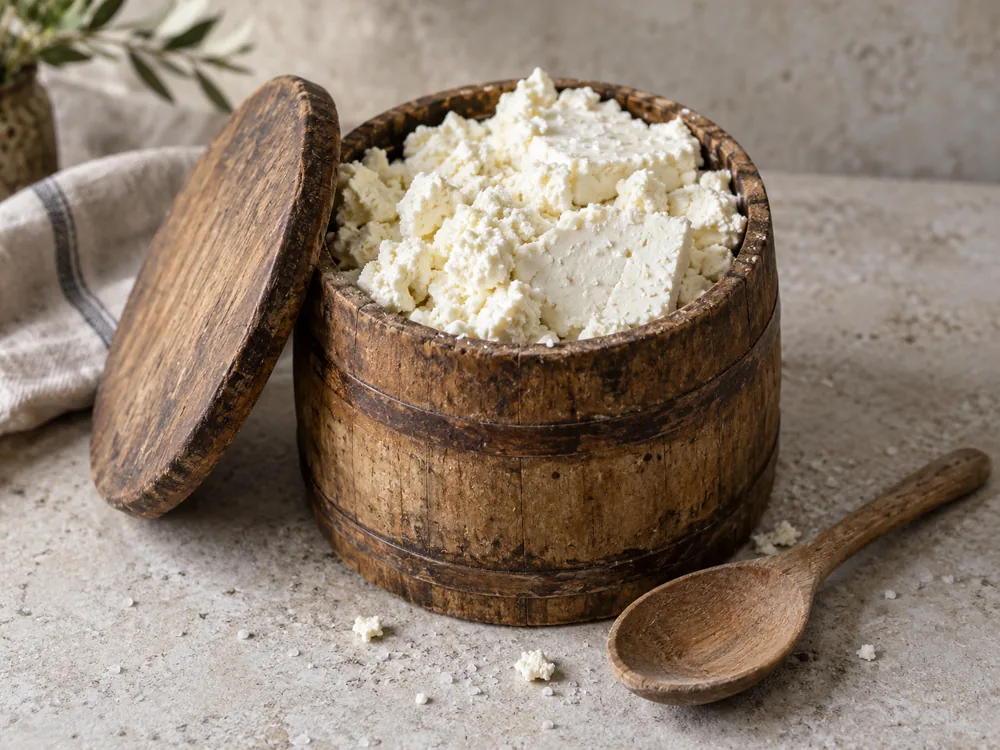
German Wikipedia adds that Brimsen is made and offered only from March to September, which fits ORF's remark that it is a summer cheese.
ORF and English Wikipedia call Brimsen crumbly, while German Wikipedia calls it spreadable once ripe, a gap that fits recipes pressing it through a sieve and creaming it with butter.
On milk, German Wikipedia says traditional Brimsen is pure sheep's milk, while some other types are partly cow's milk.
English Wikipedia reports that Slovak bryndza, protected by a PGI registered in 2008, must contain at least 50% sheep milk, while sheep (ovčia) bryndza is 100% sheep cheese. For a buyer of Slovak bryndza, the word ovčia is therefore the cue for an all-sheep cheese.
What Does Liptauer Taste Like?
The Austrian tourism board says Liptauer is available from mild to spicy-hot, and the base shifts the taste further.
German Wikipedia describes Brimsen as piquant, and English Wikipedia says bryndza starts slightly mild, turns strong and fades to a salty finish.
The Topfen version, ORF says, comes out milder than one made with Brimsen.
Mild versions sit on the same market: the AMA Käseproduzenten directory classes one Upper Austrian cow's-milk Liptauer as mild and delicate.
How Do You Make Liptauer at Home?
The Austrian tourism recipe starts by working 250 g of smooth farmer's cheese and 1 tablespoon of mayonnaise together until smooth. Finely chopped gherkin, onion, capers, garlic and parsley go in next, then mustard, paprika, salt and pepper.
The ORF recipe builds a richer spread in another order: softened butter beaten with the Brimsen, then sour cream, mayonnaise and paprika, and only then the minced onion, gherkins, capers and garlic. Anchovy paste, mustard, caraway, salt and pepper finish it before the bowl goes into the fridge, covered.
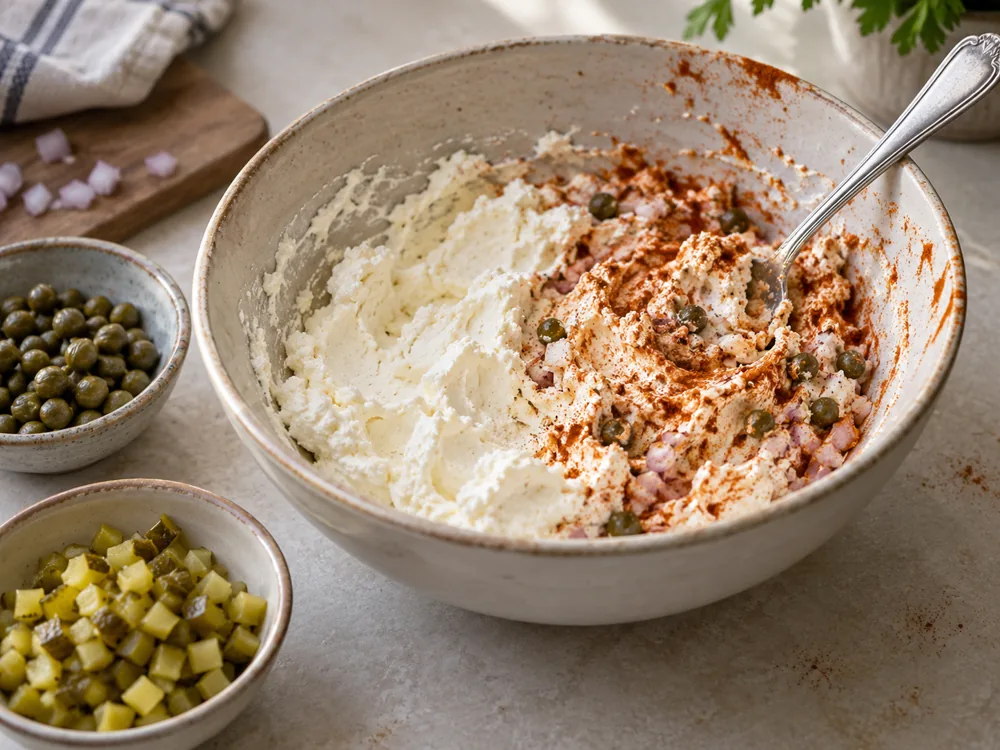
ORF advises chopping the onion, gherkins, capers and garlic as finely as possible so the flavors blend evenly, and chopping the caraway together with the onion so it does not scatter. It also notes that ground caraway is intensely flavored and calls for careful dosing.
German Wikipedia ties salt to the base: Brimsen is already salty, so salt is only needed when it is replaced by unsalted fresh cheese or Topfen. The ORF recipe, with 125 g of Brimsen, asks for only a little salt, while the tourism recipe, built on farmer's cheese alone, seasons with mustard, paprika, salt and pepper.
Recipes disagree on resting. The tourism board says the spread should rest for a few hours before serving and ORF chills its version for about four hours, while heute.at suggests a shorter pause, letting the mix stand briefly before tasting it again and adding seasoning if needed.
ORF also allows yogurt or beer in place of the sour cream.
How Do You Make Liptauer Milder or Hotter?
The tourism-board recipe uses sweet paprika as the default and swaps in hot paprika powder for a spicier version. ORF splits its paprika between sweet (edelsüß) and rose-hot (rosenscharf), and lists chopped hot peppers as a way to add more heat.
ORF says a chopped Quargel cheese stirred in makes the spread very piquant.
What Should You Serve with Liptauer?
The Austrian tourism board serves Liptauer on pumpernickel or rye bread, and German Wikipedia says it is eaten as a spread or served as a dip.
German Wikipedia names chives as a usual garnish, along with thin rings of light green pepper, which it calls typical of a Hungarian breakfast or a Speckjause, the Austrian bacon snack.
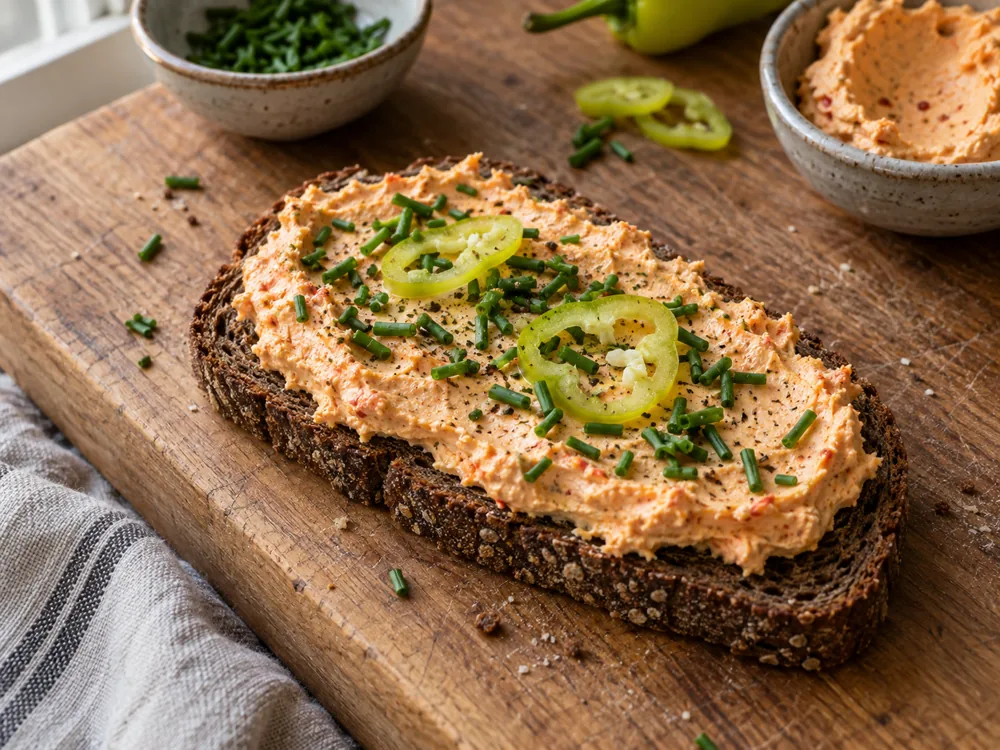
At a Heuriger buffet, ORF says, Liptauer has a fixed place between roast pork knuckle (Stelzen) and blood sausage (Blunzen).
| Pairing | Type | Why It Works |
|---|---|---|
| Rye or pumpernickel bread | Food | The serving the Austrian tourism board names for its recipe. |
| A dip | Food | German Wikipedia says Liptauer is also served as a dip. |
| Pork knuckle and blood sausage | Food | The two dishes ORF names on either side of Liptauer at a Heuriger buffet. |
| Sparkling white or young red wine | Wine | The Austrian tourism board's pairing for its recipe. |
The tourism board says Liptauer goes well with sparkling white wines or young reds.
Two of the grapes it names, Zierfandler and Rotgipfler, are typical of the Austrian thermal region and hard to find elsewhere, and its list continues with Blauer Portugieser, Neuburger and Burgundy-family wines such as St. Laurent and Pinot Blanc.
How Do You Choose a Ready-Made Liptauer?
In the 2026 VKI taste test, 58 consumers tasted ten Liptauer products blind, judging appearance, smell, consistency and taste, and six products rated good while four rated average.
Spar Premium Edition Johanna Maier Liptauer mild led with 65 of 100 points, Die Käsemacher Echter Liptauer followed with 64, and Chef Select Liptauer Art Brotaufstrich took third with 63.
The first two are sheep fresh cheese products, heute.at notes, and since the winner carries mild in its name, a mild label does not rule out a sheep cheese base.
Salt is the main nutritional catch, with the products reaching up to 1.7 g of salt per 100 g and all ten scoring D or E on the Nutri-Score, according to heute.at. The report adds that this is often more salt than potato chips contain, and that the fat content, which makes the spread creamy, is not small either.
The same report says the three organic products in the test contained no additives, while others used thickeners, preservatives, acidifying agents and flavorings.
The same report suggests homemade quark-based Liptauer as the lighter alternative, since the cook sets the salt and the oil.
Single-farm Liptauer exists too: the AMA Käseproduzenten directory lists a cow's-milk Liptauer from the Sonnberger family in Upper Austria, made since 1994 as an unripened fresh cheese.
That entry gives its fat as 45% in dry matter, a figure counted on the solids alone, and as 10% absolute, and it names Himalayan rock salt as its salt.
The same entry's milk note reads organic, hay milk, silage-free and raw milk (Rohmilch), so that farm tub may be made with unpasteurised milk.
Three label facts decide most of the choice: sheep fresh cheese or quark as the base, up to 1.7 g of salt per 100 g, and whether additives are listed. For a farm tub, the milk note shows whether the milk is raw.
How Long Does Liptauer Keep?
German Wikipedia says Brimsen keeps only for a limited time, like any fresh cheese, although some fans like it aged.
According to heute.at, the additives in some ready-made tubs make the spread creamier, keep it longer or strengthen its taste, so a tub's printed date reflects its own recipe.
The CDC says to keep a refrigerator at 40°F (about 4°C) or colder and to refrigerate perishable foods such as dairy within 2 hours, or within 1 hour when the air is above 90°F.
Is Liptauer Safe to Eat While Pregnant?
Neither the NHS nor the CDC names Liptauer, quark or Brimsen, so the answer depends on what is in the tub, starting with whether the milk was pasteurised.
NHS and CDC both list pasteurised cottage cheese and cream cheese as safe or safer. The CDC also puts any queso fresco-type cheese or similar fresh, soft cheese in its riskier column even when pasteurized, and NHS has no such category.
So pasteurisation of the cheese, butter and cream is the first thing to confirm for a Brimsen or quark spread, but under the CDC wording it may not settle the question, and neither agency says where quark or Brimsen sits.
The CDC adds that pregnant women are 10 times more likely to get a Listeria infection.
Is Liptauer Vegetarian?
Not by default, because published recipes include anchovy. The ORF recipe uses anchovy paste, while the Austrian tourism recipe and the plain farmstead form leave it out.
The cheese can matter too: German Wikipedia says Brimsen is set with rennet but not which kind, while the AMA directory lists animal rennet for the Sonnberger cow's-milk Liptauer.
An anchovy-free tub can therefore still contain animal rennet, and with the Brimsen entry silent on the kind, the maker's ingredient list is where a vegetarian can settle it.