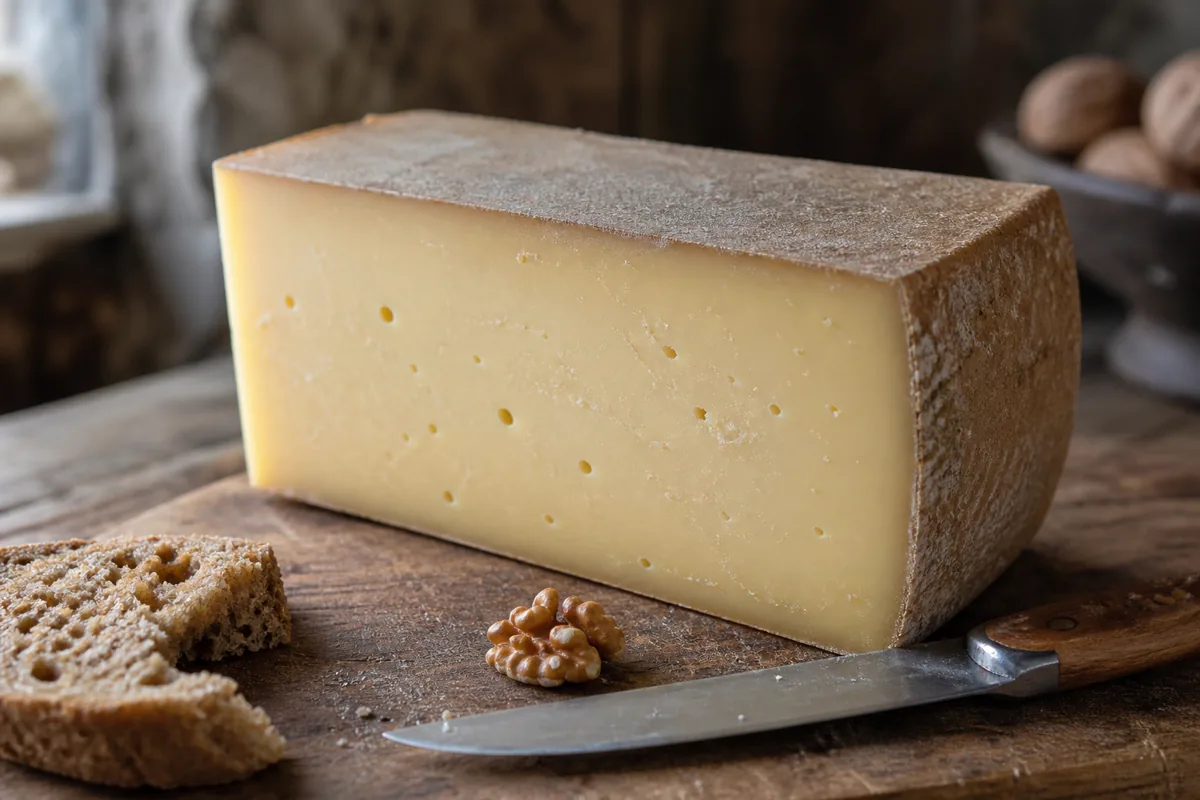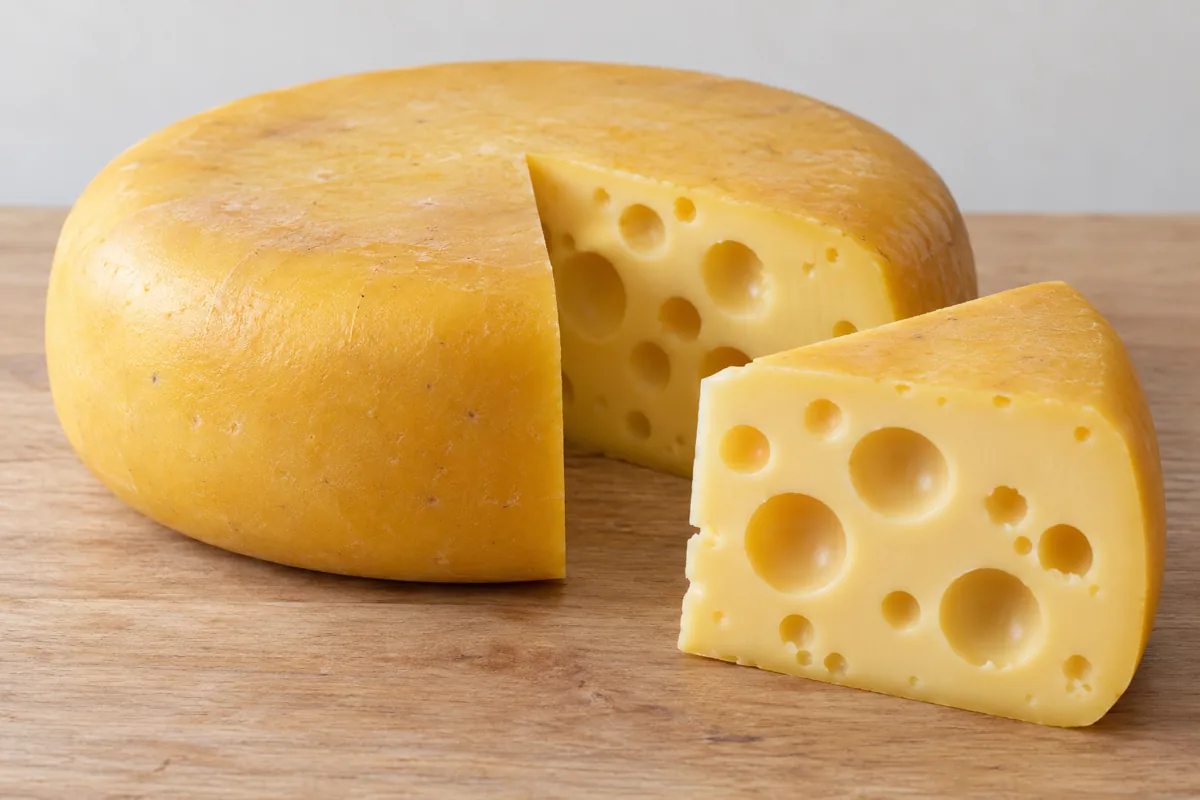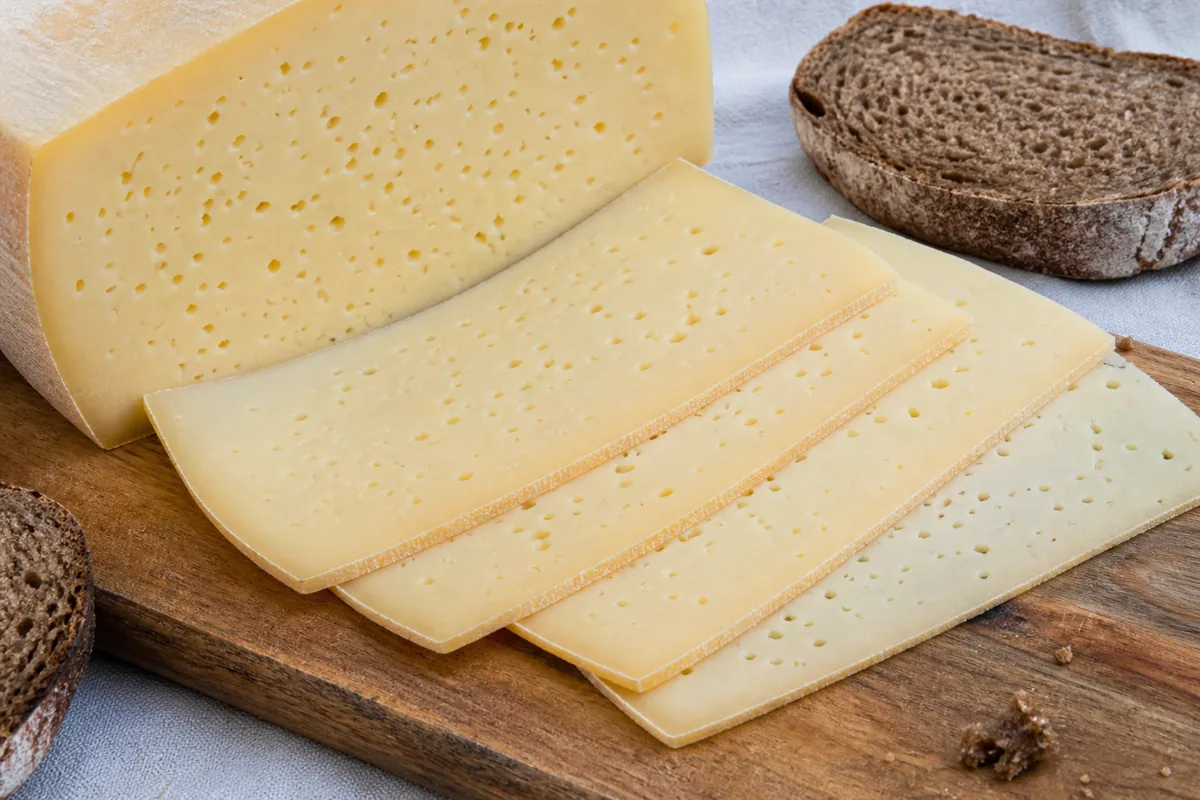
Tilsiter Switzerland, the producers' organisation, sorts Swiss Tilsiter by label colour: green, yellow and blue are made from pasteurized milk, while red and black are made from raw milk. The colour tells you the milk treatment, the fat level and the minimum age before you taste anything.
Green is the mild everyday cheese, yellow has cream added, blue is the lean style, red is the traditional aromatic one and black Extra is the longest aged.
In This Article
What Is Tilsiter?
Tilsiter is a cow's milk cheese that Tilsiter Switzerland classes as semi-hard, except Extra, which it lists as hard.
The red-label page names the cantons of Thurgau and St. Gallen and the Zürcher Oberland as where it is made, and Swiss dairies sell it under the registered brand Tilsiter Switzerland.
German Wikipedia dates that brand to 1999 and the Allgäuer Käse-Akademie dates the trademark to 1993, and both trace the cheese to Tilsit, a town in East Prussia that is now called Sovetsk.
The Allgäuer Käse-Akademie links Tilsit cheese to the Great Plague of 1709 to 1711, which killed a third of Prussia's people and emptied farms, after which settlers from the Netherlands, the Salzburg region and Switzerland arrived with dairy skills.
It adds that Prussia recruited cheesemasters from the Emmental, who found neither the milk quality nor the tools they knew and began mixing Swiss and East Prussian methods, so nobody can say for certain who invented Tilsiter.
Two Thurgau cheesemakers, Otto Wartmann and Hans Wegmüller, learned the recipe in Tilsit around 1890 and brought it home in 1893. The same source says they changed it so much that the East Prussian rectangular loaf became the round Swiss wheel.
Seventeen Swiss dairies were making it by 1903, and the Allgäuer Käse-Akademie says they differed widely and not always in quality until the first Tilsiter market order of 1948 set standards.
German Wikipedia adds that a Swiss Tilsiter office opened in Bern in 1950 and that the producers' organisation, owned by milk producers, cheesemakers and traders, now defines the varieties and their ages.
Dairy counts differ by source. Tilsiter Switzerland's colour explainer says 14 small dairies make red Tilsiter from raw milk delivered fresh every day and 8 more make the pasteurized styles, while German Wikipedia, citing the 2024 Swiss milk statistics, counts 20 dairies in total.
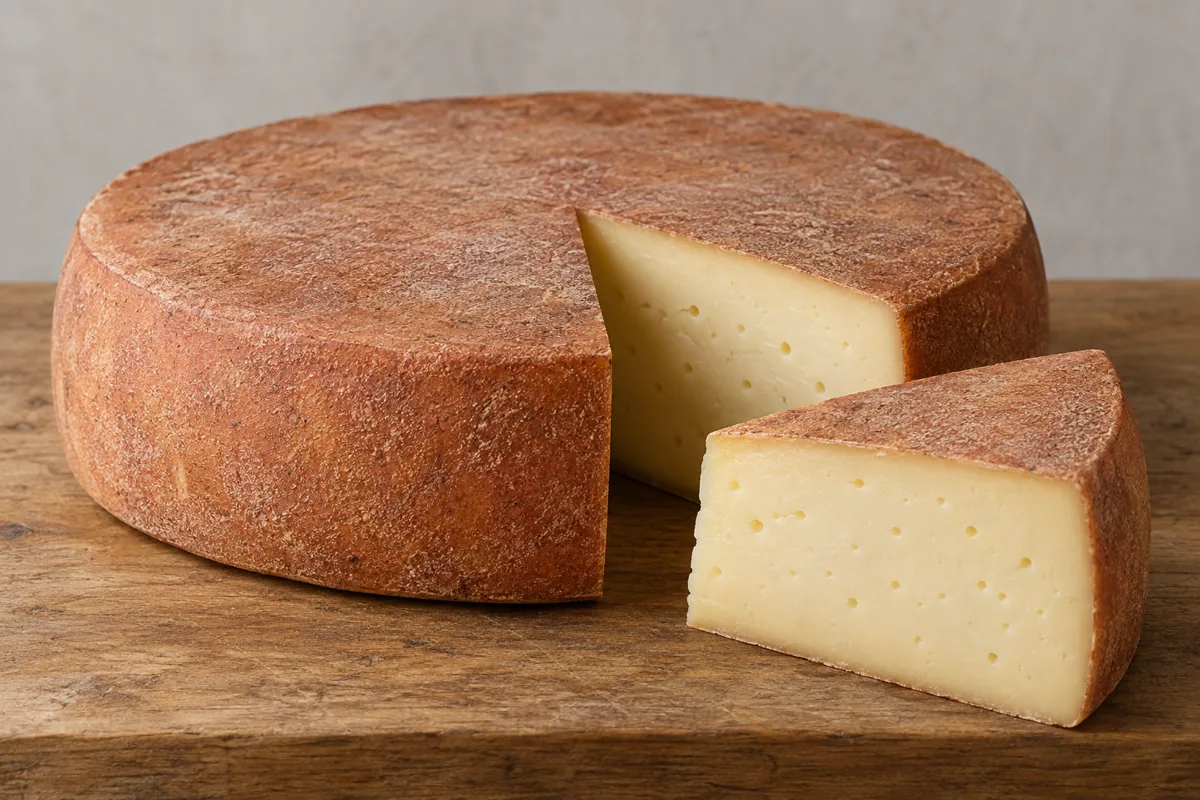
German Wikipedia describes the Swiss wheel as flat and round, about 8 cm high and 25 to 30 cm across, weighing roughly 4 to 4.5 kg.
It describes the paste as pale yellow, supple, very elastic and fairly moist, with holes the size of barley grains and some slits.
Its 2024 production table, based on Swiss milk statistics, lists 2,272 tonnes of Tilsiter Switzerland against 12,395 tonnes of Emmentaler AOP and 8,090 tonnes of Appenzeller.
The colour code belongs to Tilsiter Switzerland, so it only applies to cheese sold under that name.
Which Tilsiter Label Should You Buy?
The colour comes first and the full style name second, because red also comes as Surchoix and Extra. The table below combines Tilsiter Switzerland's red-label and Extra pages, its colour explainer and German Wikipedia's variety list.
| Label | Milk | Maturation | Rennet | Character in the sources' words |
|---|---|---|---|---|
| Green | Pasteurized | 30 to 60 days | Mostly microbial | Fresh, mild, typically slightly sour |
| Yellow | Pasteurized, cream added (Rahm) | 30 to 75 days | Mostly microbial | Very mild and richer than green |
| Red | Raw, partially thermised | At least 3 months | Animal | Mild yet aromatic and creamy |
| Red Surchoix | Raw | 120 to 180 days | Not stated | A more strongly matured red, for the connoisseur |
| Black Extra | Raw, partially thermised | At least 5 months | Animal | Spicy and robust |
The table follows the producer for red and Extra and German Wikipedia's ranges for green, yellow and Surchoix. Where both give a figure they differ slightly, since the producer's red minimum is three months while German Wikipedia's red range starts at 70 days.
The Allgäuer Käse-Akademie gives 180 days for Surchoix, which is the top of German Wikipedia's range of 120 to 180 days.
German Wikipedia describes the red, green and yellow labels as two-tone with white and the Surchoix label as red, black and gold, so the pack gives a second visual cue beside the colour word.
Tilsiter Switzerland's colour explainer calls green the most popular Tilsiter in Switzerland, describing it as fresh, mild and typically slightly sour, and the favourite on a Swiss cheese platter when children are at the table.
Yellow is the richer cheese because cream is added, and German Wikipedia sets its minimum at 55 percent fat in dry matter against 45 percent for the other varieties. Blue is the lower-fat version for people watching calories, the colour explainer says, though the cited pages give no separate maturation or rennet for it.
Red is the traditional version, made for more than 125 years and described as the stronger one, and the producer's red-label page calls it mild yet aromatic and creamy.
On a German-language label, Rohmilch means raw milk, pasteurisiert means pasteurized and Rahm means cream.
The colour marks the milk treatment and the style: green, yellow and blue are pasteurized variants, while red, Surchoix and Extra are one raw-milk family that differs mainly by age.
Is Tilsiter Vegetarian?
The answer changes with the colour. Tilsiter Switzerland's colour explainer says green and yellow Tilsiter are mostly made with microbial rennet, so the cheeses of those dairies count as vegetarian, and it names Migros, Coop, Denner, Aldi and Lidl as places that sell them.
The word mostly carries weight, because the explainer does not say that every green or yellow dairy uses microbial rennet and gives no list of the dairies that do.
Red and Extra differ. The red-label page and the Extra page both list animal rennet (tierisches Lab), so a vegetarian buyer cannot rely on the raw-milk family, and neither Surchoix nor blue is covered by any rennet statement in the cited pages.
How Does Tilsiter Taste?
Tilsiter Switzerland and the Allgäuer Käse-Akademie describe a range that runs from mild to robust, and none of the cited pages describes blue separately.
- Green: fresh, mild and typically slightly sour.
- Yellow: very mild, with cream added.
- Red: mild yet aromatic and creamy, the producer says, with the colour explainer adding that it is the stronger style, spicy and full of character.
- Surchoix: a more strongly matured red, and the Allgäuer Käse-Akademie calls it the most pronounced style.
- Extra: spicy and robust, with a paste the producer says melts delicately on the tongue.
The Allgäuer Käse-Akademie describes the aroma as milky and slightly sour, growing spicier with maturity, and German Wikipedia says the raw-milk version is usually a few shades richer in flavour than the pasteurized one.
The producer calls the red and Extra paste waxy to soft-cutting and fine.
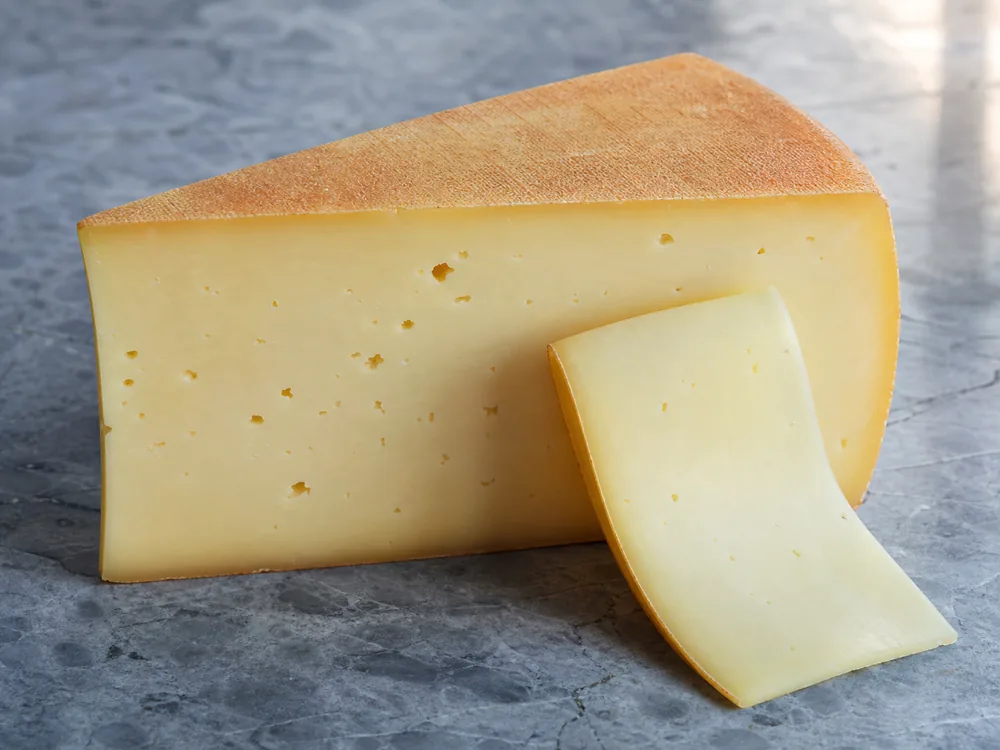
Tilsiter Switzerland describes the holes in red Tilsiter as small, round and spread from sparse to plentiful. The rind on red wheels is brown-red, and the producer says it comes from regular smearing and storage on wooden boards.
Temperature changes how the cheese tastes. Straight from the fridge it is very firm, mainly because milk fat is solid when cold, and Tilsiter Switzerland says that cold also keeps the typical aromas from developing in the mouth.
The producer puts the best eating temperature at about 20 degrees C, where the paste shows its finest, most tender structure and the aromas come out of the cheese.
How Is Swiss Tilsiter Made?
Milk treatment separates the two families. Red Tilsiter is made from fresh raw milk from cows fed without silage, and the producer says raw milk demands higher hygiene standards because it is never pasteurized.
Without pasteurizing, the cheesemaker works with a large number of living bacteria, so souring and ripening must be steered with care. The colour explainer says the red dairies use raw mixed cultures from a collection that Agroscope's Liebefeld laboratory keeps for Swiss raw-milk cheese, and that each cheesemaker usually knows his milk suppliers for years and checks the milk daily.
The green, yellow and blue styles use pasteurized milk collected over a larger area, from cows that eat silage along with hay and grass. Silage can leave feed spores in milk that disturb cheesemaking, and centrifuging the milk in a step called bactofugation removes those spore-forming bacteria before pasteurizing.
The heat also denatures the whey protein, which then stays in the curd and, the producer says, raises the cheese yield. Those dairies are larger and use a starter culture instead of raw mixed cultures.
The producer says the warming step affects microbial safety and also shapes the quality of the finished cheese.
Because Tilsiter is semi-hard, the curd is warmed only moderately, and the producer says more whey stays in the cheese than in a hard cheese.
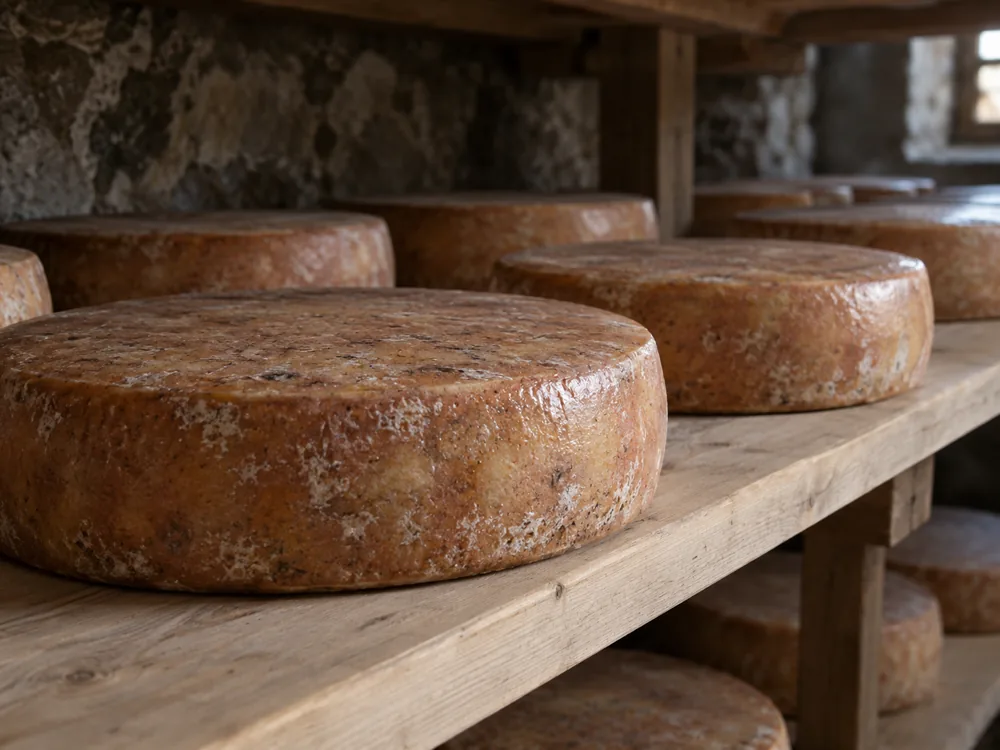
The Allgäuer Käse-Akademie describes a split in who ripens the cheese. Raw-milk wheels spend about two months in the dairy cellar and then go to cheese merchants' cellars to finish, while the pasteurized and cream cheeses finish in the dairy after one to three months.
It adds that about half of Tilsiter is now made from pasteurized milk.
Does Tilsiter Melt Well?
Tilsiter Switzerland's red-label page calls red the star of recipes for the cold and warm kitchen and includes a Tilsiter cordon bleu, which pairs a meat patty with the cheese. Its Extra page includes baked rösti nests with Tilsiter and egg.
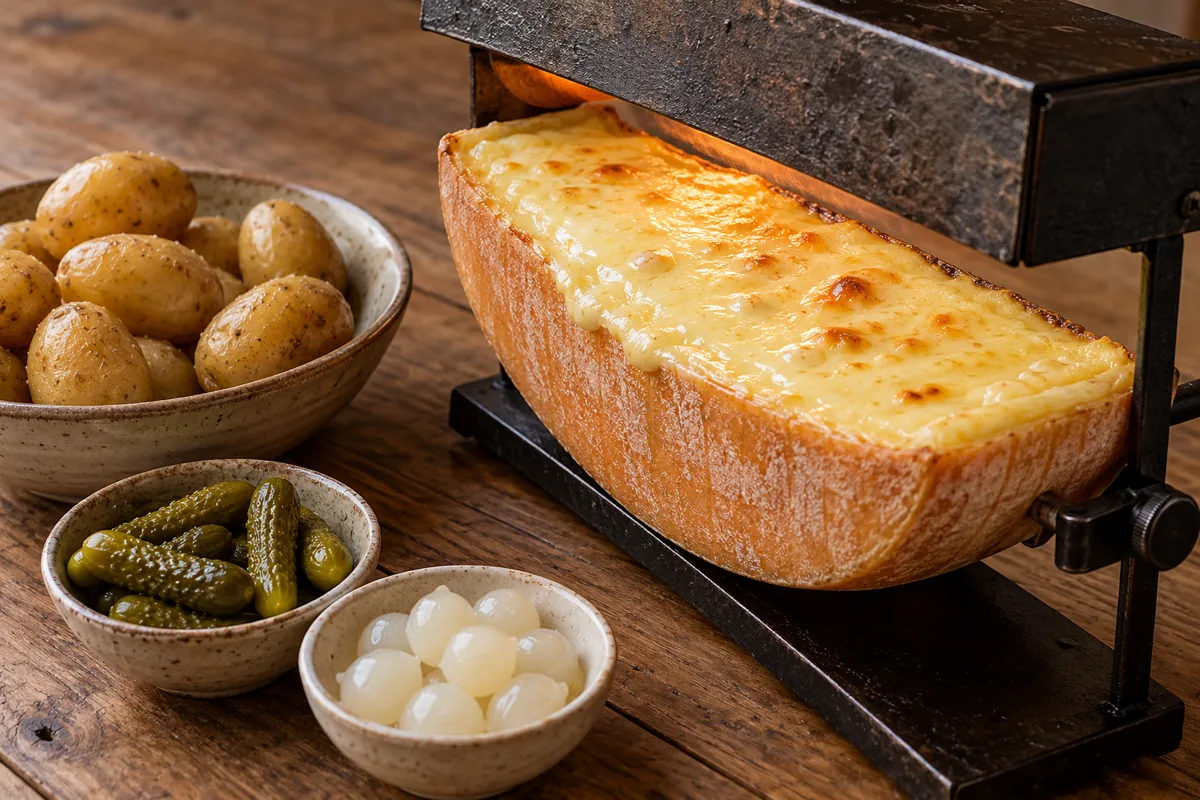
The producer's temperature explainer speaks about cheese in general, not Tilsiter alone. It says cooking releases more aroma, sometimes an intrusive smell, and that at about 180 degrees C roast aromas and a browned surface form, as on a gratin.
The same explainer warns that at those temperatures the fat starts to separate from the liquid protein, which it calls oiling out, and it says a good raclette cheese is one that delays this.
| Use | How It Works |
|---|---|
| Snack bread | The red-label page names the Znünibrot, the Swiss mid-morning bread snack, as a use. |
| Cheese platter | The red-label page names the Vesperplättli, a platter eaten with bread, as a use. |
| Cheese salad | The colour explainer's tip for red is a cheese salad with boiled jacket potatoes. |
| Cordon bleu | The red-label page includes a cordon bleu that pairs a meat patty with the cheese. |
| Rösti nests | The Extra page includes baked rösti nests with Tilsiter and egg. |
None of these pages gives a temperature at which Tilsiter oils out or a stretch measurement for the hot cheese, so the dish suggestions are the producer's guidance and not a test result.
The Extra page's wording that the paste melts delicately on the tongue describes how it feels in the mouth, not how it behaves in a pan.
How to Serve Tilsiter
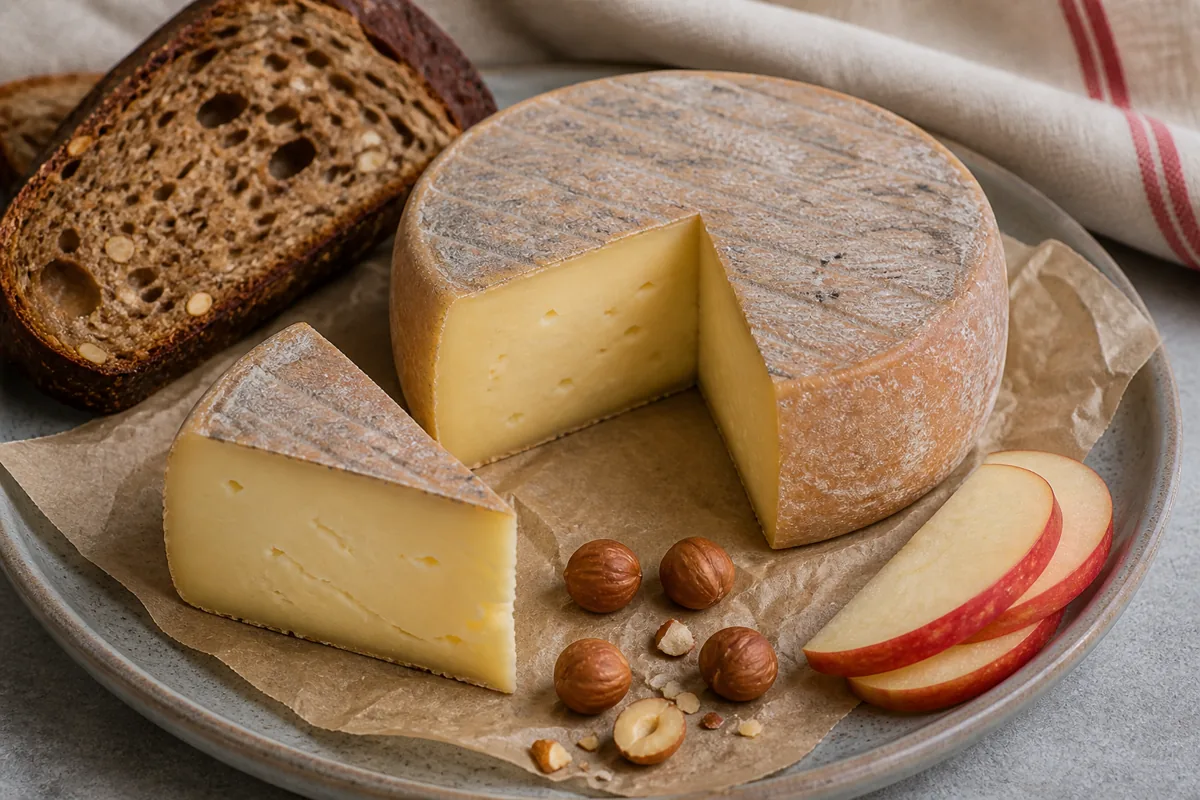
The Allgäuer Käse-Akademie matches young, mild Tilsiter with an airy, crisp baguette or classic white bread, and spicier Tilsiter with spelt bread, whose nuttiness suits the creamy paste. It pairs the most robust Tilsiter with farmhouse bread or mixed rye bread, whose light acidity sets off the piquant aromas.
For beer it names sparkling, malt-forward or moderately bitter ones, because carbonation clears the creamy fat from the palate and hop bitterness balances fat and spice without drowning the cheese.
It says sweet-tart fruit and earthy, aromatic vegetables suit mild, spicy and robust Tilsiter alike, and notes that official Swiss recipes already pair them with the cheese's spice and creaminess.
| Pairing | Type | Why It Works |
|---|---|---|
| Baguette | Food | The Allgäuer Käse-Akademie pairs young, mild Tilsiter with an airy, crisp baguette. |
| Spelt and rye bread | Food | Spelt bread for spicier Tilsiter, and farmhouse or mixed rye bread for the most robust. |
| Malt-forward beer | Drink | It names sparkling, malt-forward or moderately bitter beers. |
| Sweet-tart fruit | Food | Sweet-tart fruit and earthy, aromatic vegetables are its produce suggestions. |
| Wine with Extra | Wine | Tilsiter Switzerland suggests Extra at the end of a fine meal, served with wine. |
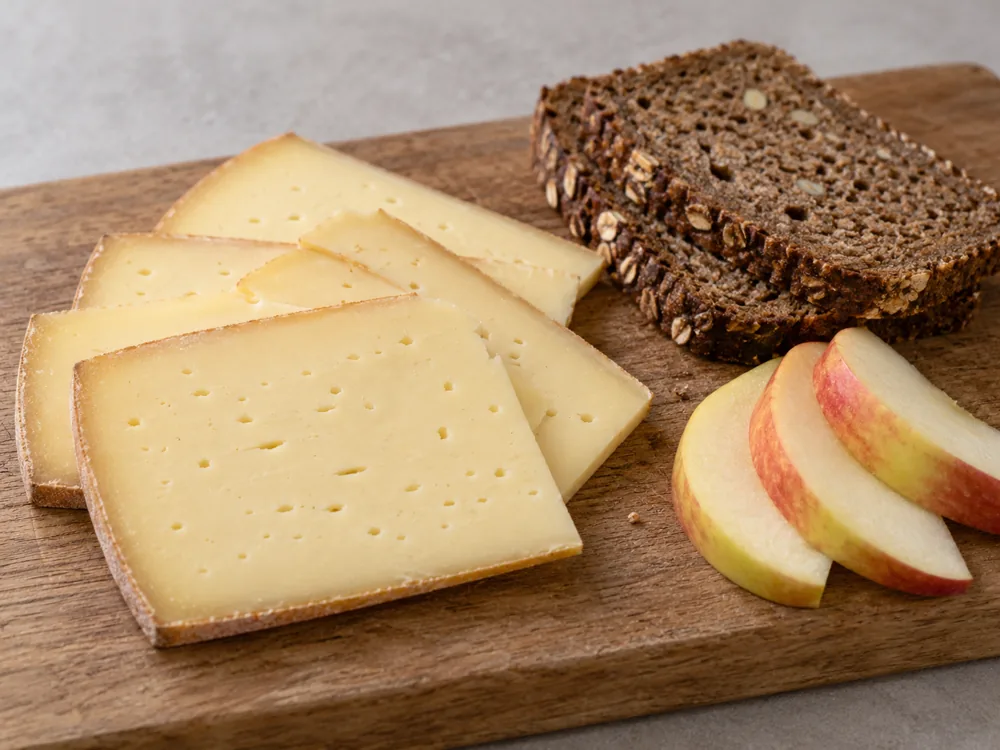
Tilsiter Switzerland positions red for cheese platters and snack bread.
It suggests Extra for the end of a fine meal with a glass of wine, and describes it as a cheese for the real cheese lover.
How to Buy and Store Tilsiter
The colour and the full style name decide the milk treatment, the rennet and the fat level, so a piece cut from a larger wheel is worth identifying by the full style name on its wrapper.
Price also differs by family. The colour explainer says large dairies with centrifuges, automatic brine baths and care robots turn out several hundred green wheels a day, which often lets pasteurized Tilsiter be sold at an attractive price.
Schweizer Käse, the marketing site for Swiss dairy products, recommends wrapping cheese in two-layer cheese paper or parchment, or in cling film with a few holes poked in it. It puts the cheese in the middle of the fridge, and the CDC says to keep a refrigerator at 40°F (4 °C) or below.
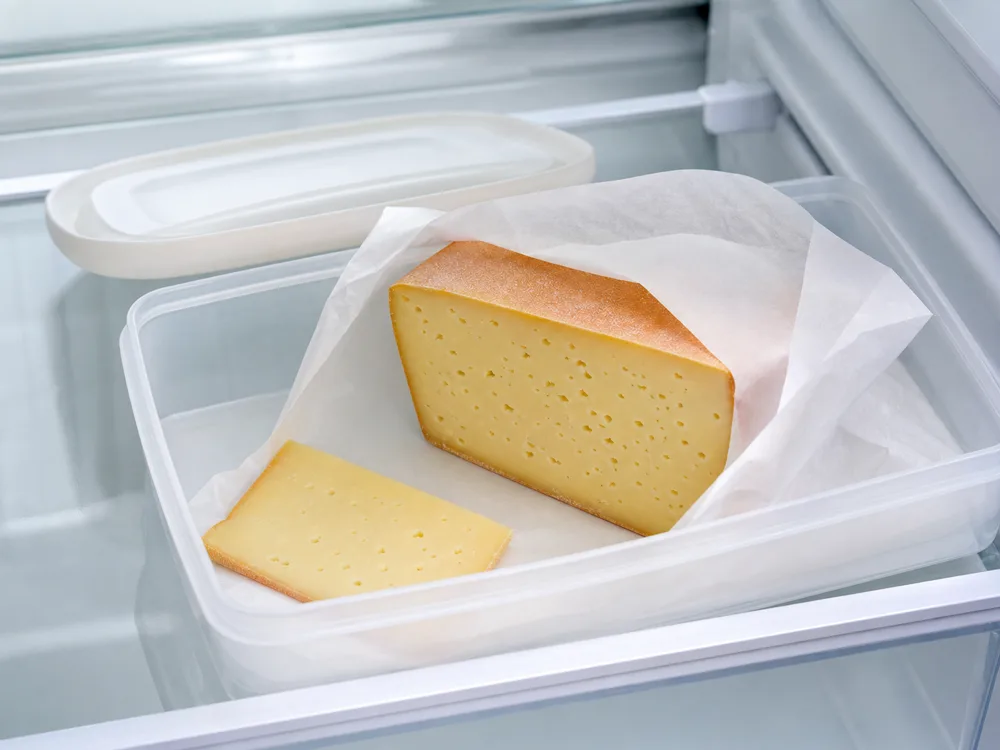
For strong-smelling cheeses it suggests a storage box with a filter, and it says to wrap each piece separately.
Vacuum-packed cheese, it adds, goes back into cheese paper or baking paper once opened.
Is Tilsiter From Germany or Denmark the Same Cheese?
No, because the name Tilsiter itself is not protected, and the Allgäuer Käse-Akademie says Tilsiter is also made in Germany, Denmark and other countries in versions that differ clearly from the Swiss original.
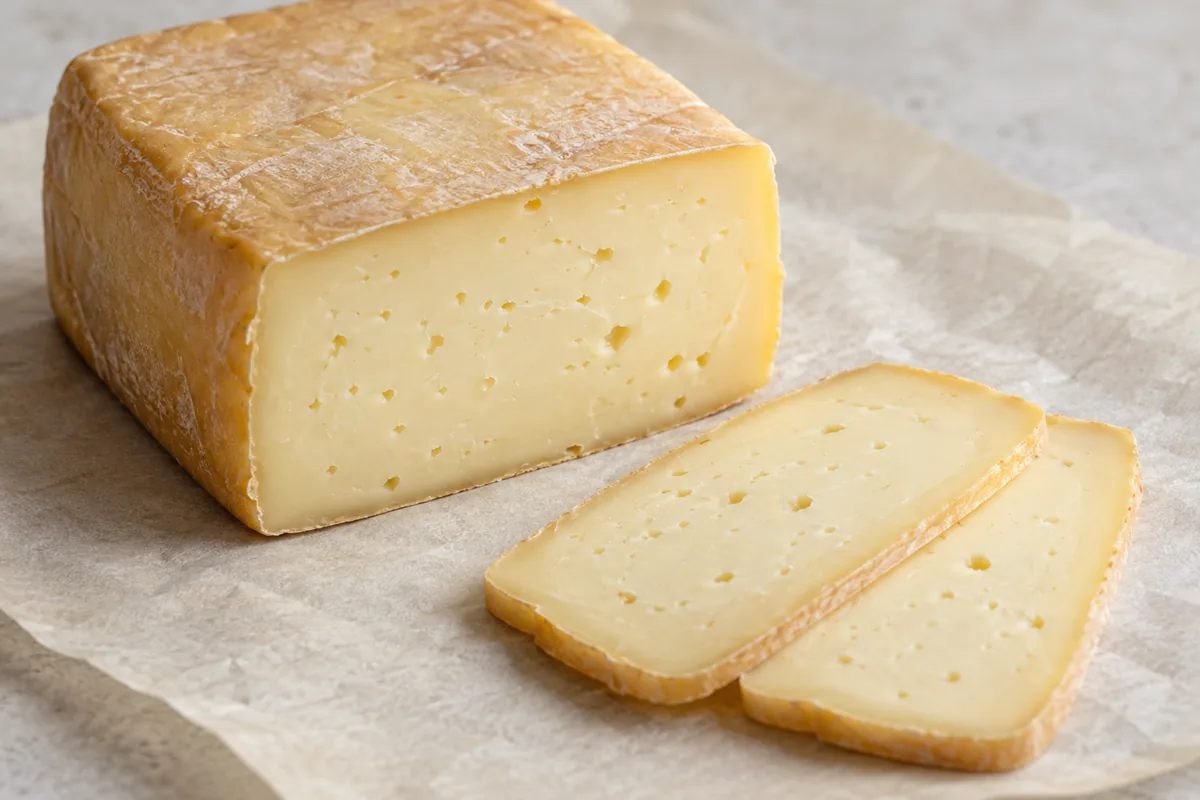
It describes those versions as having many tiny, irregular, slit-shaped holes, as being unpressed and as coming in elongated blocks instead of round wheels, with little in common with Swiss Tilsiter in flavour.
German Wikipedia agrees that Swiss Tilsiter lacks the strongly holed form usual in Germany and Denmark and is not as sharp. It adds that milder German cheeses that taste almost like Edam are increasingly sold under the Tilsiter name.
Holsteiner Tilsiter is the one German version with a legal definition, a protected geographical indication in the EU since 2013 that allows pasteurized or raw milk.
It runs from 30 to 60 percent fat in dry matter and needs at least five weeks of ripening, and only the cheesemaking has to happen in Schleswig-Holstein, while the milk can come from elsewhere.
German dairies also sell Tilsit-style cheese as Altmecklenburger, Müritzer or Nordsee-Käse, and East Germany sold it as Tollenser to avoid the East Prussian name.
The Swiss cheese travels under other names too. German Wikipedia says it was exported as Royalp and has been sold in Germany since 2016 as Swizzrocker, which the colour explainer calls a child of red Tilsiter made from daily-fresh raw milk.
A round wheel, or a wedge cut from one, with small round holes and the Tilsiter Switzerland colour label therefore points to the Swiss cheese, while a block with slit holes points to Tilsit made elsewhere.
What Can Replace Tilsiter?
None of the cited pages names a substitute for Tilsiter, so the closest matches come from what they say about the cheese itself.
- Within the range: the colour explainer says Surchoix and Extra are based on red, and the Extra page calls Extra the third and highest ripening stage of raw-milk Tilsiter, so one can stand in for another at a different age.
- For the mild styles: German Wikipedia's remark that some mild German Tilsiter tastes almost like Edam is the only hint at a mild stand-in, and it describes a different cheese from the Swiss one.
- For black Extra: no cited page names a substitute, and the closest relative is red Surchoix, the same raw-milk family at an earlier age.
Nutrition, Lactose, and Raw Milk
The red-label page gives these averages per 100 grams, and the Extra page lists the same figures for Extra.
| Nutrient | Per 100 g |
|---|---|
| Energy | 365 kcal (1528 kJ) |
| Protein | 26g |
| Fat | 29.5g |
| Water | 40g |
| Minerals | 4.5g |
The cited pages give no per-100 g figures for green, yellow, blue or Surchoix, so these numbers describe the raw-milk red and Extra styles only.
Tilsiter Switzerland's red and Extra pages describe the cheese as naturally lactose-free, and its colour explainer credits the long maturation of red. Its temperature explainer adds that lactic acid bacteria break down the milk sugar in the young cheese before it goes into the salt bath.
It is still a cow's milk cheese, so it does not suit a milk allergy.
The NHS lists pasteurised semi-hard cheeses such as Dutch edam as safe in pregnancy, and the producer classes green, yellow, blue, red and Surchoix as semi-hard, so that line fits green, yellow and blue. The producer lists Extra as hard cheese, the NHS lists pasteurised or unpasteurised hard cheeses such as cheddar and parmesan, and the CDC calls hard cheese safer when it is made with pasteurized milk.
Neither agency names raw-milk semi-hard cheese such as red Tilsiter, but the CDC lists dairy products made from raw milk as the riskier choice, which covers red, Surchoix and Extra. The CDC says pregnant women are 10 times more likely to get a Listeria infection, so ask a midwife or doctor about those three.
SOURCES & REFERENCES
Tilsiter FAQ
Tilsiter Switzerland describes green as fresh, mild and slightly sour, and red as mild yet aromatic. Extra is described as spicy and robust.
Some of it is.
Red, Surchoix and Extra use raw milk that is partially thermised, while green, yellow and blue use pasteurized milk.
Green marks mild pasteurized Tilsiter, yellow marks the cream-enriched style, blue marks the lower-fat style, red marks traditional raw-milk Tilsiter and black marks Extra, the longest aged.
The producer lists it in hot dishes such as a cordon bleu and baked rösti nests.
Its pages give no measurements for the hot cheese, so the dish suggestions are its guidance, not test results.
Tilsiter Switzerland describes its red and Extra styles as naturally lactose-free. It is still a milk product, so it does not suit a milk allergy.