Regional Guide

Spanish Cheese Regions: A Guide to Spain's DO Cheeses by Territory

Spain has 28 DO-protected cheeses across its regions. This guide covers Manchego, Idiazabal, Mahón, Tetilla, and how to buy authentic Spanish cheese imports.

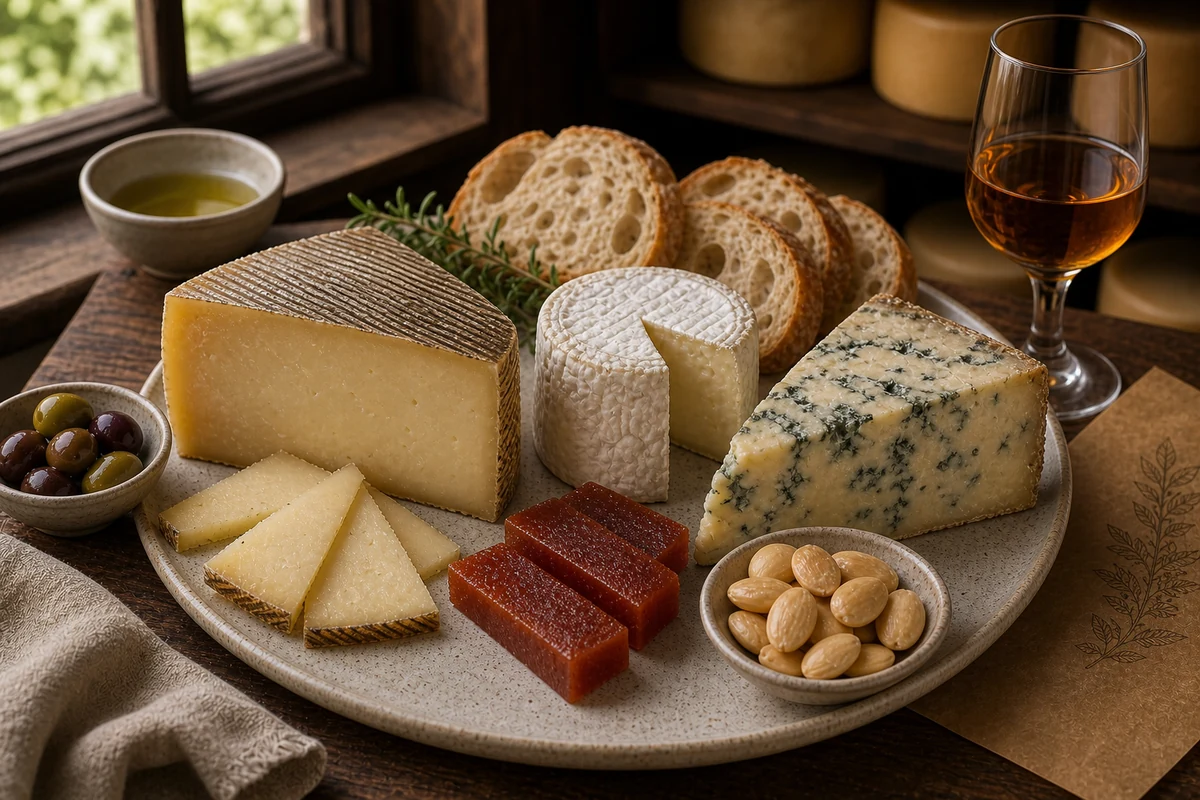
Spanish-style cheese board with Manchego-style wedge, goat cheese, blue cheese, quince, and almonds - Spain cheese region guide | KnowTheCheese
QUICK ANSWER

Spain's cheese regions range from sheep's milk wheels on the La Mancha plateau to cave-aged blues in Asturias and briny cow's milk cheeses from Minorca. DO certification, milk type, and region matter more than a generic Spanish cheese label.

Best Dairy Free: Not applicableBest Overall: ManchegoBudget: Tetilla

Spain has 28 DO-protected cheeses spanning the peninsula from Galicia and the Basque Country to La Mancha and Minorca.

SPAIN QUICK FACTS
Origin17 autonomous communities across the Iberian Peninsula and islands
MilkCow, sheep, and goat (all three; mixed milk cheeses common)
TextureSemi-hard to hard pressed-curd dominates; fresh and soft types in northern regions
RindNatural (Manchego pleita pattern). waxed (Mahón). smoked (Idiazabal, San Simón)
AgingDays (Tetilla, Arzúa-Ulloa) to 12+ months (Manchego Viejo, Roncal Añejo)
Fat Content45 to 55% FDM typical for semi-hard and hard types
PDO / DOP28 DO-protected cheeses (MAPA-certified, EU PDO recognition)
AvailabilitySpanish delis, specialty retailers, and online importers worldwide
Pricemid to premium

Spain's cheese tradition is far older and broader than Manchego alone, though Manchego is the only Spanish cheese most people outside Spain know by name. Twenty-eight DO-protected cheeses span the peninsula from the lush green pastures of Galicia and the Basque Country in the north to the dry plateau of La Mancha and the island of Minorca in the Mediterranean.

The range of milk types sets Spain apart from its European neighbors. While France and Switzerland rely primarily on cow's and goat's milk, and Italy adds buffalo, Spain has strong traditions in all three, plus a significant history of mixed-milk cheeses that blend two or three types in a single wheel.

This guide covers Spain's five main cheese-producing territories, their flagship DO cheeses, the terroir factors that shape flavor, and practical guidance for buying Spanish imports.


28
DO Cheeses MAPA-certified

60,000
Manchego Production tonnes per year

150+
Cheese Varieties named regional types

4
Milk Types Used cow, sheep, goat, mixed

Spain's DO system (Denominación de Origen) predates the EU's PDO framework and follows the same legal logic: a production specification that ties a cheese's identity to a defined geographic zone, specific animal breeds, and traditional methods. Spanish DO cheeses receive EU PDO recognition in export markets, though the domestic designation remains DO.

What Comes From La Mancha and Castile?

The high central plateau of Spain, known as the Meseta, is home to the country's most internationally recognized cheese and an extensive sheep-farming tradition.

Manchega sheep are adapted to the dry scrubland of Castilla-La Mancha. Hot summers, cold winters, and sparse vegetation shape both the farming system and its milk supply.

Queso Manchego DO is Spain's flagship. Its aging labels move from Fresco through Semicurado and Curado to Viejo.

The DO limits production to Manchega sheep milk from Albacete, Ciudad Real, Cuenca, and Toledo and replicates the historic pleita basket pattern on the Manchego rind.

Semicurado is the useful starting point when you want a Manchego that still slices cleanly and stays supple enough for sandwiches or warm dishes. Curado loses more moisture and brings a firmer bite with a more concentrated sheep milk flavor.

Viejo works best in thin shards or small board portions because its salt, sharpness, and crumbly texture can dominate a recipe. The age word tells you more about kitchen use than rind color alone.

CountrySpain
StylePressed hard curd; sheep's milk tradition
  • Queso Manchego DO - four aging stages, Manchega sheep only, crosshatch rind, Spain's most exported cheese
  • Queso Zamorano DO - raw sheep's milk from Zamora province, harder and more intense than Manchego, cylindrical wheel with pleita pattern
  • Queso Ibores DO - raw goat's milk from Extremadura, rubbed with olive oil and paprika during aging, brick-red exterior
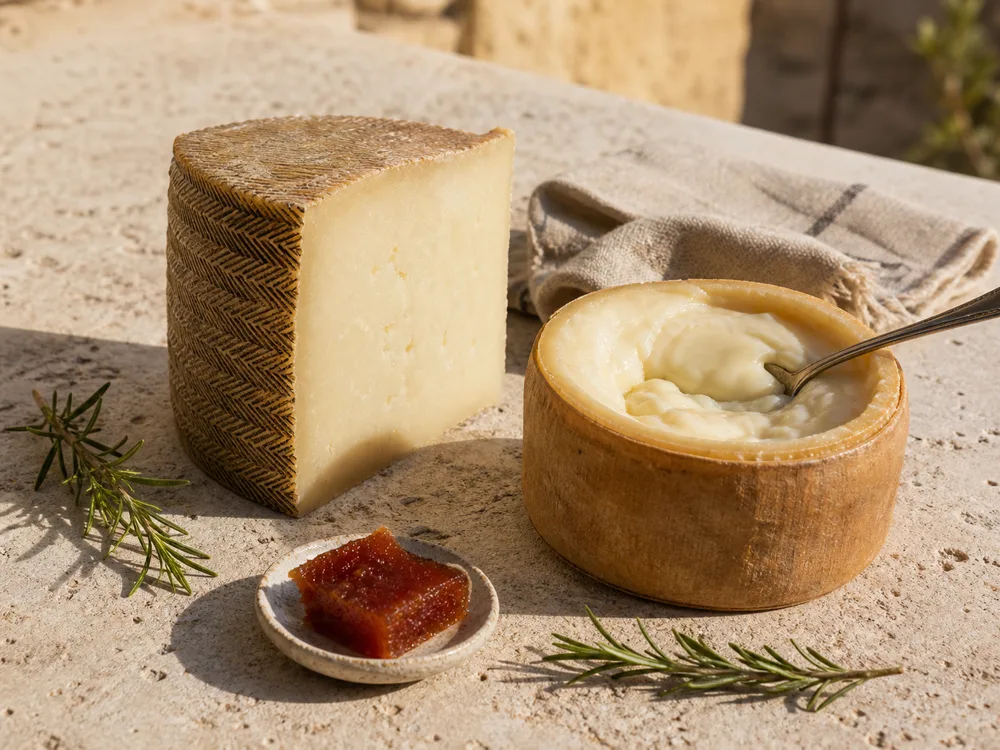
  • Torta del Casar DO - raw Merino sheep's milk, semi-liquid paste at peak ripeness, eaten by cutting off the top and spooning out the interior
Crosshatched Manchego-style wedge beside an opened spoonable Torta del Casar-style wheel - Spanish cheese regions | KnowTheCheese
Central and western Spain produce both compact aged sheep cheese and spoonable thistle-set wheels, so texture changes as much as flavor across the plateau.

Torta del Casar brings a completely different texture to the region.

Producers in Extremadura use cardoon thistle (Cynara cardunculus) to coagulate raw Merino sheep milk instead of using animal rennet. As the cheese ripens, its interior can soften enough to eat with a spoon.

The flavor is intensely savory and can carry a gentle bitterness from the plant coagulant.

TIP

When buying Torta del Casar, look for a wheel that gives slightly to pressure all the way to the center. A hard center means it has not yet developed the liquid interior. If it is fully liquid but smells strongly ammoniated, it is past peak. The optimal window is short - ask your cheesemonger when the wheel was cut or opened.

What Makes Basque Cheese Smoky?

The Basque Country (Euskadi) and neighboring Navarre sit in northern Spain against the Pyrenees. The climate shifts from Atlantic conditions in the west to a more continental pattern inland.

The regional cheese tradition centers on milk from Latxa and Carranzana sheep that graze the mountain foothills.

Idiazabal DO is the Basque Country's flagship raw sheep milk cheese. Its specification requires at least 60 days of aging.

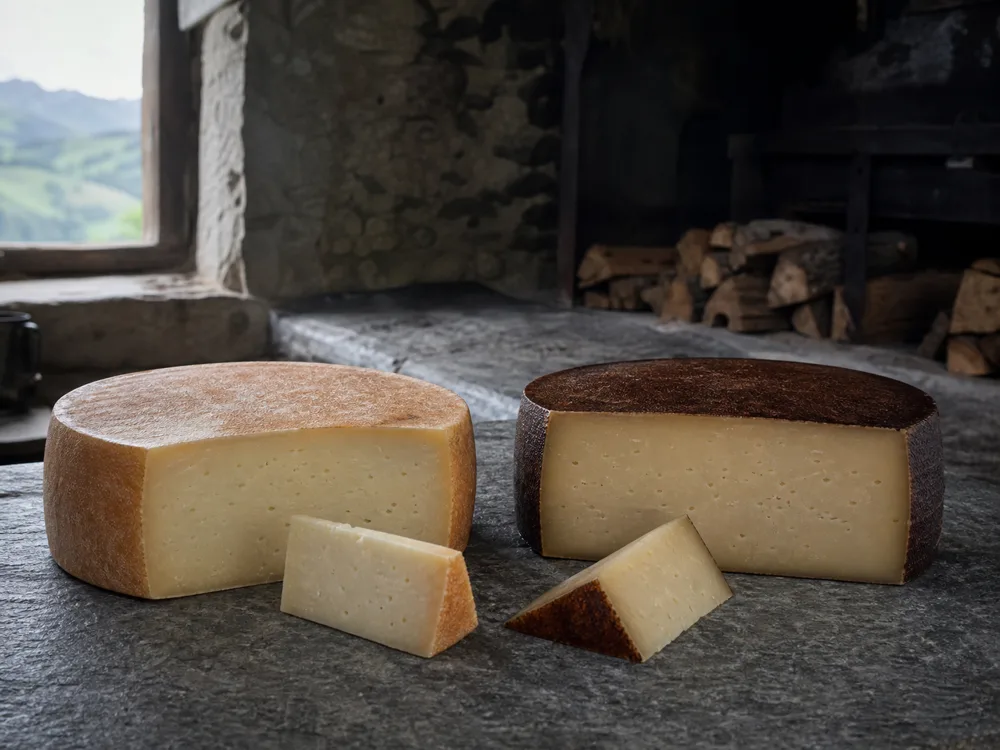
Producers can sell it natural or smoked. Smoking darkens the rind and adds a wood-smoke note near the outside of the firm paste.

Choose smoked Idiazabal for a savory smoke note in pintxos, potatoes, or salad, while natural Idiazabal keeps the sheep milk flavor more exposed beside delicate accompaniments.

Smoke does not indicate a longer aging period or a higher grade. Check the product description for ahumado or natural rather than trying to judge the whole cheese from rind color under shop lighting.

Natural and smoked Idiazabal-style sheep cheese wheels with tan and dark brown rinds - Spanish cheese regions | KnowTheCheese
Smoked and natural Idiazabal share a firm sheep milk paste, but the dark rind identifies the version that brings wood smoke into the flavor.
  • Idiazabal DO - raw Latxa or Carranzana sheep's milk, smoked or unsmoked, firm paste, intense savory flavor with slight smokiness in smoked versions
  • Roncal DO - Spain's first DO cheese (1981), raw Lacha or Rasa sheep's milk from the Roncal valley in Navarre, minimum 4 months, hard and sharp
  • Queso de los Beyos - semi-hard cow's and goat's milk mountain cheese from Asturias, small production, rarely exported

Latxa sheep differ from the Manchega breed used for Manchego, which helps keep the two regional cheeses distinct.

Older Idiazabal can develop small crystals like other hard aged wheels. Its firm texture and smoky option still separate it clearly from Parmesan-style cheese.

NOTE

Idiazabal DO comes in two clearly different products: smoked (ahumado) and unsmoked (natural). The two versions are not interchangeable in cooking. Smoked Idiazabal adds a wood-smoke dimension to pintxos and salads. Unsmoked Idiazabal is the correct choice for dishes where a clean sheep's milk flavor is wanted without the smoke overlay. Both are sold under the same DO designation.

What Does the Atlantic North Produce?

Galicia and Asturias occupy Spain's rainy northwest, far from the dry central plateau. Frequent Atlantic rain supports green pasture and a strong cow milk tradition.

That environment favors young, soft cheeses in Galicia, while neighboring Asturias adds many mixed-milk and blue styles.

Tetilla DO is Galicia's most recognizable cheese because of its breast-shaped form. It is a young, mild cow milk cheese with a semi-soft paste.

The flavor is buttery and gently acidic, and the cheese melts readily when heated. Its texture sits closer to buttery semi-soft cheeses than to Spain's hard sheep milk wheels.

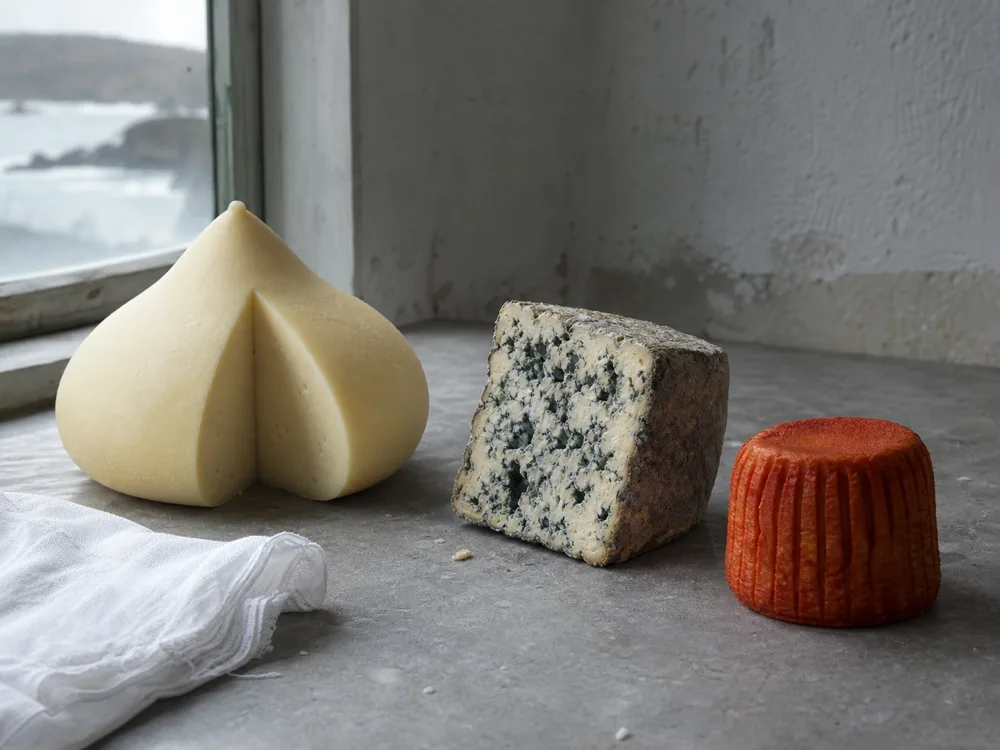
Conical Tetilla-style cheese, veined Cabrales-style blue, and paprika-coated Afuega'l Pitu-style cheese - Spanish cheese regions | KnowTheCheese
The Atlantic north moves from mild conical Tetilla to dense blue Cabrales and paprika-coated Asturian cheese without relying on one dominant milk or texture.
  • Tetilla DO - young, semi-soft, mild cow's milk, distinctive teardrop shape, Galicia's everyday cheese
  • Arzúa-Ulloa DO - soft, lactic, slightly acidic, flat disc shape, eaten very fresh (7-15 days) or semi-cured (30+ days)
  • San Simón da Costa DO - smoked with birch wood, pear-shaped, firm texture, mild smokiness, amber-brown rind
  • Queso Nata de Cantabria DO - soft, high-fat, buttery, creamy paste from Cantabria's Atlantic coast dairy herds

Asturias, east of Galicia, is Spain's blue cheese heartland, and its best-known cheese matures in the natural caves of the Picos de Europa.

Cabrales DO can use raw cow milk alone or a seasonal blend that also includes sheep and goat milk. Cool, humid cave maturation supports the blue mold that develops through the paste.

Cabrales belongs near sheep's milk blue cheese in intensity, though its texture and mixed-milk versions create a different experience.

Fresh Tetilla should feel supple and evenly moist without leaking liquid or developing a strong ammonia odor. Its short maturation means a busy counter with reliable refrigeration matters more than finding the oldest piece.

Cabrales needs the opposite buying decision. Look for a moist but cohesive paste with blue growth distributed through natural openings, then buy a small portion because its salt and aroma carry farther than a mild Galician cheese.

  • Cabrales DO - raw mixed milk (cow, sheep, goat), cave-aged in Picos de Europa, no needling, very sharp and pungent, among Spain's strongest cheeses
  • Gamonéu DO - lightly smoked, partially blue, raw milk, semi-hard to hard, more restrained than Cabrales
  • Afuega'l Pitu DO - soft, slightly sour, can be plain or seasoned with paprika; one of Asturias's oldest named cheeses

What Comes From Catalonia and Minorca?

The eastern Mediterranean coast and Spain's islands preserve cheese traditions shaped by geographic separation.

Minorca makes Mahón-Menorca, while the Canary Islands produce several goat milk wheels. Catalonia contributes fresh and small-production cheeses that rarely reach export counters.

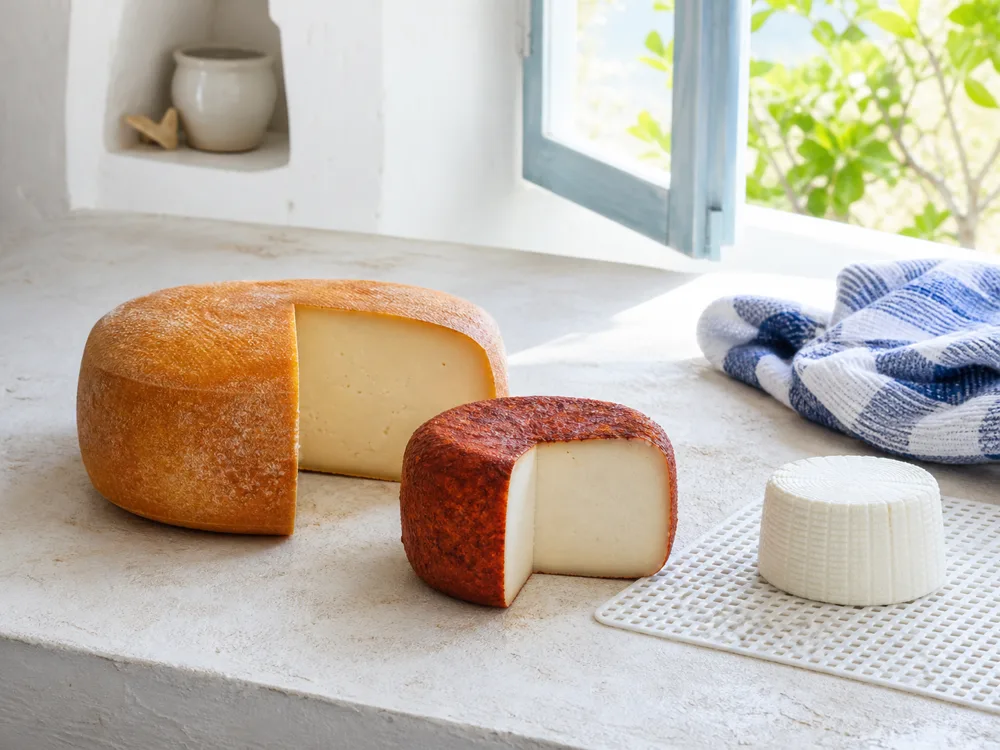
Rounded-square Mahon-style wheel, paprika-coated Majorero-style cheese, and a fresh Catalan-style cheese - Spanish cheese regions | KnowTheCheese
Rounded-square Mahon, paprika-coated Majorero, and a small fresh cheese show how island and Mediterranean traditions depart from Spain's cylindrical plateau wheels.

The rounded-square form helps you recognize Mahón-Menorca, but shape alone does not confirm origin. Use the protected name and certification mark when you need the island cheese rather than a visually similar wheel.

Tierno and Semi-Curado suit melting, sandwiches, and table portions, while firmer Curado and Añejo work better in smaller pieces or grated.

Mahón-Menorca DO is a cow milk pressed-curd cheese with rounded square corners. Its pillow-like form comes from the traditional cloth used during shaping.

The aging labels run from Tierno through Semi-Curado and Curado to Añejo. Older versions become firmer and more concentrated while retaining the cheese's characteristic salty tang.

  • Mahón-Menorca DO - cow's milk, square corners from cloth pressing, four aging stages, slightly briny and mineral
  • Formatge de Mahó - generic term for Minorcan cheese; only Mahón-Menorca DO carries production guarantees
  • Queso Majorero DO - raw goat's milk from Fuerteventura in the Canary Islands, rubbed with paprika, gofio (toasted grain flour), or olive oil during aging
  • Queso Palmero DO - smoked goat's milk cheese from La Palma island, cylindrical, firm, the most widely produced Canary Islands cheese

Majorero uses milk from Majorera goats adapted to Fuerteventura's dry climate, and producers may rub the rind with paprika, gofio, or oil during maturation.

The paprika version has a red exterior that recalls aged Cotija, but the paste and goat milk flavor remain distinct. Majorero is among the Spanish goat cheeses that sometimes reach US specialty shops.

How Do You Buy Spanish Cheese Abroad?

Manchego's global popularity has helped Spanish cheese exports reach far beyond specialist Iberian shops.

That demand also created a market for lower-priced sheep milk cheeses described as Spanish-style. A country name or familiar pattern on the rind does not prove that a cheese follows a protected specification.

Certification marks provide the most reliable check for authentic Manchego DO.

A certified wheel carries the Consejo Regulador's numbered casein plaque embedded in the rind during production. A wheel without that traceability mark is not certified Manchego DO regardless of its label design.

Strong Spanish cheese retailers often specialize in Iberian foods broadly, including wine, jamón, olive oil, and cheese.

Ask how quickly the shop turns its inventory and whether soft or rare cheeses remained refrigerated throughout import and storage. For Torta del Casar, Cabrales, and aged Zamorano, cold-chain discipline matters as much as the importer name.

For serving, pair aged Manchego, Roncal, and Mahón with quince paste, almonds, and dry sherry. A structured cheese board helps the firmer wheels taste distinct instead of turning into one salty, nutty category.

THE BOTTOM LINE

Spain's 28 DO cheeses span five distinct geographic traditions. La Mancha's Manchego is the global ambassador for Spanish sheep's milk cheese. The Basque Country's Idiazabal and Navarre's Roncal bring a smoked and mountain character. Galicia and Asturias produce Spain's freshest cow's milk cheeses and its most intense blue (Cabrales). Minorca's Mahón adds a Mediterranean, briny dimension. Always verify DO certification when buying imports, and look for the specific consortium marks on individual cheeses like Manchego's casein plaque and Cabrales's green foil.

SOURCES & REFERENCES


1.
Ministerio de Agricultura, Pesca y Alimentación (MAPA), 2023 PDO
Official Spanish government registry of 28 DO cheese certifications, production zones, and certifying Consejos Reguladores.

2.
Fundación Consejo Regulador DO Queso Manchego, 2012 PDO
Full DO specification for Queso Manchego: Manchega sheep breed requirement, permitted zone (Albacete, Ciudad Real, Cuenca, Toledo), aging stage definitions, pleita rind pattern, and casein plaque traceability protocol.

3.
Federación Nacional de Industrias Lácteas (FeNIL), 2023 Dairy Board
Spanish dairy industry annual statistics covering production volumes by cheese type and region, export data, and DO cheese market performance.

Spanish Cheese FAQ

Spanish cheese questions usually start with Manchego and end up somewhere else entirely.

Spain has 28 DO-certified cheeses as of 2023, overseen by the Spanish Ministry of Agriculture (MAPA). Each DO has its own Consejo Regulador that sets standards and certifies production.

The number has grown from fewer than 10 in the 1980s as regional cheese traditions gained official recognition. Spain's DO cheeses receive EU PDO status for export, meaning they are protected under European law in countries that recognize geographic indications.

Three things make Manchego legally distinct: the Manchega sheep breed, the La Mancha plateau production zone, and the Consejo Regulador certification with the numbered casein plaque. Other Spanish sheep's milk cheeses like Zamorano and Roncal use different breeds (Churra, Lacha) in different zones and produce genuinely different flavor profiles.

Manchego's Manchega sheep milk is higher in fat and protein than most sheep breeds, producing the dense, compact paste and distinctive tangy-nutty flavor. The crosshatch pleita rind pattern is a visual identifier but not the legal certification marker - only the casein plaque confirms DO status.

Cabrales DO is a raw mixed-milk blue cheese aged in the natural caves of the Picos de Europa in Asturias. Three things drive its intensity.

Raw milk keeps the native bacteria and enzymes that accelerate flavor development, and blending cow, sheep, and goat milk adds complexity from three different fatty acid profiles. Cave aging without needling lets the mold spread through natural fissures in the paste instead of through drilled holes.

The result is one of Europe's most pungent blue cheeses - sharper and saltier than Roquefort, less creamy than Gorgonzola Dolce, with a more aggressive lactic sharpness.

Curado ages 3-6 months and has a firm, compact paste with a nutty, tangy, slightly caramel flavor. It grates well and is the most versatile cooking and eating stage.

Viejo ages 12+ months and develops a hard, crumbly texture with intense sharpness, pepper notes, and heavy crystalline deposits throughout the paste. Viejo is primarily a board cheese or finishing cheese - too assertive for most cooking applications and considerably more expensive because of the aging time and moisture loss. For most uses, Curado is the right choice. Viejo is for when you want Manchego at its most concentrated and complex.

In the US, the best sources are Spanish specialty food importers, dedicated cheese shops with good Iberian programs, and online retailers specializing in Spanish foods. Manchego is widely available in better supermarkets, but verify the DO seal and casein plaque.

Cabrales, Torta del Casar, Idiazabal, and Roncal are less common and typically require a specialty shop or online importer. In the UK, Spanish DO cheeses are more widely distributed through supermarket chains with European cheese programs. Always check for the DO logo and the relevant Consejo Regulador mark rather than relying on general "imported from Spain" labeling.

WRITTEN BY
Elise Whitfield started out working a cheese counter in Melbourne, where she wanted a reference that was honest and practical and could not find one. KnowTheCheese is the resource she wished existed. She writes it from published references, producer and official documents where they exist, and her own tasting notes. When little has been published about a cheese, she says less rather than guessing.