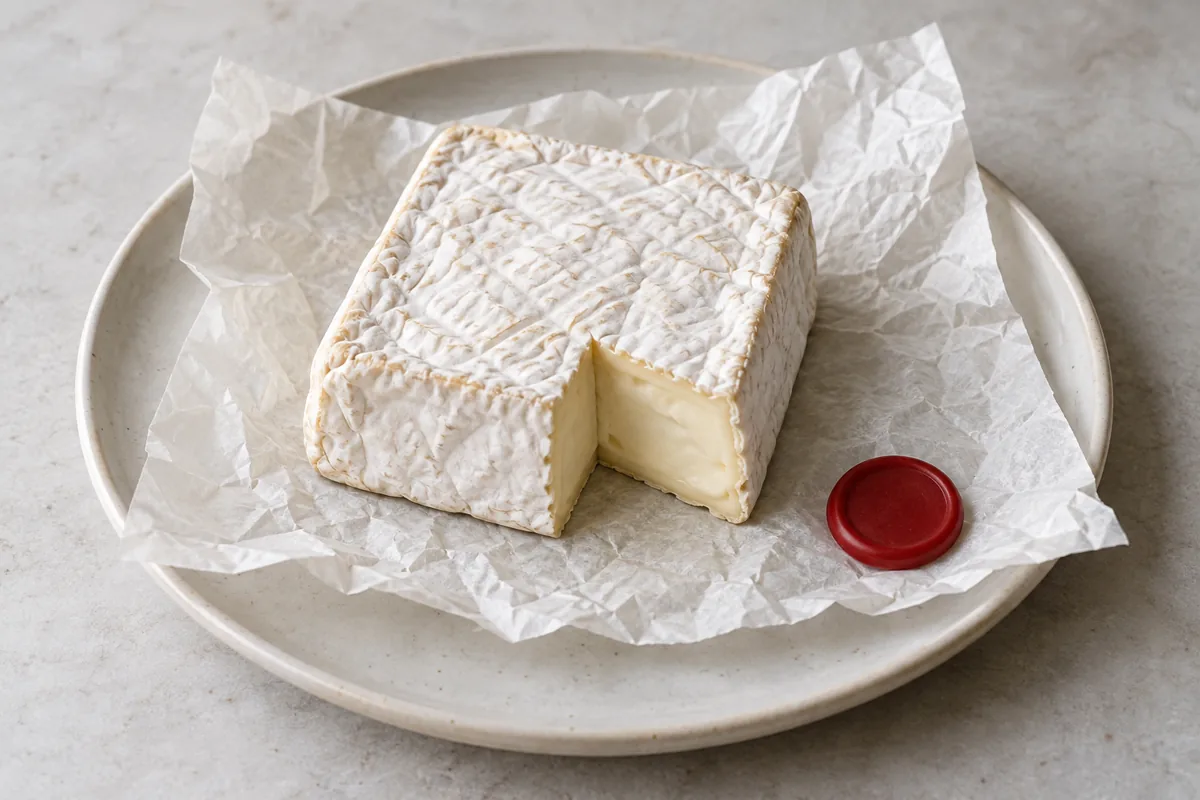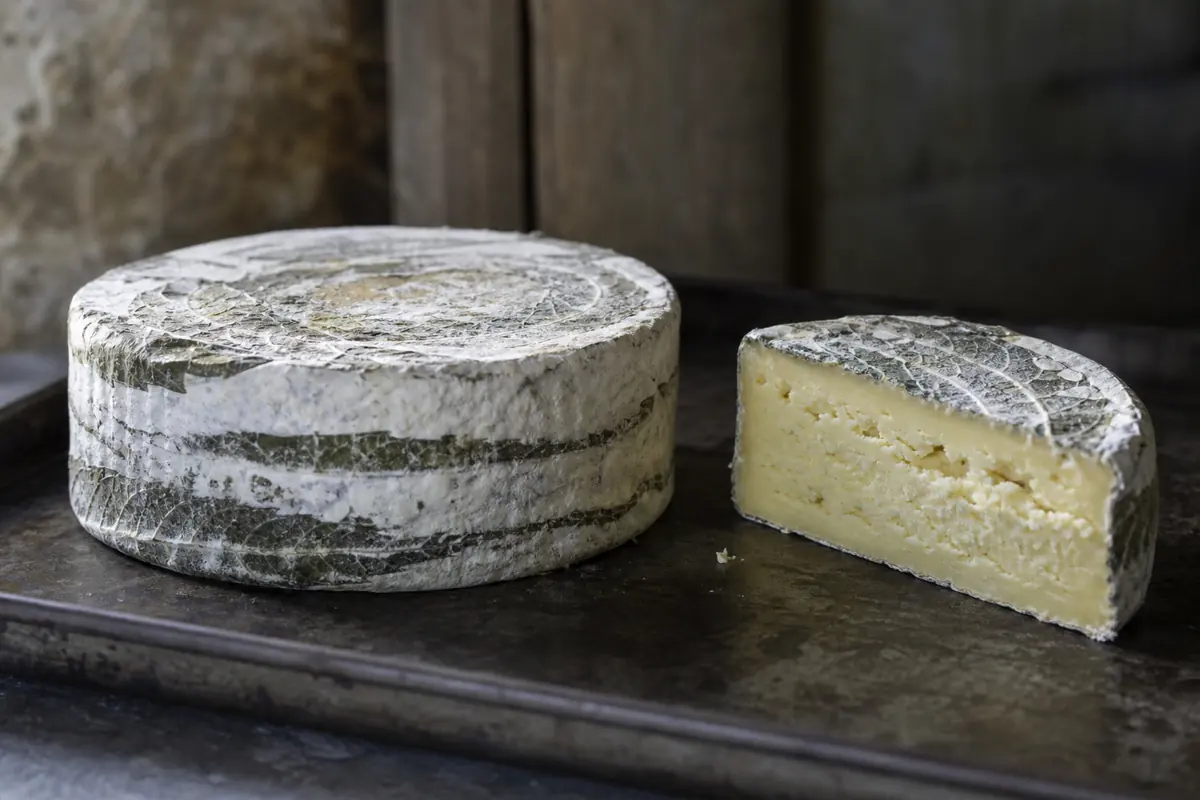
Cornish Yarg is a semi-hard cheese made from pasteurized cow's milk and wrapped in nettle leaves. Its maker, Lynher Dairy in Cornwall, calls it a Caerphilly-style cheese, and white moulds grow over the leaves during a ripening of about 4 to 6 weeks.
You can eat the leaf rind: the dairy describes it as an edible rind, and the nettles have lost their sting before they go on the cheese.
Lynher Dairy says it is the only maker of Cornish Yarg. The same dairy also makes Wild Garlic Yarg, Cornish Kern and Stithians, which are separate cheeses.
In This Article
What Is Cornish Yarg?
Culture magazine lists the United Kingdom as the country of origin and names Catherine Mead as the maker at Lynher Dairies. Neal's Yard Dairy also names her and places the dairy in Ponsanooth, Cornwall.
The name Yarg is Gray spelled backwards, after the farmer Alan Gray. Neal's Yard Dairy says Gray found a 17th century recipe for nettle-wrapped cheese in his attic in the 1980s and set about recreating it.
Sources disagree on how old that recipe is. Lynher's Yarg shop page says 16th century, Neal's Yard Dairy says 17th century, and Culture magazine dates the roots of the recipe to the 13th century.
The sources agree more closely on the cheese itself. Neal's Yard Dairy says Gray invented it in the 1980s, Culture says the nettles and the name arrived in 1983, and Lynher's shop page places the start of Cornish Yarg with Gray in 1984.
Whichever century the attic recipe dates from, the sources place the cheese in the 1980s, so the older dates describe the recipe's roots and say nothing about how long Yarg has been on sale.
Culture magazine says the recipe combines Wensleydale cheesemaking and Caerphilly processes.
Why Is Cornish Yarg Wrapped in Nettles?
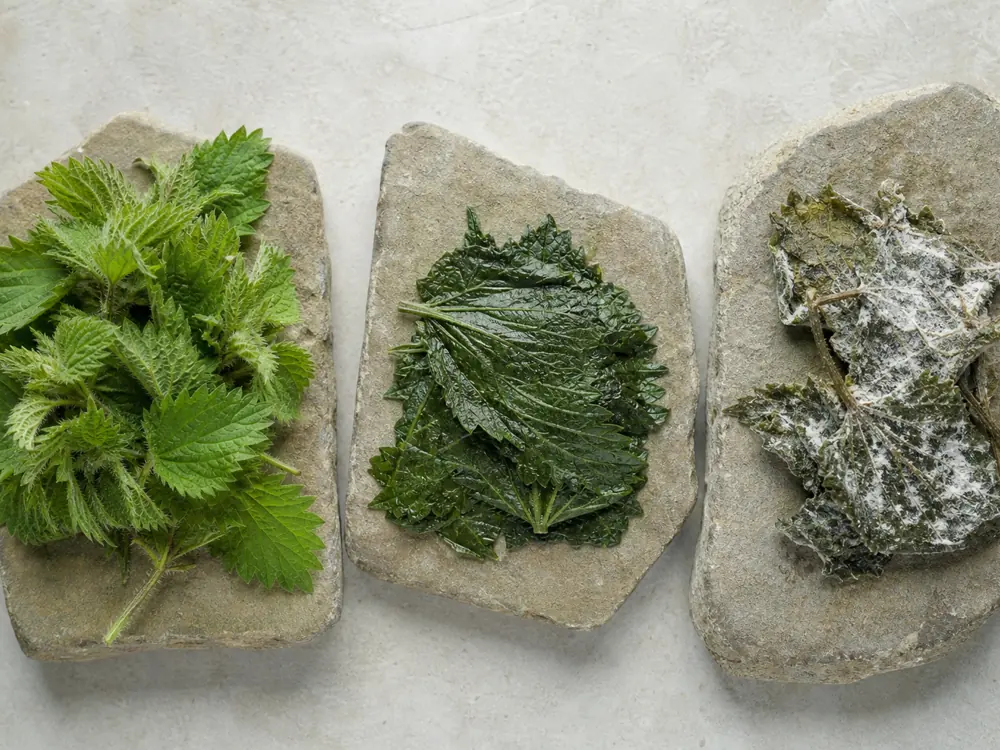
Lynher Dairy wraps Yarg in the young nettle leaves of spring. It says they are not always easy to find, and that it picks them from favourite patches in woodlands it manages sustainably.
Culture magazine says the nettles are collected during May from the hedgerows around the dairy, and Neal's Yard Dairy also names local hedgerows, so the sources describe both woodland and hedgerow picking.
Neal's Yard Dairy says the leaves are foraged each spring and frozen so they can be used throughout the year. That freezing lets leaves picked in spring wrap cheeses made in other months, and Lynher Dairy's FAQ says it carries most of its cheeses in stock all year.
Culture magazine says the leaves are either steamed or frozen, and that either treatment removes the sting. Lynher Dairy says it picks and freezes them, and that by the time they are brushed on, following a traditional pattern of concentric circles, the sting has left.
The dairy says each of its nettlers has a style that the other nettlers can recognise.
Culture magazine adds that each leaf is dipped in a sterilizing solution and that the leaves go on when the cheese is two days old, at about ten minutes per cheese.
According to the dairy, nettle leaves attract naturally occurring moulds, which raise the pH of the cheese and break down the curd. The leaves are also permeable, so air moves in and out.
The dairy says the curd starts crumbly and turns smoother as the nettles do their work.
How Is Cornish Yarg Made?
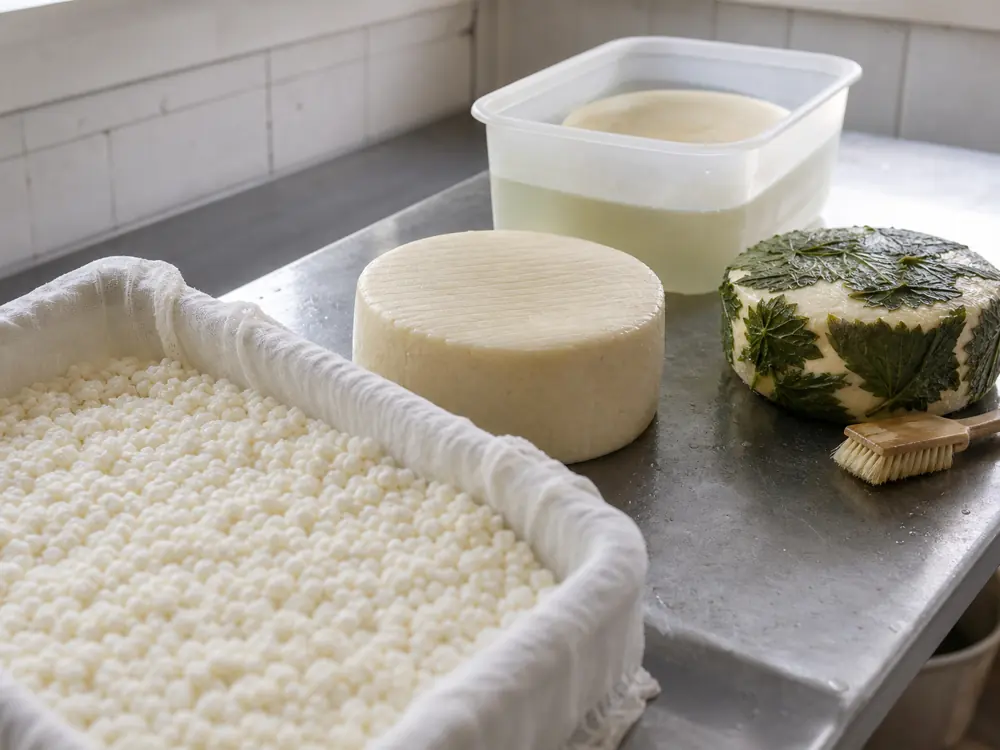
The dairy pasteurizes the milk, adds a ripening culture and a rennet, and times the set carefully. It then cuts and stirs the curd until each piece is as small as a grain of rice, which the dairy says increases acidity and fermentation.
Culture magazine says the milk comes from the dairy's own herd, and Neal's Yard Dairy says the animal-rennet Yarg it sells is made solely from the milk of the dairy's own Ayrshire cows.
Neal's Yard makes that statement for the animal-rennet version it sells.
The dairy describes the rest of the make in this order.
- Block and mill the curd, then pack it into moulds by hand.
- Press the cheese.
- Immerse it in brine overnight.
- Let it dry, then paint the leaves on by hand.
- Mature it, turning each cheese by hand until it is ready.
How Long Does Yarg Ripen, and What Changes?
Sources give different ripening times for leaf-wrapped Yarg, and one of them gives two ages. The table lists each one as written.
| Source | Time given | As written |
|---|---|---|
| Lynher Dairy, Cornish Yarg shop page | 4 to 6 weeks | Listed as maturation |
| Lynher Dairy, how it makes its cheese | About 4 to 5 weeks | Leaf-wrapped Yarg |
| Lynher Dairy, nettle-wrapped cheese page | Six weeks | From field to finish |
| Culture magazine | 4 to 8 weeks | After the nettles go on |
| Neal's Yard Dairy | 21 to 28 days at the dairy; average age 2 to 3 months | Animal-rennet version sold by the retailer |
Lynher's own pages differ by about two weeks, and the shop page's 4 to 6 weeks covers all three of them. Culture magazine's 4 to 8 weeks runs longest of the figures given in weeks.
Neal's Yard Dairy gives a different kind of figure: it says the cheese matures at the dairy for 21 to 28 days before it ships ready to sell, and its listing gives an average age of 2 to 3 months for the version it sells.
The listing does not say where the extra weeks pass, and it covers only the animal-rennet version. For a buyer, that makes the age the seller states the figure to use, because the sources give no single age for every Yarg on sale.
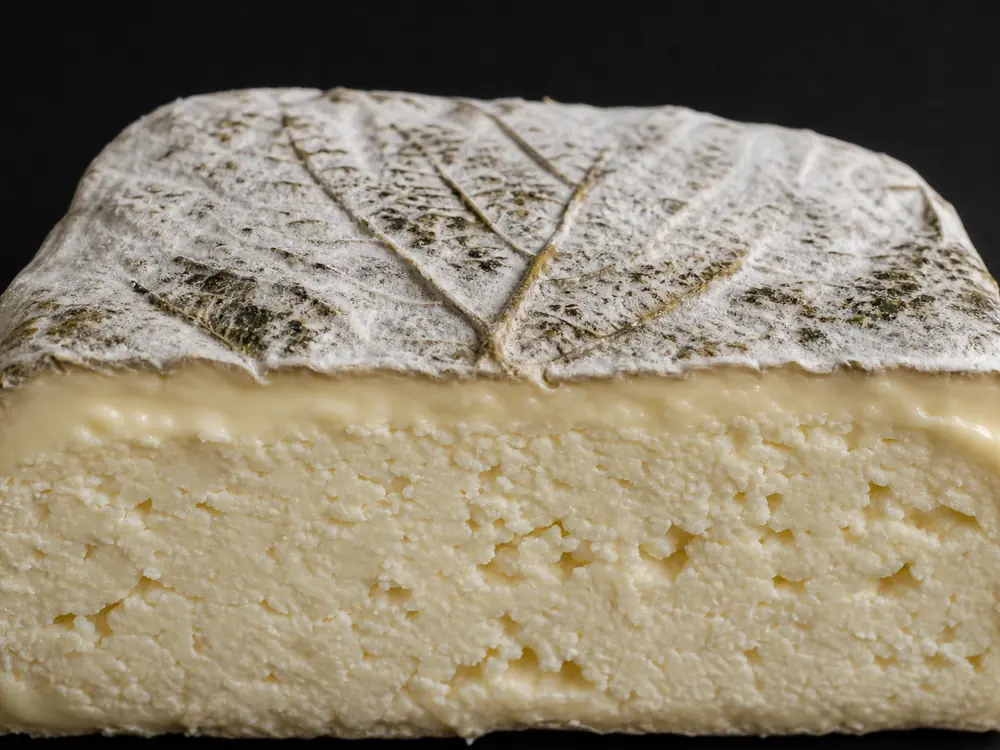
Because the leaves go on so early in the make, almost all of these weeks pass under them. By the end, the dairy says the leaves carry a dusting of bloomy white moulds.
The dairy describes a slightly open, crumbly core with a creamy layer under the rind as the cheese matures, and Culture magazine describes the paste as firm and slightly crumbly with occasional holes or slits.
Lynher Dairy and Culture magazine describe the flavour in similar terms.
- Lynher Dairy's Yarg shop page: delicate, lactic and mushroomy aroma; lactic, creamy, buttery, delicate but complex flavour.
- Lynher Dairy's nettle page: a fresh mushroomy taste with a crumbly core.
- Culture magazine: clean and lactic, with sweet, delicate notes of mushrooms, earth and cellar, and a pleasant tang.
Can You Eat the Nettle Rind?
Yes: Lynher Dairy describes the white-moulded nettle covering as an edible rind.
The dairy says it wants taste from its natural leaf rinds, from the outer layer to the very core, and that nettles give a delicate, mushroomy flavour.
Neal's Yard Dairy describes the rind as delicately earthy, giving way to a buttery breakdown and a crumbly core with notes of lemon and yoghurt.
That order bears on trimming: cutting the rind off removes the layer Neal's Yard calls earthy, while the dairy's account has the leaves' flavour reaching the core as well.
None of the sources gives a rule on trimming the rind, so removing it is a matter of taste. A thin slice that includes a little rind lets you compare the mushroomy edge with the lactic core before you decide.
How Is Cornish Yarg Different From Related Cheeses?
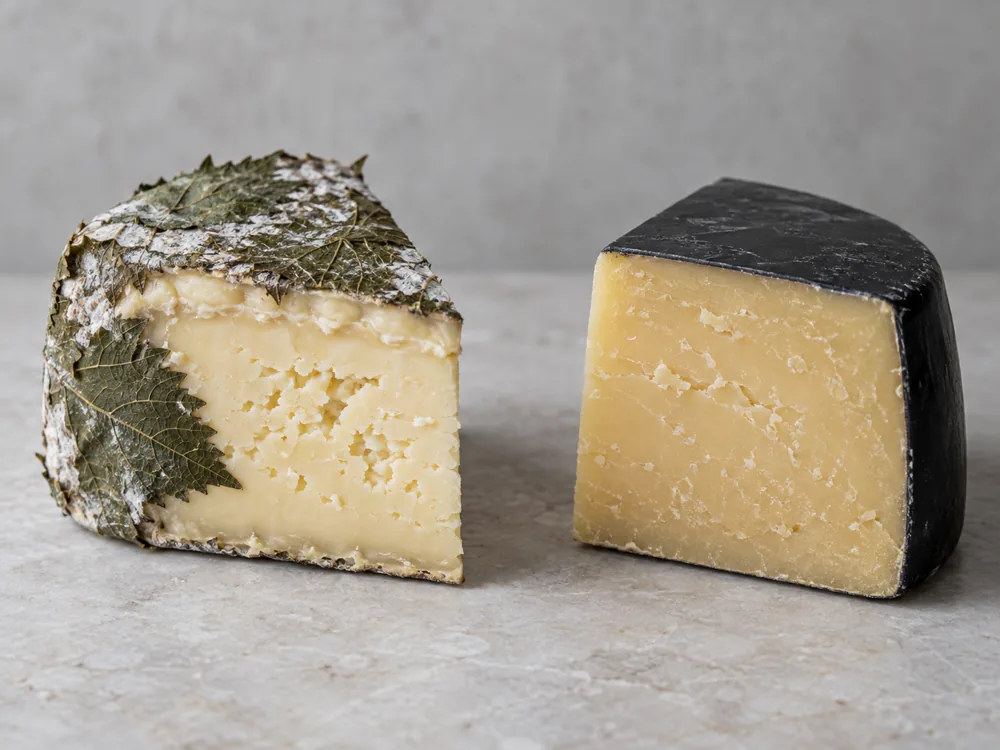
Lynher Dairy makes four cheeses, and only Cornish Yarg wears nettles. Wild Garlic Yarg starts out as the same cheese, but the dairy says the choice of leaf governs how the cheese matures and tastes.
Garlic leaves are less permeable than nettles, so the dairy says less moisture escapes and the texture is firmer, and they are anti-microbial, so they attract less mould. The leaves also change the look: white bloom appears on the nettles during ripening, while the wild garlic darkens in colour.
The dairy describes the garlic flavour as more pungent than the nettles' and says it is nothing like cheeses made with bulb garlic, calling it subtle yet complex. It picks wild garlic only while the leaves are freshest, and says the white flowers mark the end of that picking season.
| Cheese | Covering | Maturation |
|---|---|---|
| Cornish Yarg | Nettle leaves | 4 to 6 weeks (shop page) |
| Wild Garlic Yarg | Wild garlic leaves | About 4 to 5 weeks for leaf-wrapped Yarg (making page) |
| Cornish Kern | Black wax paint | 16 to 22 months |
| Stithians | White wax | 6 to 9 months |
Kern follows a different recipe: the dairy adds Alpine starter cultures that help develop its flavour over time, and the scalding of the curds gives what it calls burnt caramelised notes.
Once Kern's curds are moulded they are pressed, brined and coated in black wax paint. Stithians is dry salted instead of brined before its white wax paint.
Is Cornish Yarg Vegetarian?
Lynher Dairy's shop page and FAQ say Cornish Yarg and Wild Garlic Yarg are suitable for vegetarians, and Culture magazine lists the rennet as vegetable.
Neal's Yard Dairy adds a caveat: most of the Cornish Yarg Lynher makes uses plant-based coagulant, but the dairy makes an animal-rennet version specially for Neal's Yard, and that listing's ingredients name animal rennet.
The dairy's FAQ also says Stithians and Kern are made with a traditional rennet and are not suitable for vegetarians.
The name Cornish Yarg therefore covers more than one recipe, and the ingredient list at the point of sale is the document that shows which one is in the shop.
The dairy's own Cornish Yarg and Wild Garlic Yarg are suitable for vegetarians. The Yarg Neal's Yard Dairy sells uses animal rennet, so the seller's ingredient list decides.
How Should You Serve Cornish Yarg?
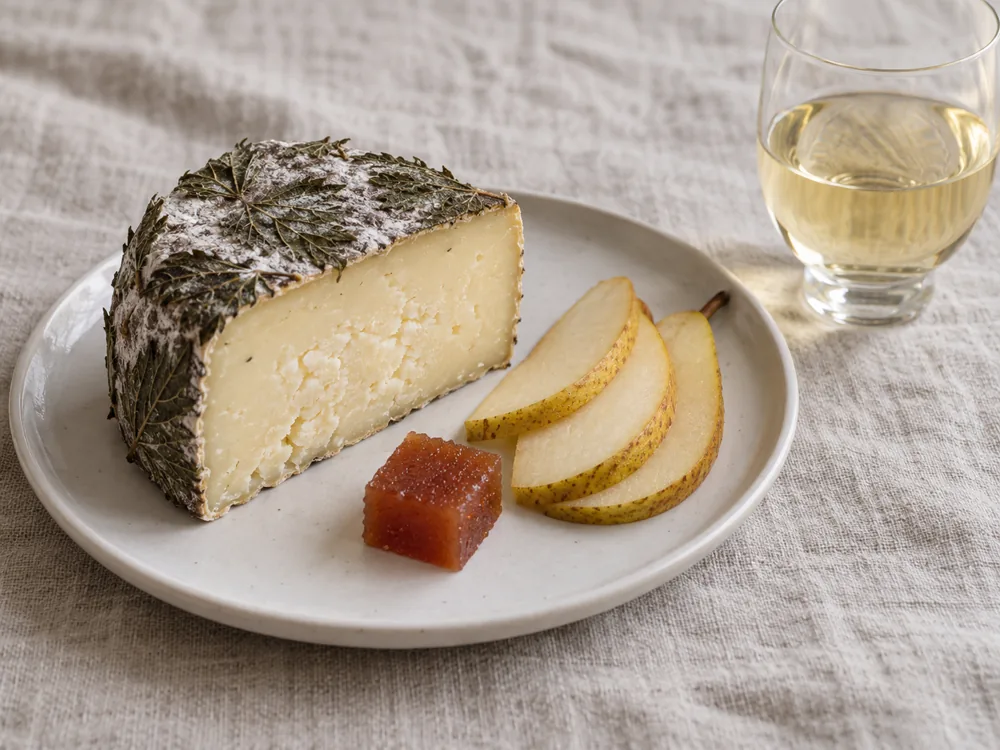
Lynher Dairy says to serve Yarg at room temperature. For flavours, it suggests pears, quince and a fruity white wine such as Riesling.
| Pairing | Type | Why It Works |
|---|---|---|
| Pears | Food | Named by Lynher Dairy on the Yarg shop page. |
| Quince | Food | Named by Lynher Dairy on the Yarg shop page. |
| Riesling | Wine | Lynher Dairy suggests a fruity white wine such as a Riesling. |
The dairy's product pages offer no cooked dishes for Yarg, so the pairings above are the serving ideas the sources support.
What Sizes Does Cornish Yarg Come In?
Lynher Dairy sells whole truckles of Cornish Yarg at 900 g, 1.6 kg and about 3.2 kg, and its FAQ gives the diameter and height of each.
| Source | Weight | Diameter and height |
|---|---|---|
| Lynher Dairy FAQ | 900 g | 14 cm across, 10 cm high |
| Lynher Dairy FAQ | 1.6 kg | 18 cm across, 8 cm high |
| Lynher Dairy FAQ (3.3 kg on the shop page) | 3.2 kg | 26 cm across, 8 cm high |
| Culture magazine | 8 lb (about 3.6 kg) | 10 to 12 in across (about 25 to 30 cm), 4 in high (about 10 cm) |
| Neal's Yard Dairy, whole | 3,970 g to 4,621 g | Not given |
The dairy says the cheeses are handmade, so sizes vary slightly, which fits the 3.3 kg on its shop page and the 3.2 kg in its FAQ for the largest truckle. Its FAQ lists Wild Garlic Yarg only at 900 g and 1.6 kg.
Culture's 8 lb and Neal's Yard's wholes of roughly 4 kg to 4.6 kg are larger than the dairy's biggest truckle, so the word whole does not mean the same weight at every seller.
Neal's Yard Dairy also sells cut portions, from a sixteenth at 245 g to 289 g up to a half at 1,985 g to 2,311 g, while the dairy's smallest truckle is 900 g.
How Should You Buy and Store Cornish Yarg?
On its own shop, Lynher Dairy gives whole truckles a use-by of at least 4 weeks from despatch date, and it recommends turning a truckle once a week to prevent a soggy bottom. Its FAQ gives delivered whole truckles a use-by of 6 weeks, so the two pages state different figures and the shop page gives the minimum.
The dairy's advice for keeping Yarg is to wrap it in wax paper. Once a piece is cut, it says to enjoy it within 10 days.
That 10 days starts at the first cut, so size sets the pace. Dividing the dairy's weights by 10 days gives about 90 g a day for a 900 g truckle and about 320 g a day for a 3.2 kg one, our arithmetic from the dairy's figures.
The dairy's FAQ says orders go by next-day courier, packed with a cool block in an insulated box, and that a delivery date can be requested up to 3 months ahead.
The CDC says to keep a refrigerator at 40°F (4°C) or below.
What Should You Know About Milk and Safety?
Lynher Dairy lists Cornish Yarg as made from pasteurized cow's milk and suitable for vegetarians. Its allergy advice says the cheese contains cow's milk.
The NHS lists pasteurised edam and other pasteurised semi-hard cheeses as safe in pregnancy. It says pasteurised or unpasteurised mould-ripened soft cheeses with a white coating on the outside, such as brie, camembert and chèvre, must be thoroughly cooked.
Neither the NHS nor the CDC names Yarg, a pasteurized semi-hard cheese with white mould on its rind, so their pregnancy cheese lists do not settle which group it belongs to.
The CDC lists soft cheese from unpasteurized milk as riskier and hard cheese made with pasteurized milk as safer. It also says pregnant women are 10 times more likely to get a Listeria infection.
SOURCES & REFERENCES
Cornish Yarg FAQ
No. Lynher Dairy says it picks and freezes the nettles, and the sting has left them by the time they go on the cheese.
Yes. Lynher Dairy describes the white-moulded nettle covering as an edible rind.
Lynher Dairy's Yarg shop page gives 4 to 6 weeks. Culture magazine gives 4 to 8 weeks, and Neal's Yard Dairy lists an average age of 2 to 3 months for the version it sells.
Lynher Dairy says its Cornish Yarg is suitable for vegetarians. Neal's Yard Dairy sells a version made with animal rennet, so the answer depends on the seller's version.
Lynher Dairy's truckles weigh 900 g, 1.6 kg and about 3.2 kg, and other sellers list larger wholes.
No. Wild Garlic Yarg uses wild garlic leaves instead of nettles, and the dairy says the leaves govern how each cheese matures and tastes.
Lynher Dairy in Ponsanooth, Cornwall, which says it is the only maker of Cornish Yarg.