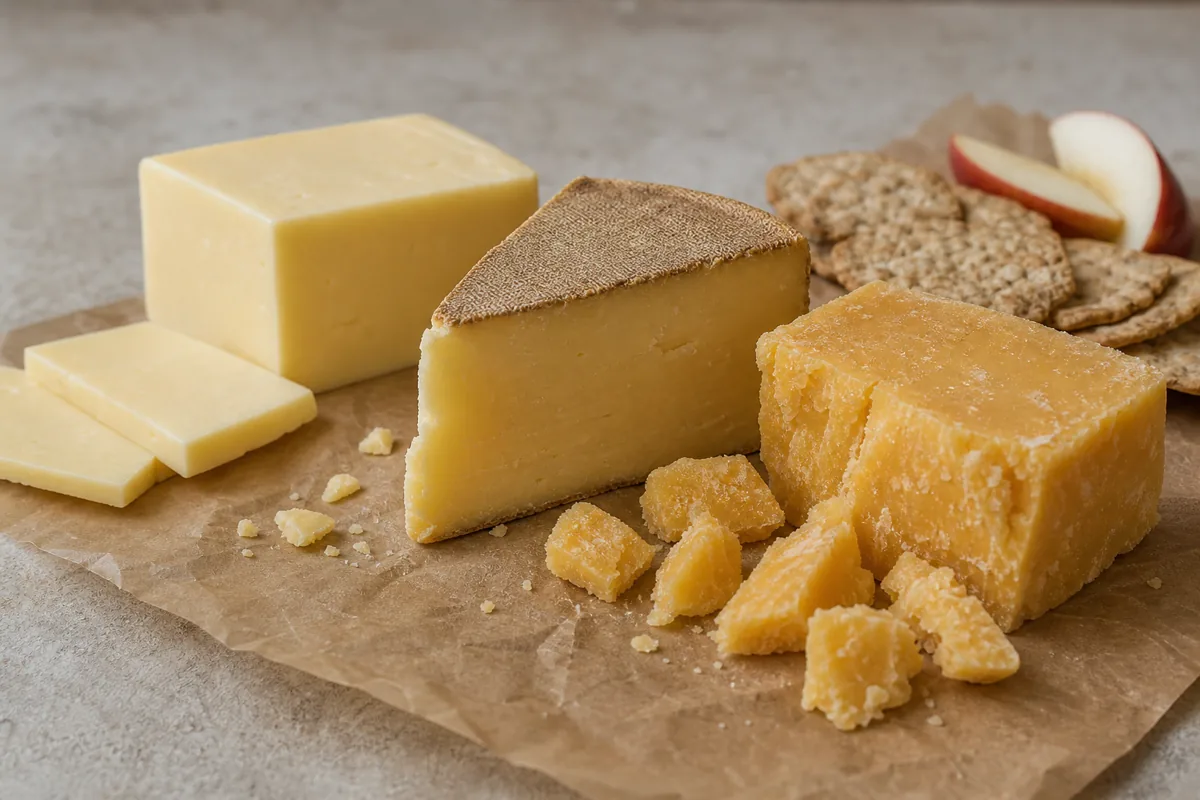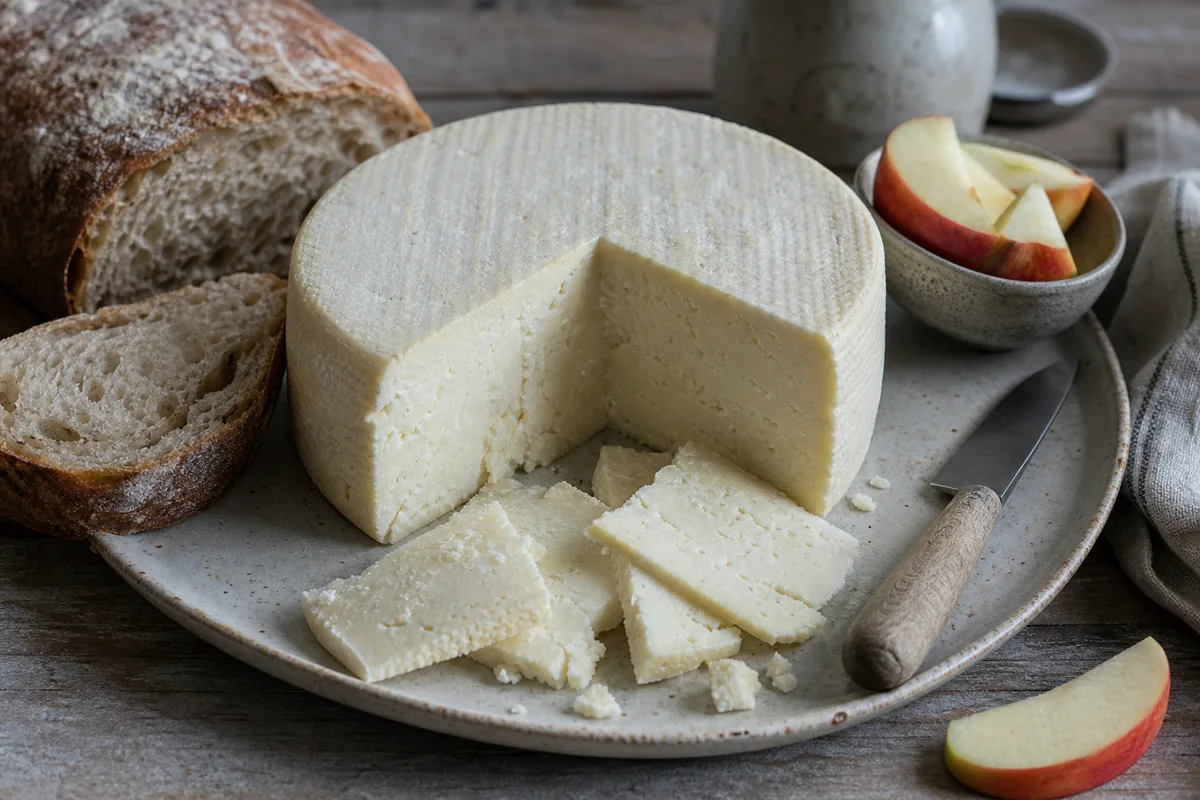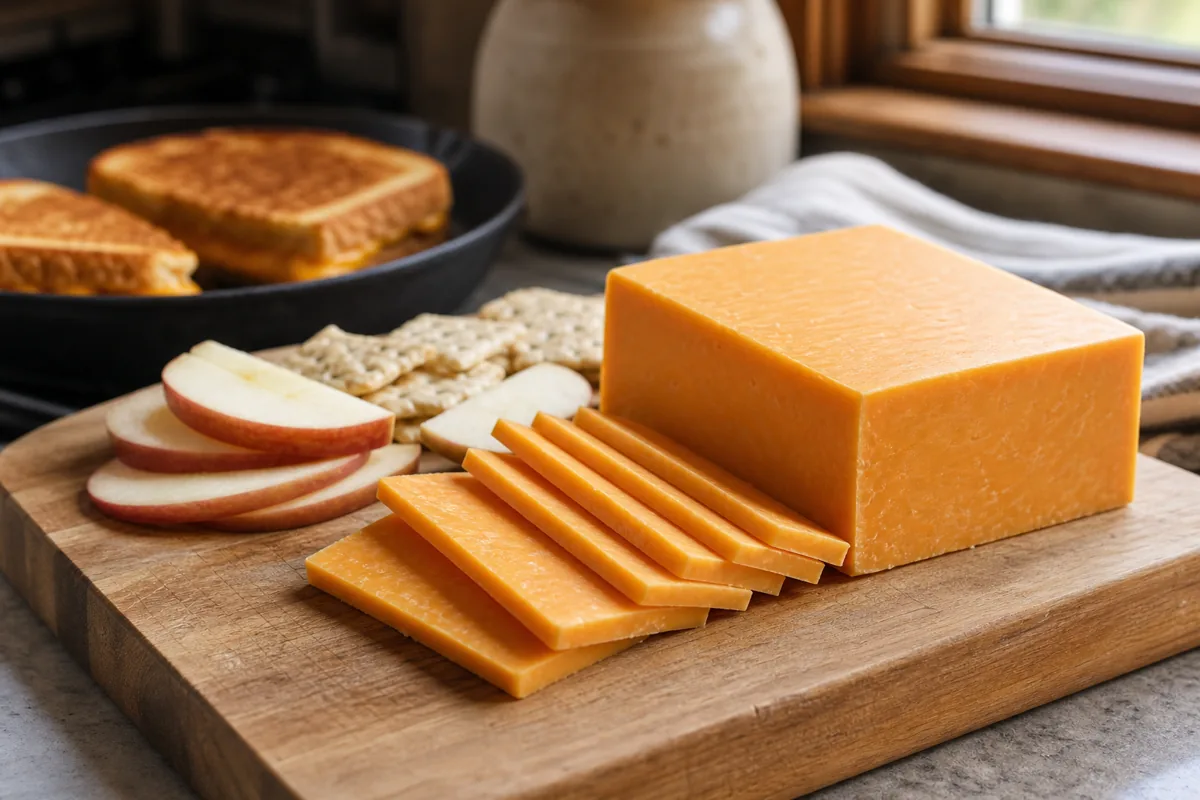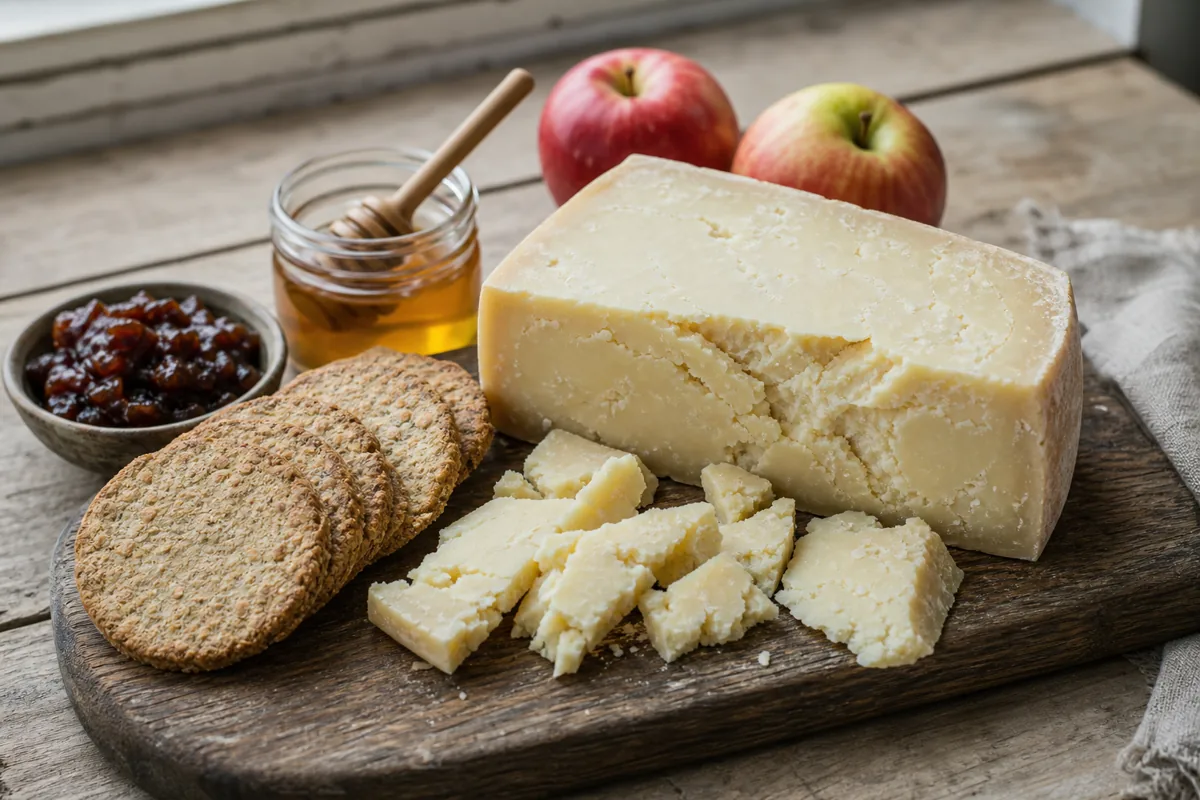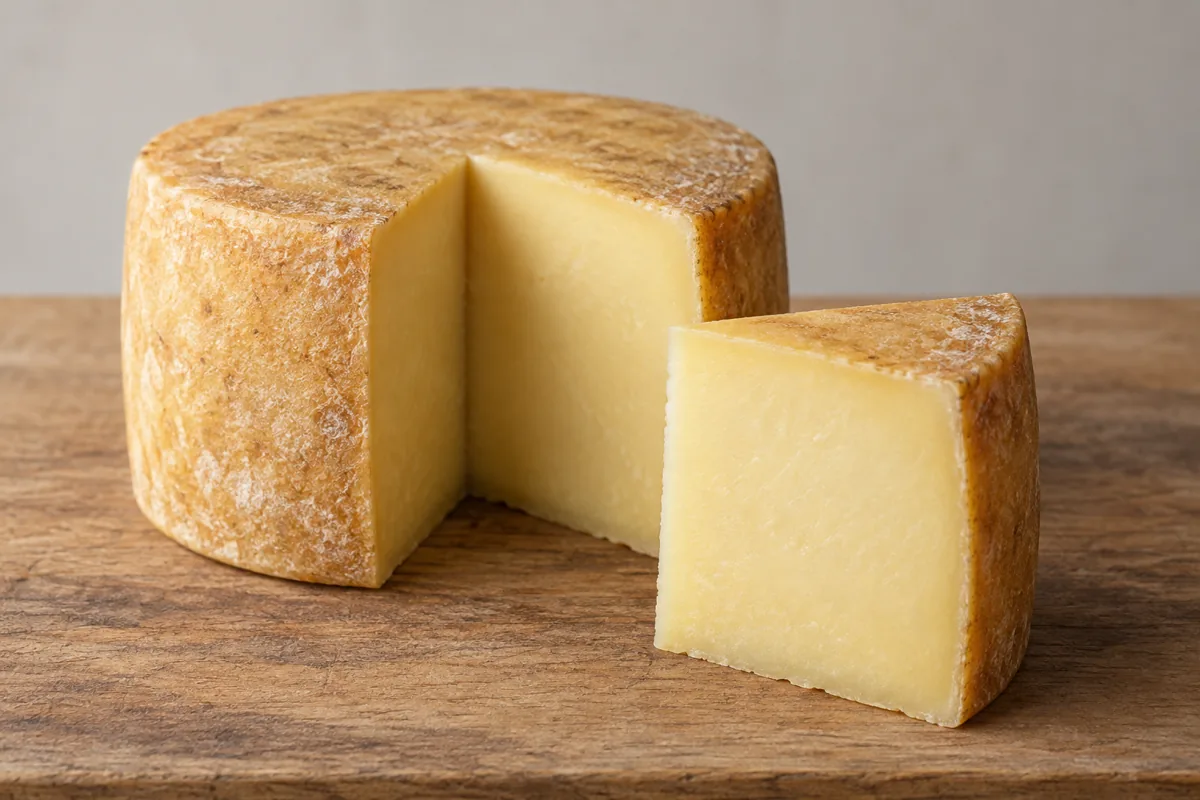
Dunlop is a mild Scottish cow's milk cheese from the village of Dunlop in East Ayrshire. Sources describe it as sweet and buttery, with a texture close to a soft cheddar.
The name covers two products: the protected Traditional Ayrshire Dunlop made around the old parish of Dunlop, and plain Dunlop, which Cheese.com says has become a generic name that other makers can use.
In This Article
What Is Dunlop Cheese Made From?
Dunlop is made from whole cow's milk, which is what set it apart from the cheese Scottish farms made before it. The PGI specification says that earlier cheese was a poor-keeping skimmed-milk cheese, made from the by-product of butter making.
The specification names the Ayrshire cow and says its milk has smaller fat globules than other breeds, so the fat mixes into the curd more easily. Larger globules, it adds, tend to be pressed out into the whey, which would leave the cheese short of the full fat it needs.
Milk treatment is where sources disagree. The specification allows raw or pasteurised milk, though the method it sets out pasteurises the milk; Wikipedia and The Cheese Lady list Dunlop as pasteurised, and CooksInfo describes it as made from raw milk.
Slow Food UK says Ann Dorward traditionally made her Dunlop with raw milk, but that Environmental Health rules make this increasingly challenging, and it describes her cheese as mostly but not exclusively made with pasteurised milk.
Rennet is also not uniform: The Cheese Lady and Cheese.com list vegetarian rennet, while Slow Food UK applies the same "mostly but not exclusively" to Dorward's vegetarian rennet.
Older names for the cheese say the same thing about the milk: CooksInfo says it was called Sweet Milk Cheese, meaning cheese from unskimmed milk, and Slow Food UK describes Gilmour's cheese as a sweetmilk cheese.
What Does Dunlop Taste and Feel Like?
The table sets each source's wording side by side. Texture is where they differ most, from Cheese.com's crumbly and firm to the moist, smooth or fudgy paste described by the specification, Slow Food UK and Fromage Homage.
| Source | Texture | Colour | Flavour |
|---|---|---|---|
| PGI specification (Defra) | Body moderately firm; smooth, close and slightly springy when young; drier with age | Natural pale yellow | Very mild and nutty when young; nutty, creamy notes with age |
| Slow Food UK | Hard-pressed, not unlike cheddar but more moist; harder as it matures | Not stated | Nutty when young; a slight sharpness when mature |
| Wikipedia | Semi-soft when young, fudgey or hard after a few months | Not stated | Mild, sweet and buttery |
| Cheese.com (Dunlop entry) | Crumbly and firm | Not stated | Buttery, nutty and sweet; mild and slightly tangy |
| The Cheese Lady (retailer) | Firm, creamy and cheddar-like | Not stated | Buttery, slightly tangy and earthy, with the sweetness of fresh milk |
| Fromage Homage (blog, one slab) | Fudgy | Buttercup yellow | Mild and sweet, without cheddar's sharpness; a slightly fruity aftertaste |
Colour has a smaller gap. The specification says natural pale yellow and credits the Ayrshire milk, and one blogger described a slab as buttercup yellow.
The specification's own characteristics list is less uniform than its description: it gives the paste's appearance as milky white and slightly open, beside a natural pale yellow colour and a smooth, close texture.
For the moist, close cut face, the specification credits the cheese's high moisture, an average of 39 to 44 percent, and says the smaller fat globules and the local grass help the cheese hold moisture better than other cheese types. The same document puts the milk's butterfat at 3.9 to 4.4 percent.
The youngest cheese is the mildest, the specification says, and stronger flavours develop as it ages.
The Fromage Homage writer ate a slab matured for at least six months and noted a milky, musty smell from the cloth rind and a slightly fruity aftertaste, a bit like chutney. That is one tasting, not a rule for every wheel.
Where Did Dunlop Cheese Come From?
The PGI specification dates the cheese to around 1690, when Barbara Gilmour brought the recipe back from Ireland, where she had been temporarily exiled, and settled in the village of Dunlop. Slow Food UK gives the same year.
Wikipedia's biography of Gilmour says she went into exile in Ireland as a Presbyterian around 1660, and that she returned after the 1688 Revolution and married John Dunlop of Overhill Farm. A second account in the same article sends her to County Down after the martyrdom of Margaret Wilson on Wigtown Sands in 1684 or 1685.
Introducing whole-milk cheese was not easy. Wikipedia says some locals, adamant that cheese could not be made from whole milk, came close to accusing her of witchcraft.
CooksInfo gives 1688, the Wikipedia article on Dunlop cheese puts her success in the early 18th century, and farmer W. Aiton argued that cheesemakers already knew about adding cream and that the name came from a trader who carried the parish's cheese to Glasgow. Others doubt the Irish origin of the recipe without disputing that she introduced Dunlop.
Her neighbours copied the method, and Wikipedia says it had spread across Scotland by the end of the 18th century, even where sheep's milk cheese had been the tradition. The 1837 Ayrshire Statistical Account records 25,000 stones imperial made in the parish annually.
Households were not the only buyers. Wikipedia's article on Gilmour says the army and navy bought her whole-milk type because skimmed-milk cheese tasted so poor that it caused dissent among soldiers and sailors.
By 1837, the same article says, some fourteen cadgers, the middlemen who bought cheeses on the farms and sent them to Glasgow, Edinburgh and other markets, made a living from the parish's cheese.
Slow Food UK reports William Cobbett rating it equal to any cheese from Cheshire, Gloucestershire or Wiltshire. The same page says the Ayrshire cow, first bred in the parish, was formerly known as the Dunlop cow.
The railways cut both ways in the sources. The specification says that from the middle of the 19th century they carried farm cheese to the Glasgow and Edinburgh markets, and that Dunlop's hard body let it travel when the area's soft cheeses could not.
Wikipedia says the same railways let farmers sell milk further afield, so less was left for cheese, and the specification says large industrial cheese units left small artisan producers almost extinct, with very little cheese made on farms by the Second World War. Slow Food UK adds the clearances and two world wars to the list.
Slow Food UK says local production had closed down completely by 1940. CooksInfo dates the stop to 1941, when UK cheesemakers were told to make only a standard Government Cheddar for the war effort, and says Dunlop tentatively began reappearing in Scottish shops in July 1954 after the rule was lifted.
Production stayed sporadic afterwards, and Wikipedia says that as of 2007 Dunlop was made at West Clerkland Farm near Stewarton and on Islay.
The Dorward family moved to Clerkland Farm in 1983, according to The Cheese Lady, and cheesemaking at Dunlop Dairy began in 1989, the year the specification gives for the revival of Traditional Ayrshire Dunlop. Fromage Homage says Ann Dorward decided Dunlop was the obvious cheese to make on a farm close to where Gilmour began.
What Does the Traditional Ayrshire Dunlop PGI Require?
CooksInfo says Dunlop Dairy applied for the name in March 2011, and Wikipedia says it has been registered since 2015 in the EU and, after Brexit, in the UK.
| Rule | What the specification says |
|---|---|
| Area | Made in an area around the traditional parish of Dunlop, bounded by roads linking Neilston, Lugton, Beith, Dalry and Stewarton |
| Milk | Whole milk of Ayrshire cows, raw or pasteurised |
| Other ingredients | Small quantities of starter culture, rennet and sea salt only |
| Paste | Natural pale yellow; a smooth, close surface that feels moist to the touch when cut |
| Shape and rind | Cylindrical, with a hard, thin, golden rind showing very slight mottling |
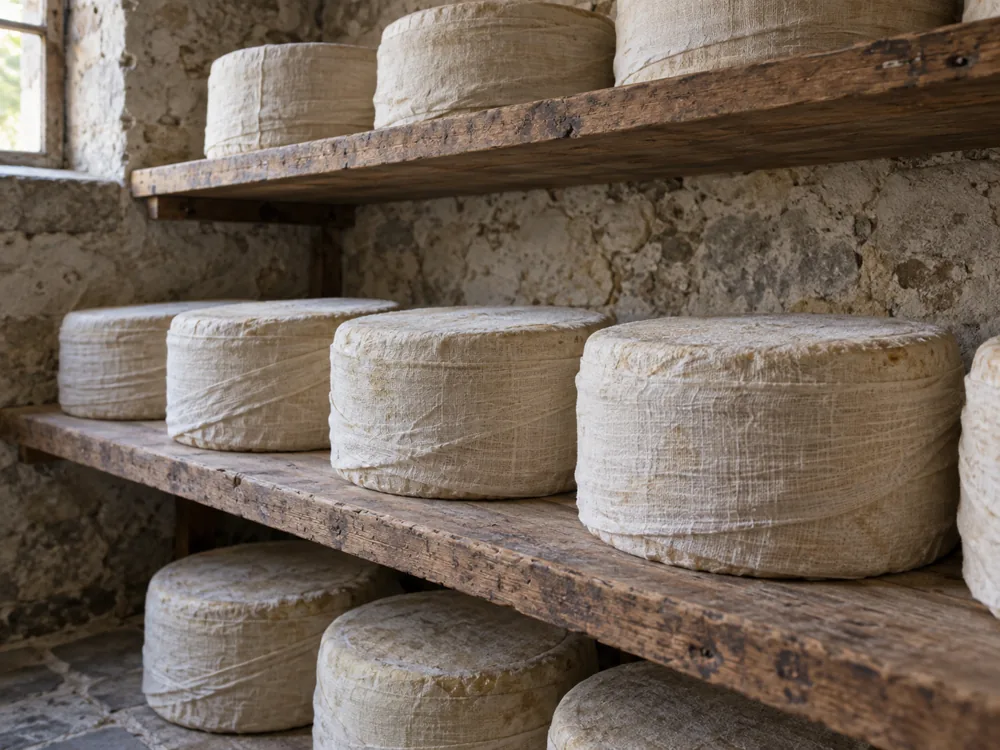
| Cloth and shelves | Wrapped in cloth bandages after pressing and matured on wooden shelves |
| Ageing | At least 6 months: mild 6 to 10, mature 10 to 12, extra mature 12 to 18; most popular at 10 to 12 |
| Salt | 1.6 to 1.8 percent in the finished cheese |
Dunlop Dairy at West Clerkland Farm applied for the name, and the specification says it was the only company making the cheese in the area, though any producer inside the area may use the name if it follows the rules.
The specification argues that place matters. It says the area's heavy clay and loam soils and mild, wet climate grow rich grass and clover for the Ayrshire cows, and that the damp air in the maturing store helps the cheese keep its moisture and stops it drying out.
It also says open vats, hand cutting, cloth bandages and wooden shelves give a rind that more modern methods would not, and it calls the cheese creamier, rounder in flavour and lighter in colour than other Dunlops.
Those are the applicant's claims, and no other source on this page measures them; the same document lists awards such as gold at the British Cheese Awards in 2001 and gold at the Nantwich International Cheese Show in 2005.
What Age of Dunlop Should You Buy?
Sources put different edges on the same cheese. The specification allows 6 to 18 months, CooksInfo says 6 to 12, Wikipedia's older account says six to twelve, and Slow Food UK says Dunlop is mild at 6 months and matures at 12 to 14.
Only the specification reaches past 14 months, so its extra mature class of 12 to 18 months has no counterpart in the other sources.
Weight explains why so much Dunlop is sold young. CooksInfo says producers like to sell it young because it loses weight as it ages.
Wikipedia's article on Gilmour says dealers in the 19th century, impatient with the weight lost during long maturing, usually retailed it before it was ripe and at an inferior price.
The Cheese Lady, which sells Dorward's cheese, says it is wrapped in cloth for a slow 6-month maturation, which falls in the specification's mild class.
The specification says a whole cheese's sewn label carries its date of production, so a buyer can count its age in months and place it in the mild, mature or extra mature class, while a vacuum-sealed wedge carries a label that describes the cheese.
How Is Traditional Ayrshire Dunlop Made?
The specification's method starts with whole milk and ends with a cloth-bandaged cheese on a wooden shelf.
- Milk: pasteurised at about 72°C for 15 seconds, the specification's own method, then cooled to 30°C.
- Starter and rennet: starter culture ripens for 1 hour, then rennet sets the milk for 40 to 50 minutes.
- Cutting: the curd is cut by hand with knives into quarter-inch cubes.
- Heating: the vat is raised to 38°C and stirred for 60 to 90 minutes before the curd settles.
- Turning the curd: whey is run off, the curd is cut and turned in slabs until its acidity reaches 0.55 to 0.65 percent, then put through a pegmill.
- Salting and pressing: sea salt is added by hand, about one kilo per 100 gallons of milk, and the curd is moulded and pressed overnight.
- Bandaging: the cheeses are scalded in hot water, wrapped in scalded cloth bandages and pressed again in the moulds.
- Ageing: next day they are dried off and set on wooden shelves in the cheese store.
The specification says scalding helps produce an even rind, while the bandages keep the shape, thin the rind and leave a cleaner appearance when the cloth comes off after ageing.
The turning of the curd slabs is the step Fromage Homage calls cheddaring: the blocks are cut, stacked and turned to release more whey and raise acidity before milling.
Wikipedia adds that salt from the Saltcoats saltpans, which contained magnesia and Epsom salts, was often used and gave the cheese a distinctive taste. It says people debated whether cheese made with cheaper imported mined salt could be called Dunlop.
Maturing is where sources pull apart. Slow Food UK and Wikipedia's older account both say the cheese must be kept in a dry place and turned upside down often.
Wikipedia's account gives the reason as a slight fermentation that heaves the top, while the specification credits the area's damp air for keeping the cheese from drying out.
Wikipedia's older account adds that Dunlop is soft and tasteless when turned out of the mould.
How Do You Serve and Cook With Dunlop?
Wikipedia says Dunlop is now valued for its use in various recipes and for eating on its own. The older records it quotes show two habits.
| Use | How It Works |
|---|---|
| Roasted on oatcake or scone | Wikipedia quotes an older account of Ayrshire families spreading roasted Dunlop on a farl of oatcake or a supple scone, with a bowl of milk, whey, tea or cold water, as a meal that often replaced bacon at breakfast. |
| Bread and cheese | Jessie Lewars, a friend of Robert Burns, recalled that his household usually had plenty of good Dunlop sent by Ayrshire friends, and that he would sit down to bread and cheese with a book by his side. |
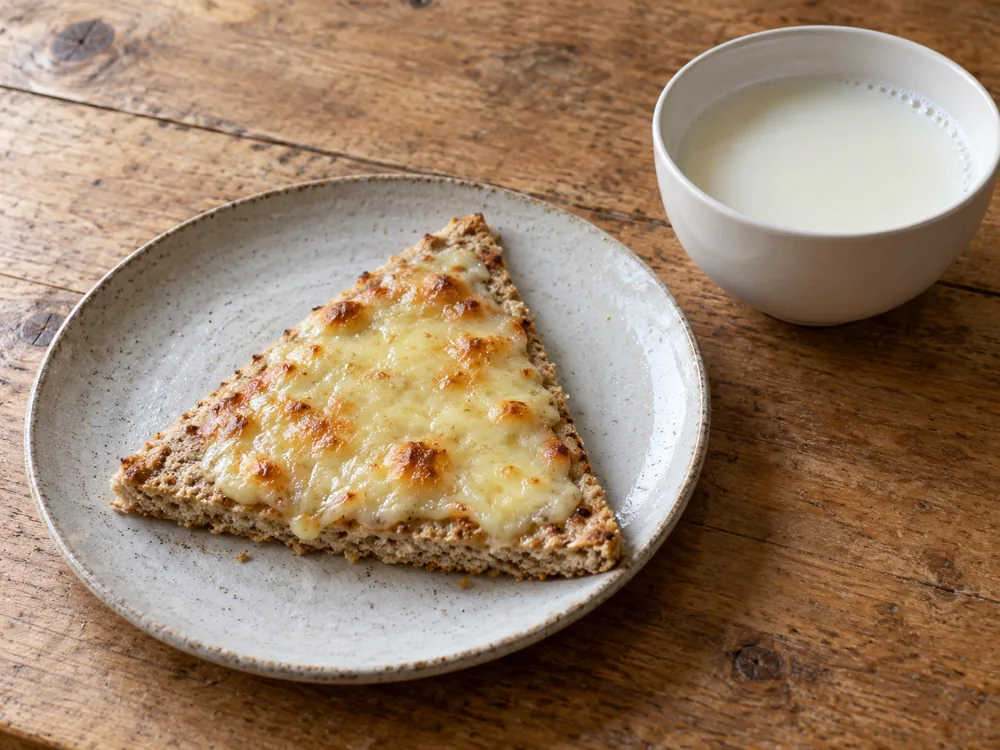
The same account says the high value set on Dunlop for roasting was very much confined to Ayrshire.
Drink advice comes mostly from retailers. The Cheese Lady's page pairs Dunlop with ales and craft beers.
For wine, the same shop names medium-bodied red wines and calls the cheese a match for complex reds.
| Pairing | Type | Why It Works |
|---|---|---|
| Whisky | Drink | Wikipedia says Dunlop is eaten with a dram of whisky. |
| Apple chutney | Food | The Cheese Lady's page lists a Bramley apple chutney among the products it recommends with the cheese. |
Dunlop vs Cheddar: What Do the Sources Say?
The sources that compare Dunlop with another cheese all pick cheddar. Wikipedia likens the texture to a soft cheddar, while Slow Food UK calls it more moist.
Fromage Homage calls it far more fudgy and without cheddar's sharpness, CooksInfo describes Gilmour's idea as making cheddar from whole milk, and Cheese.com's entry files Dunlop in the cheddar family as crumbly and firm.
Both sharpness claims come with an age: Fromage Homage's slab had matured at least six months, while Slow Food UK says a mature Dunlop develops a slight sharpness. An older wedge may therefore sit closer to cheddar than a young one, though no source tests that.
An 1866 writer quoted by Wikipedia recorded that Dunlop had to some extent been superseded by the Cheddar system of cheesemaking. Another passage in the same article says English eaters of the period took dry Cheddar raw with bread, mustard and a pot of beer, which it contrasts with the Ayrshire habit of roasting Dunlop.
The same article says that habit favoured dry cheddar and dry, salty American cheese because dryness and saltness heighten thirst and so the relish of the beer. It also names a business reason cheddar gained ground: dry, hard New Cheddar keeps its weight in stock and is ready to be shown in cuts sooner than Dunlop.
Buying Dunlop: Sizes, Labels and Prices
The specification gives the protected cheese three traditional sizes, each set by its mould.
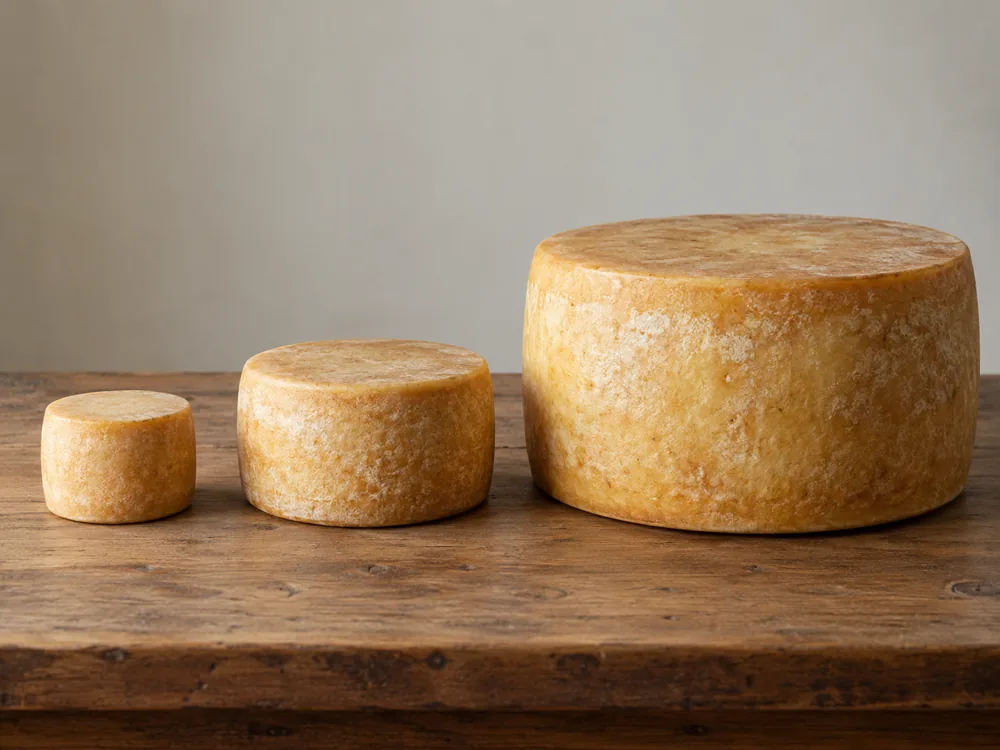
Pre-cut wedges are sold in vacuum-sealed pouches with a descriptive label, while whole cheeses are wrapped in cloth and then wax paper or sold in their natural state with the cloth left on.
The Cheese Lady lists Dunlop at £8.80 for a 200 g wedge, £16.75 for 400 g, £30.70 for 750 g, £52.70 for 1.3 kg and £100.55 for a 2.5 kg whole cheese, prices listed on its product page in October 2026.
Per kilogram, the same list falls from about £44.00 for the 200 g wedge to about £40.22 for the 2.5 kg whole cheese, by our arithmetic from those prices, which is roughly 9 percent less per kilogram.
The retailer's 2.5 kg whole cheese is lighter than the approximately 3 kg medium size in the specification; the sources say Dunlop loses weight as it matures.
Cheese.com also lists Smoked Dunlop, a variant smoked over beechwood, which the specification for the protected cheese does not mention.
Is Dunlop Safe During Pregnancy?
Neither the NHS nor the CDC names Dunlop. The NHS clears hard cheese made with either milk but only pasteurised semi-hard cheese, and the CDC prefers pasteurized milk, so a pasteurised piece is the safer reading; check the label.
The CDC adds that pregnant women are 10 times more likely to get a Listeria infection, which is why the milk statement matters when deciding which cheeses are safe in pregnancy.