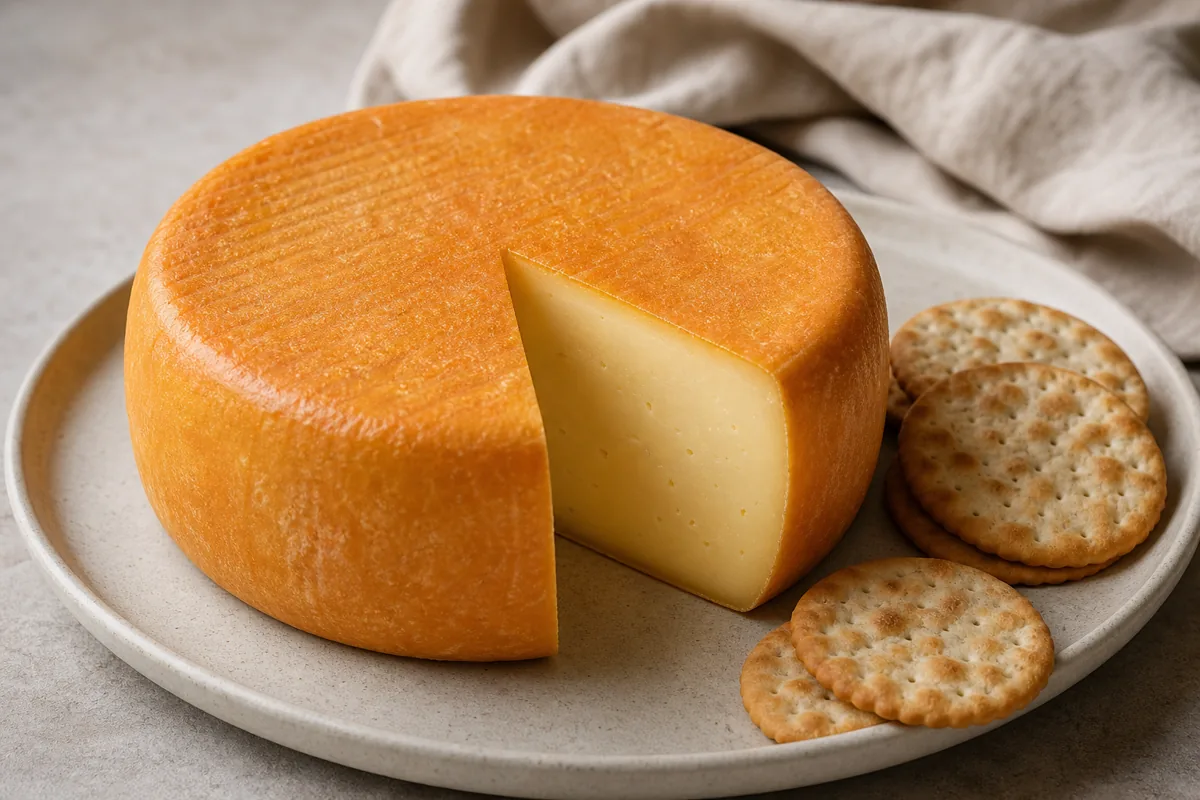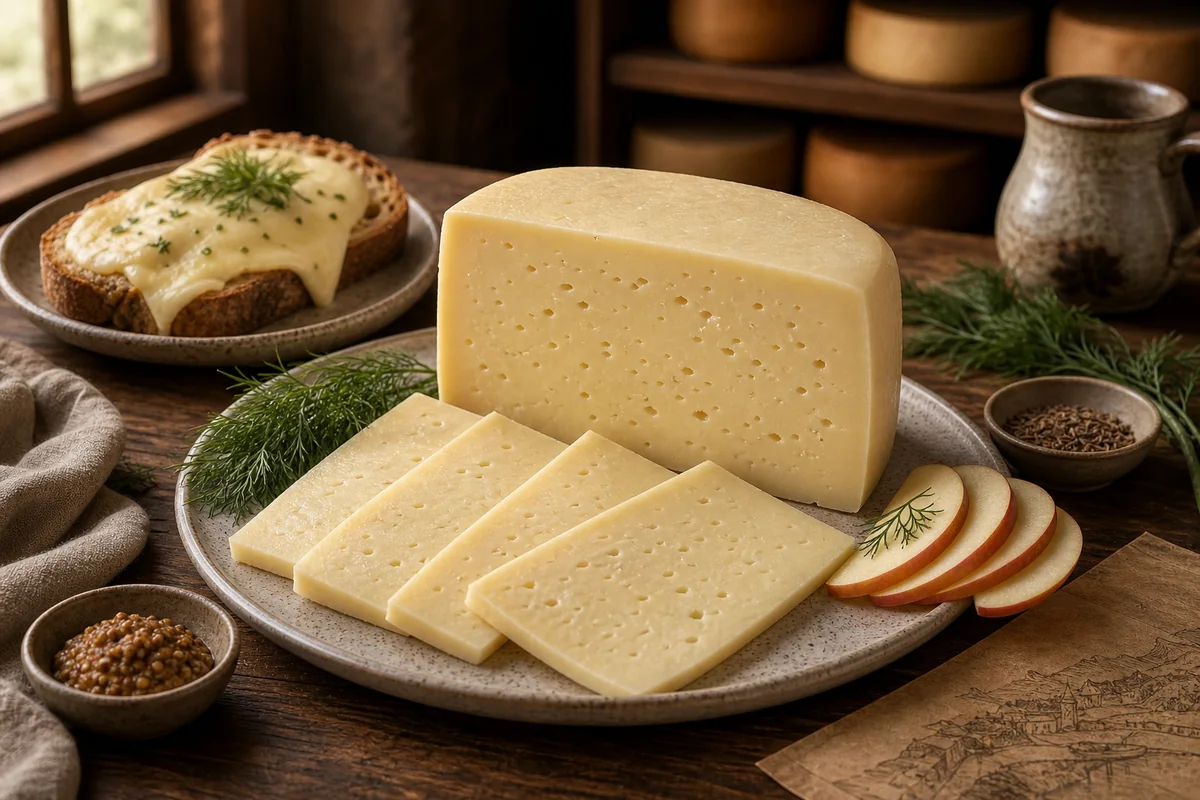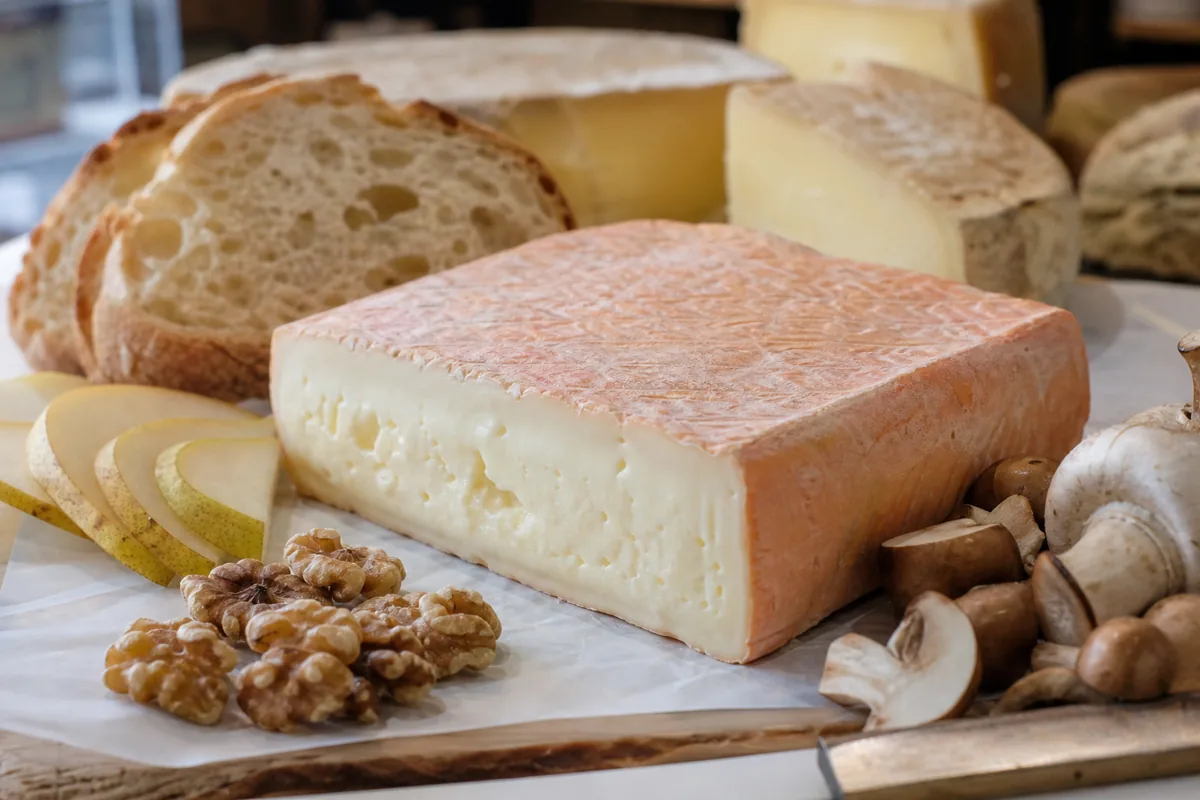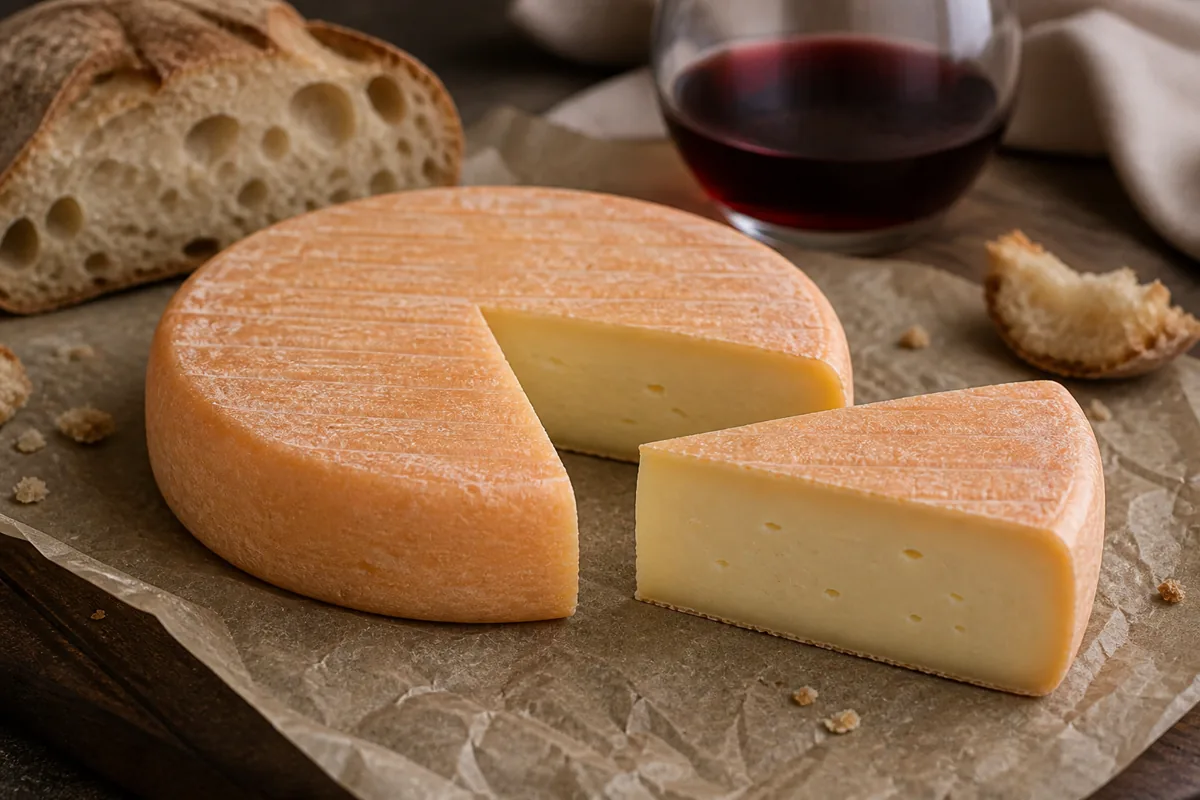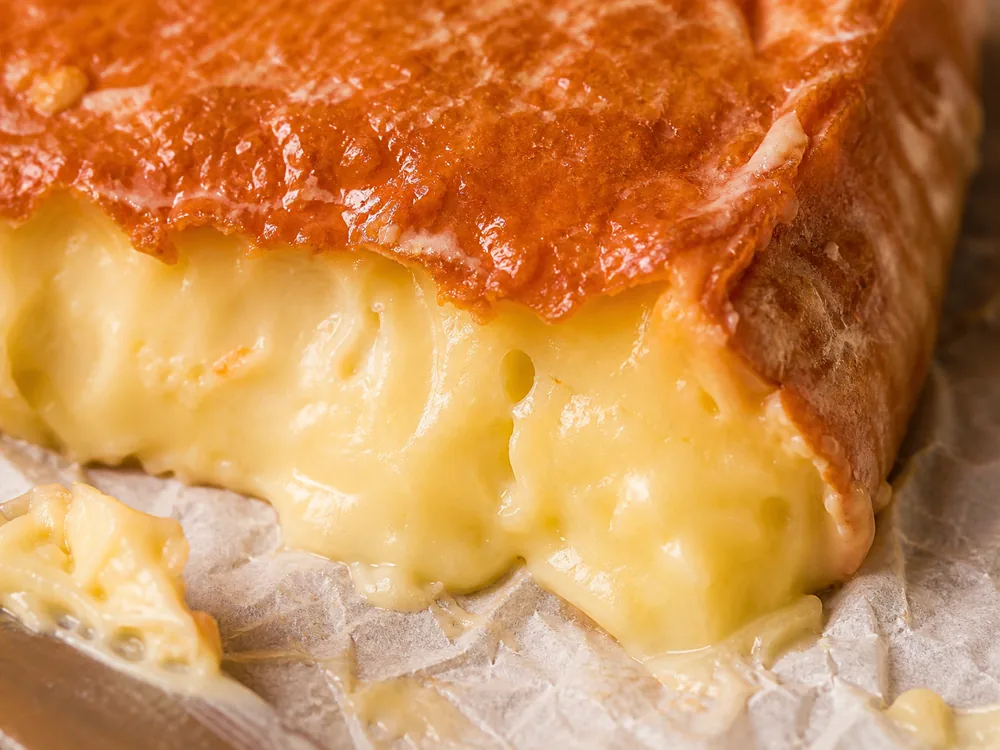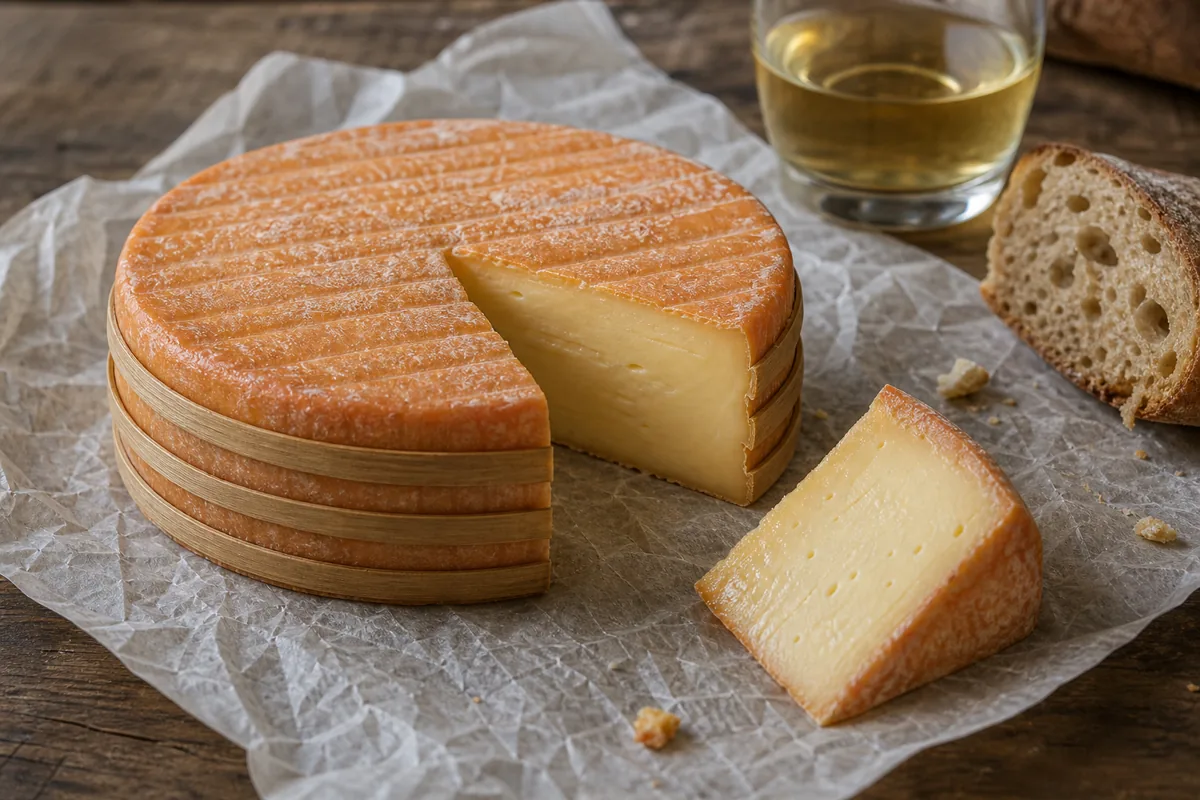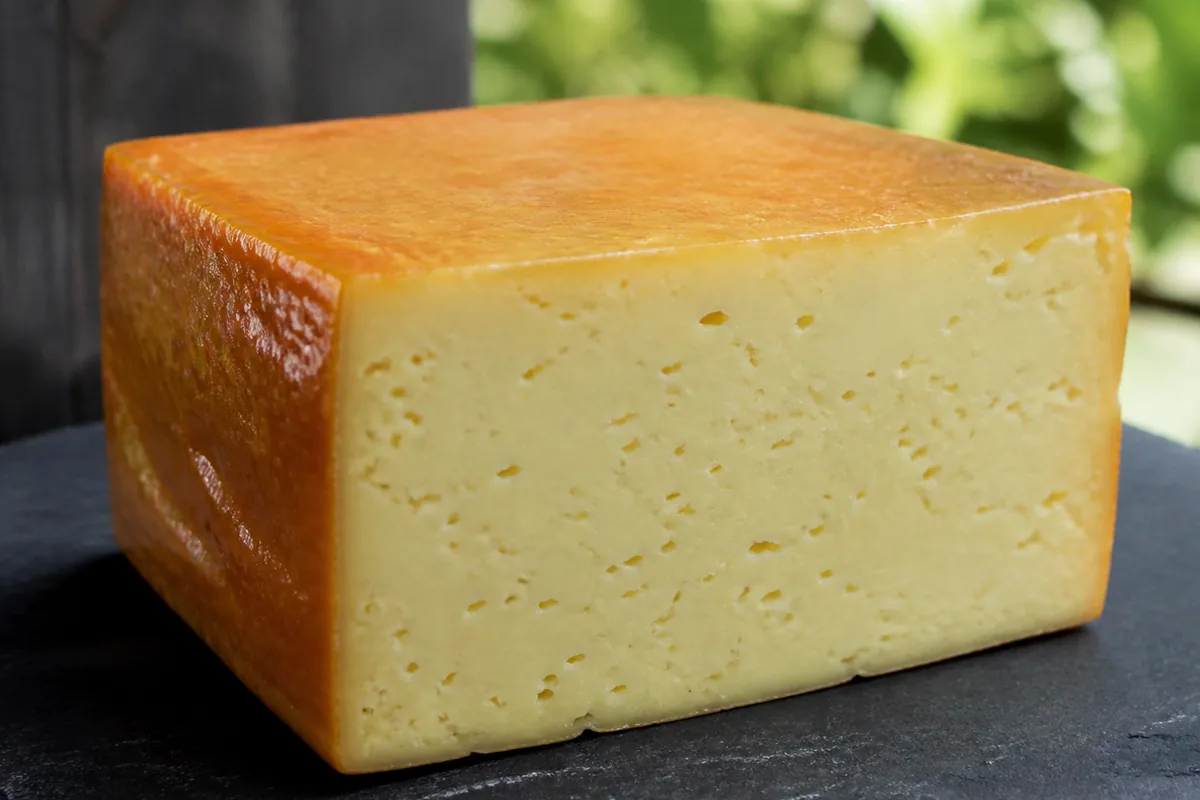
Esrom is a Danish cow's-milk cheese made in rectangular loaves, with a thin yellowish to orange-yellow rind and a pale paste full of small holes. The EU protects the name, so every loaf comes from Danish milk and a Danish dairy.
It takes its name from Esrum Abbey in North Zealand, where monks developed the cheese in the 12th and 13th centuries, according to the PGI specification. The quickest way to tell it from Havarti is the rind: Esrom has a smear-ripened one, while Havarti is usually rindless.
In This Article
What Does Esrom Look and Taste Like?
The Danish product specification describes a rectangular loaf with the length about twice the width. When you cut it, the paste should be a uniform yellowish to white, soft but sliceable, with irregular holes about the size of rice grains spread evenly through it.
You can eat the rind: the specification calls it edible, and describes it as thin, supple and yellowish to orange-yellow, covered by a thin, almost dry smear layer in yellow-brown to red-brown.
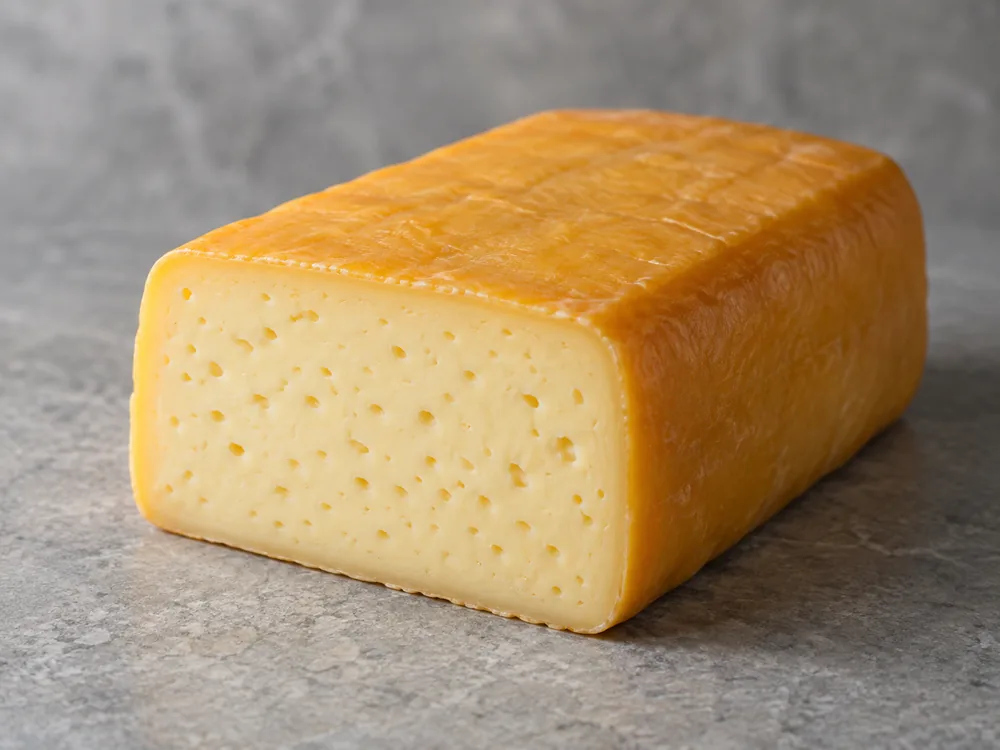
The same rind is waxy and yellow-brown in Wikipedia's description, and thin, hard and orange with a greasy feel in CooksInfo's.
As for taste, the specification calls the smell and flavour mild, tangy and aromatic, with a hint of surface ripening.
It also calls the texture uniform throughout the cheese, while Wikipedia calls the paste slightly elastic and buttery and CooksInfo calls it pliable and easy to slice.
Esrom is semi-soft in Wikipedia's class and semi-firm in the specification's (halvfast til fast in Danish), mejeri.dk's and CooksInfo's.
Why Does Esrom Smell So Strong?
The smell starts at the surface. The specification says that with age the smell and flavour from surface ripening become dominant, and mejeri.dk credits the red smear culture, rødkitkultur in Danish, with a delicate, slightly sour, rustic smell and with the soft but sliceable texture.
The rind tells you whether a loaf is older. After the washing the specification describes, older cheeses have a slightly greasy surface because the smear layer forms again, so a greasy rind points to an older loaf and a nearly dry one matches the specification's basic description.
The size of loaf you buy adds to the effect. mejeri.dk says Esrom has a larger surface than Havarti, which gives it the flavour of surface ripening, and by simple geometry the smallest of the specification's three loaf formats has more rind per gram than the largest.
Its taste is mild under a strong odour in CooksInfo's description, whereas Wikipedia describes a pungent aroma and a full, sweet flavour.
Age is the likely reason the two differ. Ostesnak says a young Esrom is quite mild and slightly acidic, and an older one is fuller, with the smear ripening noticeable in the smell.
How Long Is Esrom Aged?
Esrom ripens for a minimum of about two weeks by the PGI specification's, Thise's and Ostesnak's figures, while Wikipedia and CooksInfo describe 10 to 12 weeks.
| Source | Kind of source | Ripening time stated |
|---|---|---|
| Fødevarestyrelsen product specification | Government record for the PGI | Minimum 2 weeks |
| Thise Esrom Benedict Gylden | Producer product record | About 2 weeks |
| Ostesnak | Danish cheese blog | Minimum 2 weeks |
| Wikipedia | Reference | 10 to 12 weeks |
| CooksInfo | Reference | 10 to 12 weeks, with the rind washed during ageing |
Because the specification sets only a minimum, a loaf you buy could have ripened longer and still qualify.
What Does Esrom's Protected Name Guarantee?
The name on the label tells you where and how the cheese was made. Esrom is a protected geographical indication, and it was the first Danish cheese to receive the PGI mark, in 1996.
The name may only go on cheese made in Denmark from Danish milk at approved dairies that follow the specification, and random samples are tested four times a year by Steins Laboratorium.
The specification describes raw Danish cow's milk that is fat-standardised and low-pasteurised before starter and rennet are added, after which the curd is cut, stirred, drained and heated.
Under the specification the milk is low-pasteurised before the starter goes in, and Thise's ingredient list names pasteurized organic milk, while CooksInfo describes partially skim raw milk, which is consistent with the fat-standardising step.
After light pressing, the loaves are cooled, salted, treated with a smear culture and stored at high humidity. Once ripening ends, they are washed, dried and packed.
The specification sets four fat levels, each paired with a minimum dry matter.
| Minimum fat in dry matter | Minimum dry matter | Least fat per 100 g of cheese (the two minimums multiplied) |
|---|---|---|
| 20% | 47% | 9.4 g |
| 30% | 48% | 14.4 g |
| 45% | 50% | 22.5 g |
| 60% | 57% | 34.2 g |
Fat in dry matter counts the cheese without its water. Multiplying the specification's two minimums gives the least fat a whole loaf must hold, which is the figure you can set beside a nutrition label.
CooksInfo lists fat contents from 22.5% to 60%, while the specification's lowest level is 20%, so the specification is the figure for the protected name.
mejeri.dk names two dairies that make Esrom today, Arla's Nr. Vium dairy and Thise, and lists the other Danish PGI cheeses as Danbo, Havarti and Danablu.
mejeri.dk adds that these four are the only Danish cheeses with EU-certified quality and origin, in the same company as Serrano ham, feta, Barolo and champagne.
How Did Monks at Esrum Abbey Create Esrom Cheese?
Cistercian monks from Clairvaux Abbey in France took over the abandoned Esrum Abbey buildings in North Zealand in 1151 or 1154, after a Benedictine attempt there failed in 1140.
The abbey grew prosperous and owned much land until the Reformation reached Denmark in 1536. In 1559 the monks were sent to another abbey, and cheese production at Esrum ended with their departure.
Whether today's Esrom matches the monks' cheese is doubtful, CooksInfo says: the researchers who recreated it had no original recipe and knew only that it was a washed-rind cheese with a strong smell.
The specification says the State Experimental Dairy, Statens Forsøgsmejeri, developed the modern cheese in the mid-1930s, with production starting at Midtsjællands Herregårdsmejeri. CooksInfo says the Second World War interrupted that research, and Wikipedia dates the first large-scale production at Midtsjællands to the early 1940s.
By 1951 the Danish Cheese Institute considered the re-creation a success and sold it first as Danish Port Salut until French trademark conflicts forced a new name.
Esrom was one of Denmark's most popular cheeses in the 1960s and then almost disappeared. Thise now calls its own Esrom nearly a retro cheese, and Wikipedia says several dairies have revived production in recent years.
Esrom vs Havarti
Wikipedia calls Esrom similar to Danish Havarti or Saint-Paulin, and both Danish cheeses are made from cow's milk with small holes. When you have both in front of you, the rind is the main visible contrast: Wikipedia describes Havarti as rindless and smooth.
| Attribute | Esrom | Havarti |
|---|---|---|
| Rind | Thin, supple, yellowish to orange-yellow and edible, with a smear layer | Rindless and smooth |
| Holes | Irregular, about the size of rice grains, evenly spread | Very small, irregular eyes |
| Aroma and taste | Mild, tangy, aromatic; the surface-ripened smell and taste dominate with age | Buttery aroma; buttery, somewhat to very sweet, slightly acidic |
| Ripening | Minimum 2 weeks | Typically about 3 months |
Esrom resembles Havarti in structure but is smaller.
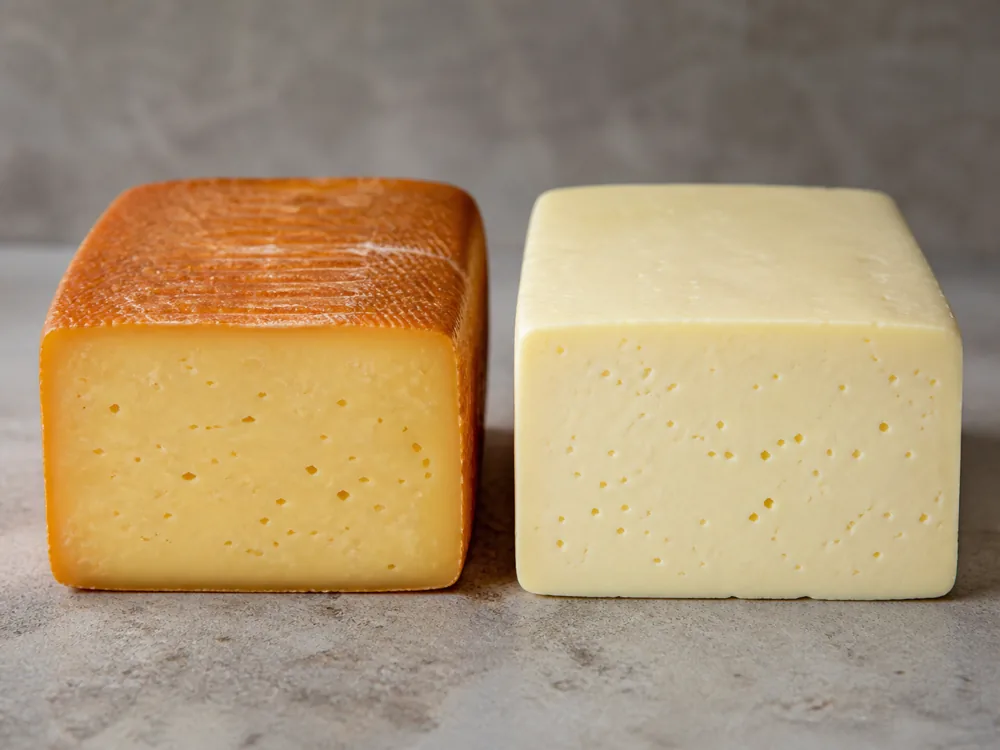
Wikipedia adds that traditional Havarti was smear-ripened while modern versions typically are not, and that Havarti was called Danish Tilsiter until it was named in 1952.
The two cheeses also mature in different places, and the washing differs too. Wikipedia calls Havarti interior-ripened and washed-curd, and says an older one turns saltier with a hazelnut taste, whereas the specification washes Esrom's rind after ripening and places its growing smell and flavour at the surface.
Which Cheeses Are Similar to Esrom?
If you cannot find Esrom, start with the two cheeses Wikipedia names as similar to it, Havarti and Saint-Paulin.
If you need a cheese to slice or grill in Esrom's place, Havarti is the closest match by use: Wikipedia says it can be sliced, grilled or melted, in line with Esrom's table-and-melting role.
CooksInfo files Esrom with its Port du Salut cheeses and its washed-rind cheeses, which fits the Danish Port Salut name that Wikipedia lists as an alternative. Treat that shared group and old trade name as a family resemblance rather than a flavour match.
How Do You Serve Esrom?
You can use Esrom on the table or melt it: Wikipedia calls it a table or melting cheese that suits casseroles and sandwiches. Ostesnak ties it to smørrebrød, the Danish open sandwich, saying that in the 1960s people spoke of Esrom as the homemaker's favourite cheese for it.
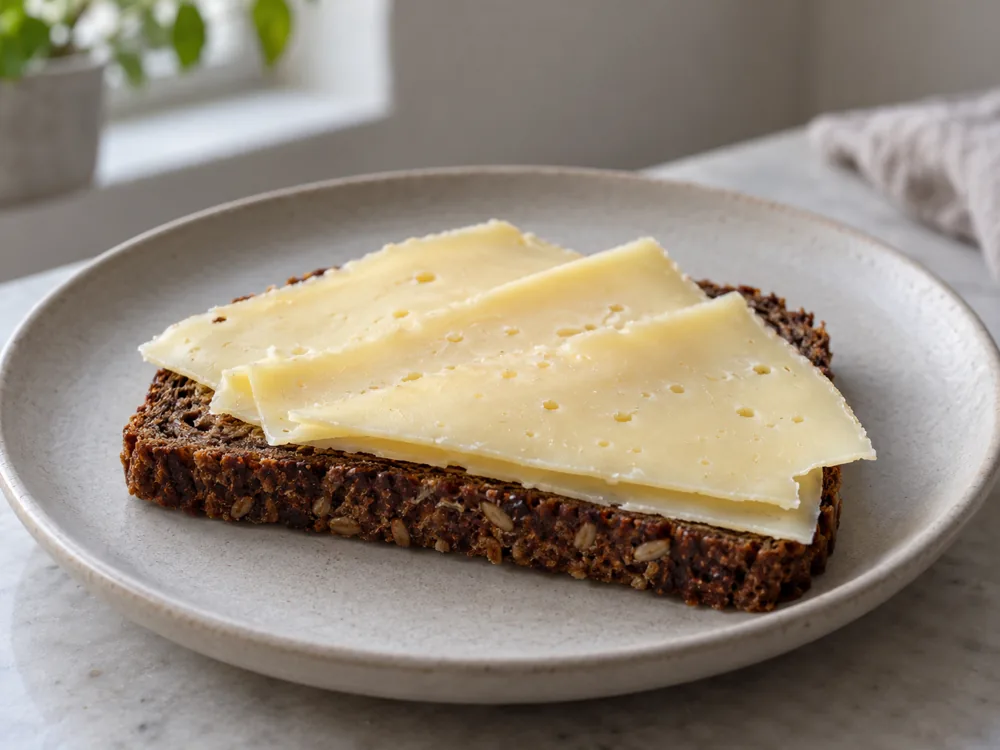
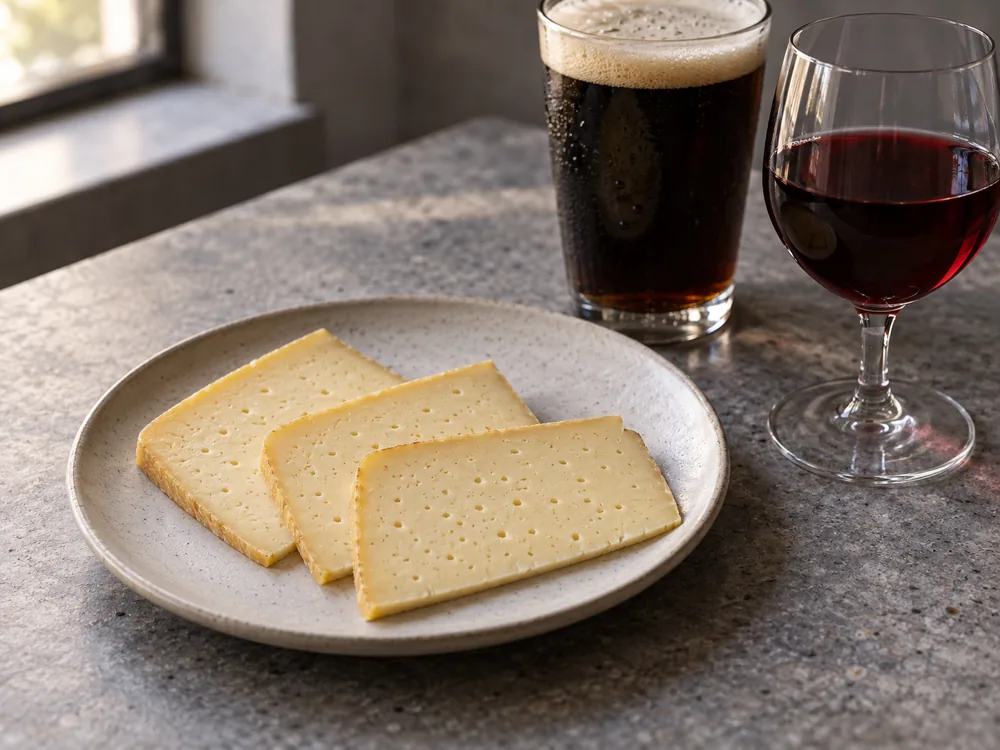
To drink, Wikipedia suggests dark beers and red wines, and says Esrom's bold flavour is why they go well with it.
| Pairing | Type | Why It Works |
|---|---|---|
| Dark rye bread | Food | The open-sandwich base for smørrebrød, where Ostesnak says Esrom was a household cheese in the 1960s. |
| Dark beer | Drink | Named by Wikipedia. |
| Red wine | Wine | Named by Wikipedia. |
Where Can You Buy Esrom, and How Should You Store It?
Denmark is not the best place to look: almost the whole production is now exported to Germany. Ostesnak adds that you may struggle to find it even at specialist cheesemongers, though some still stock it.
When you search, try Esrum too: Esrom is also called Esrum, which is how the abbey's own name is spelled.
The PGI specification allows three rectangular loaf formats.
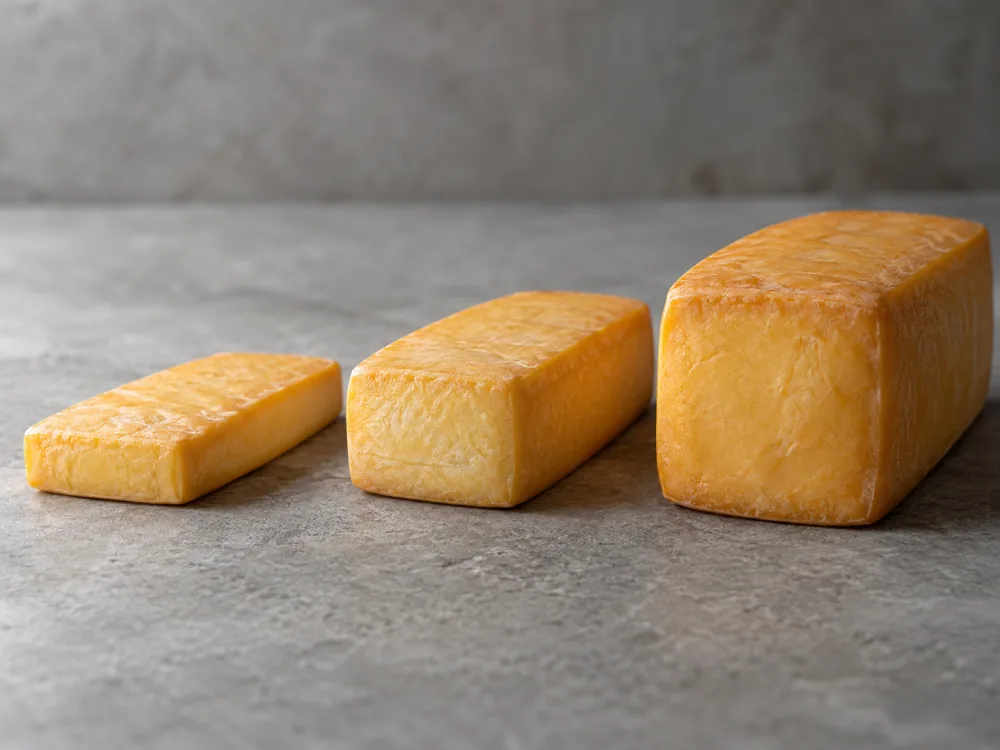
Thise sells a 1.5 kg loaf called Gylden Kloster, which falls in the middle format and is made with pasteurized organic milk, salt, lactic acid culture and microbial cheese enzyme. Its page calls it a classic Esrom with a mild, slightly tangy taste.
If you want plain Esrom, read the ingredients: CooksInfo mentions garlic and pepper varieties, while the ingredient list on the Thise loaf shows no flavouring.
The PGI specification says rennet is added, and Thise's ingredient list names a microbial cheese enzyme. If you avoid animal rennet, read the label on the loaf in your hand.
Unopened, the Thise 1.5 kg loaf has a shelf life of 60 days by its product record, and the CDC says to keep your refrigerator at 40°F (4°C) or below.
What Are the Nutrition Facts, and Is Esrom Safe in Pregnancy?
A 100 g portion of Thise's 1.5 kg Gylden Kloster loaf carries 321 kcal, 25 g of fat and 1.8 g of salt by its label.
| Nutrient | Per 100 g |
|---|---|
| Energy | 321 kcal (1,335 kJ) |
| Fat | 25 g, of which 16 g saturated |
| Carbohydrate | 0.1 g, all of it sugars |
| Protein | 24 g |
| Salt | 1.8 g |
In a 30 g slice, the label values come to about 96 kcal, 7.5 g of fat (4.8 g saturated) and 0.5 g of salt.
The label's fat, protein and salt already add up to about 51 g per 100 g, so the dry matter is at least that and the fat in dry matter cannot exceed about 49%. That rules out the 60% level for this loaf, leaving the 20%, 30% or 45% levels.
If you are watching lactose, the label's 0.1 g of sugars is also the most lactose a loaf can hold, so the amount is very small.
If you are pregnant, the specification's low pasteurisation and the pasteurized milk on Thise's label mean the raw-milk warnings in the CDC and NHS guidance do not apply to that loaf; check the label on any other. Neither agency names washed-rind cheeses, so the answer depends on how a cheese is classed and whether it is heated.
The NHS says pasteurised or unpasteurised soft blue-veined cheeses, such as Danish blue, and mould-ripened soft cheeses with a white coating, such as brie and camembert, must be thoroughly cooked. The CDC says pregnant women are 10 times more likely to get a Listeria infection and lists pasteurized soft cheeses heated to an internal temperature of 165°F or until steaming hot as safer.
Served cold, Esrom is described as a pasteurized semi-soft or semi-firm cheese, soft but sliceable, a type the CDC list does not cover, so ask a midwife or doctor.
The NHS lists pasteurised or unpasteurised hard cheeses, pasteurised semi-hard cheeses and pasteurised soft cheeses such as cottage cheese, cream cheese, mozzarella and feta as safe to eat, as it does any cheese cooked until steaming hot. It says foods made from unpasteurised milk must be thoroughly cooked.