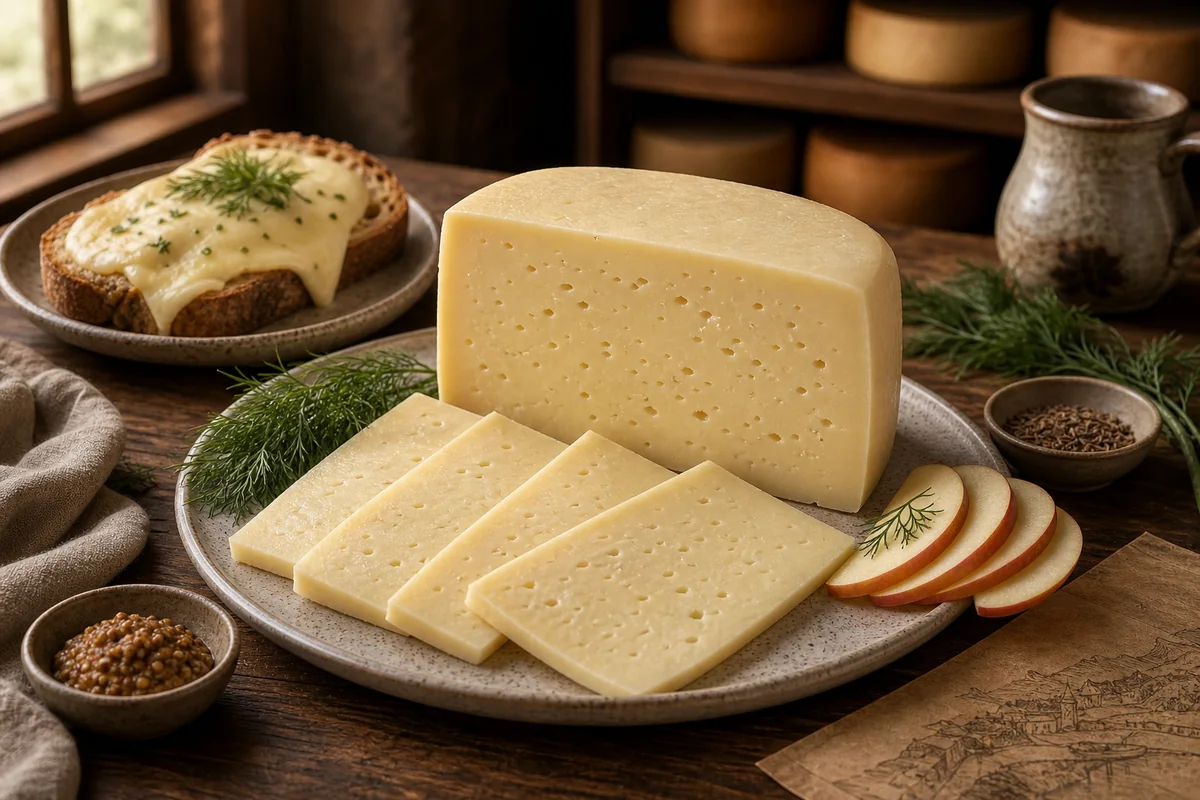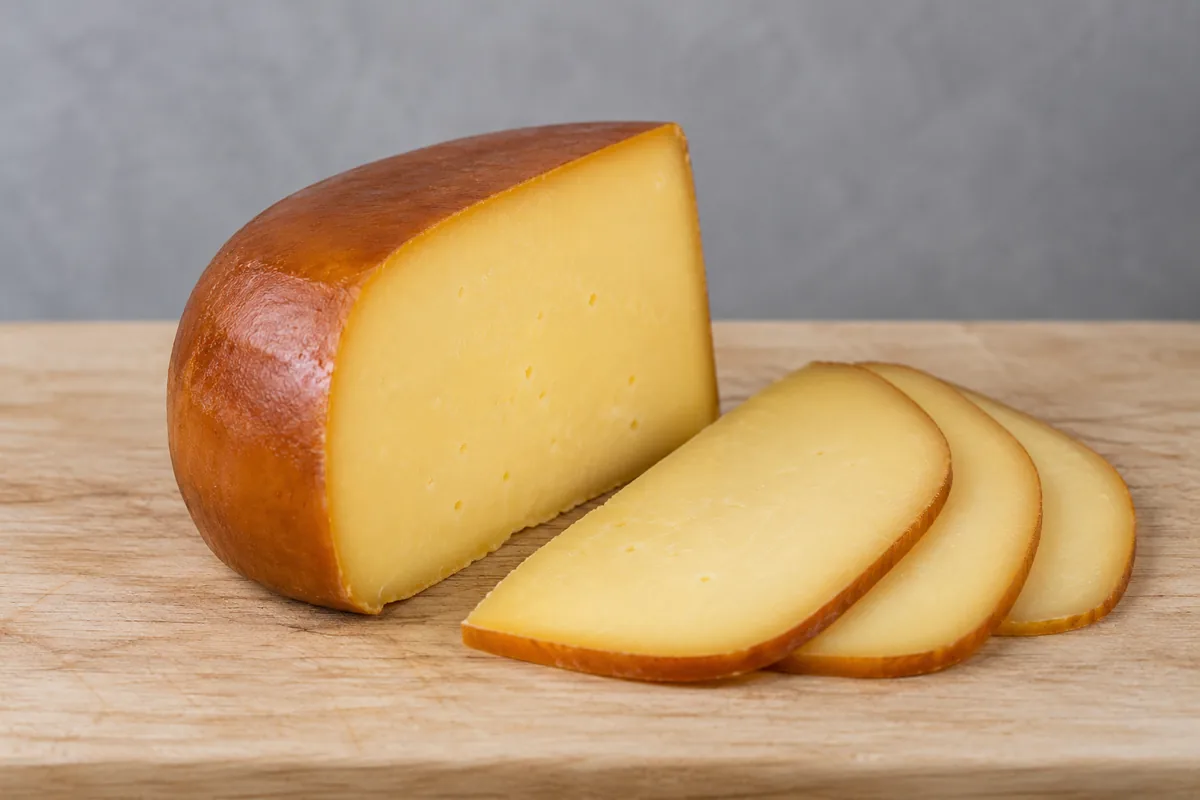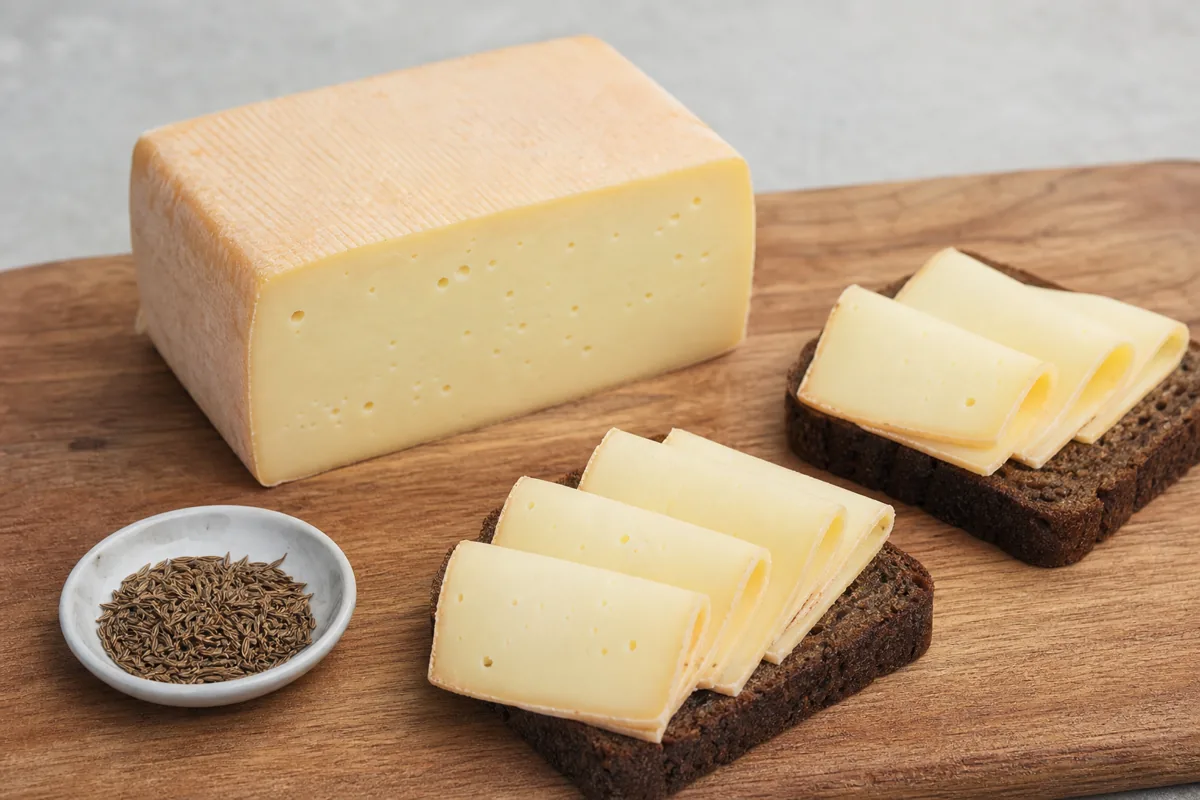
Danbo is a Danish cow's milk cheese made in flat, square or rectangular blocks, with a smear-ripened rind and a taste the EU specification calls mild, slightly acidic, and aromatic.
The EU registered the name as a Protected Geographical Indication on 18 October 2017, so Danbo sold in the EU has to be produced and ripened in Denmark. It is also the cheese Danes eat most.
In This Article
What Is Danbo Cheese?
The EU product specification defines Danbo as a matured, firm cheese made only from cow's milk, with a firm rind that carries a smear. Inside, the paste runs from whitish or ivory to light yellow and is soft and supple while still easy to cut.
The specification allows anything from a few to a large number of evenly spread round eyes, pea-sized and mostly up to 10 mm across, possibly with a few slit-shaped openings.
In 1952, Danbo was one of ten typical Danish cheeses given Danish names under the Stresa Convention and a Danish agriculture ministry order, according to the EU registration document. The same document says "Dan" comes from "the Danes" and "Bo" means "the resident".
That document puts Danbo production above 40,000 tonnes, about 13% of all Danish cheese production, and calls it Denmark's national cheese.
Why Does Danbo Smell Stronger Than It Tastes?
Cheese.com contradicts itself here: its fact box lists the aroma as "stinky, strong" and the flavour as "buttery, mild, nutty", but its description says the smell is mild and comes from smear-ripening. The EU specification agrees with the description and calls the smell and taste mild, slightly acidic, and aromatic.
Smear-ripening means Brevibacterium linens grows on the surface after the cheese is salted. The specification says the cheese spends its first 7 to 10 days at 18 to 20 °C with humidity close to the dew point, then moves to a colder, drier store.
The specification calls this the Danish method and says the smear is crucial for the cheese's distinctive taste. Its history section adds that, when the cheese was first made, the smear was a solution of bacterial and yeast cultures rubbed into the rind.
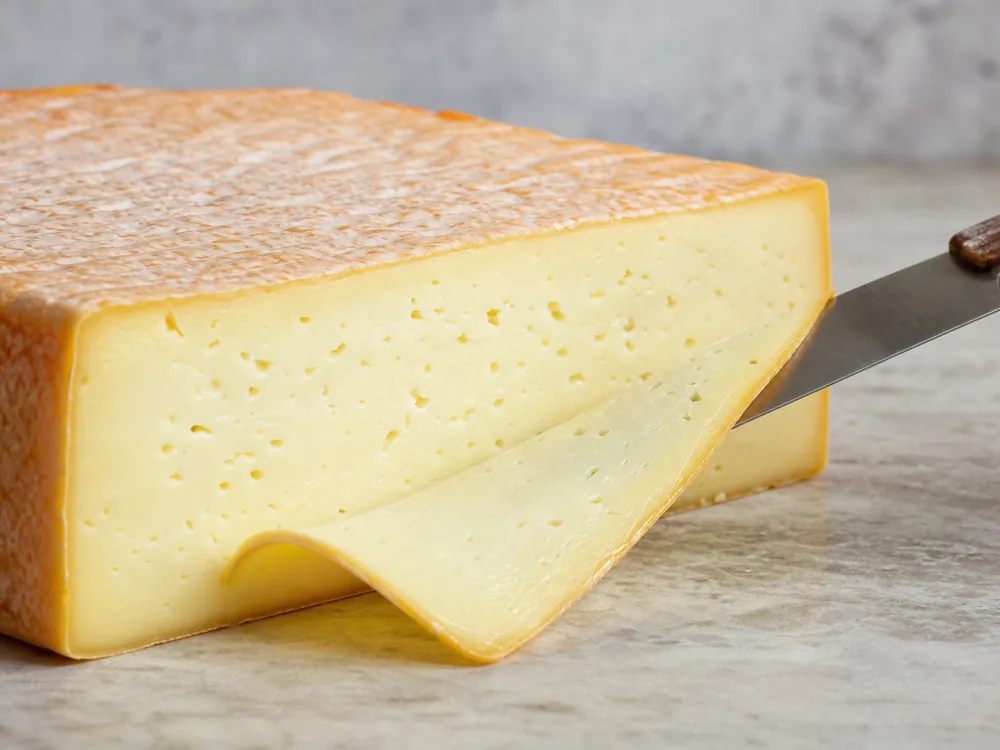
The smear layer is typically softened and washed at the end, which slows surface ripening. Wikipedia describes the same step as a bacterial culture that is washed off at the end of the aging cycle.
Age adds to the effect: both the specification and Arla's Danbo page say the smell and taste become more pronounced as the cheese ages.
The title's contrast between aroma and flavour rests on one fact-box line that Cheese.com's own description and the EU specification do not back.
How Is Danbo Made?
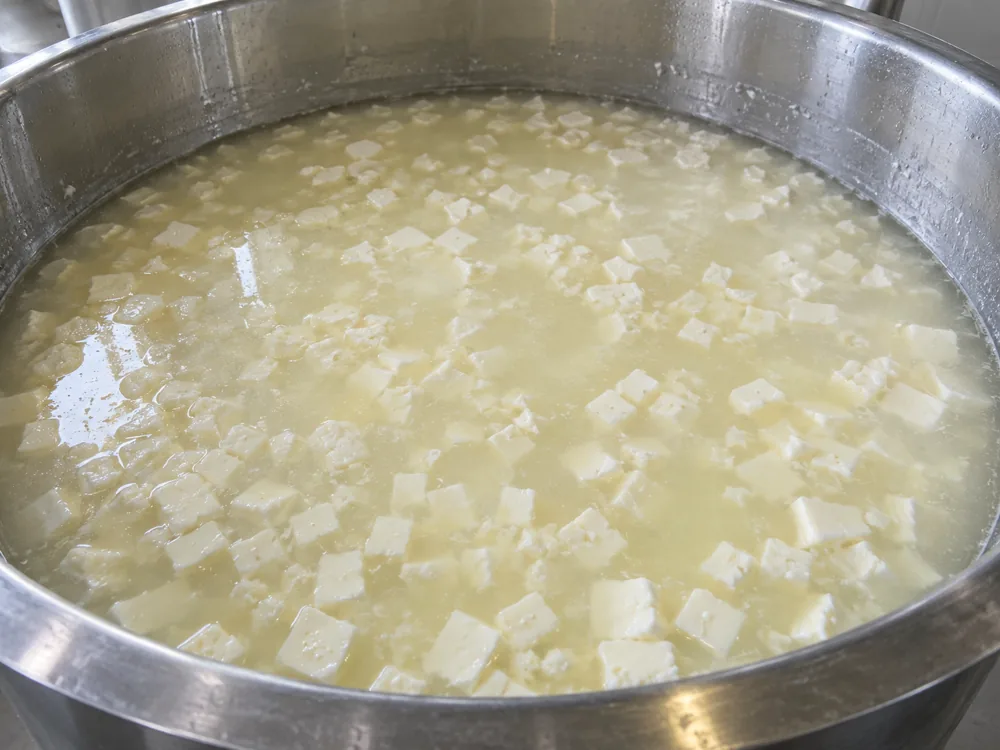
The EU specification names two production steps that differ from conventional dairy technology. The first is how the curd is treated after cutting, when large quantities of water are added and scalding finishes at a relatively low temperature.
Controlling those two settings leaves a relatively high minimum pH and a high water content, which the specification credits for Danbo's soft, supple consistency. The same high pH promotes the growth of the surface bacteria described above.
The EU document traces Danbo to Rasmus Nielsen, who became managing director of Kirkeby dairy on Funen in 1889 and in 1896 was awarded a Danish government grant to study cheese production abroad. He travelled in spring 1897 to eastern Prussia, a steppe along the Russian border whose dairies were known as good cheesemakers, then worked in several Dutch dairies and returned to Kirkeby in autumn 1897.
He did not want to copy any one cheese he had seen, and the document says a square cheese with a smear surface was a novelty at the time. Sales were brisk, and many dairies began making it.
Arla starts the story in 1896, the year the EU document gives for Nielsen's grant, and says he found a fat Russian marshland cheese that tasted so good he took the recipe home, which does not fit the EU account above of a cheese he deliberately did not copy.
Arla also says the cheese was called steppeost, marshland cheese, until 1951, while the EU document dates the Danish names, Danbo's included, to 1952. The registration regulation puts the Stresa Convention in 1951 and the EU document puts the Danish ministry order in 1952, which could explain the gap.
How Old Is Danbo When You Buy It?
Four sources give five age figures, and they measure different things.
| Source | What it says about age |
|---|---|
| EU product specification | Characteristic taste and texture after 3 to 4 weeks of ripening at 12 to 20 °C |
| Cheese.com | Matures for about 3 to 4 weeks |
| Arla Danbo page | Minimum 5 weeks when despatched from the production site |
| Wikipedia text | Typically aged 12 to 52 weeks in rectangular blocks of 6 or 9 kg |
| Wikipedia infobox | Aging time of 1.5 to 5 months |
Those are a ripening time, a dispatch minimum, and two ranges for cheese sold, so none of them says which block on a shelf is which.
Wikipedia's two ranges do not match: 1.5 to 5 months in its infobox is roughly 6 to 22 weeks, against 12 to 52 weeks in its text, so even that one source does not settle how old the oldest blocks are.
The specification lets a producer send a young Danbo to another company for further ripening or storage, but that company may not release it before the cheese has reached the minimum age.
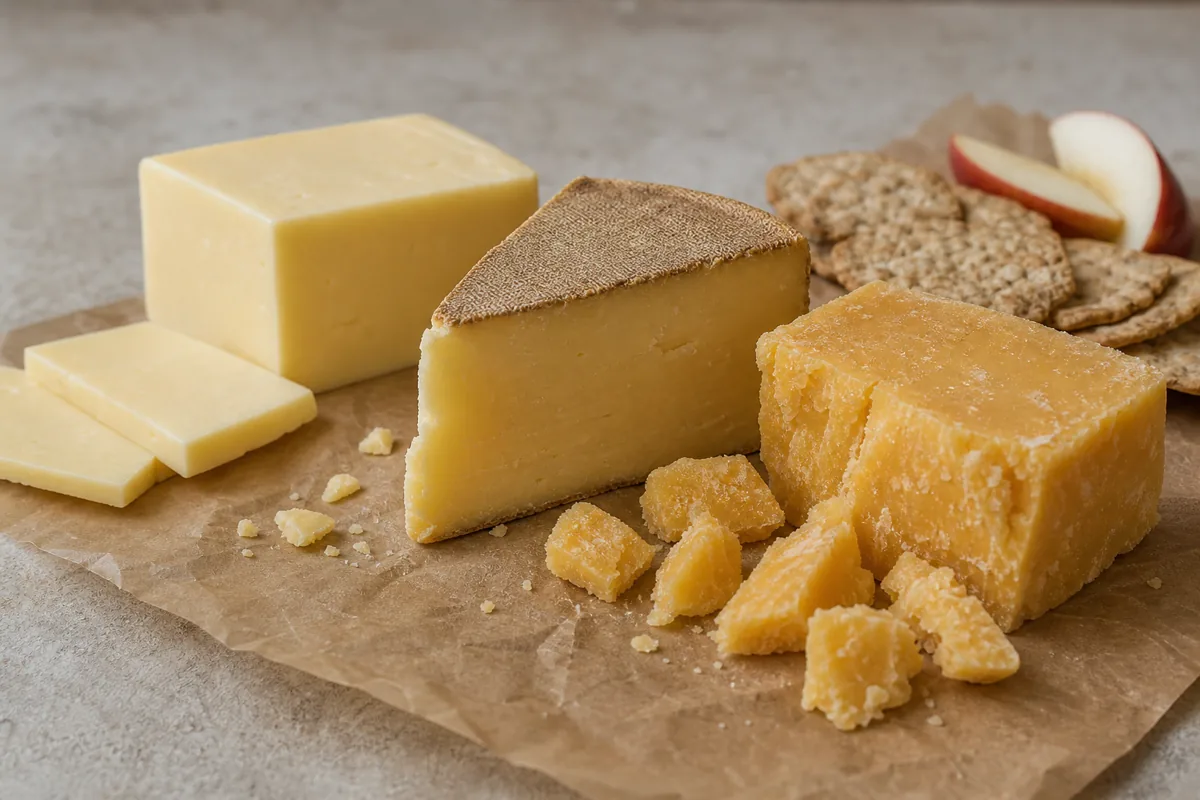
Wikipedia says Danbo is generally sold by age, in mild, medium aged, aged, and extra aged versions under trade names that include the mild Lillebror, the extra-aged Gamle Ole, and Riberhus by Arla Foods.
Lillebror is described as extremely mild and considered a cheese for children and for people sensitive to a matured cheese taste, while Gamle Ole is matured for a long time and has a strong or sharp flavour that can be considered pungent.
Because smell and taste grow more pronounced with age, an age tier on the pack is a more direct sign of how sharp a block will be than a brand name.
What Is Caraway Danbo?
Danbo can be flavoured. The EU specification says cumin may be added when the smell and taste of the cheese are characterised by it, and the flavouring has to appear in the name.
The English text says cumin, but Wikipedia, Cheese.com, and Arla all name caraway, and Wikipedia gives the Danish word as kommen. Arla adds that other aromatic herbs, spices, or fruit may be used.
A flavoured Danbo, the specification says, generally has far fewer eyes, and they are irregular in shape.
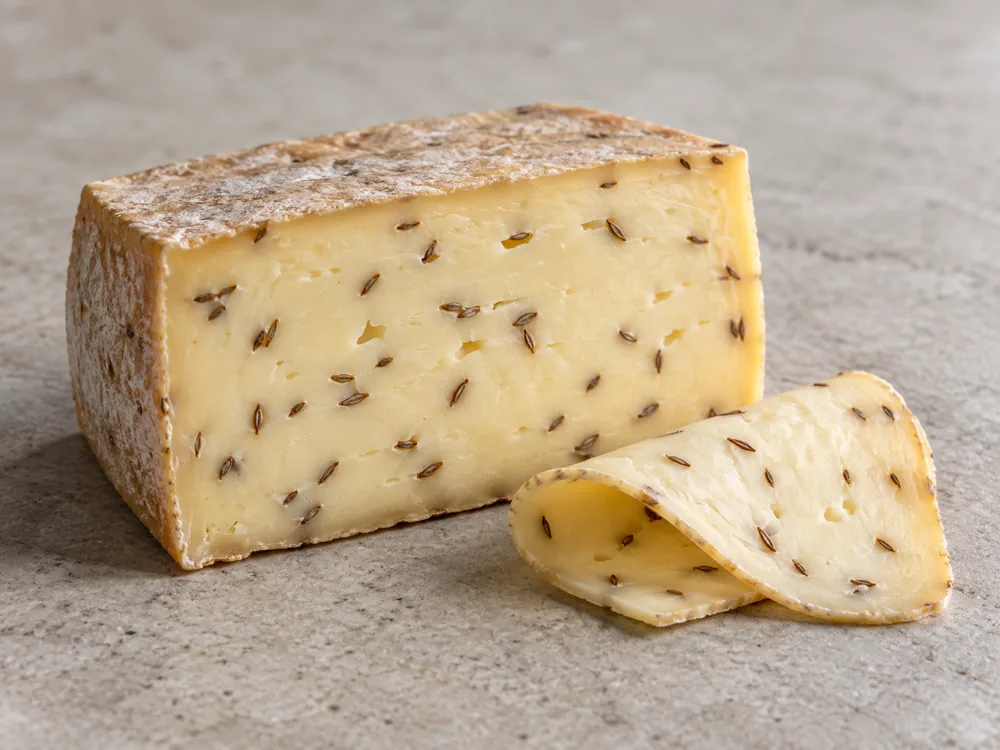
Cheese.com says Danbo with caraway is known as King Christian, after King Christian IX, who ruled Denmark in the late 19th and early 20th centuries.
Wikipedia's Havarti entry tells a similar story about a Tilsit with caraway made for the same king, and says the link to modern Havarti is disputed.
Cheese.com lists Gamle Ole and King Christian as synonyms of Danbo, but Wikipedia uses Gamle Ole for the extra-aged version and ties caraway to a separate traditional variant, so on a pack Gamle Ole points to age and King Christian to flavouring.
How Does Danbo Compare With Havarti, Esrom, and Prato?
Four Danish cheeses carry PGI protection: Wikipedia's Esrom entry lists Esrom, Danbo, and Danablu, and its Havarti entry adds Havarti, registered in October 2019.
Danish Havarti is the closest comparison in those sources, so the table sets the EU specification for Danbo beside Wikipedia's Havarti entry.
| Attribute | Danbo | Havarti |
|---|---|---|
| Rind | Firm rind with a smear | Modern Havarti is rindless, smooth, slightly bright-surfaced |
| Age | 3 to 4 weeks to reach its characteristic taste | Typically about three months |
| Flavour | Mild, slightly acidic, aromatic | Buttery, somewhat to very sweet, slightly acidic |
| Eyes | Round, pea-sized, mostly up to 10 mm | Very small and irregular |
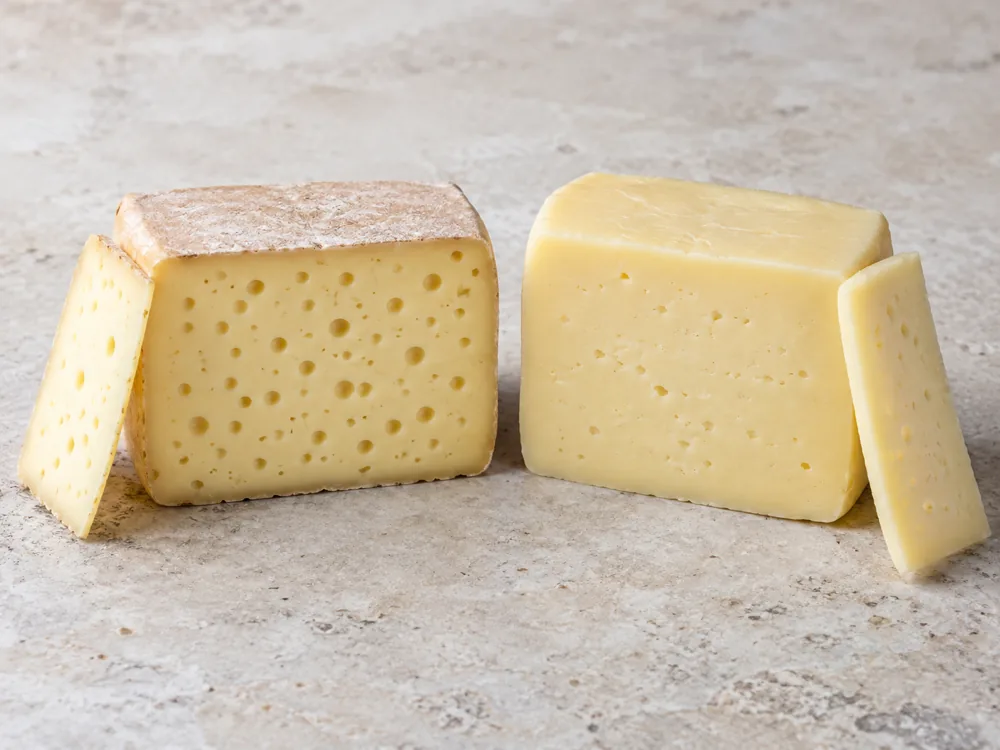
Wikipedia says Havarti can be sliced, grilled, or melted, while the EU document calls Danbo particularly suitable for slicing and says nothing about melting.
Wikipedia also treats original Havarti and flødehavarti, or cream Havarti, as different cheeses: the original was traditionally smear-ripened, as Danbo is, while cream Havarti is made from flash-pasteurised milk that keeps whey proteins in the curd, which raises yield but alters taste and texture.
Wikipedia describes semi-soft Esrom as a cheese with a pungent aroma, slow-ripened for 10 to 12 weeks and commonly used as a table or melting cheese. It also calls Esrom similar to Havarti or Saint Paulin.
Arla, which produces Esrom at its Nr Vium dairy in Denmark, describes it as pliable and sliceable, with holes no larger than a grain of rice and a smear coating applied the Danish way; the flavour it gives as mild, acidulous, and aromatic, growing more pronounced with age.
Esrom is also sold as Danish Port Salut, which Wikipedia calls Trappist-style with a waxy yellow-brown rind, and the same entry says its bold flavour suits dark beers and red wines.
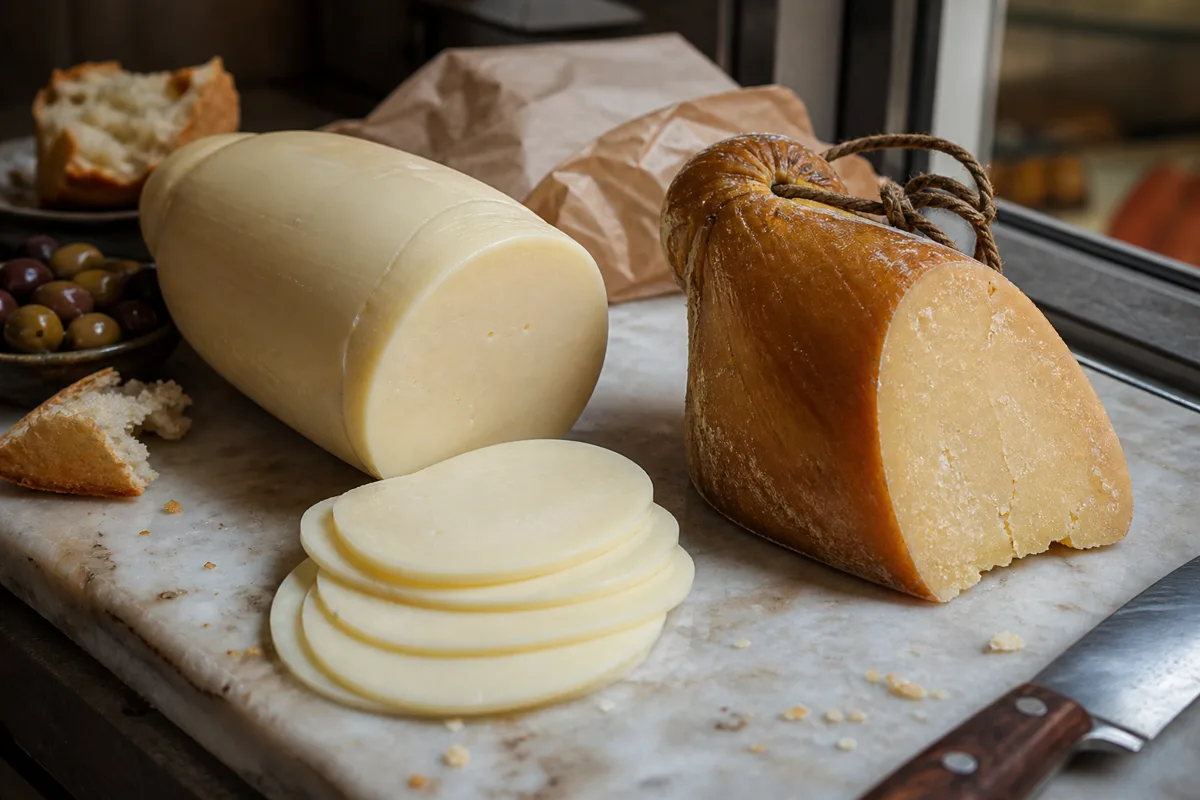
Wikipedia says Danish immigrants in Minas Gerais began making queijo prato in the 1920s by trying to reproduce Danbo, then adapted the recipe to local conditions. Because queijo prato is mostly sold in slices, makers removed the eyes the original had, and Wikipedia describes it as a semi-hard, pasteurised cheese aged at least 25 days, with low salt and lactose content and a mild flavour.
This list records the nearest relatives as each source describes them.
- Havarti: Danish, semi-soft, rindless in its modern form, and typically aged about three months
- Esrom: Danish and semi-soft, with a pungent aroma and 10 to 12 weeks of ripening
- Queijo prato: Brazilian, semi-hard, made from pasteurised cow's milk, and called similar to Danbo by Wikipedia
How Is Danbo Served?
The EU registration document calls Danbo particularly suitable for slicing and says it appears in a large number of Danish recipes.
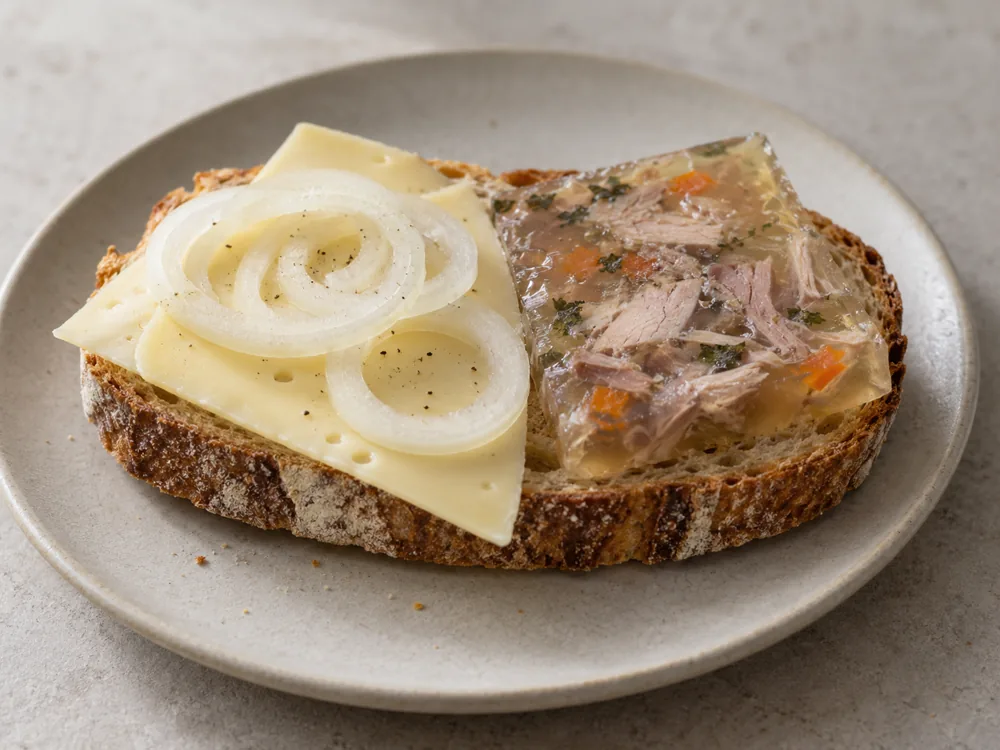
The one serving tradition a source names is for aged Danbo. Wikipedia says Gamle Ole is traditionally eaten on bread as an open-face sandwich with raw onion rings and a slice of meat aspic.
For melting behaviour, drink pairings, and storage time after opening, check the label on the block.
Can Danbo Be Made Outside Denmark?
Within the EU, no, and the 2017 registration regulation shows how that was argued: it records objections from Argentina, Australia, New Zealand, Uruguay, the Office of the United States Trade Representative, and the Consortium for Common Food Names of the United States.
They argued that Danbo had become a generic name, pointing to a Codex Alimentarius standard for it since 1966, its place in the Stresa Convention of 1951, its own customs tariff line, and production and consumption in several EU and non-EU countries, some of which have a legal standard for it.
The Commission replied that a Codex standard and a Stresa listing do not make a name generic, that tariff codes concern customs rather than intellectual property, and that genericness is judged on EU territory, so the limited data on production outside the EU did not count. It also found no evidence of imports of such cheese into the EU from third countries, so it granted no transitional period to producers there.
The Commission accepted a link based on reputation, citing Danish publications and references, exhibitions and competitions, and a large number of awards, and the specification bases the protection on the production method and the reputation.
The specification adds that Danbo has been part of Danish dairy-school teaching for over 100 years, and it gives that training and the Danish method of smear-ripening as the reasons the cheese must be produced and ripened in Denmark.
Havarti shows how different the outcome can look on a shelf: Wikipedia says less than half of the world's Havarti is made in Denmark, with the United States and Canada among the main producers, while the Commission found that within the EU Danbo is produced and marketed essentially in Denmark.
What Should You Look For When Buying Danbo?
The registration regulation says knowledge of Danbo outside Denmark is extremely limited, and the application says it is eaten almost exclusively by Danes. That application adds that Danes have embraced the taste while it does not appeal to other European palates.
Danbo sold in the EU must be produced and ripened in Denmark, and Wikipedia's Esrom entry adds that the PGI means Danish milk at approved dairies working to the specification.
The PGI works on EU territory, so outside the EU a Danbo label alone does not show Danish origin and the country of origin on the label is the check.
The specification says the surface of a Danbo may be coated, and Cheese.com adds that the rectangular block has a smooth, dry rind and is sometimes covered in red wax. A wax or coating layer therefore fits the description.
The fat band shows on the label as 30+ or 45+, and the specification sets a water limit for each.
| Fat in dry matter | Label | Maximum water |
|---|---|---|
| 30% to under 45% | 30+; the fat figure must be part of the name | 56% |
| 45% to under 50% | 45+; 45% is the reference for comparative fat claims | 50% |
The water limits are maxima and the specification states no minimum, so 56% for a 30+ block is a ceiling and not a typical figure.
Cheese.com and Wikipedia both give 15 to 45% fat, while the specification covers 30% to under 50%, which is the range the protected name is registered for.
Four checks on a Danbo pack: country of origin (Denmark for the PGI), the fat band (30+ or 45+), the age tier or name (Lillebror mild, Gamle Ole extra aged), and any flavouring named in the title.
Is Danbo Safe During Pregnancy?
The CDC and NHS advice on cheese in pregnancy sorts cheese by milk treatment and softness, and neither names Danbo.
The CDC lists soft cheese made from unpasteurized milk and unheated cheese sliced at a deli as riskier choices. It lists pasteurized soft cheeses heated to an internal temperature of 165 °F or until steaming hot, and deli-sliced cheeses heated to 165 °F or until steaming hot, as safer ones.
The CDC also lists hard cheese, when made with pasteurized milk, as a safer choice, and Arla calls Danbo semi-hard to hard. Served cold, Danbo is described as a pasteurized firm, semi-soft or semi-hard cheese, a type the CDC list does not cover, so ask a midwife or doctor.
The NHS says pasteurised soft cheeses such as mozzarella, feta, and ricotta are safe, and that pasteurised semi-hard cheeses such as edam are safe too. It adds that pasteurised or unpasteurised soft blue-veined cheeses such as Danish blue must be thoroughly cooked.
Arla calls Danbo's body semi-hard to hard, Cheese.com types it as semi-soft and the EU specification calls it firm, and the NHS lists pasteurised or unpasteurised hard cheeses, pasteurised semi-hard cheeses and pasteurised soft cheeses as safe to eat.
Cheese.com lists Danbo as made from pasteurized cow's milk, but the EU specification does not state pasteurization, so the label on the block is the evidence. The NHS says foods made from unpasteurised milk must be thoroughly cooked, and the CDC lists unpasteurized (raw) milk and dairy products made from raw milk as riskier.
SOURCES & REFERENCES
Which Questions Come Up Most About Danbo Cheese?
Cheese.com's fact box lists a strong aroma, but its description and the EU specification call the smell mild. The specification adds that smell and taste become more pronounced with age.
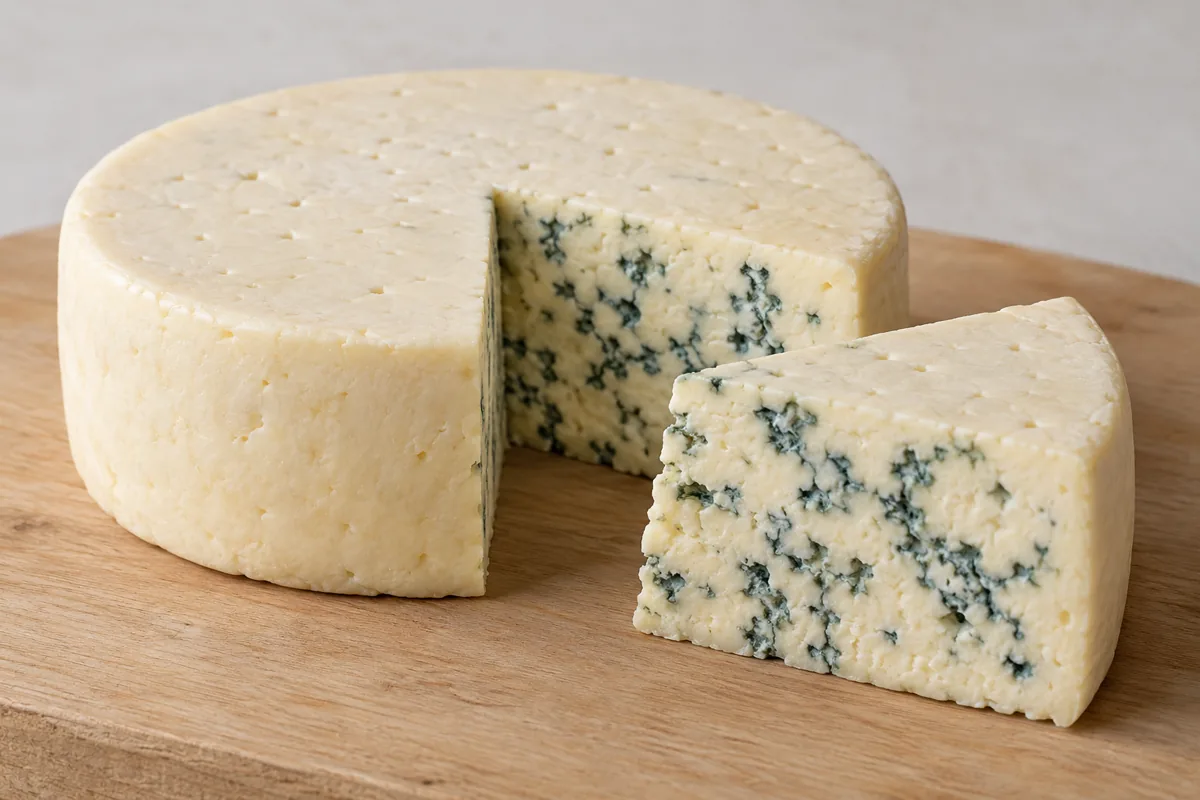
No. Both are Danish cow's milk cheeses with PGI protection, but the EU specification gives Danbo a rind with a smear, while Wikipedia describes modern Havarti as rindless.
It is a flavoured Danbo. Cheese.com says it is known as King Christian, and the EU specification requires the flavouring to appear in the name.
In the EU, yes, because the name has been a PGI since 2017.
The EU document calls Danbo particularly suitable for slicing.
Cheese.com lists pasteurized cow's milk, and the NHS lists pasteurised or unpasteurised hard cheeses, pasteurised semi-hard cheeses and pasteurised soft cheeses as safe to eat but says foods made from unpasteurised milk must be thoroughly cooked. Served cold, Danbo is described as a pasteurized firm, semi-soft or semi-hard cheese, a type the CDC list does not cover, so check the label and ask a midwife or doctor.