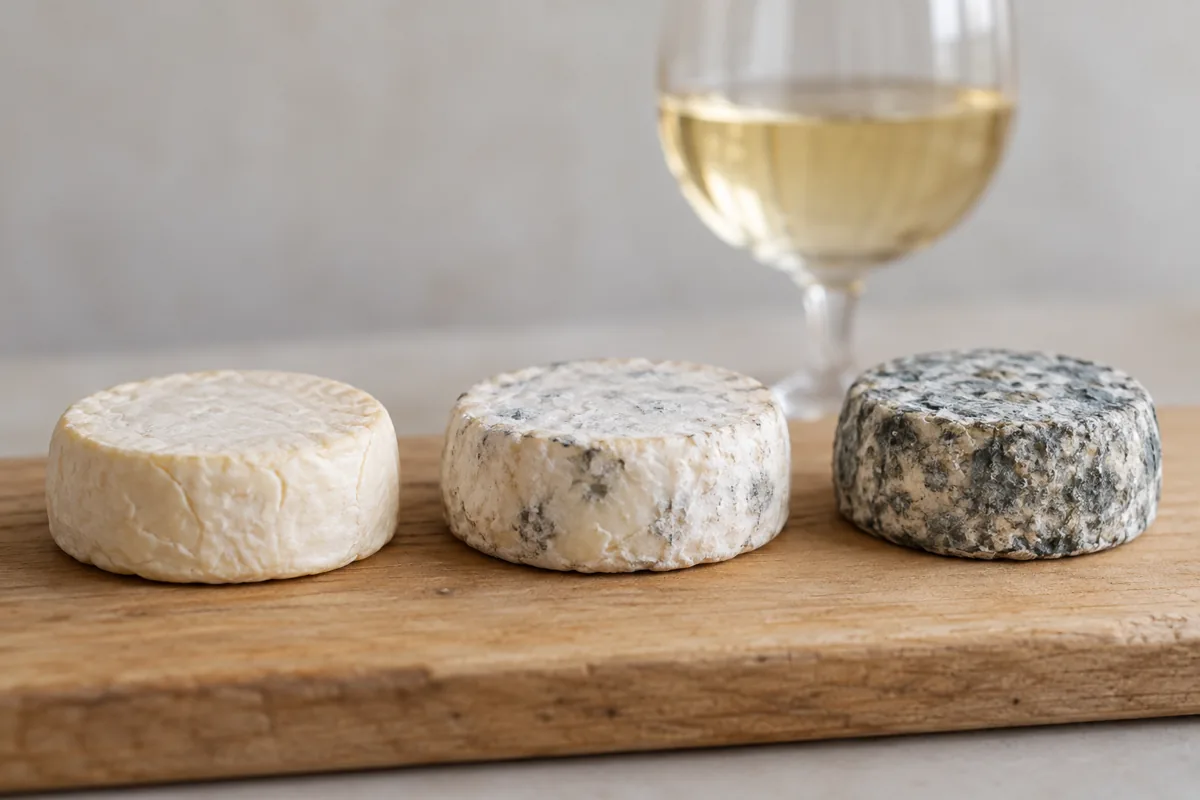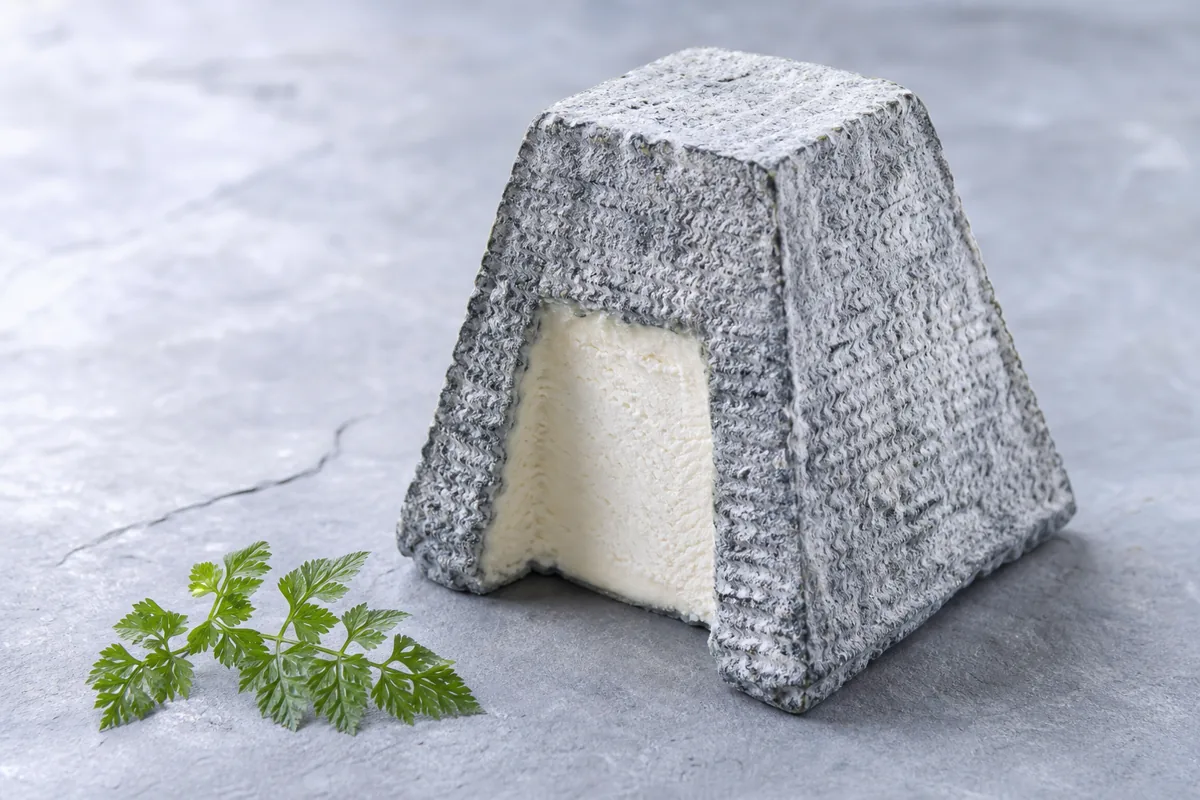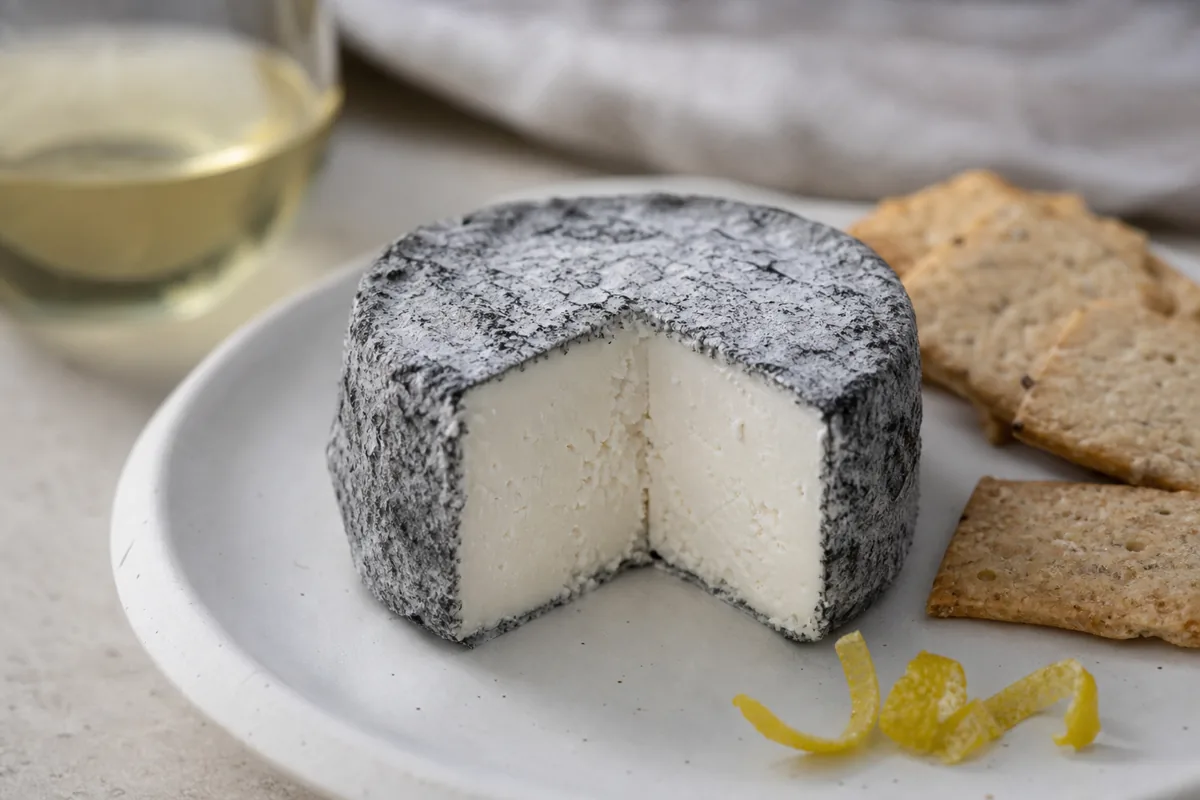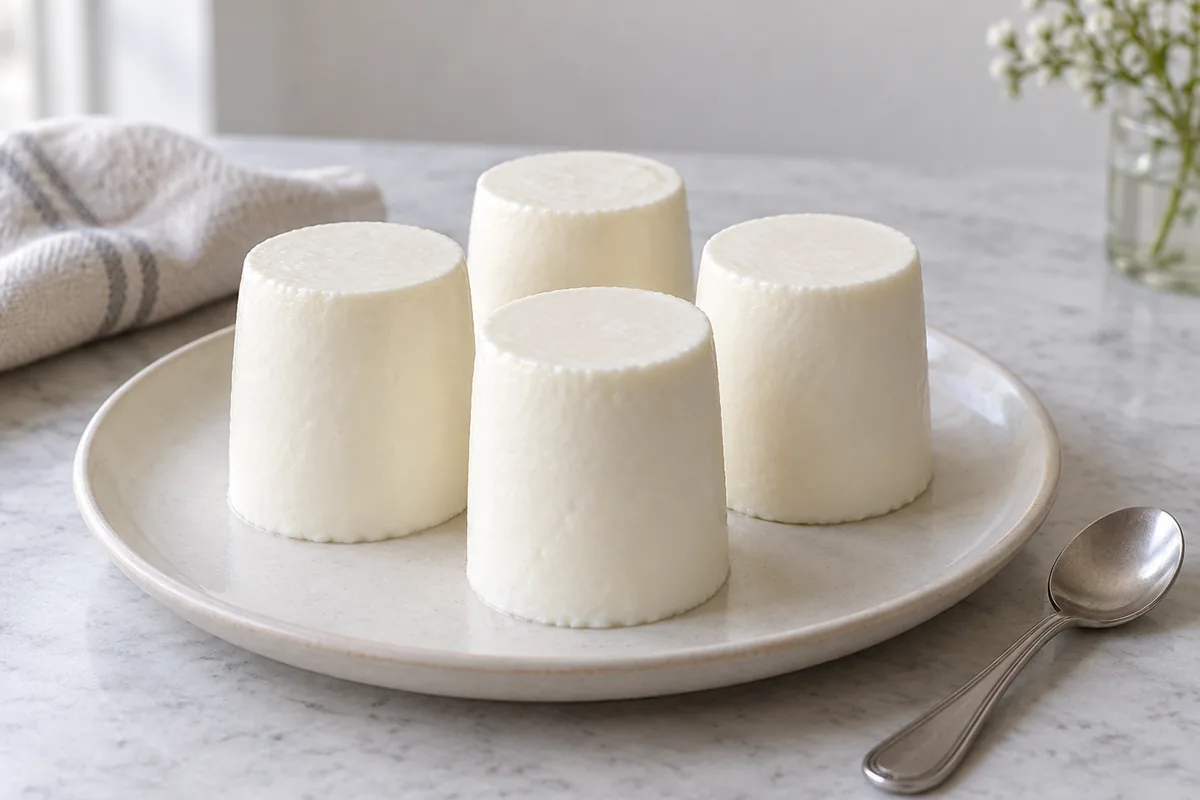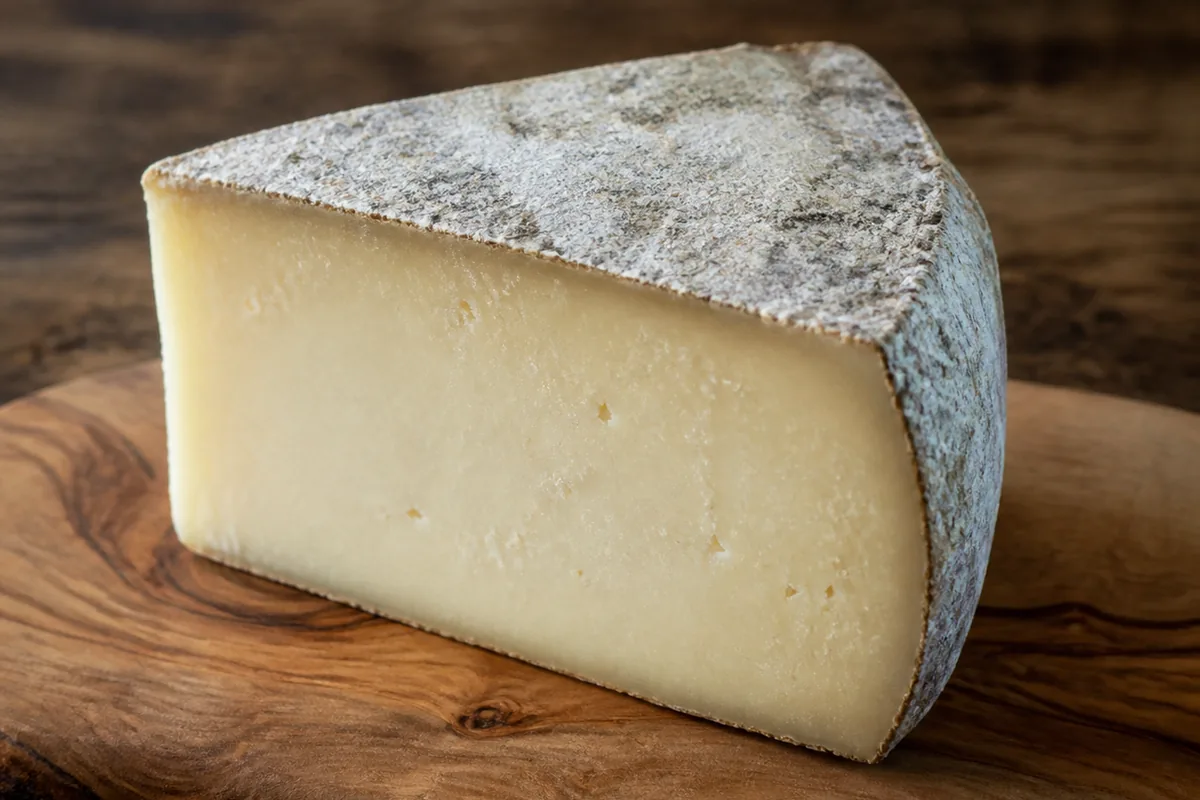
Garrotxa is a Catalan goat's cheese made from pasteurized whole milk and ripened under a grey-blue mould rind that grows on its own. The paste inside is off-white and moderately firm, with a mild lactic taste and a slight acidity.
Specialists revived it from a traditional recipe in the early 1980s. The name has been a protected geographical indication in the European Union since December 2023, and the protected area is all of Catalonia, not only the Garrotxa comarca the name comes from.
That rule explains an oddity. In August 2024 Nació Digital counted about ten Catalan producers of Garrotxa and only one inside the Garrotxa comarca, Mas Claperol in Olot.
In This Article
How Did Garrotxa Cheese Come Back in the 1980s?
In the early 1980s, goat farmers asked specialists for advice on turning surplus goat's milk into a ripened cheese, according to the PGI application, and the specialists recovered a traditional recipe and standardised it.
Nació Digital says the cheese took shape around Sant Miquel de Campmajor, where several newcomers to the countryside recovered the area's traditional goat's cheese and set it as a type.
The surplus was real. The PGI application cites figures of about 156,000 litres of Catalan goat's milk going into cheese in 1973 and about 1.3 million litres in 1983.
The same table gives about 110,000 litres for 1933 and 1.62 million for 2003, so roughly 1.1 million of the 1.5 million litres added over those 70 years arrived in the decade after 1973.
Goats were the natural milk animal, the application adds, because cattle in most of 19th-century Catalonia were bred almost entirely as work animals and gave little milk. Medical-topographical surveys from 1798 to 1913 in more than 40 municipalities often recorded goat's milk and cheese as a regular part of the diet.
Wikipedia, Culture magazine and Cheese Atlas place the revival in 1981, while the PGI application says only the early 1980s.
Nació Digital names the adviser as Enric Canut, whom Oriol Domènech of Mas Claperol describes as a cheese adviser who taught his parents to make cheese.
The recipe then travelled. The PGI application says young people who had moved from cities to the countryside took artisan cheesemaking courses at the Torre Marimon agricultural school, where the Garrotxa method was taught, and went on to make it in dairies across Catalonia.
The application also says the cheese appeared at a Barcelona trade fair in 1985 and won first prize at the London international cheese tasting in 1993, after which exports began. It lists buyers from Sweden and Portugal to Mexico, the United States, Canada and Japan.
How Is Garrotxa Made?
The PGI application starts with pasteurized whole goat's milk. Starter cultures and calcium chloride go in at 38°C or below, the milk rests for 30 to 60 minutes, and animal rennet is added at 32 to 38°C and left to act for 30 to 45 minutes.
Animal rennet is the only rennet the specification names, and Cheese.com lists the cheese as not vegetarian.
The specification calls the cheese mixed-coagulation, which fits the order of the steps: starter cultures work on the milk before the rennet is added.
The curd is cut to roughly corn-kernel size and put into round-edged moulds, 10.5 cm across for the small format and 14.5 cm for the large one, then pressed.
Salting is either 2 to 6 hours in 18 to 20 percent brine for the small cheeses and 5 to 8 hours for the large ones, or a dry rub of at least 1.5 percent salt on the fresh cheese applied by hand.
Three choices are left to the maker: lysozyme may be added with the starter cultures, the curd may be warmed to at most 39°C, and salting may be by brine or by hand.
The specification requires whole goat's milk and leaves the breed open. Wikipedia says the cheese is traditionally made from the milk of Murciana goats.
How Does Garrotxa Get Its Grey Mould Rind?
After salting, the cheeses dry until a rind starts to form, then ripen at 7 to 14°C and above 70 percent relative humidity. They are turned until an even grey, ash-like, cottony rind covers them, and the minimum ripening time is 21 days.
The mould, which the specification lists as Mucor and Penicillium species among others, grows without being added, and the specification forbids inoculating it. The cheesemaker combs it with the hands, taking care not to remove it, which helps it grow evenly over each cheese and spread through the ripening room.
Sources name the mould differently. Cheese Atlas credits Penicillium on the surface, while Oriol Domènech of Mas Claperol calls it Mucor, the mould known in Catalan as pèl de gat (cat hair).
The specification says this stage allows no mechanisation and no tool that could damage the mould layer, so it depends on the cheesemaker's hands and experience. It adds that few cheesemakers managed the cheese at first, because the technique is hard and the ripening needs close care.
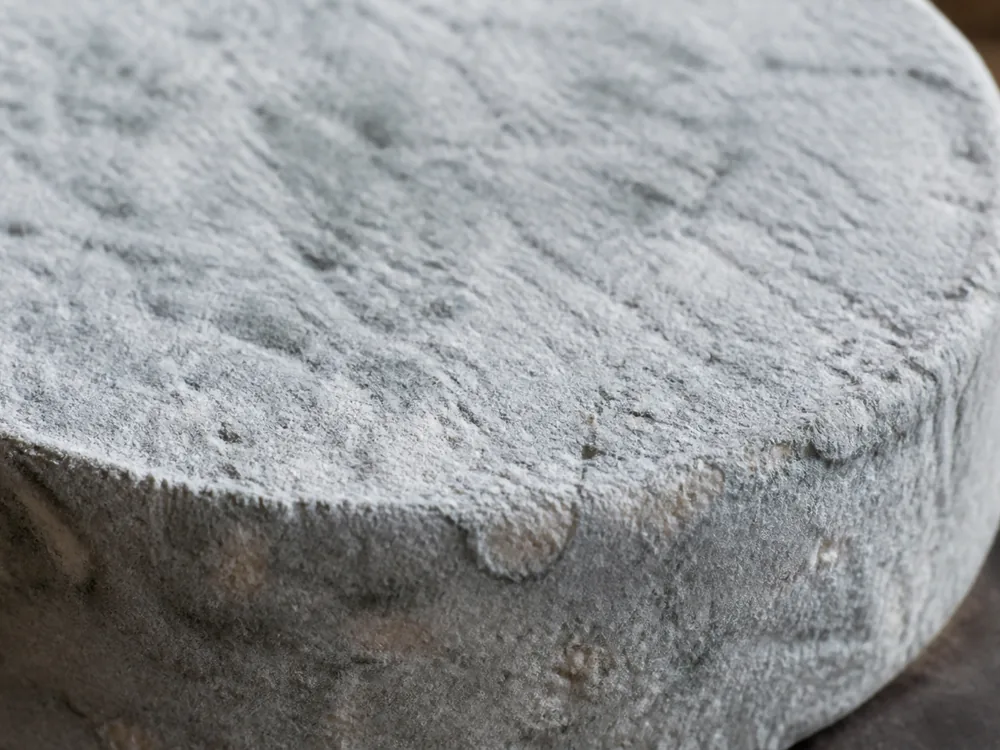
The rind does work for the paste. According to the specification, the mould slows water loss and protects the interior, and it raises the pH at the surface above that of the paste inside.
Inside, the specification says, the greater water content lets lactic bacteria develop faster and the paste acidify. Cheese Atlas adds that the mould on the surface helps neutralise acidity, which it credits for a pleasant mouthfeel.
Ripening pulls the paste two ways, according to the specification: water loss hardens it and concentrates nutrients, while the mould's moderate breakdown of protein softens it.
The rind itself stays natural. The only treatments the specification allows are brushing or rubbing.
What Does Garrotxa Taste Like?
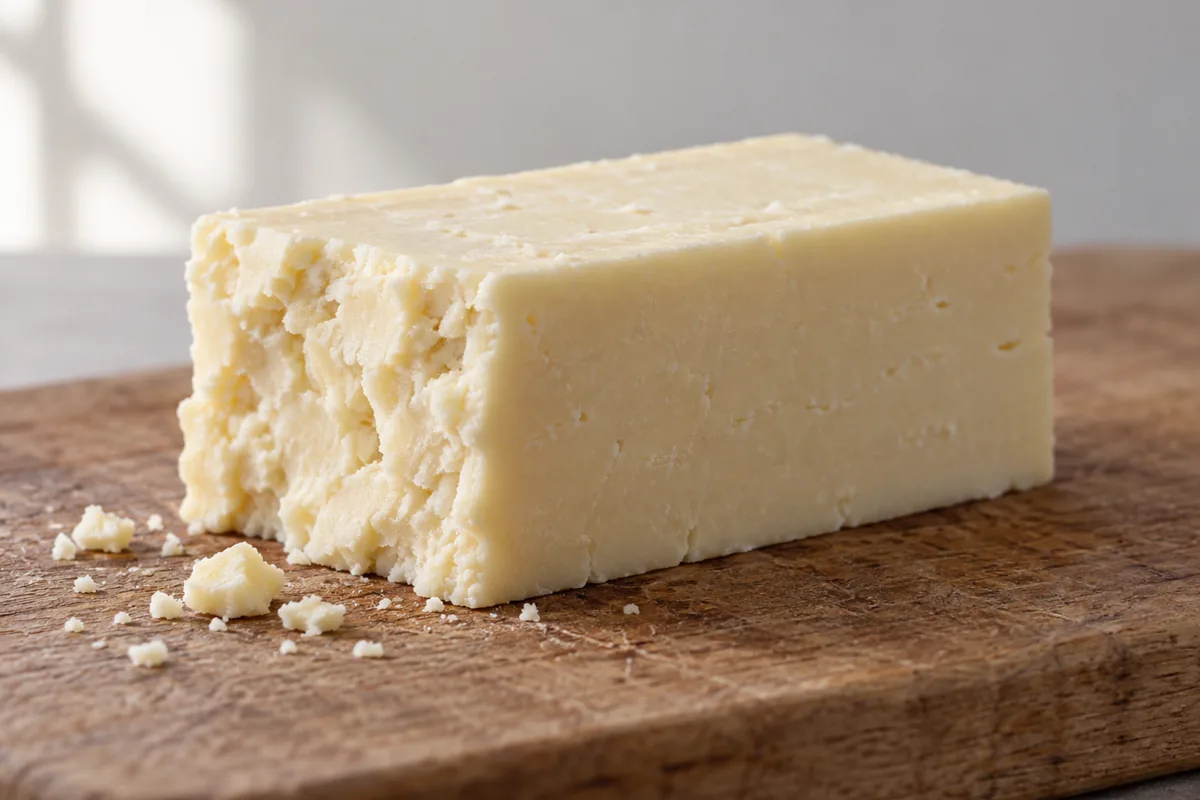
The PGI application describes an off-white paste that is closed, with at most a few small mechanical holes, and moderately firm and elastic. Inside, the smell is of medium strength, mostly fresh goat's milk and butter, while the rind gives off cellar-damp notes.
In the mouth, lactic notes dominate and a slight acidity stands out, according to the same document.
Culture magazine finds the cheese mildly herbal and earthy, with a goaty tang that lingers and a hint of hazelnut at the end.
Cheese Atlas calls the aroma mild and milky and the taste both sweet and savoury, with herbs, nuts and a subtle piquant finish, and says it suits people who usually dislike goat's-milk cheese.
Oriol Domènech of Mas Claperol says you taste mushroom and smell button mushroom.
Culture describes the paste as ivory-white and slightly darker toward a suede-like dark gray rind, and Cheese Atlas says the rind looks like a river stone with a damp woody aroma.
| Source | Ripening named | Paste described as |
|---|---|---|
| PGI application | At least 21 days | Closed, off-white, moderately firm and elastic |
| Mas Claperol (Nació Digital) | 20 days | Soft and fresh |
| Wikipedia | 4 to 8 weeks | Firm, ivory-coloured interior |
| Culture magazine | 3 to 4 weeks | Firm, smooth, slightly flaky |
| Cheese.com | 75 days | Creamy, crumbly and flaky, soft and moist |
| Cheese Atlas | Up to 6 months | Dense and buttery |
The paste ranges from soft at 20 days to firm at 3 to 8 weeks, soft and moist at 75 days, and dense and buttery at up to 6 months.
The PGI application says the mould's protein breakdown keeps working in later ripening and can liquefy the paste in the parts nearest the rind, so an older wheel softens from the rind inward.
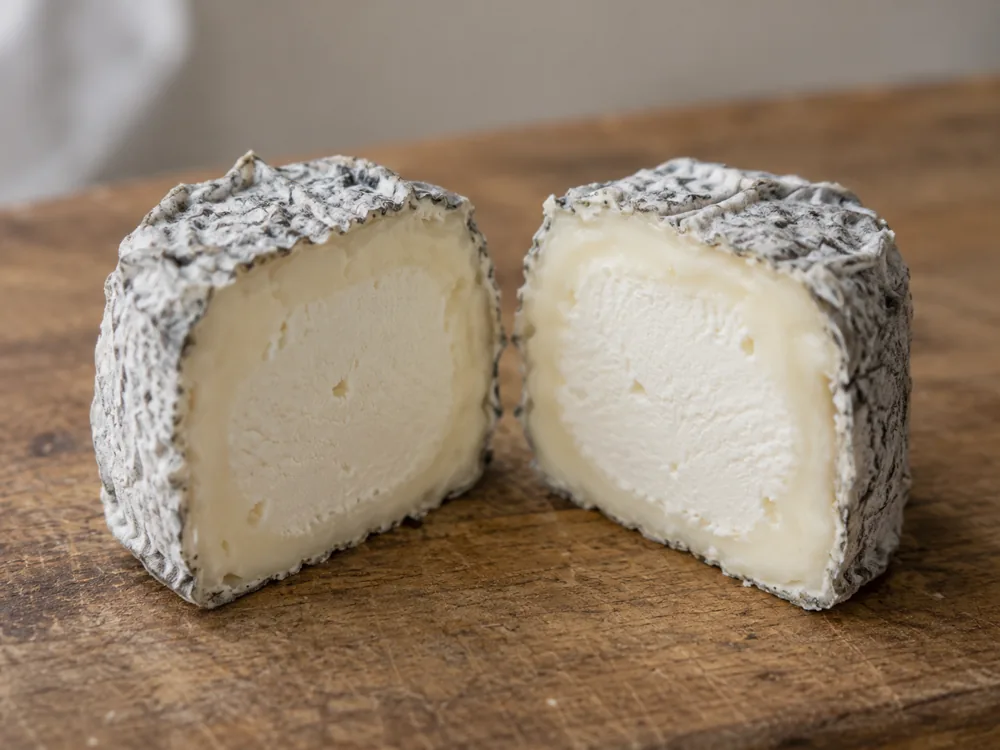
The same document places the texture between a hard, elastic paste set by enzymes and an acidic, crumbly paste set by acid, and says this sets Garrotxa apart from other goat's cheeses.
A Garrotxa's texture depends on its age and maker: the sources run from soft and fresh at 20 days to dense and buttery at up to 6 months, and an older wheel is softest near the rind.
Can You Eat the Rind on Garrotxa?
Cheese Atlas says this is one of the rare cases where it recommends removing the rind before serving. The PGI application calls the mould skin the specific character of the cheese and says it protects the cheese until it is eaten.
The choice changes the aroma. The specification puts the smell of fresh goat's milk and butter in the paste and the cellar-damp smell in the rind, so cutting the rind off changes how the cheese smells as well as how it feels.
Why Is Almost No Garrotxa Made in the Garrotxa?
The PGI application explains that the cheese took its name from the area where it was first made, yet the protection registered in December 2023 by the European Commission covers the whole of Catalonia.
Nació Digital reports the plain consequence: no other cheese can be identified as a product made in the Garrotxa, because that could cause confusion. The Mas Claperol brothers say they will have to swap the word, for example to "garrotxí", for what they sell in the comarca.
Mas Claperol, the family business of the twins Jordi and Oriol Domènech in Olot, sold the cheese as "formatge madurat de cabra" (aged goat's cheese). It began labelling it with the comarca's name only about a year and a half before the August 2024 report.
Jordi Domènech told Nació Digital that their producers' association, ACREFA, pressed for the PGI after a supermarket wanted to sell a cheaper Garrotxa made outside Catalonia. Making it outside the comarca no longer made sense to his family either, he said.
The Commission's regulation records that no reasoned statement of opposition was notified. The Domènech brothers say that nobody consulted them during the process and that they realised objections were possible only after the deadline had passed.
Which Producers Make Garrotxa Today?
The PGI's managing body must hold the data of every cheesemaker working under the name, according to the specification, but the document prints no list, and Nació Digital names only Mas Claperol.
Mas Claperol began in Sant Feliu de Pallerols and now has its workshop in the Xiprer district of Olot. The brothers took over from their parents, whom Oriol Domènech calls the first organic cheesemakers in Catalonia.
It makes over 100 cheeses a week and sells them through small shops, organic shops, fairs, consumer cooperatives, restaurants and its own website. Oriol says it will not sell to supermarkets, which have approached the family before.
Jordi Domènech told Nació Digital that Mas Claperol keeps the old formula, which cracks when exported, while other makers adapted theirs for export; because the family sells locally, the old one suits them.
What Goes Well With Garrotxa?
Wikipedia says Garrotxa can be served as tapas or at the end of a meal and notes that it is sometimes described as a dessert cheese.
| Pairing | Why It Works |
|---|---|
| Crusty country bread | Wikipedia names crusty country bread with Garrotxa. |
| Pears | Wikipedia names pears with Garrotxa. |
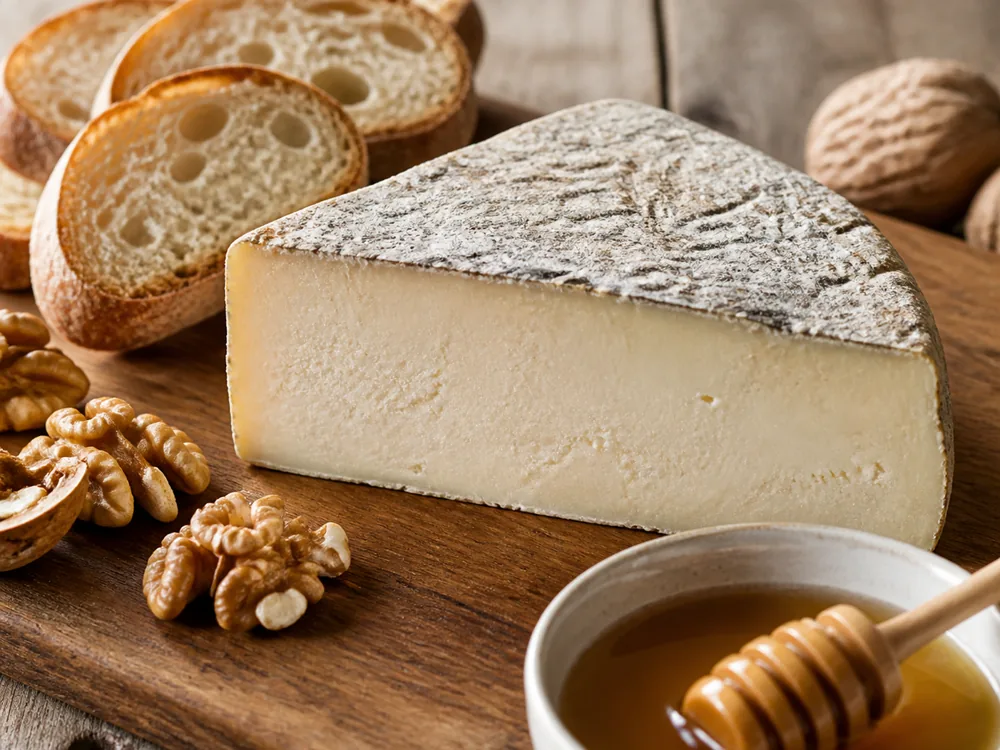
| Hazelnuts, almonds or walnuts | Wikipedia names toasted hazelnuts, almonds or walnuts; Culture names walnuts. |
| Honey and Spanish ham | Culture serves both with Garrotxa as part of a tapas spread. |
| Fresh strawberries | Cheese Atlas suggests fresh strawberries alongside a dry Cava. |
| Source | Drinks it names |
|---|---|
| Wikipedia | Priorat, Pinot Gris, Verdejo, Chardonnay, fino or amontillado sherry |
| Culture magazine | Vinho Verde, Cava, simple reds, summery wheat beers |
| Cheese.com | White wines, no style named |
| Cheese Atlas | Dry Cava |
Wikipedia ties its white wines to a texture that complements the cheese's buttery sweetness, and its fino or amontillado to the cheese's nuttiness.
Sherry and Priorat come from Wikipedia alone.
Cava is the one drink two sources name, Culture and Cheese Atlas, so it is the pairing with the most support here.
What Can You Use Instead of Garrotxa?
The PGI application claims that Garrotxa is the only mixed-curd goat's cheese in Spain and the rest of Europe made and ripened by letting mould grow on the rind. A replacement will therefore differ in at least one trait.
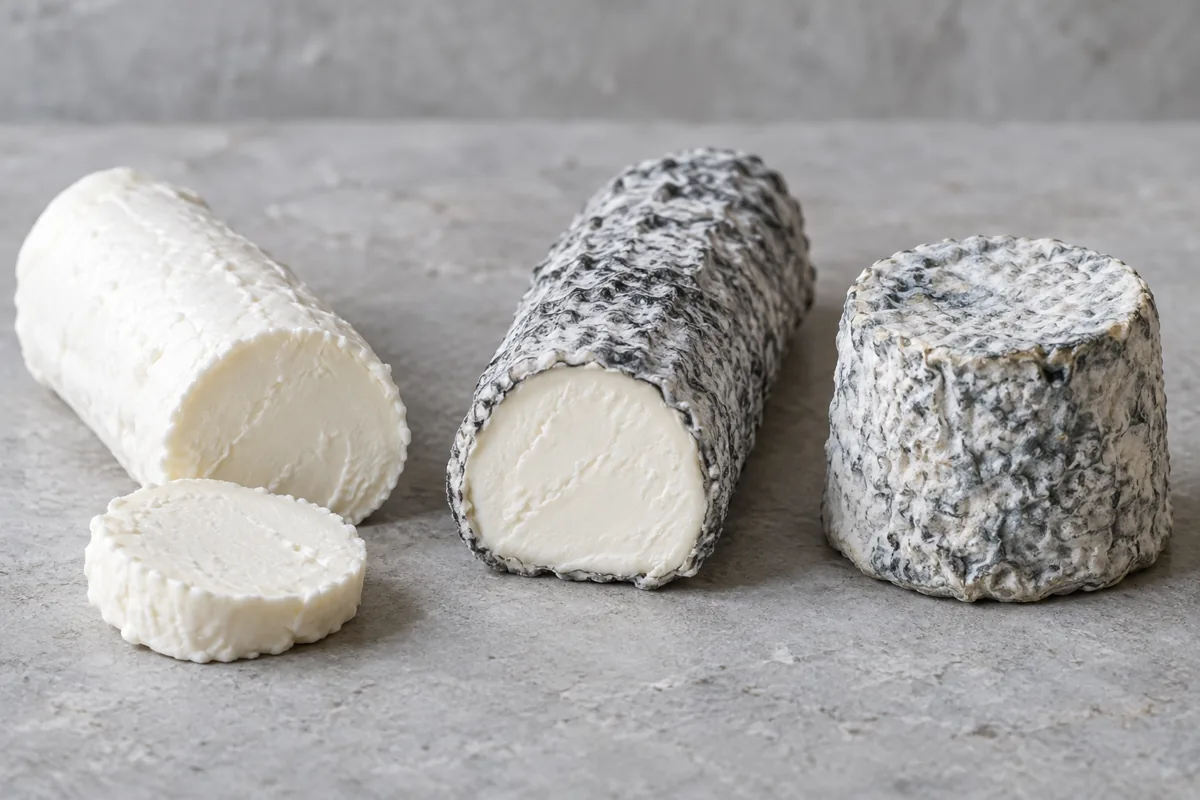
The application's own list of Catalan goat's cheeses shows what sits nearby: ripened cheeses set with enzymes and brushed on the rind, lactic-curd cheeses with a mould rind, lactic-curd cheeses with a pepper or herb rind, goat's cheeses in oil, and tupí.
On the application's texture scale, a lactic-curd goat's cheese with a mould rind matches the rind but would sit toward the acidic, crumbly end, while an enzyme-set cheese with a brushed rind would sit toward the hard, elastic end. A swap therefore keeps the mould rind or the middle texture, not both.
What Does the Garrotxa PGI Label Cover?
Behind the label sits a certification body, OCA Instituto de Certificación, which the specification charges with auditing registered makers at least once a year, and a traceability system that has to let the origin of each cheese be checked at every stage. A cheese that fails the specification cannot be sold under the name.
Several things stay outside what the label can show. The PGI covers all of Catalonia, so it says nothing about which comarca a wheel came from, and with only a 21-day minimum it does not fix how long a given wheel was ripened.
The same cheese can also turn up under another description. Culture magazine gives pell florida, Catalan for bloomy rind, as the cheese's other name, and the PGI application cites a 1998 article in the farmers' union magazine Pastors titled "Producció actual del formatge de pell florida o Garrotxa".
Nació Digital reports that the Domènech brothers will sit on the PGI's governing council and expect more inspections of Garrotxa makers.
How Should You Buy and Store Garrotxa?
Under the PGI a whole cheese comes in two formats, 1 kg and 0.5 kg, each a cylinder with rounded edges whose height cannot exceed its diameter. The specification allows a variation of 100 g on the large format and 50 g on the small one, so a 1 kg wheel can weigh between 900 and 1,100 g.
Culture lists 2 lb rounds, 6 inches across and 4 inches high, while Wikipedia says wheels typically weigh around three pounds. A kilogram is about 2.2 lb, so Culture's figure matches the large PGI format and a three-pound wheel would be heavier than either.
The specification expects the cheese whole and uncracked, with an even grey-blue rind free of stains or foreign colors.
The same document says individual cheeses are packed in paper or cardboard boxes so the mould skin is not damaged, and it does not allow vacuum packing for PGI cheese.
Ask the shop about keeping time when you buy a cut wedge.
CDC says to keep a refrigerator at 40°F or below.
CDC adds that perishable food, dairy included, should be refrigerated within 2 hours, or within 1 hour if it has been exposed to temperatures above 90°F.
Is Garrotxa Pasteurized, and Is It Safe in Pregnancy?
Pasteurization is part of the specified method, and Cheese.com, Culture and Wikipedia all list pasteurized goat's milk.
The open question is classification. The PGI application calls the paste moderately firm, Cheese Atlas semi-hard and Cheese.com semi-firm, which points to the semi-hard and hard lines of NHS and CDC.
Against that, NHS sorts goats' cheese by whether it has a white coating, Garrotxa's coating is grey-blue, and an older wheel softens near the rind. Ask a midwife or doctor before eating Garrotxa uncooked.
Cooking until steaming hot is the route both agencies describe. CDC adds that pregnant women are 10 times more likely to get a Listeria infection.