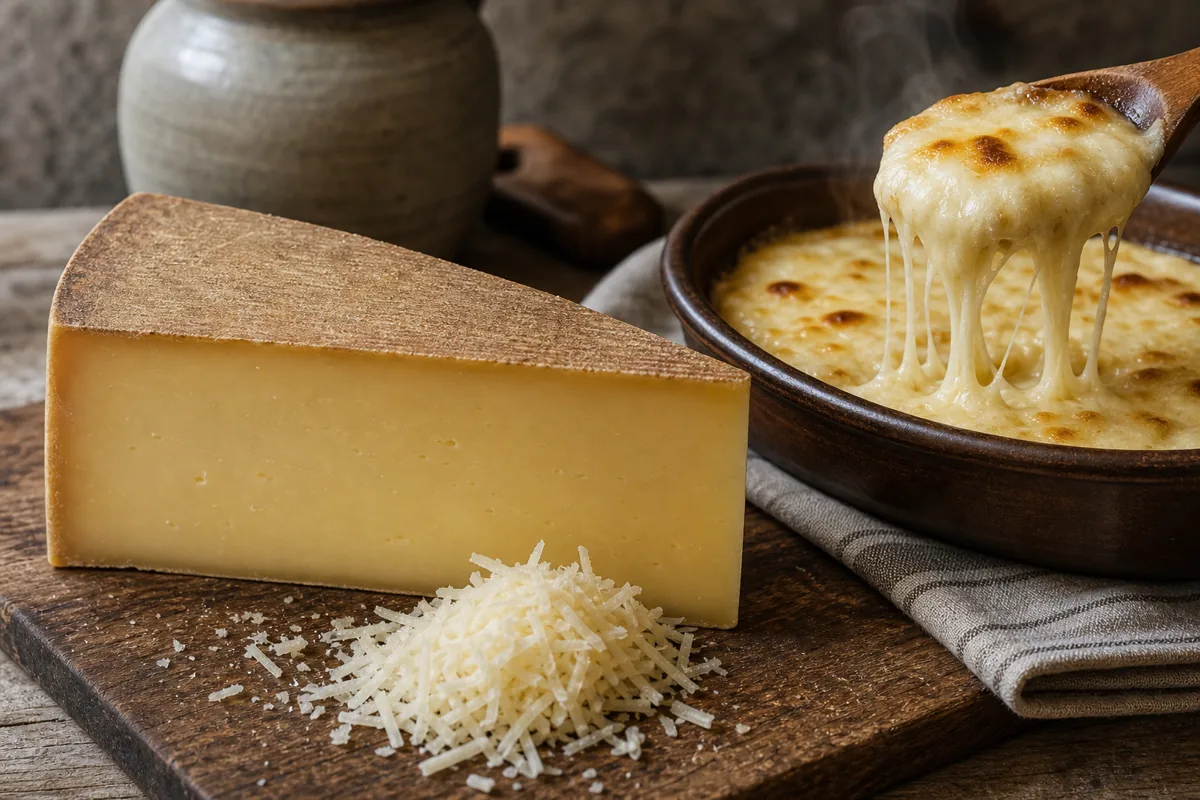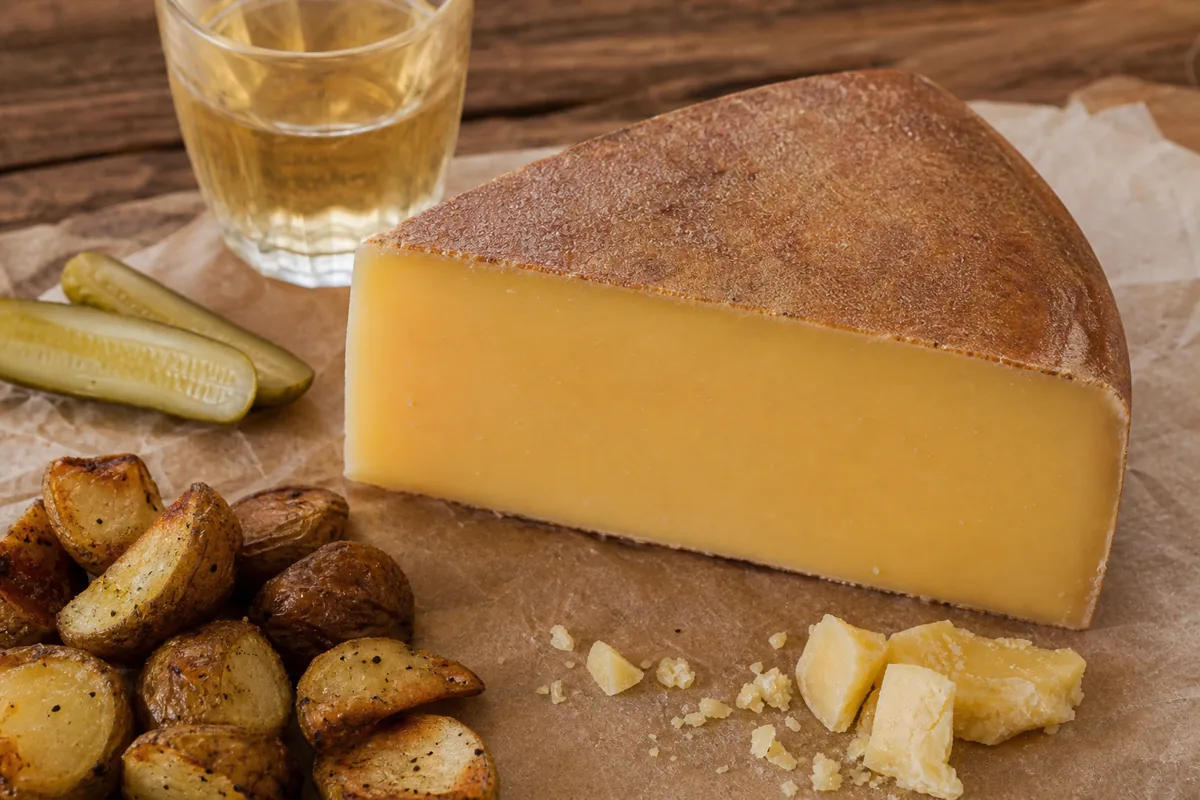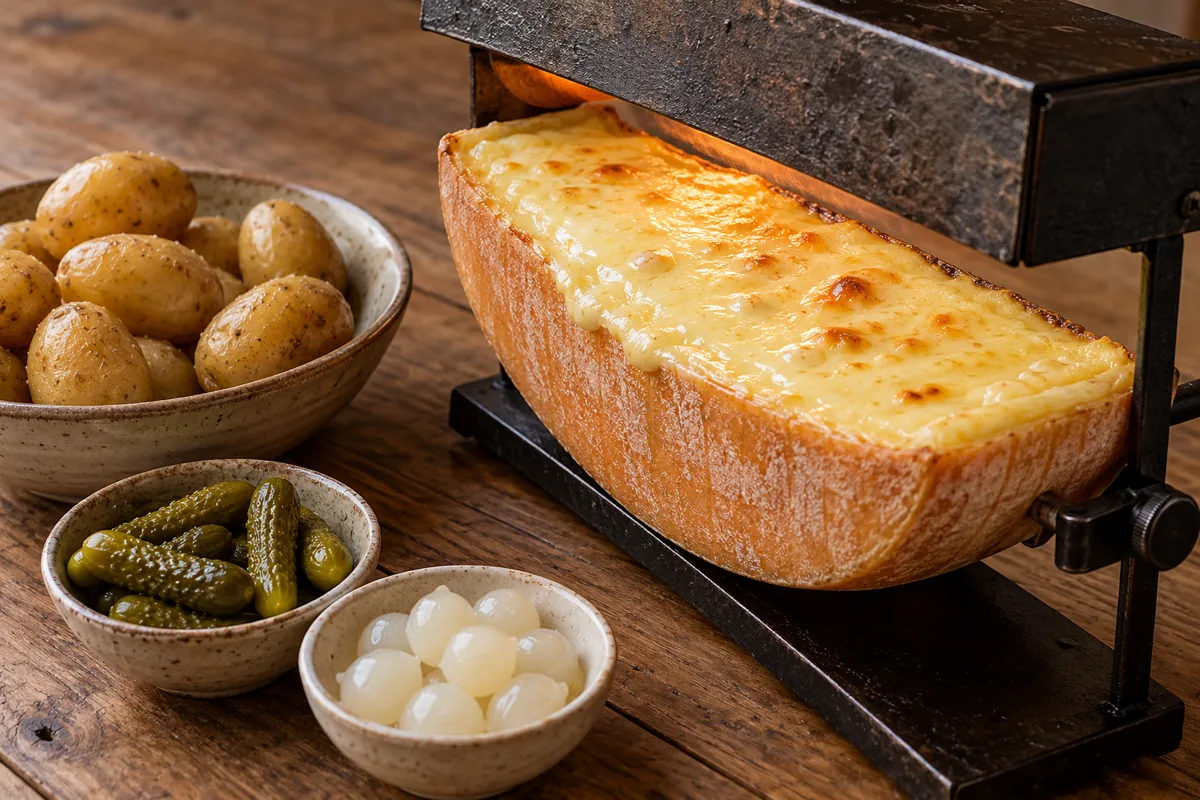
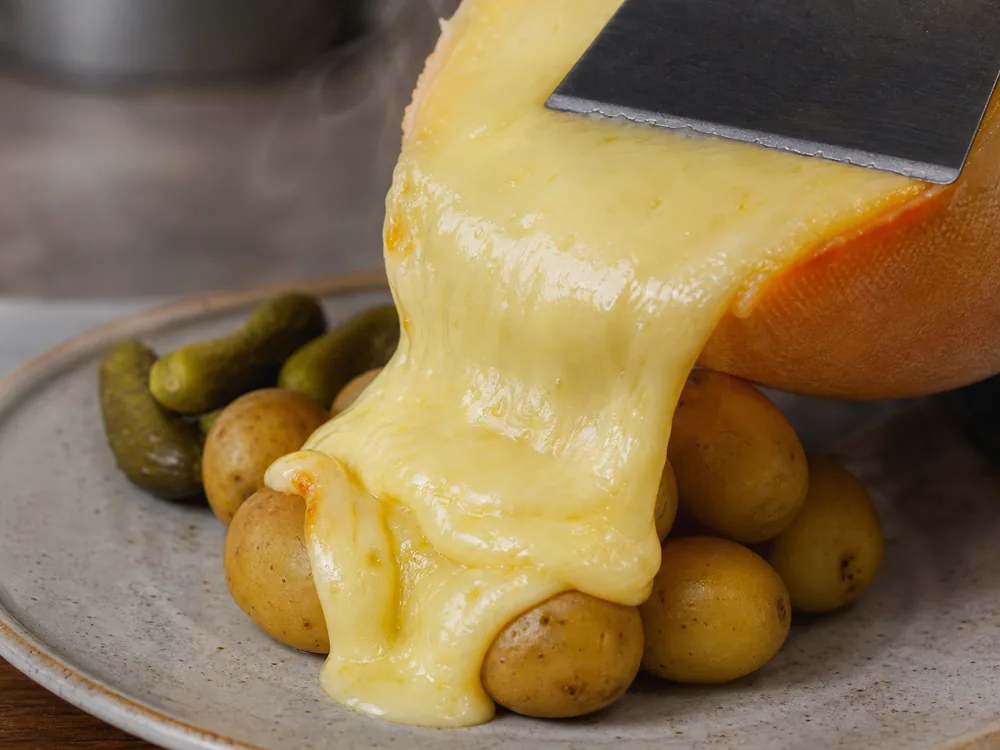
Raclette is a semi-hard cow's milk cheese made to be melted and scraped onto boiled potatoes, and its name comes from the French racler, to scrape. Its home is the canton of Valais in Switzerland, where Raclette du Valais AOP is made from raw milk and aged for at least three months.
The same name also covers a protected French cheese from Savoie and a wider range of Swiss wheels, so the words after "raclette" on your label decide the milk and the age.
In This Article
What Is Raclette Cheese?
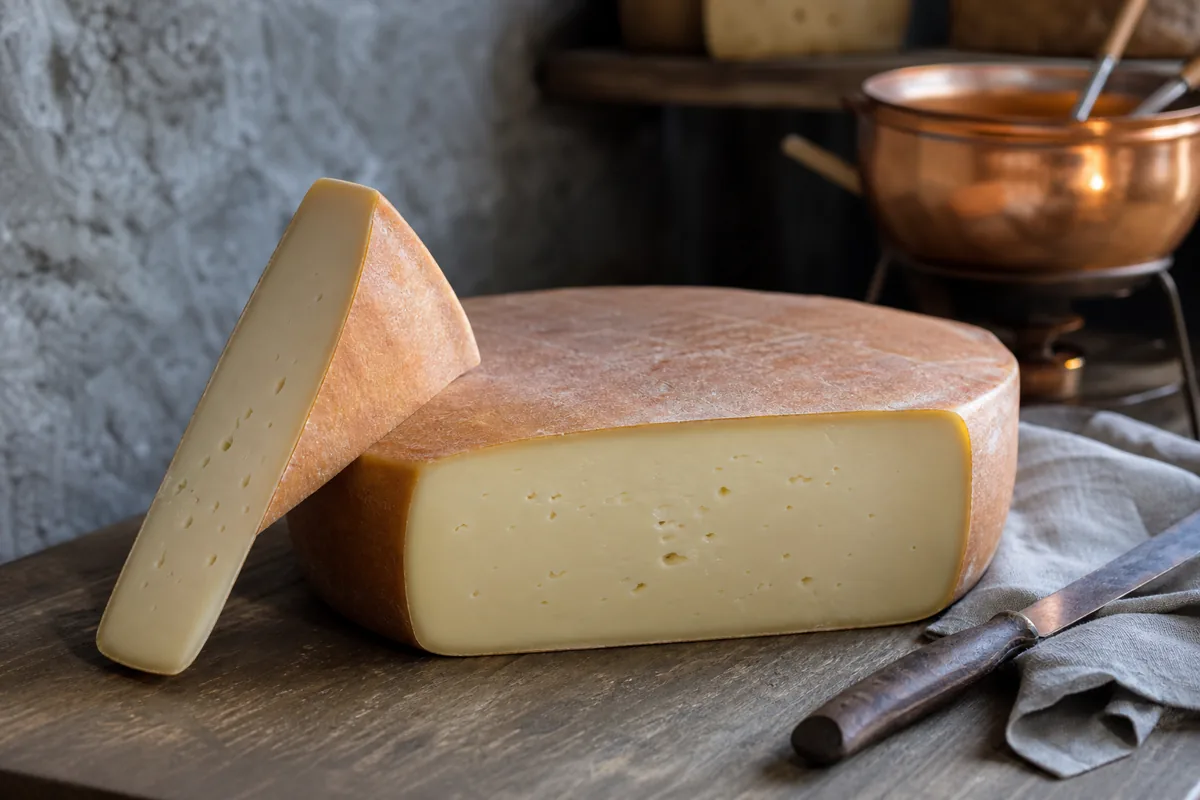
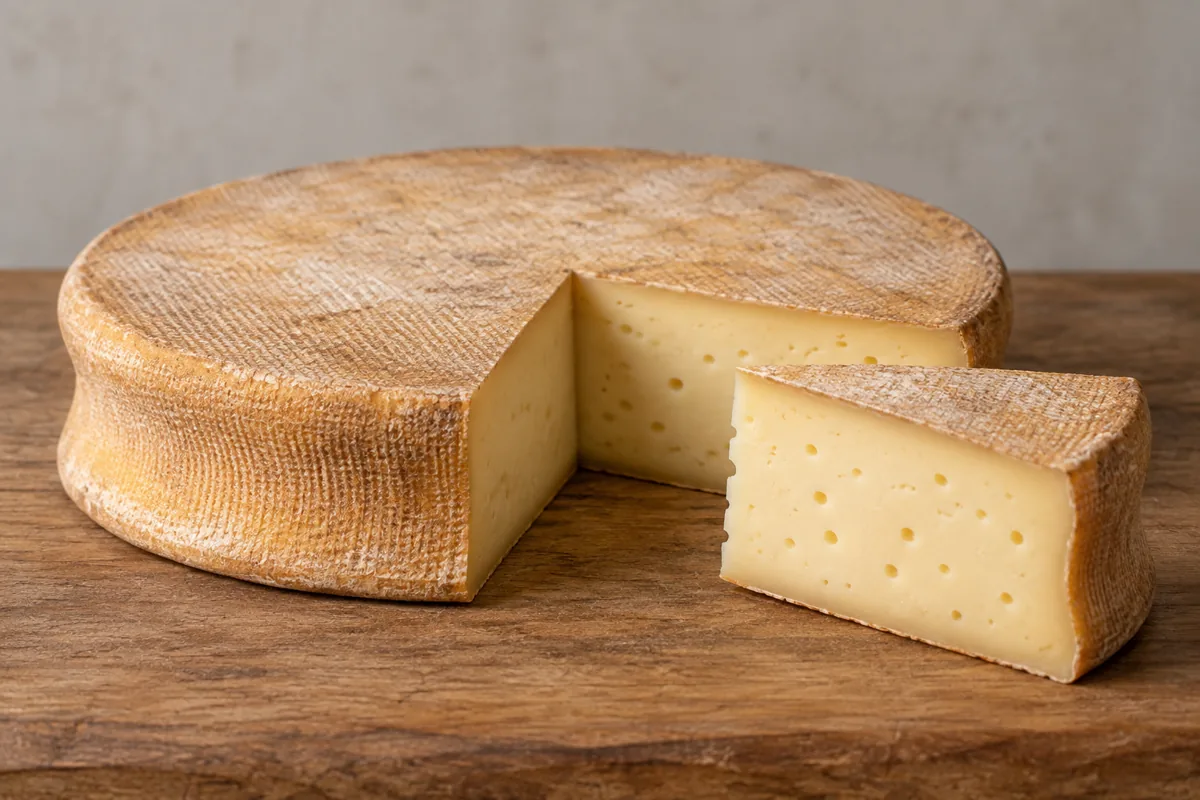
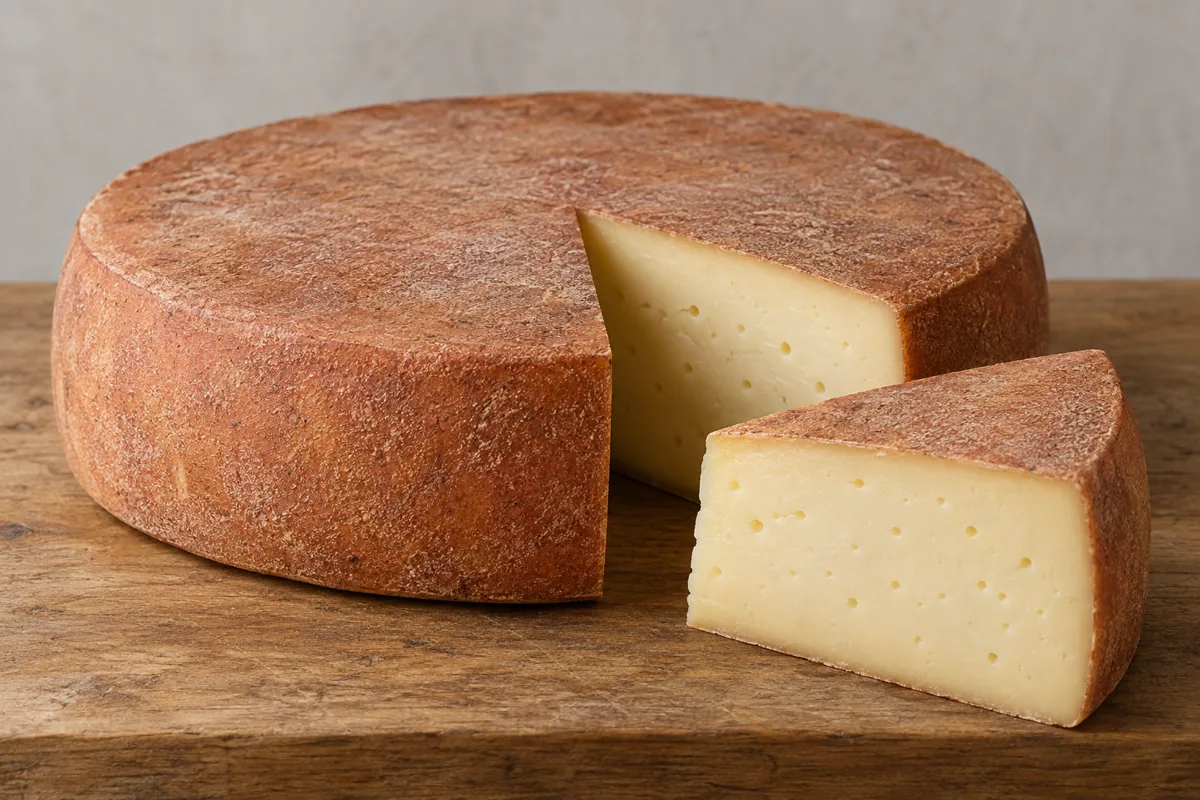
Raclette du Valais is a full-fat, semi-hard cheese in a flat round wheel 29 to 32 cm across and 6 to 8 cm high, as the specification that the Swiss Federal Office for Agriculture holds describes it. The specification gives its paste as smooth, supple and unctuous, and its smooth, slightly moist rind as a natural brown to orange.
Openings in the paste are rare and even, 2 to 3 mm across at most. The same document gives the smell as fresh and lactic, like fresh butter and crème fraîche, with floral notes.
For taste it names a fresh, lactic flavour held up by acidity, with vegetal and fruity notes leading. Raclette Suisse, the trade body for raclette made across Switzerland, calls its own wheels pure and mild, growing more aromatic as they ripen.
Le Guide du Fromage describes Raclette de Savoie as melting, with a frank, balanced and very fragrant taste.
How Do Raclette du Valais, Savoie and Suisse Differ?
Raclette du Valais AOP must be made from raw cow's milk, and the specification keeps milk production, cheesemaking and ripening inside the canton of Valais. The one exception is the Spittelmatten alp, which lies in the Bernese commune of Kandersteg.
Under the specification, the wheel ripens for at least three months on raw spruce boards. Switzerland Cheese Marketing lists it at 4.8 to 5.2 kg, which sits inside the 4.6 to 5.8 kg that the specification allows.
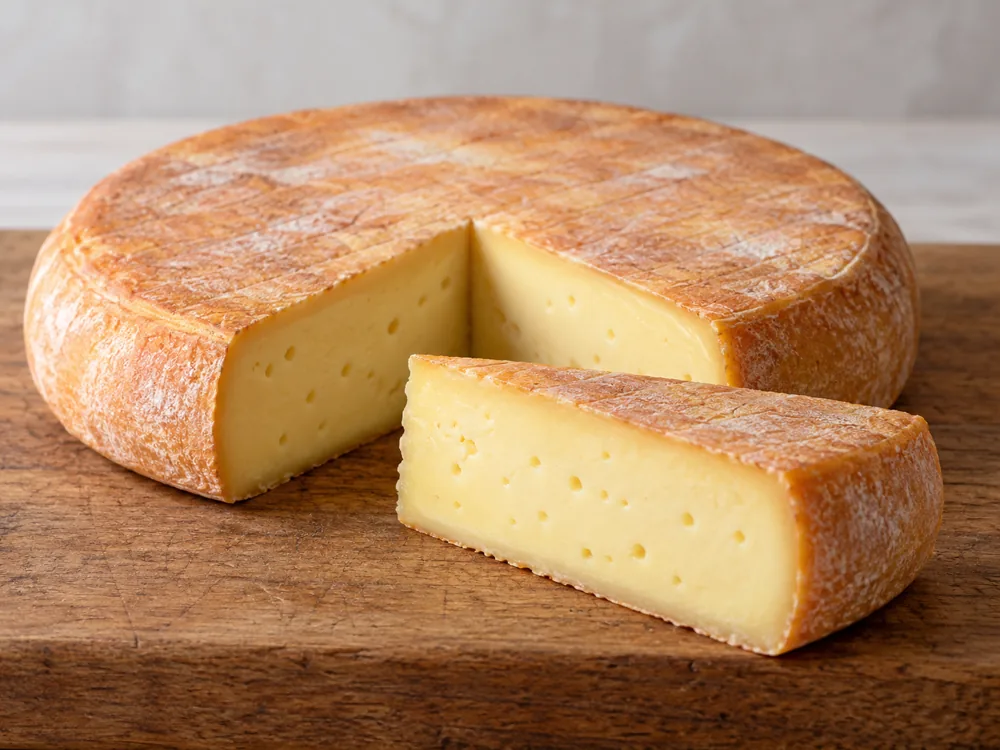
Raclette de Savoie has been an IGP since 27 January 2017. Le Guide du Fromage gives the specification as raw or thermised cow's milk in a wheel of about 6 kg, 28 to 34 cm across and 6 to 7.5 cm high, aged for at least eight weeks.
The same guide gives its paste as white to straw yellow, supple and dense at once, with perhaps a few small openings, and its rind as smooth, yellow to orange-brown, with a very fine white down.
| Point | Raclette du Valais AOP | Raclette de Savoie IGP | Raclette Suisse |
|---|---|---|---|
| Where made | Canton of Valais, with one Bernese alp | Savoie, Haute-Savoie, 27 communes of Ain and 5 of Isère | Several Alpine cantons |
| Milk | Raw cow's milk | Raw or thermised cow's milk | Raw or pasteurised cow's milk |
| Wheel | 4.6 to 5.8 kg; 29 to 32 cm across | About 6 kg; 28 to 34 cm across | Not stated |
| Ageing | At least 3 months | At least 8 weeks | 3 to 5 months given as optimal |
| Protection | AOP, decided 3 November 2003 and amended after a Federal Supreme Court ruling on 15 October 2007 | IGP since 27 January 2017 | A trade brand, not a protected name |
Raclette du Valais carries two protection dates: the specification's title page records the AOP decision of 3 November 2003 and an amendment after a Federal Supreme Court ruling of 15 October 2007, the month that Switzerland Cheese Marketing gives for the AOP.
That ruling also settled the plain word: raclette on its own is not protected, and it is used for cheeses of the same type made elsewhere in Switzerland and abroad.
Raclette Suisse covers Swiss wheels made outside the Valais rules, and its product sheet describes a full-fat, semi-hard cheese from raw or pasteurised cow's milk, made without additives in several Alpine cantons.
How Is Raclette Made and Why Does It Melt?
Raclette du Valais starts with rules on feed and milk. The specification requires that at least 75 percent of the dairy cows' coarse forage come from the Valais area, bans silage and other fermented feed, and allows no heating of the milk apart from cooling.
The vat is open and made of copper, holding up to 8,000 litres, or 3,000 at alpine dairies. The milk is warmed quickly to 32 °C and seeded with lactic cultures, and the specification calls for 30 to 60 minutes before rennet goes in at 30 to 33 °C.
It allows only water, salt, rennet and lactic and rind cultures as ingredients, and the rennet must be calf rennet. Patrimoine culinaire suisse describes a recipe with 13 cm³ of rennet per 100 litres of milk and a set of about 35 minutes, after which the curd is cut into grains the size of rice or corn.
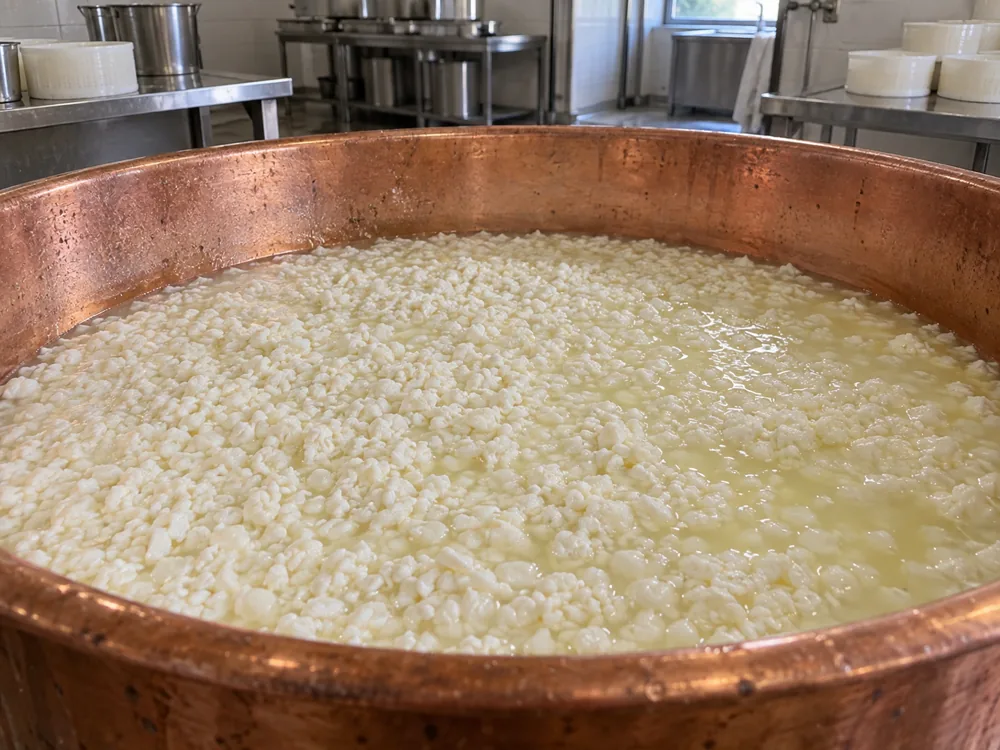
The next step in the vat is one that Le Guide du Fromage ties to the melt: it says washing the curd grains with clear water is important because it gives the maker control over how well Raclette de Savoie melts.
The Valais specification requires the same washing under the name délactosage, adding drinking water equal to 10 to 15 percent of the milk volume, though alpine dairies may skip it. The curd is then stirred, heated to 36 to 45 °C and stirred again.
Raclette Suisse credits the special bacterial cultures in its wheels with creating the desired melting qualities.
The curd is pressed for at least an hour with the wheels turned at least twice, then brined, and the specification gives the finished cheese 1.2 to 2.2 percent salt. Patrimoine culinaire suisse's recipe presses in stages, with turns up to the eighth hour, and leaves the wheels in the brine for 24 hours.
Ripening cellars run at 7 to 14 °C and 88 to 96 percent relative humidity, according to the specification, and the rind forms from cultures already living in each dairy's cellar. A dairy restarting after a long break such as summer may borrow cultures from another Valais dairy.
The specification advises turning and brushing the wheels daily for the first 10 days, three times a week until day 30 and twice a week after that. Patrimoine culinaire suisse describes a different routine: rubbing with salt water and turning daily for 14 days, three times a week for the next 21 days and twice a week for the last 60, which adds up to 95 days, just over the three-month minimum.
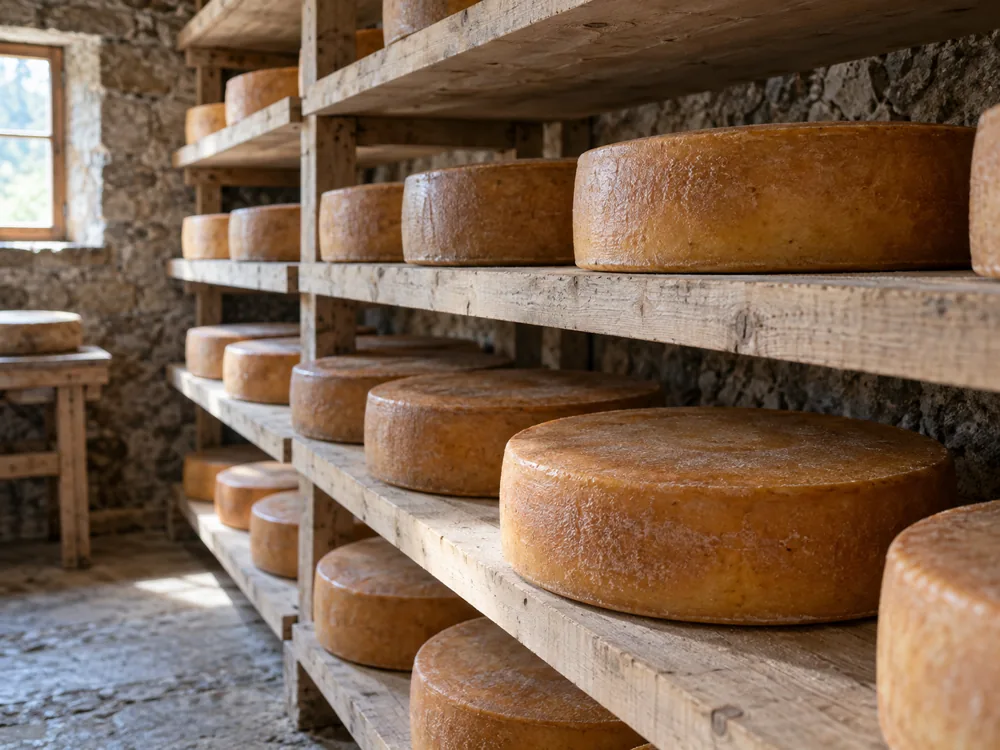
Le Guide du Fromage describes Raclette de Savoie along the same lines: milk at 32 to 36 °C with lactic ferments, grains washed and pressed, a brine bath and at least eight weeks on wooden boards. Acidification from moulding to brining lasts at least five hours, and the maker may be a farm or a dairy.
Is There a Raclette Made for Slicing or Shaving?
Yes. The Valais protection also covers two named specifications, Raclette du Valais à la coupe, the version for eating in slices, and Raclette du Valais à rebibes, the version for shaving.
Patrimoine culinaire suisse says the cheese is eaten unmelted too, and that on the Valais plate it sits beside dried meat, dried bacon, dried ham, dried sausages and rye bread.
| Point | Raclette du Valais | À la coupe | À rebibes |
|---|---|---|---|
| Minimum ripening | 3 months | 2 months | 12 months |
| Paste | Semi-hard; smooth, supple, unctuous | Semi-hard; smooth, supple, unctuous | Extra-hard; firm, hard, slightly crumbly |
| Rind | Brown to orange, brushed | Brown to orange, brushed | None |
| Weight | 4.6 to 5.8 kg | 4.3 to 5.8 kg | 3.3 to 5 kg |
| Water in the fat-free cheese | 600 to 640 g per kg | 570 to 620 g per kg | Under 500 g per kg |
| Taste | Fresh, lactic, acidity, vegetal and fruity notes | Same as the melting wheel | Medium-salty, slightly milky, same acidity and notes |
Under the specification, rebibes wheels ripen in a drier cellar, 70 to 80 percent humidity against 88 to 96 for the melting wheel. At 3 to 4 months they are soaked in 22 to 25 °C water for 25 to 30 minutes, the rind is scrubbed off, and after 12 hours of drying the wheel is rubbed with two parts vegetable oil to one part flavoured table vinegar.
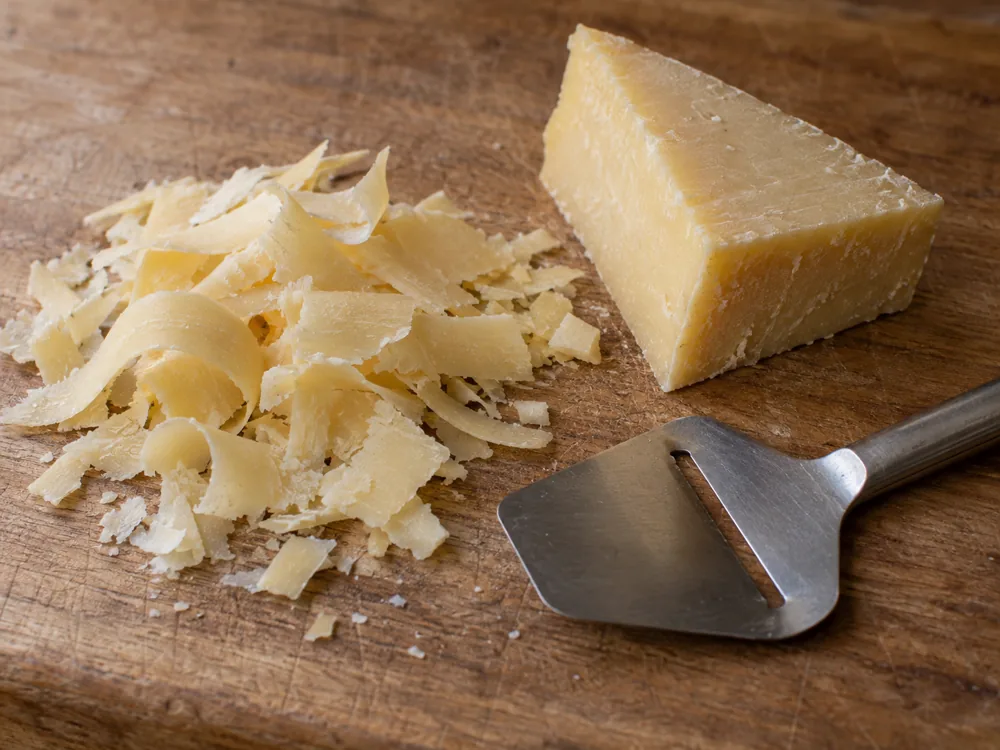
Patrimoine culinaire suisse says wheels aged for this purpose become very hard and are cut into fine shavings with a cheese plane and eaten raw. It adds that wheels kept for several years suit slicing and are poorly suited to melting.
If you want raclette for a cold plate, the names to look for are à la coupe for slices and à rebibes for shavings.
How Do You Choose a Raclette at the Counter?
The AOP name is graded. Valais wheels are scored out of 20 on appearance, openings, paste, and smell and taste, and a score of 18 or more makes grade 1A, the only grade the specification allows to be sold cut to order or prepacked.
Grade 1B, from 16.5 points with at least 4 for smell and taste, goes into fondue mixes or is grated. Wheels under 16.5 may not carry the AOP name, so any piece you buy cut to order or prepacked under Raclette du Valais AOP is the top grade, 1A.
Every Valais wheel carries a dairy or alp name in its heel, and the specification lists the places allowed to use one, from Anniviers and Bagnes to Dixence. This heel marking dates to the 1920s, and wheels from outside the Valais are sometimes marked in imitation, though rarely.
On the surface, look for the casein mark that the specification adds, carrying the dairy number or name, the date of manufacture and the batch. Raclette de Savoie has its own casein plate marked Savoie, according to Le Guide du Fromage, with the workshop and lot number.
Rind colour gives a second clue. Patrimoine culinaire suisse says Valais rinds run from copper-red to dark brown as the wheel ages, wheels made elsewhere usually have a paler rind, and non-AOP raclette also comes in square blocks.
The same source says industrial raclette made outside the Valais is generally made from pasteurised milk, with raw milk found mostly in small dairies. It follows the Valais outline in simplified or shortened form, and most of these cheeses are rarely eaten except melted and do not suit ageing.
Look for the specification's mark on a prepacked cut piece too: it is required on whole pieces, half pieces and prepacked cut pieces, and the specification lets prepacked cheese be sold without the rind.
Where Do the Name and the Dish Come From?
The dish is older than its name. Monastery documents from Obwalden and Nidwalden show shepherds melting half a cheese loaf before the heat of an oven and scraping it off as early as the 12th century.
Melting cheese at a wood fire began in several places in the Alps, not only the Valais, and central Switzerland still makes a Bratkäse, or roasting cheese.
In Valais the first detailed account dates from 1574, when Gaspard Ambuel, a physician and pharmacist in Sion, described melting cheese before a fire. He called the cheeses flavourful, fatty, mild and tender.
Patrimoine culinaire suisse finds the word raclette in many French-language sources from 1875 and says the word was most likely taken straight from Franco-Provençal dialect, whose verb for scraping sounds almost the same.
It adds that the word entered French from the Valais, while Le Guide du Fromage says the name appeared in Savoie only at the start of the 20th century.
At the cantonal exhibition in Sion in 1909 the dish was presented as the national dish of Valais, yet cheese production stayed mostly inside the canton until the 1960s.
The 1964 National Exhibition in Lausanne gave the dish national and then international fame, and Valais dairies could not keep up with demand, so other Swiss firms began making a substitute.
Raclette de Savoie owes its fame to the ski resorts that grew from the 1960s and 1970s. Its mid-sized wheel let producers preserve modest quantities of milk, compared with the region's very large formats, and came to complement them.
The tonnages show how far production spread: in 1970 Valais and the rest of Switzerland each made about 1,000 tonnes, and in the early 2000s the split was 2,000 tonnes against 10,000.
By 2015 Swiss output reached 13,629 tonnes, of which 1,725 tonnes were Raclette du Valais AOP, which works out to roughly one tonne in eight.
How Much Raclette Cheese per Person?
Plan on 200 to 250 g of cheese per person and the same weight of potatoes by Raclette Suisse's figure, while Tourisme Haute-Savoie, a regional tourism site, sets 200 g per adult, 250 g for big eaters and 150 g for small appetites or children.
For potatoes, Tourisme Haute-Savoie adds three medium ones, about 300 g, for each adult.
| Guest | Cheese | Potatoes |
|---|---|---|
| Adult | 200 g | The same weight as the cheese (Raclette Suisse); about 300 g (Tourisme Haute-Savoie) |
| Big eater | 250 g | The same weight as the cheese (Raclette Suisse) |
| Child or small appetite | 150 g | Two to three small potatoes (Tourisme Haute-Savoie) |
Tourisme Haute-Savoie recommends firm-fleshed potatoes such as Annabelle or Roseval, which hold their shape, brushed rather than peeled before cooking, and kept warm in a bowl with a splash of water on the raclette grill.
It also suggests that you hold some of the cheese back in the fridge and put it out as appetites show.
Do You Need a Raclette Machine?
You do not need any one machine: one of the three set-ups Raclette Suisse describes uses a fire-proof electric or microwave oven.
- Traditional: a purpose-made central grill melts the face of a half or quarter wheel, and each portion is scraped off.
- Quick and simple: pre-cut slices melt in individual trays under a communal grill, or in an electric or microwave oven.
- Outdoor: a cheese grill for the balcony or garden.
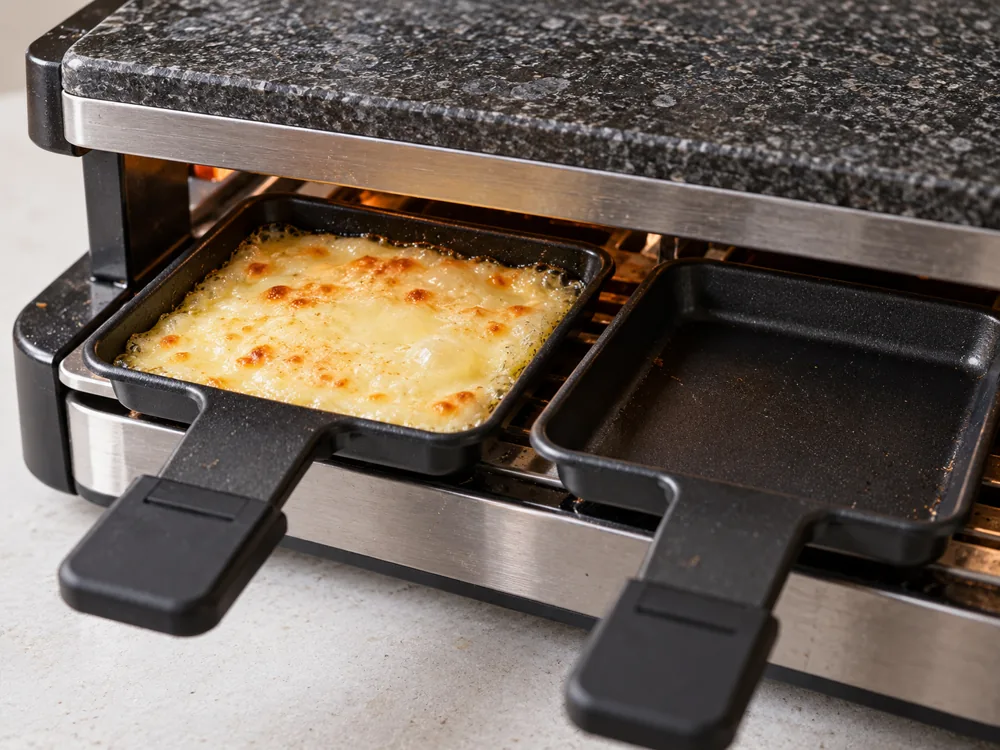
In the Valais, electric ovens built for a half wheel melt the cut face in a few seconds and the melted part is scraped onto the plate with a large knife. Elsewhere almost everyone uses ovens with individual pans, where each guest melts a rectangular slice, a method that has also grown in the Valais.
The original method needed no machine at all: the cut face of a half wheel was set facing the embers of a wood fire, a practice that survives but is exceptional.
The individual plate came from a partnership between Rippoz and Téfal in Savoie around 1975, which bonded Teflon to aluminium in place of cast iron over a wood fire, and the first electric appliances were reserved for restaurants.
Small candle-heated grills fit in a backpack, and a Vulcano grill melts cheese within 3 minutes on burning paste, with wind protection for outdoor use. Raclette Suisse's preparation page calls the large electric grill the standard fixture in many households.
How Do You Keep the Melt from Turning Oily?
Take the cheese out of the fridge 20 to 30 minutes before eating, Raclette Suisse advises, and let each slice melt but not for too long, so the aroma develops without the fat separating.
Le Guide du Fromage says Raclette de Savoie turns stringy when heated and releases little oil.
Raclette Suisse links fat separation to leaving the slice under the heat too long.
Can You Eat the Raclette Rind?
Yes. Raclette Suisse says you can scrape the rind a little but should not cut it off, because it turns crisp and aromatic as the cheese melts.
In Valais the grilled, crisp edges of the half wheel have a name of their own, the religieuse, which Patrimoine culinaire suisse says most raclette lovers prize.
What Do You Serve with Raclette?
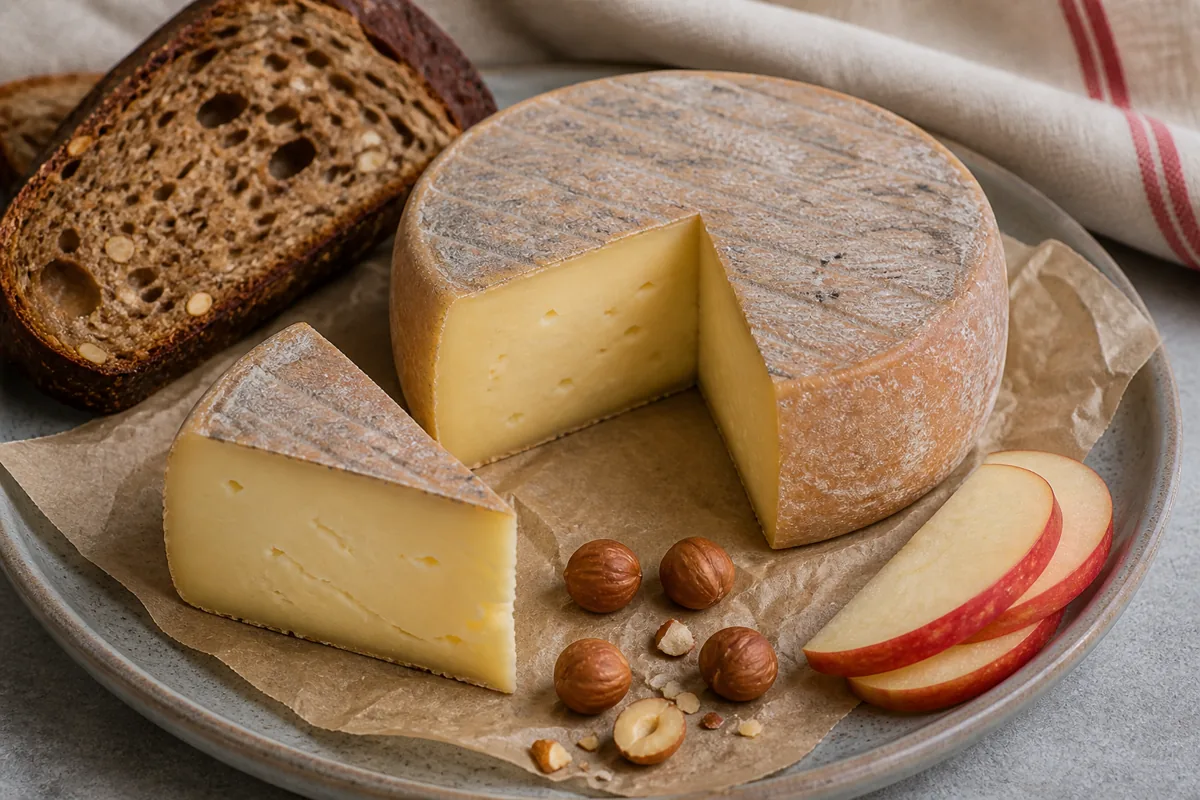
Patrimoine culinaire suisse lists boiled potatoes, vinegar vegetables such as cornichons and onions, and pepper ground over the melted cheese as the classic accompaniments, while allowing individual fancy. Raclette Suisse names pickles, silver onions and baby corn as the traditional trio.
Raclette Suisse's preparation page ties the extras to the season. Spring and summer bring cherries stewed in a little balsamic cream, raw peach slices with thyme or figs, and autumn and winter bring grapes, apples and pears, with apples and pears also suited to caramelising.
It also suggests placing a few of these ingredients directly on top of or under the cheese in your pan.
For white wine with raclette, Raclette Suisse's preparation page says dry and its product sheet full-bodied, and the sheet also names light ale where the page names sparkling apple juice.
| Pairing | Type | Why It Works |
|---|---|---|
| Boiled potatoes | Food | Cooked in their skins; Raclette Suisse gives about 30 minutes on its product sheet and about 35 on its preparation page. |
| Cornichons | Food | Named among the vinegar vegetables by Patrimoine culinaire suisse and as pickles in Raclette Suisse's traditional list. |
| Pickled onions | Food | Onions among the vinegar vegetables in Patrimoine culinaire suisse; silver onions in Raclette Suisse's list. |
| Dry or full-bodied white | Wine | Dry on Raclette Suisse's preparation page, full-bodied on its product sheet. |
| Black or herbal tea | Drink | Raclette Suisse says tea is popular because it stimulates digestion. |
| Rosé or light red | Wine | Listed on both Raclette Suisse pages, which also name light ale or sparkling apple juice. |
For dessert, Raclette Suisse suggests fresh fruit salad or fruit sorbet, since a raclette is not a light dish and a four-tier buttercream cake after it would be a tad too much.
How Does Raclette Differ from Gruyère?
The two cheeses are made differently. Le Guide du Fromage classes Raclette de Savoie as a pressed, uncooked cheese and the Valais specification heats the curd to 36 to 45 °C, while English Wikipedia says the Gruyère curd is cooked at 43 °C and raised quickly to 54 °C.
Gruyère is a hard cheese that English Wikipedia says is fully aged at five months to a year, against the three-month minimum for Raclette du Valais.
Gruyère has served as a raclette cheese before: Joseph Favre, in an 1894 dictionary that Patrimoine culinaire suisse quotes, listed a full-fat Emmental, a Gruyère, or cheeses from Thyon or Cleuson for what he called a Valais fondue but was really raclette.
A 1902 geographical dictionary, quoted by the same source, says of these Valais cheeses that their shape is that of Gruyère but that they are much fattier, with a less hard paste.
English Wikipedia calls Gruyère a good melting cheese, particularly suited to cheese fondue. If you are choosing between them, let the dish decide: a scraped plate for raclette, a shared pot for Gruyère.
The flavours differ too: English Wikipedia describes Gruyère as creamy and nutty when young and more earthy and complex with age. It says fully aged Gruyère tends to small cracks and a slightly grainy texture, while the Valais specification asks for a smooth paste with rare openings.
How Long Does Raclette Keep?
Leftover raclette stays fresh for about eight days in cling film, or around two months vacuum-packed, on Raclette Suisse's product sheet, while its preparation page gives about a week in cling film.
For your leftover slices, the same product sheet suggests cheese sandwiches, salads, soufflés and Welsh rarebit, and the preparation page adds casseroles and toast toppings.
For the smell after the meal, the product sheet suggests a lemon or orange studded with cloves and left overnight.
How Much Fat and Lactose Is in Raclette?
Raclette Suisse gives average values per 100 g of 28 g fat, 26 g protein, 42 g water and 340 kcal.
Switzerland Cheese Marketing classes Raclette du Valais AOP as a full-fat cheese and describes it as lactose-free. That listing is for Raclette du Valais AOP, so if you avoid lactose and buy a Savoie or Suisse raclette, ask the maker.
The Valais specification held by the Swiss Federal Office for Agriculture sets that fat at 500 to 549 g per kg of dry matter, which means it is measured on the cheese once its water is taken out.
A footnote to the specification adds that, because of the natural fat in milk at the end of lactation, cheese made at alpine dairies can reach the cream-cheese level.
Is Raclette Safe During Pregnancy?
It depends on the milk and on how hot the cheese is when you eat it. The milk named on the label decides the cold case, and the table above shows which milk each name allows.
For cheese eaten during pregnancy, the NHS lists pasteurised or unpasteurised hard cheeses such as cheddar, gruyère and parmesan as safe, along with pasteurised semi-hard cheeses such as edam. It also lists any cheese that has been cooked until steaming hot, including soft or blue cheese.
The NHS says foods made from unpasteurised milk must be thoroughly cooked, so a cold slice of raw-milk raclette is not on its safe lists, while raclette melted until steaming hot falls under the NHS cooked-cheese line.
The CDC lists unpasteurized (raw) milk and dairy products made from raw milk and unheated cheese sliced at a deli among riskier choices, and pasteurized soft cheeses heated to an internal temperature of 165°F or until steaming hot and deli-sliced cheeses heated to 165°F or until steaming hot among safer ones. It adds that pregnant women are 10 times more likely to get a Listeria infection.
If you follow CDC advice and want heated raw-milk raclette, ask your midwife or doctor first, since those heated lines name pasteurized soft cheese and deli-sliced cheese. Served cold, pasteurized raclette is described as a semi-hard cheese, a type the CDC list does not cover, so ask a midwife or doctor.
SOURCES & REFERENCES
What Else Do People Ask About Raclette?
Cow's milk. Raclette du Valais AOP uses raw milk, Raclette de Savoie IGP raw or thermised milk, and Raclette Suisse raw or pasteurised milk.
Patrimoine culinaire suisse notes that raclette made outside the Valais is rarely eaten any way but melted, while the Valais cheese is also cut or shaved. If you are pregnant, check the milk first: a cold slice from a raw-milk wheel is not on the NHS safe lists.
The name comes from the French verb racler, to scrape, because the melted face of the cheese is scraped onto the plate.
Gruyère is a harder, cooked-curd cheese that Wikipedia describes as particularly suited to fondue. An 1894 dictionary quoted by Patrimoine culinaire suisse listed Gruyère among the cheeses for a Valais dish that was really raclette.