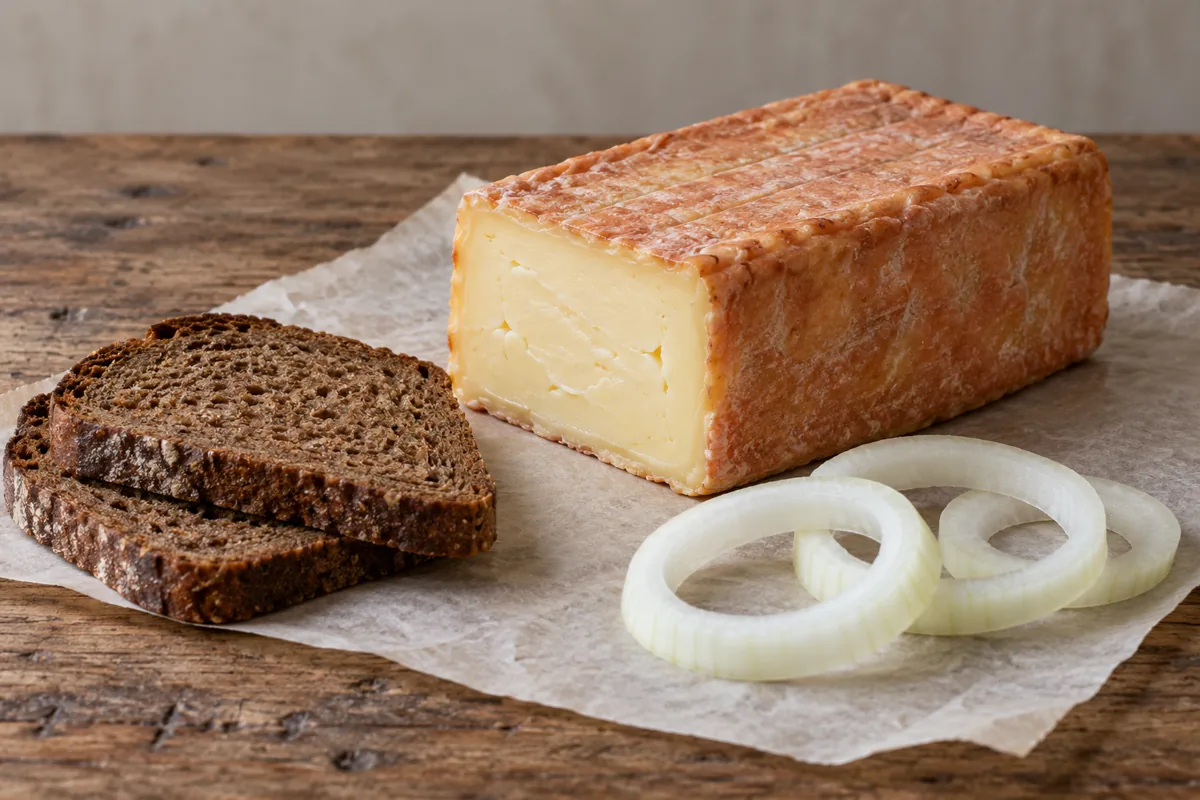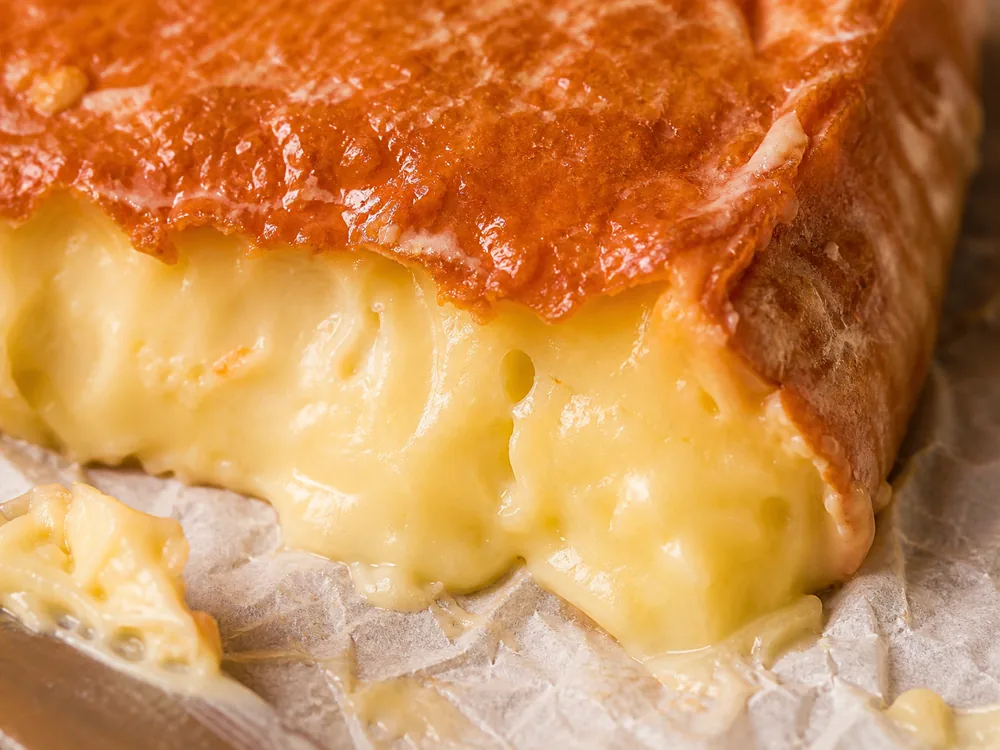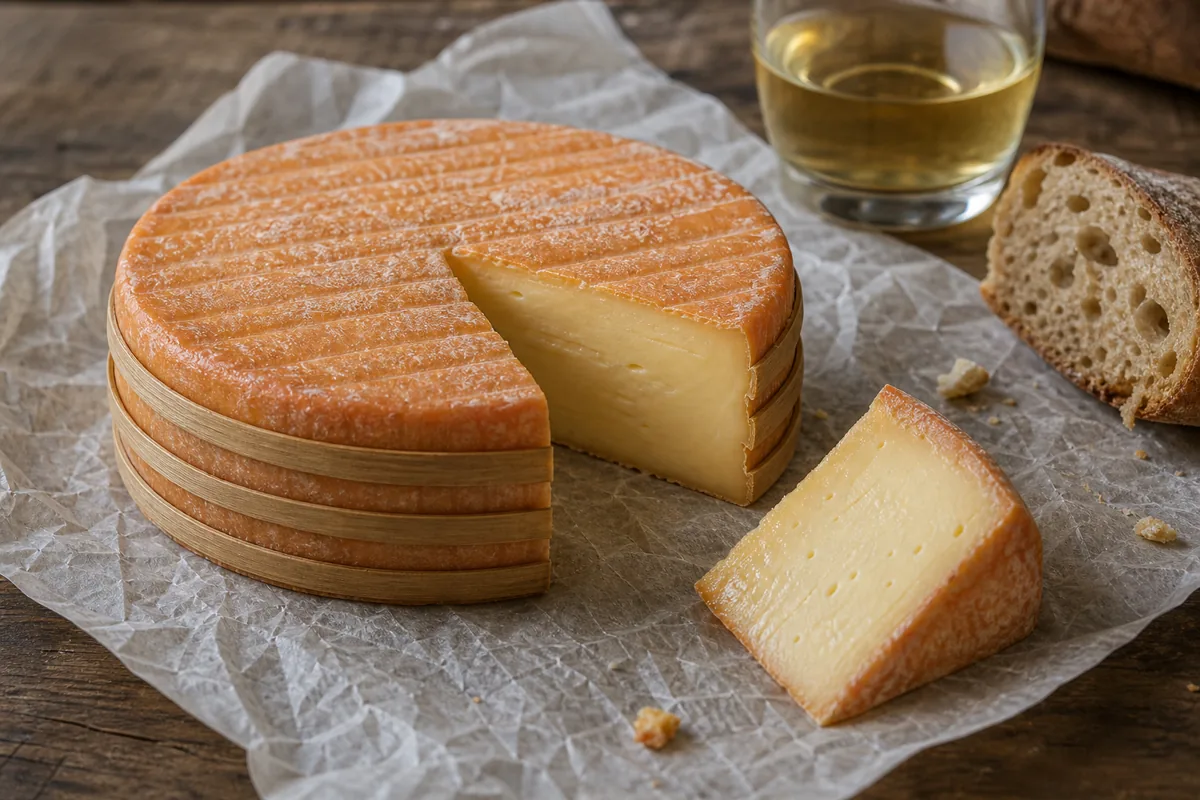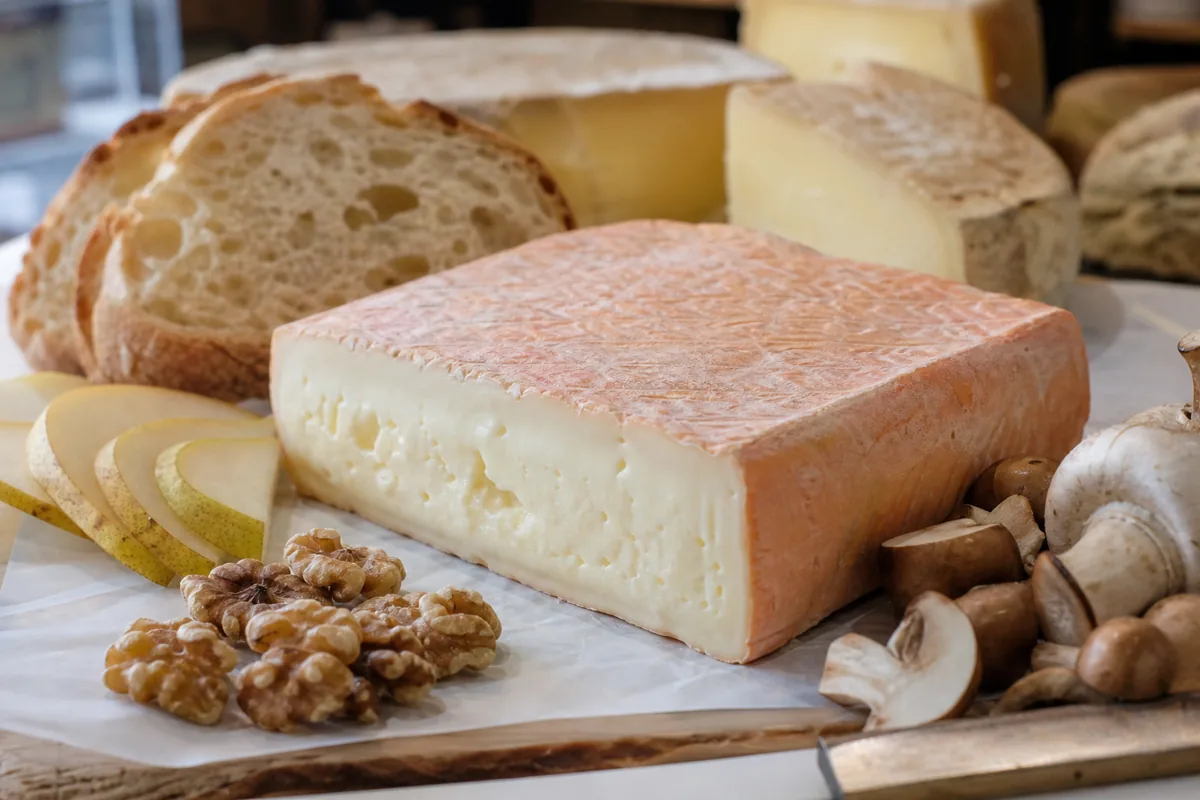
Taleggio is a soft Italian cow's-milk cheese with a brine-washed rind and a creamy centre. Its pinkish surface has a pronounced aroma, while the interior is generally milder, with dairy sweetness and savoury notes.
It works both as a table cheese and melted into a dish, especially when you want more rind character than Brie brings.
The DOP name identifies a protected cheese, but it does not tell you whether a particular pack uses raw or pasteurized milk. That label distinction matters when buying for someone who is pregnant.
In This Article
What Makes Taleggio a DOP Cheese?
Taleggio takes its name from the Lombard area around Val Taleggio and Valsassina. Its protected production area extends beyond the valley, covering specified provinces in Lombardy, Piedmont and Veneto, including Bergamo, Novara and Treviso.
The specification published in July 2022 defines a square cheese with sides of 18-20 cm and a weight of 1.5-2.5 kg at the end of its minimum maturation. A shop-cut wedge is a portion of that square, rather than a separate smaller format.
During at least 35 days of ripening, the cheeses are turned and their rinds treated with water and salt. The specification permits no other rind treatment, so the wash is distinct from the wine or spirit washes used for some other cheeses.
Thirty-five days is the minimum, not the age of every piece at the counter.
What Does Taleggio Taste Like?
The PDO specification describes a sweet, aromatic flavour with balanced saltiness, dairy notes and a truffle-like aftertaste. Here, sweet means a dairy impression rather than added sugar.
The smell can be more forceful than the taste: Cooperativa Sant'Antonio describes that contrast in its own washed-rind cheeses. Cademartori also describes its younger Taleggio as delicate and its more mature cheese as more pungent.
The interior softens especially close to the rind, so a cut piece need not have an identical texture from edge to centre. Taleggio is not a blue cheese; its characteristic surface growth is different from the interior blue veining of Gorgonzola.
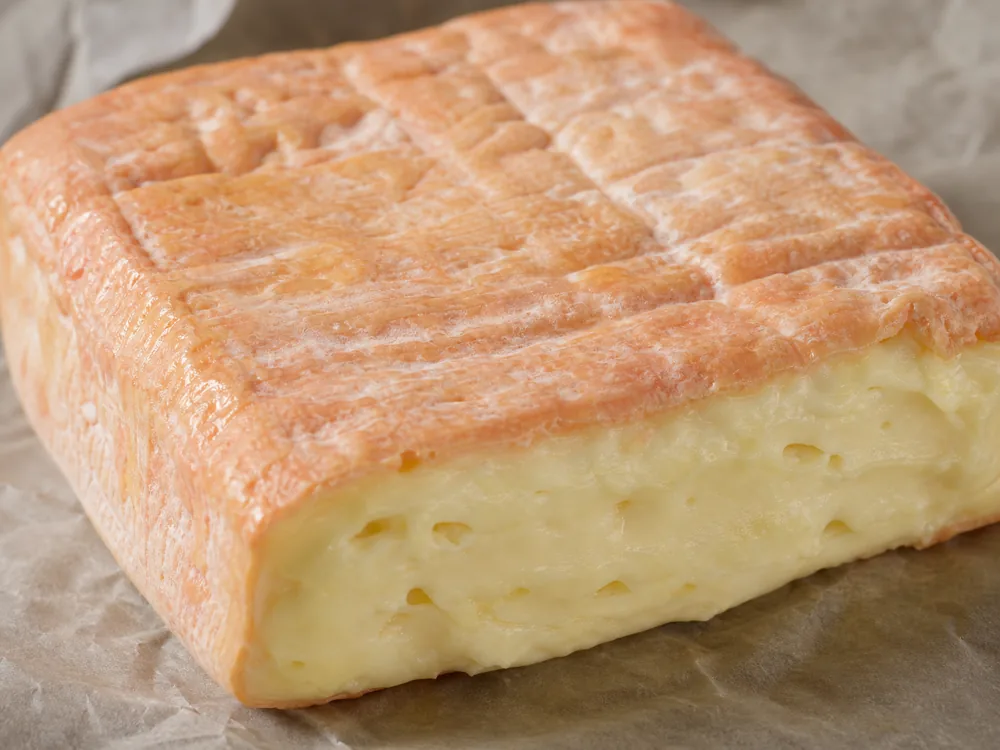
The natural rind is edible, though you can trim it for taste or to keep pieces of rind out of a smooth sauce.
That choice does not resolve food safety: removing the rind cannot make an improperly stored cheese suitable to eat. A normal smell or appearance cannot establish that harmful bacteria are absent.
How Do You Cook and Serve Taleggio?
For risotto, dice the cheese so it disperses easily through the rice. Cademartori's radicchio risotto finishes with Taleggio stirred in after the heat is switched off; this is a cooking method, not proof that a dish meets a pregnancy-safe heating condition.
For a pourable sauce, its fonduta recipe melts small pieces into heated milk and cream. That gives a sauce for vegetables, pasta or potato gnocchi, rather than relying on a slice of cheese alone to cover the plate.
Trim the rind before dicing if you want the sauce to be smooth. A softer centre can still be used in a cooked dish, provided the cheese has been stored correctly and remains within its labelled conditions.
At the table, try a small portion with bread and pear, or add walnuts for crunch. Cademartori also suggests fruit, honey and preserves as companions.
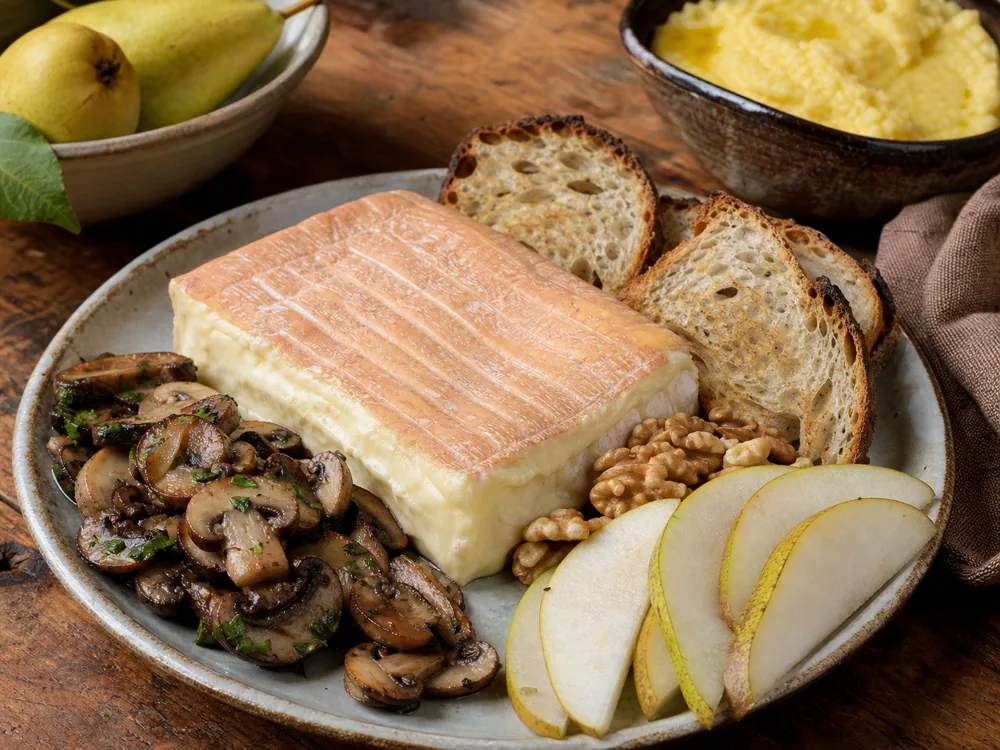
If you prefer the texture less cold, set out only the portion for the meal and keep the rest refrigerated. Time spent softening it counts toward the food-safety limits below.
What Can Replace Taleggio?
Choose a replacement for the part of the dish that needs Taleggio: its melt, its soft texture or its assertive flavour. No single alternative reproduces all three.
| Alternative | Where to try it | What changes |
|---|---|---|
| Fontina | A melted sauce or hot potato dish | A firmer cheese with an Alpine character; it will not reproduce Taleggio's soft centre. |
| Brie | Bread or a soft-cheese plate | A bloomy rind and a different flavour; it preserves the soft serving style rather than the brine-washed identity. |
| Gorgonzola dolce | A creamy sauce where blue cheese is welcome | Blue flavour becomes part of the dish, so it is a deliberate change rather than a close match. |
These are culinary options, not interchangeable dietary choices. Check the replacement's milk and ingredients if the meal has a pregnancy, allergy or vegetarian requirement.
Does Taleggio Use Raw Milk, and Is It Vegetarian?
Taleggio can be made with raw or pasteurized cow's milk. Cademartori specifies pasteurized milk for its product, but that does not establish the milk treatment of another maker's Taleggio.
The PDO rules require animal rennet from calves or young cattle, so Taleggio DOP is not suitable for a diet that excludes animal rennet.
Nutrition also belongs to the actual product. Ambrosi's Taleggio record lists 312 kcal, 26 g fat, 19 g protein and 2.1 g salt per 100 g; these are its declared values, not a universal analysis of all Taleggio.
The PDO minimum of 48% fat in dry matter excludes water from the calculation. It does not mean that every 100 g of cheese contains 48 g of fat, and neither a low sugar nor a low carbohydrate value establishes a lactose-free claim.
How Long Does Taleggio Last?
Follow the pack's use-by date and any after-opening instructions. For a piece cut at a counter, ask for the storage directions and date supplied with that cheese; an unopened shelf life does not restart when the cheese is cut.
There is no universal one-to-two-week allowance for an opened wedge.
Keep it refrigerated in the wrapping or resealable pack recommended by its maker, with the exposed cheese covered. FDA household guidance calls for a refrigerator at 40 F (4 C) or below; use the stricter condition if the label requires it.
For serving, FDA limits perishable food outside refrigeration to two hours, or one hour when the air is above 90 F (32 C). Count preparation and time on the table together, and discard cheese left out beyond that limit.
Neither a stronger smell nor a softer centre gives permission to ignore the date or temperature history.
Is Taleggio Safe During Pregnancy?
A raw-milk DOP cheese is still a raw-milk cheese for food-safety decisions. In the US, the CDC lists soft cheese made from unpasteurized (raw) milk as riskier and pasteurized soft cheeses heated to an internal temperature of 165 F (74 C) or until steaming hot as safer.
Simply melting Taleggio into warm rice does not show that it has reached that heating condition throughout.
Served cold, a pasteurized Taleggio is described as a soft washed-rind cheese, a type the CDC list does not cover, so ask a midwife or doctor.
French public-health guidance advises pregnant readers to avoid soft washed-rind cheeses, including pasteurized versions. Taleggio belongs to that category, so serving a cold wedge does not follow that advice.
In the UK, the NHS lists pasteurised soft cheeses and any cheese that's been cooked until steaming hot as safe to eat, and says foods made from unpasteurised milk must be thoroughly cooked. Check the milk on the label, because the DOP allows raw or pasteurized milk.