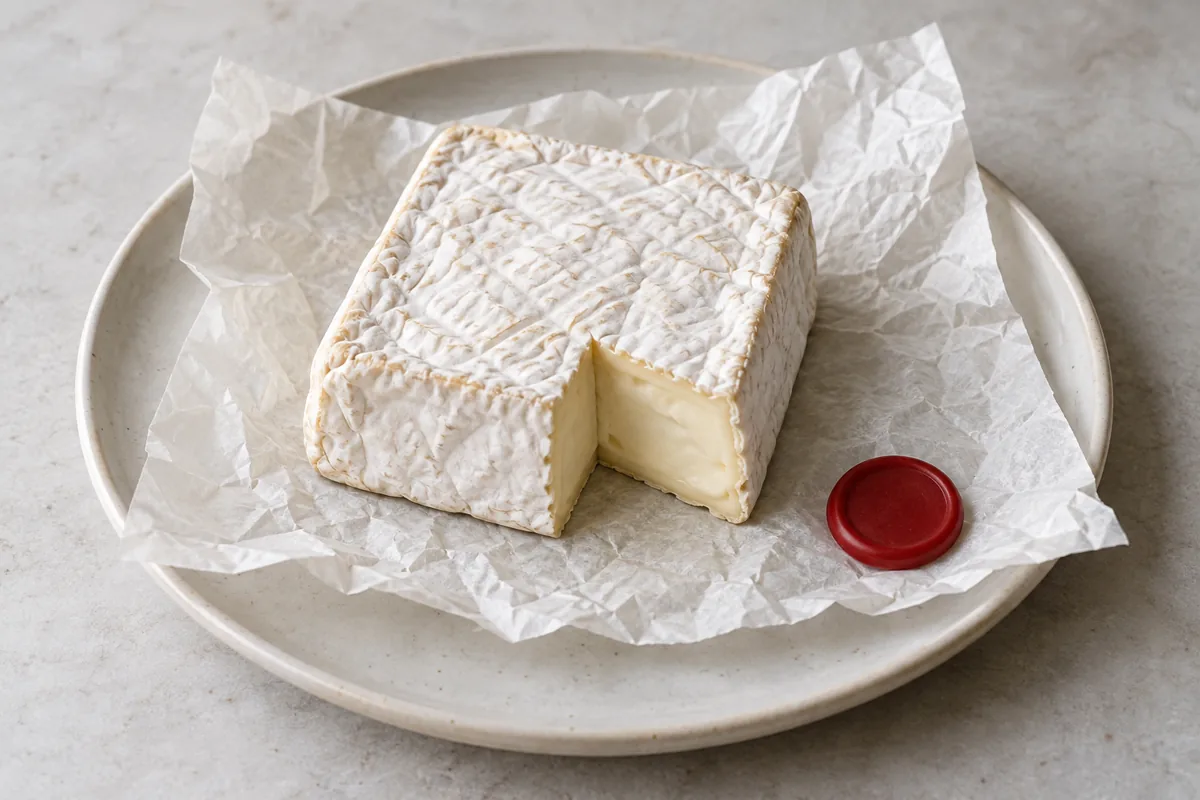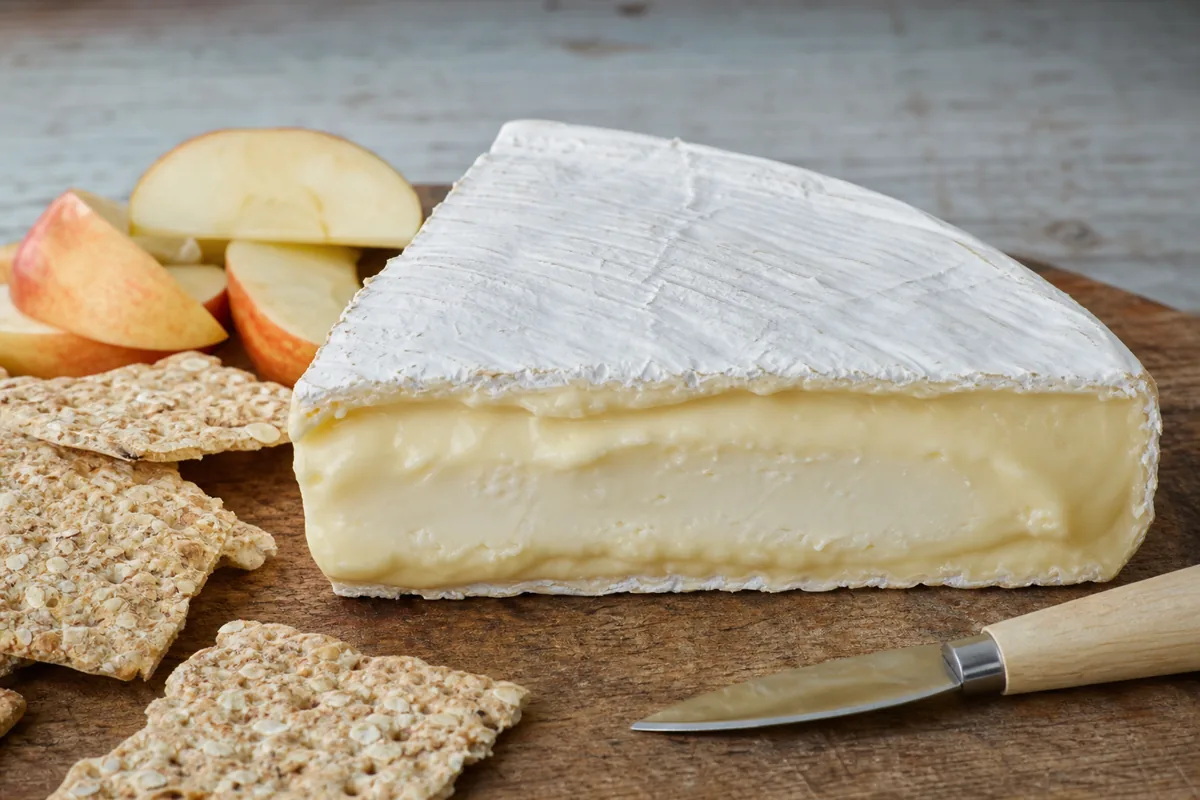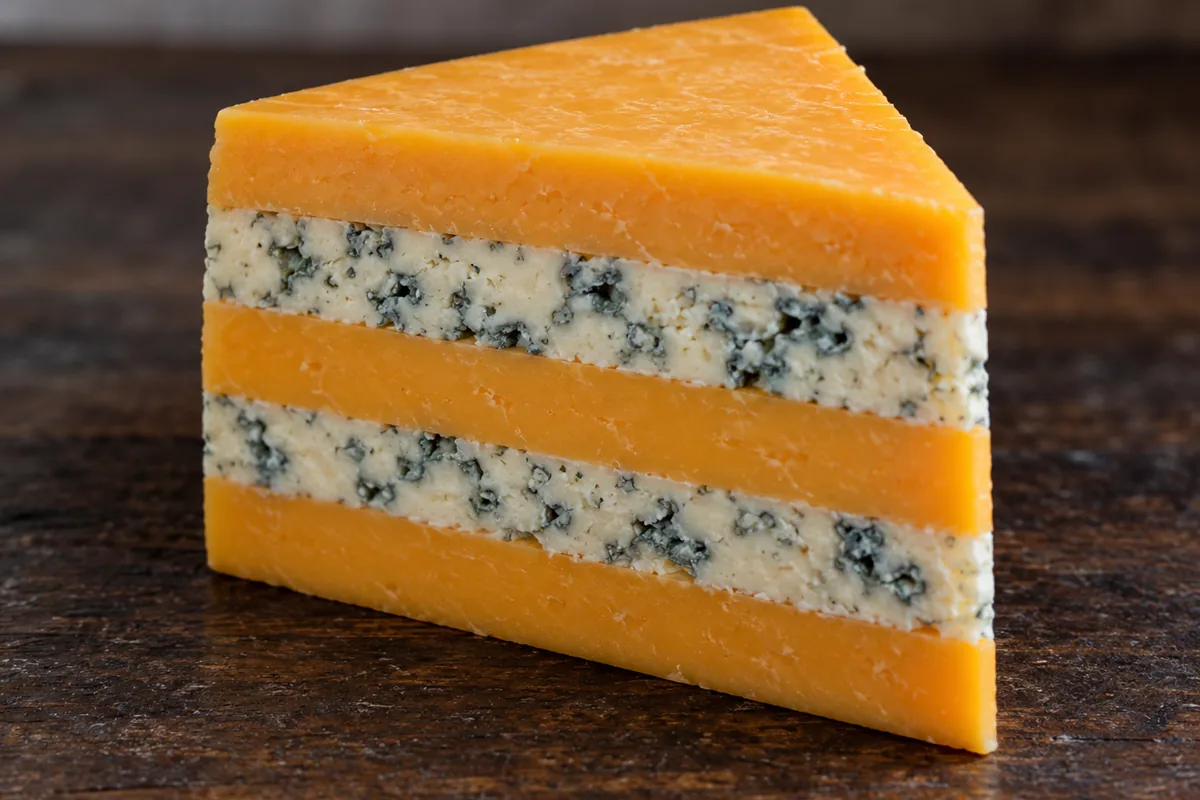
Huntsman is a layered cheese that Long Clawson Dairy in Leicestershire makes from Double Gloucester and Blue Stilton, in either three or five layers.
The layers stack on top of each other, so a portion cut from the top of the stack to the bottom carries both cheeses, while a cut along one layer gives only one of them.
In This Article
What Is Huntsman Cheese?
Huntsman is a trademarked name, and Long Clawson Dairy says the cheese is produced only at its dairy, where it was first created in the 1960s. The dairy describes it as a pasteurised cow's milk cheese made with its traditional Blue Stilton and Double Gloucester recipes.
CooksInfo dates the name to at least 1982, citing a People magazine article of 29 November 1982 that described Huntsman as "a combination of Stilton and Double Gloucester cheeses assembled like a layer cake". That is the earliest date CooksInfo documents, so it leaves Long Clawson's 1960s start unchallenged.
Each half is a finished cheese before the two meet. Long Clawson's trade product sheet says the dairy cuts its own Blue Stilton into rings and layers them by hand between rings of Double Gloucester.
The Academy of Cheese puts ages on the two halves: the Double Gloucester is aged for around three months and the Stilton matured for around 12 weeks.
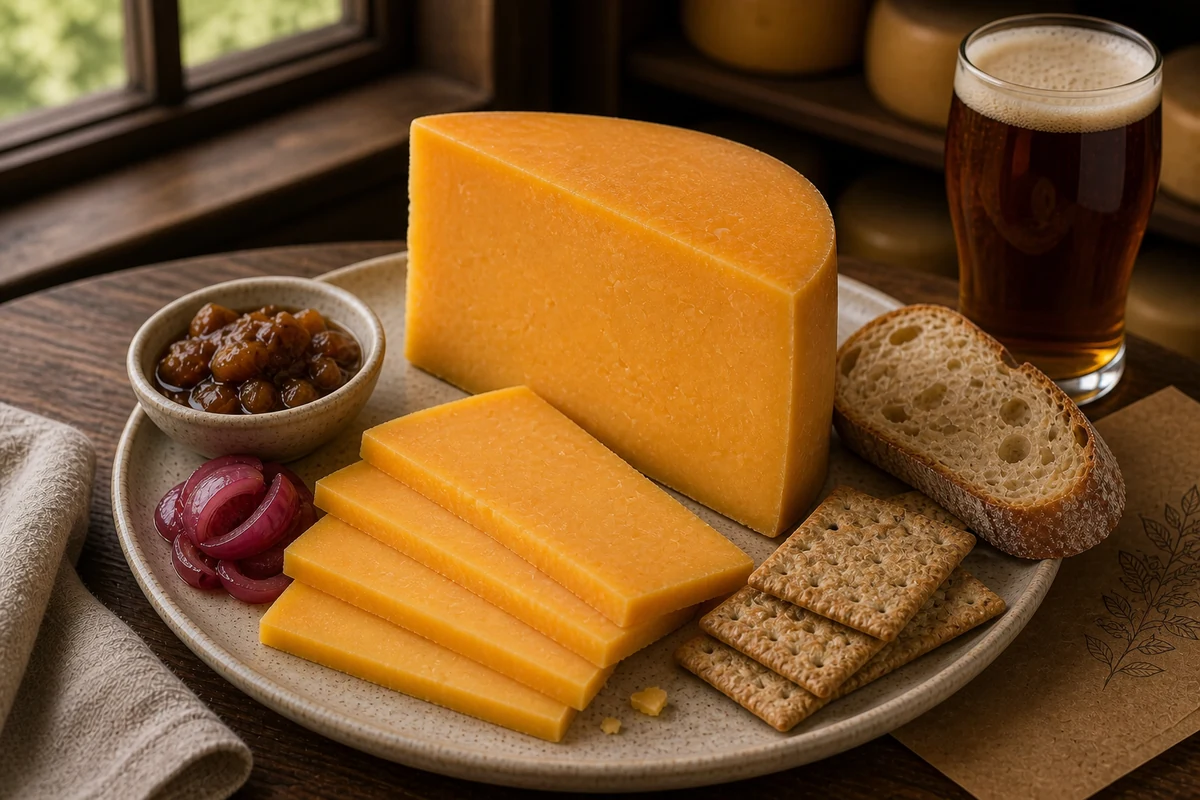
The orange comes from the Double Gloucester, which Long Clawson says has a "characteristic light orange hue given by the addition of annatto to the milk". On a cut face, the orange bands are therefore Double Gloucester and the bands carrying the blue mould are Stilton.
How Is Huntsman Made?
Long Clawson says rings of its Double Gloucester are moulded by hand to sandwich slightly smaller rings of Stilton, which gives the layered effect through the whole wheel.
The Academy of Cheese describes the first step: vacuum-packed cylinders of Double Gloucester are cut into circular slices, which are then layered with slightly smaller slices of Stilton. Each layer is therefore a finished cheese before assembly, not a mixed curd.
The dairy makes the wheel in three or five layers. CooksInfo gives the split as two Double Gloucester layers and one Stilton layer in the three-layer version, and three Double Gloucester layers and two Stilton layers in the five-layer one.
The trade sheet names a count that no other source uses: its product title reads "2 Layer Huntsman Half Wheel", where Long Clawson's consumer page and CooksInfo give three or five layers. Whether that is half of a larger wheel or a separate build is not documented.
The Academy of Cheese describes a five-layer wheel as five 1.5 cm layers and says the pliable Double Gloucester is shaped around the Stilton by hand. That puts Double Gloucester around the Stilton at the edge of the wheel, so the blue shows on a cut face rather than on the outside.
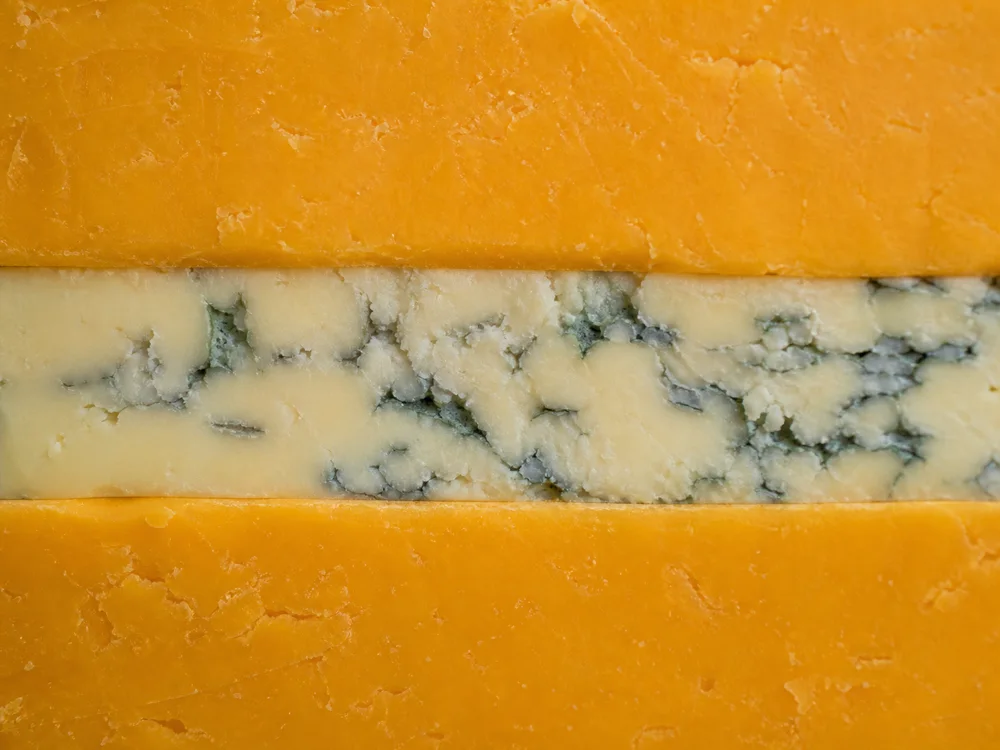
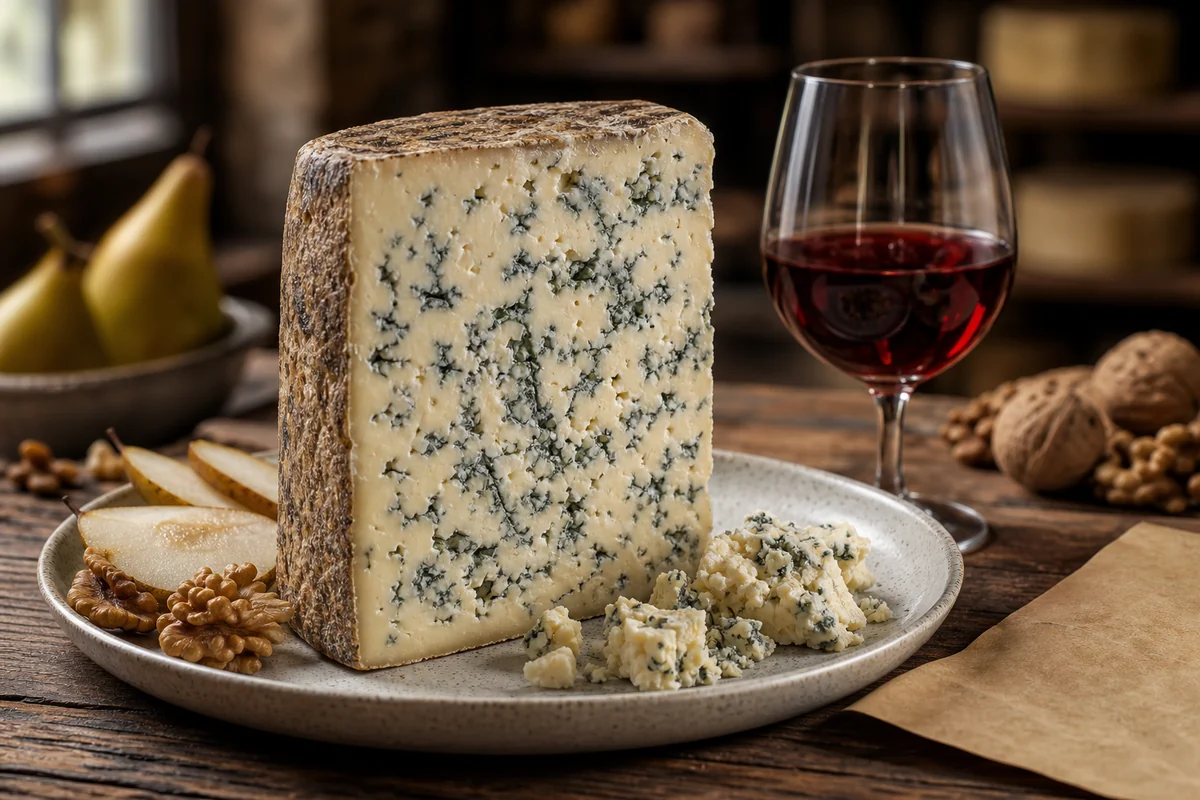
The layers differ so much on a cut face because the two cheeses are made differently. Wikipedia describes Blue Stilton as unpressed, with veins that form when needles pierce the crust and let air into the core, while Long Clawson describes its Double Gloucester as firm and close in texture.
The Academy's Stilton age of around 12 weeks sits at the top of the nine to twelve weeks that Wikipedia gives for making and ripening Stilton, so the Stilton has finished its usual ripening by the time it is layered.
How Is Huntsman Different From Cotswold and Similar Cheeses?
Wikipedia lists two variations of Double Gloucester side by side: Huntsman, made with alternating layers of Double Gloucester and Stilton, and Cotswold, Double Gloucester blended with chives and spring onions.
The difference shows in the paste. Huntsman keeps the Double Gloucester and the Stilton in separate bands, while Cotswold carries its flavouring through the whole cheese.
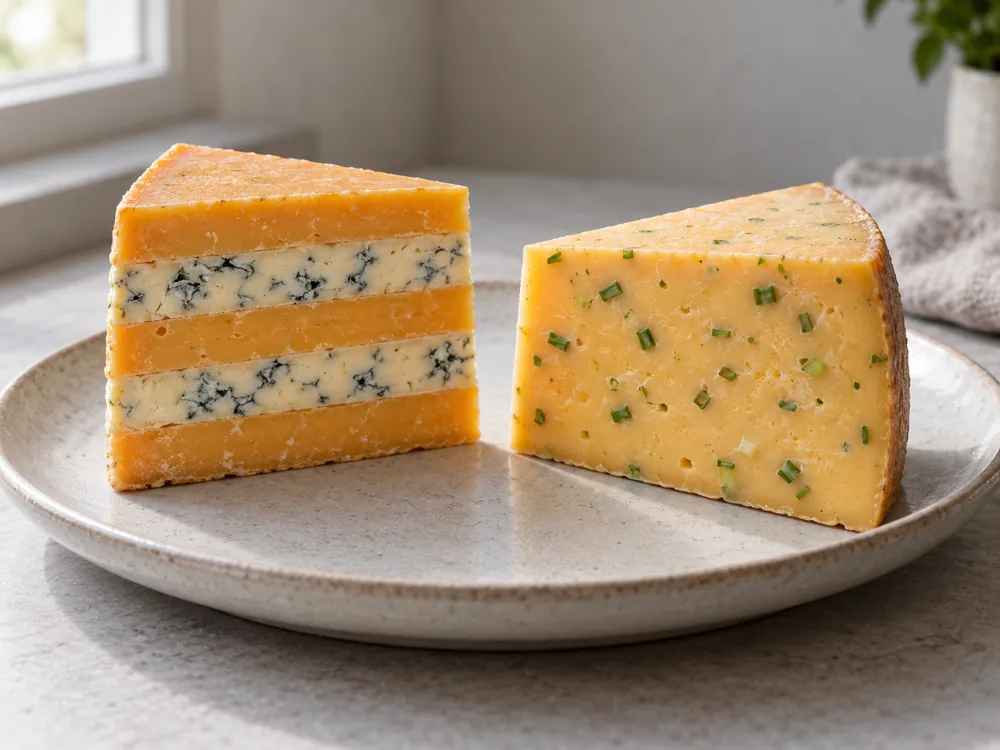
Long Clawson says Huntsman is now sold in a number of countries, and CooksInfo records the name as a granted trademark in Australia in 1985 and in the United States in 2008.
In the United States the application was initially opposed by Ilchester Cheese Company, the maker of the similar Somerset Blue. CooksInfo lists Somerset Blue and Dairy Crest's Stilchester as similar products without describing how either is made.
Orange and blue layers under the Huntsman name come from Long Clawson Dairy. Double Gloucester with chives and spring onions blended through it is Cotswold, and a similar cheese under another name is a different product.
What Does Huntsman Taste Like?
Long Clawson sets a Double Gloucester with a "clean mellow, creamy and buttery taste" against a "bold and expressive tangy Blue Stilton". The Academy of Cheese describes the same pair in its own words, which the table sets side by side.
| Layer | Long Clawson Dairy | Academy of Cheese |
|---|---|---|
| Double Gloucester | Firm, close texture; clean, mellow, creamy and buttery | Smooth and golden, creamy, with savoury notes |
| Blue Stilton | Bold, expressive and tangy | Crumbly, with salty, savoury and lactic notes |
Long Clawson says flavour levels depend on the age of the cheese. Wikipedia says Double Gloucester ages longer than Single Gloucester and tastes stronger and more savoury for it, and its infobox lists 36 weeks for Gloucester cheese.
The Academy puts the Double Gloucester in Huntsman at around three months, about 13 weeks, far younger than that listing. That fits Long Clawson's "clean mellow" wording and means the layer is milder than a long-aged Double Gloucester.
Going by layer count, Double Gloucester is the larger share of every Huntsman: two of three layers in the small wheel and three of five in the large one. The Stilton share is one layer in three against two in five, so the five-layer wheel carries more blue by count.
At the Academy of Cheese's 1.5 cm per layer, the two Stilton layers of a five-layer wheel add up to 3 cm of a 7.5 cm stack. Because Long Clawson says the Stilton rings are slightly smaller than the Double Gloucester rings, Stilton's share of the cheese by volume falls below its share of the thickness.
How Do You Cut Huntsman's Layers?
Cut from the top of the stack to the bottom so the blade passes through every layer. Each portion then holds Double Gloucester and Stilton, where a cut running along one layer lifts off a slab of a single cheese.
This comes from how the wheel is built rather than from producer advice. Long Clawson's pages give no cutting instructions for a retail wedge, and its trade sheet for a half wheel says only to remove the packaging and cut with a wire.
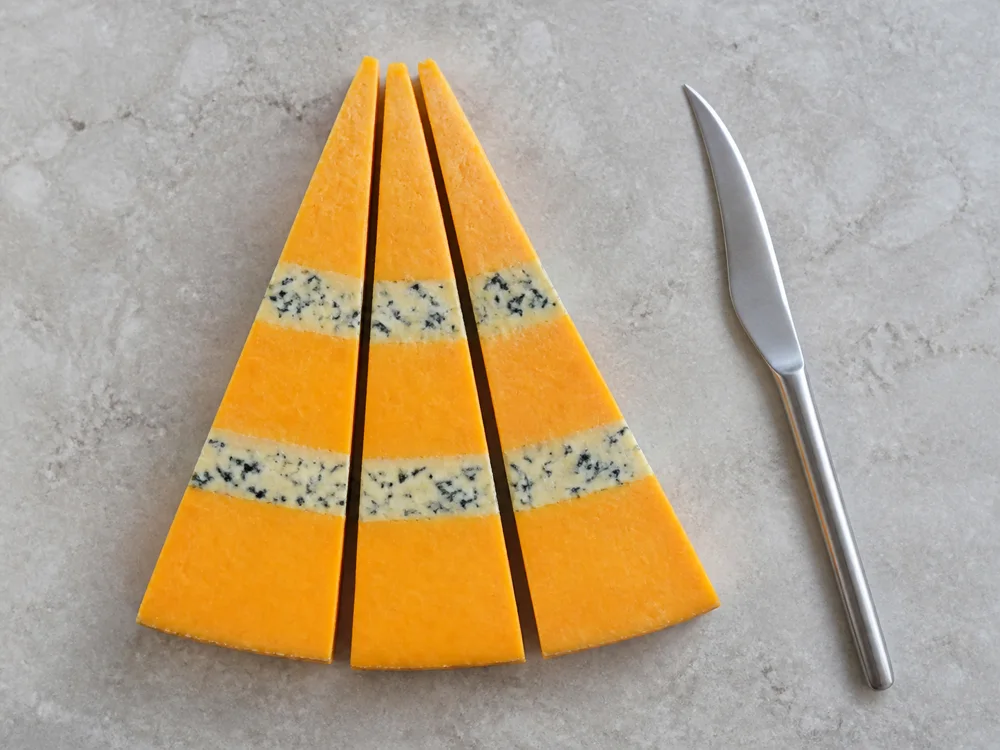
The face of a retail piece shows which way it was cut. Bands of orange and blue mean the blade went across the layers, while a face of one colour means it ran along a single layer.
What covers the outside is less clear. The Academy's finish line lists both natural rind and artificial finishes such as maturing in a vacuum pack.
How Big Is a Huntsman, and How Many Servings Is That?
The Academy of Cheese lists an approximate weight of 2 kg and dimensions of 9.6 cm high, 11 cm wide and 22.2 cm long, with its diameter field left blank. Width and length are how a block or a cut piece is measured, whereas Long Clawson describes rings and wheels, and the Academy does not say which format it measured.
Five 1.5 cm layers add up to 7.5 cm, 2.1 cm less than the listed height.
The trade sheet describes a different piece, a half wheel, and its 128 servings of 28 g multiply out to about 3.6 kg, which matches its 8 lb net weight.
At the same 28 g serving, the Academy's weight gives about 71 servings, so the two sources describe pieces of clearly different size. Twenty-eight grams is a label serving rather than a portion per guest.
| Source | Piece described | Weight | Servings of 28 g |
|---|---|---|---|
| Academy of Cheese | Approximate weight; 9.6 x 11 x 22.2 cm | About 2 kg | About 71 (calculated) |
| Long Clawson trade sheet | Half wheel | 8 lb net (about 3.6 kg) | 128 (stated) |
What Goes With Huntsman Cheese?
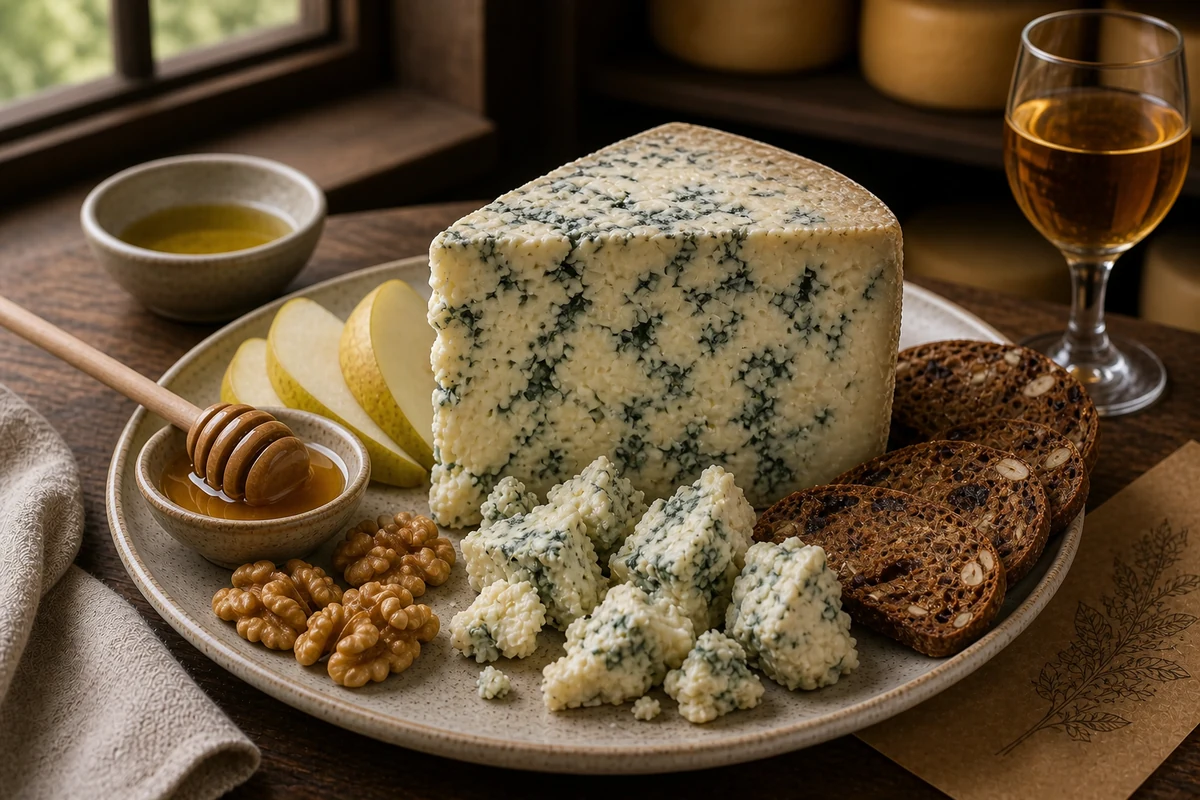
Long Clawson calls Huntsman a great addition to a cheese board or Ploughman's lunch, and says it is best served by itself as a midday snack.
| Pairing | Type | Why It Works |
|---|---|---|
| Fig paste | Food | Long Clawson's own way to serve it, by itself with fig paste. |
| Crusty bread | Food | Served alongside the fig paste in the same Long Clawson suggestion. |
| Grilled steak | Food | Long Clawson suggests melting it over grilled steak; the Academy of Cheese says it melts well on steaks. |
| Salads | Food | Sliced into salads, per Long Clawson. |
| British ales | Drink | Long Clawson's first drinks pairing; the Academy of Cheese repeats it. |
| Chenin Blanc | Drink | Named by both Long Clawson and the Academy of Cheese, the Academy as one of the dry whites. |
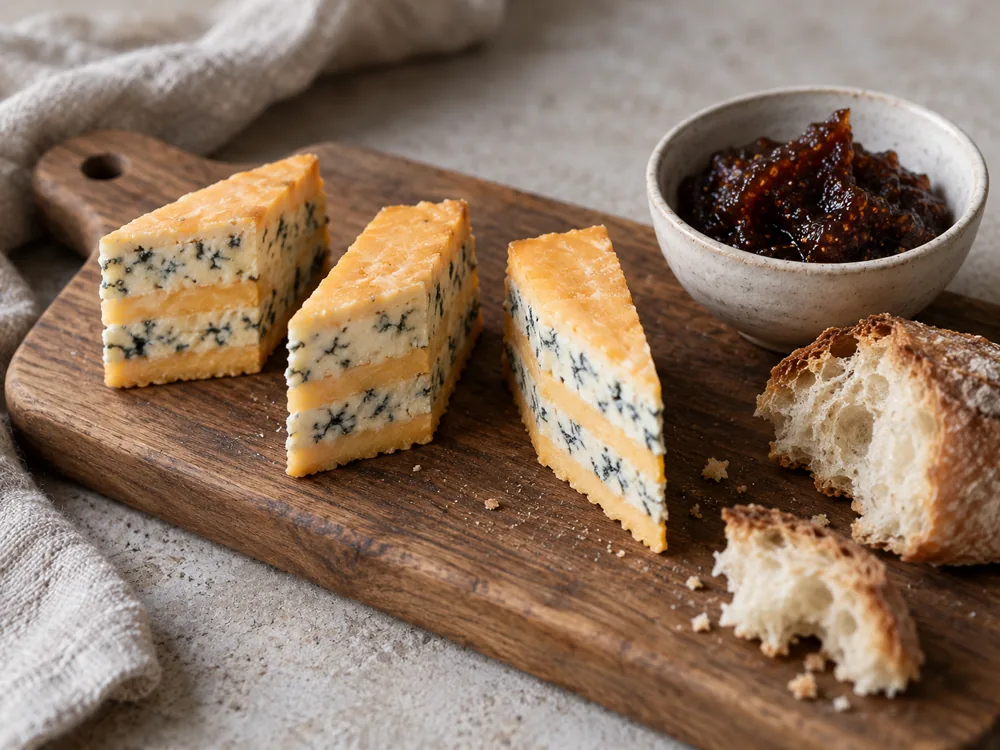
The dairy also suggests melting it over hamburgers and grilled steak, and the Academy of Cheese says it melts well on burgers and steaks.
Neither source describes how the Double Gloucester and Stilton layers behave separately under heat, so how much blue character survives melting is not documented.
For drinks, Long Clawson recommends British ales, with Chenin Blanc or Sauvignon Blanc as the ideal wines. The Academy of Cheese passes the advice on as British ales and dry whites such as Chenin Blanc, so Sauvignon Blanc is named only by the dairy.
How Do You Store Huntsman?
Long Clawson says to store Huntsman in waxed paper or an airtight container, away from other fresh foods.
The dairy's trade sheet for a half wheel says to keep it refrigerated, gives a storage range of 35 to 37.5°F, and lists a shelf life of 117 days. That sheet covers the half wheel and does not say when the 117 days start counting.
The CDC's general limit for a home refrigerator is 40°F or below, slightly above the top of the sheet's range.
For a Huntsman left out on a board, the CDC's rule for perishable food, a group that lists dairy, is refrigeration within 2 hours, or within 1 hour once temperatures pass 90°F.
What Is in Huntsman, and Is It Vegetarian?
Long Clawson's product sheet lists pasteurised cow's milk, salt, enzymes, dairy cultures, annatto extract as a colour and Penicillium roqueforti, the blue mould.
The sheet says only enzymes and does not name the rennet. The Academy of Cheese lists vegetarian rennet, but neither Long Clawson source confirms it, so a vegetarian buyer needs the pack's own label.
The same US-format sheet declares milk as an allergen and gives nutrition for a 28 g serving.
| Nutrient | Per 28 g | % Daily Value |
|---|---|---|
| Calories | 115 | Not listed |
| Total fat | 10 g | 12% |
| Saturated fat | 6 g | 32% |
| Cholesterol | 25 mg | 9% |
| Sodium | 165 mg | 7% |
| Total carbohydrate | 1 g | 0% |
| Protein | 6 g | Not listed |
| Calcium | 170 mg | 13% |
Saturated fat carries the largest share of the daily value on the sheet, 32% for 6 g of the 10 g of fat, against 13% for calcium and 7% for sodium. The sheet bases those percentages on a 2,000-calorie day.
Scaled to 100 g, the same label works out to roughly 410 calories, 36 g of fat, 21 g of protein and 590 mg of sodium. The sheet rounds to whole grams, so these per-100 g figures are approximate.
Is Huntsman Safe to Eat During Pregnancy?
The NHS says pasteurised or unpasteurised soft blue-veined cheeses, such as Danish blue, gorgonzola and roquefort, must be thoroughly cooked. It also says any cheese cooked until steaming hot is safe, including soft or blue cheese.
The CDC says pregnant women are 10 times more likely to get a Listeria infection. Its riskier group includes soft cheese made from unpasteurized milk, blue-veined cheese among them, and its safer group includes hard cheese made with pasteurized milk and pasteurized soft cheese heated until steaming hot.
Neither agency names Stilton, Double Gloucester or layered cheeses, so neither says whether the Stilton in Huntsman counts as a soft blue-veined cheese, and uncooked Huntsman is in neither agency's named safe group. Cooking Huntsman until it is steaming hot meets the NHS rule for any cheese, soft or blue.