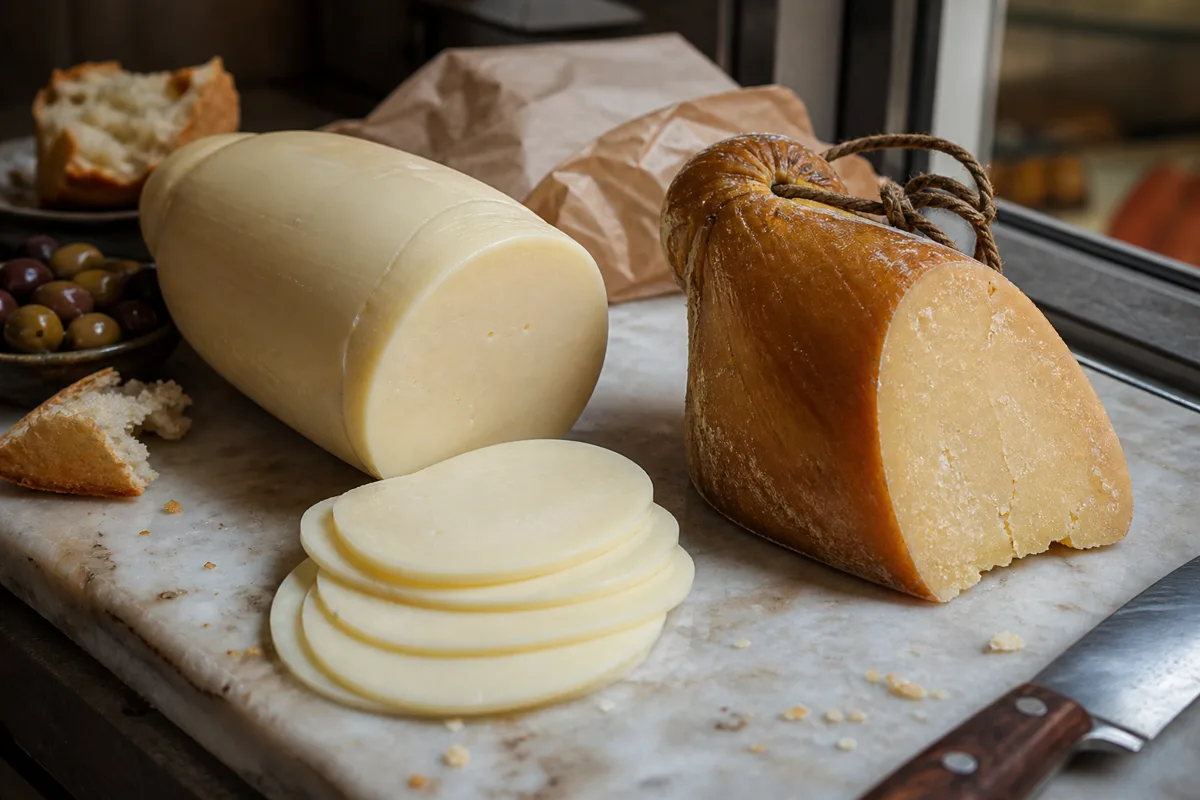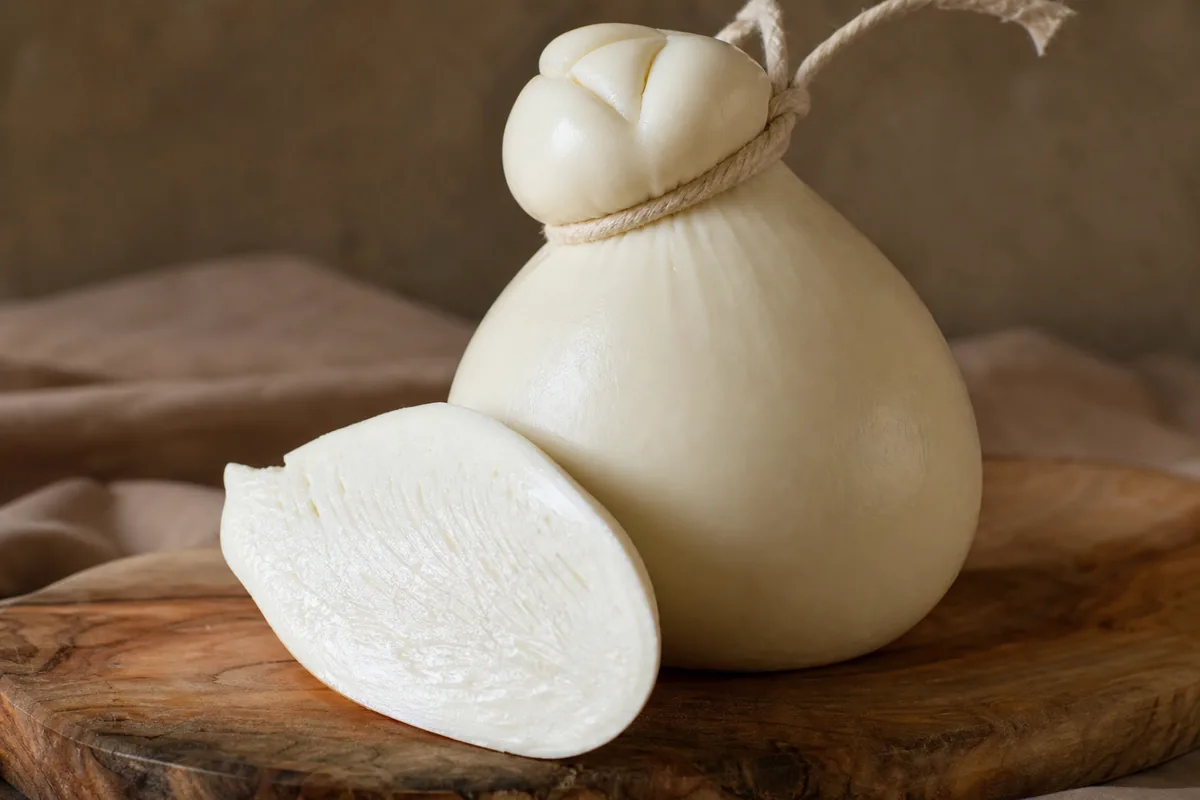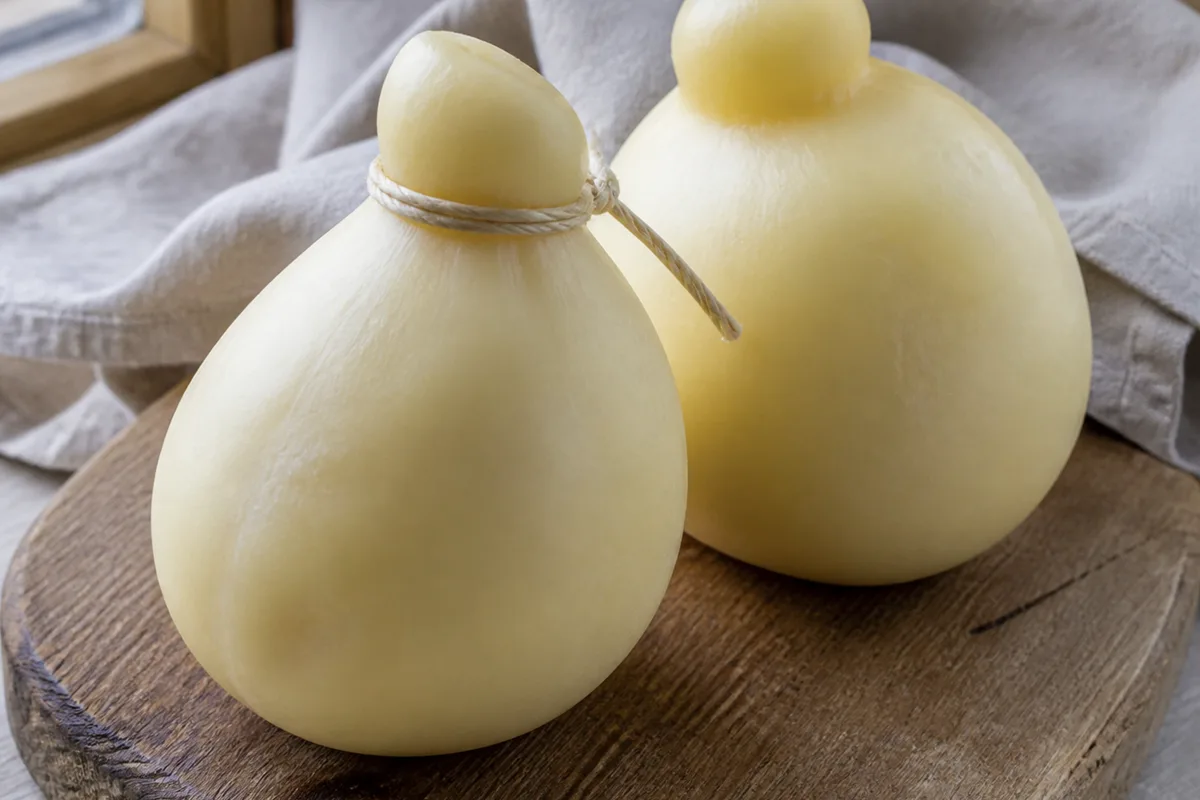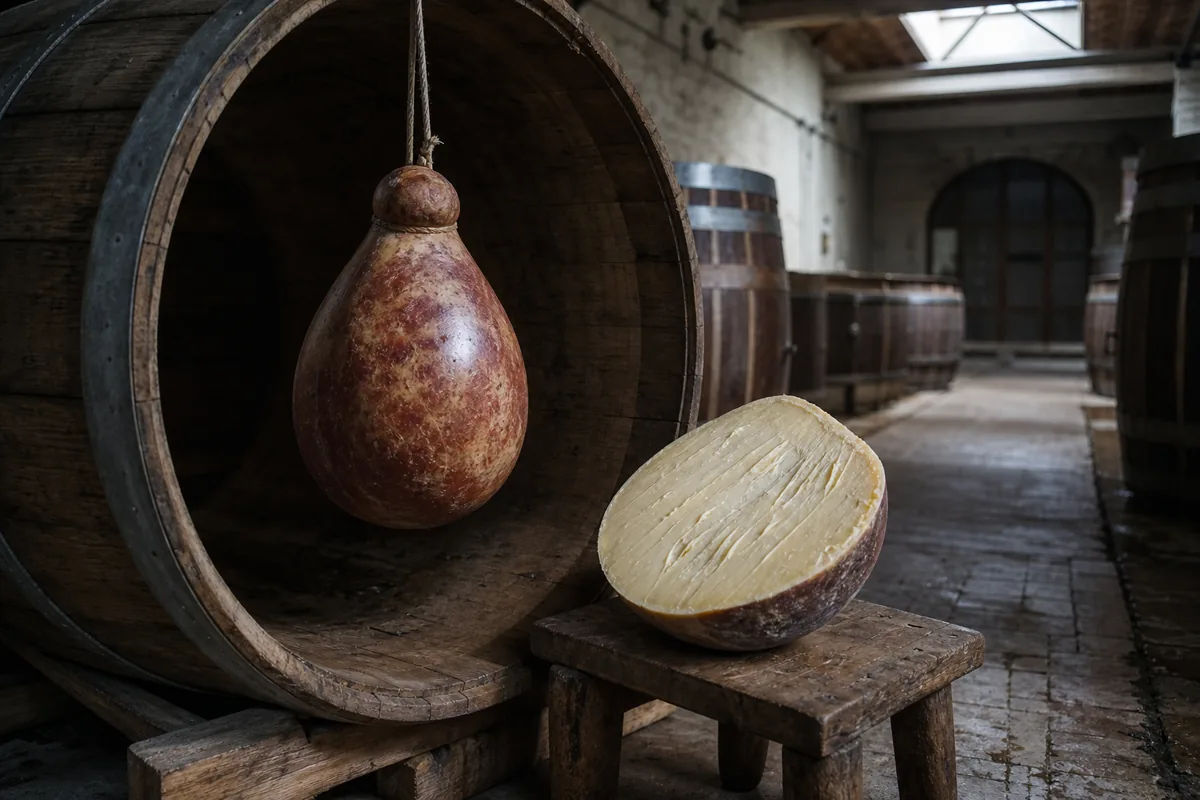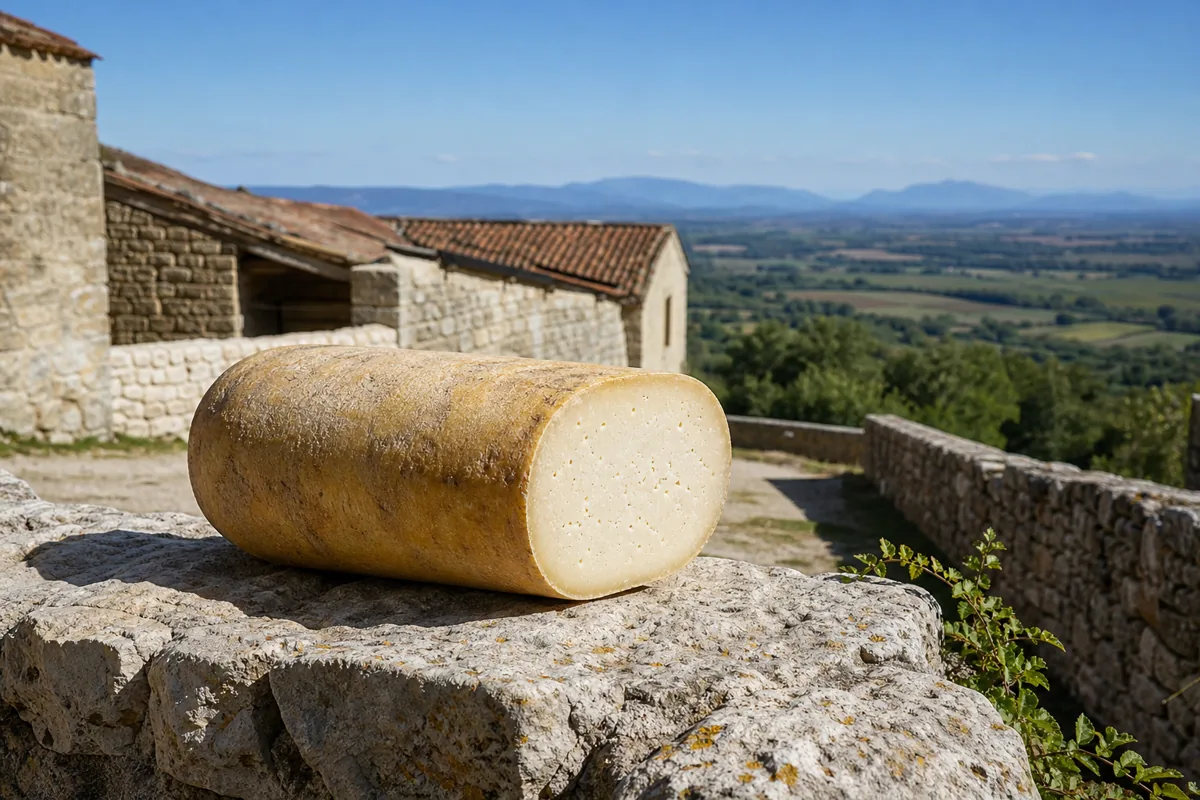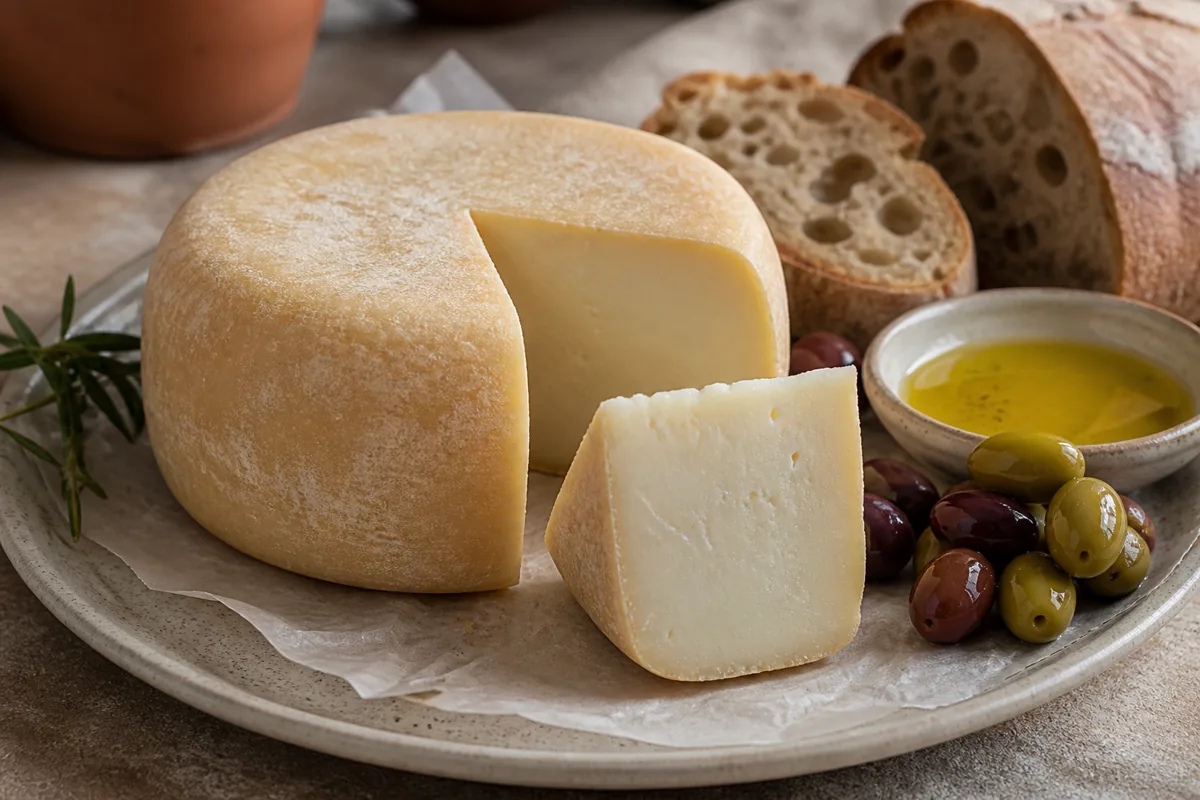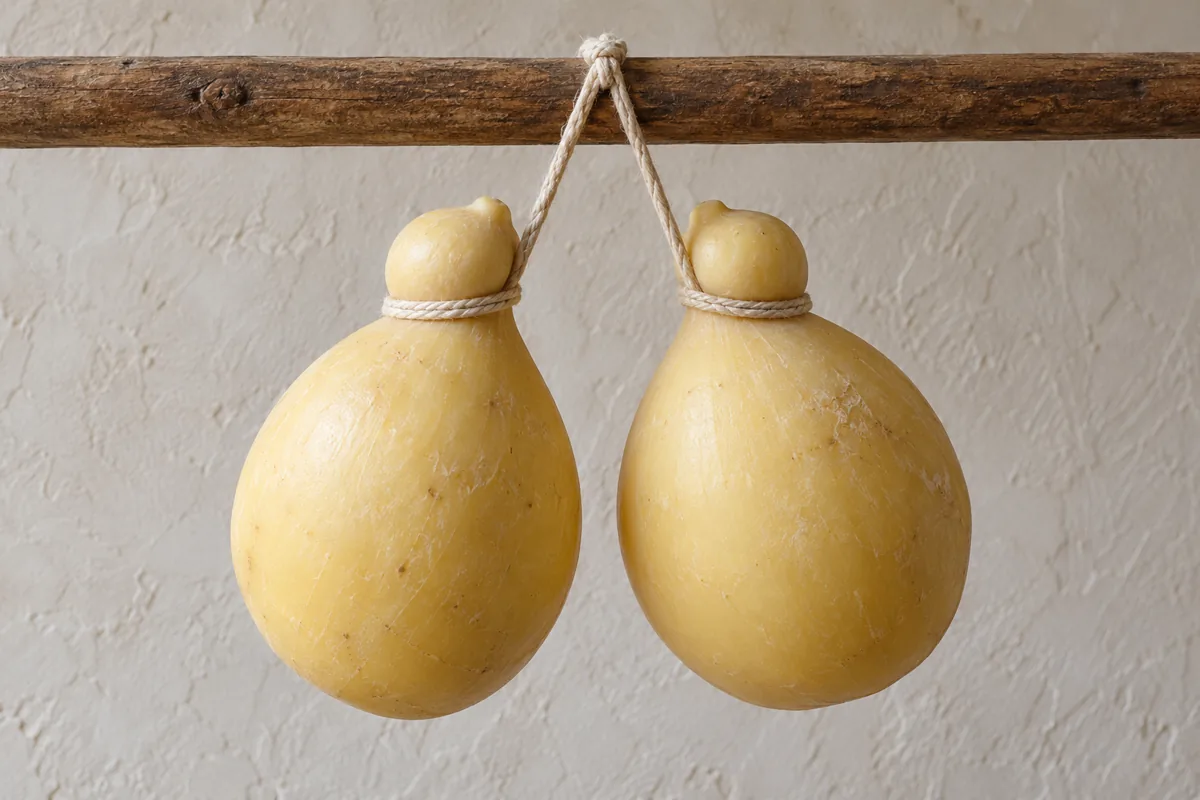
Caciocavallo is a stretched-curd cheese from southern Italy, formed into a teardrop or gourd and ripened hanging from a pole.
The best-known version is Caciocavallo Silano DOP, made from cow's milk in five southern regions and ripened for at least 30 days.
In This Article
What Is Caciocavallo?
The Silano DOP specification defines Caciocavallo Silano as a semi-hard, stretched-curd (pasta filata) cheese with a thin, smooth rind and a compact paste.
English Wikipedia describes the wider family as made from sheep's or cow's milk across southern Italy, especially in the Apennine Mountains and on the Gargano peninsula. The Silano DOP specification allows only cow's milk.
| Point | English Wikipedia | Italian Wikipedia | Silano DOP specification |
|---|---|---|---|
| Milk | Sheep's or cow's milk | Cow's milk, with only rennet, lactic ferments and salt | Cow's milk only, raw or thermized |
| Type | Stretched curd with a hard edible rind | Aged stretched-curd cheese | Semi-hard, compact paste with very slight holes |
| Shape | Teardrop | Like a number 8, two rounded bodies joined at the tie | Oval or truncated cone, with or without a small head |
The milk question therefore divides by label: the DOP specification fixes cow's milk, and Italian Wikipedia agrees for the cheese in general, which leaves English Wikipedia's sheep's milk line as the only source that allows another milk.
Several traditional types exist inside Italy. English Wikipedia names caciocavallo podolico, made only with milk from Podolica cattle, caciocavallo di Castelfranco from the Miscano Valley, and caciocavallo di Godrano, often called caciocavallo palermitano.
Italian Wikipedia's list of the best-known varieties adds caciocavallo di Agnone and says the Sicilian type can be the Godrano one. It also records versions with soppressata, a salami, inside, which it calls caciocavallo dell'emigrante.
Why Is It Shaped Like a Gourd and Hung?
The name comes from the way the cheese ripens. English Wikipedia translates caciocavallo literally as horse cheese and explains that two forms are bound together with rope and left to mature a cavallo, straddling a horizontal stick or branch.
The DOP specification describes the same step: after brining, the forms are tied in pairs and hung from wooden or steel poles to ripen.
Murray's Cheese says the cheese is tied at the top and hung from cellar beams, and that after several months it becomes an elongated bulb with a small round nub on top. The shop also repeats an old legend that the cheeses travelled to market slung across the back of a donkey.
Italian Wikipedia reads the finished shape as a number 8, two rounded bodies joined by a narrowing where the cheese is tied, which matches the head-and-body outline in the figure below.

The form still differs by region. The consortium says Calabrian makers traditionally shape a truncated cone with no head, while the other regions use an oval with a small head.
The specification allows cylinders or blocks only for cheese that will be sliced, cubed or grated.
The consortium puts a form at 1 to 2.5 kg, while the specification PDF prints its upper limit as 2500 kg, which reads as a typing slip for 2.5 kg.
The ties leave their mark: the specification says the rind may show slight grooves where the cord sat, and it permits clear, colourless surface treatments as long as the rind colour is respected.
Where Do the Names Caciocavallo and Silano Come From?
The consortium says the name probably comes from the old custom of tying forms in pairs and hanging them astride a beam, which is the explanation given above. Italian Wikipedia lists the other readings the name has attracted.
One reading traces it to working the paste a cavalluccio, and another to a horse brand pressed into the forms under the Kingdom of Naples.
A third has nomadic herders curdling milk in the fields and hanging pairs of cheese across the backs of horses to sell or barter in the villages they passed through.
Italian Wikipedia adds that a nineteenth-century Neapolitan text describes horses and donkeys at markets decorated with paired cheeses, but it also notes that the custom can be read several ways and may say little about where the word comes from.
The Balkan reading runs the other way: Italian Wikipedia says kashkaval, a widespread cow's milk cheese in the Balkans since the 15th century, may be the ancestor of both the Italian name and the cheese type.
It cites University of Belgrade veterinary researchers who credit the Aromanian people with creating cașcaval, with the -kaval ending tied to the seasonal movement of semi-nomadic Vlachs and their herds between summer and winter pastures.
For a buyer the dispute changes nothing at the counter, because the DOP rules, not the etymology, decide what a Caciocavallo Silano label guarantees.
Silano points to a place instead. The specification derives it from the Sila plateau in Calabria, where the cheese originated, and says the name prevailed through long use in both the production area and the markets that bought it.
The DOP zone is far wider than that plateau. It is a patchwork of listed communes in Calabria, Campania, Molise, Puglia and Basilicata, from the Gargano in Puglia to the Sorrento peninsula and the Amalfi coast in Campania, plus the whole province of Isernia in Molise.
English Wikipedia says a kind of caciocavallo is believed to have first been mentioned by Hippocrates, who emphasised the Greeks' cleverness in making cheese, and that Columella described its preparation precisely in De re rustica in 35 to 45 CE.
The specification dates the Hippocrates remark to 500 BC, while English Wikipedia gives his years as about 460 to 370 BC, and both describe a remark about Greek cheesemaking, so the date and the link to this exact cheese stay uncertain.
How Is Caciocavallo Silano Made?
The specification fixes each stage from milk to hanging, and the hot-water test on the curd is the step that makes this a stretched-curd cheese.
| Milk | Raw cow's milk, or milk thermized in the dairy at up to 58°C for 30 seconds |
| Coagulation | 36 to 38°C with calf or kid rennet paste; a natural whey starter is allowed |
| Curd | Cut to hazelnut-sized pieces, then left to ferment for 4 to 10 hours on average |
| Stretching | Small pieces are dipped in near-boiling water until they pull into elastic, shiny, continuous strands |
| Shaping | Moulded by hand into a smooth form and closed at the top in boiling water |
| Salting | Cooled in water, then brined for at least 6 hours, longer for heavier forms |
| Ripening | Tied in pairs and hung on poles for at least 30 days |
The specification leaves fermentation open-ended on purpose: 4 to 10 hours is an average, and it runs longer with the milk's acidity, the temperature or the mass of curd. A maker's sampling decides when to stop waiting, since small pieces taken at short intervals must pull into fibres before the curd is ready.
The consortium says the cheese was born of the need to work milk quickly before high temperatures soured it. The specification gives a second reason for the short working time: it limits the loss of fat-soluble aroma molecules from the milk fat, which ties the cheese's aroma closely to the quality of the milk.
Rennet also shapes the taste. The specification credits the kid rennet used in most production for the change from sweet to piquant during ripening.
What Do the Cows Eat, and Does It Change the Cheese?
The specification does not name a single breed. It lists Podolica, Bruna, Alpina, Frisona, Pezzata and mixed breeds with their crosses as the cattle the cheese has historically come from, so Silano, unlike podolico, does not promise one breed.
Feed is tied to the area: at least 50% of the dry matter the milking cows eat over a year must come from the production zone. The specification also states that forage makes up about 45% of the feed and that 70% of that forage dry matter comes from the zone.
It admits that some feed must come from outside the area. Its reasons are that farming is less widespread than it was and that soil and climate cannot supply feed in every season.
Meadows are also shrinking, it says, as wildlife it calls non-native, such as wild boar, damages the turf and woodland advances where the land is less tended.
The specification calls this outside feed supportive and says its effect on the character of the cheese is almost negligible, while a ration rich in local forage helps decide that character.
Italian Wikipedia gives the traditional picture: free-ranging cows grazing from Mediterranean scrub up to Apennine steppe, where the aromatic plants they eat are said to mark the cheese's aroma and scent.
The consortium says production runs all year, and its calendar covers the seasons beyond winter. Pastures start to grow in spring, summer pastures give the cheese its shades of flavour while hay is cut for the cold months, and in autumn the feed changes and the milk turns fattier again.
On the Sila plateau, before cattle were stabled all year, the cheese was made only in spring and summer in the small wooden huts of the cowherds, called vaccarizzi, and the technique was refined because the cheese had to keep for a long time.
Beyond feed, the specification says aroma, taste, aftertaste and the look of the paste depend on the local climate acting on forage crops and on the natural whey starter, whose microflora comes from the area's milk and the dairy's own environment. These are the specification's own claims for the tie to the place, and none of the sources measures the effect.
How Does Age Change Caciocavallo's Flavour?
Age decides most of what you taste. The specification describes a delicate, usually sweet cheese when young that turns piquant with advanced ripening.
| 30 days | Sweet and delicate, typical of spring cheese (consortium) |
| 3 months | Dense and firm, buttery and tangy with a subtle spicy flavour (Murray's Cheese) |
| At least 4 months | May be labelled Extra (DOP specification) |
| At least 9 months | May be labelled Gran Riserva (DOP specification) |
| 12 months | More piquant and mature, typical of winter cheese (consortium) |
The consortium ties those ages to the season. In winter the cows spend more time in the barn on hay and grain, and their milk is richer in fat.
Colour changes across one piece too: the specification describes a white to straw-yellow paste that is deeper toward the outside and paler at the centre.
The 3-month piece Murray's sells sits between the 30-day minimum and the 4 months a cheese needs before the specification lets it be labelled Extra.
How to Read a Caciocavallo Silano Label
Shape alone does not prove the DOP. Every whole form must carry the consortium's logo heat-stamped in dotted lines with the producer's identification number, and forms meant for portioning, slicing or cubing carry the logo three times.
The label on each form must show these items in clear, indelible print:
- The consortium's Caciocavallo Silano logo
- The European Union symbol
- The name and address of the producer or packer
- The producer's identification number
- A progressive serial number
Extra and Gran Riserva are the only extra words allowed, printed no larger than half the height of the DOP lettering. The specification bans words such as tipo, gusto, uso, selezionato and scelto.
A label may also name the region where the dairy stands, since the specification allows that reference.
Behind the marks, the specification requires every step to be documented with its inputs and outputs, and producers, agers and packers must be on lists kept by the control body, which it names as Agroqualità SpA.
How Do You Cook With Caciocavallo?
The consortium says Caciocavallo Silano is eaten raw or cooked in southern Italian kitchens, and the specification describes the paste as aromatic, pleasant and melting in the mouth.
| Use | How It Works |
|---|---|
| Pan-seared slices (alla piastra) | Cookist trims the rind, cuts 2 cm slices and cooks them in a non-stick pan over medium-high heat for 2 to 3 minutes per side. |
| Hung over a fire (impiccato) | Culture magazine describes the cheese hung by its twine about 12 inches above the flames, with the melted outside scraped onto bread. |
| Baked in a dish (in terrina) | Culture's home method bakes sliced cheese in an earthenware bowl at 350 to 375°F for about 10 minutes. |
| Pizza | Murray's Cheese suggests melting it on pizza. |
| Grated or sliced | Murray's Cheese suggests both grating and slicing it. |
Cookist's pan method ends when the slices are soft and stringy with a thin golden crust and, after a few more seconds, fully melted.
The stringiness has a cause in the making: the curd is ready to shape only when pieces dipped in hot water pull into elastic fibres, so the pan brings out the same property that defines a stretched-curd cheese.
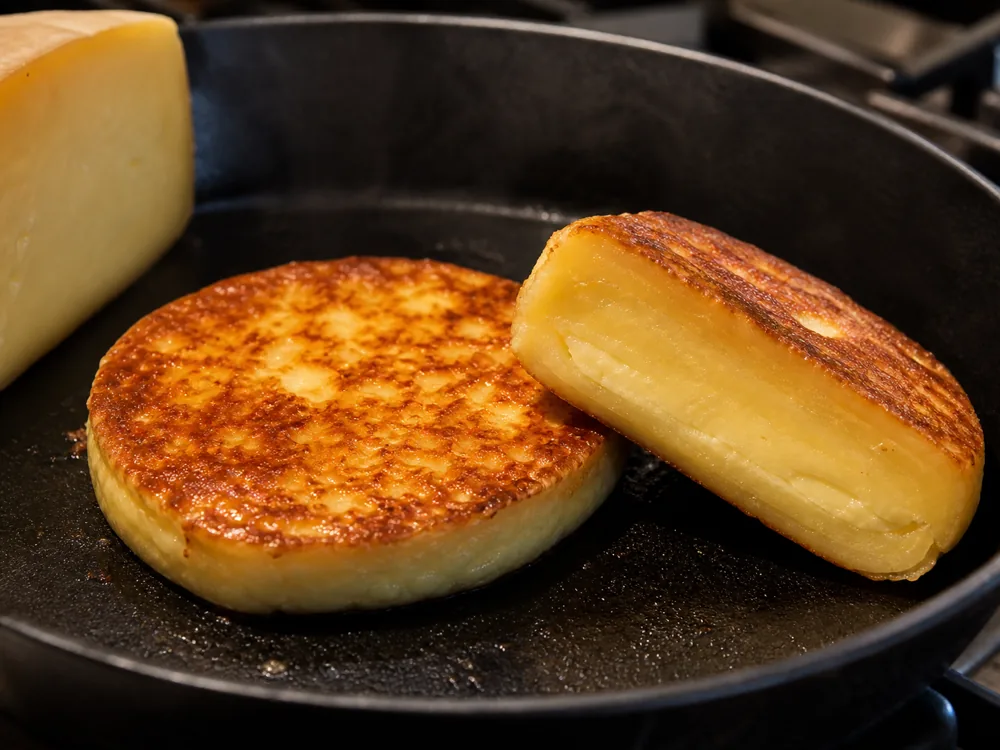
Cookist serves the slices on bread as an antipasto or aperitivo finger food and, for a richer version, presses an oiled slice of bread onto the cheese once both sides are cooked. It recommends Caciocavallo Silano DOP for its aromatic, delicate flavour.
Culture magazine traces caciocavallo impiccato, or hanged caciocavallo, to cattle herders who moved their animals between pastures and likely held the cheese over their nightly fires to eat with bread. Culture describes the flavour as fruity, funky and smoky.
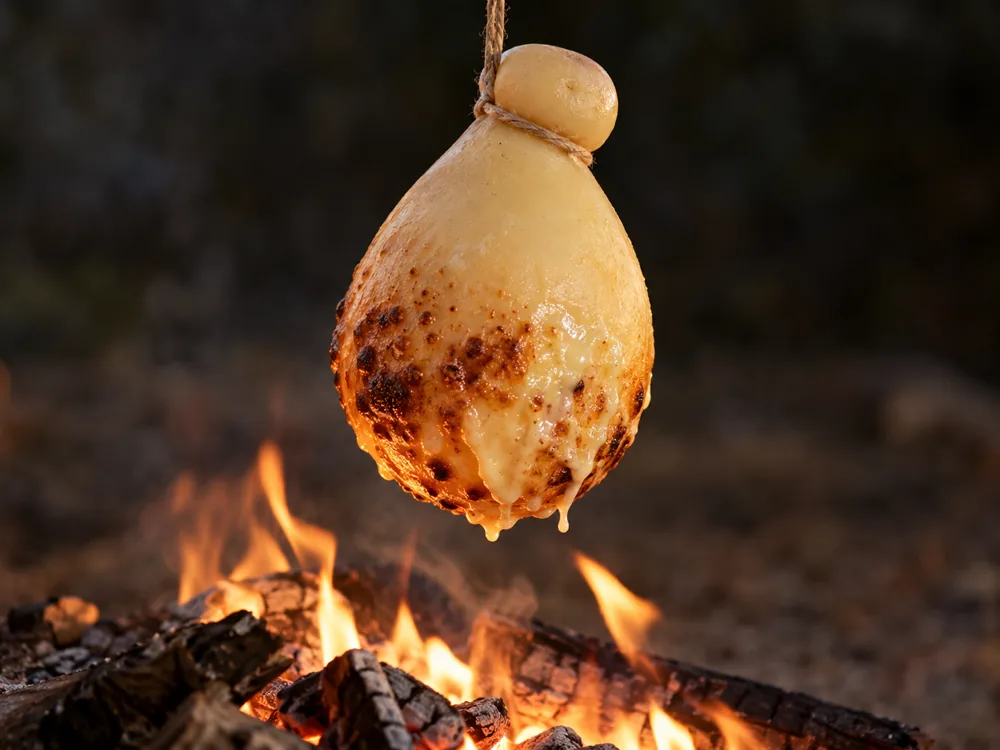
Culture's cue for the fire method is the cheese starting to ooze slightly from the bottom, and it serves the scrapings on bread or potatoes. For the baked version it layers sliced or chopped cheese in the earthenware bowl with tomatoes, salami or eggplant.
The method follows the form on hand: the fire needs a whole cheese with its twine, while the pan and the bowl work from slices or chopped pieces.
What to Serve With Caciocavallo
The pairings below come from Murray's Cheese, Cookist's pan recipe and Culture's article on the fire-hung cheese, and none of the sources ranks them.
Murray's suggests slicing Caciocavallo Silano to serve with salumi on a charcuterie board. The shop also names its roasted salted pistachios and an Iberico de Bellota paleta.
For drinks, the shop names only an Italian red wine, with no grape or region.
| Pairing | Type | Why It Works |
|---|---|---|
| Salumi | Food | Murray's Cheese suggests serving slices with salumi. |
| Italian red wine | Wine | Murray's Cheese names an Italian red without a grape. |
| Roasted salted pistachios | Food | Paired on the Murray's product page. |
| Bread | Food | Cookist serves pan-seared slices on bread; Culture's fire-hung cheese is scraped onto bread. |
| Green tomato preserves or apple chutney | Food | Cookist's options for the pan-seared slices. |
| Hot peppers | Food | Another Cookist option for the pan-seared slices. |
| Oil, lemon, thyme and rosemary | Food | Cookist's alternative to preserves: an emulsion of salt, pepper, olive oil, lemon juice, thyme and rosemary poured over the slices. |
| Potatoes | Food | Culture serves the scraped fire-hung cheese on bread or potatoes. |
| Honey | Food | Culture suggests a drizzle of honey on the fire-hung cheese. |
How Does Caciocavallo Compare with Provolone and Other Relatives?
English Wikipedia compares the taste to aged southern Italian provolone. Murray's Cheese places Caciocavallo Silano between an aged mozzarella and a young provolone, and one of its staff reviews calls it a touch drier than provolone.
The early steps match mozzarella: Murray's explains that fresh curds are heated, stretched and shaped into a ball. Caciocavallo then parts ways, because it is tied at the top and hung to age.
Similar names turn up across the Balkans and further east, such as Bulgarian kashkaval, Romanian cașcaval and Turkish kaşkaval. English Wikipedia says each of them is a different cheese from Caciocavallo Silano and from the others.
Sicily's Ragusano, once known as caciocavallo ragusano, had to drop the word caciocavallo to gain DOP status, according to the same article.
What Are Caciocavallo's Nutrition and Storage Facts?
CREA, Italy's public agricultural research council, lists Caciocavallo in its food composition tables per 100 g and per 50 g portion, and the figures describe the cheese in general, not one brand. The consortium publishes its own average values for a 30-day cheese, shown in the last column.
| Nutrient | CREA per 100 g | CREA per 50 g portion | Consortium per 100 g, 30-day cheese |
|---|---|---|---|
| Energy | 431 kcal | 217 kcal | 333 kcal |
| Water | 30.0 g | 15.0 g | Not given |
| Protein | 35.7 g | 17.9 g | 25.5 g |
| Fat | 31.1 g | 15.6 g | 23.0 g |
| Saturated fat | Not given | Not given | 14.7 g |
| Carbohydrate | 2.3 g | 1.2 g | 6.5 g |
| Sodium | 960 mg | 480 mg | Not given |
| Salt (sodium chloride) | Not given | Not given | 1.0 g |
| Calcium | 860 mg | 430 mg | Not given |
The two sets do not describe the same piece. At the DOP floor of 38% fat in the dry matter, 23.0 g of fat means no more than about 60 g of dry matter per 100 g.
CREA's 31.1 g of fat and 30.0 g of water leave 70 g of dry matter and a fat share near 44%, by our arithmetic from the two tables.
Drying is one way such a gap arises: Italian Wikipedia says hanging is how the cheese dries, and every gram of water lost leaves more protein, fat and salt in each 100 g. CREA's entry does not state an age.
Salt shows the same split, with 1.0 g of sodium chloride from the consortium against 960 mg of sodium from CREA, which is about 2.4 g of salt at the usual conversion of 2.5 g of salt per gram of sodium.
Murray's Cheese gives only general cheese storage advice: harder cheeses stay fresh for up to two to three weeks when wrapped tightly and unopened. A refrigerator drawer or vegetable bin helps keep them from drying out.
Is Caciocavallo Safe During Pregnancy?
The Silano specification allows raw cow's milk or milk thermized at up to 58°C for 30 seconds, and it does not mention pasteurization. Murray's tags its piece as thermalized and lists raw cow's milk, rennet and salt as ingredients.
The CDC lists hard cheese made with pasteurized milk as a safer choice, and it puts unpasteurized milk and dairy products made from raw milk among the riskier choices. It says pregnant women are 10 times more likely to get a Listeria infection.
The NHS lists pasteurised or unpasteurised hard cheeses, such as cheddar, gruyère and parmesan, as safe to eat, along with pasteurised semi-hard cheeses such as edam.
The NHS also says foods made from unpasteurised milk must be thoroughly cooked, and it counts any cheese cooked until steaming hot as safe.
Neither agency names Caciocavallo, and the specification calls Caciocavallo Silano semi-hard. A piece made from raw or thermized milk is on neither agency's safe list as it comes, and the NHS treats it as safe once it is cooked until steaming hot.
SOURCES & REFERENCES
What Else Do People Ask About Caciocavallo?
The DOP specification calls young Caciocavallo delicate and sweetish and says it turns piquant with long ripening. Murray's describes a 3-month cheese as buttery and tangy with a subtle spicy note.
No. Both are Italian stretched-curd cheeses, and English Wikipedia says Caciocavallo tastes similar to aged provolone, but Caciocavallo is tied and hung in its own gourd form and Murray's finds it a touch drier.
It translates literally as horse cheese. English Wikipedia links the name to hanging two tied forms astride a stick or branch while they mature.
Yes. Cookist pan-sears slices until they turn soft and stringy with a golden crust and fully melt, and Culture's fire-hung version is ready when it starts to ooze from the bottom.
Caciocavallo Silano DOP may be made from raw or thermized cow's milk. Murray's tags the one it sells as thermalized and lists raw cow's milk, rennet and salt as its ingredients.
No. Only Caciocavallo Silano is the DOP described here, English Wikipedia names podolico, Castelfranco and Godrano as separate traditional types, and Ragusano had to drop the word caciocavallo to get its own DOP.