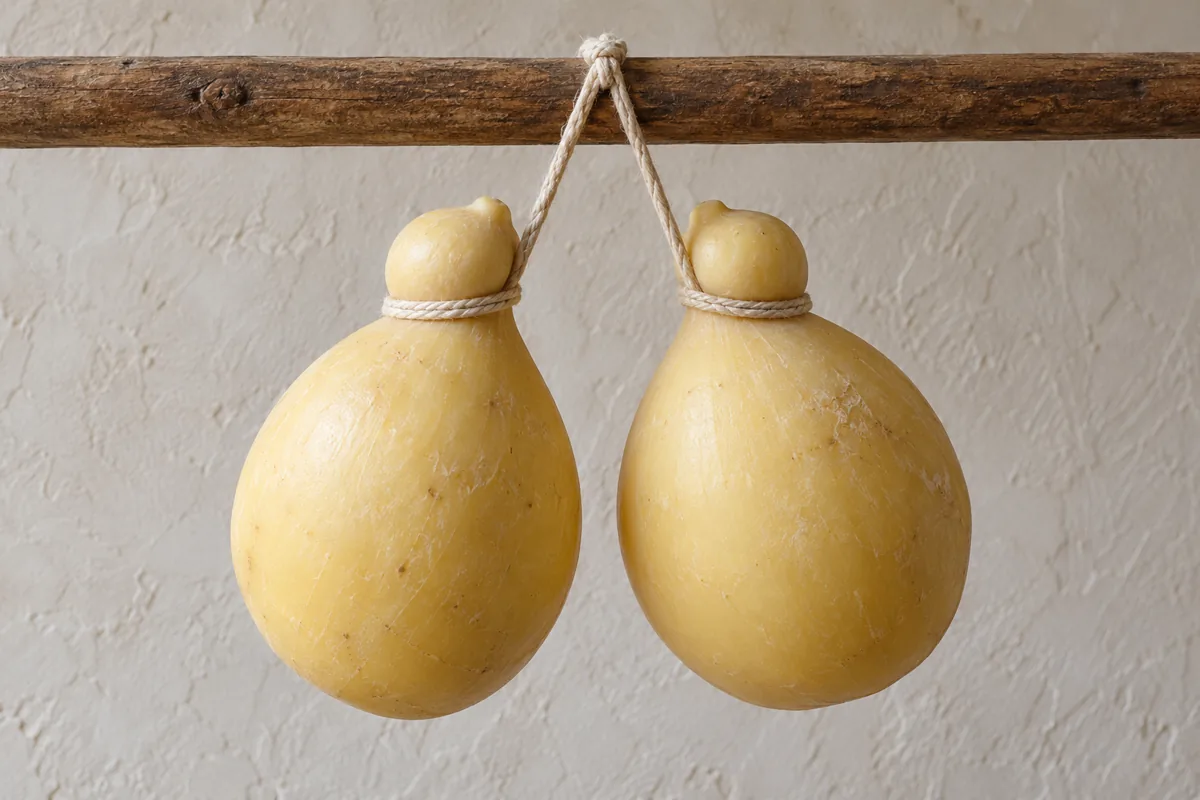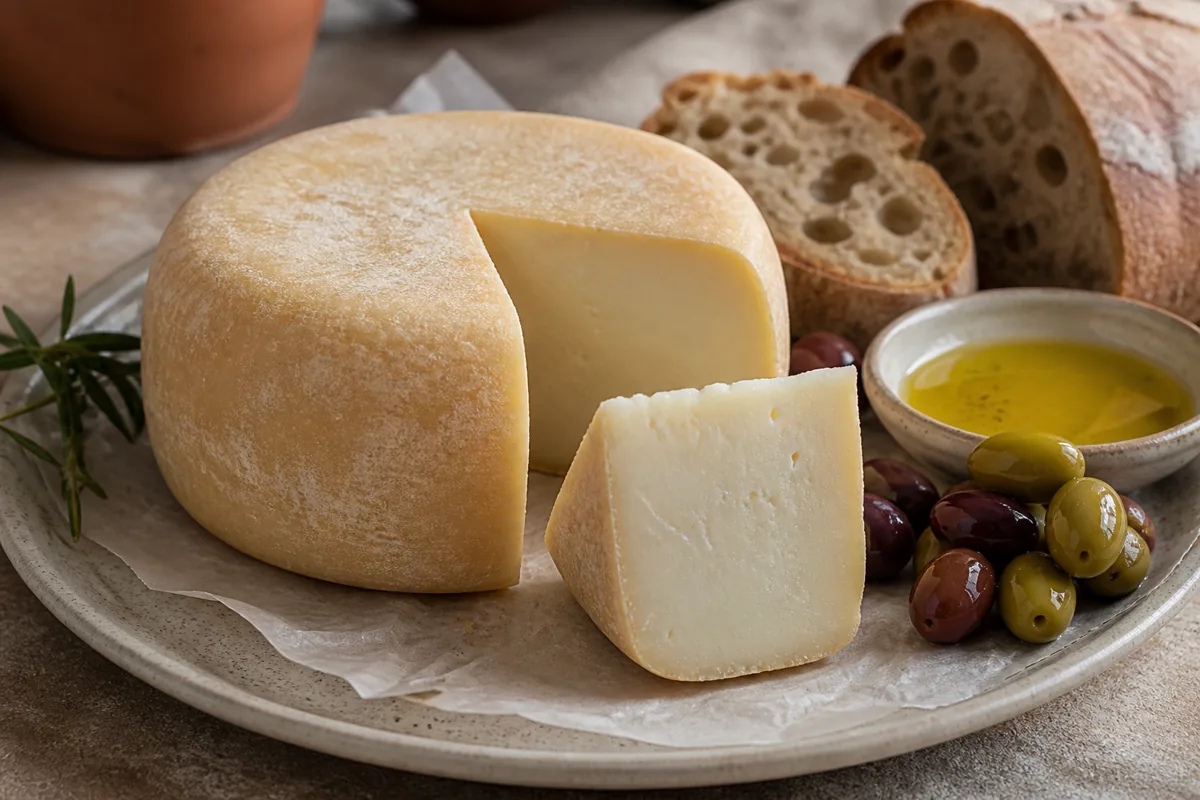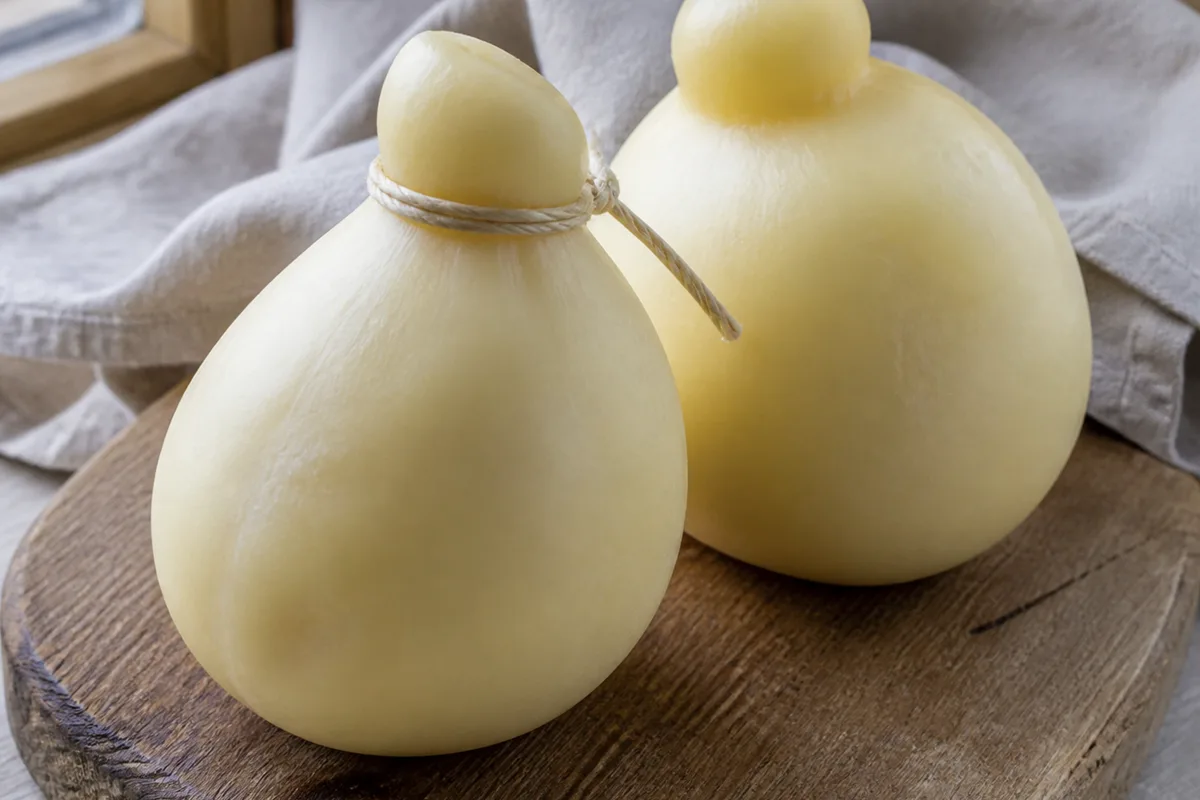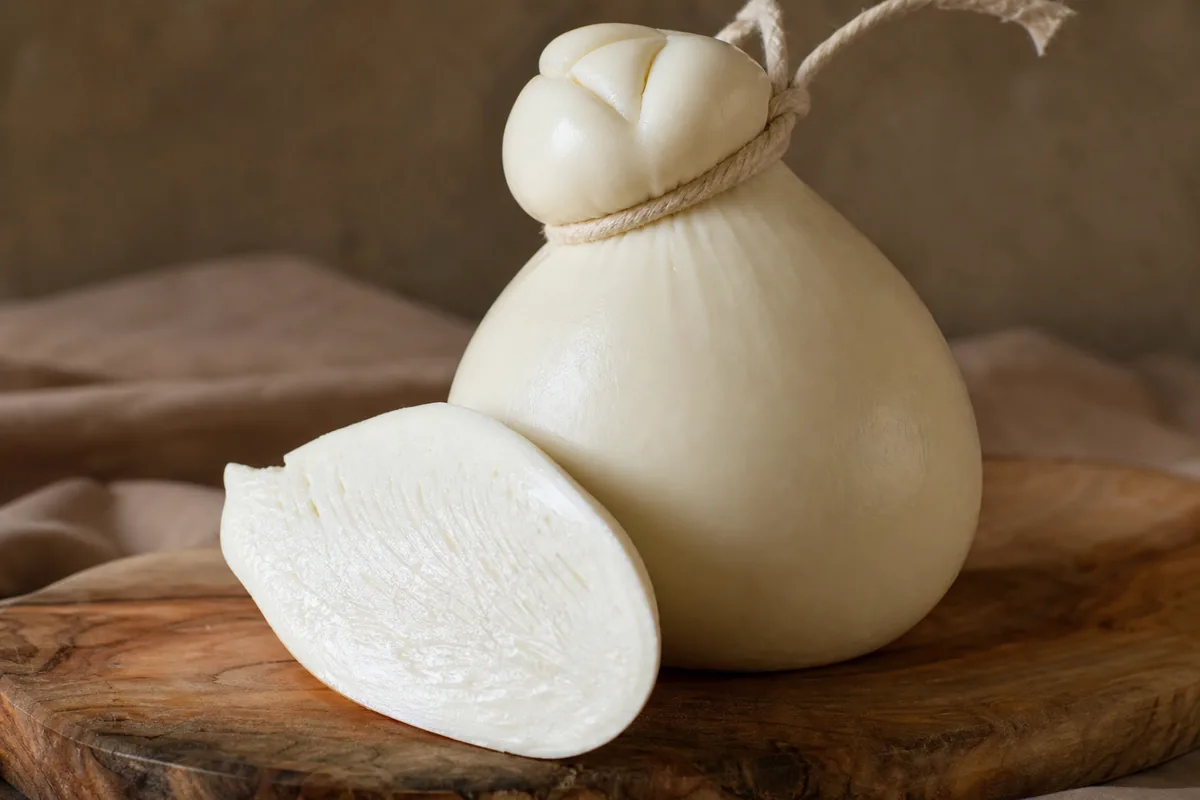
Scamorza is a southern Italian stretched-curd cheese shaped like a pear, with a short head tied off by cord. It is usually made from cow's milk and sold plain or smoked.
Writing in the Philadelphia Inquirer in 2018, critic Craig LaBan called it a drier, much firmer cousin of fresh mozzarella.
Italian regions list scamorza as a traditional agri-food product (PAT) without one shared recipe, so sources differ on size, aging, milk treatment and smoke. Each figure below names the source it came from.
In This Article
What Is Scamorza Cheese?
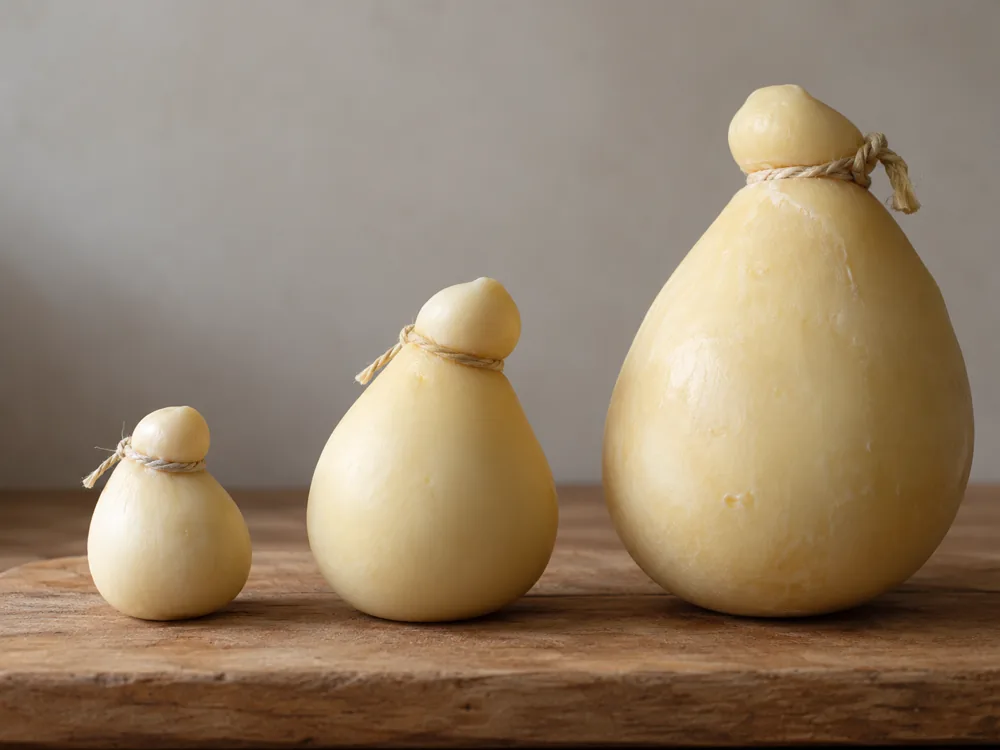
Scamorza belongs to the pasta filata family, in which curd is stretched in hot water and shaped by hand. Its classic form is a pear with a short neck or head, though sources give different sizes.
The pear is not the only form. The Campania survey describes its plain cheese as a sphere with a slight constriction at the middle, and ONAF allows smoked scamorza to be shaped as a braid (treccione) or a ring (tarallo).
| Source | Width | Length | Weight |
|---|---|---|---|
| Puglia traditional-products record | 7 to 9 cm | 10 to 12 cm | 250 to 350 g, up to 500 g |
| Campania survey (CNR) | Up to 6 to 7 cm | 12 to 13 cm | 250 to 300 g |
| ONAF profile | 7 to 9 cm | 10 to 15 cm | 200 to 500 g |
| Italian Wikipedia | Not given | Not given | 150 to 250 g, described as a ball |
| Caseificio del Cigno, smoked retail piece | About 7 cm (6.5 cm high) | About 12.5 cm | 280 g net |
| Salerno long form (CNR) | 8 to 10 cm | 18 to 20 cm | About 1 kg |
The range is wider than any one row, because the Puglia record also notes pieces under 100 grams and a scamorzone that stays under 1 kilogram, while the Salerno long form is shaped by hand into an elongated, irregular, slightly flattened piece. On a label, scamorza can therefore mean a piece from under 100 grams to about a kilogram.
Where Does Scamorza Come From, and Which Milk Does It Use?
The Puglia record says scamorza was born almost by chance during caciocavallo production, when a cheesemaker cut the curd into smaller pieces and cooked it at a slightly lower temperature, which gave a paste with a softer consistency. Culture adds that scamorza was traditionally made as a way to use up extra curd.
Italian Wikipedia lists traditional-product status for scamorza in eight Italian regions, from Puglia and Campania to Lazio and Calabria, where it takes the name provola.
Cow's milk is the usual base, and Italian Wikipedia adds buffalo-milk versions in Campania and occasional sheep's-milk versions in Puglia, where the regional atlas also lists a separate sheep's-milk scamorza. Whether the milk is raw or pasteurized varies by maker, as the table shows.
| Source | What it says about the milk |
|---|---|
| Puglia traditional-products record | By tradition, raw cow's milk, filtered and heated to 36 to 38°C |
| Campania survey (CNR, 15 producers) | Raw cow's milk is standard; pasteurized at 70 to 72°C for 20 seconds when milk quality is doubtful |
| ONAF profile | Whole raw cow's milk |
| Caseificio del Cigno, smoked 280 g | Pasteurized cow's milk, all from Italy |
| The Mozzarella Company (Texas), via Culture | Pasteurized cow's milk |
The CNR survey ties pasteurization to doubtful milk quality rather than routine practice, while the two producers in the table state pasteurized milk outright.
How Is Scamorza Made, and Why Does It Have a Neck?
The Puglia traditional-products record is the most detailed source here, and its figures set the pace in the steps below. The Campania survey puts its stretch water at 82 to 85°C against the Puglia record's 90 to 92°C, so makers elsewhere do not follow the same clock.
The Campania survey adds a cooking step the Puglia record does not mention: the curd goes back into hot water at 42 to 45°C for 5 to 10 minutes before its overnight rest. The survey calls the result semi-cooked paste, while ONAF lists the curd as raw.
Brine time sets how salty the cheese turns out, and the Puglia record varies it from 10 minutes to 3 hours with the saltiness the maker wants.
The Campania survey instead salts for 2 to 3 hours at about 10°C in brine acidified with lactic acid at 1 to 2 grams per liter, which helps a thin skin form.
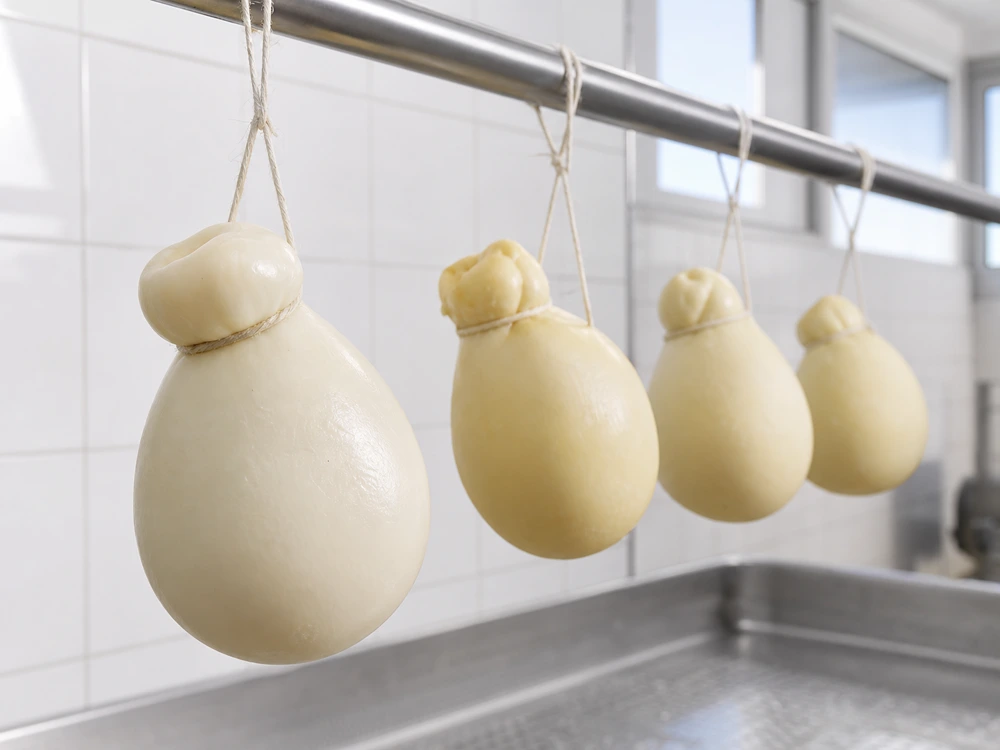
The neck comes from the tying: the Puglia record has the stretched cheese modeled into a pear with a short neck or head and tied with raffia. Culture says makers tie the string around the top before hanging the cheese to dry, a step that helps concentrate flavor and gives scamorza its silhouette.
The Campania survey ties the cheeses in pairs with raffia thread passed around the constriction. Italian Wikipedia says the cord, which gives scamorza its two-part shape, has been replaced by a plastic strip for hygiene, though Culture's library entry still has The Mozzarella Company placing a raffia noose on the neck.
The name follows the same cut: the Puglia record derives it from the dialect verb scamozzare, to cut partly off, while Italian Wikipedia cites capa mozza, a severed head.
Why Does Scamorza Curd Rest Before It Is Stretched?
Culture explains the rest as acid development: the curd sits in its own whey while lactose turns into lactic acid, and makers cut and stretch it only once it reaches the right pH. Culture's library entry adds that the curds begin to knit together in the whey during this wait.
Makers seed the acid with a starter. The Puglia record uses whey kept overnight at room temperature from the previous day's cheesemaking, or a starter from milk that soured on its own.
The Campania survey's whey starter measures about 40 on its acidity scale (°SH) against 8 for the milk, and the vat is brought up to 10.
In the Campania survey the cooked curd is cut into strips and left under cloths at 27 to 28°C until the next day before it is stretched.
When the milk is more acidic than usual, the same survey says makers coagulate at a lower temperature, add more rennet and cut back or skip the whey starter. They also break the curd to grains of about 1 centimeter, while sweeter milk gets grains the size of a walnut, about 3 centimeters.
Caseificio del Cigno lists a pH of 5.2, plus or minus 0.2, for its finished smoked scamorza, and none of the other pages cited gives an acidity figure for a finished cheese.
How Long Does Scamorza Age?
Sources put the aging time anywhere from 1 day to about a month, and none claims its figure applies to every maker.
| Source | Aging figure |
|---|---|
| Puglia traditional-products record | 1 to 6 days, up to 20 days for older versions |
| Campania survey (CNR) | 1 to 2 days of rapid maturation |
| ONAF profile | 1 to 20 days |
| Italian Wikipedia | One week to one month |
| Philadelphia Inquirer (LaBan, 2018) | Hangs up to two weeks in a refrigerator |
| The Mozzarella Company (Culture) | Most released at 1 to 3 weeks old; the wax dip allows smoked pieces to age up to several months |
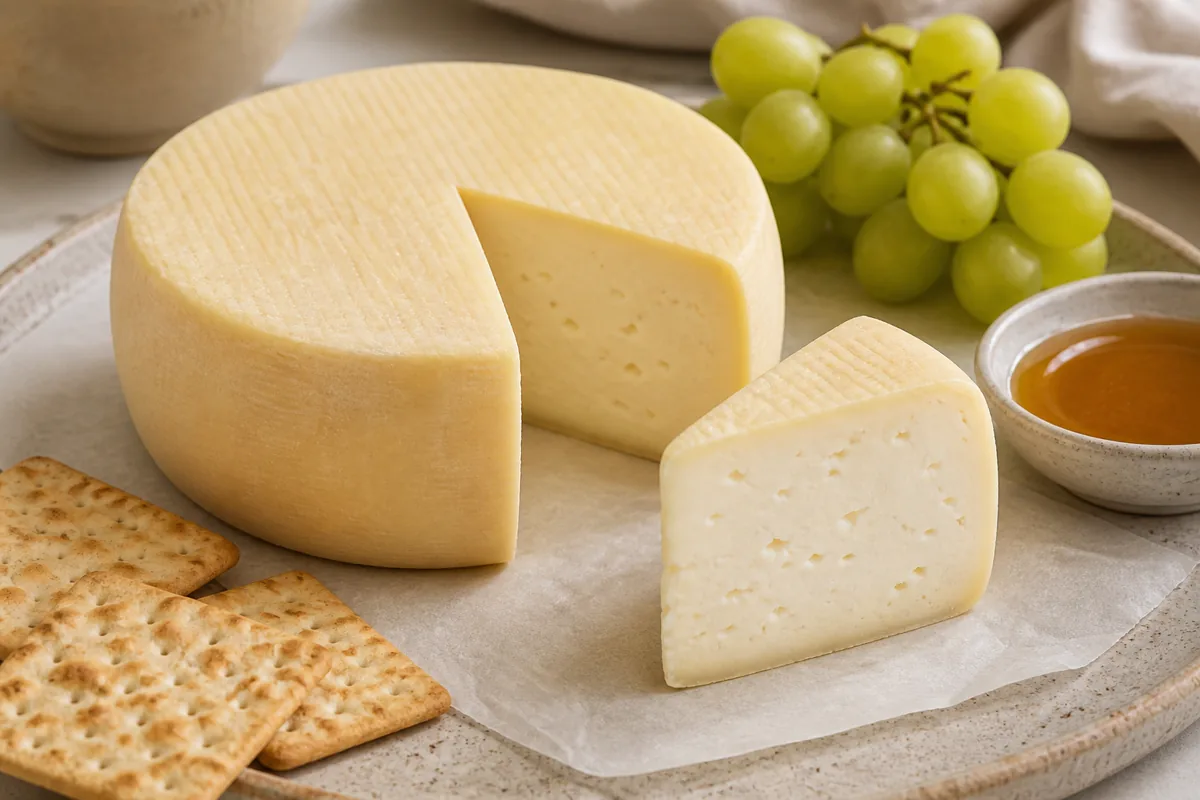
On plain scamorza the skin color tracks the clock: the Puglia record says it runs from white to a more or less intense straw yellow with maturation time, and ONAF ties its ivory-white to straw-yellow skin to the time since production.
On smoked scamorza ONAF says the brown skin deepens with the time spent in smoke, so color is a poorer guide to age there.
Plain vs Smoked Scamorza
Plain scamorza tastes sweetish or slightly savory, and the Puglia record gives it a delicate, pleasant aroma that ONAF describes as cooked milk. Smoked scamorza gets its smoke after drying, and makers use different fuels.
- Puglia record: straw and beech shavings
- Campania survey: smoke from burning straw for 10 to 15 minutes at 40 to 50°C in concrete smokehouses
- Caseificio del Cigno: hot smoking over burning beech wood
- Di Stefano Cheese (California), via Culture: hay and hickory chips for about an hour
- The Mozzarella Company (Texas), via Culture: pecan shells
Time and temperature vary as much as fuel: Caseificio del Cigno describes hot smoke, while Di Stefano's cheesemaker describes a dense, cool smoke and keeps the cheeses in it for about an hour.
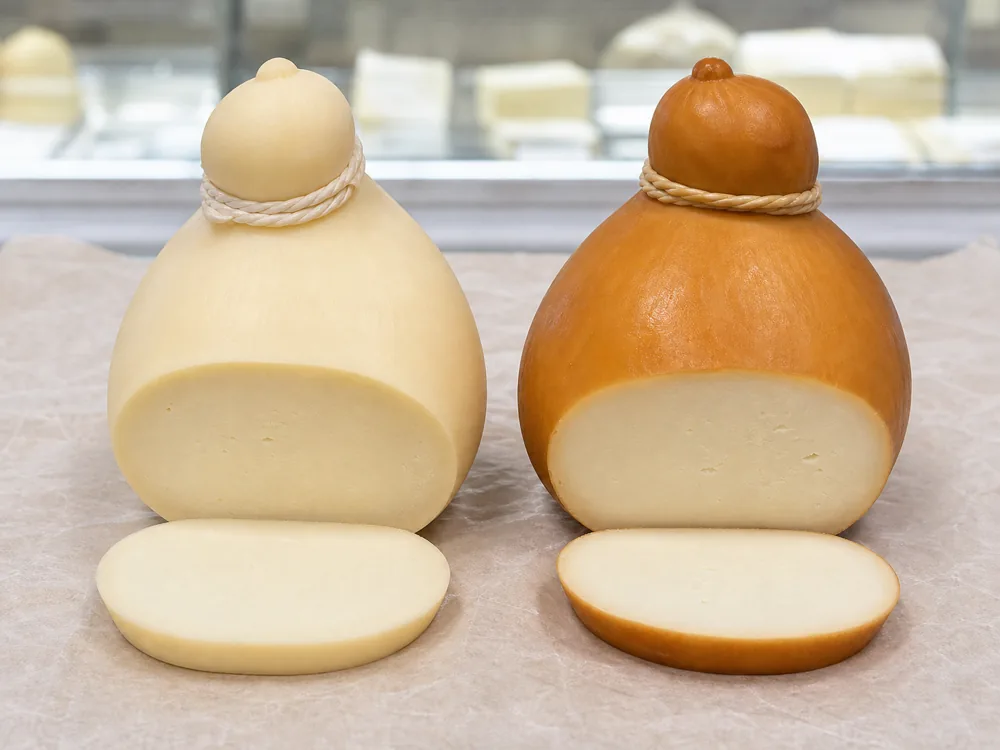
| Plain | Smoked |
|---|---|
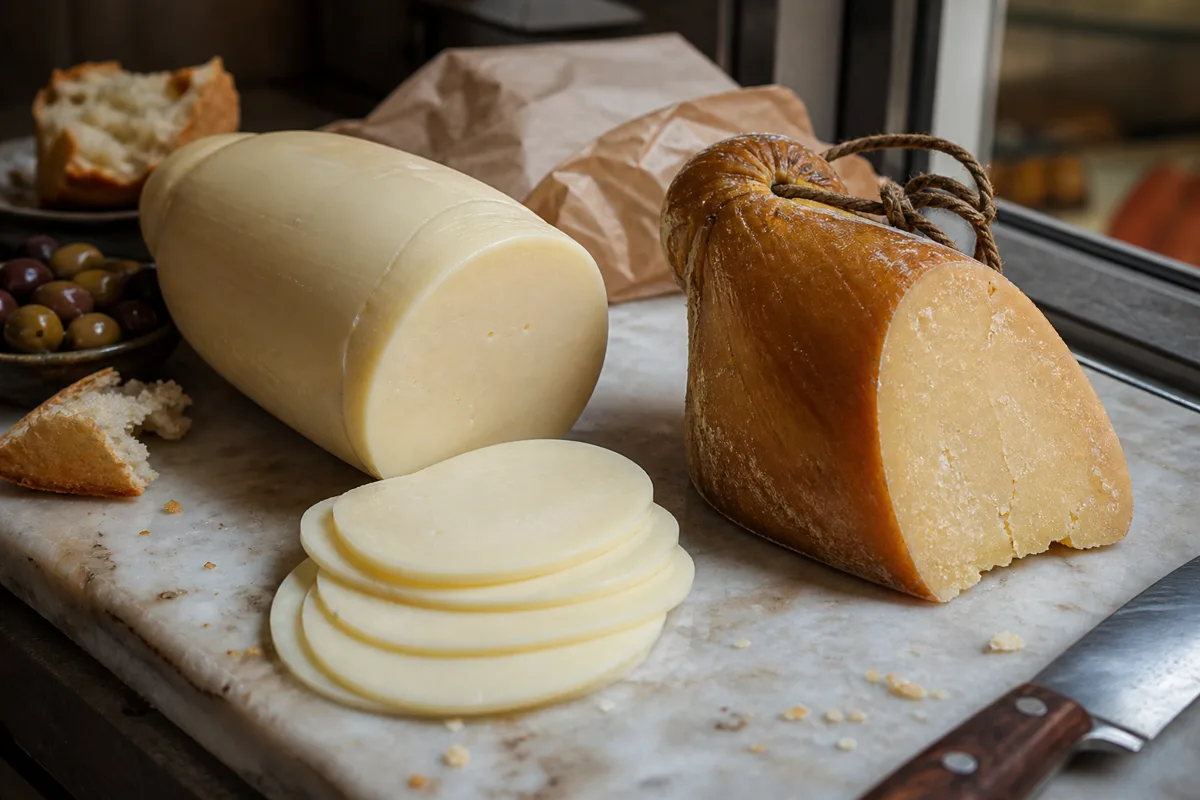
| Skin white or straw yellow (Puglia record), thin and ivory to pale yellow (ONAF) | Skin golden (Puglia record), brown crust (ONAF), amber (Culture) |
| Sweet, with a cooked-milk aroma (ONAF) | Sweet and slightly saltier with mild bitter notes (ONAF), gently caramelized (Culture) |
| Compact and elastic with no holes (ONAF) | Compact and elastic, described as slightly melting (ONAF) |
Smoke stays mostly at the surface: the Puglia record describes a golden, extremely flavorful skin with a smoky aftertaste and an interior that stays soft with only subtle smoke notes.
Italian Wikipedia describes the plain version as softer, with a thinner skin, and credits the smoke with letting the smoked version keep better.
Culture describes Di Stefano's hay and hickory smoke as balanced, enhancing the cheese's milky sweetness without overpowering it, while LaBan finds that the smoke on Claudio's scamorza adds a layer of tangy sweetness.
What Is Stuffed Scamorza?
The Campania survey says stuffed scamorza is filled only by hand: the maker opens a pocket inside a ball of stretched curd, puts in the filling and closes the pocket into a head shaped like a crest.
The fillings it lists are olives, mushrooms and hot chili pepper, or dried small tomatoes, or diced ham, at 50 to 100 grams of filling for every 200 grams of stretched curd.
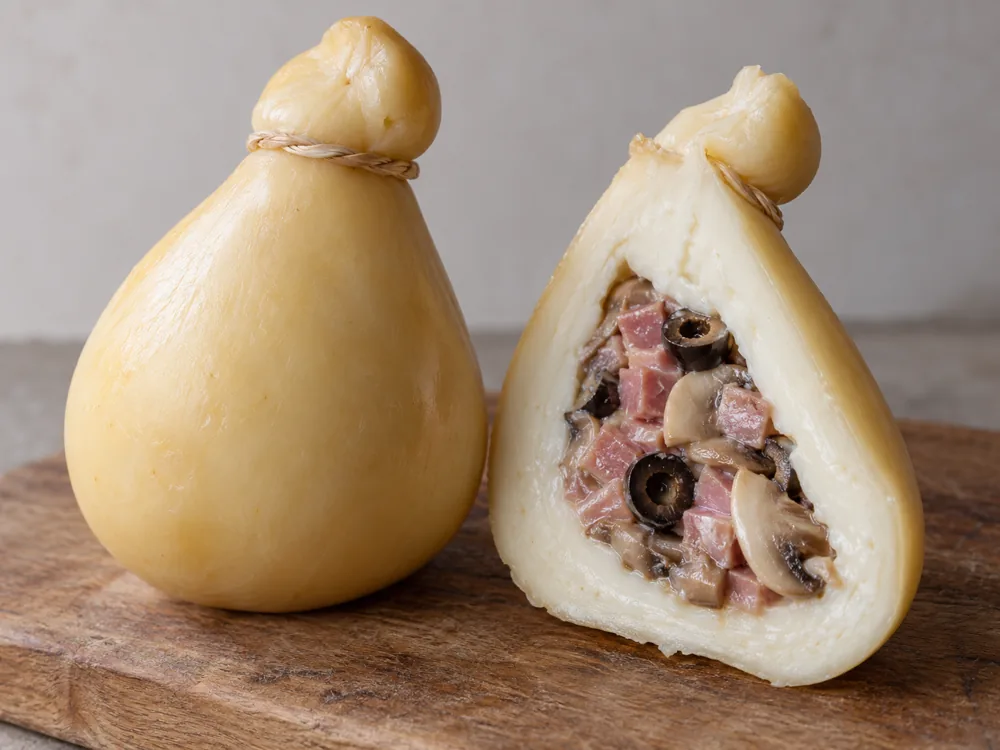
This version is typical of the provinces of Naples, Salerno and Caserta, takes its flavor from the filling and can also be smoked like the plain cheese.
It takes the pear shape with a head, and the survey gives the same 250 to 300 grams for both versions.
Why Does Scamorza Suit Hot Dishes?
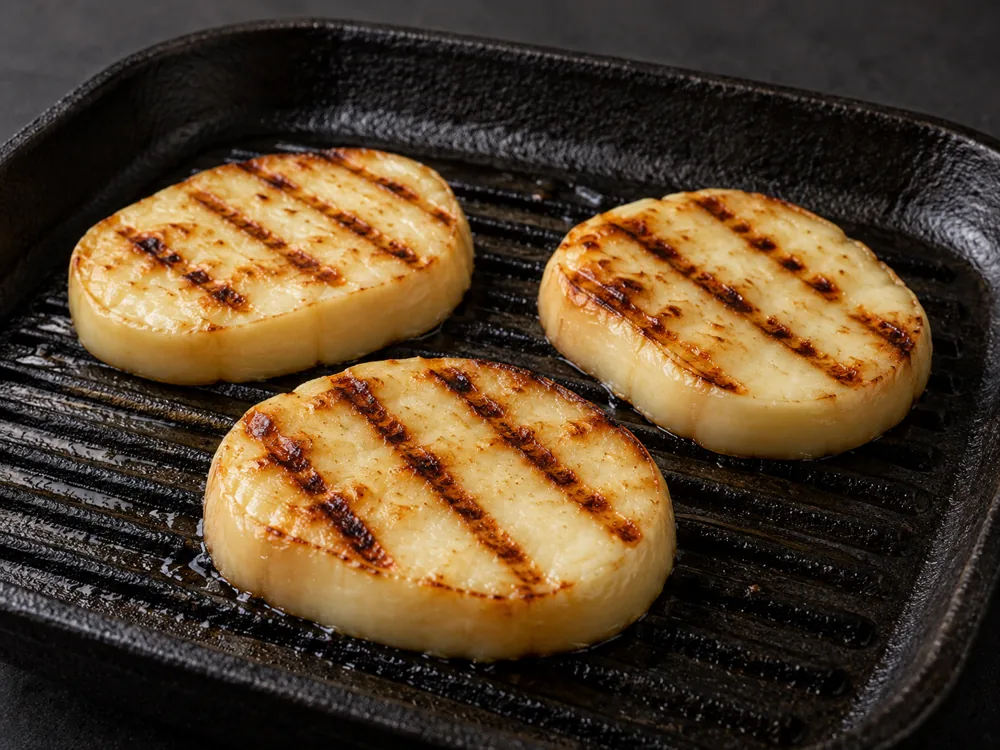
LaBan traces the lower moisture to the curd, which is broken up more finely than mozzarella's. In a hot, dry cast-iron pan he says it crisps to a brown without melting all over the place, much like halloumi.
Culture's library entry says The Mozzarella Company's smoked scamorza melts beautifully when heated, and ONAF describes the smoked paste as slightly melting, so how far it melts depends on the heat and the dish.
The one moisture figure comes from Caseificio del Cigno's product page: 48.5 percent, plus or minus 3, for its smoked 280-gram scamorza. No page cited here gives a matching figure for fresh mozzarella.
Cheesemaker Stefano Bruno of Di Stefano Cheese tells Culture magazine that smoked scamorza should always be eaten hot or melted, while LaBan calls Claudio's smoked version a mild yet flavorful snack simply cut into chunks.
The Campania survey is looser, calling scamorza mostly a table cheese eaten fresh and well liked after grilling over embers, and ONAF lists it as a table cheese served as it is in antipasti or grilled as a main course. Culture's library entry adds that The Mozzarella Company's smoked scamorza is equally good sliced onto salads and sandwiches.
What Are the Best Ways to Cook and Serve Scamorza?
Grilling is the best documented use, and Italian Wikipedia gives thick slices of about 1 centimeter as the traditional way to do it.
LaBan describes Sal Auriemma of Claudio's Specialty Foods in Philadelphia stringing one over a fireplace or open grill, cutting the bottom and slicing it onto crusty bread.
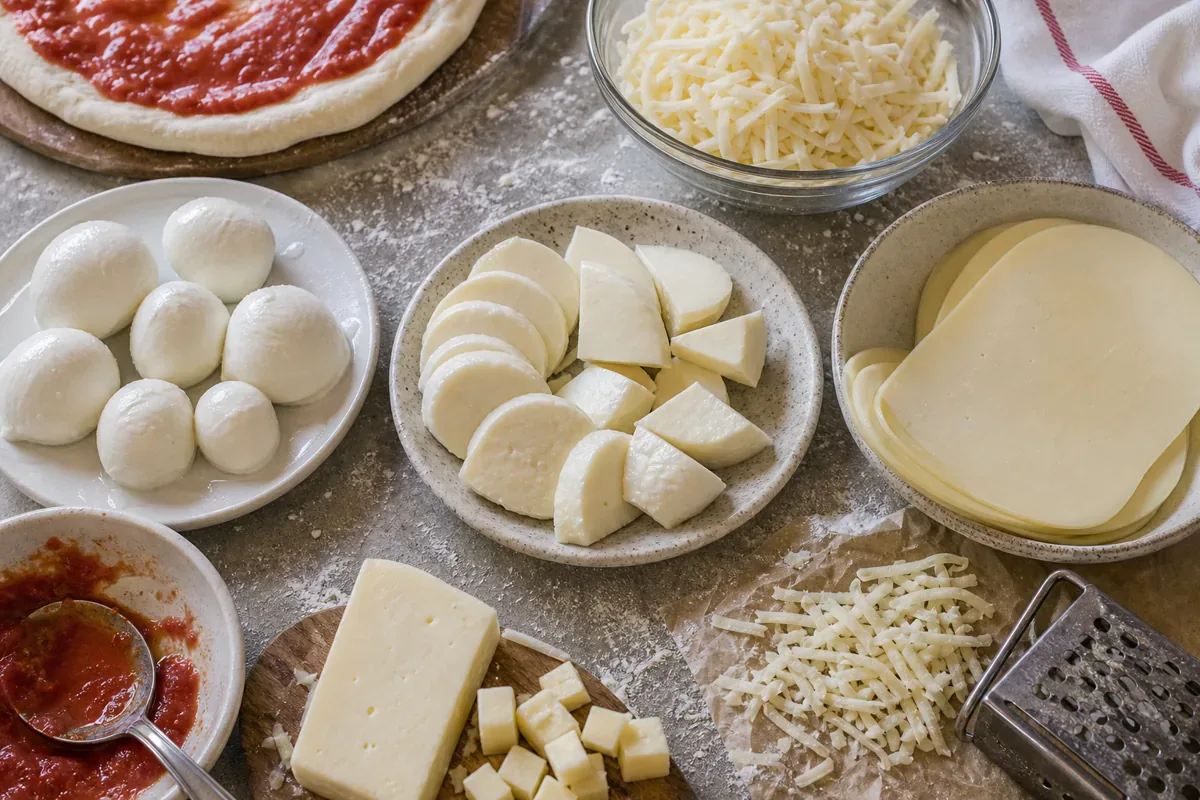
LaBan says the lower moisture lets scamorza bake perfectly over pizzas and sandwiches, and ONAF singles out the smoked version for pizza.
ONAF names baked pasta and eggplant parmigiana as typical dishes, and LaBan calls the smoked version a subtle, earthy addition to pasta casseroles and Neapolitan-style eggplant Parmesan.
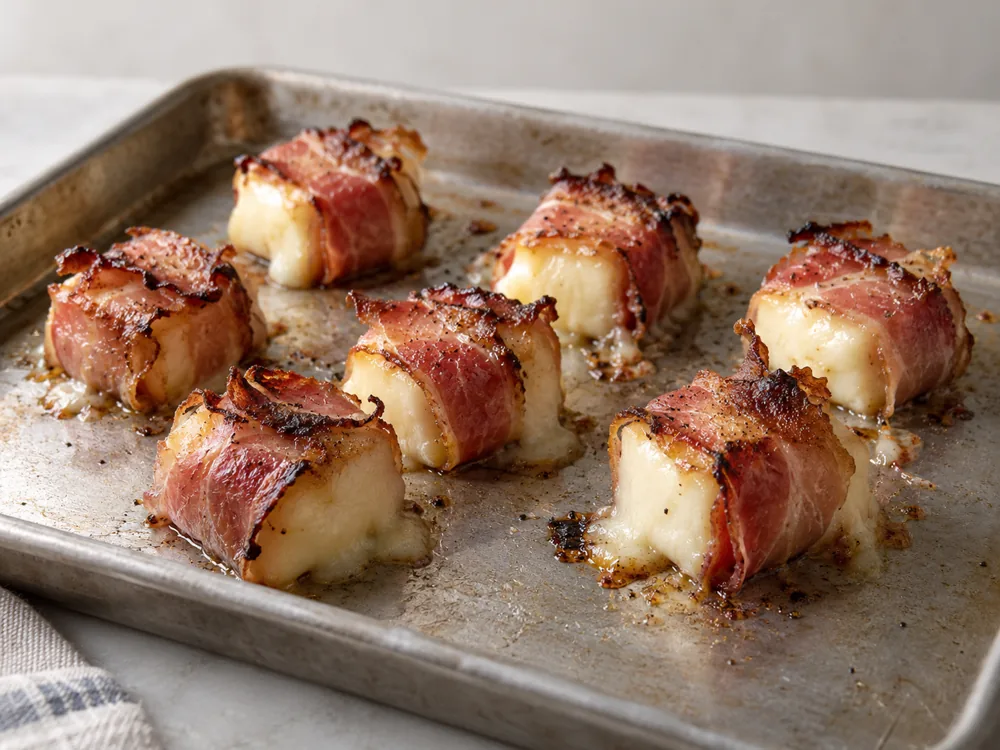
Culture magazine's smoked scamorza feature gives one cheesemaker's method: cut the cheese into one-inch cubes, wrap each in a thin slice of speck and broil until the speck crisps and the cheese melts.
What Should You Serve With Scamorza?
ONAF suggests light-bodied white wines such as Bombino Bianco or Verdeca, the local pairing, or rosés made from Negroamaro grapes. Culture's library entry pairs The Mozzarella Company's smoked scamorza with oak-aged Chardonnay.
For red wine, LaBan quotes Sal Auriemma of Claudio's recommending a glass with his scamorza on crusty bread.
| Pairing | Type | Why It Works |
|---|---|---|
| Light white wine | Wine | ONAF names light-bodied whites such as Bombino Bianco and Verdeca. |
| Negroamaro rosé | Wine | ONAF's second wine suggestion. |
| Oak-aged Chardonnay | Wine | Culture's pairing for The Mozzarella Company's smoked scamorza. |
| Red wine | Wine | Sal Auriemma's suggestion with scamorza on crusty bread, quoted by LaBan. |
| Speck | Food | Culture's cheesemaker wraps it around scamorza cubes before broiling. |
| Crusty bread | Food | LaBan describes grilled scamorza sliced onto it at Claudio's. |
| Salads and sandwiches | Food | Culture's library entry calls The Mozzarella Company's smoked scamorza equally good sliced onto them. |
Can You Eat the Skin?
LaBan describes scamorza as developing an edible rind during its light aging, and the Puglia record describes the skin as thin.
The tie and any coating are separate matters. Culture notes that The Mozzarella Company dips its smoked scamorza in wax, and the Puglia record and Italian Wikipedia describe the raffia and plastic-strip ties.
Raffia, plastic strips and wax are not the cheese's own skin, so take them off before eating.
How Do You Buy and Store Scamorza?
The milk treatment is the first label detail to check, since the sources in the milk table split between raw and pasteurized. The smoke is the second: beech, straw, hay with hickory and pecan shells all appear in the smoke list, and the label or the maker can say which one was used.
Three checks decide the purchase: raw or pasteurized milk on the label, the smoke fuel on a smoked piece, and the production date, since the one shelf-life figure cited counts 45 days from it.
Storage figures come from a maker's own page. Caseificio del Cigno gives +2 to +4°C and 45 days from the production date for its smoked 280-gram scamorza, sold vacuum-packed and ready to eat.
The same Caseificio del Cigno page says to eat that product within 48 hours of opening it. The pages cited for other brands give no after-opening window, so the date and instructions printed on the pack you buy are the guide.
The Campania survey describes what an overripe piece is like: kept beyond its maximum shelf life, the cheese turns firmer, smells unpleasant and tastes bitter.
Is Scamorza Safe During Pregnancy?
Neither the NHS nor the CDC names scamorza, so pregnancy guidance on cheese turns on the milk and the heat. The NHS lists pasteurised mozzarella among the soft cheeses it considers safe, and the CDC lists mozzarella made with pasteurized milk among its safer choices.
Raw-milk scamorza is where the guidance gets less clear, because neither agency says how it treats a semi-soft stretched-curd cheese made that way.
The CDC calls soft cheese made from unpasteurized milk riskier, and the NHS says any foods made from unpasteurised milk, such as soft ripened goats' cheese with a white coating, must be thoroughly cooked.
The CDC lists pasteurized soft cheeses heated to an internal temperature of 165°F or until steaming hot among its safer choices, and says pregnant women are 10 times more likely to get a Listeria infection.
What Is in a Serving of Scamorza?
Caseificio del Cigno's smoked 280-gram product is the one cited label with a full panel, and the figures below are per 100 grams.
A 30-gram portion at those values works out to about 95 calories, 7.5 grams of fat and 6.6 grams of protein. The Puglia record lists 329 kilocalories per 100 grams of edible portion without saying whether the cheese is plain or smoked, 12 more than the Caseificio del Cigno figure, so the effect of smoking cannot be told apart from the difference between makers.
The same product page lists fat at 24.5 percent of the whole cheese and above 44 percent of the dry matter, and all of the 1.8 grams of carbohydrate as sugars.
Scamorza is a drier, firmer cousin of fresh mozzarella that the sources above use for grilling, baking and eating hot. Check whether the label says raw or pasteurized milk and how the smoke was made before you choose plain or smoked.
SOURCES & REFERENCES
What Do Shoppers Ask Most About Scamorza?
Plain scamorza tastes sweetish or slightly savory, according to the Puglia record. ONAF says the smoked version is sweet and slightly saltier, with mild bitter notes.
No. Both are pasta filata cheeses, but LaBan describes scamorza as drier and much firmer than fresh mozzarella.
No. The Puglia record and ONAF both describe plain and smoked versions.
Not for taste or texture: Caseificio del Cigno sells its pasteurized smoked scamorza ready to eat, the Campania survey says it is generally eaten fresh or after charcoal grilling, and LaBan eats it cut into chunks as a snack. For raw-milk scamorza and for pregnancy, the NHS wording in the pregnancy section applies.
Not by default. The Puglia record specifies liquid calf or kid rennet, and the Campania survey specifies liquid calf rennet.
Culture's library entry lists microbial rennet for The Mozzarella Company's smoked scamorza. The sources cited here do not give the rennet for every brand, so check the ingredient list.
Often in baked dishes. LaBan says its lower moisture lets it bake over pizzas and sandwiches, so it can stand in for mozzarella there, though the drier body behaves differently from fresh mozzarella.