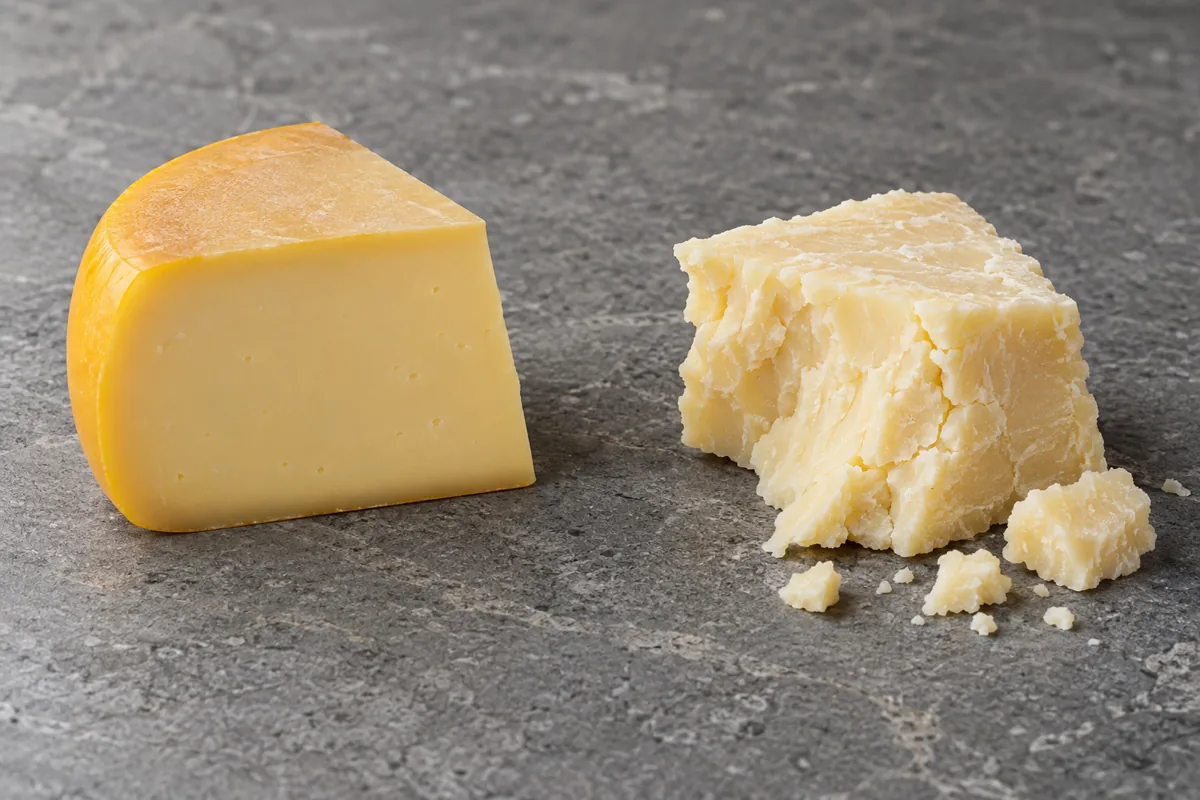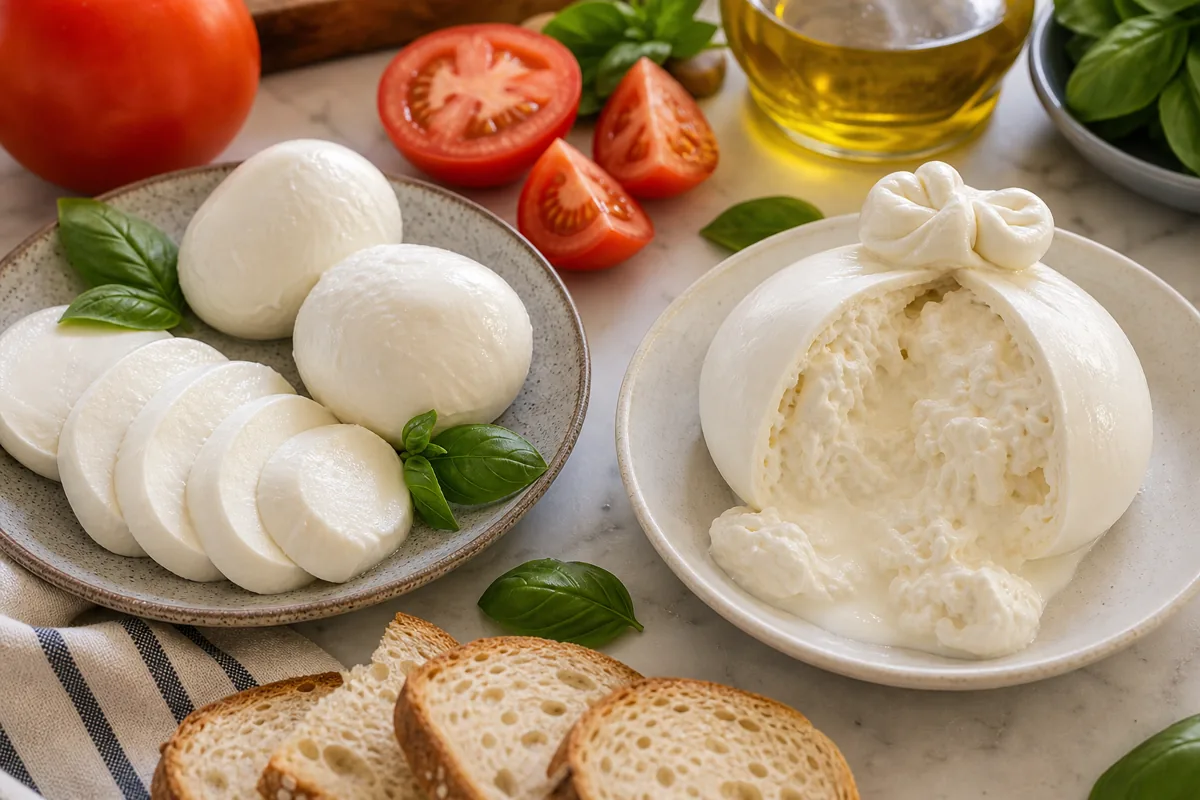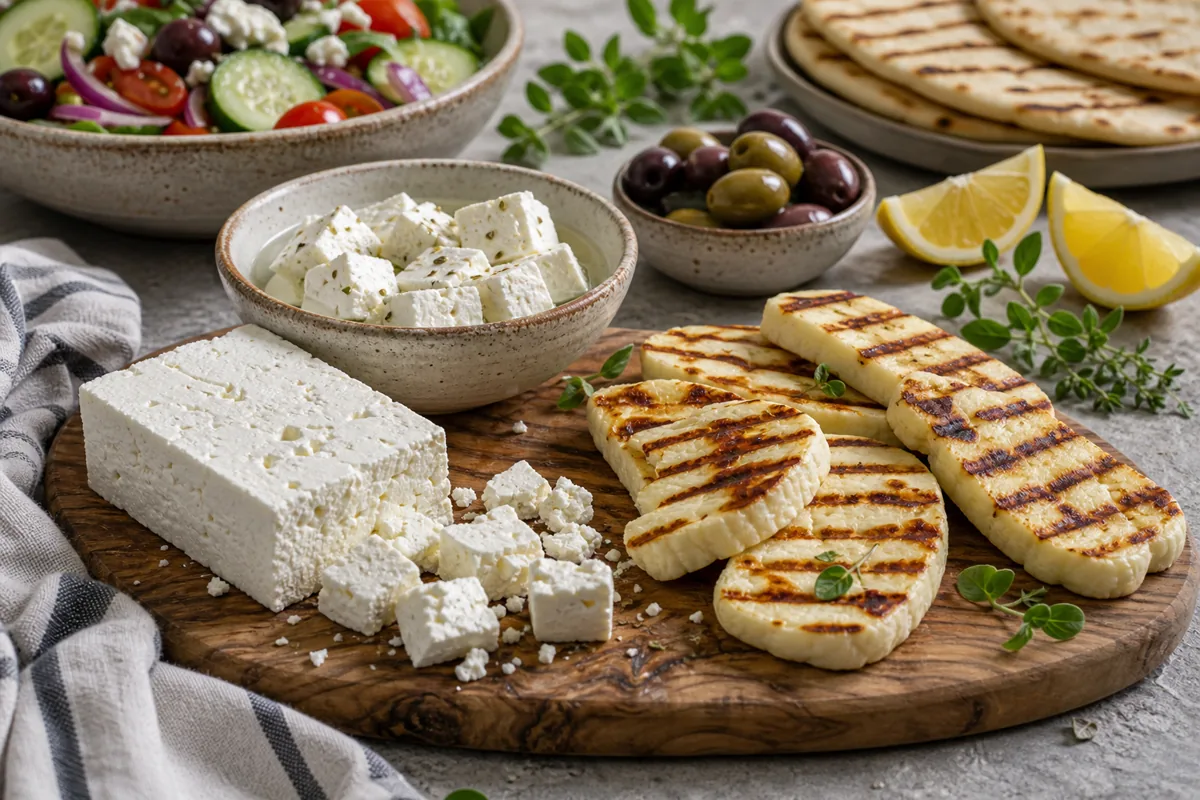
Choose halloumi when the cheese goes on a grill or into a hot pan, because its curd is cooked in whey and does not spread or melt. Choose feta when the cheese should crumble into a salad or bake inside a pie.
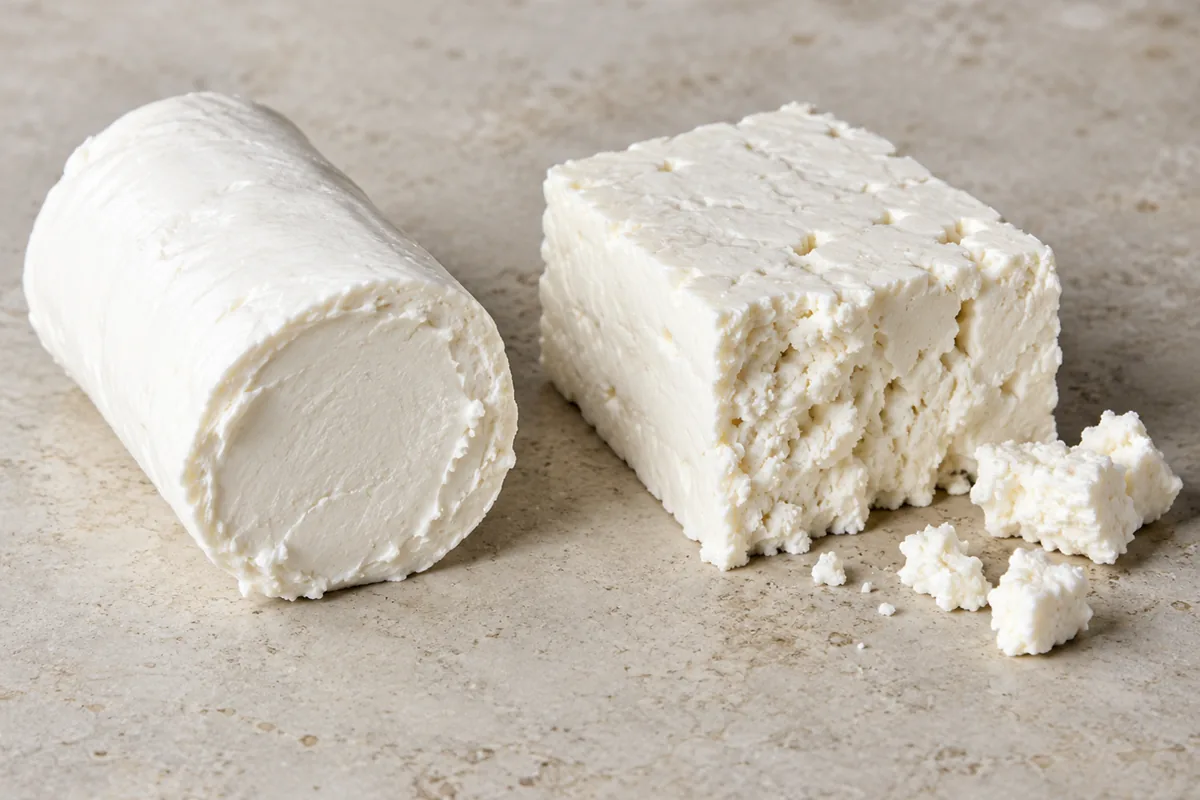
Greek feta is a white brined cheese that ripens for at least two months.
Halloumi comes from Cyprus, where the curd is heated in its own whey and then folded. That single step explains most of the choice below, because it leaves a cheese you can grill as a slice.
In This Article
What Is the Difference Between Feta and Halloumi?
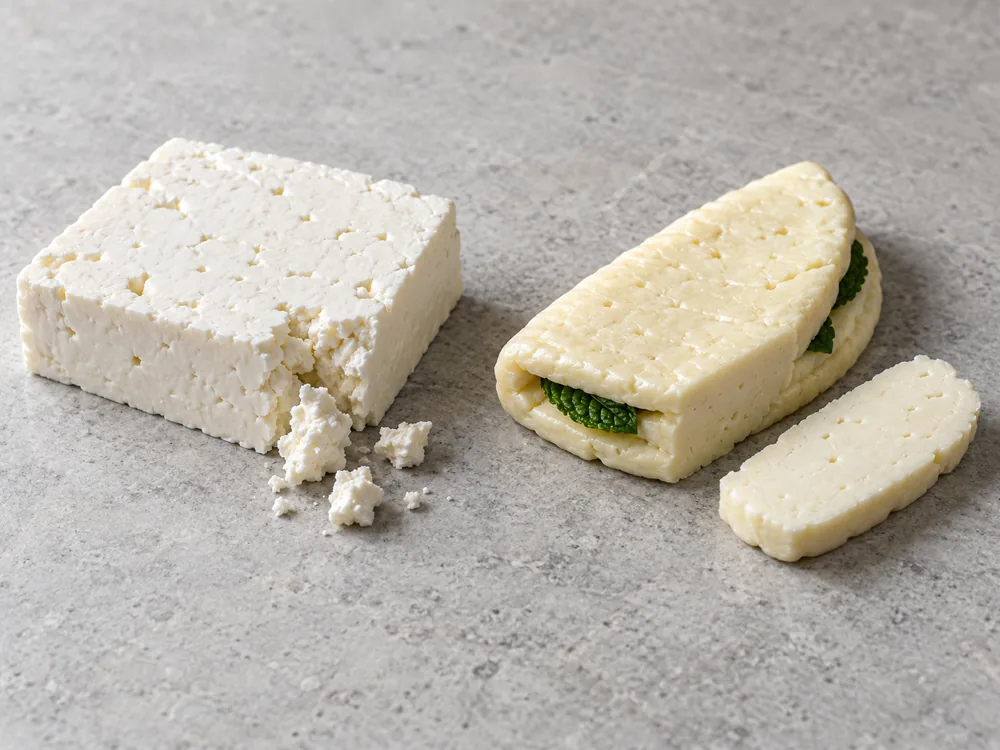
The two cheeses are made in opposite ways. Feta curd drains in its moulds without pressing before it is dry-salted and ripened in brine, while halloumi curd is pressed, heated in whey and folded around mint leaves.
The table sets out what each protected-name specification requires, from the 1994 Greek ministerial decision for feta and the 2022 EU single document for halloumi.
| Attribute | Feta (PDO) | Halloumi (PDO) |
|---|---|---|
| Milk | Sheep's milk, or sheep's with up to 30% goat's milk | Sheep's or goat's milk, with or without cow's milk; sheep and goat must outweigh cow |
| Milk treatment | Raw or pasteurised | Pasteurised, or heated above 65°C |
| Rennet | Traditional rennet or enzymes with the same action | Rennet, but not pig rennet |
| Key step | Curd drained without pressing, dry-salted, then put in 7% brine | Curd heated in whey above 90°C for at least 30 minutes, then folded with mint |
| Ripening | At least two months in total | Sold fresh; mature halloumi spends at least 40 days in salted whey |
| Shape | Wedge or rectangular block, no rind | Folded rectangle or half-moon, 150 to 350 g |
| Texture | Soft, can be cut into slices, few or no holes | Semi-hard and elastic, close texture, easily sliced |
| Maximum moisture | 56% | 46% fresh, 37% mature |
| Minimum fat in dry matter | 43% | 43% fresh, 40% mature |
The Greek decision regulates feta's milk before any cheese is made. Goat's milk may not exceed 30% by weight, the milk must be at least 6% fat with a pH of at least 6.5, and it must be set into curd within 48 hours of milking.
It bars concentrated milk, milk powder, milk protein and casein salts from the vat and allows no added colourants or preservatives. The milk must come from sheep and goat breeds traditionally reared in the production area and fed on its local flora.
Wikipedia, summarising the specification, credits the land's biodiversity and the special breeds for feta's aroma and flavour.
The Greek decision describes feta as having a pleasant, slightly acidic taste and a rich aroma, and Wikipedia adds that it is tangy, slightly salty and mildly sour, with aromas of ewe's milk, butter and yoghurt.
The halloumi specification records a strong smell of milk and whey, the aroma and taste of mint, a barnyard smell and a pungent, salty taste.
Halloumi's fold has a practical origin. The specification says folding made the cheeses easier to fit into the containers of whey they were kept in, and it holds the Cypriot mint leaves (Mentha viridis) in place between the curd layers.
Both names are protected in the EU. Feta has been a PDO since 2002 and must come from named regions of mainland Greece or from Lesbos, while halloumi became a PDO in 2021 and must be made and packed in Cyprus.
How Is Feta Ripened, and What Types Exist?
Ripening starts before the brine. Once the drained curd has set firm, it is dry-salted on the surface with coarse salt, and the decision says a rich surface microflora develops at this stage and contributes to ripening and to feta's sensory character.
The salted curd then goes into wooden or metal vessels with brine, and ripening runs in two stages. The first lasts up to 15 days in rooms held at up to 18°C and at least 85% relative humidity.
The second stage moves the cheese into cold stores that hold a steady 2 to 4°C at 85% humidity or more. The decision counts both stages toward a single minimum, the two months in the table.
Sources count the time differently. Wikipedia's summary box gives three months as the minimum, and its production text puts a further two months of refrigeration after several weeks at room temperature, whereas the Greek decision counts both stages inside the two months.
The decision sets two months as the floor, so any longer ageing on a pack sits above the legal minimum rather than inside it.
Wikipedia adds that barrel ageing, the more traditional of the two vessels, is said to impart a unique flavour. The ripened cheese reaches shops either cut from its container or as standard-weight blocks sealed in plastic cups with some brine.
Wikipedia also divides PDO feta into firm and soft varieties. The firm kind is tangier and considered higher in quality, while the soft kind is almost spreadable, sold at a lower price and mostly used in pies.
Why Does Halloumi Hold Its Shape Over Heat?
Halloumi holds its shape because its protein network is set rigid before the cheese ever reaches a pan. Cheesemaker Gianaclis Caldwell, writing in Culture magazine, explains that a cheese melts only when its proteins form a flexible network loosely held together by calcium phosphate.
Halloumi is pressed only briefly, which leaves its pH at around 5.8, and is then dipped in hot whey. Caldwell says the whey bath kills the starter bacteria and stops further acid from developing, which leaves a strong, rigid protein network.
The halloumi specification sets that step at over 90°C for at least 30 minutes, and it lists the fact that halloumi does not spread or melt at high temperatures among the cheese's defining traits.
Cheese.com describes the result in a pan: heated halloumi forms a crisp crust while staying soft and somewhat creamy inside. The Cyprus Ministry's trade service adds that its slightly rubbery texture lets it fry without oil or butter, ready when it colours around the edges.
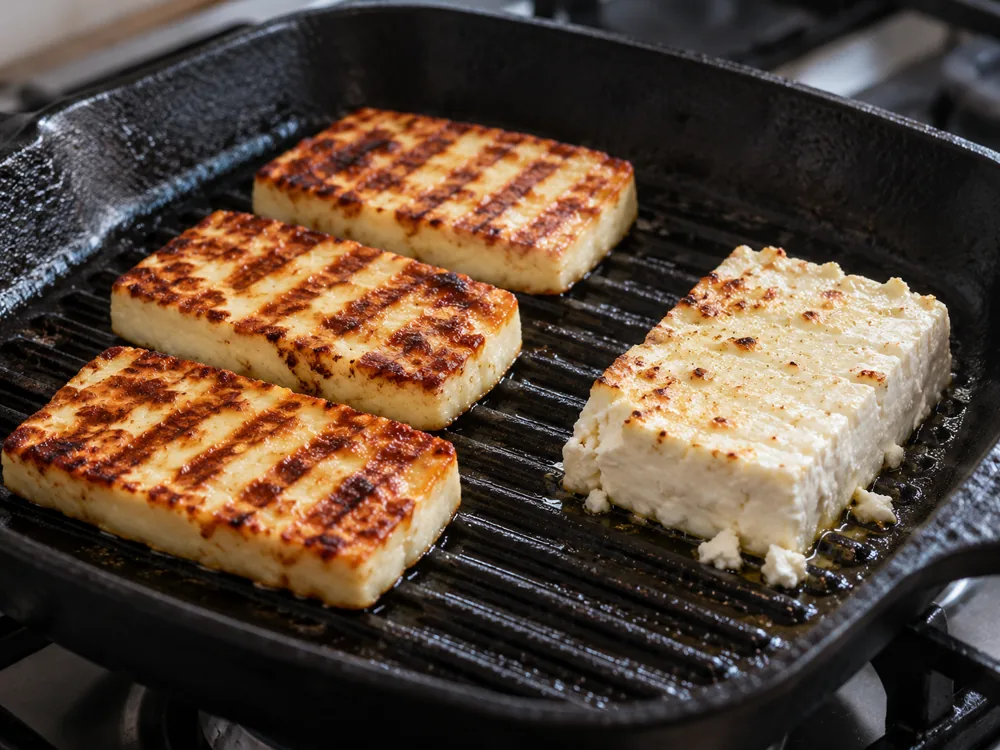
Feta sits at the acid end of the scale, with a pH that usually runs from 4.4 to 4.6 according to Wikipedia. Under heat it softens but keeps its shape, Cheese.com says, without turning creamy the way mozzarella or cheddar does.
Wikipedia notes that feta can be served cooked, often grilled, so heat is not off limits; what feta lacks is the elastic, easily sliced body the halloumi specification describes.
Feta's acidity is made on purpose. Wikipedia says feta from pasteurised milk is given a starter culture to replace the organisms the heat killed, and that these organisms are required for acidity and flavour development.
Cheese.com says no acid or acid-producing bacteria play a role in making halloumi, and Caldwell says its whey bath stops acid from developing, so the two cheeses part ways on acid long before either meets a pan.
What Is the Difference Between Fresh and Mature Halloumi?
Fresh and mature halloumi are made from the same raw materials and differ in how long they are kept and how they eat. The Cyprus Ministry's trade service describes fresh halloumi as semi-hard and elastic, white to lightly yellow, with a firm, sliceable consistency.
Mature halloumi is semi-hard to hard and less elastic than fresh, with a more spicy and salty taste and a mild bitterness, according to the same page. It adds that halloumi may be left to mature in brine and sold in food-grade plastic containers instead of the usual vacuum packs.
Grating over pasta is the only use the ministry's serving notes name for mature halloumi, whereas fresh halloumi gets a long list of uses.
The figures for fresh halloumi differ between sources. The 2022 EU single document, which the table above follows, caps fresh halloumi at 46% moisture and sets pieces at 150 to 350 g, while the ministry's page gives 52% and 150 to 1,200 g.
Both pages agree on 37% moisture for mature and on a minimum fat content in dry matter of 43% for fresh and 40% for mature. The ministry page is undated, so nothing on either page shows which moisture or weight range a given pack follows.
What both pages share is the usual retail size: the ministry says halloumi is typically sold in vacuum-packed pieces of 230 to 280 g.
Which type a pack holds therefore changes three things at once: how elastic the cheese is, how salty and spicy it tastes, and how much salt the specification allows.
Which One Is Saltier?
Neither cheese is the low-salt choice, and the published figures do not make feta clearly the saltier one.
The sources below measure different things, so read each row for what it is. A reference average, a serving percentage, a production figure and a legal ceiling in a specification are separate kinds of number.
| Source | Cheese | Figure |
|---|---|---|
| Wikipedia nutrition table | Feta | 1,116 mg sodium per 100 g, 49% of the Daily Value |
| Wikipedia production notes | Feta | Curd salinity reaches about 3%; ripened in 7% brine |
| Cyprus Ministry trade service | Halloumi | Sodium 15% of the Daily Value per 1 oz (28 g) serving |
| Halloumi PDO specification | Fresh halloumi | No more than 3% salt |
| Halloumi PDO specification | Mature halloumi | No more than 6% salt |
The halloumi specification allows mature halloumi up to 6% salt, double the ceiling for fresh, and it describes the mature cheese as very salty.
The two nutrition rows also count different amounts, 100 g of feta against a 28 g serving of halloumi, so their percentages cannot be set side by side.
For a salt-restricted diet, the pack label is the number that counts. These sources span a per-100 g average, a per-serving percentage, a curd figure and two legal limits, and none of them describes the block in your basket.
Can You Swap Feta and Halloumi?
Only partly, because the two cheeses do different jobs. Halloumi can stand in for feta when you want warm, browned pieces on a salad, but its elastic curd will not crumble through a dressing the way feta does.
Cheese.com compares halloumi to a cross between feta and mozzarella: feta's salty, briny notes in a smoother, less crumbly body.
Going the other way is harder, for the reason set out in the heat section above.
A true halloumi stand-in has to resist melting too. Culture magazine names Indian paneer, queso fresco, juustoleipä (often called bread cheese) and Lithuanian white cheese as cheeses that stay intact on the grill.
Paneer and queso fresco reach that result by a different route. Caldwell explains that they are curdled by adding acid to hot milk, with no rennet, which gives a dense, inflexible cheese.
Which One Suits Salads, Pies and Sandwiches?
Feta's classic dishes are cold, or baked inside something. Wikipedia names Greek salad and the filo pies spanakopita (spinach pie) and tyropita (cheese pie), and says feta is often served with olive oil or olives and sprinkled with oregano.
Halloumi's uses start with heat. Its specification says it can be eaten as it is, fried or grilled, and records it as one of the most common accompaniments to bread in Cypriot homes.
- Salads: both. Wikipedia names Greek salad for feta, and Cheese.com lists salads for halloumi.
- Filo pies: feta, in spanakopita and tyropita.
- Grill, pan and skewers: halloumi. Cheese.com names grilling, pan-frying and kebabs.
- Sandwiches and wraps: both appear. Wikipedia lists feta in sandwiches, and Cheese.com lists halloumi in sandwiches and wraps.
- Eggs: feta, which Wikipedia lists in omelettes.
- Pasta and pizza: halloumi. Cheese.com lists pasta dishes and pizza topping, and the Cyprus ministry names grating over pasta.
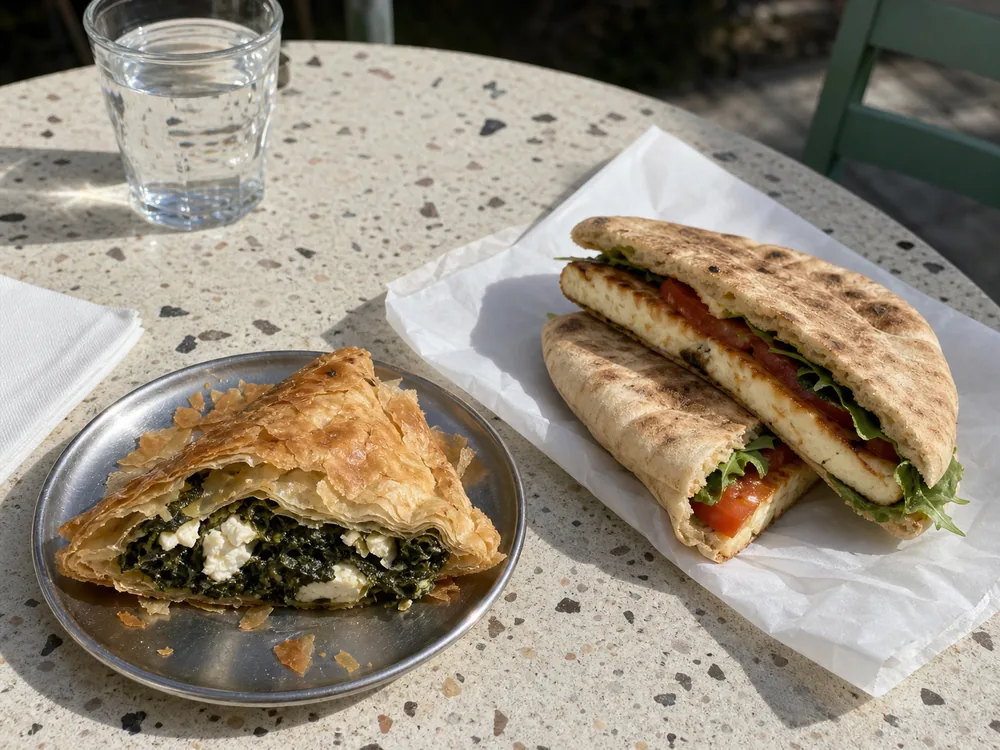
In sandwich fillings the choice comes down to form. A grilled halloumi slice goes in as one piece, while feta goes in as crumbs.
The Cyprus ministry's serving notes pair fresh halloumi with melons and grapes, and with salads, sandwiches and stuffings in ravioli, cheese puffs, aubergines and red peppers.
For the grill, the ministry describes halloumi as worthy of being the centrepiece of a dish, served hot with olive oil or cubed onto a kebab with thick chunks of tomato and onion. It also calls burgers a popular summer barbecue idea, made vegetarian or combined with meat.
Fried chunks go onto a bed of crisp green salad with olive oil and shredded mint, and Cheese.com adds a halloumi and watermelon salad, a halloumi and fig pizza and a place in a Cyprus meze, where it is often offered with a cold beer.
How to Buy and Store Feta and Halloumi
Outside the EU the word feta is often used for similar brined cheeses, and Wikipedia notes that most cheese sold as feta in the United States is American and made from cow's milk.
Cow's milk on a feta label therefore marks a cheese made outside the Greek PDO rules.
The 1994 Greek decision lists what a PDO feta pack must show: the name feta, the words protected designation of origin and cheese, the producer-packer's name and seat, the weight, the production date and a control code starting with the Greek letters ΦΕ. It also prohibits preservatives and antibiotic substances in the cheese and its brine.
Wikipedia notes that makers of imitations use names such as "salad cheese" and "Greek-style cheese", and that Denmark's Arla changed its white cheese to the name Apetina after the EU's decision.
PDO halloumi that mixes milks must list them on the label in decreasing order of percentage, so the first milk named is the largest share. The sheep and goat milk the specification requires is only a minimum, and that minimum rises in steps.
The Cyprus Mail reported in August 2024 that the minimum would reach 30% sheep and goat milk from 1 February 2025, after standing at 25% until 31 August and at 15% from 1 September to 31 January because the animals give less milk in autumn.
Halloumi made in autumn can therefore carry a smaller sheep and goat share than halloumi made earlier in the year and still meet the rules the paper describes.
The paper adds that the European Commission granted Cyprus a five-year extension in July 2024, after the first ten-year transition period, due to end on 9 July, was set to be missed amid stakeholder disagreement over milk quotas. The agriculture ministry expects sheep and goat milk to overtake cow's milk in 2029, on the way to the eventual 50-50 split the law requires.
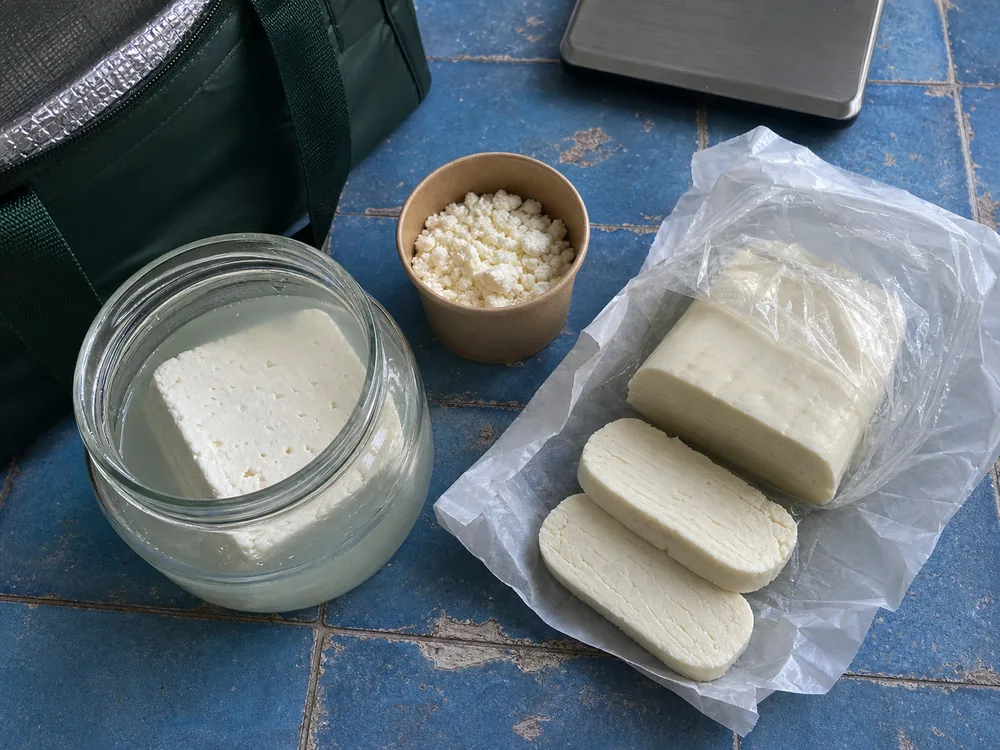
Feta dries quickly even in the fridge. Wikipedia advises keeping it in brine or lightly salted milk if you store it for longer than a week.
For halloumi bought fresh, Cheese.com gives up to two weeks in the refrigerator and says an opened pack is best eaten within a few days.
Milk treatment is the check that matters in pregnancy. The feta specification allows raw or pasteurised milk, and the halloumi specification allows milk that is heated above 65°C without being pasteurised.
The NHS lists pasteurised feta and pasteurised halloumi among the soft cheeses that are safe during pregnancy. The CDC puts feta made with pasteurized milk on its safer list and notes that pregnant women are 10 times more likely to get a Listeria infection.
The NHS also lists any cheese cooked until steaming hot as safe to eat, and says foods made from unpasteurised milk must be thoroughly cooked. The CDC lists soft cheese made from unpasteurized (raw) milk as riskier and pasteurized soft cheeses heated to an internal temperature of 165°F or until steaming hot as safer, and eaten cold, pasteurized halloumi is a type its list does not cover, so ask a midwife or doctor.
Feta or Halloumi: Which Should You Buy?
Buy halloumi when the cheese has to go on a grill or into a hot pan and come out as a slice. Buy feta when it should crumble into a salad, fill a filo pie or wait in brine in the fridge.
Halloumi is the cheese for direct heat, because a curd cooked in whey above 90°C does not spread or melt. Feta is the cheese for cold and baked dishes, from Greek salad to spanakopita, so a kitchen that cooks both kinds of food will use both.
SOURCES & REFERENCES
Feta vs Halloumi FAQ
These answers cover the questions that the sections above do not.
It depends on the maker. The feta specification allows traditional rennet or other enzymes with the same action, and the halloumi specification allows rennet but not pig rennet.
As summarised in the table above, neither specification limits rennet to a non-animal kind, so a vegetarian buyer needs the maker's own statement.
Yes. Cheese.com says halloumi can last up to six months in the freezer.
Cheese.com attributes the squeak to the cheese's high melting point and its blend of proteins, which pack tightly when it is grilled or fried.