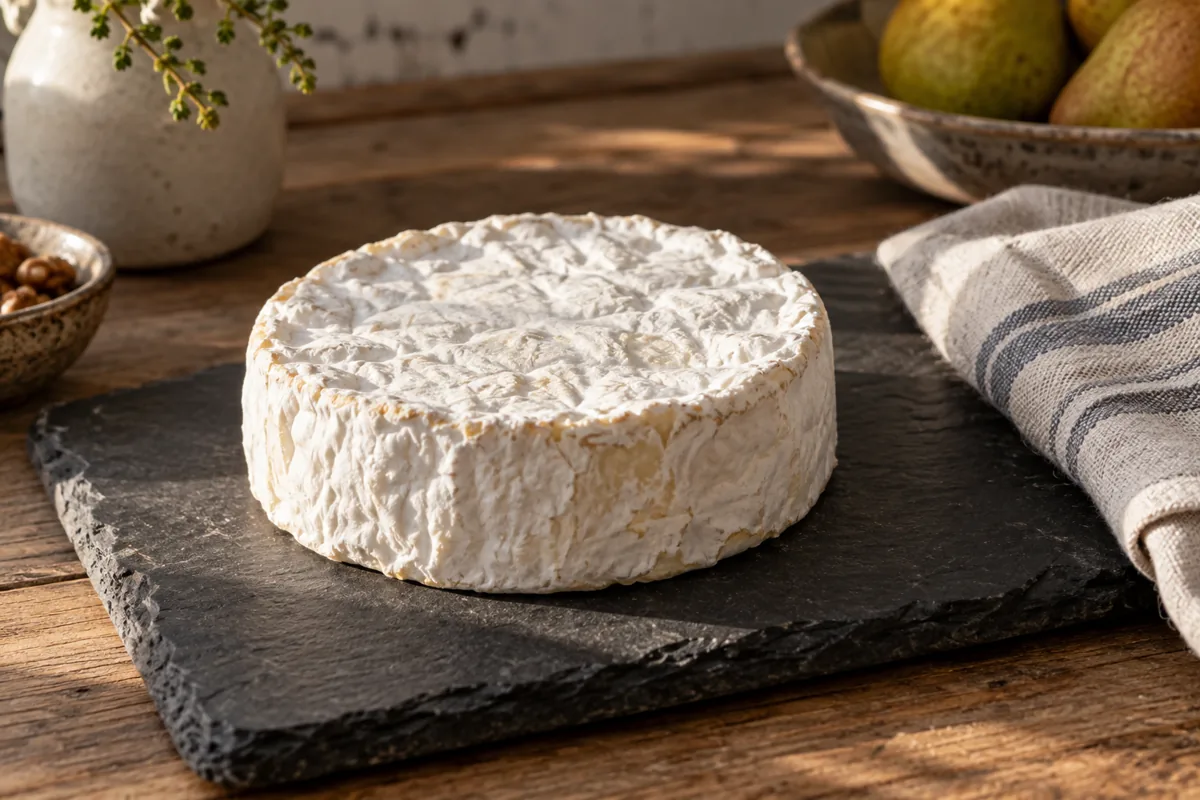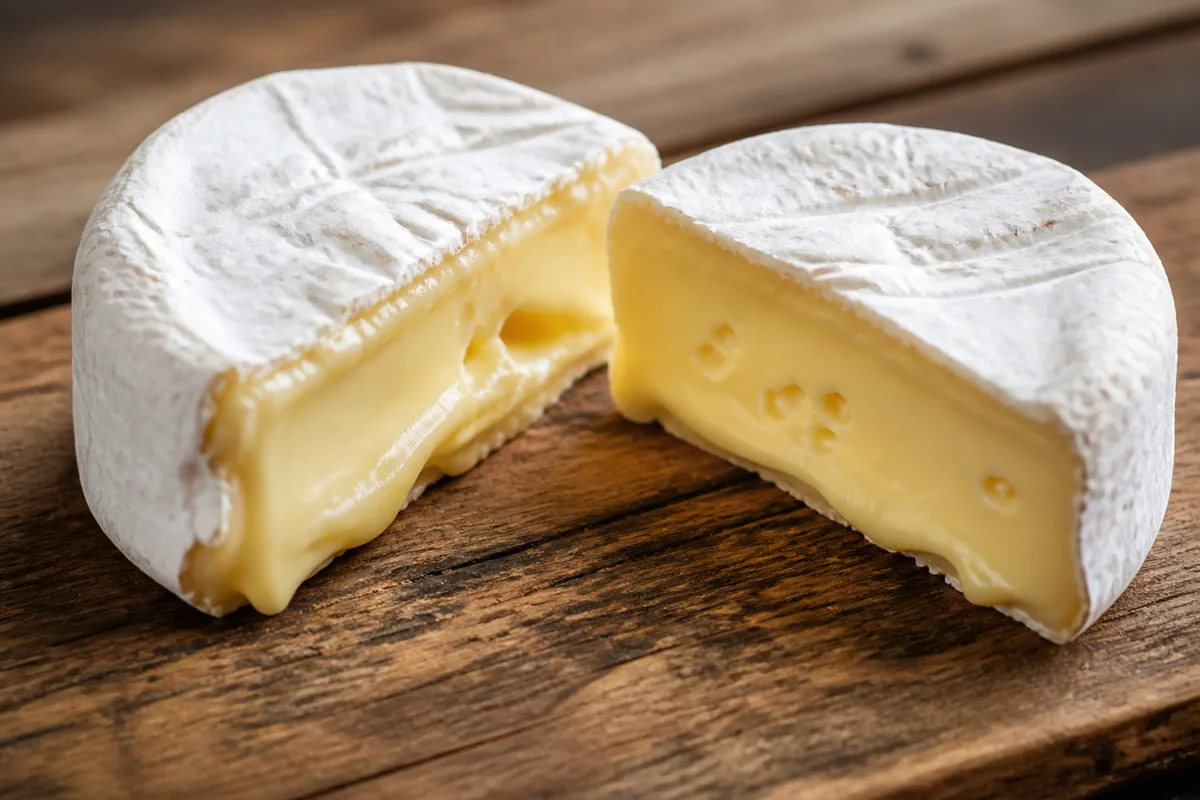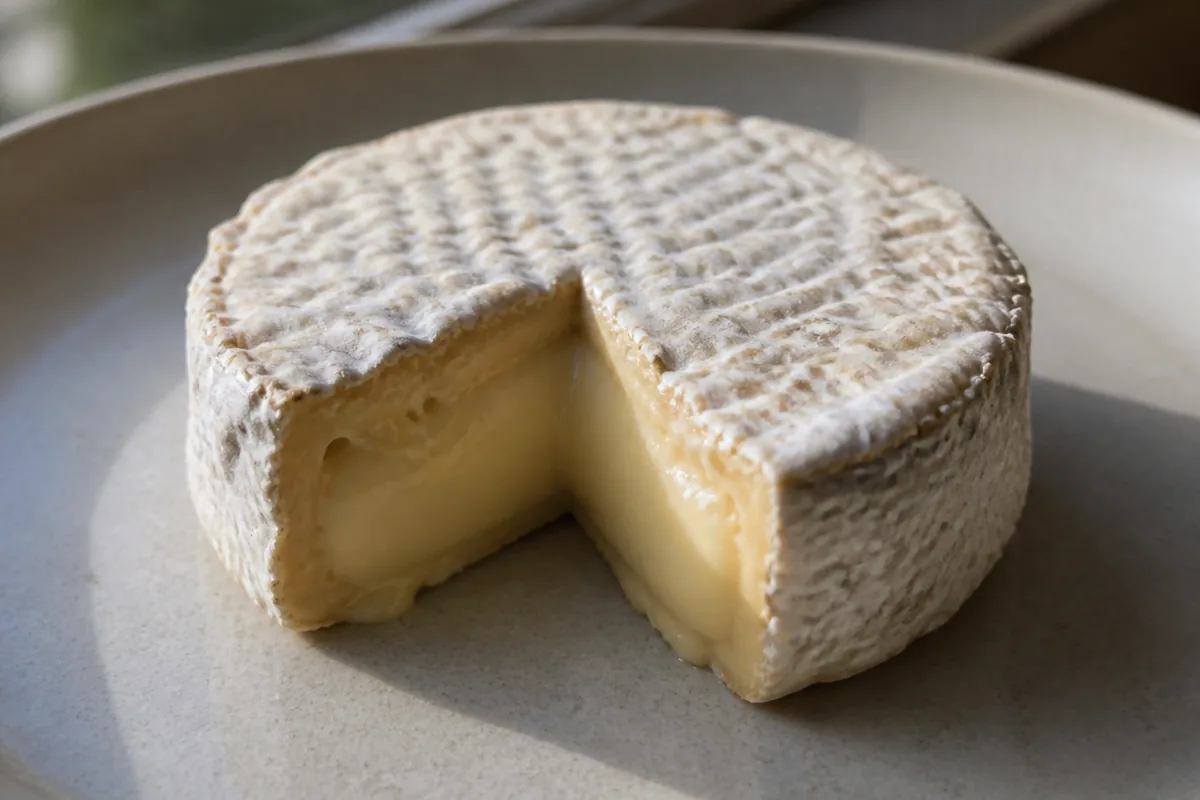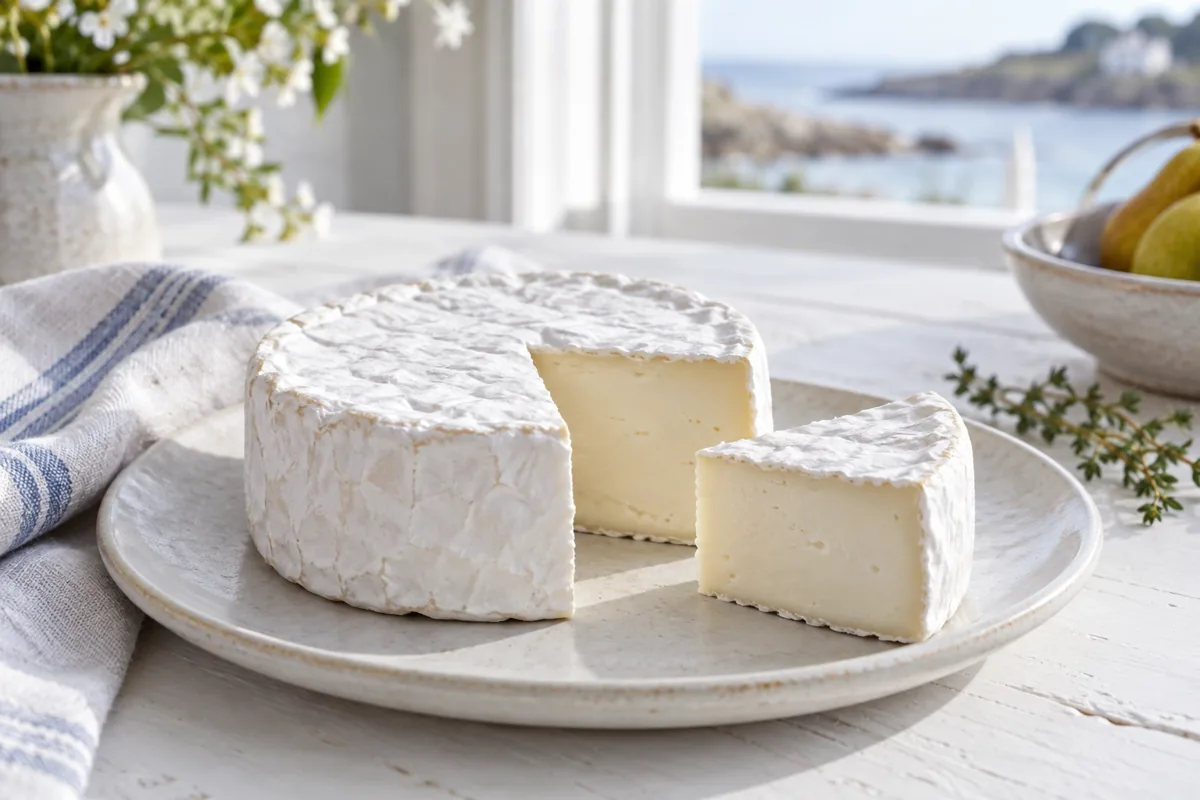
Mt Tam is an organic triple cream from Cowgirl Creamery in California, made from pasteurized cow's milk and cream with microbial (vegetarian) rennet and finished with a white bloomy rind. The maker calls it its best-selling cheese.
The creamery's shops have closed, and the cheese is still made at its creamery in Petaluma.
In This Article
How Does Mt Tam Taste as It Ripens?
Cowgirl Creamery says Mt Tam goes from fudgey firmness to buttery softness, with flavors that span bright creme fraiche to complex and mushroomy.
At every age the maker lists salted butter, cream, fresh pasture and white mushrooms. It ties the flavors to North Bay's lush green and gold pastures and to its organic, locally sourced milk.
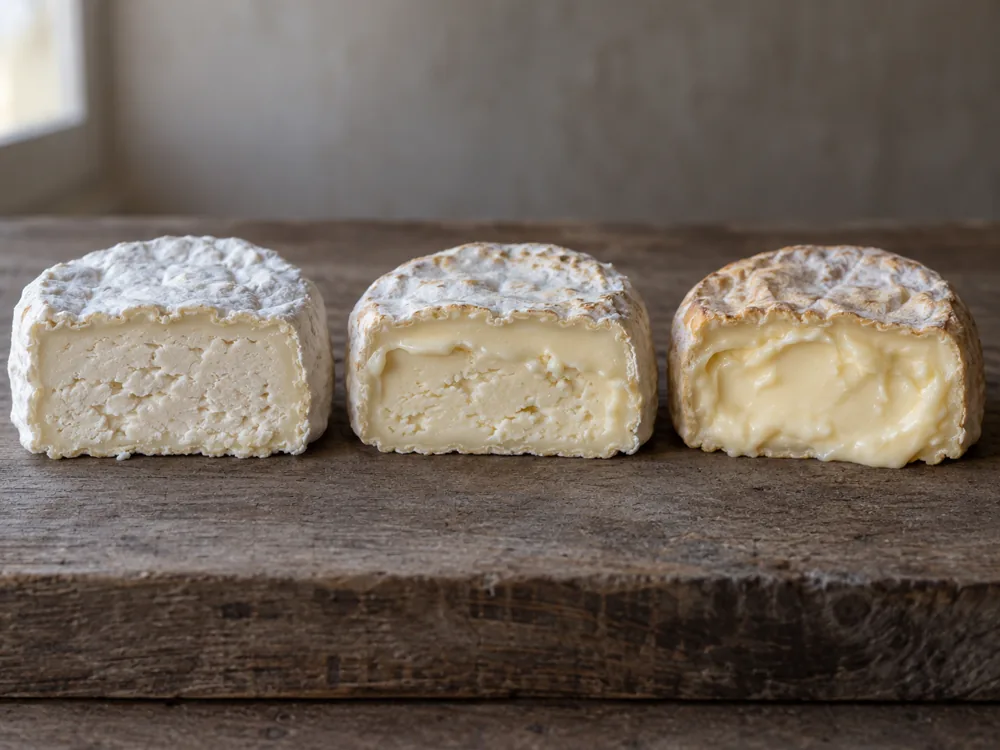
The range comes from one wheel changing over time, so the taste depends on how far along the cheese is. The maker's page on the cheese's life splits it into three stages.
| Stage | Rind | Inside | Flavor |
|---|---|---|---|
| Young | White, with minimal browning | Paste crumbly and firm; creamline starting to develop | Tangy and lactic, fresh milk and pronounced salt; creme fraiche and cultured butter |
| Ripe | Slight browning | Thicker, smooth creamline; some crumbliness at the core; more fudgy | Mushroomy note more pronounced; milky and salty-briny, but richer and buttery |
| Mature | Chewy, almost leathery | Creamline and paste merged into a creamy, pudgy texture, similar to soft butter at room temperature | Rind's mushroomy flavor stronger, with slight bitterness; deeper umami, brown butter and cultured cream |
Rind color, creamline thickness and the firmness of the middle move together in the maker's description, which gives a buyer something to look at. A white rind and a firm cut face point to the tangy end, a browned rind and a soft center to the buttery end.
The maker's flavor profile gives the rind a wider visual range than the table does, from pillowy to birch bark, and says the supple rind changes in texture as the cheese matures.
The creamline has a named cause: the maker's glossary defines proteolysis as the enzymatic breakdown of proteins that creates the creamline just under the rind.
Because the band starts at the rind, the three stages read as one layer thickening inward, from a creamline only starting to develop, to a thicker one with some crumbliness left at the core, to a mature wheel where creamline and paste have merged.
The same glossary defines lipolysis as the natural breakdown of fats that gives distinct aromas and flavors, but it does not tie that process to any particular Mt Tam flavor.
The maker also says a mature wheel can show some ammonia, which it describes as expected and says should dissipate fairly quickly.
The maker's tagline is "organic triple cream with a heart", and the heart is the fudgy core: its 2020 post says Mt Tam "retains a fudgy core as it ripens".
What Makes Mt Tam a Triple Cream?
Triple cream, a style that originated in France, has a fat floor of 75 percent butterfat, against 60 to 74 percent for a double cream, according to the cheesemaking supplier New England Cheesemaking Supply, which measures cheese fat as a share of dry matter. Cowgirl Creamery calls Mt Tam a triple cream but its page gives no fat figure for it.
The supplier adds that triple cremes are defined by law at that floor but does not name the country whose law it means, which leaves 75 percent as a benchmark for the category.
Dry matter is the cheese with its water removed, so the figure describes the solids and not the wedge. At the roughly 45 percent moisture the supplier gives for a high-fat brie or a double or triple cream, 75 percent of the solids comes to about 40 percent fat in the wedge, against 22 to 28 percent for a cheddar.
The fat gets there because cream goes in with the milk before cheesemaking starts. Mt Tam's ingredient list reads organic pasteurized cow's milk, organic pasteurized cream, salt, cultures and enzymes.
The supplier's home-cheesemaking example shows the scale of the addition: 10 to 12 ounces of heavy cream added to 118 ounces of 3.25 percent milk makes a gallon of milk at 6 percent butterfat, which becomes 75 percent once the water is removed. Cowgirl Creamery gives no proportions for Mt Tam.
The same supplier describes triple cream as camembert or brie taken further by cream enrichment.
The supplier says Brillat-Savarin gets hot cream to reach 75 percent and is cured for about three weeks under a thin bloomy rind, and that it should be served young. Mt Tam's maker describes a longer arc, through a mature stage it calls approachable for any triple cream lover.
The white rind is mold: in their account for Culture, the founders write that Mt Tam ordinarily grows a fluffy white Penicillium candidum coat within four or five days.
How Is Mt Tam Different From Red Hawk?
Red Hawk began in 2001 as a Mt Tam that went wrong. In the account the founders gave Culture, Sue Conley went to turn the wheels and found them bald and mottled: cheese mites had jumped off a Stilton in the same aging room and were stopping the mold from growing.
Spraying the rind with a solution of Penicillium candidum and water was meant to restart the mold. It killed what was left, and wild Brevibacterium linens took over a rind that turned light pink and sticky.
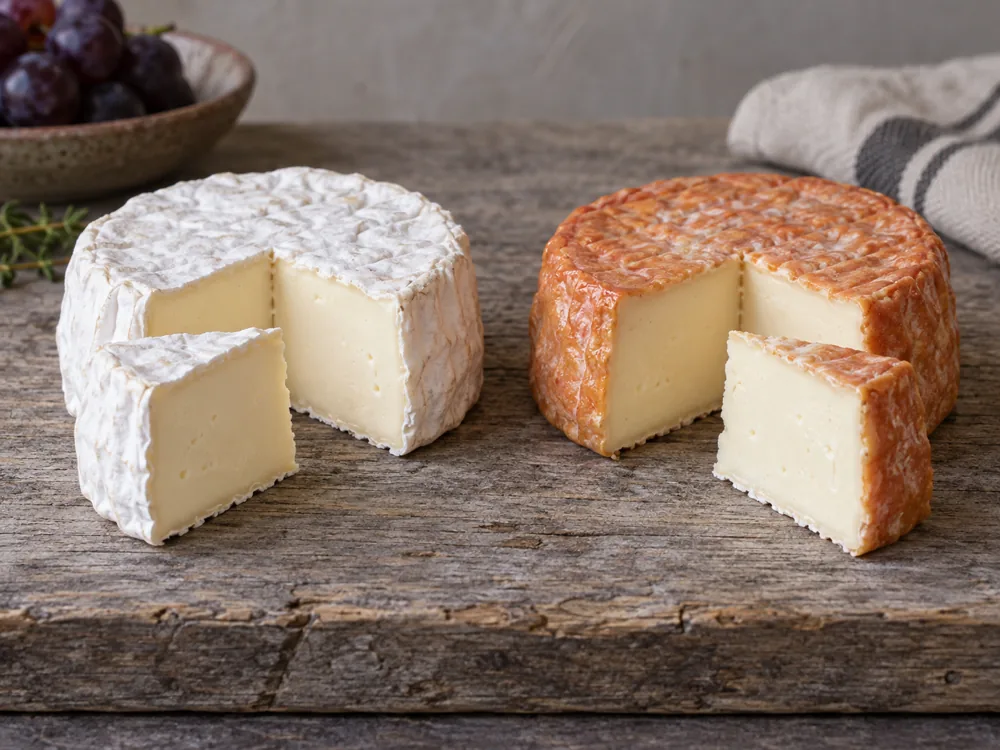
In the founders' account, Kate Arding of Neal's Yard Dairy, who had come to help set up a proper cheese counter, found the forgotten wheels three weeks later still ripening and strongly scented. She cut one open to a gooey texture and called it rich, savory and almost meaty, with a hint of anchovies and lemon and a long sweet-cream finish.
Red Hawk became a cheese of its own, and the maker says it is named for the local red-tailed hawk. The founders add in Culture that it was judged Best of Show at the American Cheese Society competition in 2003, the first washed-rind cheese to win.
The founders describe the aroma as almost alarmingly strong and the flavors as seductively mellow, so Red Hawk smells bolder than it tastes.
B. linens, they write, thrives in cool, humid climates and grows faster when salt is present, and the wild strain around Point Reyes grows everywhere, so they never had to inoculate the rind as most makers do.
They name it as the dominant bacterium used to wash the rinds of big-flavored cheeses such as Taleggio, which makes Red Hawk's rind a bacterial one where Mt Tam's is mold.
| Feature | Mt Tam | Red Hawk |
|---|---|---|
| Style | Triple cream, bloomy rind | Small format triple cream, washed rind |
| Flavor | Salted butter, cream, fresh pasture, white mushrooms | Cured meats, roasted peanuts and ocean brine behind a pungent funk |
| Best placings the maker lists | 2nd, California State Fair 2022 and 2025 | 1st, International Cheese & Dairy Awards 2022 and American Cheese Society 2025 |
The maker's ingredient lists for the two cheeses are identical, so the difference sits in the rind and in what the rind does to the flavor. The maker calls Red Hawk Mt Tam's "funky cousin" and describes a "rough and rowdy aroma".
The maker's style line for Mt Tam also reads Washed Curd, a term its page does not explain, while Red Hawk's line says washed rind, so the word washed appears on both pages for different things, curd on one and rind on the other.
The two overlap in one respect, because the maker calls a mature Mt Tam pungent and calls Red Hawk's funk pungent, so a strong smell alone does not separate them and the rind does.
Their pairing lists do not overlap either: for Red Hawk the maker names Pinot Noir, Gewurztraminer or Riesling, amber to dark ales, barrel-aged sours, root beer, pickles and charcuterie, and onion jam or shallot confit.
A reader who wants butter and mushroom is describing Mt Tam, and one who wants cured meat and brine is describing Red Hawk.
Choose Mt Tam for salted butter, cream and white mushrooms under a white bloomy rind, and Red Hawk for cured meats, roasted peanuts and ocean brine under a washed rind. A mature Mt Tam and Red Hawk are both pungent, so the rind is what tells them apart.
How Do You Eat Mt Tam?
Cowgirl Creamery describes Mt Tam at room temperature as a dense fudgy core wrapped in an evolving, pudgy creamline.
Its recipes take the wheel out of the refrigerator 30 to 45 minutes ahead for a caviar and potato chip platter and about an hour ahead for a bagel board.
The Brussels sprout tart recipe sets the wheel out while the tart bakes for 30 to 35 minutes at 350°F, "so it has time to bloom", which puts the maker's waits between half an hour and an hour.
The caviar recipe gives the purpose of the wait as letting the cheese "come to serving temperature", and the maker states both its fudgy-core description and its soft-butter description of a mature wheel at room temperature.
The pairings come from the maker's page and recipes.
- Sparkling wine: the maker lists Champagne, Prosecco and Cava.
- California Chardonnay and sparkling dry cider: both on the maker's list.
- Drinking chocolate and sweet snacks: the maker lists preserves and honey among the snacks.
- Salty and savory plates: the maker's recipes put a wedge on a potato chip under white sturgeon caviar, and spread wedges across a bagel board with smoked salmon, bacon, cucumber, tomato and capers.
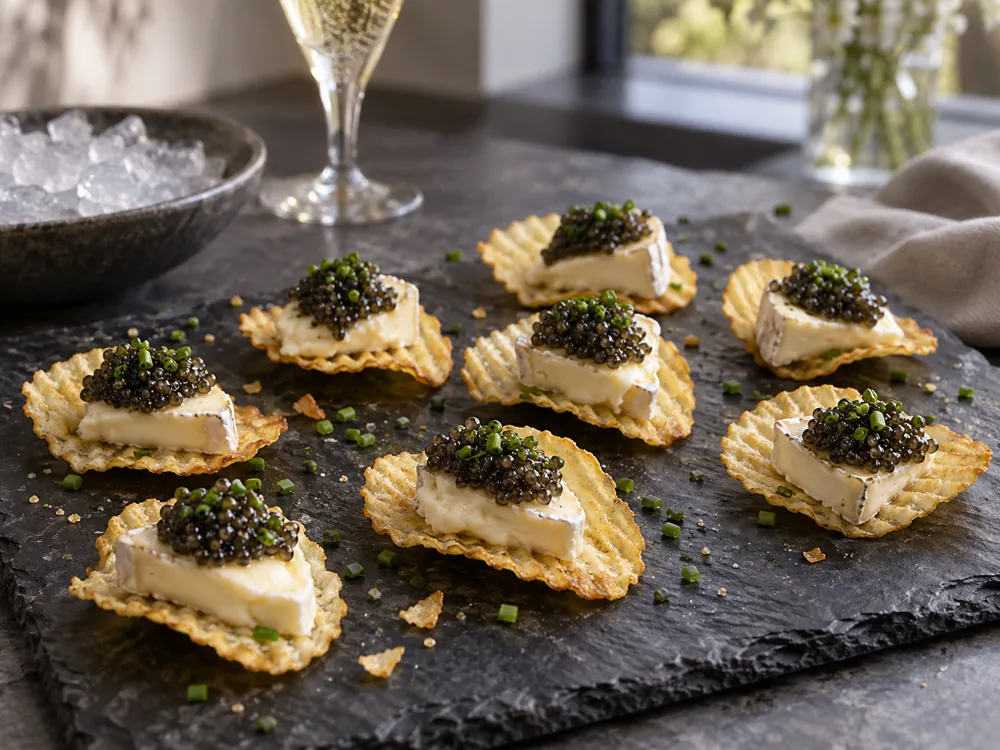
Mt Tam also takes heat in the maker's recipes. Three or four thin slices go into a truffle grilled cheese that cooks two to three minutes a side until the cheese has melted.
A Brussels sprout tart gets wedges laid on after baking, where they begin to melt into the sprouts. A brulee recipe broils the wheel for two to three minutes until the sugared top is hardened.
Can You Eat Mt Tam While Pregnant?
The NHS puts pasteurised or unpasteurised mould-ripened soft cheeses with a white coating on the outside, such as brie, camembert and chèvre, in the group that must be thoroughly cooked. Mt Tam is a soft cheese with a white bloomy rind, so that wording covers it even though its milk and cream are pasteurized.
The same NHS page lists any cheese cooked until steaming hot, including soft cheese, as safe to eat.
The CDC lists soft cheese made from unpasteurized milk among the riskier choices and pasteurized soft cheeses heated to an internal temperature of 165°F or until steaming hot among the safer ones. Its page does not place an unheated pasteurized bloomy-rind cheese in either list, and it adds that pregnant women are 10 times more likely to get a Listeria infection.
The maker's heated recipes give times and not an internal temperature, so a sugared top broiled for two to three minutes or a sandwich cooked until the cheese melts does not show steaming hot all the way through.
Did Cowgirl Creamery Close, and Is Mt Tam Still Made?
The creamery's retail shop and former factory in Point Reyes Station closed permanently on 5 September 2022 after 25 years, according to Sonoma Magazine.
The shop opened in 1997 as the company's headquarters barn, and Sonoma Magazine says the founders introduced Mt Tam and Red Hawk there among other cheeses, where visitors could watch Red Hawk curds and whey being separated through glass panels.
Neither account dates the first Mt Tam wheel, but together they bracket it: Sonoma Magazine places the introduction at the barn that opened in 1997, and the founders' Culture account has Mt Tam wheels in the aging room in 2001.
Sonoma Magazine, citing the Point Reyes Light, lists wastewater limits among several ongoing problems at that shop: they ruled out more customer bathrooms and scaling up Red Hawk production. The Ferry Building shop in San Francisco had closed in 2021, which the same article ties to COVID-19 slowing foot traffic to a trickle.
Production moved to the current Petaluma facility in 2008, so the closure did not move the cheesemaking. A 2020 post from the maker says Mt Tam is made in its Petaluma creamery with Straus Creamery organic milk and added cream.
The maker's own pages show the cheese outlived the shop: its Mt Tam recipe posts run from November 2024 to June 2025, and its award list for Mt Tam includes a second place at the California State Fair in 2025.
Sonoma Magazine says the closure came five years after Cowgirl Creamery was sold to Emmi, a Swiss dairy conglomerate, and that founders Sue Conley and Peggy Smith stepped back from daily operations in 2019 and retired in 2021.
Where Can You Buy Mt Tam?
The maker's site points shoppers to a store locator titled "Find Cowgirl Creamery Cheese Near You". Its Mt Tam page links to six online collections sold through Goldbelly, from the Cowgirl Classic to a seasonal cheese club.
Two of the six, Cowgirl Creamery Deluxe and The Ultimate Cowgirl Experience, are also listed on the Red Hawk page, which makes them the collections that cover both cheeses.
The maker's 2020 serving post tells readers to ask a local cheesemonger for a wheel, and its caviar recipe calls for a 7 oz wheel.
How Many Mt Tam Wheels Does Each Recipe Need?
The maker's recipes are written by the wheel, and only the caviar recipe states a weight for the wheel, the 7 oz wheel from the buying routes above. The other four give a count or a fraction, so the maker does not say how much cheese a bagel board or a tart actually uses.
| Dish | Wheels used | How the cheese is cut | How it is served |
|---|---|---|---|
| Caviar and potato chips | One | A small wedge on each chip | Unheated |
| Bagel and lox board | One or two | Cut into 8 to 10 wedges | Unheated, beside six toasted bagels |
| Truffle grilled cheese | Half | Long, thin slices | Pan-cooked between buttered bread |
| Brussels sprout tart | One | Cut into slices | Added after baking, then begins to melt |
| Brulee | One | Top removed, then sugared | Broiled in a dish |
Half a wheel fills one grilled cheese in the recipe, so a single wheel makes two, while the bagel board is the largest order at one or two wheels.
The brulee is the only recipe that treats the wheel as a dish: the maker removes the top, sprinkles on 1 tablespoon of sugar, broils it, and serves it warm with crackers and raspberries, blackberries and blueberries.
Why Is It Called Mt Tam?
Cowgirl Creamery named the cheese for Mount Tamalpais, which rises over San Francisco Bay in Marin County.
"Mt Tam" is also the short name of the mountain, so the bare phrase can mean either one. Adding "cheese" or the creamery's name gets to the cheese.