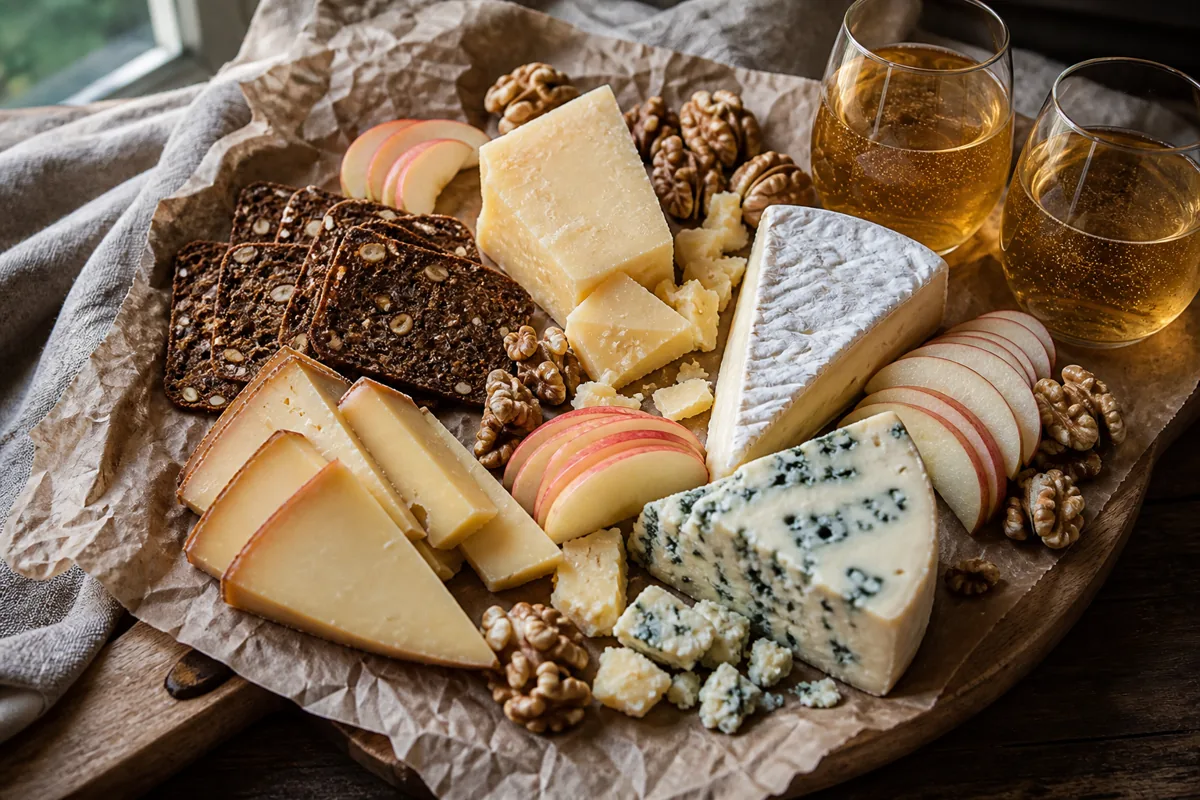
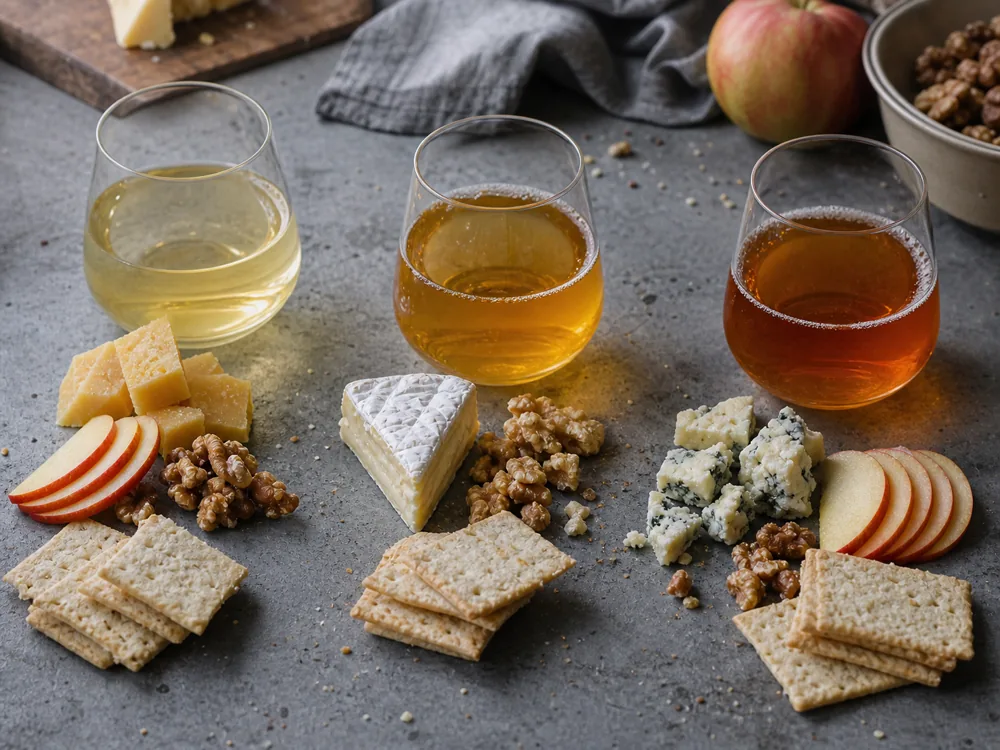
Read the sweetness word on the cider before you pick the cheese: in most cheesemongers' and cider makers' guides, the sweeter bottles go with blue cheese and the crisp, dry ones with fresh goat cheese.
Cheddar and Brie are where the guides split, and perry has a short list of cheeses of its own.
In This Article
What Cheese Goes with Cider?
Start from the style on the bottle: Saxelby Cheesemongers advises choosing a cheese that can match a cider's sweetness and intensity.
| Cider style | Cheeses suggested | Suggested by |
|---|---|---|
| Crisp, acid-driven, or bone-dry | Fresh goat cheese (chèvre) | Saxelby Cheesemongers; Joshua Page, La Fromagerie |
| Dry and sparkling | Camembert, Brie, soft-ripened goat cheese, triple crèmes | RAW Cider Co.; Marissa Mullen, Food52 |
| Dry | Aged Gouda; Lamb Chopper | Wisconsin Cheese; Culture |
| Semi-dry | Cheddar; firm goat and sheep's milk cheeses | RAW Cider Co.; Marissa Mullen, Food52 |
| Medium or off-dry, not too tannic | White-rinded soft cheeses; Manchego | Andy Swinscoe, The Courtyard Dairy |
| Tannic West Country or farmhouse | Cheddar; washed-rind cheeses; hard sheep's milk cheese | Andy Swinscoe; Marissa Mullen; Joshua Page |
| Semi-sweet | Washed-rind cheeses, Gouda, and Buttermilk Blue | RAW Cider Co.; Wisconsin Cheese |
| Sweet, ice, or keeved | Blue cheese | Andy Swinscoe; The Cheese Professor; Saxelby Cheesemongers; Fiona Beckett |
| Hopped or dry-hopped | Gouda; floral alpine-style cheese; smoked salt and rosemary goat cheese | Marissa Mullen; The Cheese Professor; Culture |
| Herbal | Fontina | Wisconsin Cheese |
Cellarman Sam, quoted by Andy Swinscoe of The Courtyard Dairy, separates matches that echo a trait, such as gentle acidity in the drink beside a citric tang in the cheese, from matches that contrast, where salt meets sweet.
In the contrasting kind, Sam says, balance is the point, because tipping too far in one direction makes it too much.
RAW Cider Co. gives the same warning in general terms: when one partner is far more overpowering than the other, the less assertive one gets lost.
Fiona Beckett, writing for Matching Food & Wine after a cheese-school tasting, found that milder pasteurised cheeses do not need such strong, characterful ciders.
Why Does Cider Go with Cheese?
Joshua Page, senior cheesemonger at La Fromagerie, describes cider's structure as much like wine's, built from tannin, acid, and sugar in amounts that vary with the apple.
Matt Raboin, co-owner of Brix Cider in Mount Horeb, Wisconsin, says the bubbles, fruitiness, acidity and aromas of hard cider contrast with the creaminess of cheese.
For bloomy-rind cheese, Marissa Mullen of Food52 says the carbonation in a crisp dry cider is a palate cleanser for its buttery elements, and the cider is not sweet enough to overpower the cheese's aroma.
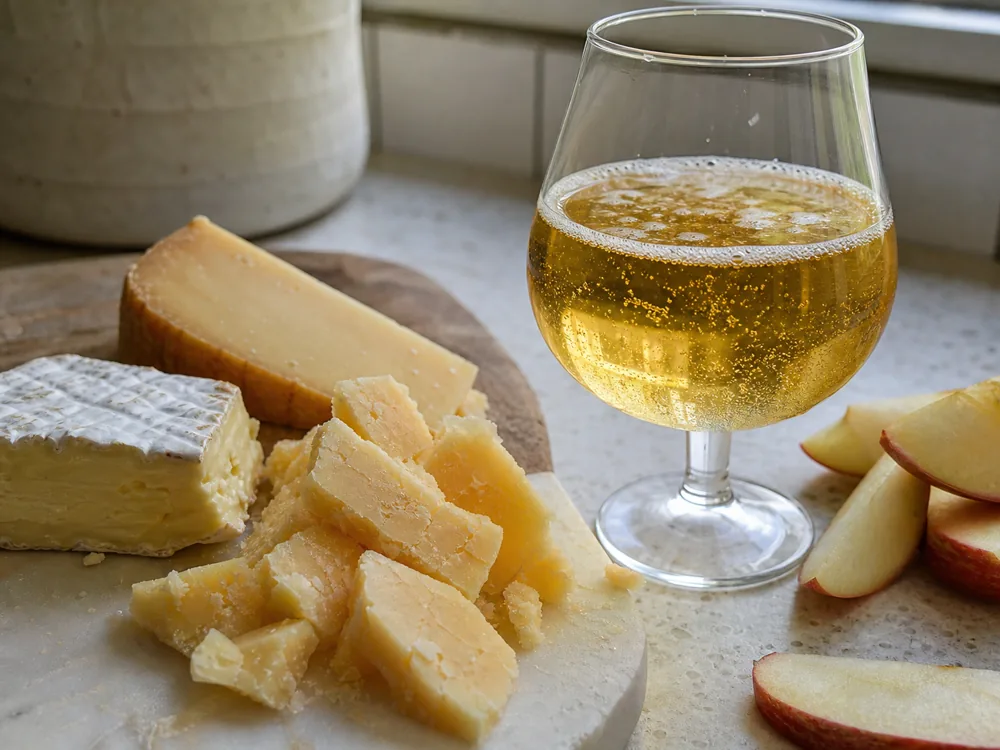
Tannin gives a cider its grip: tannins control a cider's astringency and bitterness, and heritage ciders made from bittersweet and bittersharp apples such as Dabinett and Kingston Black carry more of them than modern ciders.
John Biondi of The Cider Farm in Mineral Point, Wisconsin, also separates modern ciders made from table apples with added ingredients from heritage ciders made from true cider apples, which have fewer additives and generally lower sugar.
Andrew Byers of Finnriver Farm & Cidery in Chimacum, Washington, told Culture that a growing crop of bitter sweet and bitter sharp apples was letting makers produce "profound and complicated ciders."
Page shows what a cider's tannic grip does with cheese. A tannic, full-bodied cider can be mellowed and rounded off by a hard, protein-rich sheep's milk cheese, which lets toffee and leather notes show that the tannin normally covers.
Acid works the other way: Page pairs a sharp, acid-driven cider with a lemony, fresh goat cheese, which lifts the cheese's acidity, rounds off the cider's prickly edges, and cleans the palate for the next bite.
Saxelby Cheesemongers explains why sweetness matters so much with cider: even the driest ciders have less astringency and tannin than similarly dry wines to balance their natural sugars.
Mullen's reason for choosing cider over red wine is delicate cheese, since a big, bold red can overpower a fresh goat cheese.
The Cheese Professor's Fiona Young-Brown puts the two directions in one line: the creamy, buttery taste of the right cheese suits the tartness of a dry cider, while something a little salty offsets a cider's fruity sweetness.
How Sweet Are Dry, Semi-Dry, and Medium Cider?
In Mullen's description, dry cider is typically made from a blend of tart and ripe apples, bittersweet and bubbly like Champagne, while semi-dry cider holds more than 2% residual sugar and has a more pronounced apple flavour. Most American cider makers separate their varieties by levels of residual sugar.
Beckett found that medium farmhouse ciders are generally quite a bit less sweet than ciders from larger commercial producers, so check who made a cider as well as its sweetness word.
Swinscoe, writing for the British pub trade, warns about the other end of the market: he says just 35% juice allows a drink to be called cider, with the other 65% made up from anything that ferments, often sugar and water.
Alcohol varies too: Beckett gives Harry's Dabinett at 4.5%, her two medium ciders at 6%, and a 2013 Dunkertons Organic Vintage, opened with the lunch leftovers, at 7.5%.
Cider can be sparkling or still, and the sparkling variety is the more common.
Before a cider goes on a cheese board, check four things on it: the sweetness word or residual sugar level, whether the sweetness is natural or added, whether tannic cider apples went into it, and whether it is sparkling.
Dry or Semi-Dry Cider: Which Suits Cheddar and Brie?
Neither cheese has one answer: for cheddar, Swinscoe pours a dry cider and Cabot a super-dry one with its own White Oak Cheddar, while RAW Cider Co., Mullen and Beckett go semi-dry or medium, and for Brie, RAW and Mullen go dry while Swinscoe wants a rounded, fruity cider.
| Cheese | Dry cider | Semi-dry, medium, or rounded cider |
|---|---|---|
| Cheddar | Dry West Country cider (Andy Swinscoe, The Courtyard Dairy); a super-dry cider with no added sugar, with Cabot's own White Oak Cheddar (Cabot Creamery) | Semi-dry cider, with English cheddars such as Montgomery's (RAW Cider Co.); semi-dry cider (Marissa Mullen, Food52); medium-dry to medium cider (Fiona Beckett, Matching Food & Wine) |
| Brie and other white-rinded cheeses | Dry cider with triple creams and camemberts (RAW Cider Co.); crisp dry cider (Marissa Mullen, Food52) | Rounded, fruity cider from off-dry to medium, or a gently sparkling perry (Andy Swinscoe, The Courtyard Dairy) |
On cheddar, Mullen pours semi-dry cider because she finds that cheddar's sharp, piquant notes can overpower a crisp dry one.
Swinscoe goes the other way for strong cheddar: he says the tannic structure and pleasant astringency of West Country cider apples stand up to its savoury, salty, rich notes, and he names the naturally sweeter Yarlington Mill beside dry West Country ciders.
Beckett's two full-bodied cheddars, a Montgomery and a pasteurised Fordham Farm, needed a slightly fuller, richer-tasting cider.
On Brie, RAW Cider Co. says triple creams and camemberts are almost cooling after the tartness of a dry cider, while Swinscoe says their buttery creaminess demands a rounded cider with some fruitiness.
Ripeness matters too, in RAW Cider Co.'s account: younger, tougher wheels taste more buttery, fruity, and earthy, while older ones add heavier notes of mushroom, garlic, and even egg. So it advises asking the cheesemonger how ripe the wheels are.
Match the reason to your wedge: for a sharp cheddar, Mullen's reasoning points to semi-dry cider, for a full-bodied one Beckett's points to a fuller cider, and for a strong, savoury one Swinscoe's points to tannic West Country cider.
Which Cider Suits Cheddar, Gouda, and Sheep's Milk Cheese?
Swinscoe says hard cheese varies too much for one rule and splits it into three groups: crumbly cheeses, harder British territorials such as Cheddar and Leicester, and continental types such as Parmesan and Comté.
For crumbly Lancashire, Wensleydale, and Cheshire, he wants something that will not overpower their light, vibrant acidity, which means slightly sparkling perries and crisp dry ciders made with dessert apples.
Cider maker Kingsley Ash picks a crisp, eastern-style, dessert-apple cider from Thornborough with Old Roan Wensleydale or Kirkham's Lancashire.
For older continental-style cheeses, Swinscoe suggests a classic dry cider that is not bold enough to overpower their sweetness, and a very sharp, long-aged cheese such as Old Winchester can take something bolder, such as the barrel-aged Gold Rush.
| Pairing | Why It Works |
|---|---|
| Strong cheddar + rich, tannic, sparkling cider | Cider maker Tom Oliver, quoted by Swinscoe, says the range of cheddars this suits is amazing, from Keens and Montgomery to Westcombe and Hafod. |
| Montgomery cheddar + Harry's Dabinett (4.5%) | Fiona Beckett found the slightly tarter single-variety cider particularly good with the Montgomery, and both come from Somerset. |
| Habanero Cheddar + a cider from sweet apples | Cabot pairs Downeast's Original Blend, made with juicy sweet apples, with its spiciest cheddar and calls the match perfectly balanced. |
| Manchego + slightly sparkling perry or medium cider | Swinscoe says the sweeter notes of sheep's milk cheese suit a perry or medium cider that is not too tannic, because fruitiness and sweetness complement the richness of the milk. |
| Gouda + semi-sweet cider | RAW Cider Co. says Goudas, sweet and salty with caramel and hazelnut notes, bring out the fruitiness of both cheese and cider when the cider is semi-sweet, especially with some tannic elements. |
Wisconsin Cheese pairs a fruited cider with Renard's one-year cheddar, saying crisp, fruit-forward notes balance a creamy, slightly sharp aged cheddar.
Wisconsin Cheese goes drier than RAW's semi-sweet Gouda match, pairing Marieke aged Gouda, a slightly crystallized, nutty cheese, with a dry cider for the cider's complex apple and fruity flavours.
For a sheep's milk cheese, Culture's fall list pairs Seattle Cider Company Dry with Cypress Grove's Lamb Chopper.
RAW Cider Co. gives semi-dry cider a texture test: seek cheeses that are firm yet still have a little give, crumbling slightly under a finger without flaking, such as Berkswell, Ossau-Iraty, and young Mahon.
Which Cider Suits Goat Cheese and Washed Rinds?
For younger goat cheeses, Swinscoe says their fresh, acidic flavours match a naturally fizzy, bottle-fermented perry or cider, and tells shoppers to look for Champagne Method on the label.
Dessert-apple ciders and perries also work, he says, because they keep a bright acidity without tannin or bitterness and so complement the freshness of goat and sheep's milk cheeses.
Tom Oliver names Dorstone, a soft goat cheese, with his Sweet Juice Perry as a favourite, crediting the soft texture set against the perry's citrus zing and the cheese's lemony hints.
Beckett paired a medium-dry perry with Ragstone goat cheeses, noting that perry is often compared with white wine and goes with goat cheese as easily as sauvignon blanc does.
Saxelby Cheesemongers says light, crisp, bone-dry ciders appreciate a fresh, tangy chèvre, and The Cheese Professor pairs a tart grapefruit cider with a soft, creamy goat cheese.
Washed-rind cheeses are the funky end of the range, and the ciders paired with them run from tannic and barrel-fermented to farmhouse and dry sparkling.
- Epoisses, Stinking Bishop, and St James: Swinscoe names deep, tannic, barrel-fermented ciders like Gold Rush and a classic cloudy scrumpy, which suit the wild, yeasty notes of these pungent cheeses.
- Taleggio: Mullen pairs its sticky orange rind, mild buttery flavour, and tang with farmhouse cider, her funky-with-funky match.
- Gently washed rinds: RAW Cider Co. says dry sparkling ciders from tannin-forward apples suit them, because the cheese's slight sweetness relieves the astringency.
Mullen defines farmhouse cider as cider made with apples on or near the cider mill, and a true one as unfiltered, unpasteurised, and historically fermented with the wild yeast that comes with the apples.
Which Cider Suits Blue Cheese?
For blue cheese, most matches use a sweet or sweeter cider: Swinscoe, The Cheese Professor, Saxelby Cheesemongers, and Beckett all pair it with one.
Swinscoe says blue cheese needs a cider with body and power. That comes either from a big barrel-fermented cider such as Oliver's Gold Rush, or from a sweet cider or perry whose sweetness gives the richness to stand up to the strong flavours.
He adds that the sweetness should be naturally sweet rather than added with sugar or apple juice, and that the best sweet types tend to be ice cider, from frozen apples, or keeved cider, where fermentation halts on its own.
Wisconsin Cheese pairs a semisweet cider with Roth Buttermilk Blue, setting a lightly sweet, bubbly cider against a creamy, tangy, mellow blue.
Felix Nash of The Fine Cider Company describes rich, salty blue cheese meeting sumptuous sweet ice cider with a cleansing bit of acid, and suggests a creamy, rich blue such as Pevensey Blue or Stichelton with Brannland Ice Cider.
Beckett matched Cropwell Bishop Stilton and Stichelton with two sweeter Somerset ciders, Hecks medium-sweet Port Wine of Glastonbury and Millwhite's Rum Cask, to mimic the effect of a fortified wine.
Mullen picks rose cider to balance blue cheese's peppery bite, saying the red-fleshed apples give it a light pink colour and a sweet, fruity flavour with notes of rose and strawberries.
Saxelby Cheesemongers warns that a dessert-style or ice cider may taste downright syrupy, and says a rich cheese such as Bayley Hazen Blue can stand up to all that sweetness.
RAW Cider Co. goes the opposite way for custardy blue cheese, naming a dry sparkling cider from tannin-forward apples instead of a sweet one.
Ice cider has a defined recipe in Quebec, where the rules set by the province's artisan cider producers call for a juice concentration of 30 degrees Brix before fermentation, at least 130 grams per litre of residual sugar, and alcohol of more than 7% and less than 13%.
The Cheese Professor says that sweetness is typically drunk in small 2 or 3 oz servings, and ice cider is commonly sold in 375 ml bottles, half the size of a typical wine bottle.
Which Cheeses Suit Hopped, Fruit, Herbal, and Barrel-Aged Cider?
- Hopped cider: The Cheese Professor says hops push a cider toward a pale ale without the bitterness, and pairs its floral side with a floral-coated alpine-style cheese or the caramel nuttiness of Gouda. Mullen also pairs Gouda with hopped cider, saying it recalls a caramel apple, and Swinscoe calls hopped cider worth trying with Parmesan- and Comté-style cheeses.
- Dry-hopped cider: Culture pairs Finnriver Dry Hopped Cider with Chevoo's smoked salt and rosemary goat cheese.
- Fruit cider: The Cheese Professor says much depends on the fruit and the sweetness, and that blue cheeses or chèvres can pair with the acidity of the fruit. Swinscoe suggests trying cherry- or strawberry-flavoured ciders with Brie, Camembert, and Tunworth.
- Herbal cider: Wisconsin Cheese pairs it with Carr Valley Fontina, saying the cheese's creamy, mild, nutty flavour gives the cider's herbal notes a chance to come forward.
- Barrel-aged cider: The Cheese Professor says bourbon- or rum-barrel ageing adds depth to the lighter apple taste, and calls for a robust, earthy cheese that can live up to it, pairing Ship's Wheel Bourbon Barrel Aged Cider with Manchego.
What Cheese Goes with Perry?
Perry is made from pears, and Chris Allsop, writing in Culture, says all three commonly found styles go well with cheese.
Traditional perry comes from bitter pears with tough, speckled skins and may be sparkling or still. Culture's example pairs ÆppelTreow's Orchard Oriole Perry, a traditional perry, with Charles Martell and Son's Stinking Bishop.
Charles McGonegal of ÆppelTreow Winery & Distillery in Wisconsin tells Culture to "think of a semi-dry white wine, but half the alcohol," with a floral nose that is distinctly pear-like, "but not fresh Bartlett pear," maybe lemony, and a tiny hint of vinegar.
In Allsop's description, modern perry is fruitier and more floral, typically made from the less acidic Bartlett and Bosc pears sold in supermarkets, and producers tend to leave more residual sugar in it. Dessert perry is super-sweet and high in alcohol, with notes of juicy Bartlett pear, apricot and spiced apple.
Two blue cheeses sit under Culture's modern perry heading: Lively Run Goat Dairy's Cayuga Blue with ACE Perry's bottle, which Culture labels "Dessert Perry," and Rogue Creamery's Oregonzola with Once Upon A Tree's The Wonder.
Does Pairing Cider and Cheese from the Same Region Work?
Several guides lean on the saying that what grows together goes together: Saxelby Cheesemongers and La Fromagerie's Page use it directly, and The Cheese Professor compares regional pairing to wine experts' advice to make the most of terroir.
Swinscoe points to two regions famous for both, Normandy and Somerset, where he says a dry West Country cider with Cheddar, or a naturally sweet Normandy cidre with Camembert, is hard to beat.
Saxelby Cheesemongers also sorts ciders by the country whose style they follow.
- Spanish-style: light and barely effervescent, with a twangy funk from natural yeast fermentation, and in Asturias and the Basque Country usually served with soft and semi-hard, barnyardy sheep's milk cheese; Saxelby's shop names Wischago and Anabasque as Spanish-style cheeses to look for.
- French-style: richer and fuller bodied, sometimes smoky, and matched with the mushroomy Harbison and the gelato-like richness of Kunik, two American cheeses made in the style of petite French bloomy rinds.
- English-style: crisp, fruity, and heavily carbonated, with sweeter versions suited to a ripe blue cheese and drier bottles to cheddar or Gouda.
How Should You Serve a Cider and Cheese Tasting?
Cabot Creamery advises serving lighter cheeses and lower-alcohol ciders first, then moving to heavier cheeses and higher-alcohol ciders, and offering only a few choices of each.
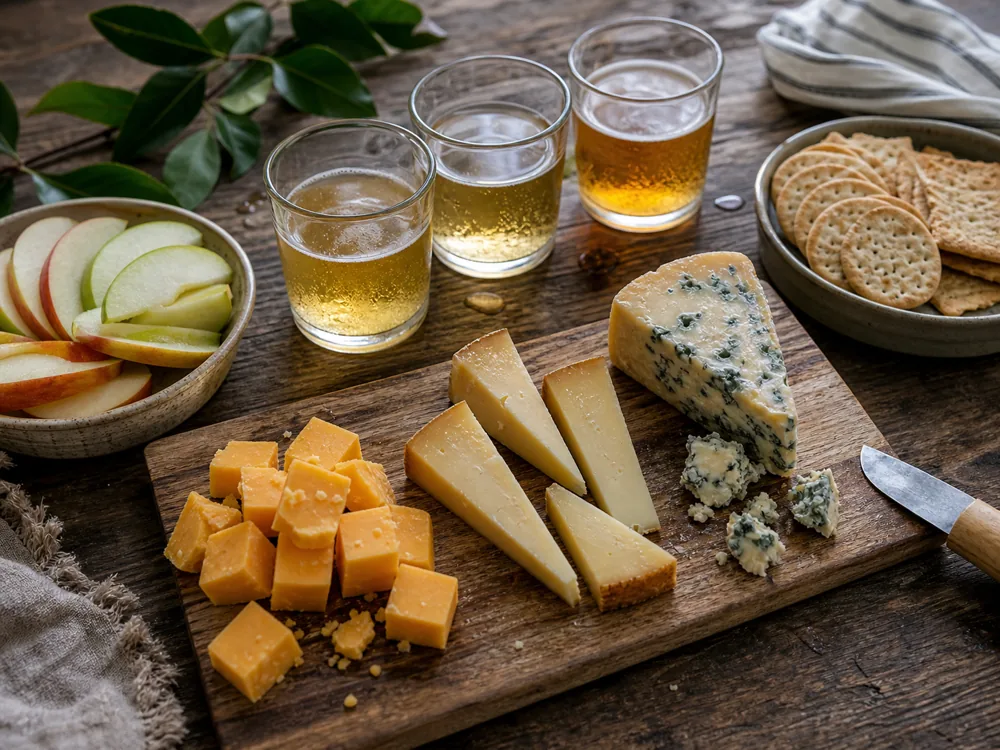
Beckett's cheese-school tasting ran four rounds from goat cheese to blue, each with its own cracker.
- Round 1: Ragstone goat cheeses with a medium-dry perry and rosemary or chive crackers.
- Round 2: Gorwydd and Caws Cenarth Caerphilly with medium ciders and Bath Ovals.
- Round 3: Montgomery and Fordham Farm cheddars with medium-dry to medium ciders and oatcakes.
- Round 4: Cropwell Bishop Stilton and Stichelton with medium-sweet ciders and cherry, almond, and linseed toast.
Two guides give different resting times for the cheese: RAW Cider Co. says to take cheese out of the fridge about 30 minutes before so its aromas begin to release, while Cabot says to rest it out for an hour so the full-bodied taste can develop.
Nash suggests tasting for how each partner changes the other, saying a really good match gives a longer, more interesting transition that elevates both.
SOURCES & REFERENCES
What Else Do People Ask About Cheese and Cider Pairing?
Beckett calls cider a great pairing for traditional British cooked cheese dishes like pies and pasties, though not for a lasagne. After her tasting she ate a Gorwydd Caerphilly, potato, and onion pie with the hosts' own homemade unpasteurised cider, and says a 2013 Dunkertons Organic Vintage, opened with the leftovers, matched it perfectly too.
RAW Cider Co. cites an experiment on cheese and cider flavour combinations in which eating cheese before cider significantly changed the sensory profile of the cider, and suggests trying both orders.
The Cheese Professor says it is often hard to go wrong with a sharp Cheddar, as they do in England, and calls it a traditional cheese for a traditional cider. Saxelby Cheesemongers, RAW Cider Co., and The Cheese Professor all add that the best pairing is the one you enjoy most and that their matches are starting points.
Culture lists two non-alcoholic pairings: Beemster Classic with Citizen Cider's All-Times Sparkling Cider, and Quicke's Mature Cheddar with fresh apple cider.