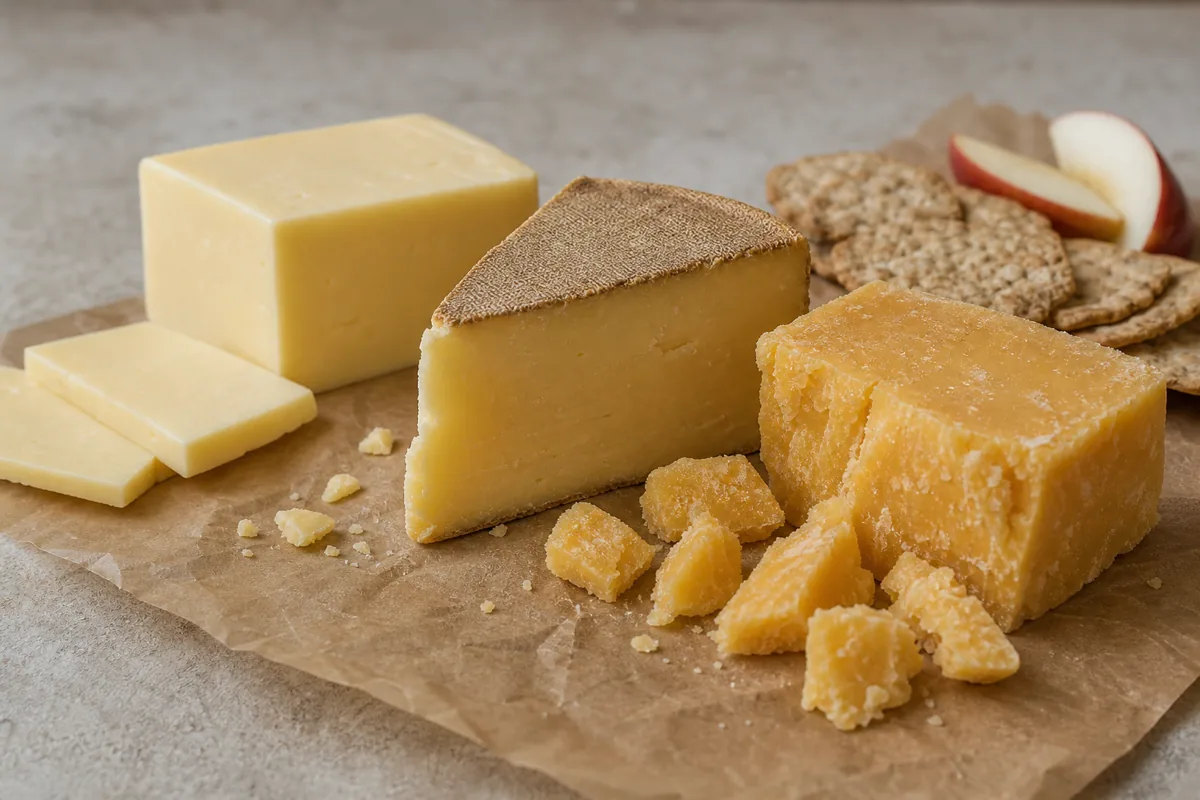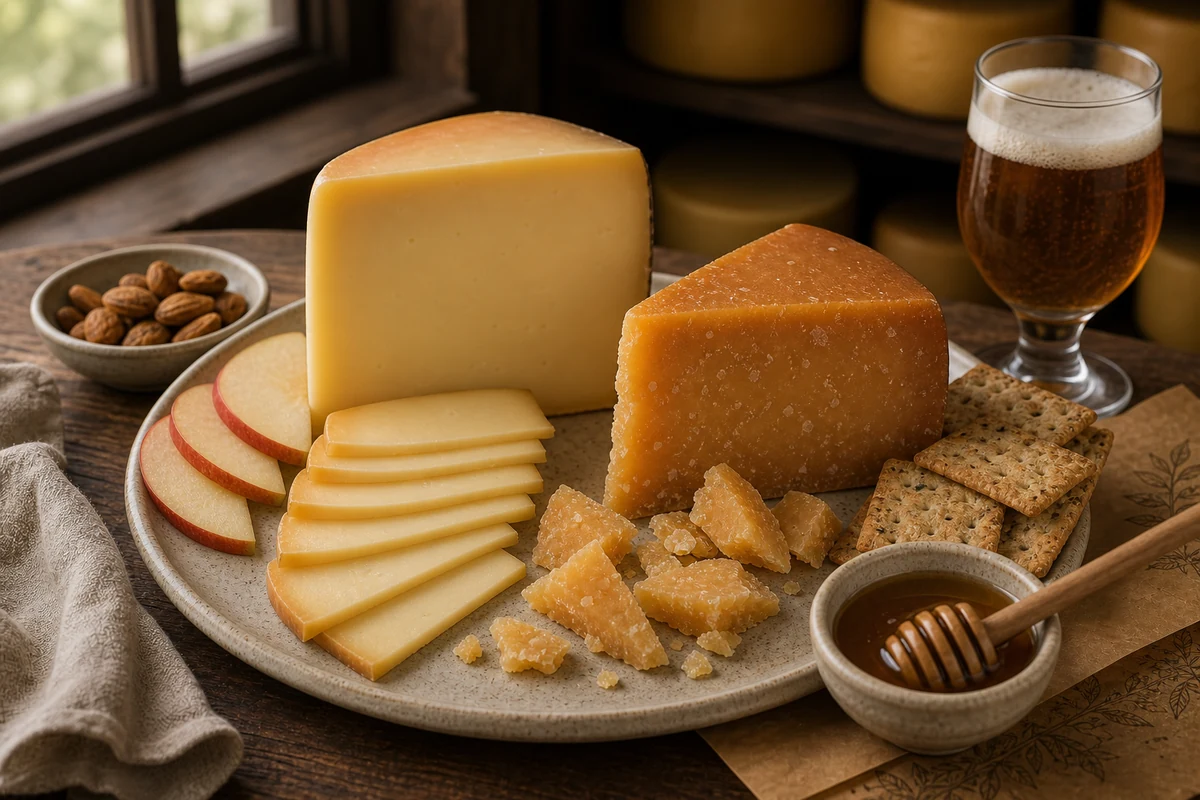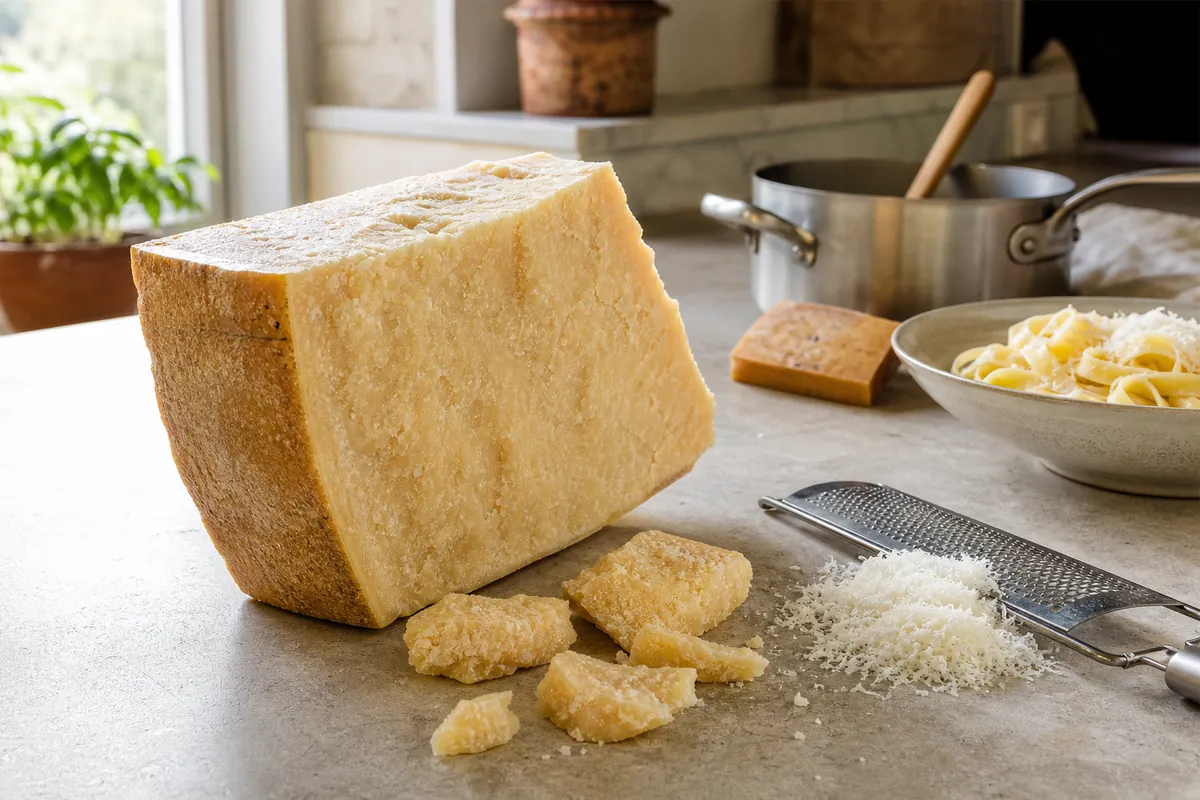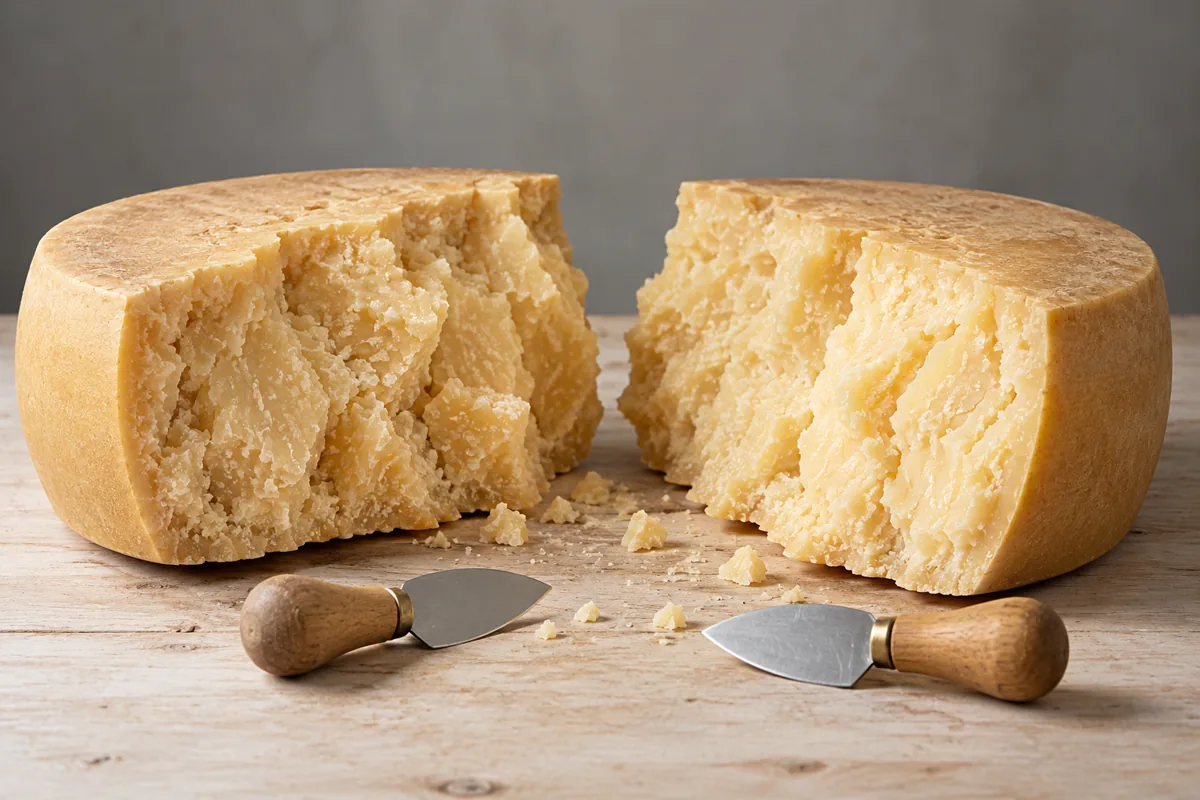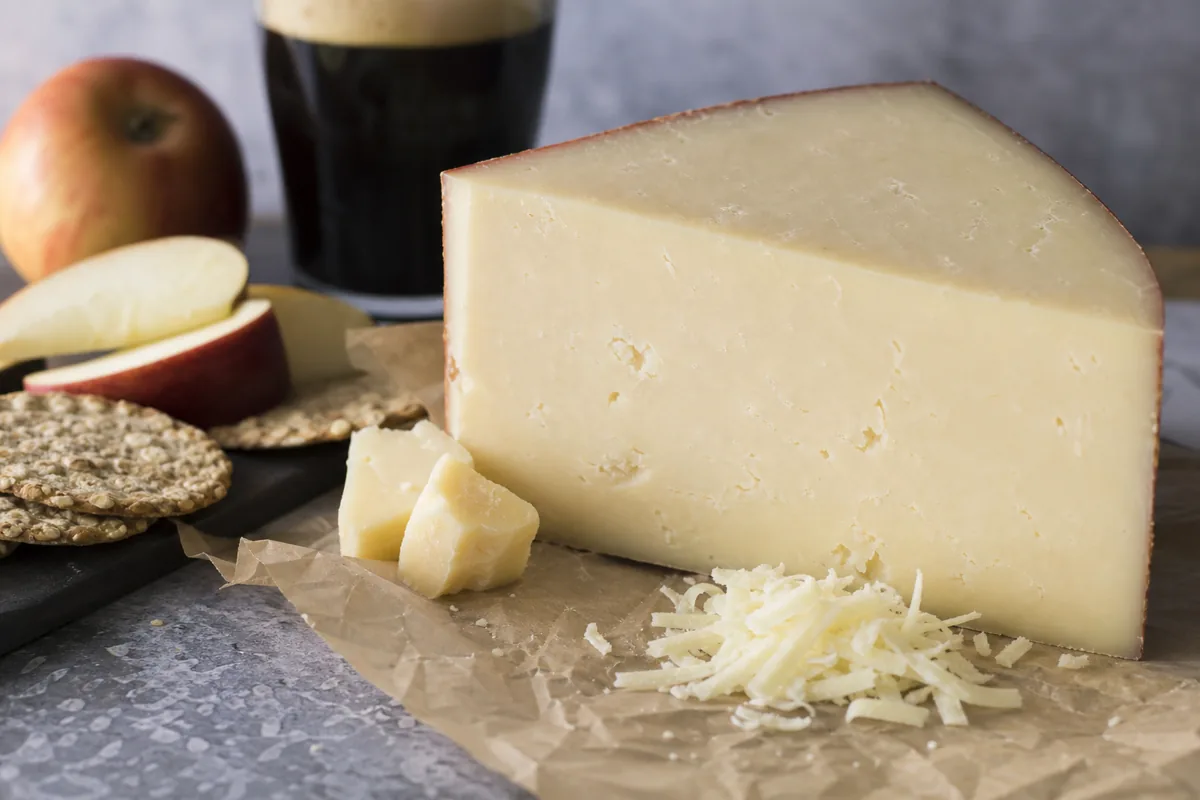
Old Winchester is a hard cow's milk cheese made at Lyburn Farm on the northern edge of the New Forest and sold at about 18 months old. By the maker's classification it is a "hybrid" in the Gouda family, not the cheddar that menus often call it.
In This Article
Is Old Winchester a Cheddar?
No: Old Winchester is classed as Gouda-like, "much closer to a northern European cheese" and "regarded as 'British Modern'."
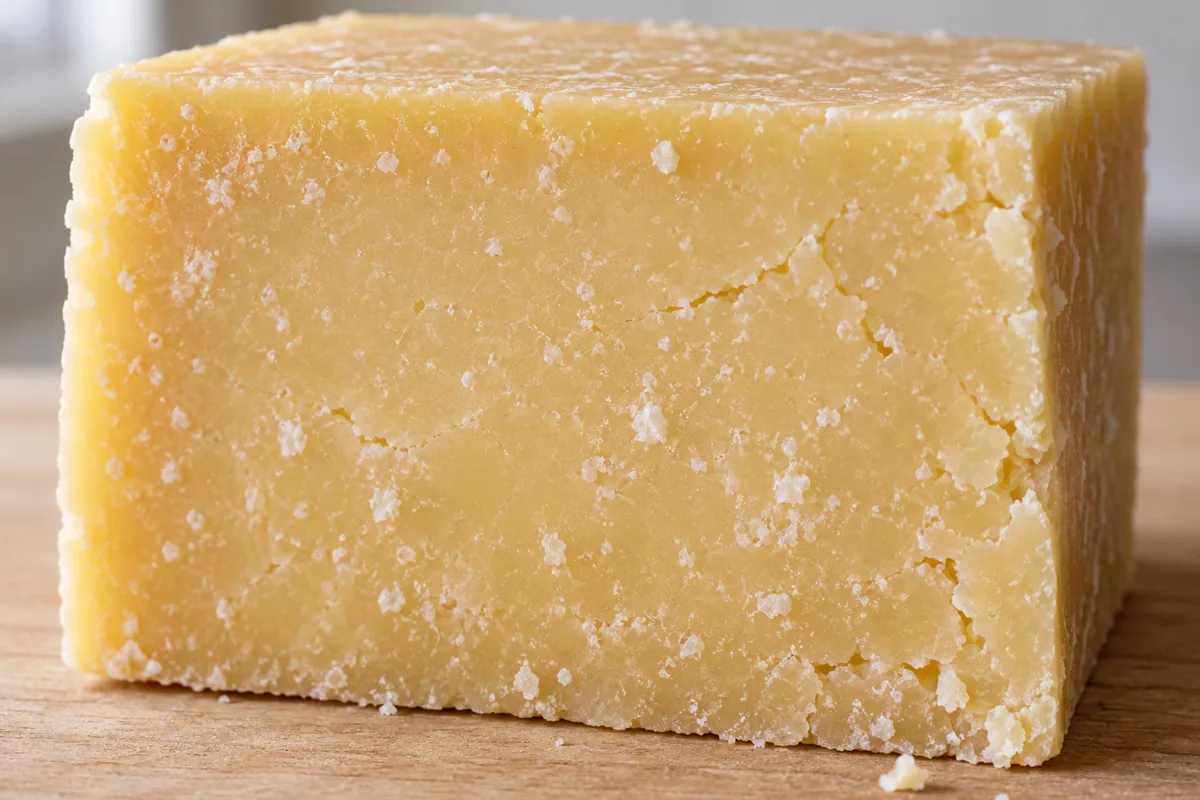
It is described as "much dryer harder and crystalline," becoming "more reminiscent of an old gouda," and it is filed in the Gouda family.
The make also sets the farm's cheeses apart from cheddar: unlike a cheddar, they are not dry salted.
Old Winchester is the older version of the farm's Winchester and is also known as Old Smales, the name it went by in the USA in 2010.
The Smales family has dairy farmed at Lyburn since 1952 and started making cheese in 1999 to add value to its milk. Mike and Judy Smales chose a continental approach, with Lyburn Gold, Winchester and Old Winchester all made in the Gouda style.
How Is Old Winchester Made?
Old Winchester is one of six cheeses the farm makes. It is made from pasteurised cow's milk from a herd of 170 pedigree Holstein-Friesians, on a farm that has milked twice a day, every day, since 1969, and it is set with vegetarian rennet.
The steps below are the farm's make for its cheeses in general, rather than for Old Winchester alone. The make starts at 6 am after milking, when 3,000 litres of milk are pasteurised over about two hours and cooled to around 28°C before the starter goes in.
Rennet then sets the milk into a soft curd likened to blancmange, and the cheesemaker cuts the curd at the right moment to release the whey. The make finishes by about 1:30 pm, so milk that was still in the cow at 6 am is cheese by lunchtime.
Old Winchester is a washed curd cheese that is brine washed after pressing.
The curd goes into moulds that take about 6 kg each, and the moulds are stacked five or six high under pneumatic rams that press overnight to shape the cheese, knit the curd together and drain the remaining whey.
Next morning the cheeses go into a brine tank for about 24 hours and take up about 1.5% salt of their own accord, and another 24 hours in the tank would not add much more.
The cheeses are then dried, given a batch number and ripened on racks with plenty of air flow, in rooms kept at a constant temperature and humidity. They are turned regularly so they ripen evenly and do not dry out at the top.
Two months after a make, the batches are graded on smell, dry matter, shape and taste, and the make sheet is used to adjust later makes.
The finished wheels average about 4.5 kg.
What Does Old Winchester Taste Like?
Old Winchester has a nuttiness.
Culture describes "a rich creaminess with notes of nuts and caramelization," with sweetness "offset by a slight tang"; the flavour is described as strong and said to become more robust as it ages.
For a drink, robust fruity red wines or Herefordshire cider could suit the cheese.
Has Old Winchester Won Any Awards?
Yes: Old Winchester is listed with a 3 Star Gold at the Great Taste Awards in 2025 and again in 2026, and in 2024 with a 2 Star Gold at Great Taste and a Bronze at the World Cheese Awards.
At the 2024 Great Taste Awards, where Old Winchester took its 2 Star Gold, 266 of 13,672 entries from 115 countries reached three stars, and the three-star winners were chosen in blind tasting by judges from across the food industry.
At the British Cheese Awards, it has a Bronze in the Export class in 2022 and a Silver and a Gold (Export) in 2024, and it took a Gold at the 2016 awards.
Earlier awards include Best Modern British Cheese in 2006 and Reserve Champion Cheese at the Bath and West in 2007, and a Gold and a Silver at the Artisan Cheese Awards Melton in 2021.
Old Winchester Extra Mature won Super Gold at the 2014 World Cheese Awards, held in London on 14 November that year, where more than 250 cheese experts from 26 nations judged nearly 2,600 entries from 33 countries.
What Are the Crystals in Old Winchester?
The crunch is attributed to amino acid crystals.
Cheese crystals come in two kinds, tyrosine and calcium lactate, and both form as protein chains unravel with age. They are neither sugar nor sodium, so they are not salt.
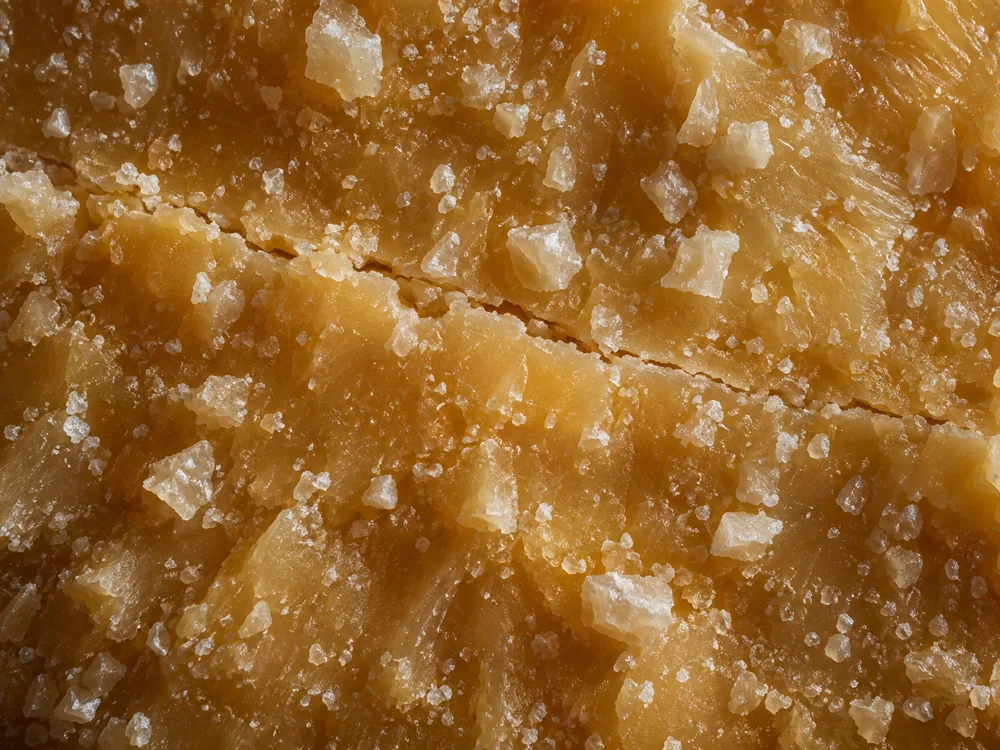
Whether a cheese grows crystals depends on the kinds of protein in it and how concentrated they are, and not every aged cheese develops them.
Tyrosine crystals form only inside the cheese, are firm and bright white, and are found in Swiss and Romano cheeses. Calcium lactate crystals form inside and on the surface, are softer and paler, appear more often, and typically turn up in cheddar and Colby.
Both kinds can sit side by side in aged Gouda or Parmigiano-Reggiano, and a crystal that is softer, paler and matches those on the surface is calcium lactate. Use that test to tell the two apart on a piece of Old Winchester.
X-ray diffraction has confirmed that the hard, crunchy crystals in Parmigiano-Reggiano and long-aged Gouda are tyrosine. It has also tentatively identified round "pearls" up to 6 mm across in 2-year-old Parmigiano-Reggiano and long-aged Gouda as an unusual crystalline form of leucine, and crystals can also grow in the eyes of long-aged Gouda.
How crystals are judged depends on the cheese: as of 2015, visible crystals were often treated as defects by the US Cheddar industry, while in some traditional cheeses, such as Parmigiano-Reggiano, and in hand-crafted artisanal cheeses they are viewed as important to the cheese's character and quality. None of this testing covered Old Winchester, so it does not show which crystal type a piece of Old Winchester holds.
Does the Age on the Label Change What You Get?
Old Winchester is meant to be sold at about 18 months, but the age comes and goes, and every batch can be slightly different from the previous one. The reason given for the changing age is that it is impossible to get the stock level right all the time.
Stated ages run from about 18 months to 24 months.
In 2010 Old Winchester was matured for 14 to 16 months, shorter than any age stated for it now.
Which Lyburn Cheese Should You Buy?
Choose by age: Lyburn Gold is ripened for about 8 to 12 weeks and Old Winchester is usually sold at about 18 months old.
Winchester, also made at Lyburn, is the younger cheese that Old Winchester is the older version of, so a listing titled Winchester is for a less aged cheese than the one here.
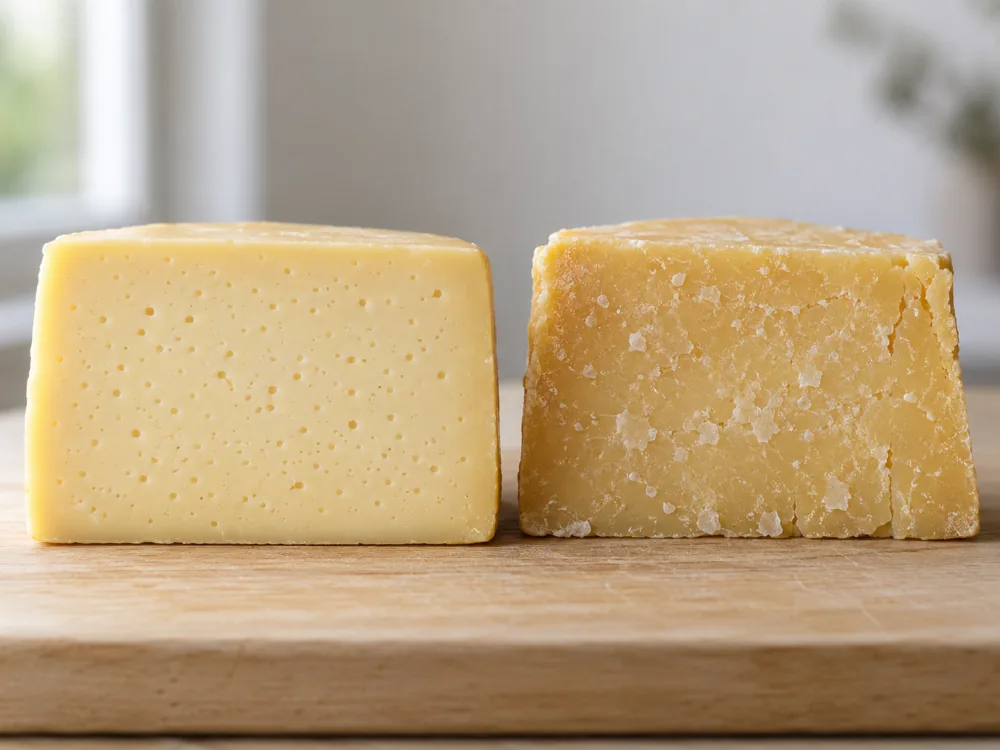
Gold is technically hard because it has been pressed but is generally semi-hard because at 10 weeks it still has some movement in it, and at 5 kg and about 9 inches across it is slightly larger than an Old Winchester wheel.
| Cheese | Age | The maker's description |
|---|---|---|
| Lyburn Gold | About 8 to 12 weeks | Creamy smooth texture with very small holes evenly distributed, and great for melting |
| Old Winchester | About 18 months | Much dryer, harder and crystalline, and still usable as a table cheese |
Is Old Winchester Vegetarian?
Yes: Old Winchester is set with vegetarian rennet, and the rennet is also listed as vegetable.
The recipe also contained egg until recently: the cheese previously contained egg white as lysozyme, and from 1 April 2026 the maker has stopped using lysozyme derived from egg.
The reason given for the egg white is the style: because this is a Gouda style cheese, there were traces of egg white in the form of lysozyme.
That matters to vegans and to anyone avoiding egg, and not to vegetarians who eat eggs.
Because a wheel is meant to be sold at about 18 months, a piece bought after 1 April 2026 can come from a wheel made before that date, so if you avoid egg, ask the seller when your piece was made.
Is Old Winchester Pasteurised, and Can You Eat It When Pregnant?
If you are pregnant, you can eat pasteurised Old Winchester: Mousetrap Cheese calls it a "very hard cheese" and Cheese.com lists it as hard, the NHS lists pasteurised or unpasteurised hard cheeses, such as cheddar, gruyère and parmesan, as safe to eat, and the CDC lists hard cheese, when made with pasteurized milk, such as Asiago, Cheddar, Parmesan, or Swiss/Gruyere/Emmental, as safer.
The CDC says pregnant women are 10 times more likely to get a Listeria infection.
Its milk is listed as pasteurised by Culture, Mousetrap Cheese and Cheese.com, and the maker's cheesemaking page, written for the farm's cheeses in general rather than Old Winchester alone, describes its milk being pasteurised. Its texture is also given as firm by Cheese.com and as firm by Culture.
Can You Use Old Winchester Instead of Parmesan?
Yes, as a vegetarian stand-in: it is made with vegetarian rennet and, for that reason, sold and used as a vegetarian replacement for a hard Italian cheese.
That matters because, as of 2010, most Italian hard cheeses were made with animal rennet.
Mousetrap Cheese calls it quite a good stand-in for Parmesan when a vegetarian option is needed, and it can be used as you might use Parmigiano Reggiano because it is both pasteurised and vegetarian-friendly.
It is also called versatile, great on a cheese board but also perfect to cook with.
Where Can You Buy Old Winchester?
The maker's Old Winchester page carries online sales links, national sales and a stockist list. Sizes run from 200 g to a 4 kg whole wheel.
The maker's average is only about 4.5 kg per wheel, so wheels vary in weight, and Mousetrap Cheese's 4 kg whole wheel is lighter than that average.
For a shop near you, the maker's stockist pages let a visitor find the nearest provider. A product specification is available through an Erudus link on the same page.
Read the stated age and the weight on a listing before buying: stated ages run from about 18 months to 24 months, and the maker's average wheel is about 4.5 kg.
How Should You Store Old Winchester?
The CDC says to keep a refrigerator at 40°F (about 4°C) or below, and it lists dairy among the perishable foods to refrigerate within 2 hours, or within 1 hour if the food is exposed to temperatures above 90°F, without singling out hard cheese.
For how long a cut piece keeps, check its label or ask the seller.