Moose cheese is real, but you should think of it as a tiny farm product rather than a cheese style you can order from a normal counter. The documented producer is Älgens Hus, the Moose House, in Bjurholm in northern Sweden.
Two reports from 2004 put annual output near 300 kilograms and the price somewhere between $500 and $1,100 per kilogram. Those figures show why the cheese became famous, but they are historical reports rather than a current price list.
In This Article
Who Makes Moose Cheese?
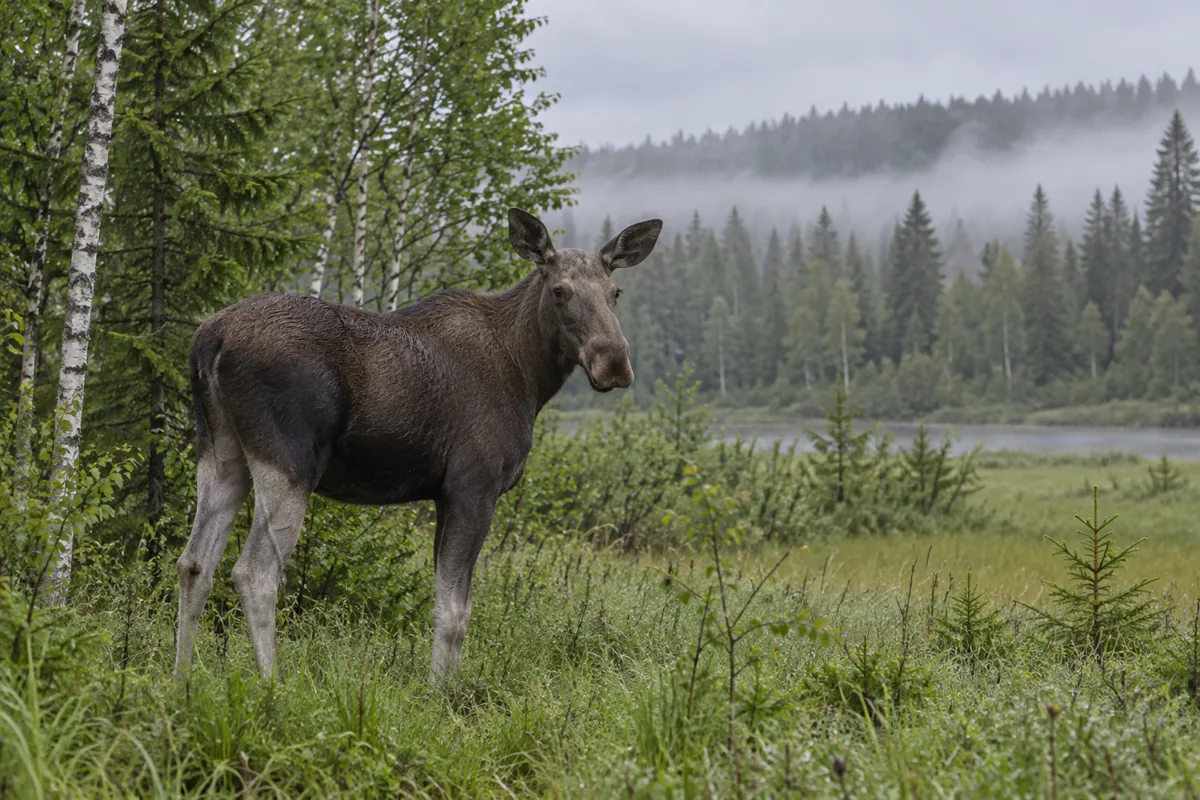
Christer and Ulla Johansson began with a few calves in 1996, according to a 2019 profile of Älgens Hus. The article uses elk in the European sense for the animal North American readers call a moose.
The herd is larger than the milking line-up. A 2004 count included eight adults and six calves, but only three cows were being milked; a 2019 profile counted 11 animals, nearly all born on the farm.
A second 2004 report also counted 14 moose, which supports the herd total even though it does not add another milked cow.
The 59-acre farm also operated as a visitor attraction drawing about 25,000 people a year in the 2004 accounts. Reported gross income from the animals was about $150,000 before visitor revenue, so the business was broader than cheese alone.
How Do You Milk a Moose?
The animals are not ordinary dairy stock. On the farm's cheesemaking page, the owners describe several years of imprinting and close contact that made the cows calm enough to milk.
The owners also take part in births and raise the calves closely, creating a bond that Johansson compared with the cows treating the family as their own young. That relationship matters because an adult cow can weigh around 500 kilograms and will not give milk on command.
Calm also sets the pace because a disturbed cow stops giving milk. A 2004 Farm Show report says hand milking took 30 to 45 minutes in quiet conditions and up to two hours when a car or another disturbance interrupted the animal.
The cows were described as standing for milking while free in the forest and living outdoors throughout the year. You should picture a managed relationship with semi-domesticated animals, not a conventional dairy barn.
The reported calf-feeding schedule moved from the mother's milk in the first week to a milk-and-replacer mix in the second, then fully to replacer by the third. This allowed the farm to continue collecting milk during the short lactation season.
The animals' origin remains unclear: one account calls the milked cows abandoned calves found near Bjurholm, while two others say calves came from animal parks. The records do not show whether they are describing different animals or conflicting versions of the same history.
Russian moose dairies provided the model for this approach. The best-documented example is Kostroma Moose Farm, where people raise calves closely enough that adult cows return from the forest to be milked.
At Kostroma, a farm-born calf is separated within two to three hours of birth and raised by people. The cow comes to accept the milkers as substitute calves, ranges in the forest and returns daily until lactation ends in September or October.
Early Russian work found stall housing harmful to moose health, possibly because penned animals miss nutrients available in wild plants. Their selective feeding also makes confinement expensive, with the animals reportedly rejecting branches thicker than about 10 millimetres.
At Älgens Hus, the useful milk season runs only from calving in May until the cows return to heat in September. That narrow window limits supply before cheesemaking even begins.
Why Does Moose Cheese Cost So Much?
Every price in the comparison below comes from 2004 reporting because the farm pages do not publish a current cheese price. Read the numbers as a record of the product's scarcity at that time, not as a quote you can use today.
| Source | Date | Price as reported | Roughly per kilogram |
|---|---|---|---|
| Farm Show | 2004 | $227 per pound | $500 |
| Deseret News | 2004 | Nearly $500 per pound | $1,100 |
Both prices describe the same year, so the twofold gap cannot be explained by inflation or a later price rise. It is a reporting conflict that should stay visible.
The lower figure passes an internal check: 660 pounds at $227 per pound comes to about $150,000, matching the reported gross income from the animals. Our calculation does not prove the price, but it shows that the figures in that account are consistent with one another.
The higher number comes from a separate 2004 report and would imply roughly $330,000 at the same output. Because $227 per pound is almost $500 per kilogram, a unit mix-up is possible, but the surviving accounts do not resolve it.
The feta-style cheese comes in jars of 25 and 50 grams. Applying the historical range gives an illustrative cost of $12.50 to $27.50 for 25 grams and $25 to $55 for 50 grams, but the farm does not publish those jar prices.
Milk yield is similarly uncertain, with the two 2004 reports giving about or up to one gallon per cow per day. The wording makes that 3.8-litre figure a ceiling rather than a dependable daily average.
A single milking can yield only a few decilitres and at best a couple of litres, while not every cow lactates. Two best-case sessions could approach a gallon, reinforcing that it is a ceiling rather than an average.
The milk is accumulated and turned into cheese only three times a year. Accounts disagree on whether it was frozen or merely refrigerated, so the storage method cannot be stated more firmly.
This is our own arithmetic, not a reported figure. Three cows giving a gallon a day over the roughly 150 days from May to the end of September would come to about 1,700 litres, the most a season could supply at Farm Show's figure.
Publicity was already increasing demand in 2004, and Johansson planned to add a fourth milked cow the following year. No later production record here confirms that the expansion happened.
The high price follows from slow hand milking, a short season and very little milk per animal. Even before ageing or labour in the dairy, the farm has far less raw material than a cow's-milk cheesemaker.
What Is in Moose Milk?
Two 2004 reports give moose milk as 12 percent fat and 12 percent protein, but neither identifies a laboratory measurement. Those matching numbers are press figures, not a published composition standard.
The farm instead gives a seasonal fat range of 7 to 11 percent and describes protein as much higher than in cow's milk. The ranges do not reconcile, so you should not quote one fat number as universal.
How Much Fat and Protein Is in Moose Cheese?
A separate composition list describes 100 grams of finished cheese but does not identify the style. You cannot safely apply it to the feta, white-mould cheese or either blue individually.
The same list gives 47.8 grams of water and 5.9 grams of ash in every 100 grams, and the 1,200 kilojoules convert to about 287 kilocalories.
At 22.1 grams of fat per 100 grams the cheese holds at least twice the 7 to 11 percent the farm gives for the milk. The 12 percent quoted for the milk therefore cannot stand in for the fat in the cheese.
What Kinds of Moose Cheese Are Made?
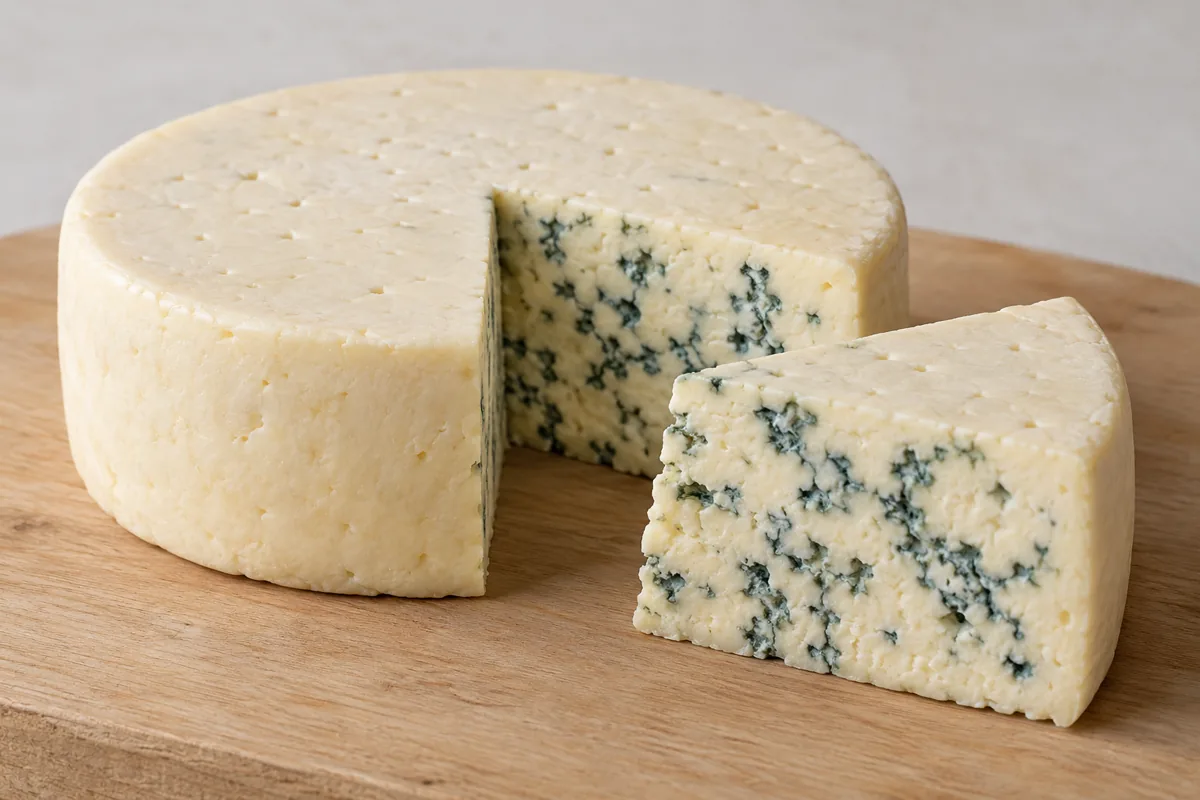
Older reports collapse the range into three varieties, while the farm now lists four: white mould, creamy blue, dried blue and feta. The simplest explanation is that the two blue cheeses were once counted as one category, although the records do not date that change.
For you as a diner, the distinction matters because the two blues differ in texture, strength and keeping quality rather than representing one interchangeable product.
| Style | Type | Weight or pack | Storage time |
|---|---|---|---|
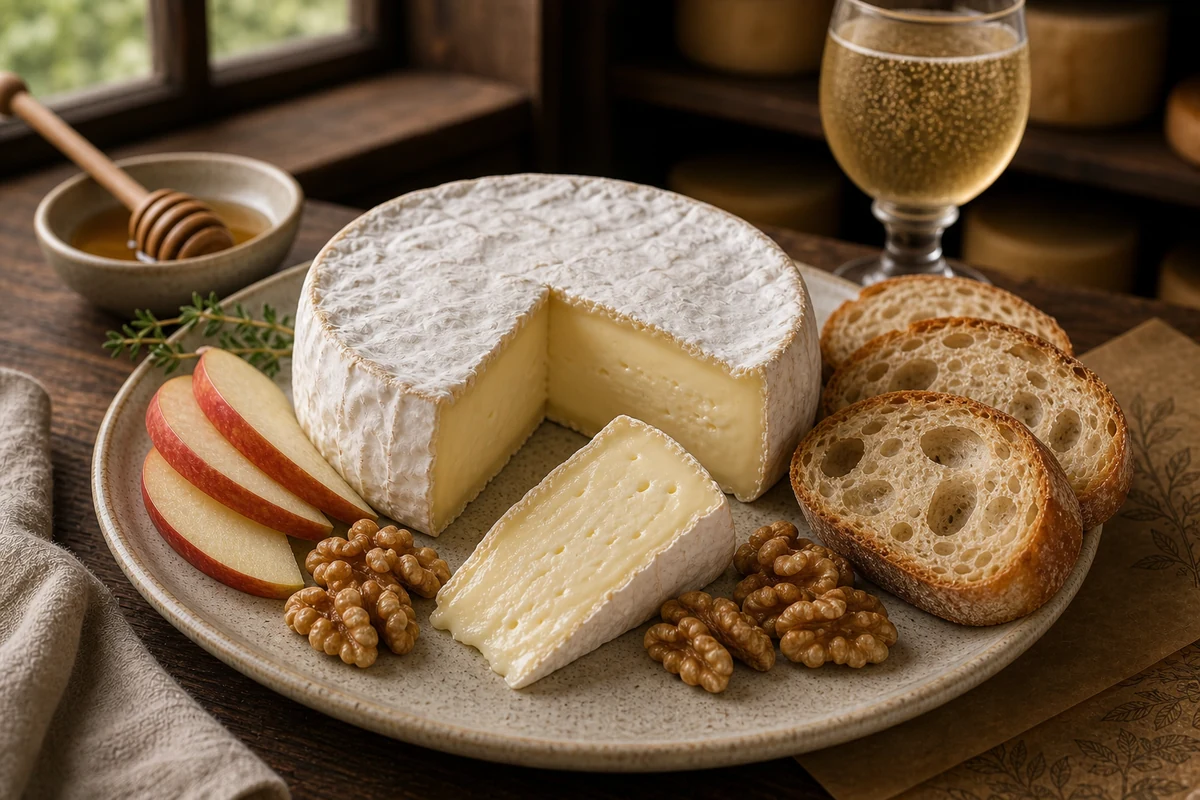
| White-mould | Camembert type | About 150 to 180 g | Not given |
| Creamy blue | Blue | About 150 to 210 g | Very short |
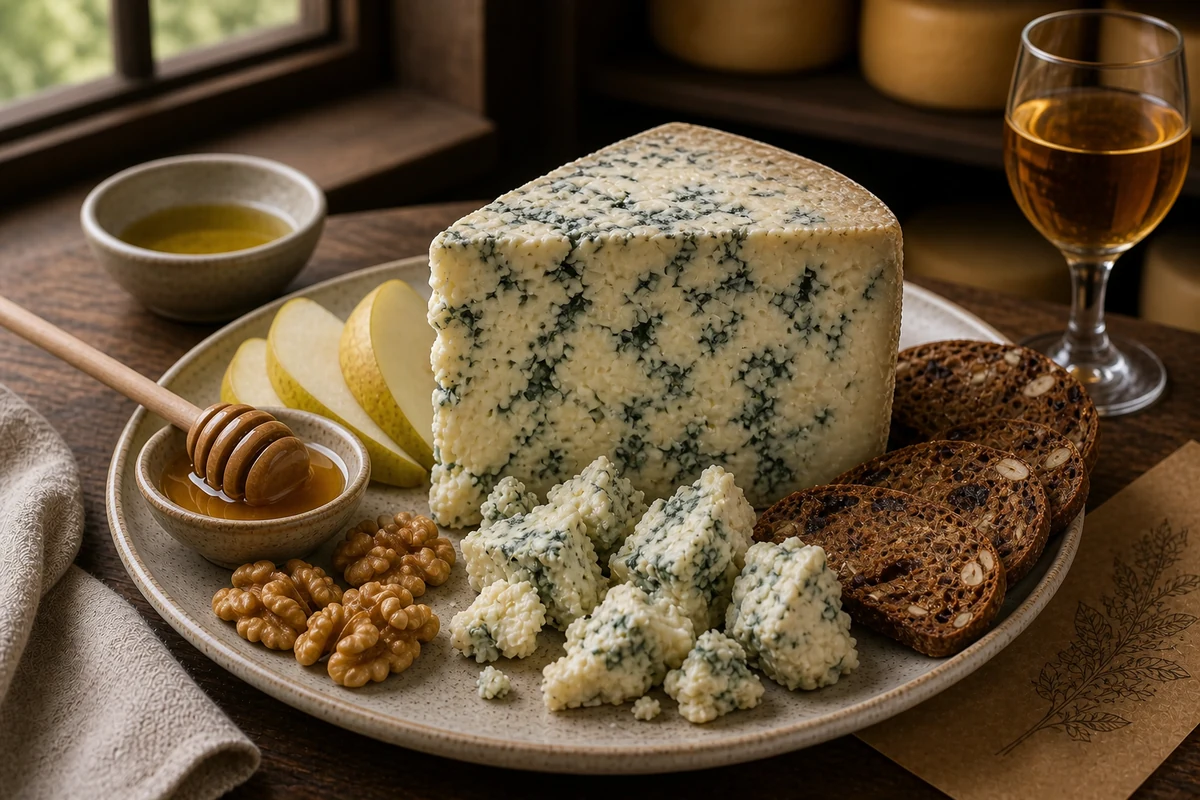
| Dried blue | Made like the creamy blue and dried in the last part of ageing | About 120 to 180 g | Not given |
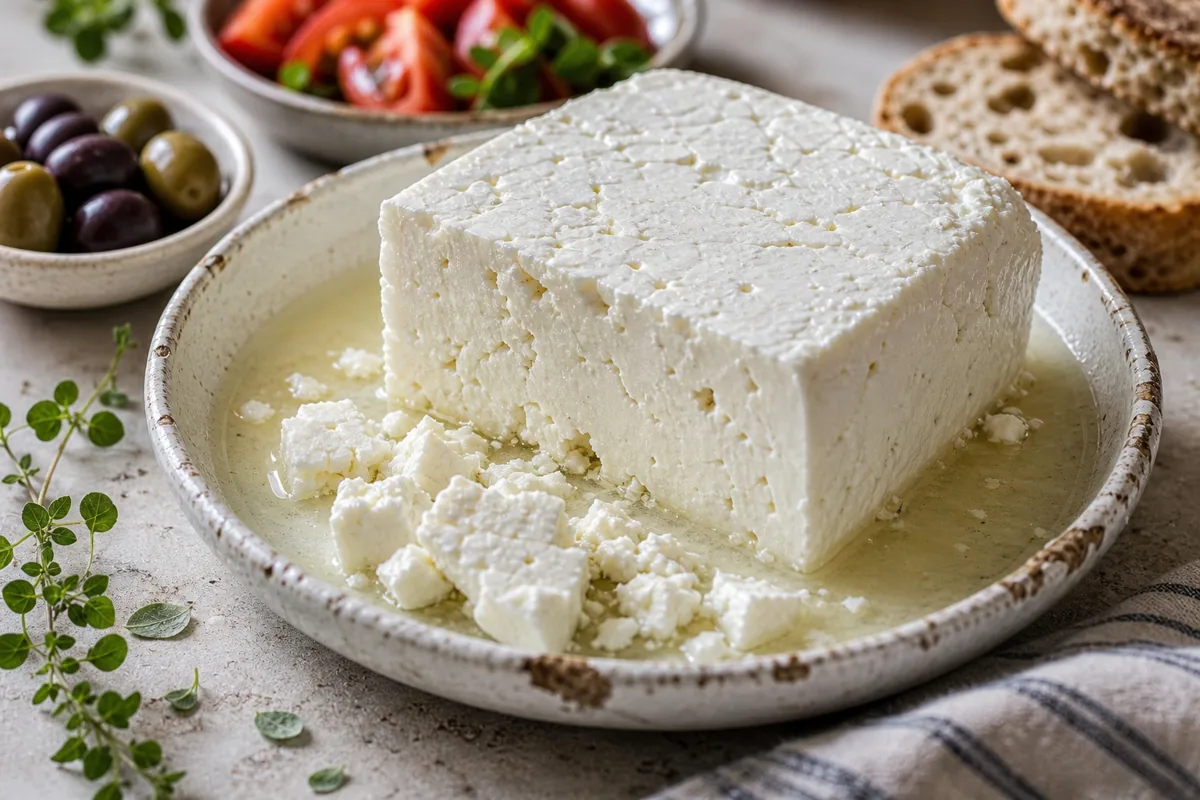
| Feta | Kept in neutral vegetable oil; the bestseller | Usually jars of 25 g and 50 g | At least 6 months, up to a year, before its peak |
Two of the four are blue cheeses, and the creamy one is the hardest style to make because the mould culture reacts strongly with the protein-rich milk.
The same page ties that reaction to the creamy blue's very short storage time and its sensitivity to transport and temperature changes.
Deseret News quotes Johansson saying the feta is "laid down in oil and easy to transport".
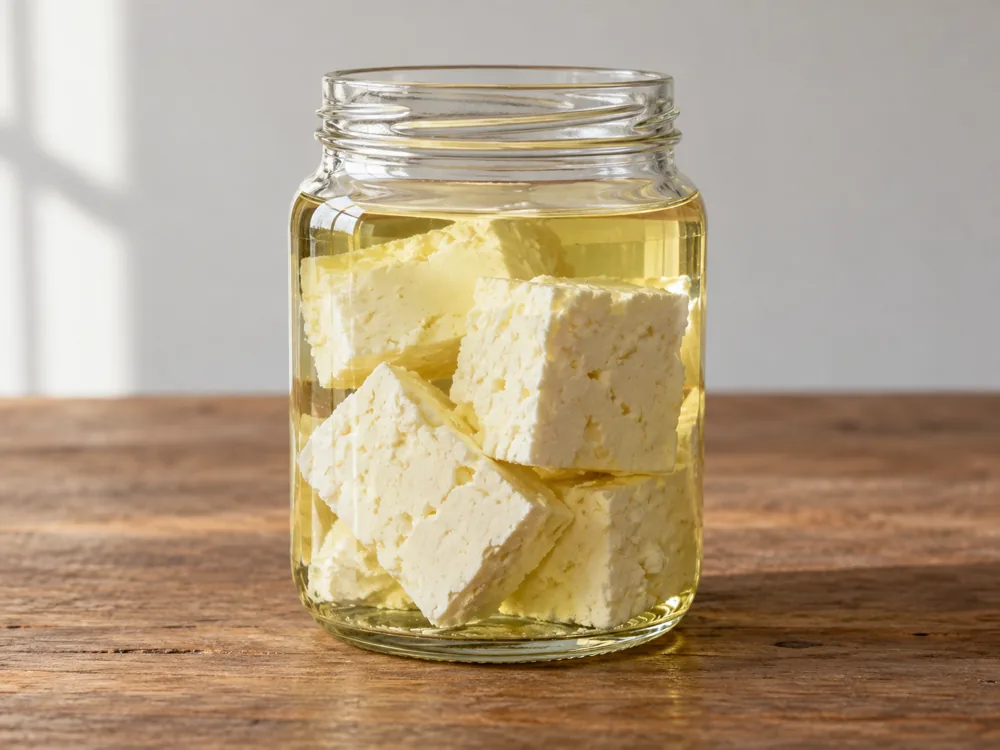
No reliable description gives the colour or rind of every style, so the illustration stays with the documented oil-packed format rather than inventing a recognisable wheel.
What Does Moose Cheese Taste Like?
Every published description comes from the farm or its owner, and none comes from a named independent taster.
The feta-style cheese is presented as tangy, smooth and creamy, becoming broader and more powerful as it matures. An older interview uses the plainer description "somewhat sour", which fits the same acidic direction.
The white-mould Camembert-style cheese is the mildest of the four, with a creamy texture and a smooth, fine flavour.
The creamy blue is positioned as the crowd favourite, while the dried blue is stronger and broader with a texture compared to Parmesan. These are producer descriptions, so they help you distinguish the styles without replacing an independent tasting.
What Goes With Moose Cheese?
For most of its cheeses the farm's page recommends wine, without naming a style or a grape.
The dried blue has enough intensity for beer as well as wine, while the milder styles need less forceful partners.
For dessert, the page prints a parfait recipe that uses just 50 grams of grated moose cheese for five to six portions. The mixture is frozen on a base of crushed digestive biscuits and served with raspberries, or another berry or a sauce, and lightly whipped cream.
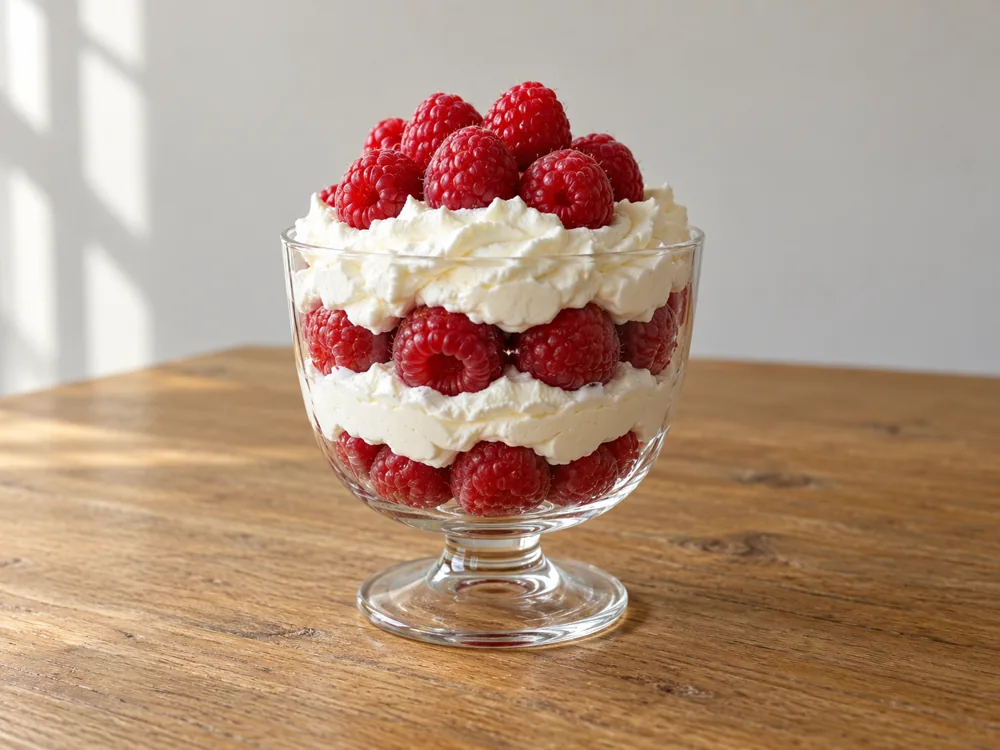
The recipe uses 50 grams for five to six servings, or about 8 to 10 grams of cheese per portion. That is also the larger of the two documented jar sizes, which tells you how sparingly the rare cheese is used.
Where Can You Buy Moose Cheese?
The most credible place to encounter the cheese is the farm's own restaurant in Bjurholm. Its restaurant page says the milk becomes moose cheese that can appear on the menu and lists a moose-cheese parfait among the desserts.
The restaurant serves tour visitors and people who come only for a meal. Seasonal drop-in arrangements have existed, but bookings are required at other times.
A farm notice dated 23 April 2024 says visits were available only by booking with a minimum charge of 4,400 SEK. Check the current farm notice before travelling because that arrangement can change.
Historical buyers included tourists, upscale Swedish hotels and restaurants, with 66 pounds a year reportedly going to the Ice Hotel. That was a tenth of the roughly 660-pound annual output quoted in the same 2004 account.
Exporting more of the oil-packed feta was an ambition in 2004, not a confirmed current sales route.
A 2019 profile mentions restaurant and overseas sales, while the farm places the white-mould and creamy blue cheeses mainly at Älgens Hus. The disagreement means you should confirm current availability directly instead of planning around an old reseller account.
No current farm page provides an online shop, public cheese price list or shipping option. If you are outside Sweden, there is no confirmed route here to order a jar of the feta.
The feta is the one style the sources describe as packed to travel, in oil and in jars of 25 and 50 grams, while the farm's page places the white-mould and the creamy blue at Älgens Hus, which as of April 2024 takes bookings only.
Is Moose Cheese the Same as Moose Head Cheese?
No. Head cheese is a meat terrine or jelly, usually set in aspic, and it contains no dairy products.
Moose enters head cheese only through Newfoundland and Labrador, where brawn is typically made from wild game such as moose and caribou. A moose head cheese recipe is that meat dish.
Is Anyone Else Making Moose Cheese?
No cited page names a moose cheese producer in Canada or anywhere else outside Sweden, and Johansson told the Associated Press in 2004 that the Russian moose dairies that inspired him produce only milk.
The best-documented Russian operation is Kostroma Moose Farm near Sumarokovo, founded in 1963 under an agricultural research station. It keeps a semi-domesticated herd primarily for milk and supplies a nearby sanatorium rather than making a documented cheese range.
Its recorded activities are milk production, antler velvet harvesting and tourism. None of the inspected material identifies a Kostroma cheese, so Russian moose dairying does not give you another cheese producer.
Kostroma's multi-year records sit well below the Swedish press ceiling of a gallon a day. From 1972 to 1985, 23,864 litres were collected while the milked herd averaged 11 cows, equal to roughly 1,800 litres a year.
By our arithmetic that is about 170 litres per milked cow a year, against about 570 litres per cow if a cow gave Farm Show's gallon a day for 150 days.
The Russian experience also shows why this has not become a normal dairy industry. Moose farming needs expertise, capital and suitable habitat, while failed meat operations reportedly faced costs as high as ten times those of beef.
Moose farming in Russia is older than Kostroma. Wikipedia dates the first experimental moose farm to 1949, run by staff of the Pechora-Ilych Nature Reserve at Yaksha in the Komi Republic under Yevgeny Knorre.
Can You Eat Moose Cheese While Pregnant?
The farm and press pages do not say whether Älgens Hus pasteurises its moose milk, so a pregnancy answer has to depend on the cheese style and how it is served. You cannot infer milk treatment from rarity, price or the fact that the animals live on a named farm.
For the soft white-mould style, the NHS guidance says a white-coated mould-ripened soft cheese must be thoroughly cooked whether its milk is pasteurised or not. For the feta-style cheese, the unknown milk treatment prevents a firm cold-serving recommendation.
The CDC safer-choice table also treats unpasteurised soft cheese as riskier and heated pasteurised soft cheese as safer. Neither agency names the farm's creamy or dried blue specifically, so cooking until steaming hot is the clearer conservative route.
Moose Cheese FAQ
Yes. Älgens Hus in northern Sweden documents making several cheeses from moose milk, and press reports have covered the farm since at least 2004.
Reports from 2004 put it between about $500 and $1,100 per kilogram, but the two accounts may contain a unit discrepancy. The farm does not publish a current retail cheese price, so those numbers should not be treated as today's quote.
It depends on the style. The farm describes a tangy, creamy feta-style cheese, a mild white-mould cheese and two stronger blue cheeses, but these are producer descriptions rather than an independent tasting panel.
The farm restaurant in Bjurholm is the only current route supported across the sources, and even there availability can vary. No current farm page provides an online shop, shipping option or public price list for the cheese.