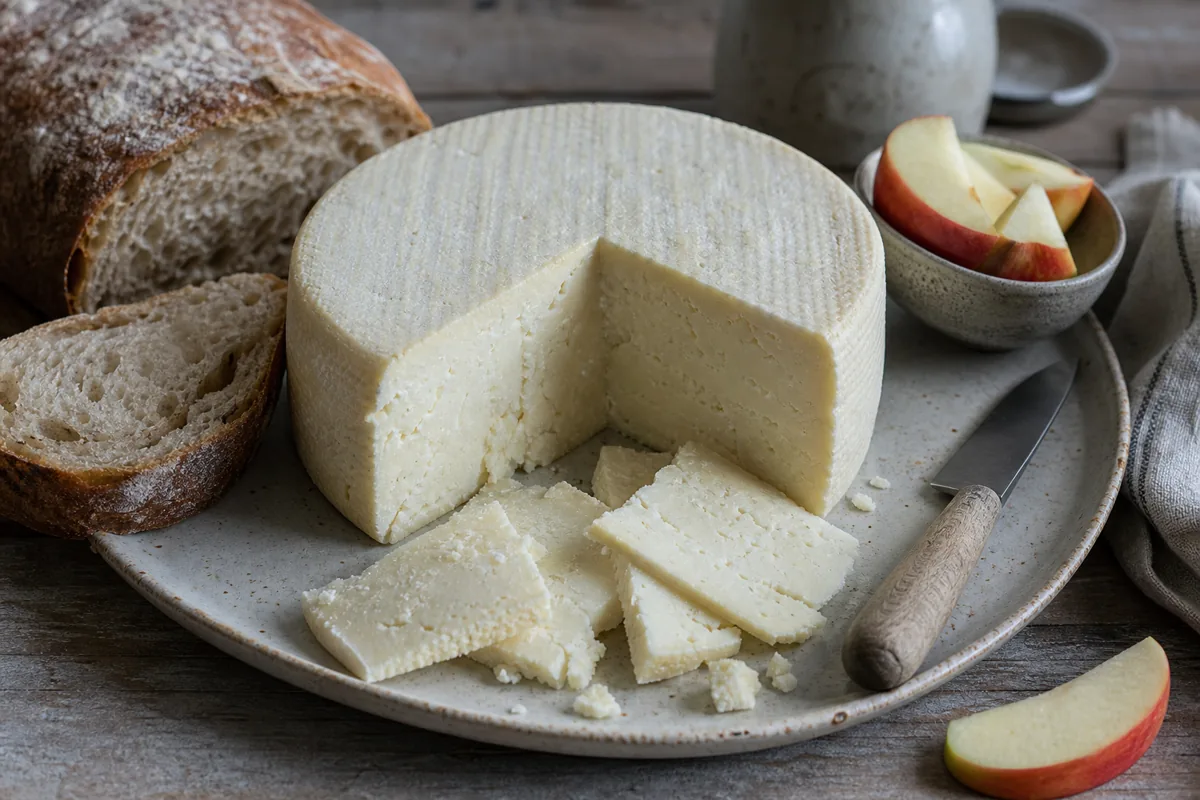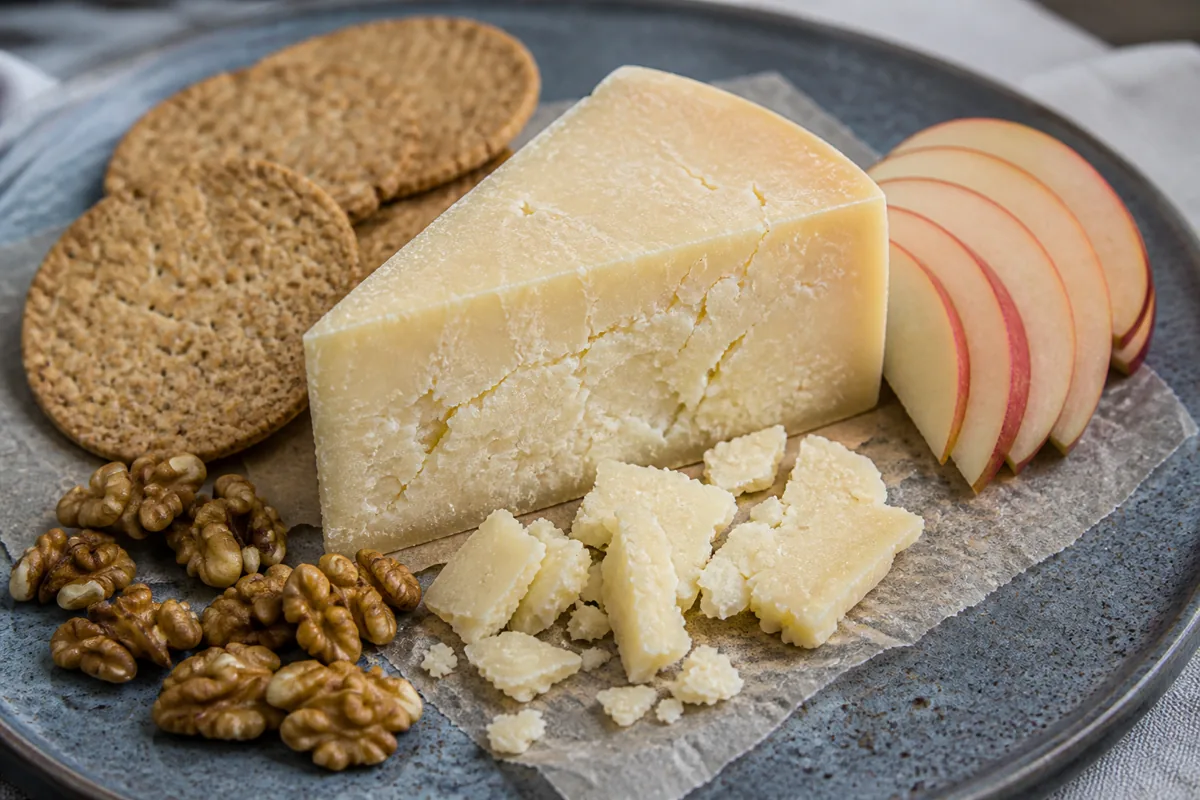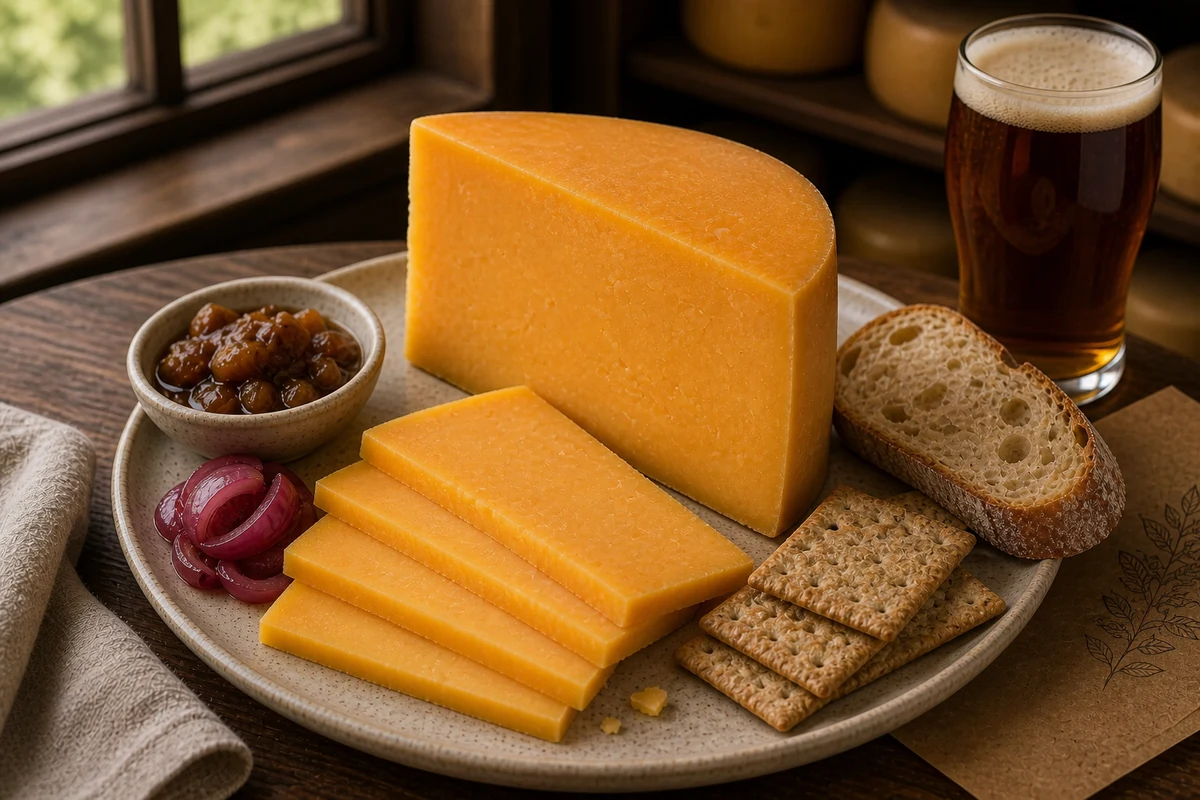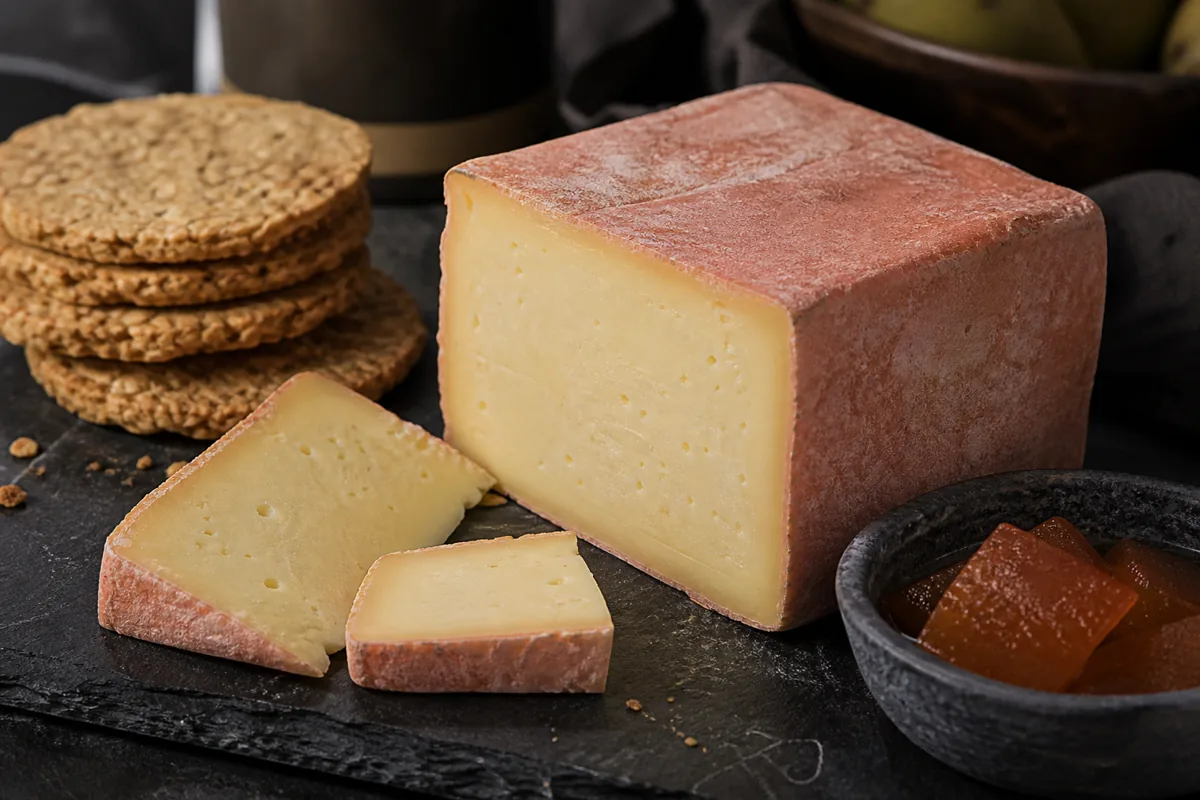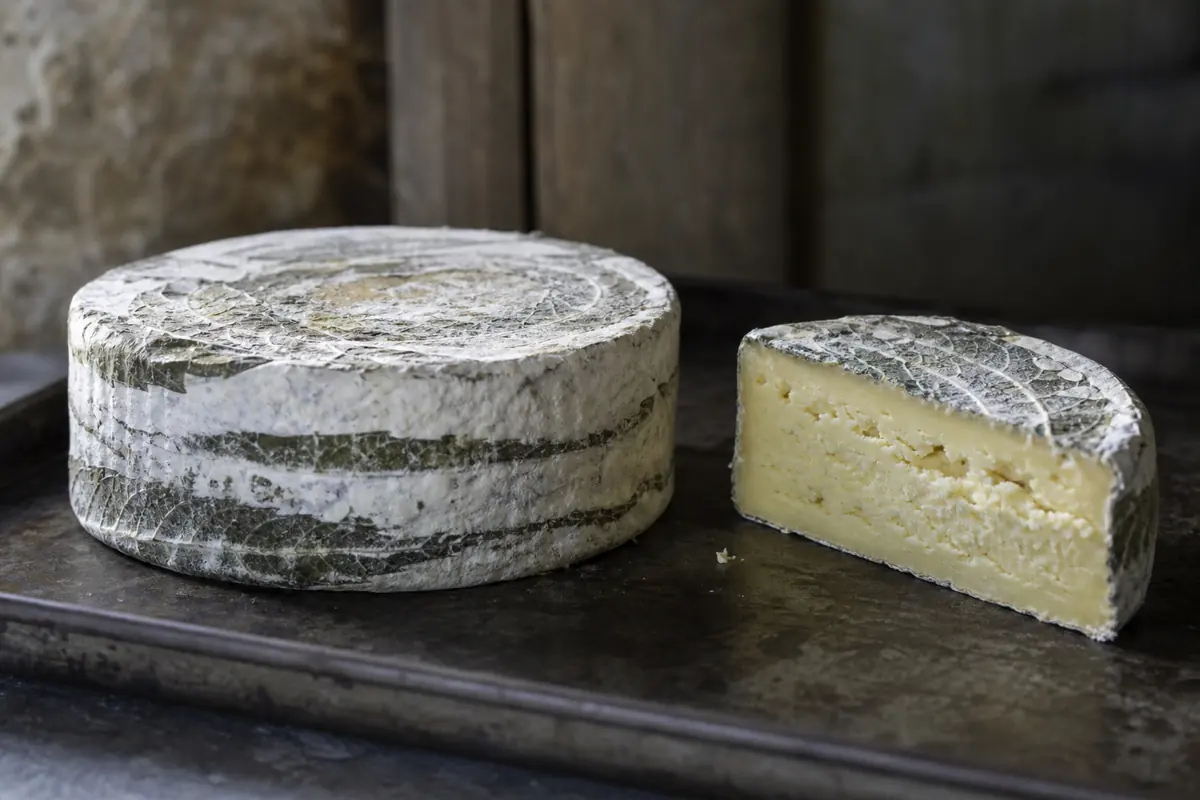
Cornish Yarg is a semi-hard, Caerphilly-style cheese made from pasteurized cow's milk and wrapped in nettle leaves. White moulds grow over the leaves during a ripening of about 4 to 6 weeks.
The leaf rind is edible, and the nettles have lost their sting before they go on the cheese.
Lynher Dairy in Cornwall is the only maker of Cornish Yarg as of October 2026. The same dairy also makes Wild Garlic Yarg, Cornish Kern and Stithians, which are separate cheeses.
In This Article
Who Makes Cornish Yarg, and How Old Is the Recipe?
Catherine Mead makes Cornish Yarg at Lynher Dairies in the United Kingdom, and the dairy is in Ponsanooth, Cornwall. As of October 2026, her son Otto Mead is taking on the day-to-day leadership of the dairy.
The name Yarg is Gray spelled backwards, after the farmer Alan Gray who found a recipe for nettle-wrapped cheese in his attic in the 1980s.
That recipe dates from the 16th century on the dairy's shop page, the 17th century in Neal's Yard Dairy's account and the 13th century in Culture magazine's, while Paxton & Whitfield traces it to a printed book, Gervase Markham's The English Huswife, first published in 1615; Culture puts the nettles and name at 1983, while the dairy's shop page and Paxton & Whitfield put the attic find at 1984.
Whichever century the recipe dates from, those older dates describe its roots and do not tell you how long Yarg has been on sale. The recipe combines Wensleydale cheesemaking and Caerphilly processes.
Lynher Dairies was Michael Horrell's firm, based near Rilla Mill, and Yarg has been made in West Cornwall since 2001, after Horrell and his wife Margaret retired.
By January 2010 the dairy was at Pengreep Farm, Truro, making more than 200 tonnes of Cornish Yarg and Wild Garlic Yarg a year in open round vats, having doubled its output over the previous eight years.
The cheese has won competition awards since at least 2012, when it took Best English Cheese at the International Cheese Awards. It has since collected golds at the British Cheese Awards (2017), the World Cheese Awards (2018), the Global Cheese Awards (2024) and the Taste of the West (2020, 2022 and 2024), and a silver at the British Cheese Awards (2024).
Its Great Taste ratings were three stars in both 2023 and 2024 and two stars in 2026, and it took a Best of Class at the Artisan Cheese Awards (2022).
As of October 2026, Lynher Dairies is a Certified B Corporation and holds a King's Award for Enterprise in Sustainable Development.
Why Is Cornish Yarg Wrapped in Nettles?
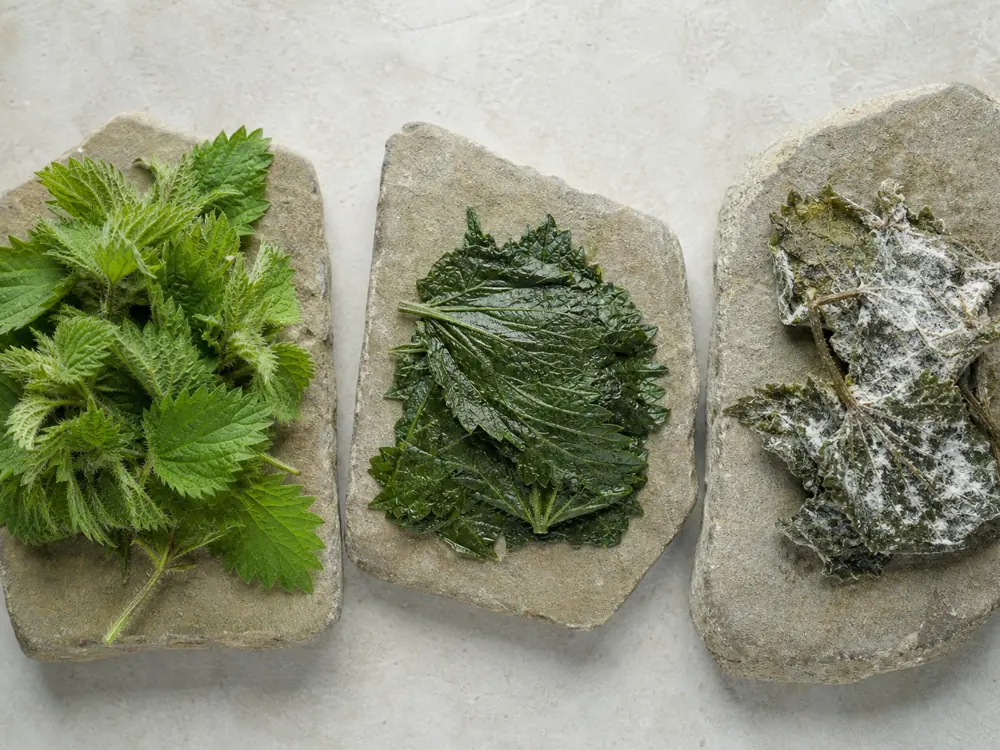
Yarg is wrapped in the young nettle leaves of spring, and the dairy picks them from favourite patches in woodlands it manages sustainably. Hedgerows around the dairy supply them too, and the nettles are collected during May.
The dairy forages about two tonnes of nettles each spring and freezes them for year-round use, so leaves picked in spring wrap cheeses made in other months. The picking runs into June, and friends, family and the local community help gather the year's leaves.
The sting is gone before the leaves touch the cheese: picking and freezing remove it, and steaming also works.
The brushing follows a traditional pattern of concentric circles, and each nettler has a recognisable style.
Each leaf is dipped in a sterilizing solution, and the leaves go on when the cheese is two days old, at about ten minutes per cheese. Those two days cover the pressing, the overnight brine and the drying that come first.
Nettle leaves attract naturally occurring moulds, which raise the pH of the cheese and break down the curd. The leaves are also permeable, so air moves in and out.
The curd starts crumbly and turns smoother as the nettles do their work.
How Is Cornish Yarg Made?
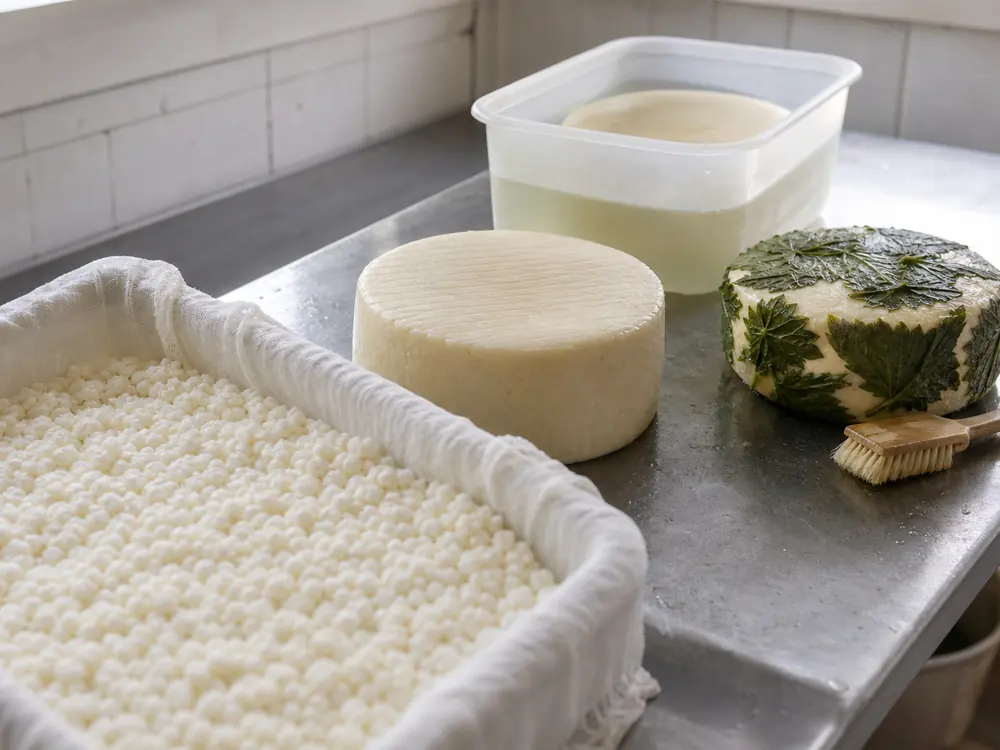
The dairy pasteurizes the milk, adds a ripening culture and a rennet, and times the set carefully. It then cuts and stirs the curd until each piece is as small as a grain of rice, which increases acidity and fermentation.
The ingredients in the vegetarian version are pasteurized cow's milk, salt, nettle leaves, starter cultures, vegetarian rennet, calcium chloride and Penicillium candidum.
The animal-rennet version is made solely from the milk of the dairy's own Ayrshire cows.
In August 2020 the herd numbered about 80 Ayrshires, 57 of them in milk, and their summer diet was about 90% grass and 10% haylage. At that time all of the herd's milk went into the animal-rennet recipe made for Neal's Yard Dairy, and the dairy bought milk from a local co-op to make the bulk of the cheeses it sold.
After the curd is cut, the make follows this order.
- Block and mill the curd, then pack it into moulds by hand.
- Press the cheese.
- Immerse it in brine overnight.
- Let it dry, then paint the leaves on by hand.
- Mature it, turning each cheese by hand until it is ready.
How Long Does Yarg Ripen, and What Changes?
How long leaf-wrapped Yarg ripens depends on the source, and one seller's figures differ from the rest.
| Source | Time given | As written |
|---|---|---|
| Lynher Dairy, Cornish Yarg shop page | 4 to 6 weeks | Listed as maturation |
| Lynher Dairy, how it makes its cheese | About 4 to 5 weeks | Leaf-wrapped Yarg |
| Lynher Dairy, nettle-wrapped cheese page | Six weeks | From field to finish |
| Culture magazine | 4 to 8 weeks | After the nettles go on |
| Neal's Yard Dairy | 21 to 28 days at the dairy; average age 2 to 3 months | Animal-rennet version sold by the retailer |
The dairy's own pages differ by about two weeks, and the shop page's 4 to 6 weeks covers all three of them. Culture magazine's 4 to 8 weeks runs longest of the figures given in weeks.
Neal's Yard Dairy gives a different kind of figure: 21 to 28 days at the dairy, with an average age of 2 to 3 months for the animal-rennet version it sells.
That 2 to 3 months covers only the animal-rennet version, so for the Yarg in front of you, go by the age on the label.
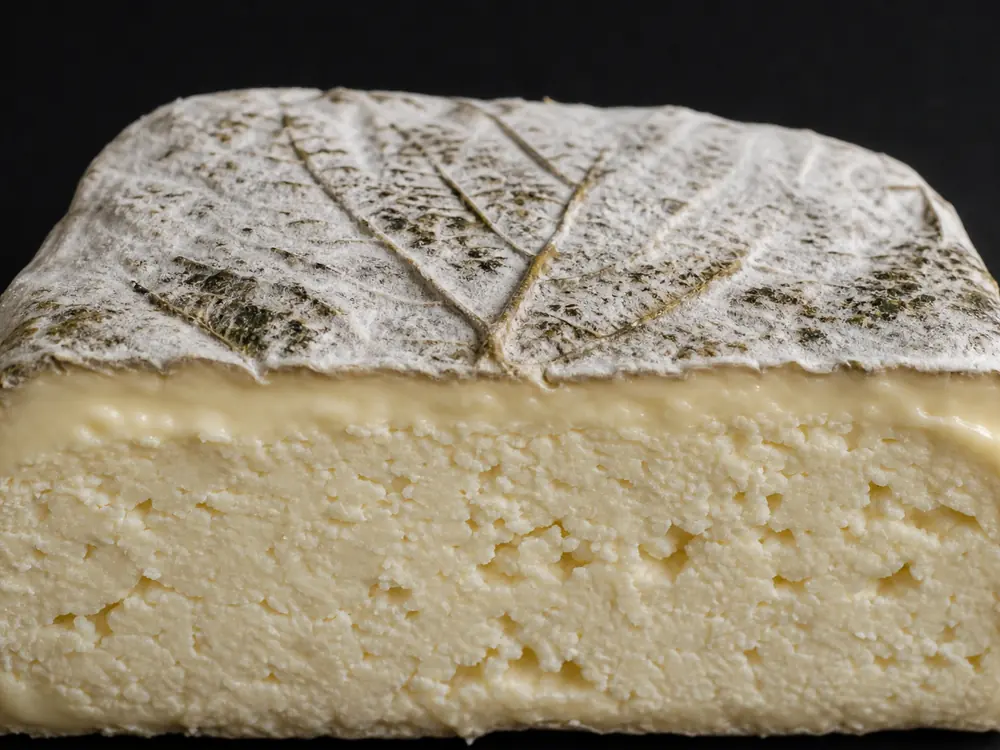
Because the leaves go on so early in the make, almost all of these weeks pass under them. By the end, the leaves carry a dusting of bloomy white moulds and the rind develops a white-and-green pattern.
The paste is described as slightly crumbly, with an open core that can show occasional holes or slits, and a creamy layer forming under the rind as the cheese matures.
The flavour descriptions converge on a lactic, delicate character.
- Lynher Dairy's Yarg shop page: delicate, lactic and mushroomy aroma; lactic, creamy, buttery, delicate but complex flavour.
- Lynher Dairy's nettle page: a fresh mushroomy taste with a crumbly core.
- Culture magazine: clean and lactic, with sweet, delicate notes of mushrooms, earth and cellar, and a pleasant tang.
Can You Eat the Nettle Rind?
Yes: the white-moulded nettle covering is an edible rind.
Neal's Yard Dairy describes the rind as delicately earthy, giving way to a buttery breakdown and a crumbly core with notes of lemon and yoghurt.
Cutting the rind off removes that earthy edge, so a thin slice that includes a little rind lets you compare both layers before you decide.
How Is Cornish Yarg Different From Related Cheeses?
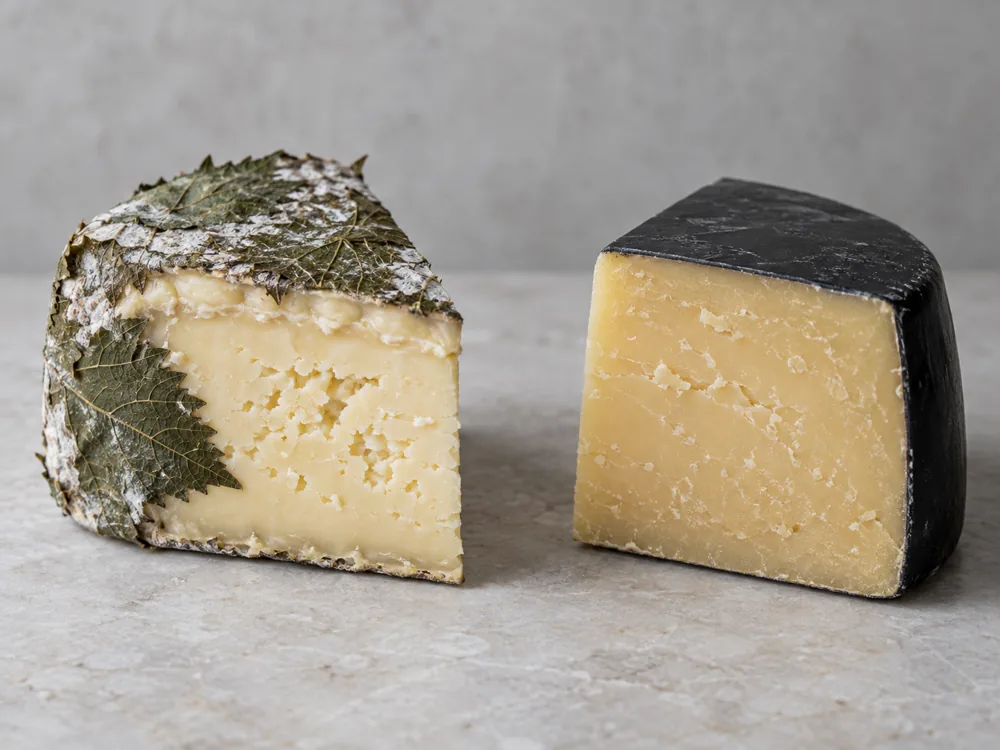
Lynher Dairy makes four cheeses, and only Cornish Yarg wears nettles. Wild Garlic Yarg starts out as the same cheese, but the choice of leaf governs how the cheese matures and tastes.
Garlic leaves are less permeable than nettles, so less moisture escapes and the texture is firmer, and they are anti-microbial, so they attract less mould. The leaves also change the look: white bloom appears on the nettles during ripening, while the wild garlic darkens in colour.
The garlic flavour is described as more pungent than the nettles' and nothing like cheeses made with bulb garlic.
The dairy picks wild garlic only while the leaves are freshest: once the plant puts its energy into flowering, the leaves are past their best, and the white flowers mark the end of the picking season.
| Cheese | Covering | Maturation |
|---|---|---|
| Cornish Yarg | Nettle leaves | 4 to 6 weeks (shop page) |
| Wild Garlic Yarg | Wild garlic leaves | About 4 to 5 weeks for leaf-wrapped Yarg (making page) |
| Cornish Kern | Black wax paint | 16 to 22 months |
| Stithians | White wax | 6 to 9 months |
Kern follows a different recipe with Alpine starter cultures that help develop its flavour over time, and its curds are scalded during the make.
Once Kern's curds are moulded they are pressed, brined and coated in black wax paint. Stithians is dry salted instead of brined before its white wax paint.
Is Cornish Yarg Vegetarian?
Cornish Yarg and Wild Garlic Yarg are suitable for vegetarians and use vegetable rennet.
Most Cornish Yarg uses plant-based coagulant, but as of October 2026 an animal-rennet version is made specially for Neal's Yard Dairy, whose ingredients include animal rennet.
Stithians and Kern use a traditional rennet and are not suitable for vegetarians.
The name Cornish Yarg therefore covers more than one recipe. If you are vegetarian, read the ingredient list where you buy, because that list shows which version is in the shop.
The dairy's own Cornish Yarg and Wild Garlic Yarg are suitable for vegetarians. As of October 2026, the Yarg Neal's Yard Dairy sells uses animal rennet, so the seller's ingredient list decides.
How Should You Serve Cornish Yarg?
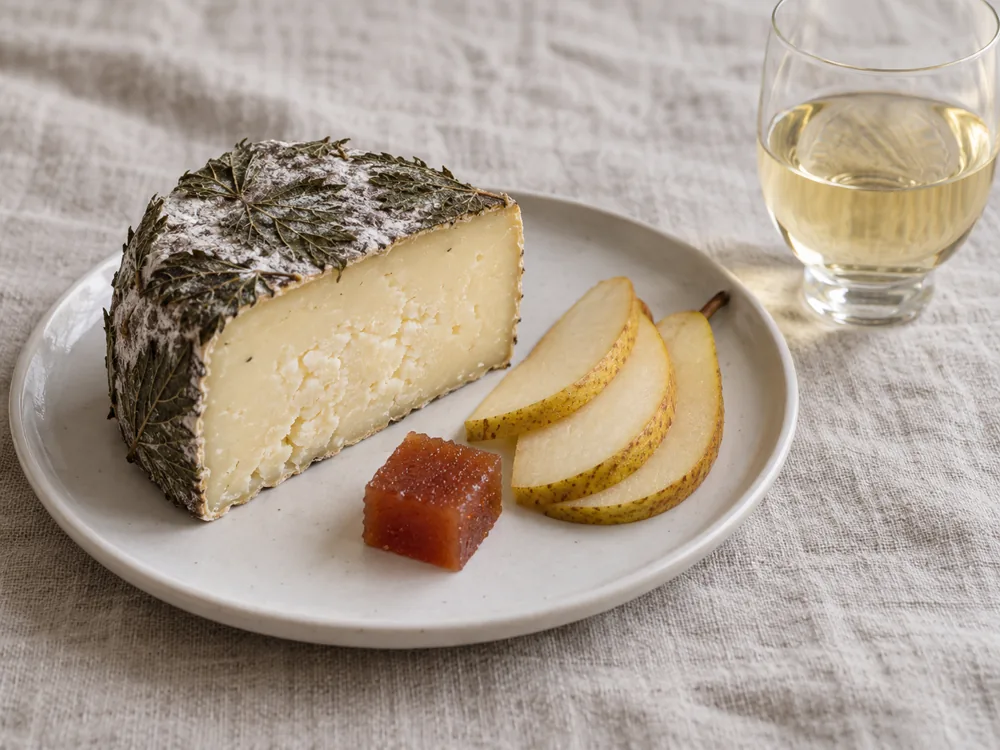
Serve Yarg at room temperature, and try pears, quince and a fruity white wine such as Riesling. Take the cheese out of the refrigerator about an hour before serving.
Other pairings to try include dry Cornish cider, a crisp white wine such as Sauvignon Blanc, figs and toasted hazelnuts. In cooking, try grating Yarg into a mushroom omelette.
| Pairing | Type | Why It Works |
|---|---|---|
| Pears | Food | Named by Lynher Dairy on the Yarg shop page. |
| Quince | Food | Named by Lynher Dairy on the Yarg shop page. |
| Riesling | Wine | Lynher Dairy suggests a fruity white wine such as a Riesling. |
What Sizes Does Cornish Yarg Come In?
A whole Cornish Yarg truckle weighs 900 g, 1.6 kg or about 3.2 kg.
| Source | Weight | Diameter and height |
|---|---|---|
| Lynher Dairy FAQ | 900 g | 14 cm across, 10 cm high |
| Lynher Dairy FAQ | 1.6 kg | 18 cm across, 8 cm high |
| Lynher Dairy FAQ (3.3 kg on the shop page) | 3.2 kg | 26 cm across, 8 cm high |
| Culture magazine | 8 lb (about 3.6 kg) | 10 to 12 in across (about 25 to 30 cm), 4 in high (about 10 cm) |
| Neal's Yard Dairy, whole | 3,970 g to 4,621 g | Not given |
The cheeses are handmade, so sizes vary slightly, which fits the 3.3 kg on the shop page and the 3.2 kg in the FAQ for the largest truckle. Wild Garlic Yarg comes only at 900 g and 1.6 kg.
Culture's 8 lb and Neal's Yard's wholes of roughly 4 kg to 4.6 kg are larger than the dairy's biggest truckle, so the word whole does not mean the same weight at every seller. Check the weight before you order one.
The Neal's Yard wholes are the animal-rennet recipe made for that shop, which in 2020 was a 4 kg cheese rather than 3 kg.
As of October 2026, Neal's Yard Dairy also sells cut portions, from a sixteenth at 245 g to 289 g up to a half at 1,985 g to 2,311 g, while the dairy's smallest truckle is 900 g.
How Should You Buy and Store Cornish Yarg?
On the dairy's own shop, whole truckles carry a use-by of at least 4 weeks from despatch date; the FAQ figure for delivered truckles is 6 weeks, so the shop page is the minimum.
At home, wrap it in wax paper and store it below 8°C. Once a piece is cut, finish it within 10 days.
That 10 days starts at the first cut, so pick a size you can finish. Dividing the weights by 10 days gives about 90 g a day for a 900 g truckle and about 320 g a day for a 3.2 kg one.
Turn a whole truckle once a week to prevent a soggy bottom. Orders go by next-day courier, packed with a cool block, protective paper wool and an insulated cardboard box, and a delivery date can be requested up to 3 months ahead.
The dairy carries most lines in stock all year round, and gift orders can carry a handwritten message added at checkout. Visitors to Cornwall can also buy at the dairy's cheese shop, where staff offer tastings alongside guest cheeses, crackers and wine.
As of October 2026, the dairy's online shop prices the three truckle sizes from £30 for a 900 g to £94 for a 3.3 kg.
The CDC says to keep a refrigerator at 40°F (4°C) or below.
Is Cornish Yarg Pasteurized, and Can You Eat It While Pregnant?
Yes, it is pasteurized: Lynher Dairy lists Cornish Yarg as made from pasteurized cow's milk and suitable for vegetarians. Its allergy advice says the cheese contains cow's milk.
If you follow NHS advice, cook Cornish Yarg until it is steaming hot before you eat it: Lynher Dairy says its nettle leaves carry a dusting of bloomy white moulds by the end of ripening, and the NHS says pasteurised or unpasteurised mould-ripened soft cheeses with a white coating on the outside must be thoroughly cooked and lists any cheese that's been cooked until steaming hot as safe to eat.
The CDC lists soft cheese made from unpasteurized (raw) milk as riskier and says pregnant women are 10 times more likely to get a Listeria infection. Served cold, Cornish Yarg is described as a pasteurized semi-hard, firm and slightly crumbly cheese, a type the CDC list does not cover, so ask a midwife or doctor.
SOURCES & REFERENCES
What Else Do People Ask About Cornish Yarg?
No. The dairy picks and freezes the nettles, and the sting has left them by the time they go on the cheese.
Yes. The white-moulded nettle covering is an edible rind.
The dairy's shop page gives 4 to 6 weeks. Culture magazine gives 4 to 8 weeks, and Neal's Yard Dairy lists an average age of 2 to 3 months for the version it sells.
The dairy's Cornish Yarg is suitable for vegetarians. As of October 2026, Neal's Yard Dairy sells a version made with animal rennet, so the answer depends on the seller's version.
Truckles weigh 900 g, 1.6 kg and about 3.2 kg, and other sellers list larger wholes.
No. Wild Garlic Yarg uses wild garlic leaves instead of nettles, and the choice of leaf governs how each cheese matures and tastes.
Lynher Dairy in Ponsanooth, Cornwall, which is the only maker of Cornish Yarg as of October 2026.