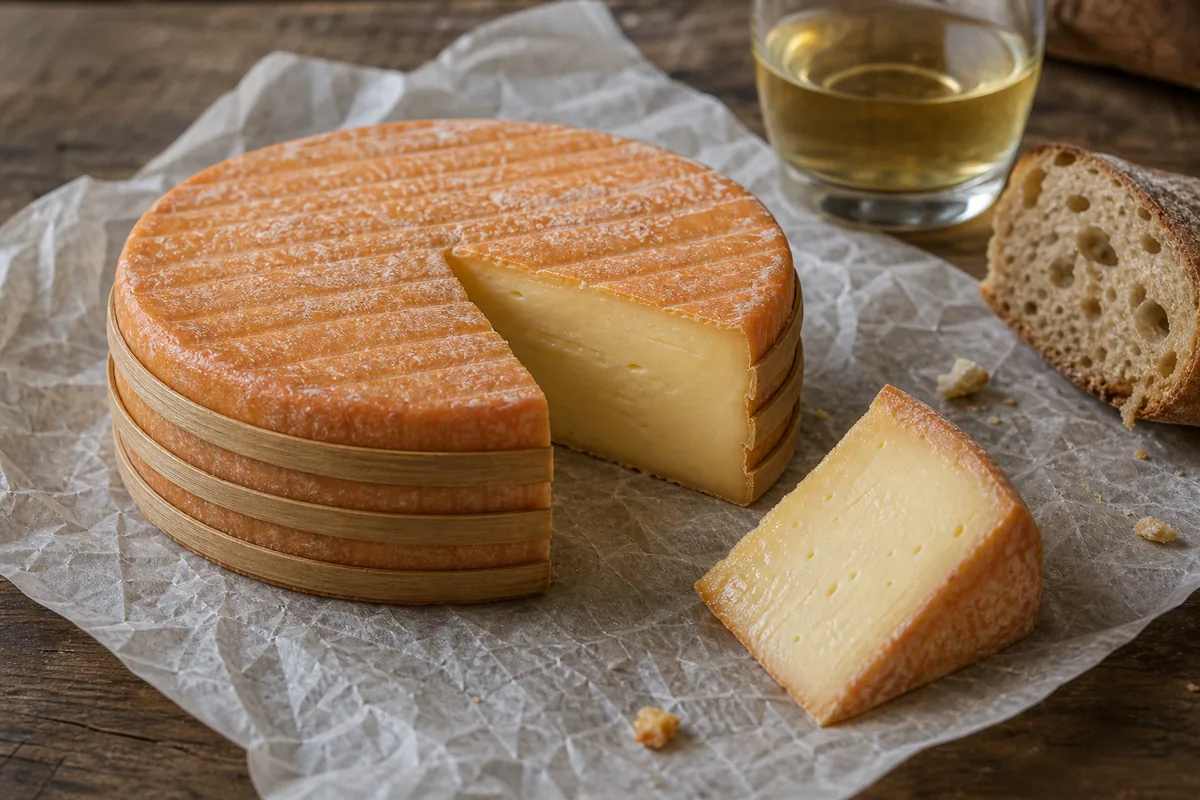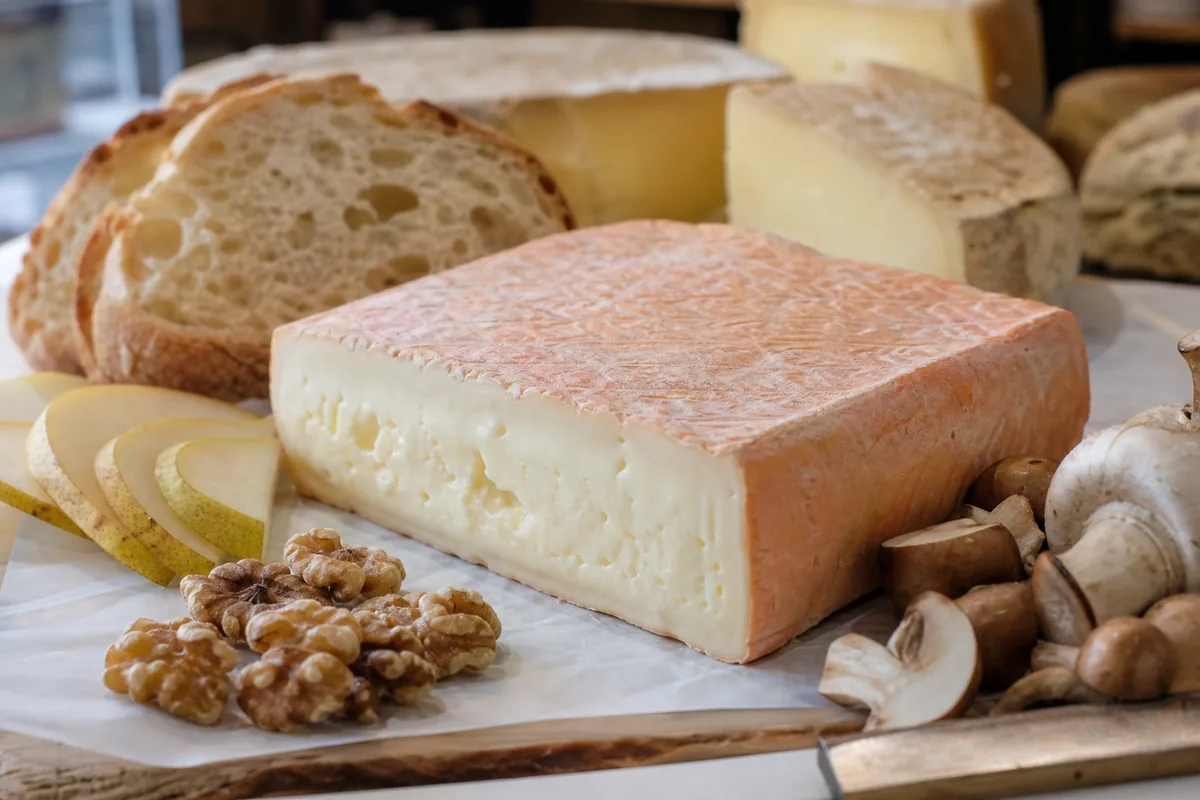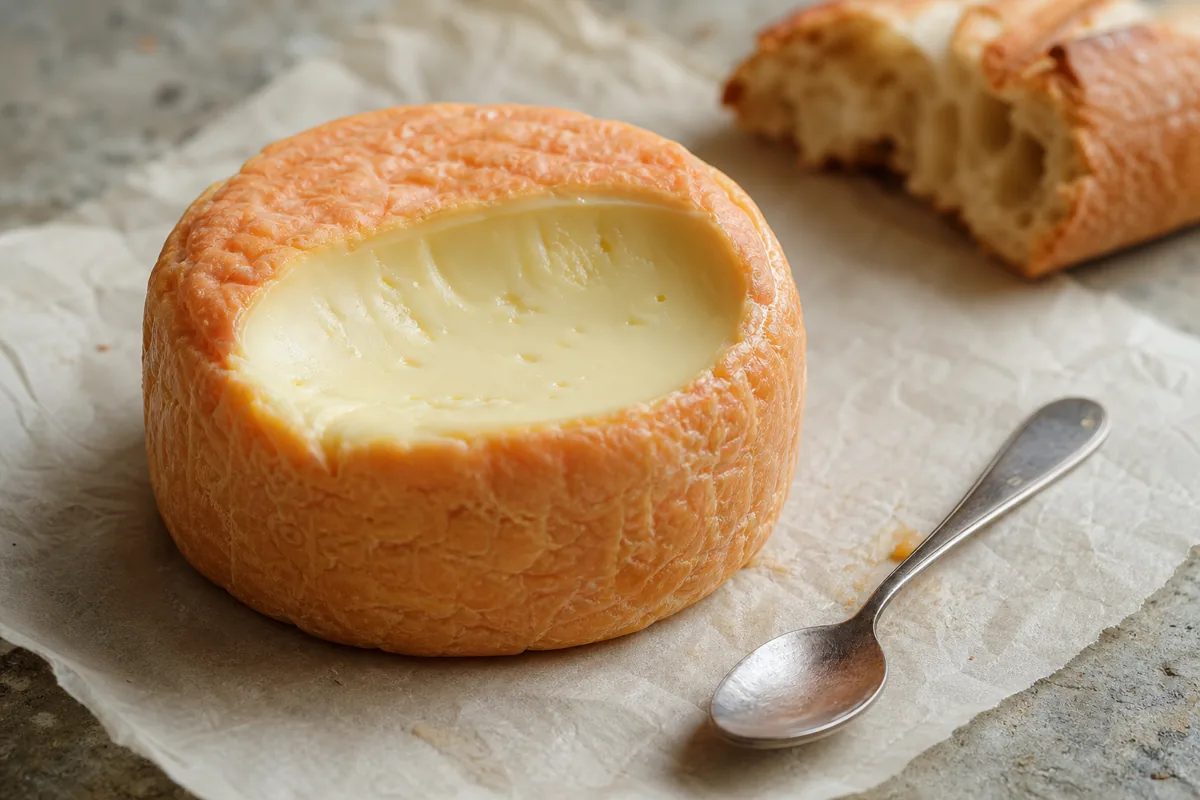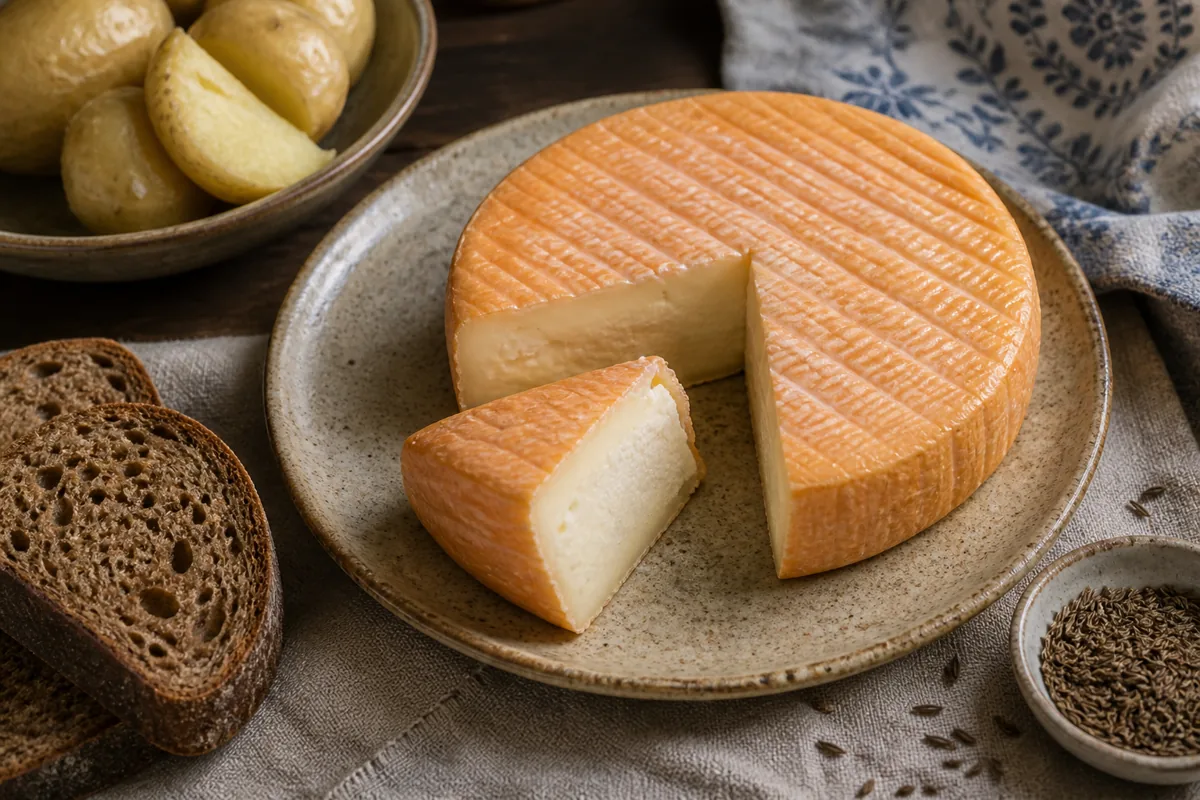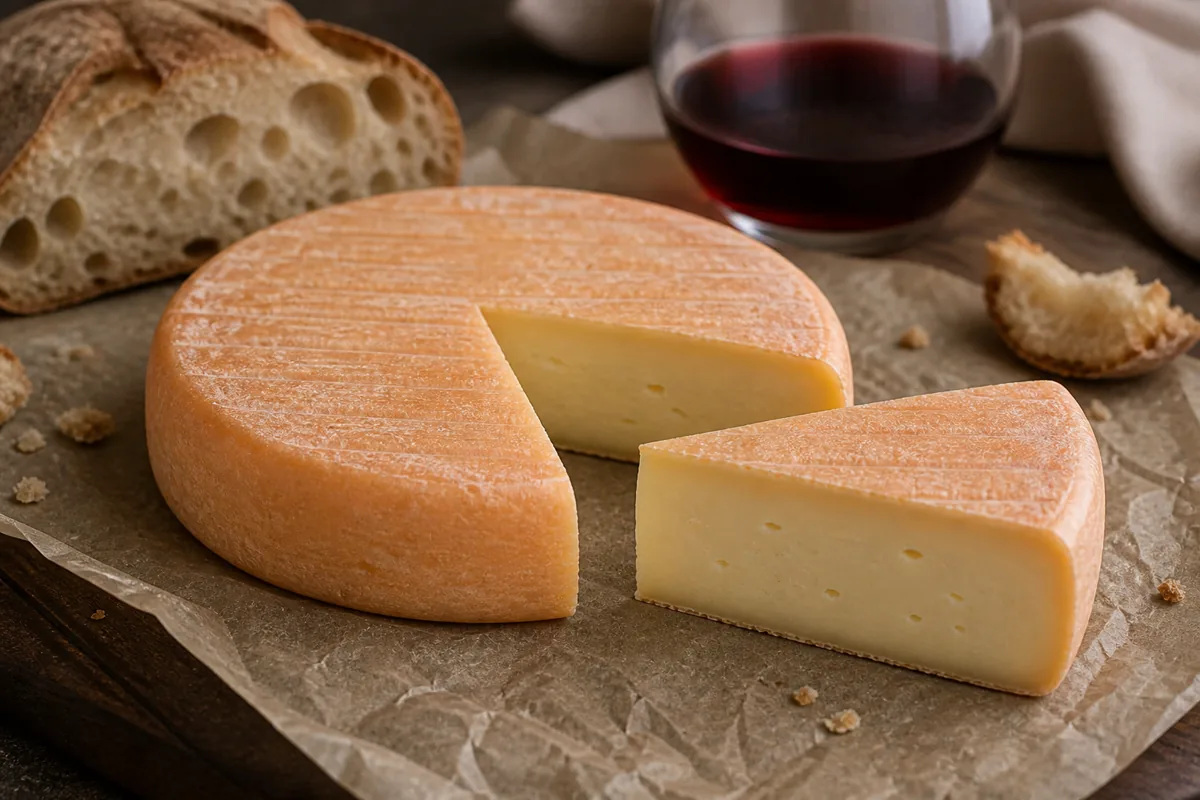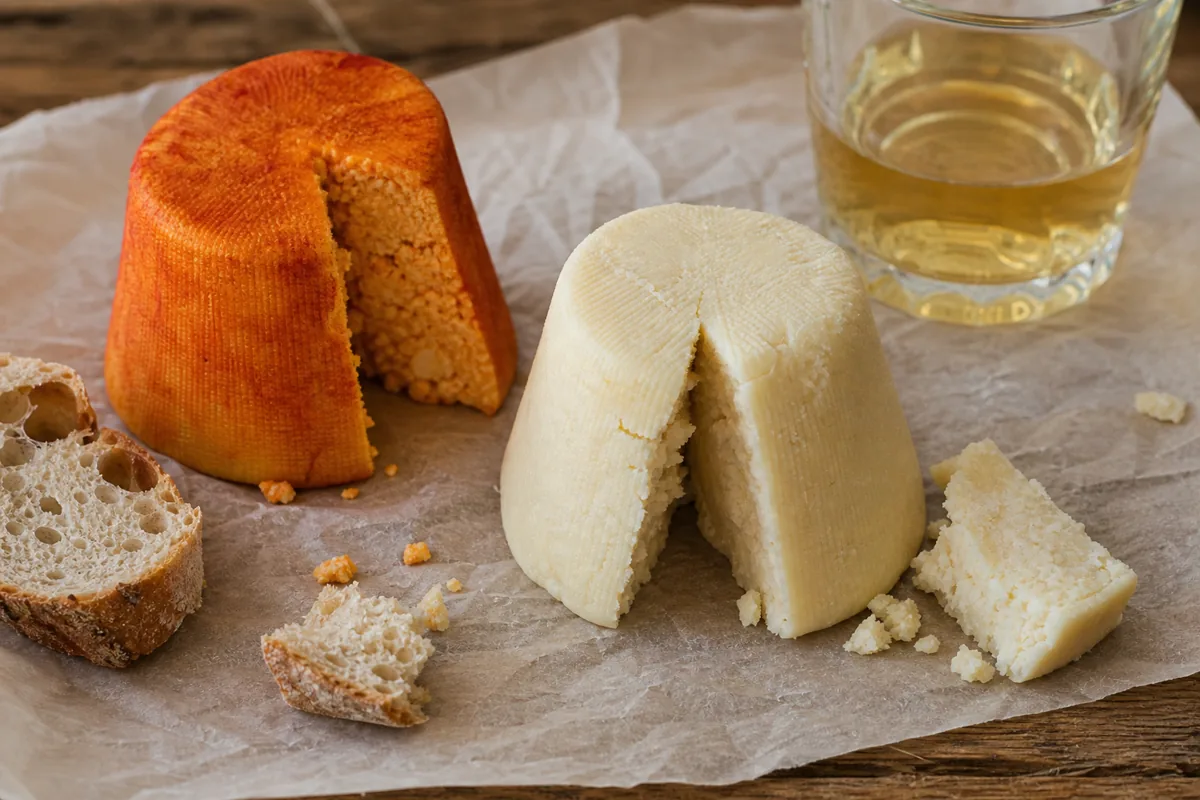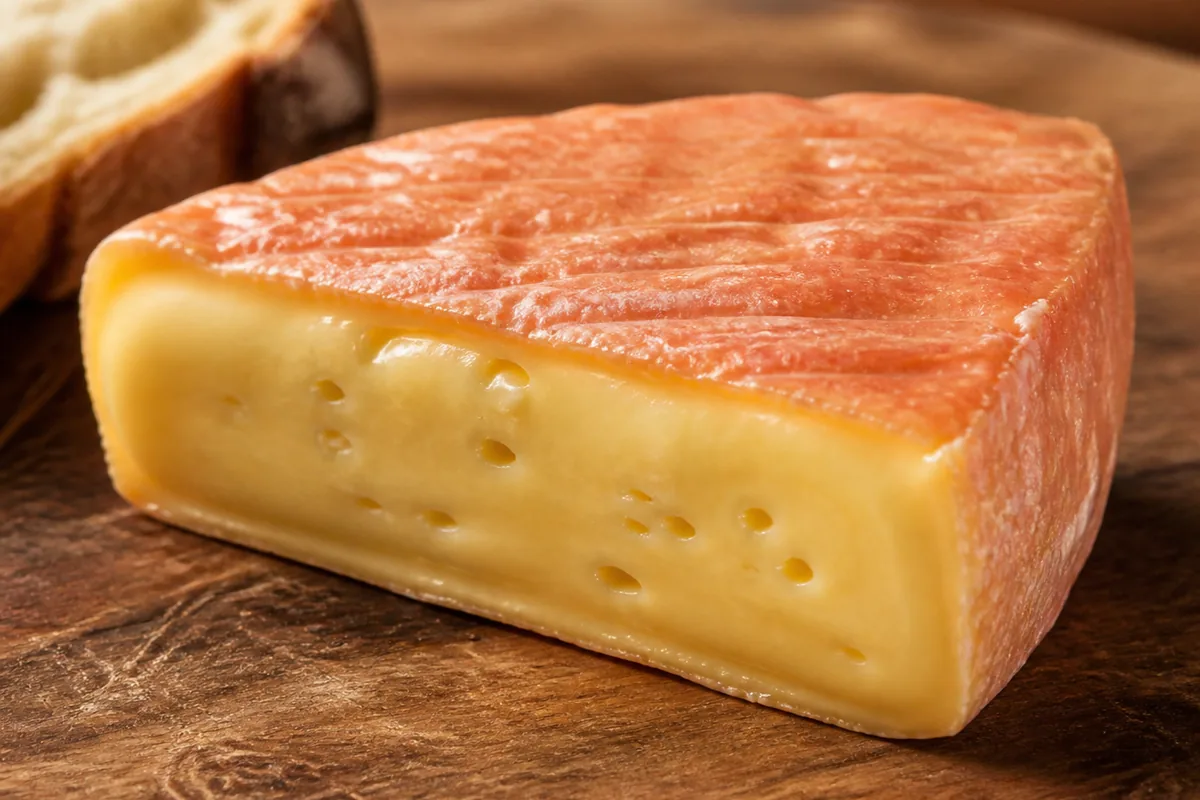
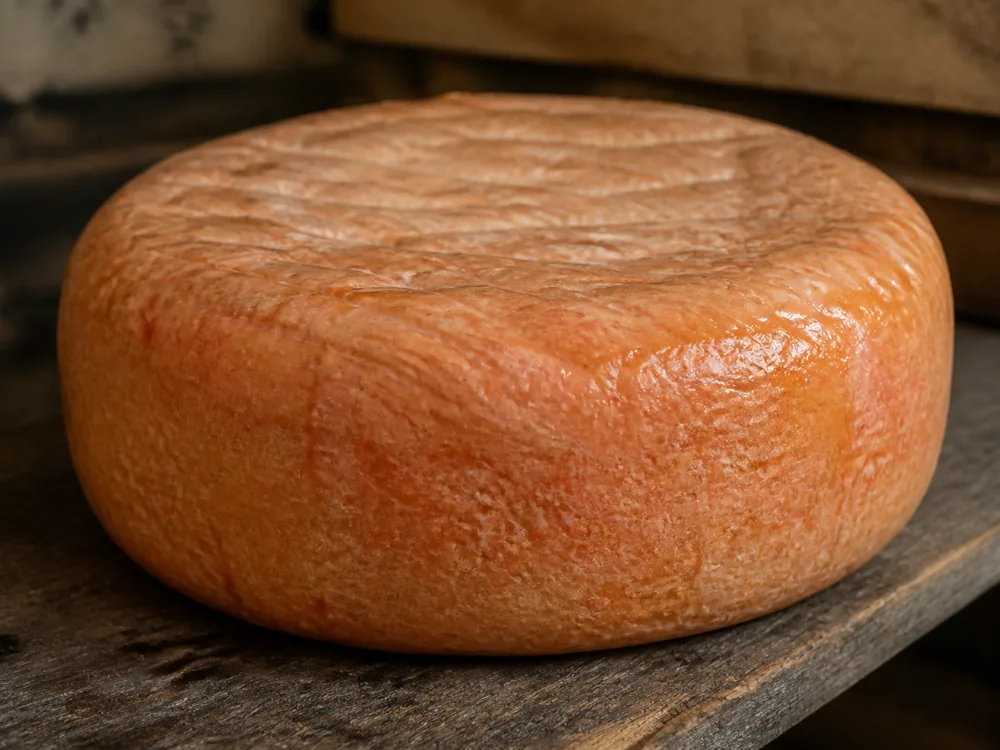
Gubbeen is a washed-rind cheese made from cow's milk by Tom and Giana Ferguson on their farm near Schull in County Cork, Ireland, and the plain wheel is made from pasteurised cow's milk. You will know it by its pink rind and a paste that is usually semi-soft, with a savoury, nutty flavour.
A bacterium that grows on its rind, Microbacterium gubbeenense, was named in 2001 after the farm and dairy.
In This Article
Who Makes Gubbeen, and Where Does the Milk Come From?
The Fergusons make Gubbeen on their 100-hectare (250-acre) farm outside Schull, and as of October 2026 all of the milk came from their own herd, a mix that includes Friesian, Simmental, Jersey and Kerry cows. Keeping their own cows lets the family control the quality of the milk.
In 2017 the herd was mostly Friesian, with a few Jerseys kept for their cream, and 25 people, family included, worked at Gubbeen. In 2025 the farm made roughly 2 tonnes of cheese a week from a herd of 140 cows, and the wider business, smokehouse included, employed over 20 people.
The cheese room started small and has grown into a full production facility with the milking parlour attached, so the milk from the herd has only a few metres to travel to the cheesemakers.
The farm sits where the Gulf Stream regularly comes ashore from the Atlantic, and the warmer climate means grass arrives early in the year and the herd can go out to pasture sooner. The cows are outside on pasture for at least eight months of the year.
When Did the Fergusons Start Making Gubbeen?
Tom Ferguson inherited the farm in the early 1970s, and making cheese from the milk the farm already produced was the next step. Giana Ferguson made the first batch of Gubbeen at the family's kitchen table in 1975, and the cheese has been made since 1979 or 1980.
Giana spent part of her childhood in Spain, where her family made goat's milk cheeses, and she helped her father make cheese there before gaining experience in France. In West Cork she was one of a number of women developing their own cheeses around the same time.
In the 1960s and 1970s the Fergusons were friends with Veronica Steele of Milleens, Jeffa Gill of Durrus and Dick and Helene Willems of Coolea, among the first makers of Irish farmhouse cheese. Those Cork families helped create the farmhouse cheese movement in Ireland.
As of October 2026, farmers' markets were still very important to the family as a way to try out their produce and to hear directly from customers what they like and do not like.
What Awards Has Gubbeen Won?
Gubbeen won gold in the washed-rind category at the 2002 British Cheese Awards, and gold at the British Cheese Awards in 2010 for semi-soft cheese.
In 2016 it won two British Cheese Awards gold medals, one for rind-washed cheese and one for Mature smoked Gubbeen. It also won silver at the 2011 Irish Cheese Awards for semi-soft cheese.
Where Does the Name Gubbeen Come From?
Gubbeen is the English spelling of the Irish word goibín, which means "a small beak or mouth". The cheese takes its name from the townland the farm stands in, An Goibín in Irish.
What Does Gubbeen Cheese Taste Like?
Gubbeen tastes savoury and nutty, with mushroom in the flavour. It belongs to the Cork washed-rind tradition.
Culture describes a pliable, golden, straw-coloured paste with small holes, an aroma that is "slightly musty, earthy and reminiscent of an old cellar", and flavours of mushrooms, butter, peat and nuts that are "not as strong as the aroma would suggest".
How Does Gubbeen Change as It Matures?
Gubbeen is matured for several weeks, and the wheels Neal's Yard Dairy sells average two to three months old.
In Giana Ferguson's words, Gubbeen has "a real buttery milky taste especially when young" and a texture that is "buttery and soft, not runny or cloying".
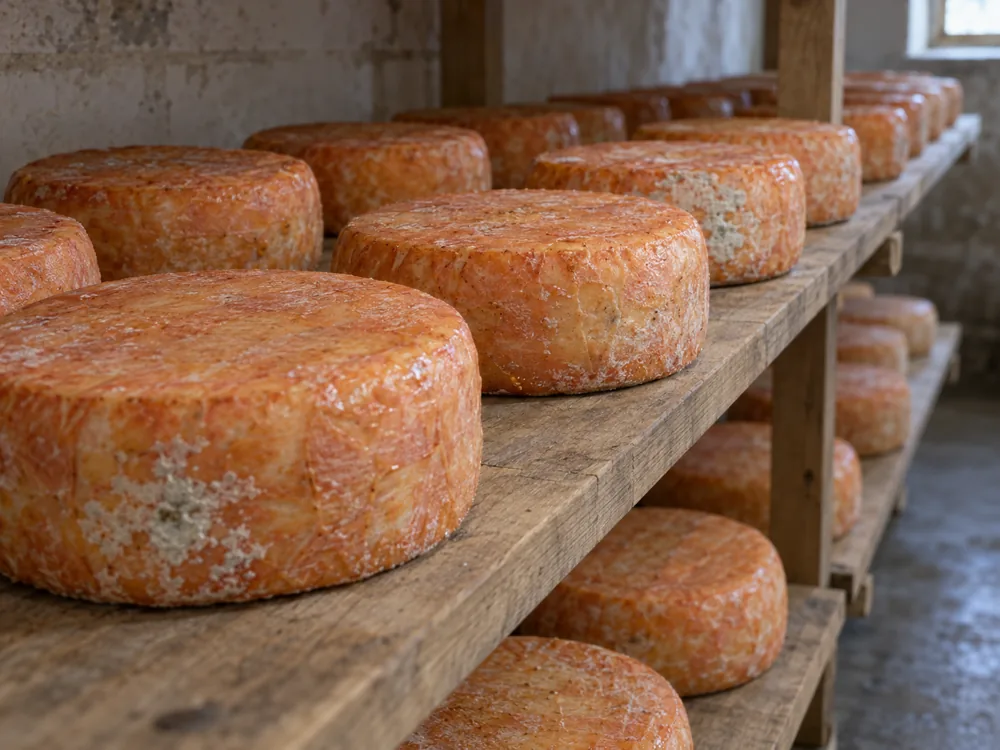
Neal's Yard Dairy receives its wheels from Ireland every two weeks, unwraps them onto racks and keeps them in its warmest maturing room, where it finds the meaty flavours peak after a week or two.
When you buy, ask the seller how old the wheel is and how long the shop has kept it.
How Is Gubbeen Made?
The milk for the plain wheel is pasteurised, and starter culture and rennet are added in vats to set it before the curd is cut and stirred. After salting, the wheels are matured in carefully controlled conditions, where they are regularly washed and turned.
The rind is washed daily, and the wash is a solution of the farm's own rind flora, isolated and made up as a rind wash, together with white wine, salt and water. Microbacterium gubbeenense, the bacterium named after the farm, is also inoculated by hand into each wheel four times.
The curing room is kept at a steady temperature that does not rise and fall. In 2025, Diane, who has worked on the farm since Fingal Ferguson was a child, was in charge of the curing rooms.
The ingredient list for the 450 g Gubbeen that Ardkeen sells names pasteurised whole cow's milk, lactic bacteria, traditional rennet, salt and Gubbeen smear culture.
Can You Eat the Rind on Gubbeen Cheese?
Yes. The rind is edible.
The rind is pink, and with age it often develops patches of white candidum mould. It is called a washed rind because it forms through the regular washing of each wheel with water and white wine.
Is Gubbeen Cheese Vegetarian?
No. Gubbeen is made with animal rennet, the traditional rennet that is made from an enzyme that grows in a calf's stomach.
The family tried vegetarian rennet, and it did not work for them. A new format of the cheese released in 2008 replaced the vegetarian rennet used before with a traditional version.
If you avoid animal rennet, read the rennet line on the ingredient list for smoked Gubbeen as well: it is made from Gubbeen wheels chosen for smoking at five days old.
Read the rennet line on the ingredient list: Gubbeen's lists name animal or traditional rennet, which is made from an enzyme that grows in a calf's stomach.
What Is Microbacterium Gubbeenense?
Microbacterium gubbeenense is a lactic acid producing bacterium named after the Gubbeen farm and dairy. It flourishes on the rind of Gubbeen cheese, and regular washing in brine encourages its growth.
The species was named in a 2001 paper by Brennan and colleagues, from 11 strains isolated from the surface of a smear-ripened cheese; the strains were small, slender, Gram-positive rods that grew in 12% salt. Their nearest relative was Microbacterium barkeri, but DNA-DNA hybridisation showed only 38% chromosomal similarity, and on those differences the strains were proposed as a new species.
In a 2002 Teagasc study of a farmhouse smear-ripened cheese, sampled at 4, 16, 23 and 37 days of ripening, the surface was dominated by Corynebacterium casei (50.2% of isolates), C. mooreparkense (26%) and M. gubbeenense (12.8%). Contrary to accepted belief, Brevibacterium linens was not a significant member of that cheese's surface flora.
Even on cheese deliberately inoculated with a B. linens strain, BL2, that strain was not recovered, because the Staphylococcus isolates and many of the coryneforms inhibited it. M. gubbeenense did not grow below pH 5.8 in 5 to 10% salt, while the two Corynebacterium species grew below pH 4.9 in 8% salt.
How Is Smoked Gubbeen Made?
Before the farm had its own smokehouse, Fingal Ferguson, in his early teens, drove the cheeses to Chris Jepson in Goleen to be smoked. Chris Jepson was a local fish smoker, and when he gave up the business he designed a special smoker for Gubbeen.
Smoked Gubbeen starts as wheels chosen for smoking at five days old, brined and then dried to give a dry surface, then smoked for four days over locally gathered beech and oak wood stored for a season. The smoking follows the Pinney method, which diverts any tar from the smoke away from the cheese.
The wheels are watched during smoking, and the process is adjusted for heavy or wet weather, which slows everything down. Each cheese is checked to make sure no ash has fallen onto the rind.
After a day drying in the creamery, each wheel takes three thin coats of wax per side and spends about five months in a humidity-controlled room at 41-46°F (5-8°C), then gets one last coat of wax before release. That is longer than the two to three months the plain wheels Neal's Yard Dairy sells average.
Culture quotes Giana Ferguson's aim as "Cheese with smoke, not smoke with cheese" and gives the smoked wheel "light notes of smoke, butter, mushrooms, bog and a fudgy sweetness on the finish".
Gubbeen Smokehouse, the family-run business on the farm, also makes bacon, salami and chorizo. A listing that names Gubbeen Smokehouse as the producer can still be the plain cheese: Sheridans' plain Gubbeen carries that producer name.
What Do You Serve with Gubbeen?
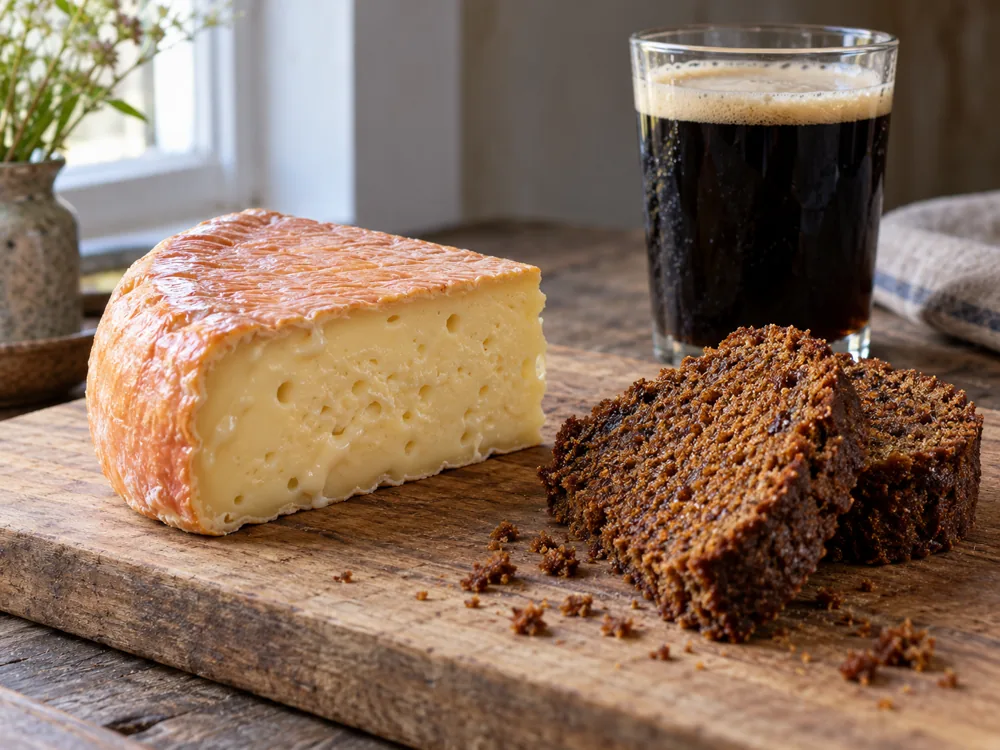
Try Gubbeen with gingerbread, and with darker beers. An orange compote, charcoal crackers and a white frizzante wine also go well with it.
| Pairing | Type | Why It Works |
|---|---|---|
| Gingerbread | Food | Try a slice of gingerbread with a wedge of Gubbeen. |
| Darker beers | Beer | A darker beer goes well alongside it. |
| Orange compote | Food | A Prunotto orange compote. |
| Charcoal crackers | Food | Millers Damsel charcoal crackers. |
| Sampagnino Bianco Frizzante | Wine | A white frizzante wine from Bulli. |
Can You Eat Gubbeen Cheese When Pregnant?
If you follow NHS advice, you can eat pasteurised Gubbeen: the NHS lists pasteurised or unpasteurised hard cheeses, pasteurised semi-hard cheeses and pasteurised soft cheeses as safe to eat.
If you follow US advice, heat pasteurised Gubbeen to an internal temperature of 165°F or until steaming hot, or ask a midwife or doctor before you eat it cold.
The CDC lists pasteurized soft cheeses heated to an internal temperature of 165°F or until steaming hot as safer, and served cold, a pasteurised Gubbeen is described as a pasteurized semi-soft or semi-firm, soft, buttery, pliable, bouncy, unctuous or smooth washed-rind cheese, a type the CDC list does not cover.
If you are pregnant, check the label for the milk on smoked Gubbeen: the plain Gubbeen that Neal's Yard Dairy, Ardkeen and Sheridans sell is made with pasteurised milk.
If there is no label, or it does not say pasteurised milk, cook smoked Gubbeen until it is steaming hot before you eat it: the NHS says any foods made from unpasteurised milk must be thoroughly cooked and lists any cheese that's been cooked until steaming hot as safe to eat.
If you follow US advice, ask a midwife or doctor before you eat smoked Gubbeen without a label that says pasteurised milk, even cooked: the CDC lists unpasteurized (raw) milk and dairy products made from raw milk, and soft cheese made from unpasteurized (raw) milk, as riskier, and its safer line for heated soft cheese names pasteurized soft cheeses heated to an internal temperature of 165°F or until steaming hot.
How Much Gubbeen Should You Buy for a Table?
Allow 53 to 80 g a person for a board or a shared plate, and 75 to 100 g a person when a whole wheel is the centrepiece. Those figures come from dividing each size in Sheridans' serving guide by the number of people it serves.
| Size | Serves | Use in the guide | Grams per person |
|---|---|---|---|
| 160 g | 2 to 3 | A cheese board pairing | 53 to 80 g |
| 320 g | 4 to 6 | A starter or shared plate | 53 to 80 g |
| Whole wheel, 1.2 kg | 12 to 16 | A centrepiece for entertaining | 75 to 100 g |
If you would rather have an uncut piece, the 170 g mini Gubbeen comes as a single unit that is not cut. Neal's Yard Dairy cuts the wheel into quarters and halves as well as selling it whole.
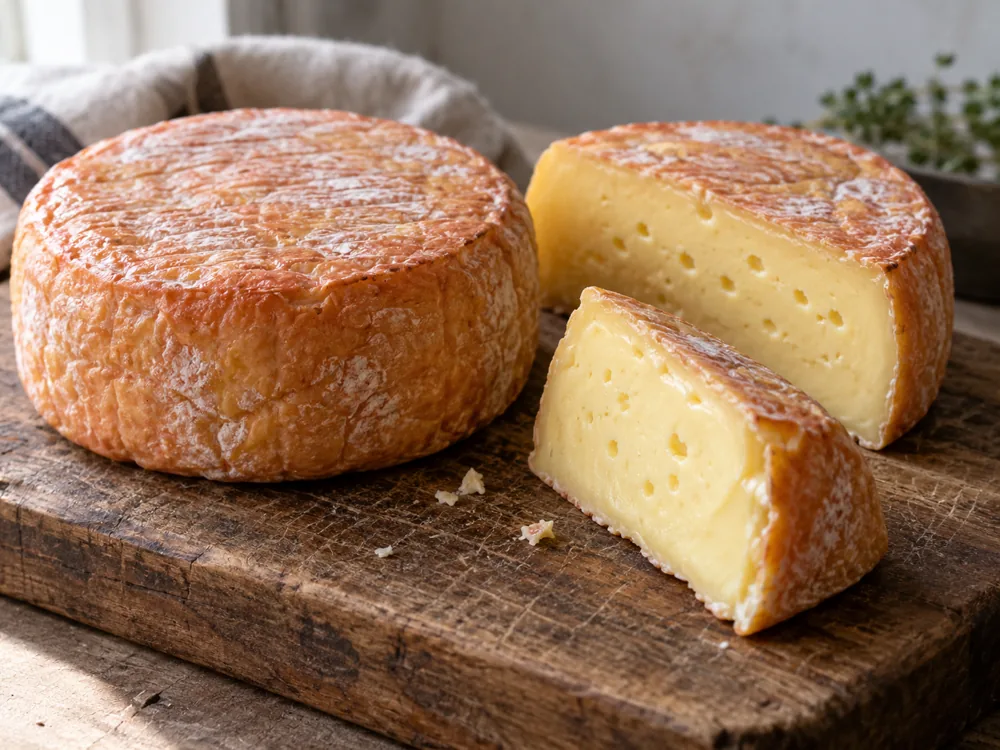
If you order a whole wheel, expect its weight to vary, from about 1,160 g to 3 lb (about 1.4 kg). A wheel measures 15 cm to 20 cm (6 to 8 in) across and 5 to 7.6 cm (2 to 3 in) high.
Where Can You Buy Gubbeen, and How Do You Store It?
As of October 2026, Neal's Yard Dairy sold Gubbeen in the UK, and Ardkeen and Sheridans Cheesemongers sold it in Ireland, at the sizes and prices below.
- Neal's Yard Dairy: quarter wheel 290 to 331 g at £13.00, half 580 to 662 g at £24.50, whole 1,160 to 1,324 g at £49.00.
- Ardkeen: 450 g at €11.50.
- Sheridans Cheesemongers: 170 g mini at €5.70, with 390 g and 1.5 kg portions also offered.
At home, Ardkeen's product page says to keep Gubbeen refrigerated between 0 and 4 degrees. Read as Celsius, the top of that range is about 39°F, just inside the CDC's advice to keep your refrigerator at 40°F or below.
If you leave a wedge out on a board, the CDC says to refrigerate perishable food, dairy included, within 2 hours, and within 1 hour if the food is exposed to temperatures above 90°F.
What Are the Nutrition Facts for Gubbeen?
Per 100 g, the Gubbeen that Sheridans sells has these nutrition figures.
- Energy: 271 kcal (1,130 kJ)
- Fat: 30.6 g, of which 20.5 g is saturated
- Carbohydrate: 0.8 g
- Protein: 21.1 g
- Salt: 0.769 g
Saturated fat, at 20.5 g, is about two thirds of the 30.6 g of fat. A 53 to 80 g portion, the size worked out from the serving guide above, comes to about 144 to 217 kcal, 11 to 17 g of protein and 0.4 to 0.6 g of salt.