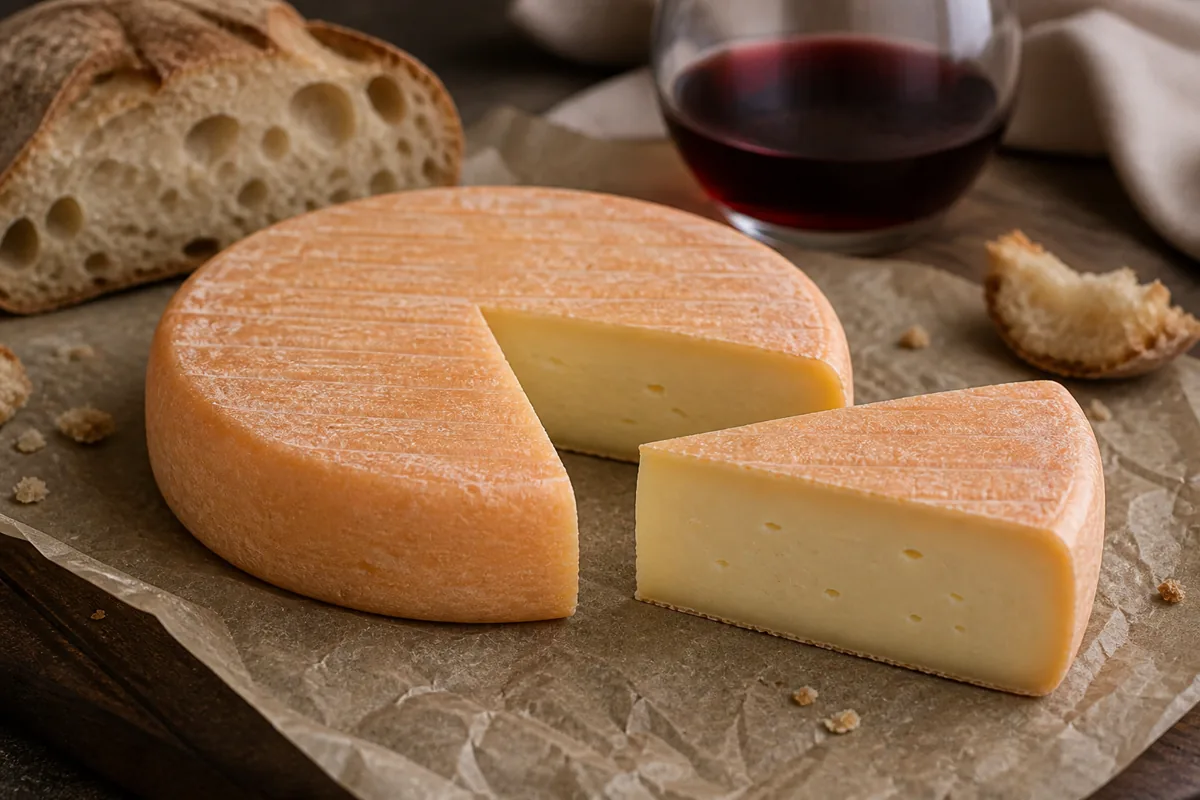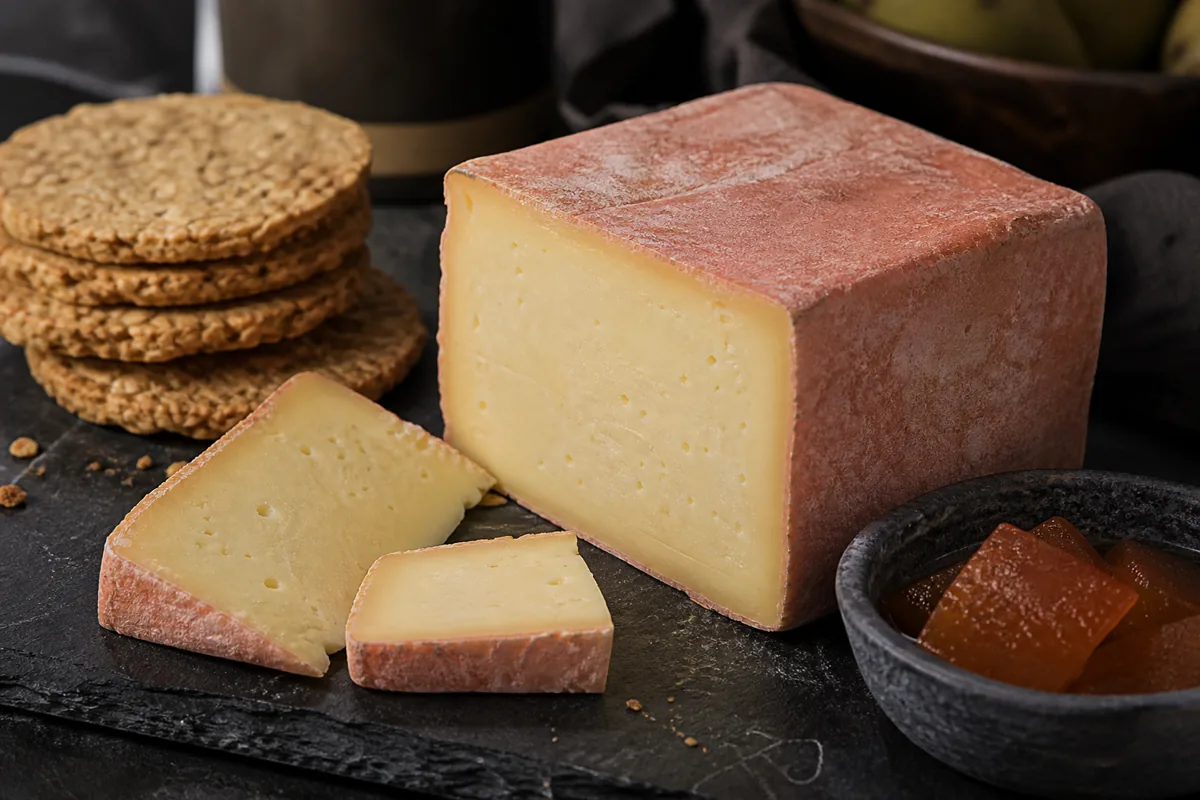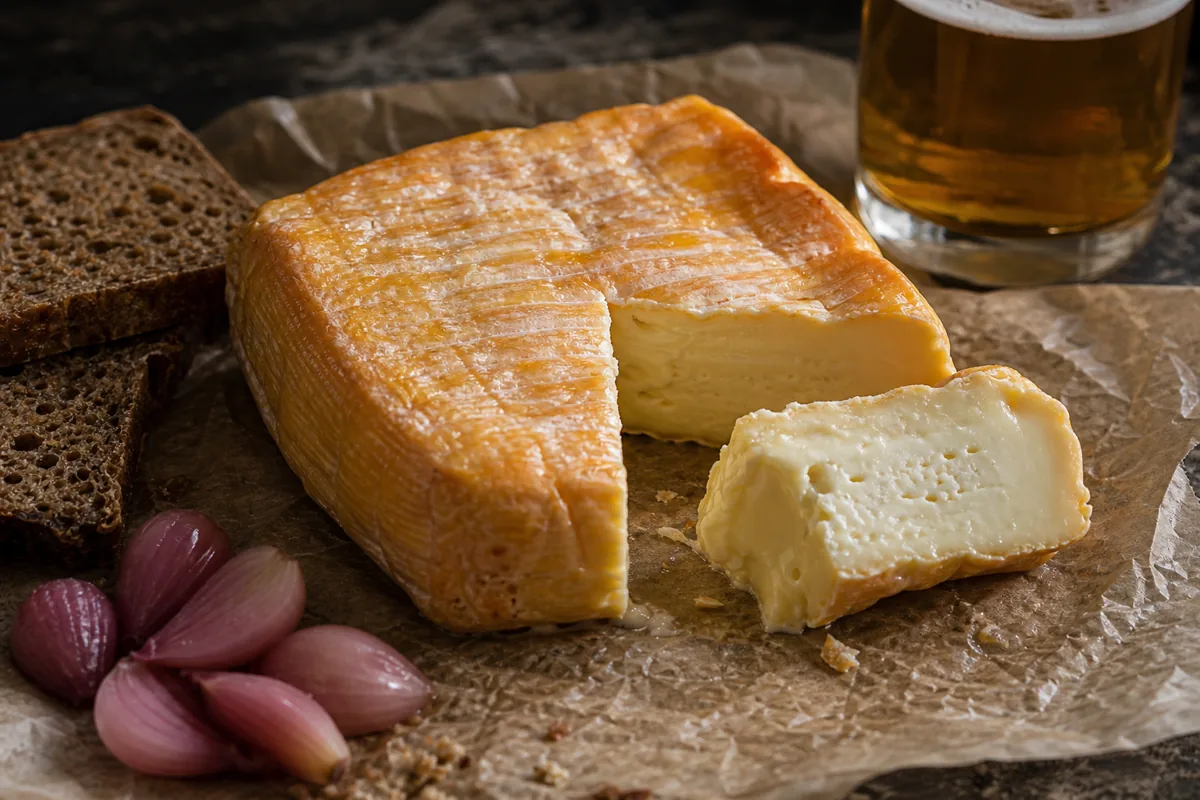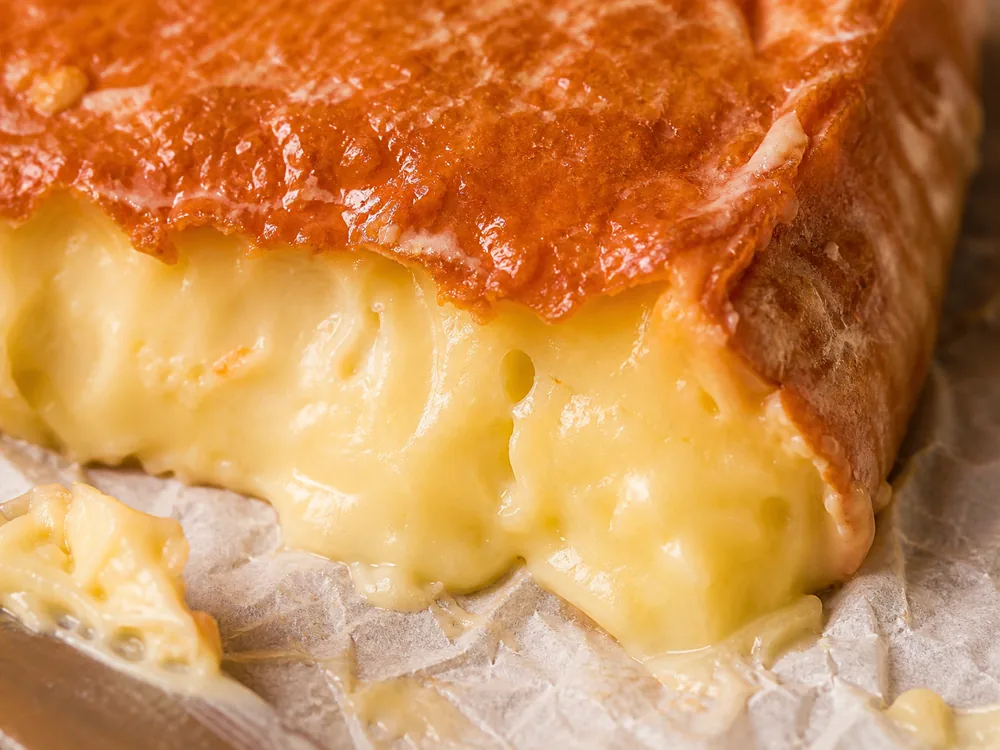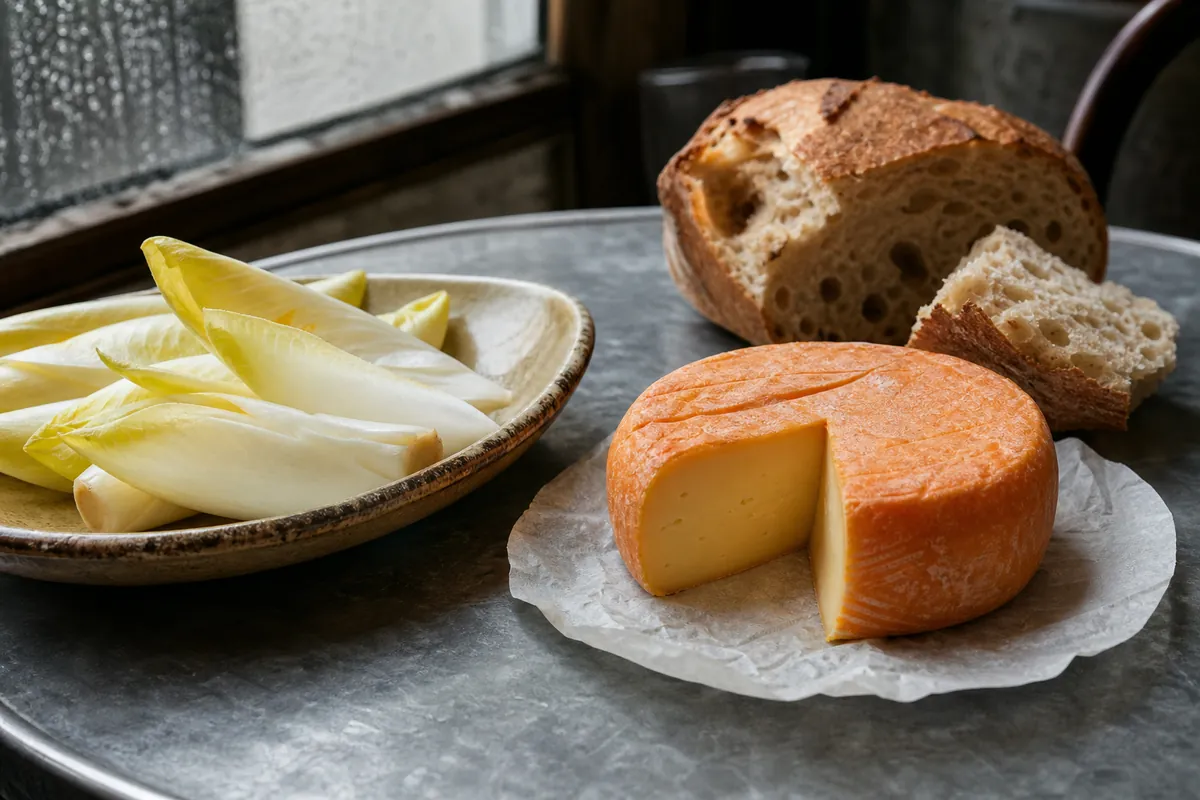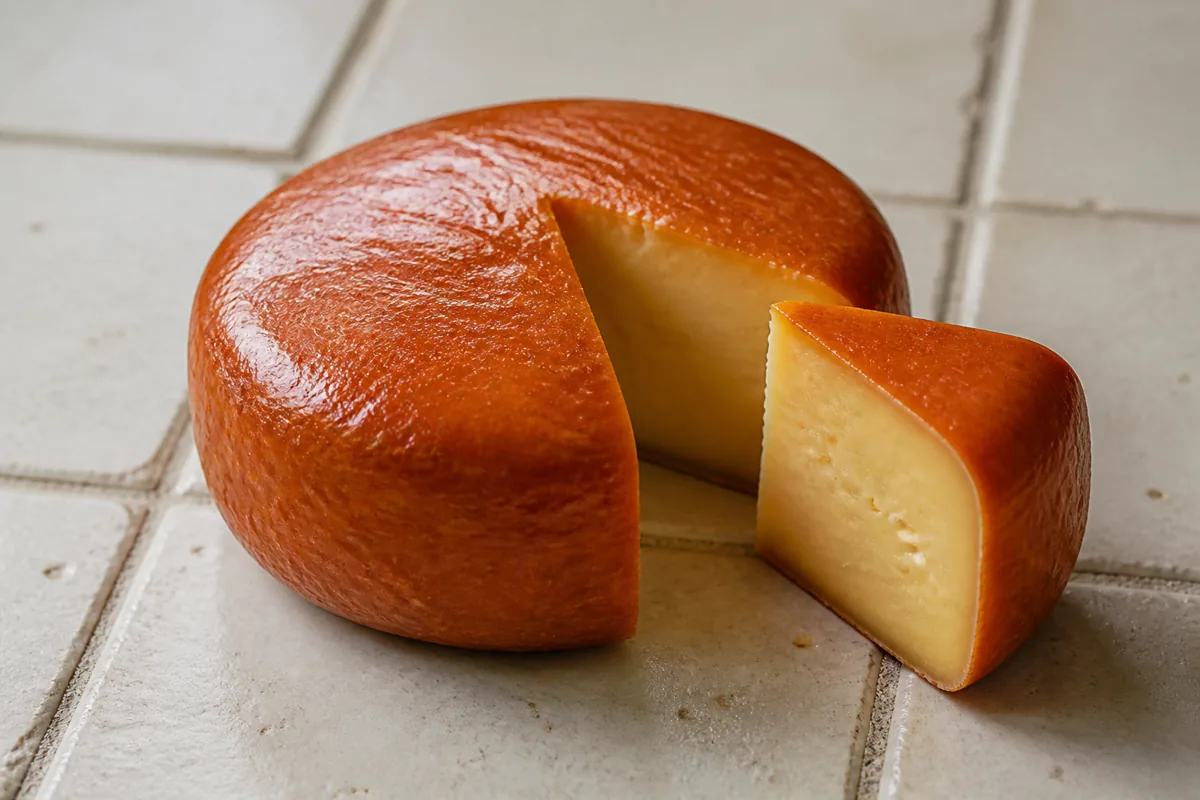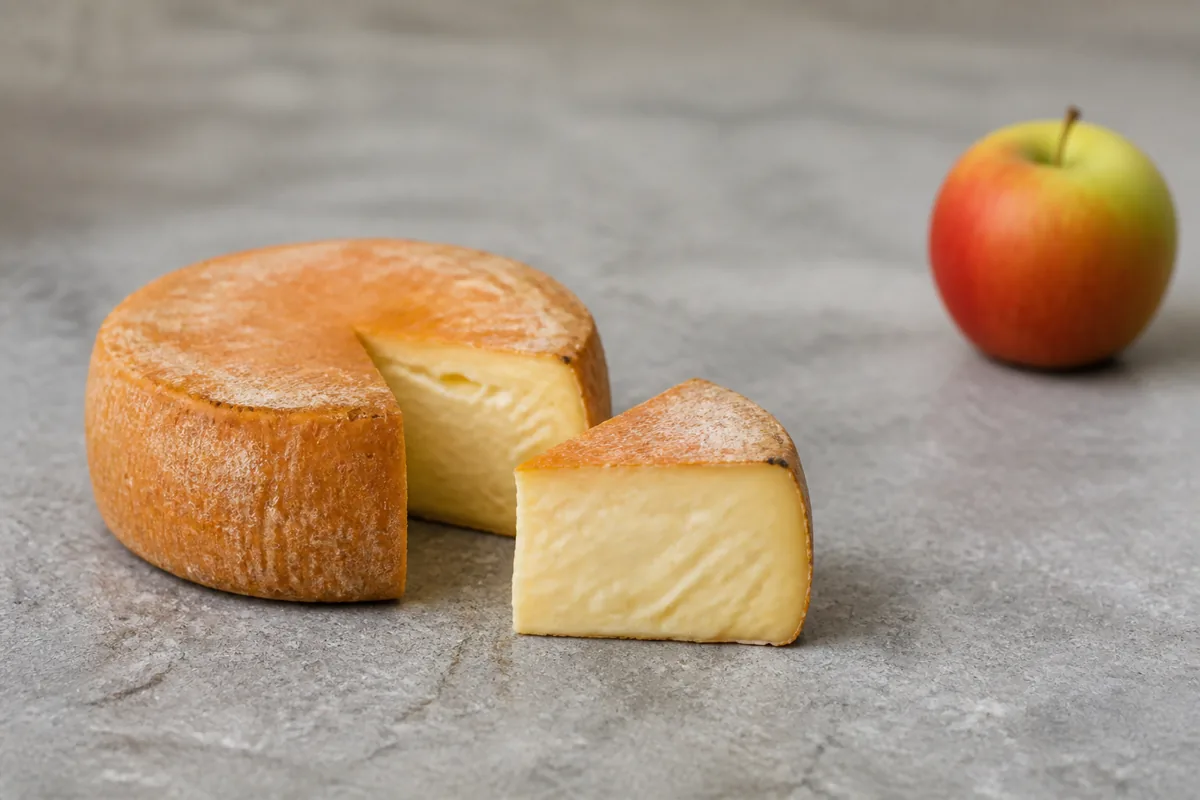
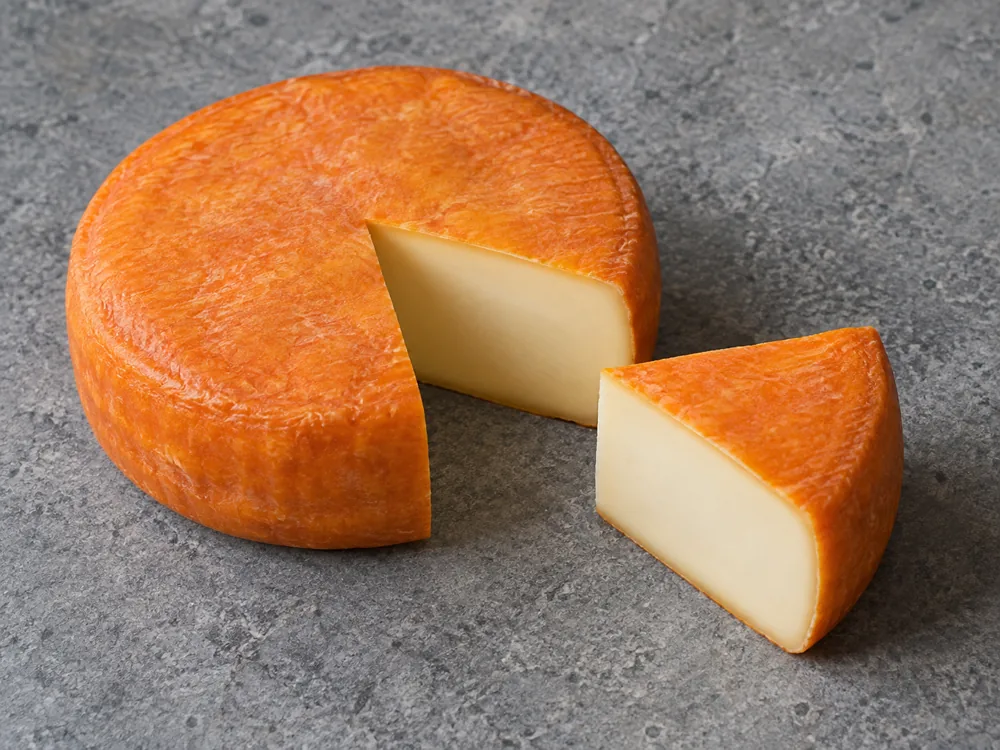
If you choose Keltic Gold, expect a Cornish cow's-milk cheese with a pungent orange rind and a creamy, sweet paste. The maker describes each wheel as dipped and scrubbed in local cider, which gives you the apple-toned character that separates it from the underlying Miss Muffet recipe.
You should not expect one tidy texture label. Sellers describe it as soft or semi-hard, but they agree more usefully on a smooth paste, a pronounced rind aroma and fruit in the flavour.
In This Article
Who Makes Keltic Gold and What Is It Based On?
Keltic Gold begins as Sue Proudfoot's Miss Muffet, then gains a cider-washed rind during maturation. The current Cheese Shed listing identifies Whalesborough Farm in Bude as the maker and sells the cheese in portions of a larger wheel.
Miss Muffet already has a sweet, supple character from its washed-curd make. The cider treatment changes the outside of that base cheese, so you get a creamy centre with a more aromatic rind rather than cider flavour distributed evenly through the paste.
A profile of cheesemaker Sue Proudfoot places the cheese in a related range that began with the firm Cheddar-style Trelawny and then Miss Muffet. Small changes in curd handling, additions and rind care create distinct cheeses from that shared foundation.
Proudfoot moved into a dedicated dairy near the family farm in 2009. The current producer address is Norton Barton Farm in Launcells, near Bude, so that is the location to use when you are checking provenance.
Retail references label Keltic Gold as pasteurised and vegetarian, and one secondary account names Trewithen Dairy as the milk supplier. These are useful shopping details, but they do not all appear on the maker's product page.
For that reason, check the current package if milk treatment or rennet matters to you. The available pages support the pasteurised label, but only the retailer supplies the vegetarian claim and no inspected page identifies the rennet.
Specialist retailers including Fortnum and Mason and Paxton and Whitfield have carried the cheese, although current stock can change.
How Is Keltic Gold Washed with Cider?
Each wheel is dipped and scrubbed in local cider three times a week. The retailer gives a five-week washing period, which would mean roughly 15 treatments if that schedule holds from start to finish.
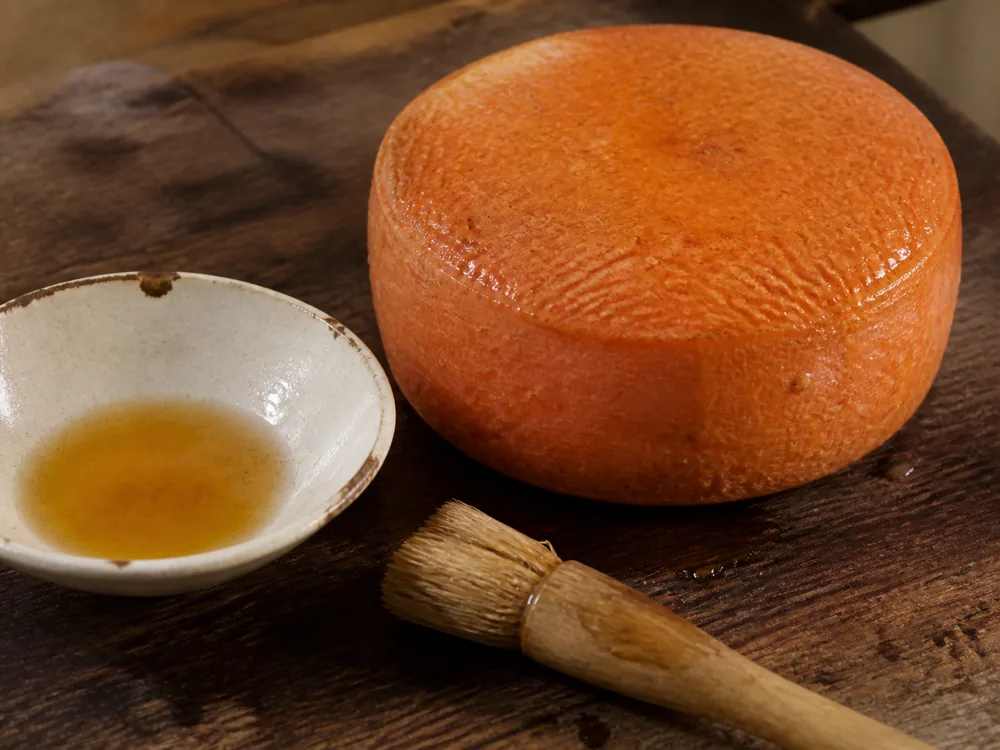
Repeated washing keeps the rind moist and encourages the surface community associated with washed-rind cheese. That is why the orange colour and pungent aroma belong mainly to the rind, even though the centre remains creamy and comparatively sweet.
Brevibacterium linens is often associated with reddish-orange smear rinds, but no culture list is published for Keltic Gold. The appearance fits the family; it does not prove which organism is present on a particular wheel.
This is repetitive, hands-on work rather than a one-time flavouring step. Regular treatment keeps the rind developing throughout the early maturation period.
The stable detail is that the cider is local, not that one supplier has always provided it. Older accounts name Countryman Cider or Cornish Orchards, so you should not turn either name into a permanent specification.
A 2016 local report names Cornish Orchards, while the retailer names Countryman Cider. You can rely on local cider as the stable fact, but the named supplier may have changed or one account may be out of date.
No inspected record gives the alcohol content of the wash or the finished cheese. One reference loosely glosses the cider as unfiltered apple juice, but that wording is not supported by the maker and should not be used to infer that the wash is alcohol-free.
Keltic Gold matures in a separate room so its surface culture does not mingle with the rest of the range. Neither the maker nor the retailer publishes the age at sale, so the rind colour cannot tell you an exact number of weeks.
How Does Keltic Gold Differ from Miss Muffet?
Miss Muffet gives Keltic Gold its sweet, supple foundation. The cider-washed version keeps that creamy centre but adds a pungent surface and apple-toned finish.
| Miss Muffet | Keltic Gold |
|---|---|
| Washed curd, continental style | A Miss Muffet with a rind washed in cider |
| Supple texture | Creamy, smooth texture |
| Sweet, nutty, creamy flavour | Round, full, sweet flavour with apple overtones |
| No aroma or rind description on the page | Pungent washed rind and an edible orange rind |
Sweetness appears in both descriptions. The Cheese Shed credits Miss Muffet's washed-curd process with the sweet, supple cheese, while Whalesborough credits the cider with the apple overtones and the orange rind.
That distinction helps when you are choosing between them: pick Miss Muffet for a gentler profile and Keltic Gold when you want the rind aroma to lead.
The two washes act on different things. The washed-curd process belongs to making Miss Muffet, and the cider goes onto the rind of a Miss Muffet over five weeks, so a description that says only "washed" does not show which step is meant.
Miss Muffet has its own award history, including Best Modern Cheese at the 2013 Nantwich International Cheese Show. Those honours belong to the base cheese and should not be transferred to Keltic Gold.
The wider range shows how one production change can redirect a related recipe. Cornish Crumbly, for example, leaves the curd undisturbed to create a chalkier young Lancashire-style cheese.
Cornish Smuggler changes the visual result instead, with annatto added after the curds begin to form and a marbled pattern appearing in the cut paste.
Across the seven-cheese range, Keltic Gold is the only product presented with a washed rind. That makes the cider treatment its defining production choice, not a decorative detail shared by every Whalesborough cheese.
Whalesborough calls Keltic Gold its best seller.
What Does Keltic Gold Taste and Smell Like?
You can expect a creamy paste, fruit around the flavour and a rind with a stronger aroma than the centre. The remaining disagreement is mainly vocabulary: some sellers call the texture soft, while others place it in the semi-hard range.
| Source | Texture | Flavour and aroma | Paste colour |
|---|---|---|---|
| Whalesborough (maker) | Creamy, smooth | Pungent washed rind, round full sweet flavour, apple overtones | Not stated |
| The Cheese Shed (retailer) | Soft | Pungent, earthy | Not stated |
| Cheese.com (reference) | Semi-hard, creamy and smooth | Creamy, fruity flavour; fruity aroma | Straw |
The table shows why both impressions can be true. Pungent describes the washed surface, while apple, fruit and sweetness describe what you notice in the paste and finish.
No measured intensity or standard tasting scale sits behind these words. The maker's comparison with French Alpine cheese is best read as a broad flavour cue, not as a claim that Keltic Gold follows an Alpine specification.
That comparison names a family of cheeses but leaves open whether it means the aroma, the sweetness or the texture. Inside its own description, pungent belongs to the washed rind cheese while sweet and apple belong to the flavour on the palate, so the maker uses the two words for different things.
On texture the words run from soft (The Cheese Shed) to semi-hard (Cheese.com and Wikipedia), and the maker uses neither.
A washed rind does not tell you how firm the centre will be, since the family ranges from soft cheeses to hard Appenzeller. Let the cut texture and age of the wheel guide you instead.
The soft versus semi-hard split may come from age, individual wheels or simple category conventions, and the available pages do not settle it. If texture matters for a dish, ask how yielding the current cut is rather than relying on the category word alone.
Can You Eat Keltic Gold's Rind?
Yes. The maker calls the orange rind edible, so you can taste it with the paste and decide whether its stronger aroma suits you.
Whalesborough calls the cheese pungent without separating the rind from the paste.
Because the claim originates with the maker, it tells you the rind is intended for eating rather than whether every diner will enjoy its pungency.
Which Awards Has Keltic Gold Won?
The strongest recurring award claim is a Super Gold at the 2012 World Cheese Awards. Secondary records also list results at the 2011 Nantwich show and Great Taste Awards in 2011 and 2013.
| Year | Competition | Wikipedia | Cheese.com |
|---|---|---|---|
| 2011 | Great Taste Awards | Two Star Gold | Gold |
| 2011 | Nantwich International Cheese Show (Speciality Cheese) | Gold | Listed, level unrecorded |
| 2011 and 2012 | British Cheese Awards | Gold | Not listed |
| 2012 | World Cheese Awards | Super Gold | Super Gold |
| 2013 | Great Taste Awards | 2 Star Gold | Gold |
| 2013 | British Cheese Awards | Silver | Not listed |
| 2014 | Great Taste Awards | Not listed | Gold |
| 2014 | World Cheese Awards | Not listed | Super Gold |
The records diverge after 2013, with one adding 2014 honours and another ending with a 2013 British Cheese Awards silver. Read the table as an assembled historical record rather than a complete official roll.
Keltic Gold also reached the final four in its category at the 2016 Great British Cheese Awards. More than 7,500 public votes narrowed the field before a panel judged the leading producers and retailers.
The contemporary report mentions a Great Taste result and record summer sales without stating the medal level, so neither detail belongs in the awards table as a precise result.
The awards show the cheese's track record by year and do not grade a wedge in a shop.
Is Keltic Gold Safe in Pregnancy?
The retail and reference listings describe Keltic Gold as pasteurised, but the milk treatment is not on the maker's product page. Check the current pack because the label in your hand is more useful than an undated secondary listing.
The NHS guidance lists pasteurised semi-hard cheeses and pasteurised soft cheeses as safe to eat and says foods made from unpasteurised milk must be thoroughly cooked. Keltic Gold has an orange rind rather than the white coating in the NHS mould-ripened warning, and sellers call it soft or semi-hard, two classes the NHS lists as safe to eat when pasteurised.
The CDC safer-choice table lists pasteurized soft cheeses heated to an internal temperature of 165°F or until steaming hot as safer and soft cheese made from unpasteurized (raw) milk as riskier. Served cold, Keltic Gold is described as a pasteurized soft or semi-hard cheese, a type the CDC list does not cover, so ask a midwife or doctor.
What Sizes and Prices Does Keltic Gold Come In?
A whole wheel is listed at about 1.3 kg, with portions down to one sixth. That range lets you buy a tasting piece without committing to a large washed-rind wheel.
| Portion | Weight | Price | Price per 100 g |
|---|---|---|---|
| Sixth | About 212 g | £13.63 | £6.43 |
| Quarter | About 325 g | £20.89 | £6.43 |
| Half | About 650 g | £41.79 | £6.43 |
| Whole | About 1.3 kg | £83.58 | £6.43 |
The price per 100 g in the last column is our calculation from the listed prices and approximate weights. It is the same across these four portions, so a larger piece gives no discount and a smaller one costs no premium.
A sixth of the 1.3 kg wheel works out to about 217 g, a little above the listed 212 g. The listing calls every weight "around", so a portion cut from a wheel can differ from the figure on the page.
The page also lists a sample at £3.50 with no weight, so no price per 100 g can be worked out for it. Retailer prices change, so treat these figures as the October 2026 listing.
The producer also offers a ready-made cheeseboard with roughly 150 g slices of five cheeses. You need to confirm the selection when ordering because the page does not guarantee that Keltic Gold is included.
Because the listed unit price is the same across the four portions, buy the amount you can serve while it is in good condition. The larger piece does not provide a published discount.
Every portion costs about £6.43 per 100 g, so the choice of size depends on how much cheese you want to keep.
How Should You Store Keltic Gold?
No product-specific storage period is published, so the date and instructions on your pack are the practical limit. General cheese storage can help with wrapping, but it cannot create a Keltic Gold shelf life that the maker has not supplied.
CDC advises keeping a refrigerator at 40°F (about 4°C) or below.
What Else Do Buyers Ask About Keltic Gold?
The maker describes apple overtones rather than the cheese tasting like a glass of cider. Because the cider is used on the rind, you should expect its effect around the aromatic orange surface more than as a uniform flavour through the paste.
Yes. Whalesborough describes the orange rind as edible, although you may trim it if its pungency is stronger than you enjoy.
It starts from the Miss Muffet cheese, but repeated cider washing changes the rind, aroma and surface flavour. Treat it as a related cheese with a distinct maturation step rather than a simple relabelled wedge.
Whalesborough makes it near Bude in Cornwall, England. Current retail availability and price can change, so check the producer or a specialist British cheese shop before planning around a particular size.