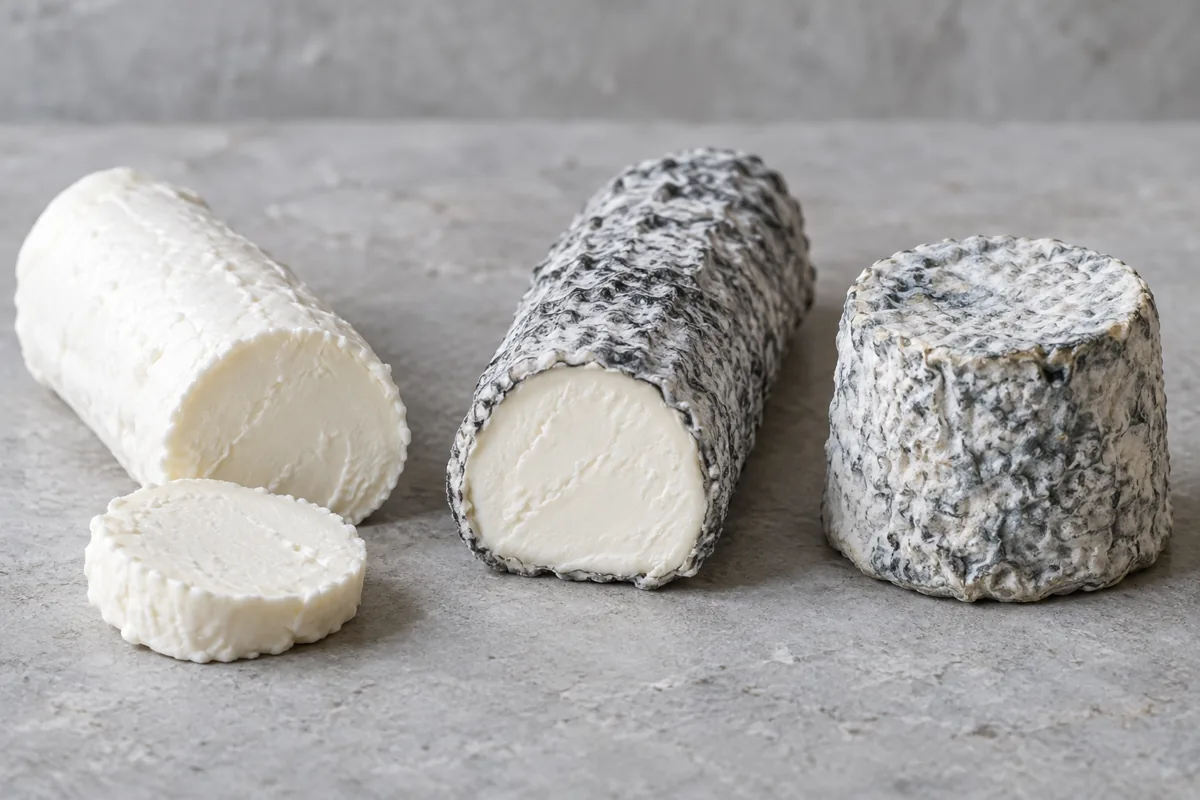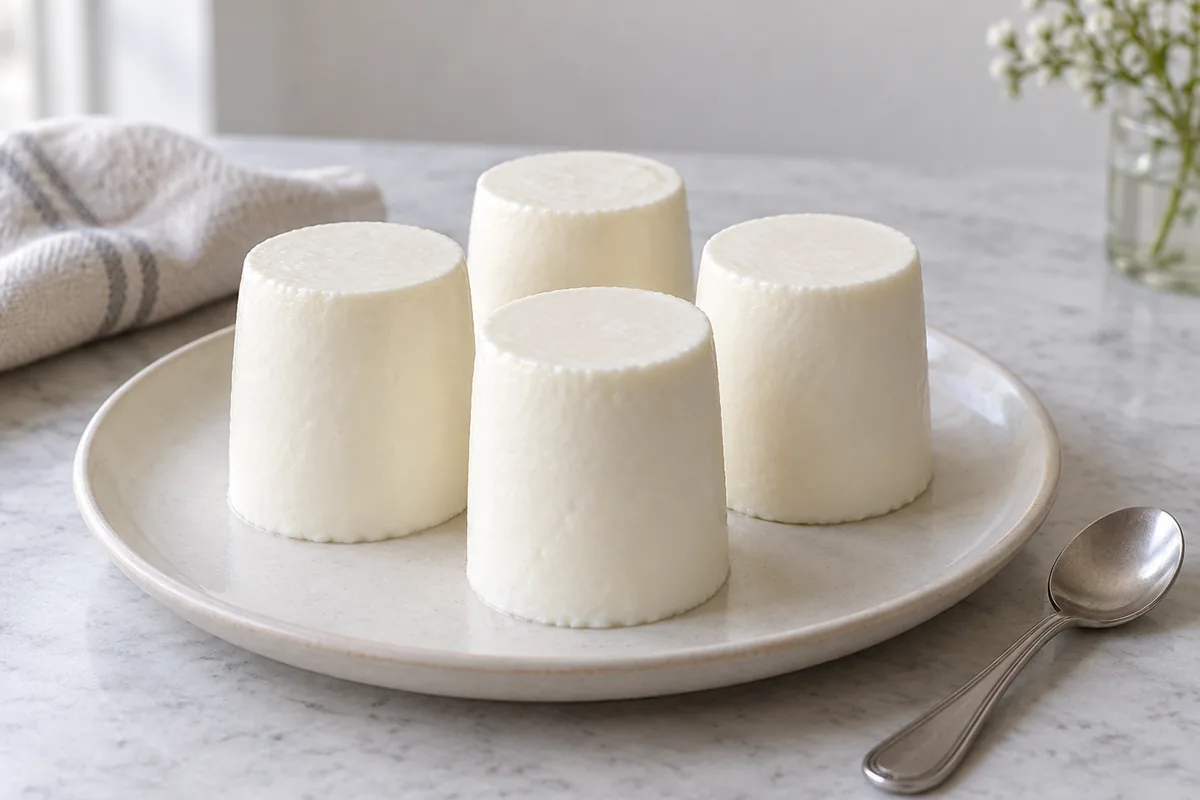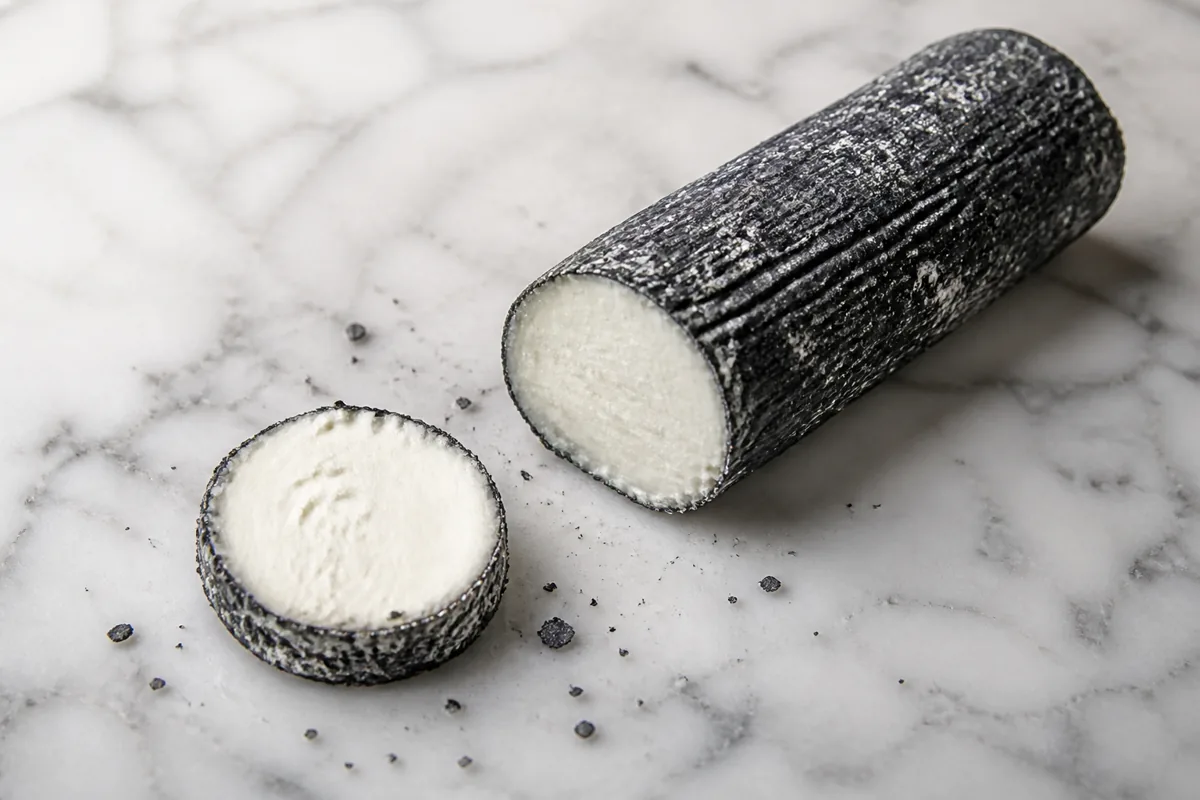
Kidderton Ash is a 150-gram goat's cheese log from Butlers Farmhouse Cheeses, rolled in food ash before it matures under a furry, speckled coat.
Butlers describes a bright white, silky-smooth log, and Pong Cheese says a silky white mould coat blooms through the ash.
In This Article
What Is Kidderton Ash Cheese?
Butlers says the milk comes from its goat herd at Throstle Nest Farm, travels a few miles to the dairy, and is pasteurised and made into Kidderton Ash the same day.
The maker lists the cheese as suitable for vegetarians, with goat's milk as its allergen. It won Silver in the Non Traditional Soft Cheese class at the 2021 International Cheese & Dairy Awards.
Great British Chefs calls it a log with a delicate creamy flavour and a good alternative to brie in cooking.
Great British Chefs says the Butlers family has made cheese in Lancashire since the 1930s, and it lists Inglewhite and Beacon Blue as the maker's other goat's cheeses.
Where Is Kidderton Ash Made?
Butlers states that Kidderton Ash is handmade in Lancashire, and Great British Chefs places the making at Wilson Fields Farm.
Two sellers describe it differently. Pong Cheese says Butlers makes it at Ravens Oak Dairy in Nantwich, Cheshire, while The Cheese Society says Cheshire and lists an unpasteurised, dome-shaped cheese.
| Source | Where it says it is made | Milk treatment | Shape and size | Price listed on 1 October 2026 |
|---|---|---|---|---|
| Butlers Farmhouse Cheeses | Handmade in Lancashire | Pasteurised | Log, 150 g | £5.00 |
| Great British Chefs | Wilson Fields Farm | Not stated for this cheese | Log | Not listed |
| Pong Cheese | Ravens Oak Dairy, Nantwich, Cheshire (by Butlers) | Not stated | Log, about 150 g | £6.95 |
| The Cheese Society | Cheshire | Unpasteurised | Dome, about 150 g | £10.99 |
The maker's claim covers more than this one cheese. Butlers says all of its cheeses are handmade in its farmhouse dairy in rural Lancashire, and Great British Chefs says all of the cheese is made exclusively at the family dairy, though the same feature places Kidderton Ash at a farm.
Great British Chefs also names Ravens Oak as one of Butlers' soft cheeses, so the Ravens Oak Dairy that Pong Cheese gives shares its name with a Butlers cheese.
On milk, Great British Chefs agrees with the maker: its feature says Butlers' milk travels only a few miles before it is pasteurised and made into cheese. The Cheese Society's unpasteurised label stands alone against both.
Butlers makes the cheese, so its pages are the primary record of where and how it is made. The Cheese Society's unpasteurised label conflicts with them on the detail that matters most for pregnancy, which is why the wording on the pack in your hand is the final check.
Per 100 g, the listed prices work out, by our arithmetic, at £3.33 at Butlers (£5.00 for 150 g), £4.63 at Pong Cheese (£6.95 for about 150 g) and £7.33 at The Cheese Society (£10.99 for about 150 g). Delivery is extra, and free delivery starts at £40 at Butlers, £50 at Pong Cheese and £60 at The Cheese Society, so a single log reaches none of those thresholds.
Butlers, the maker, describes a pasteurised 150 g log made in Lancashire, while The Cheese Society lists an unpasteurised dome. The three sellers price it from £3.33 to £7.33 per 100 g.
Why Is Kidderton Ash Rolled in Ash?
Butlers rolls the formed cheese in ash before maturing it, and says the ash helps a distinctive rind develop, gives the contrasted, speckled look and helps contain a flavour that keeps developing.
Pong Cheese names the mould. It says young cheeses are dipped in brine and then in Penicillium to create the white mould coating.
Pong Cheese adds that cheesemaker Katy Hollinshead dusts the moulds with food ash and leaves the cheeses to ripen slowly, and The Cheese Society says each cheese is hand-rolled into a dome and coated.
Butlers, Pong Cheese and The Cheese Society all describe the ash going on before the white coat shows through it, but none gives the order of the ash, the brine and the Penicillium dip.
The general reason comes from cheesemaking suppliers rather than from Butlers. The New England Cheesemaking Supply Company says ash is alkaline, lowers the surface acidity of a goat's cheese and lets white mould (Penicillium candidum) develop more quickly while keeping its activity from becoming excessive.
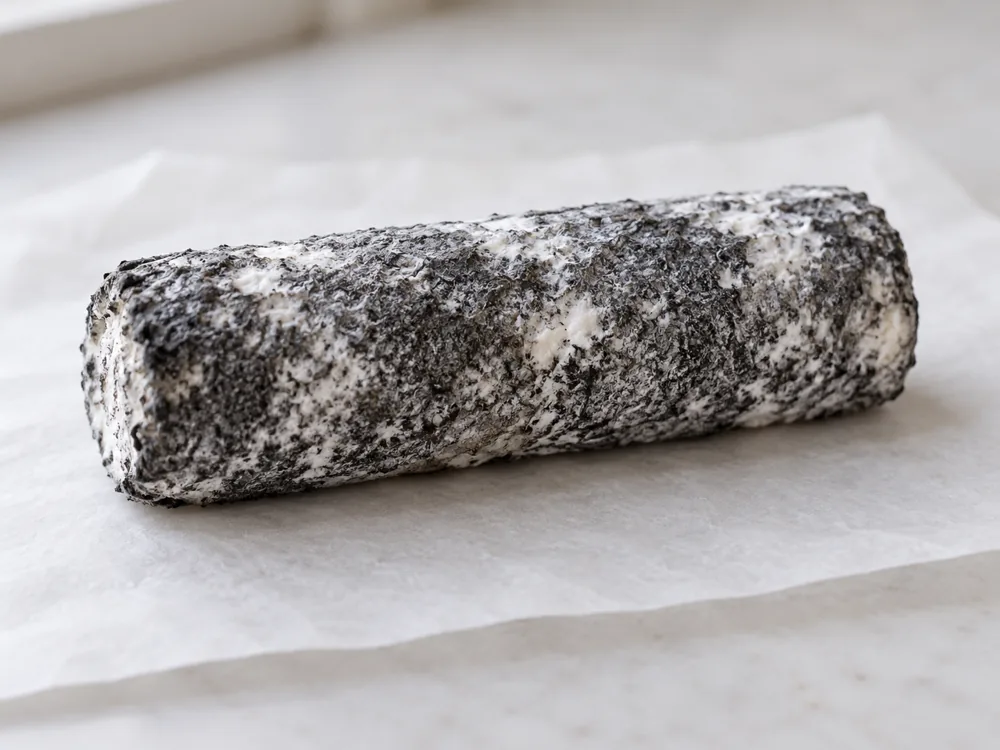
Butlers credits the ash with enriching mineral notes, and Great British Chefs says its flavour subtly comes through in the cheese. Butlers also compares charcoal ash to an oak barrel in whisky, saying it defines what the cheese is.
Why Are Most Ash-Coated Cheeses Made From Goat's Milk?
The New England Cheesemaking Supply Company says most ash-covered cheeses are goat's milk because these cheeses are lactic in style, with very soft surfaces and weak bodies.
Rubbing, brushing and oiling, which suit firmer natural-rind cheeses, do not work on such fragile surfaces, so the usual treatment is a natural mould cover, either a mixed natural rind or the bloomy white kind. The supplier adds that this style develops a high level of acid and that white mould is slow to grow in it, which is the problem the ash answers.
The supplier separates three materials: ash, the mostly alkaline salt left when vegetable matter burns in open air, and charcoal, mostly porous carbon formed when the burn gets limited air. The third is activated charcoal, treated to have finer pores so it absorbs more, and the supplier says the surface coat today is normally activated charcoal mixed with salt.
The Kidderton Ash sellers use looser words, with Butlers and Great British Chefs saying charcoal ash and Pong Cheese saying food ash, and none states which of the three materials it is.
The supplier traces the practice to the time before wax and plastic wraps, when a coat of fine grey ash discouraged flies and dust from settling and dried the surface a little, making it less welcoming to unwanted growth. In the Loire Valley, it adds, the ash once came from burned grapevine clippings.
Selles-sur-Cher is the supplier's example of a young cheese ripened under a layer of ash, and Sottocennere, buried in ash in terracotta pots for months, is its Italian one.
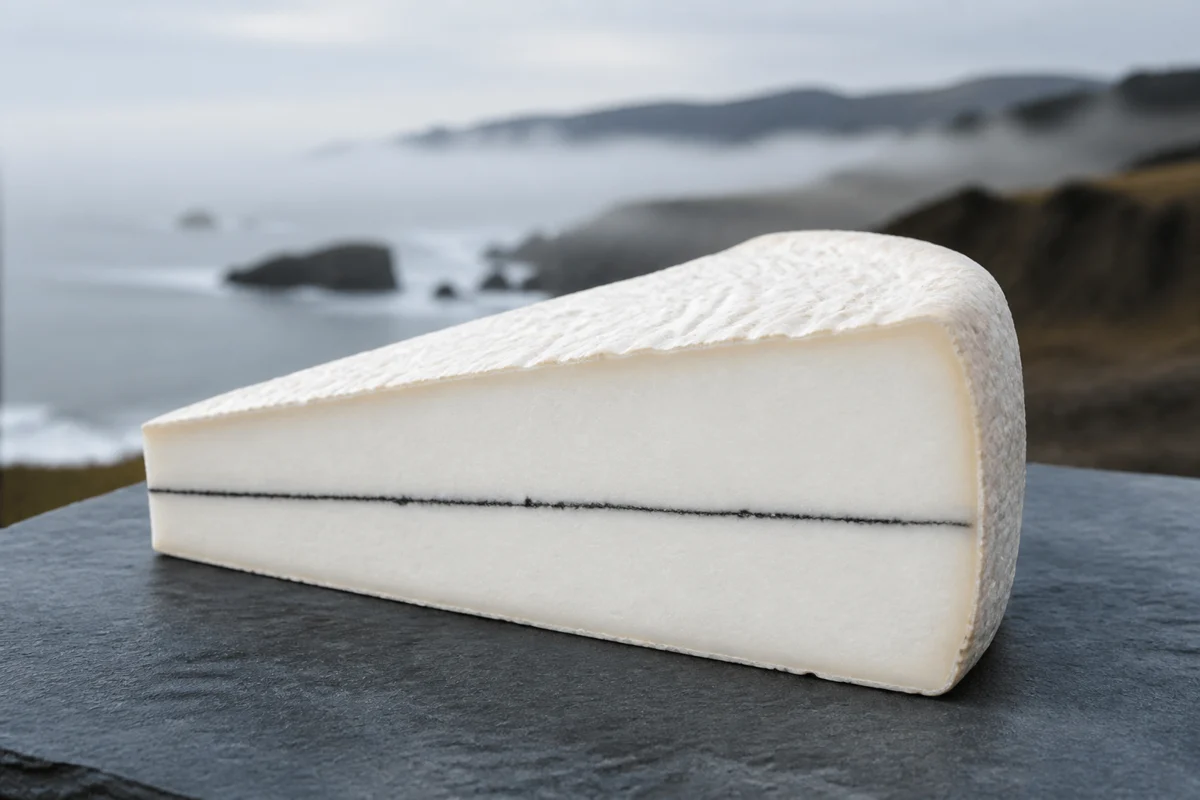
Morbier is the supplier's contrast: its black line through the middle began as carbon from blackened vats, rubbed onto the surface of a half-filled mould between milkings, and the commercial line now serves no functional purpose.
What Does Kidderton Ash Taste Like?
The maker and sellers describe a mild, creamy goat's cheese. Butlers calls it silky-smooth, Great British Chefs gives a delicate creamy flavour, and Pong Cheese calls it mild.
A comment quoted beside Butlers' tasting video says the milk is fresh enough to avoid the "goaty" taste people associate with goat's cheese in the 1980s, with a sweetness that gives way to an intense, deep flavour at the back.
The Cheese Society describes a pure white paste with a creamy texture and a gentle, clean flavour that grows more complex with age, and it adds subtle citrus notes and a mellow nuttiness. That is a retailer's description, and the Butlers pages do not repeat it.
How Does Kidderton Ash Change as It Ripens?
Butlers says Kidderton Ash only gets creamier with each day, and Great British Chefs says the same as the cheese matures.
Culture magazine explains that surface-ripened cheeses ripen from the rind inward, and that a bloomy-rind cheese starts semi-firm and softens from the rind inward as it ages until it is quite soft and gooey.
Culture adds that the flavour of a bloomy-rind cheese eventually becomes earthy and mushroomy, while the sellers call Kidderton Ash mild and creamy.
The Cheese Society gives an age of 4 to 5 weeks or more.
Culture describes a different group of goat's cheeses, ripened with Geotrichum candidum, with wrinkly, brain-like rinds, a chalky centre and a creamy line just under the rind, as in Bijou and crottin.
Butlers calls the coat of Kidderton Ash furry and speckled and Pong Cheese names Penicillium, which puts the log with the velvety bloomy rinds.
Can You Eat the Ash and Rind on Kidderton Ash?
The Cheese Society calls the ash on Kidderton Ash edible and says it develops into a silvery grey rind as the cheese matures.
For pregnancy, see the section below.
How Do You Serve Kidderton Ash?
Butlers and Great British Chefs both serve it in thin slices, and Great British Chefs ties that to the log shape, which it says suits cutting slices to place on crackers.
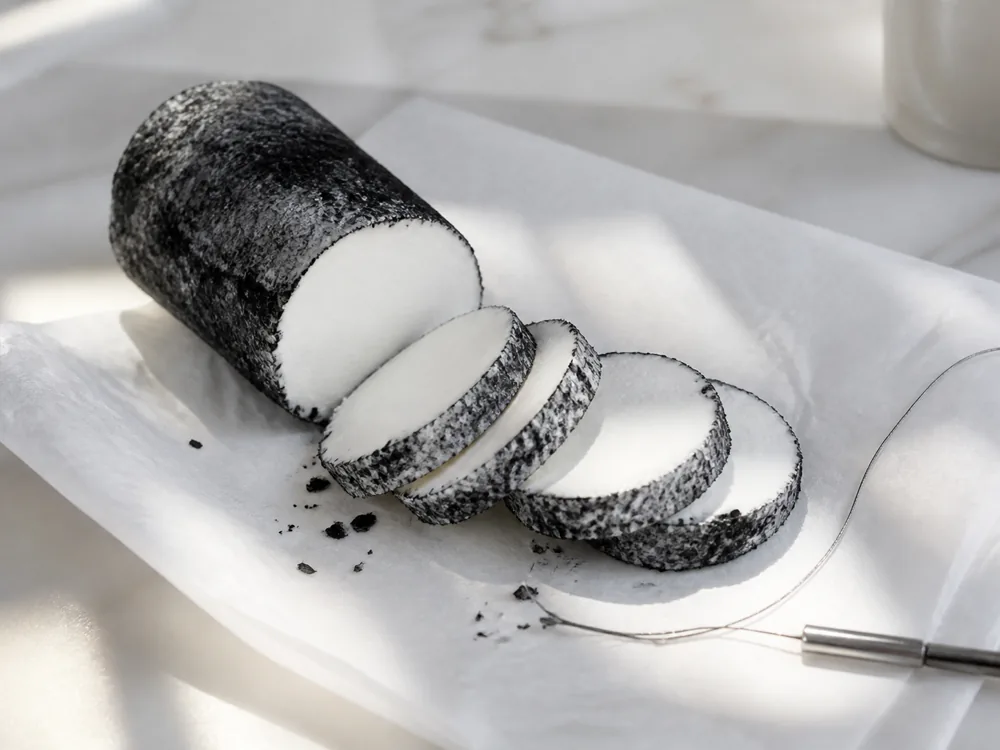
Butlers and Great British Chefs name three servings.
- Butlers: thin slices on black charcoal crackers with a slither of ripe fig, for canapés or a snack.
- Butlers: walnuts and beetroot on a warm salad, a pairing one of its staff enjoys.
- Great British Chefs: figs baked in pomegranate molasses with mint, in a recipe by Helen Graves.
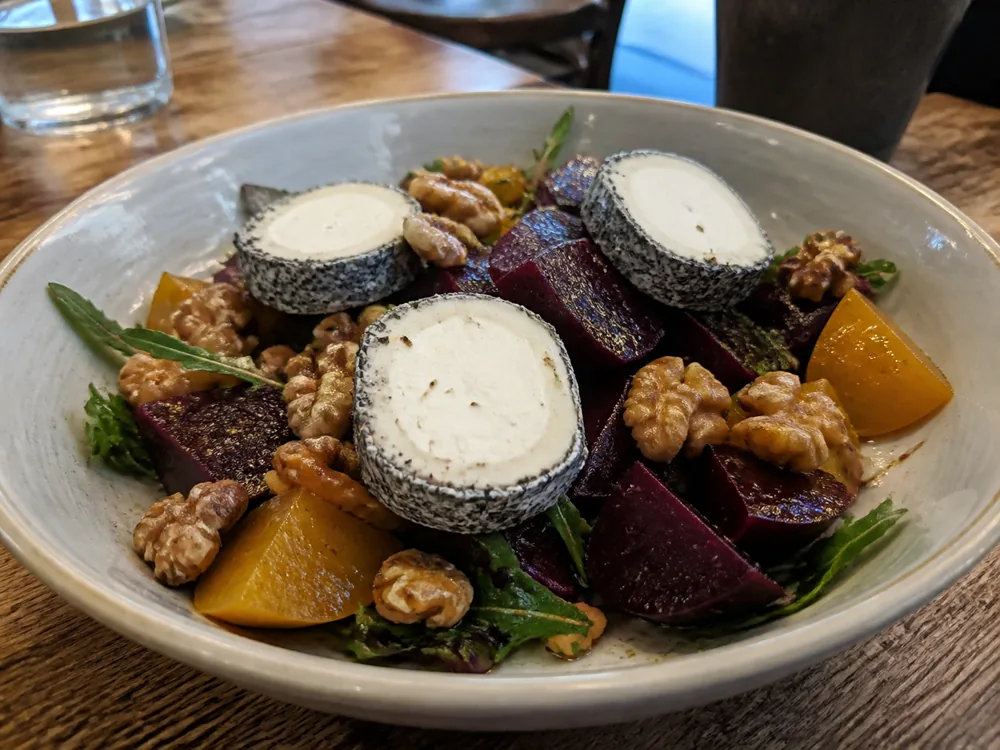
Pong Cheese's recipe notes, which cover goat's cheese in general rather than this log, also say earthy beetroot works perfectly with creamy goat's cheese.
Fig appears in the most suggestions: ripe fig with Butlers, baked figs from Great British Chefs, and fresh or dried figs and fig chutney from The Cheese Society, which makes it the clearest pairing pattern.
| Pairing | Why It Works |
|---|---|
| Smoked almonds | The Cheese Society's cheesemonger Pam tops slices of the log with them. |
| Fresh or dried figs | Called particularly good by The Cheese Society with a drizzle of honey and some thyme. |
| Fig chutney | Listed by The Cheese Society among the items perfectly paired with the cheese. |
| Quince paste | Also on The Cheese Society's pairing list. |
Can You Eat Kidderton Ash When Pregnant?
The NHS says pasteurised or unpasteurised mould-ripened soft cheeses with a white coating on the outside, such as brie, camembert and chèvre, must be thoroughly cooked.
The NHS lists goats' cheese without a white coating (rind) on the outside among the pasteurised soft cheeses that are safe to eat. Great British Chefs describes a fuzzy white rind on Kidderton Ash and Pong Cheese a white mould coat, so the white-coating line above is the NHS line that applies to it.
The NHS also says any cheese cooked until steaming hot is fine, including soft cheese. The CDC lists soft cheese made from unpasteurized (raw) milk as a riskier choice, and pasteurized soft cheeses heated to an internal temperature of 165°F or until steaming hot as a safer one.
Served cold, a pasteurised Kidderton Ash is described as a pasteurized soft goat's cheese with a white mould coat, a type the CDC list does not cover, so ask a midwife or doctor.
How Much Kidderton Ash Do You Need?
The Cheese Society's guide for a cheeseboard serving six allows 40 to 60 g of each cheese per person, with three or four cheeses at around 250 g each.
A log of about 150 g covers between 2.5 and 3.75 of those portions by our arithmetic, so a board for six needs two logs, about 300 g, to reach the 240 to 360 g that six portions add up to.
The same seller says all its cheeses are cut by hand and the weights it lists are approximate, and it gives this log as approximately 150 g.
What Are the Nutrition Facts for Kidderton Ash?
Butlers' product page lists per 100 g: 1372 kJ (331 kcal), 27.8 g fat of which 18.5 g saturates, 20.1 g protein, 0.1 g carbohydrate and 1.2 g salt.
Scaled from those per-100 g figures, a 40 to 60 g portion and a whole 150 g log come to the amounts below; the arithmetic is ours, and the weights are the sellers' approximations.
| Amount | Energy | Fat | Saturates | Protein | Salt |
|---|---|---|---|---|---|
| 40 g portion | 549 kJ / 132 kcal | 11.1 g | 7.4 g | 8.0 g | 0.48 g |
| 60 g portion | 823 kJ / 199 kcal | 16.7 g | 11.1 g | 12.1 g | 0.72 g |
| Whole 150 g log | 2058 kJ / 497 kcal | 41.7 g | 27.8 g | 30.2 g | 1.8 g |
How Should You Store Kidderton Ash?
The Cheese Society says to keep it in the fridge wrapped in the waxed paper or packaging it arrives in, and to avoid plastic wrap because cheese needs to breathe.
The CDC says to keep a refrigerator at 40°F (about 4°C) or below.