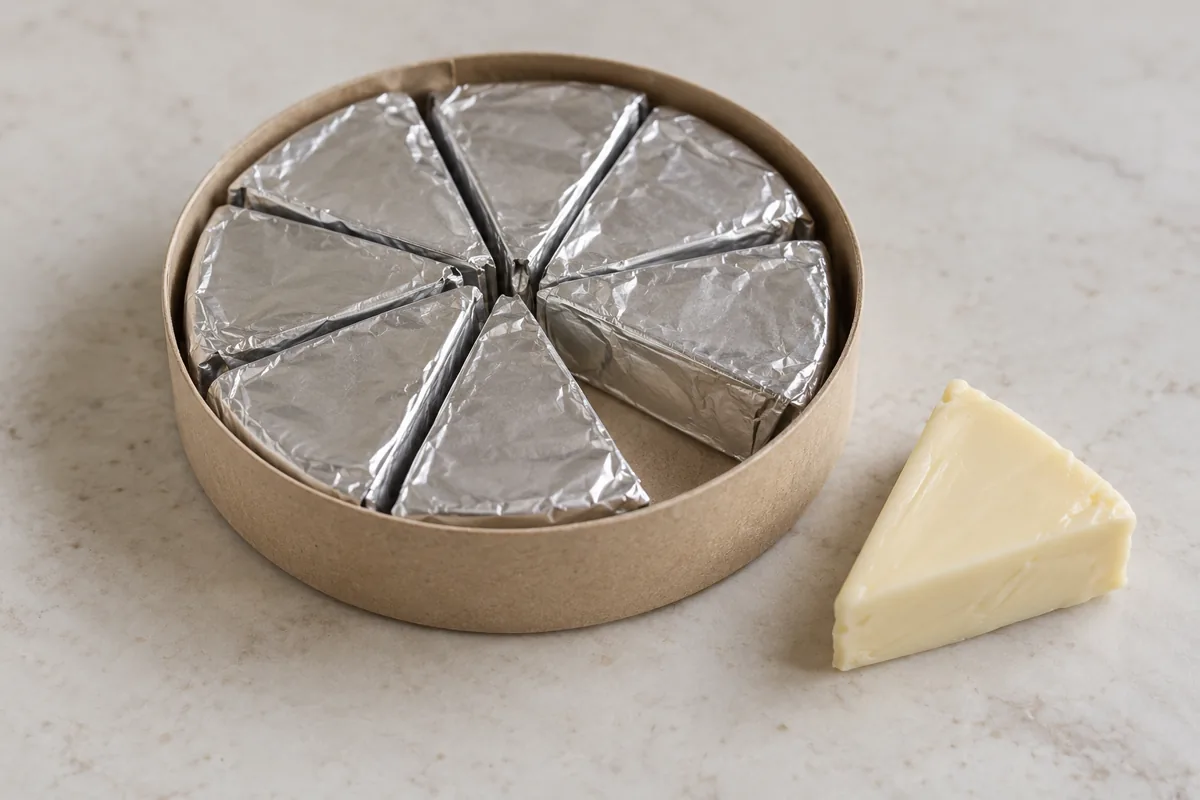
La Vache Qui Rit is a processed cheese that Bel launched in 1921 and sells in individually sealed wedges, and English-speaking countries know it as The Laughing Cow. Bel's French product sheet gives its legal name as fromage fondu, a processed cheese made from rehydrated skimmed milk, cheeses, butter and milk protein.
The wedge spreads on bread and melts into sauces, the recipe differs between France and the US, and Bel's storage wording differs between its US, UK and French sources.
In This Article
What Is La Vache Qui Rit Made Of?
Bel UK sums up the make as milk powder blended with water to bring it back to milk, cheeses and butter, with emulsifying salts. Bel's French product sheet for the 17.5 g portion lists rehydrated skimmed milk from France, cheeses, butter, milk proteins and melting salts (polyphosphates), then tricalcium phosphate, milk minerals, a lactic milk concentrate and vitamin D.
The recipe is not the same everywhere: Bel's US page lists cheddar and semisoft cheese blended with whey, milk protein concentrate and butter, plus sodium polyphosphate and citric acid. Its FAQ says wedges sold in the United States are primarily made in its Kentucky plant.
The two lists also open differently, with rehydrated skimmed milk first on the French sheet and the cheeses first on the US page, and Open Food Facts, reading the order of the French list, estimates about 57% skimmed milk, 21% cheese and 11% butter.
Those percentages are estimates from the order of the list, not figures Bel publishes, and Bel's own pages give none for either recipe; its French press kit calls the recipe unique and secret.
Which cheeses go in is only partly public: the French sheet says just "cheeses", while Bel's US page names cheddar and a semisoft cheese made from pasteurised cultured milk and part-skim milk. Its FAQ says the cheeses are made with 100% real cow's milk.
Does La Vache Qui Rit Melt?
Yes, and Bel cooks with it itself. Bel France calls the wedge a cooking ingredient in its own right and lists soups, purées, pasta, gratins, savoury tarts and vegetable sauces.
In a natural cheese, calcium links the casein proteins into a network that holds the fat, and Wikipedia's processed-cheese entry says prolonged heating typically leaves a lumpy protein gel with liquid fat on top.
The melting salts bind that calcium, so smaller clusters of casein mix into the fat as microscopic droplets and the cheese does not separate when melted. Phosphates are among the agents Wikipedia lists, and they are the salts both Bel lists name, polyphosphates on the French sheet and sodium polyphosphate on the US page.
Bel UK compares the salts to the citrate in the white wine of a fondue Savoyarde, which stops the fat separating. Wikipedia credits the tartaric acid in wine with that job in Swiss fondue, so both sources describe a calcium-binding acid from wine doing what the phosphates do in the wedge.
What Can You Cook With La Vache Qui Rit?
Bel France's 2022 recipe kit uses the wedge in two ways: heated into a sauce, a purée or a fried dough filling, and whisked cold with a spoonful of milk or cream into a topping or filling.
| Dish | Wedges | Liquid added | What happens to the wedges |
|---|---|---|---|
| Macaroni gratin with lemon cream and sardines | 6 | 100 ml cream | Warmed gently with the cream and whisked into a smooth sauce, then baked 15 to 20 minutes at 200°C |
| Broccoli and potato purée | 4 | A little of the vegetable cooking water | Stirred into the mashed vegetables and warmed over low heat |
| Cheese naans | 8 (2 per naan; Bel allows 4 to 8) | None | Pressed between two dough rounds and fried over high heat, about 2 minutes a side |
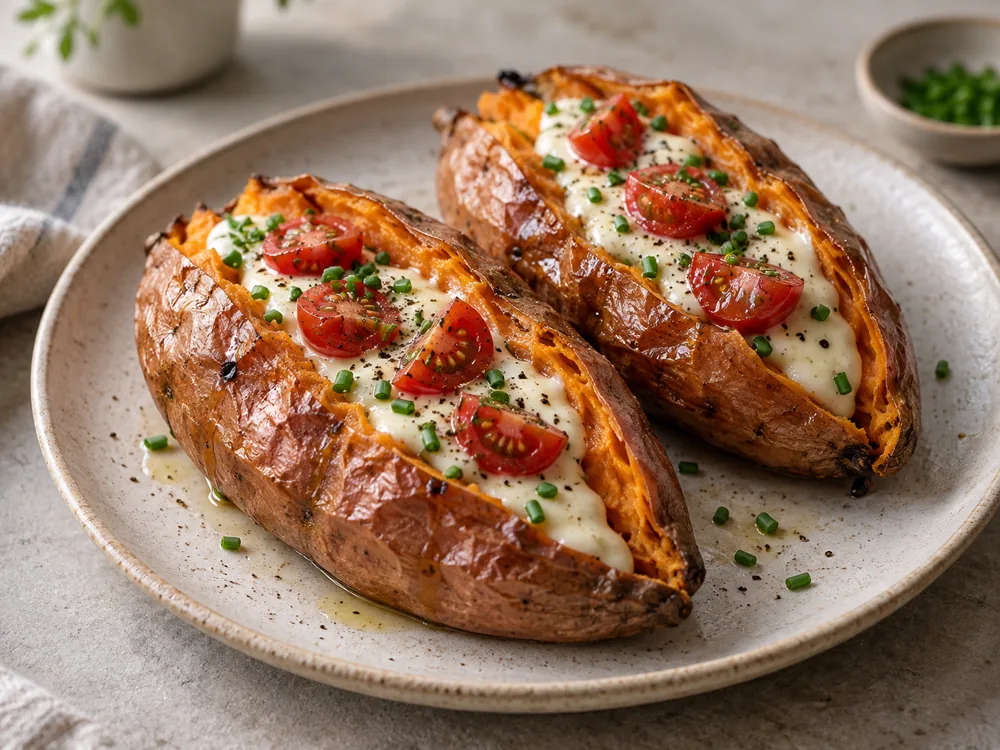
| Roasted sweet potato | 4 | 1 tablespoon milk or cream | Whisked cold and spooned onto the baked potatoes |
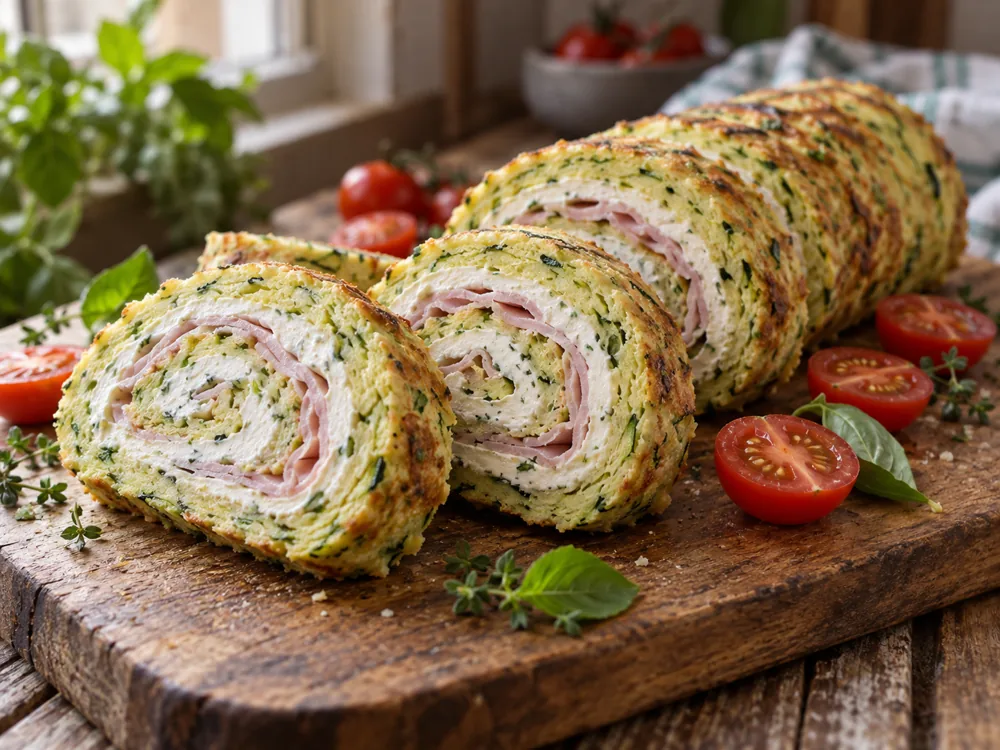
| Courgette sponge roll with ham | 6 | 1 tablespoon cream or milk | Crushed smooth with the cream, spread on the sponge, rolled and chilled at least 1 hour |
The liquid amounts show how much the wedge needs: one tablespoon loosens four or six wedges into a spread, while the gratin sauce takes 100 ml of cream for six.
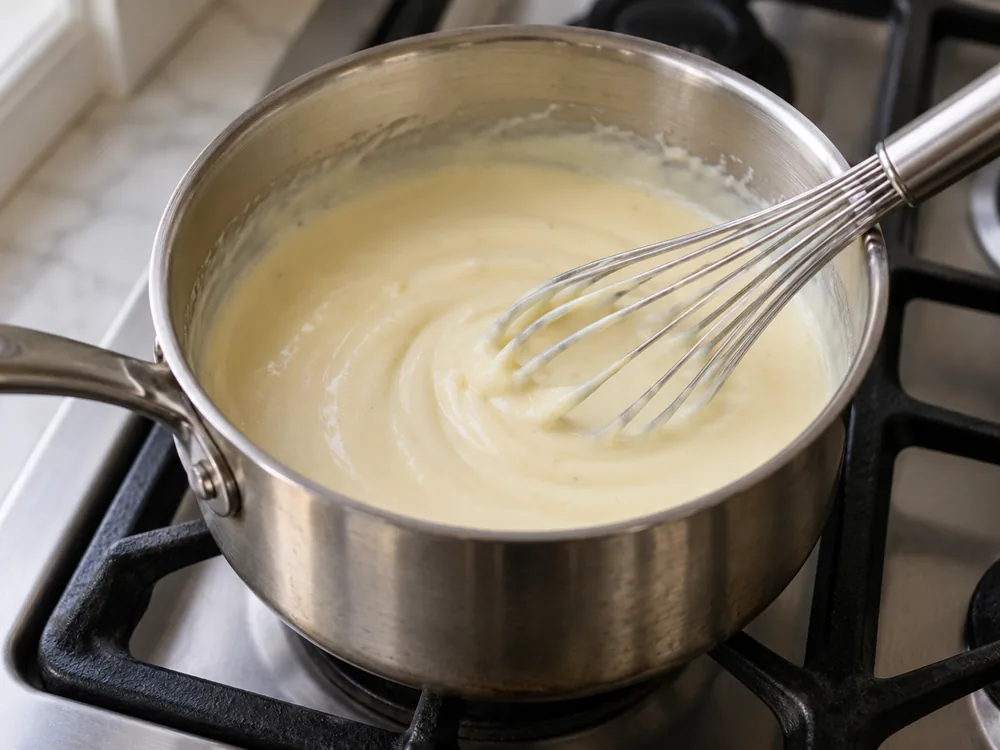
Bel bakes the gratin for 15 to 20 minutes at 200°C under breadcrumbs, until it is hot and lightly golden, so the sauce is meant to go through oven heat as well as pan heat.
In the sweet potato recipe the whisked cream goes on after the potatoes have baked 45 minutes at 200°C, so the wedges themselves are not baked, and Bel tops the potatoes with quartered cherry tomatoes and chives.
The sponge roll goes the other way: the crushed wedges and cream are spread on a courgette sponge with sliced ham, rolled tight in cling film and chilled for at least an hour.
None of the five recipes reports whether a wedge browns or stretches on its own, which matters for a grilled sandwich or a pizza topping.
What Does La Vache Qui Rit Taste Like?
Bel France describes a gentle taste and an ultra-creamy, melting texture.
Bel's French sheet gives 40.7 percent dry matter, which leaves roughly 59 percent water, and 18 g of fat per 100 g, so fat makes up about 44 percent of the dry matter.
Which La Vache Qui Rit Should You Buy?
Bel's US page sells more than the original: it also lists Creamy Light, Garlic & Herb, Aged White Cheddar, Spicy Pepper Jack, Dill Pickle, Smoked Gouda and Jalapeño wedges, two plant-based wedges and double packs.
The figures on this page describe the original wedges, the French 18% fat portion and the US Creamy Original, and the plant-based wedges are not made from cheese, so the milk and cheese statements here do not describe them.
Bel France describes the wedge as made from selected cheeses, skimmed milk and butter, and Wikipedia adds that in many countries a product with a high share of additives cannot legally be labelled cheese, while a similar product with more cheese in it can.
The name printed on the pack shows which rules apply. In France the sheet gives fromage fondu.
In the US, Wikipedia says, FDA rules define pasteurized process cheese, process cheese food and process cheese spread by what goes in, with at least 51 percent cheese for the food class, and leave names such as "pasteurized prepared cheese product" without a standard.
For a US pack the class matters because Wikipedia says the FDA does not permit milk protein concentrate in standardised processed cheese, and Bel's US list includes it; Bel's US page does not show which name its pack prints.
Read the legal name on the pack (fromage fondu in France; in the US a standardised class or an unregulated name) and the first ingredients (skimmed milk on the French sheet, cheeses on the US page). The figures in this article describe the original wedges, not the flavoured, light or plant-based ones.
Does La Vache Qui Rit Need to Be Refrigerated?
Bel's wording differs by market, but its US and UK sites both point to the fridge. Bel's US FAQ says the cheese stays good to the printed date only if kept refrigerated, and Bel UK says it keeps for a very long time in the fridge.
French documents add dates. Bel's catering sheet lists the 17.5 g portion as fresh, with a total product life of 182 days, and the 8-wedge retail pack, as recorded on Open Food Facts, says to keep an opened pack closed in the fridge and use it within 3 days.
Bel UK explains the long life by heat: the mixture is heated at a very high temperature, which lets it last longer than regular cheese.
Wikipedia's processed-cheese entry adds that the long life comes less from the salts themselves than from what they allow, since heat-based sterilisation such as canning can be applied to the cheese without lumps forming.
Bel UK says it adds no colours or preservatives and the French sheet lists the portion as free of preservative, which leaves the heat treatment as the explanation Bel gives for the long life.
| Source | Before opening | After opening | Freezing |
|---|---|---|---|
| Bel US FAQ | Refrigerate; good to the printed date if kept cold | Eat right away; air dries the cheese | Do not freeze, quality suffers |
| Bel UK website | Keeps a very long time in the fridge | Not stated | Not stated |
| French 8-wedge pack (Open Food Facts) | Range on the pack not repeated here | Closed, in the fridge, use within 3 days | Not stated |
| Bel catering sheet, 17.5 g portion | Fresh; total life 182 days | Marked not applicable | Not stated |
None of Bel's sources says how long a wedge can sit out of the fridge, and the printed date and the pack's instruction are the only limits it documents.
CDC says to keep a refrigerator at 40°F (about 4°C) or below and to refrigerate perishable food, dairy included, within 2 hours, or 1 hour above 90°F. This page leaves out the warmer ranges printed on the French packs because they sit above that CDC limit.
Can You Eat La Vache Qui Rit When Pregnant?
The NHS counts processed cheese spreads among the pasteurised soft cheeses that are safe in pregnancy, but neither the NHS nor the CDC names La Vache Qui Rit, so their lists do not settle it. Bel gives the wedge as pasteurised.
Those pasteurisation statements come from Bel's French and US material, so a pack from another market has to carry the word itself.
Calories, Protein, and Dietary Facts
Bel's French sheet gives these averages per 100 g for the 18% fat portion, and recipes in other markets differ, so their panels will too.
| Nutrient | Per 100 g |
|---|---|
| Energy | 232 kcal (964 kJ) |
| Fat | 18 g, of which saturates 12 g |
| Carbohydrate | 6.5 g, of which sugars 6.5 g |
| Protein | 11 g |
| Salt | 1.7 g |
| Calcium | 910 mg |
Portion weight changes the per-wedge figure. Worked out from the sheet's energy figure, the 17.5 g catering portion holds about 41 kcal.
The 170 g French pack of eight averages about 21 g a wedge, and Open Food Facts gives that pack 239 kcal per 100 g, or about 51 kcal a wedge.
Bel's US page gives a 19 g wedge as the serving, at 50 calories with 3.5 g fat (2 g saturated), 2 g protein, 130 mg calcium and 160 mg sodium. That scales to roughly 260 kcal and 18 g of fat per 100 g.
On calcium, 910 mg per 100 g works out at about 160 mg in the 17.5 g French portion against 130 mg in the US wedge. The French sheet files the portion in GEMRCN category 15, cheeses with at least 150 mg of calcium per portion.
Open Food Facts, working from the pack's panel, scores the French 8-wedge pack Nutri-Score D, with saturated fat taking the maximum 10 negative points. It also places the pack in NOVA group 4, ultra-processed foods, because of two markers: the polyphosphate additive E452 and the milk proteins.
Bel's French sheet lists the portion as gluten-free, pork-free, vegetarian and free of palm oil and alcohol, and Bel's US FAQ says its wedges contain no gluten-containing ingredients and suit lacto-vegetarians, but neither names the rennet in the cheeses.
Bel's US list says only "enzymes" for its cheeses, without saying whether they come from animals, plants or microbes, and the US FAQ adds that the products are not kosher certified.
Milk is the declared allergen, and the French sheet gives no lactose figure: its 6.5 g of sugars per 100 g does not say how much is lactose.
Why Is It Called La Vache Qui Rit?
La Vache Qui Rit means "the cow that laughs", and Bel's UK and US sites sell it as The Laughing Cow.
Bel's French press kit dates the brand to 1921 and Lons-le-Saunier in the Jura, describes its red smile and cheese-box earrings, and counts more than 120 countries in 2022, while the French product sheet records the wedge as processed in département 39, the Jura.
Is La Vache Qui Rit the Same as Kiri or Cream Cheese?
No to both, going by Bel's own descriptions. Kiri is a separate Bel brand, created in 1966 as a small individual portion.
Bel's press kit says Kiri is made from French milk and cream collected within 60 km of its Sablé-sur-Sarthe plant, while the wedge lists cheeses, skimmed milk, butter and milk proteins held together with melting salts.
Bel's recipe kit puts Kiri into sweet and savoury dishes, from lemon sponge sandwiches to stuffed eggs and a vegetable tart, whereas all five of its wedge recipes are savoury.
Cream cheese is a separate soft fresh cheese. In Wikipedia's summary of the US rules for pasteurized process cheese, cream cheese and cottage cheese are excluded from the cheeses the product may be made from, and Bel's US list names cheddar and a semisoft cheese instead.