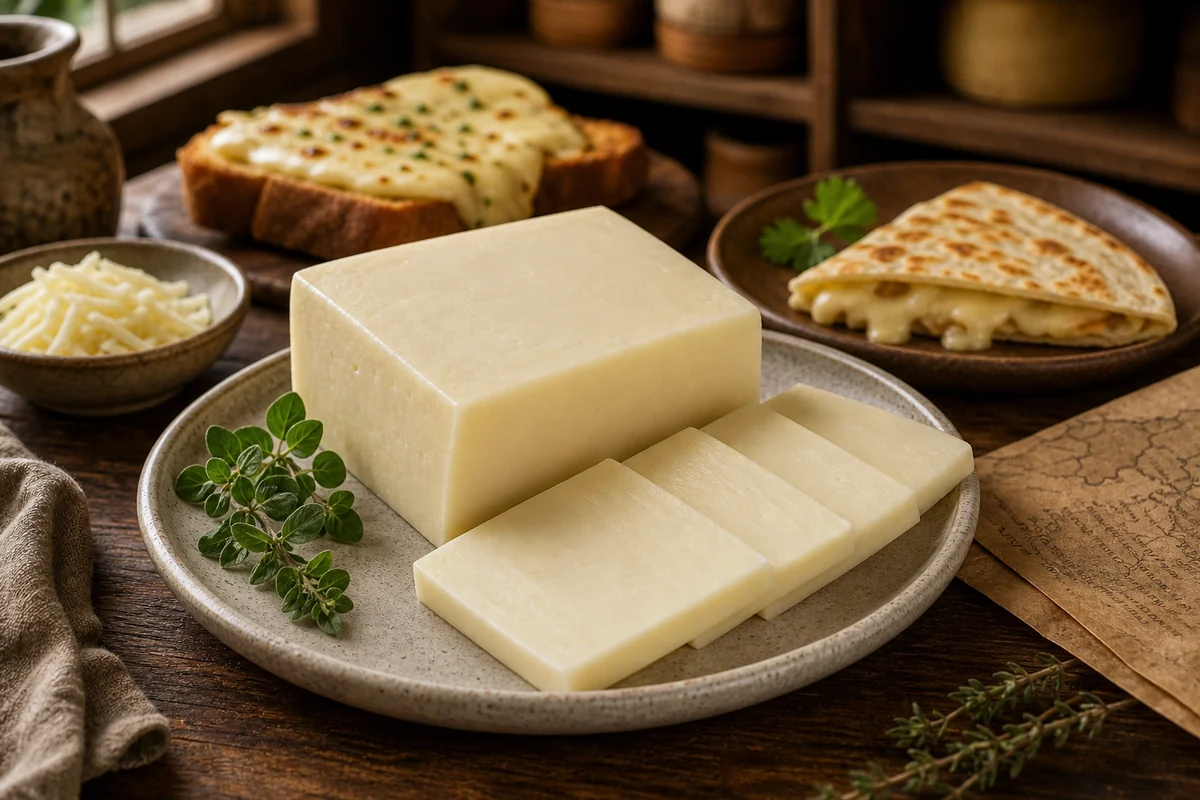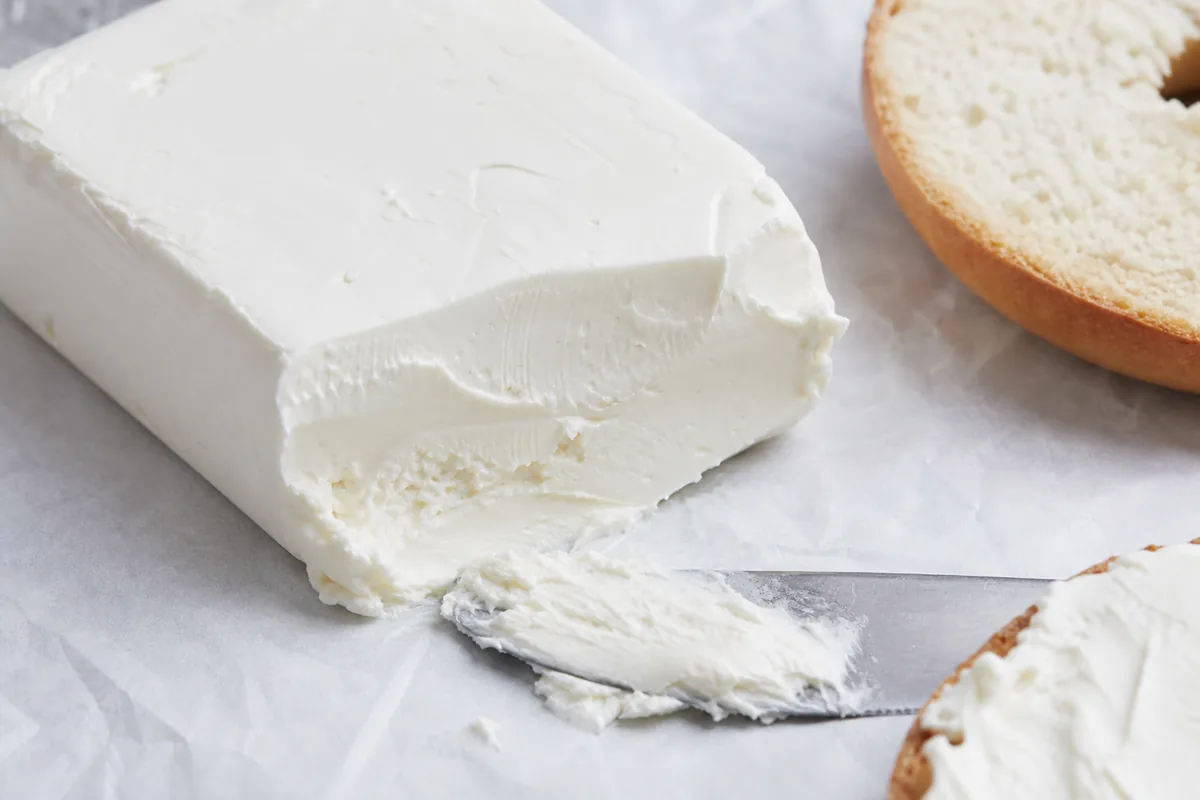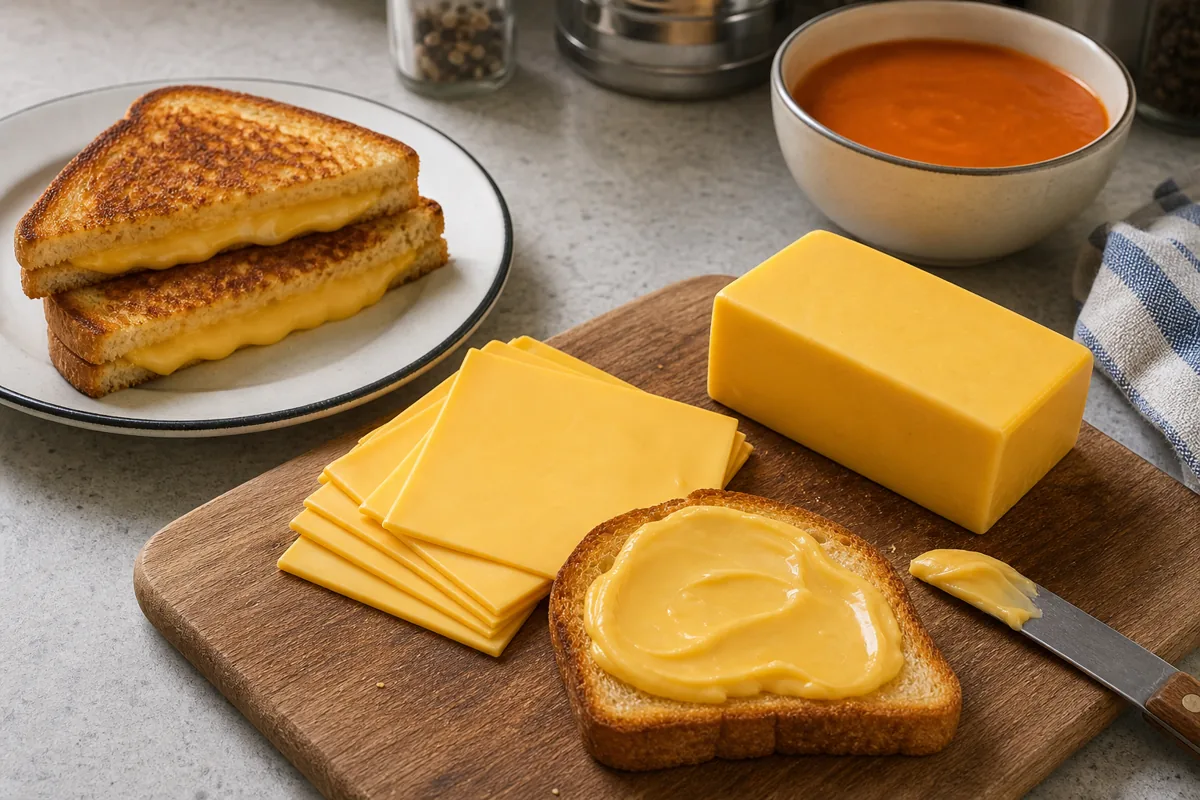
Pasteurized processed cheese is natural cheese that has been ground, mixed with an emulsifying agent, and heated into one smooth, uniform mass. The U.S. standard in 21 CFR 133.169 requires a heating step during preparation, and its name begins with "pasteurized".
That heating is applied to a finished blend of cheeses. A natural cheese made from pasteurized milk was pasteurized before the cheesemaking began.
Three federal names begin with "pasteurized process cheese", and each one promises a different range of moisture and fat.
In This Article
What Does Pasteurized Process Cheese Mean on a Label?
Part 133 of Title 21 of the Code of Federal Regulations (21 CFR 133) defines the three main names, and the name on the front of the pack tells which limits applied. Plain process cheese is built from cheese and an emulsifying agent, cheese food adds milk-based ingredients, and cheese spread holds the most water.
| Label name | Cheese share | Moisture | Fat | Other limits |
|---|---|---|---|---|
| Pasteurized process cheese (133.169) | Cheese is the base; no percentage stated | Generally 43% at most | At least 47% of the solids | Added cream or milkfat under 5% of weight; pH 5.3 or higher |
| Pasteurized process cheese food (133.173) | At least 51% of the weight | 44% at most | At least 23% | Milk, whey, or cream may be added; pH 5.0 or higher |
| Pasteurized process cheese spread (133.179) | At least 51% of the weight | More than 44%, up to 60% | At least 20% milk fat | Spreadable at 70°F; gums up to 0.8%; pH 4.0 or higher |
Cheese spread is the only name allowed more than 44 percent moisture, up to 60 percent. It is also the only one of the three that the standard requires to be spreadable at 70°F (21°C), and the only one that allows gums, such as guar gum, xanthan gum, carrageenan, and gelatin, up to 0.8 percent of the finished weight.
Process cheese and cheese food list no gums. Spread also lists sweeteners such as sugar and corn syrup for seasoning, and a nisin preparation up to 250 parts per million.
Added ingredients show up in the name. A spread made with fruit, vegetables, or meat is named "pasteurized process cheese spread with" followed by those ingredients in order of predominance by weight, and a flavoring or smoke that characterizes the product has to appear in the name too.
Pimento cheese has its own standard in 133.171, with pimento solids at 0.2 percent or more of the weight, moisture no higher than 41 percent, and a cheese base of cheddar, washed curd, Colby, or granular cheese. Smoke, spices, and flavorings are not allowed in it.
Every figure above is a U.S. federal limit. Wikipedia notes that in many countries some products made this way cannot legally be labeled as cheese at all, so a pack from another country may follow different naming rules.
Is Pasteurized Process Cheese Real Cheese?
Process cheese starts from real cheese. Cheese.com describes it as natural cheeses mixed and heated with unfermented dairy ingredients, emulsifiers, colorings, salt, or whey, and the federal standard defines it as one or more cheeses ground and mixed with an emulsifying agent.
Cheese food and cheese spread must be at least 51 percent cheese by weight, and the rest can include milk, skim milk, buttermilk, whey, cream, and whey albumin. Wikipedia puts the whole category at roughly 50 to 60 percent cheese, with the remainder other ingredients.
The plain process cheese standard states no cheese percentage, so the 51 percent floor is the one number a buyer can hold a cheese food or cheese spread to.
The standard also decides which cheeses can serve as the base: cream cheese, Neufchâtel, cottage cheese, and hard grating cheeses are excluded from process cheese.
The word "product" changes the picture. Wikipedia reports that the FDA keeps no standard of identity for "pasteurized prepared cheese product" or "pasteurized process cheese product", so a pack under those names is not held to the limits in the table.
Kraft's own page describes its American Singles as "a pasteurized prepared cheese product made with real cheddar cheese, dairy, and other ingredients". The ingredient list starts with cheddar cheese and includes milk protein concentrate, which is not among the dairy ingredients that 21 CFR 133.173 lists for cheese food.
Wikipedia ties that naming to the ingredient: after an FDA warning letter about milk protein concentrate in late 2002, some Kraft Singles moved from "pasteurized process cheese food" to "pasteurized prepared cheese product".
How Is Pasteurized Processed Cheese Made?
Makers grind one or more cheeses, mix them with an emulsifying agent, and heat the mixture until it forms what the standard calls a "homogeneous plastic mass". The heating must reach 150°F for at least 30 seconds, and the finished cheese has to pass a phosphatase test limit of 3 micrograms phenol equivalent per 0.25 gram.
The emulsifying agent is one salt or a mixture from a list of 13 phosphates, citrates, and tartrates, and it can make up no more than 3 percent of the finished weight. Sodium citrate, trisodium phosphate, and sodium potassium tartrate are all on that list.
Each variety in a two-cheese blend must make up at least 25 percent of the weight, and each variety in a blend of three or more at least 15 percent, with lower floors for blue-veined cheeses such as Roquefort and Gorgonzola. A mixture of cheddar, washed curd, Colby, and granular cheese counts as one variety for these minimums.
The process cheese standard (133.169) allows a short list of optional ingredients beyond cheese and the emulsifying salts.
- An acidifier, either vinegar or lactic, citric, acetic, or phosphoric acid, as long as the pH stays at 5.3 or above
- Cream, anhydrous milkfat, or dehydrated cream, supplying less than 5 percent of the weight as fat
- Water, salt, artificial coloring, and spices or flavorings that do not imitate the flavor of any cheese
- Safe and suitable enzyme-modified cheese, and smoke from smoked cheese or from condensed wood smoke
Wikipedia credits Walter Gerber and Fritz Stettler with developing the method in Switzerland in 1911. They were looking for a cheese that kept longer, added sodium citrate to melted Emmentaler, and found that the sauce set into a solid again as it cooled.
James L. Kraft applied for the first U.S. patent on this kind of process in 1916, which Wikipedia describes as a way of storing cheese that halts maturation by sterilization.
Cheese.com says processed cheese accounts for a large section of cheese sales because it lasts longer and costs less than other cheeses. Wikipedia adds that mass production brings a steadier supply and lower distribution costs.
Why Does Processed Cheese Melt Without Splitting?
Cheese is an emulsion of fat particles in a watery medium, held together by proteins that cling to each other through calcium, according to Cook's Illustrated. A young cheese such as Monterey Jack melts smoothly because the fat turns liquid while the protein mesh loosens and stretches with it.
Aging takes that behavior away. Cook's Illustrated explains that water evaporates from an aged cheese, which leaves relatively more fat and less water to hold the emulsion, and that the proteins pull into tight clusters that do not come apart under heat.
A sharp, long-aged Gruyère then melts into a lumpy, chewy blob of protein sitting in a pool of liquid fat.
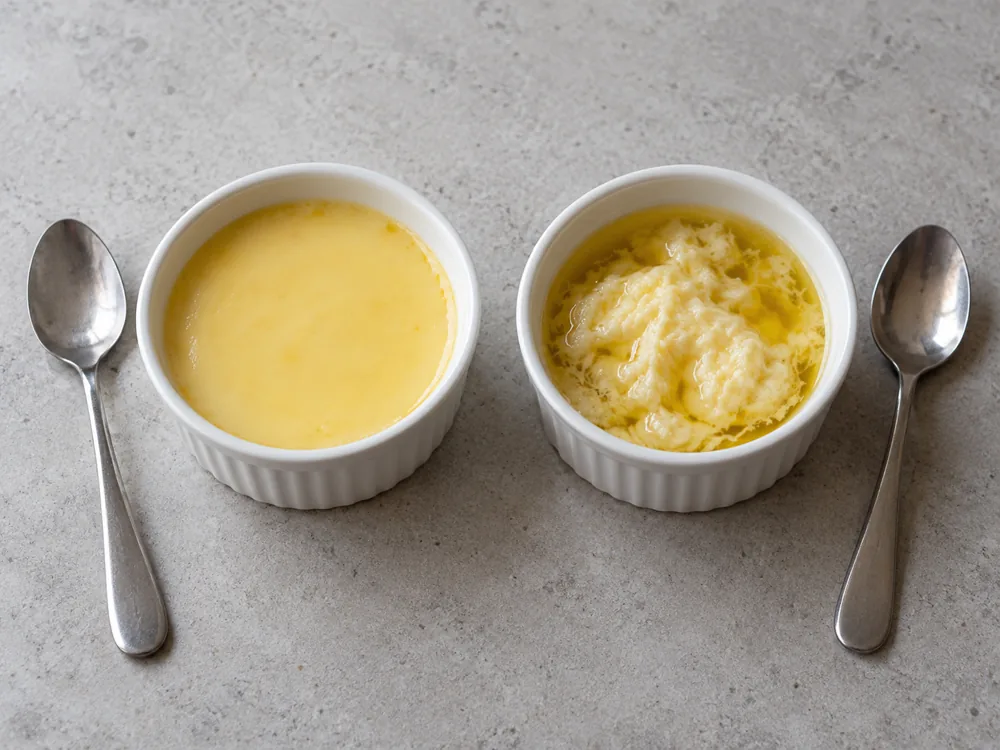
Emulsifying salts work on that calcium. Cook's Illustrated names sodium citrate as the best known melting salt: the sodium replaces some of the calcium binding the proteins, so the proteins separate, act as emulsifiers again, and hold fat and water together.
Wikipedia describes the same step as a calcium-sequestering agent that lets the casein break into smaller linked groups, which mix into the fat as microscopic droplets instead of large lumps. It adds that the tartaric acid in wine does this job in Swiss fondue.
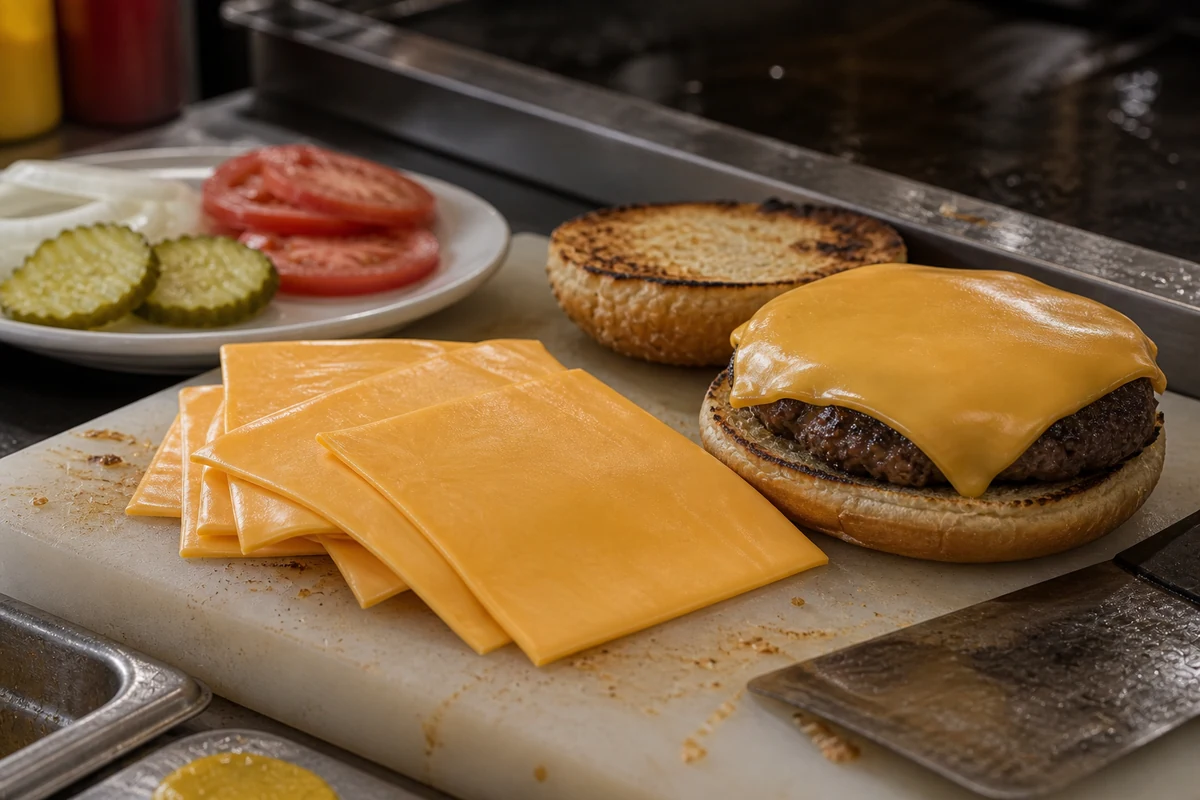
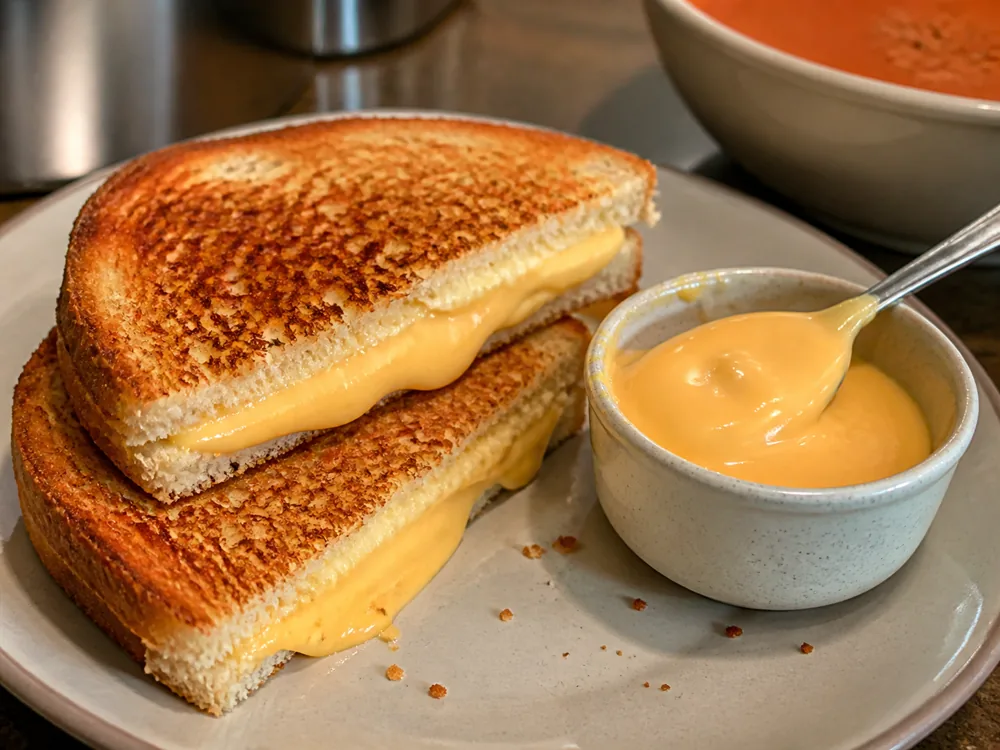
That smooth melt is why Wikipedia lists cheeseburgers and grilled cheese sandwiches as the classic U.S. uses, where the cheese cooks evenly, stretches smoothly, and resists congealing, unlike traditional cheddar.
Cook's Illustrated names Velveeta and American cheese as examples of smooth processed cheeses and presents the same citrate trick as the route to smooth cheese sauces and fondues.
What Formats Does Processed Cheese Come In?
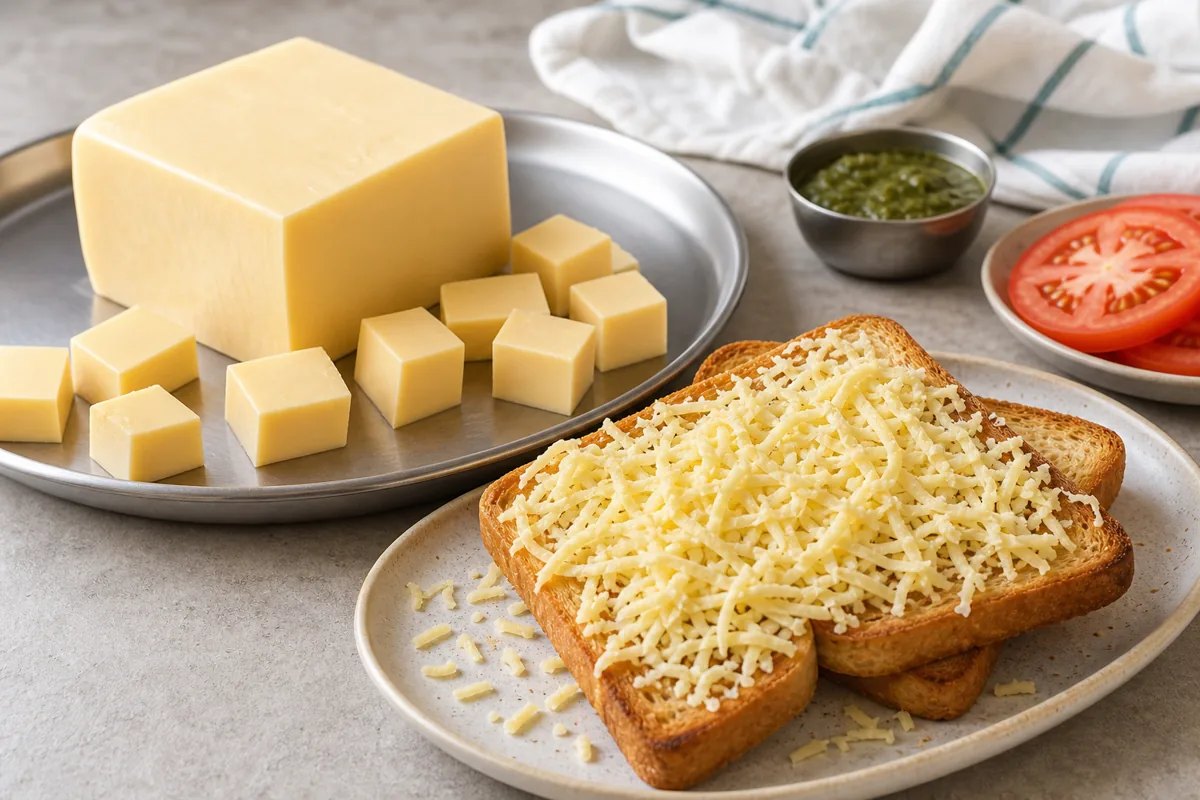
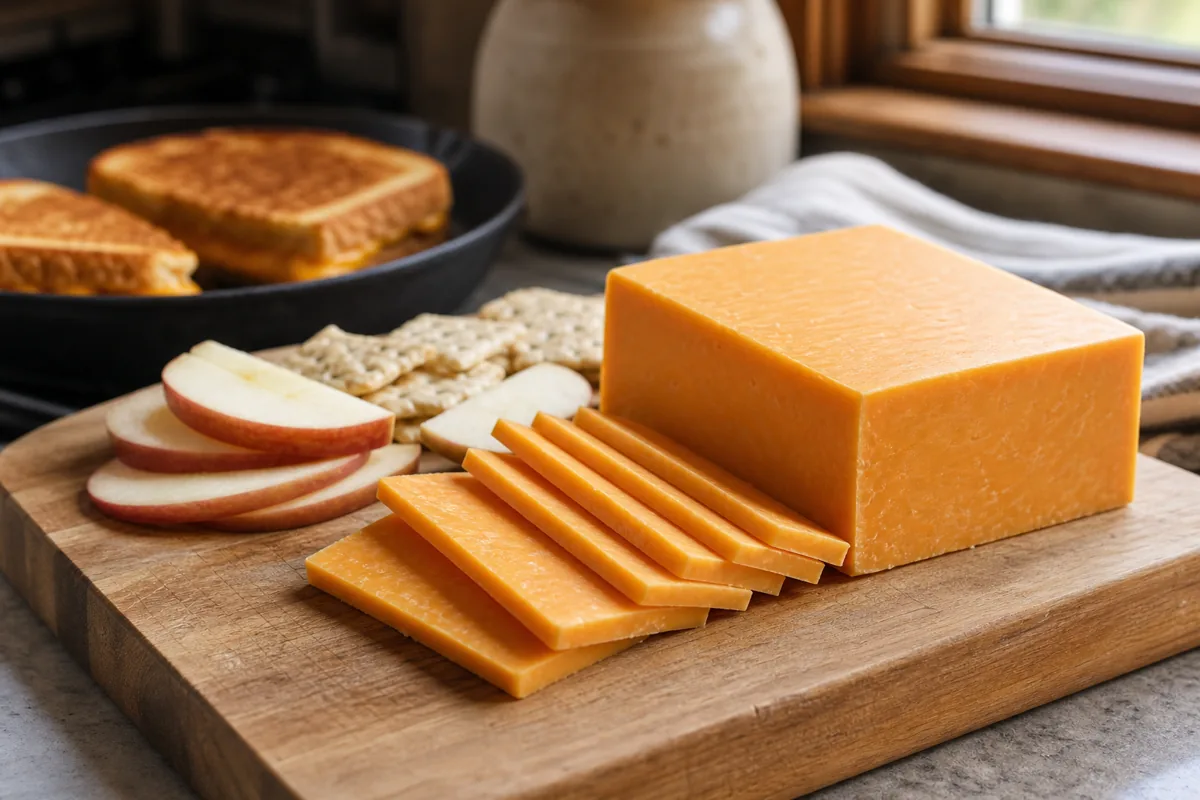
Wikipedia lists blocks, packs of slices often separated by wax paper, and slices individually wrapped by machine. It adds that processed cheese was first sold in unpressurized cans and that some still is.
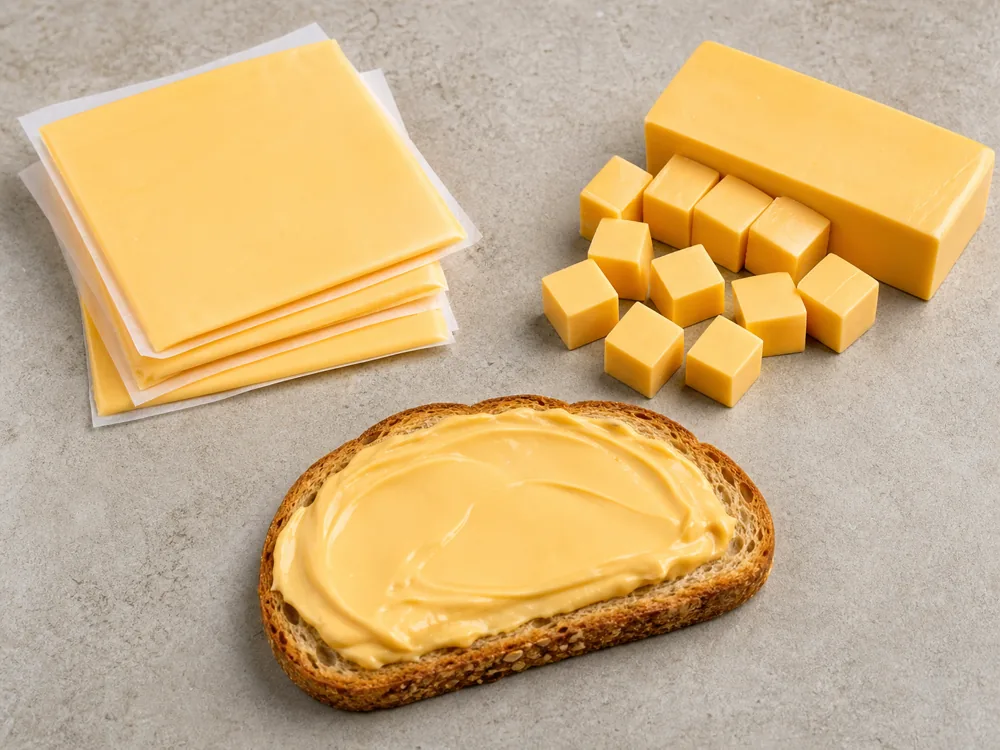
In the United Kingdom, Wikipedia says, spreadable processed cheese is usually sold in tubs, pots, or wedges, while wrapped slices there are called "singles" or, whatever their style, "American cheese".
The slice format carries one more detail in the process cheese standard. Slices and cuts in consumer-sized packages may contain sorbic acid or its potassium or sodium salts up to 0.2 percent, sodium or calcium propionate up to 0.3 percent, and lecithin up to 0.03 percent as an anti-sticking agent.
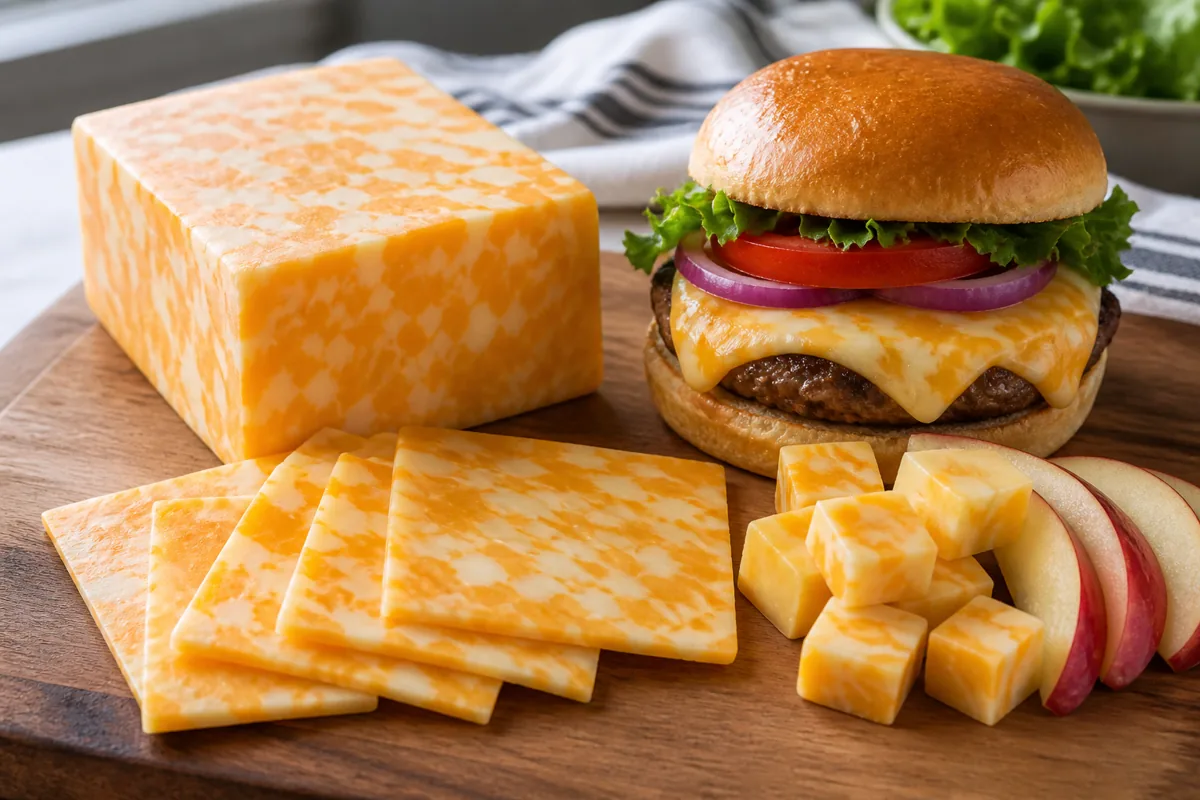
Two named styles show how far the family stretches. Wikipedia describes American cheese as typically a blend of Colby and cheddar that is yellow or off-white, mild, and easy to melt, and Provel, made from cheddar, Swiss, and provolone, as the cheese commonly used on St. Louis-style pizza.
What to Check on the Pack Before Buying
The printed name comes first, because it sets the limits in the table. The standard requires the full name on the principal display panel in type of uniform size, style, and color, and it must sit beside any conspicuous word that emphasizes an ingredient, such as "cheddar", in type at least as large.
Next comes the cheese itself. A name such as "pasteurized process Swiss and cheddar cheese" lists varieties in order of weight, and the standard lets cheddar, washed curd, Colby, and granular cheese, alone or mixed, appear as "American cheese" in the name and the ingredient list.
Sodium reaches the pack from two directions. The standards list salt as an optional ingredient with no stated limit and include several sodium salts among the permitted emulsifying agents, and Kraft's list names both salt and sodium phosphate.
The process cheese, cheese food, and cheese spread standards state no sodium figure, so the amount per serving appears only on the Nutrition Facts panel and differs from one product to the next.
A standardized name (process cheese, cheese food, or cheese spread) brings the limits in the table, while 'product' wording does not. After the name, look for a named cheese at the start of the ingredient list, any milk protein concentrate or gums, and the sodium figure.
Can You Eat Processed Cheese During Pregnancy?
The NHS lists processed cheese spreads among the pasteurised soft cheeses that are safe to eat in pregnancy, alongside cottage cheese, cream cheese, mozzarella, feta, and ricotta. It also says most dairy products sold in supermarkets are pasteurised, which the packaging shows, and that any cheese cooked until steaming hot is safe, including soft or blue cheese.
The CDC's pregnancy page does not name processed cheese. It lists soft cheese from unpasteurized milk, queso fresco-type cheeses, and unheated cheese sliced at a deli as the riskier choices, and it counts pasteurized soft cheese heated to an internal temperature of 165°F or until steaming hot among the safer ones.
The NHS names only spreads, and it lists pasteurised or unpasteurised hard cheeses, pasteurised semi-hard cheeses and pasteurised soft cheeses as safe to eat. Served cold, processed cheese is described as a pasteurized smooth, uniform cheese sold as slices, blocks or spreads, a type the CDC list does not cover, so ask a midwife or doctor.
The three standardized names begin with "pasteurized", and 21 CFR 133 requires a heating step during preparation, described in the making section above. A pack named "product" sits outside those standards, so its own label is where pasteurization is confirmed, and Kraft's "prepared cheese product" name includes the word.
Does Processed Cheese Need to Be Refrigerated?
Kraft states that its Singles "should always be refrigerated", says not to freeze them, and prints the expiration date on the back of the pack. Those instructions come from one maker for one product line.
Wikipedia says processed cheese keeps far longer than natural cheese, because the emulsifying agent allows heat sterilization methods such as canning to be applied without the cheese forming lumps.
None of the standards or agency pages gives a number of days for an opened pack of slices or a tub of spread, so the maker's date and instructions set the limit. The CDC adds that a refrigerator should stay at 40°F or below.
The CDC says bacteria multiply rapidly between 40°F and 140°F and that perishable food, dairy included, should be refrigerated within 2 hours, or within 1 hour when the temperature is above 90°F.
What Can Replace Processed Cheese in a Recipe?
An aged natural cheese can take the place of processed cheese in a melt only with help from the salt described above. Cook's Illustrated says to add a small amount of sodium citrate to a warm mixture of the cheese and a liquid, and calls it a white powder with a salty-sour taste that is not noticeable in the finished cheese.