
Pepato is a Sicilian sheep-milk cheese with whole black peppercorns mixed straight into the curd. It is a variant within the island's pecorino tradition, not a separate style invented apart from it.
That relationship to the wider Pecorino Siciliano designation is worth untangling before anything else, since the two names get used inconsistently.
In This Article
What Is Pecorino Pepato?
It is a semi-hard sheep-milk cheese with whole black peppercorns worked into the curd as the whey drains out. That single step is what separates it from a plain pecorino.
Its home is Sicily, where it is a genuine regional cooking staple rather than a novelty flavour. The name itself, pepato, simply means "peppered" in Italian.
In Sicilian dialect it also goes by tumazzu di piecura ccu pepi, literally "sheep cheese with pepper." That older name is a useful sign of how long the peppered version has existed alongside the plain one, rather than being a modern add-on.
Is Pepato the Same as Pecorino Siciliano DOP?
Related, but not identical. Pecorino Siciliano DOP is the protected legal designation covering Sicilian sheep pecorino generally.
Pepato is the common name for the peppercorn-studded version made within that same tradition. A wheel can carry the DOP mark without any pepper at all, and a cheese sold simply as pepato outside Italy may not carry the DOP designation either.
So the two names describe overlapping territory rather than the same fixed thing. Checking the label settles which one is actually in front of you.
How Old Is the Protection Behind Pepato?
Older than the DOP system itself. Sicilian pecorino was officially recognised as a protected historical product in Italy's own Official Gazette in 1955, decades before the EU's PDO framework existed to formalise it under EC Regulation 1107/1996.
It is sometimes described as one of the oldest cheeses in Europe with continuous production, a claim tied to its documented use going back to antiquity rather than a modern marketing label.
Production today stays genuinely small-scale rather than industrial. The regional control body CoRFiLaC certified 8,145 wheels of Pecorino Siciliano DOP in 2019, a fraction of the volume a mass-market cheese moves in a single year.
A dedicated consortium, recognised by Italy's agriculture ministry in 2018, now exists specifically to police that designation and defend it against imitation, which matters given how often pepato and Pecorino Siciliano get sold loosely outside Italy.
Is Pepato Vegetarian?
No. The DOP specification requires lamb rennet paste, added to the milk at 36 to 40 degrees Celsius.
That is a legal production requirement, not a producer's choice, so there is no vegetarian version of the genuine DOP cheese.
Is Pepato Pasteurised, and Can You Eat It Pregnant?
Under the DOP specification, no. Genuine Pecorino Siciliano is legally made from raw whole sheep milk, with no starter culture added.
Firmness and aging do not automatically settle the pregnancy question for a raw-milk cheese the way they might for a pasteurised one.
Checking the label for pasteurisation status is the reliable step, since not every pepato sold outside Italy is necessarily the raw-milk DOP version.
How Is Pepato Made?
Whole or cracked black peppercorns are mixed in by hand right after the curd forms and the whey is drained off.
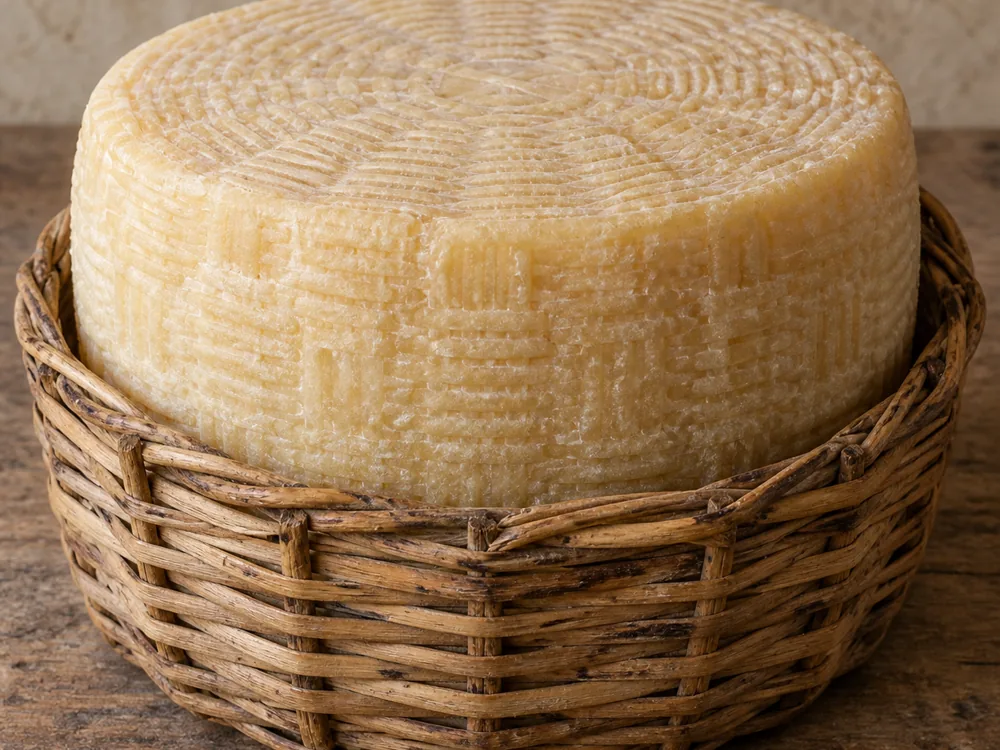
The curd then rests in traditional woven reed baskets called fascedde, which press a distinctive basket-weave pattern into the rind as the cheese takes shape.
From there it is scalded in a second batch of whey for about four hours. That step firms the curd further before salting begins.
Dry salting happens twice, ten days apart, covering the entire surface each time rather than a single light pass.
Ripening follows at a controlled 14 to 18 degrees Celsius and 75 percent humidity, for at least 20 days before the cheese can legally be sold under the DOP. Every step in that sequence is specified, not left to individual producers to improvise.
What Does Pepato Taste Like?
It depends heavily on age, more than most cheeses. A young wedge, matured for as little as 10 days, is notably mild.
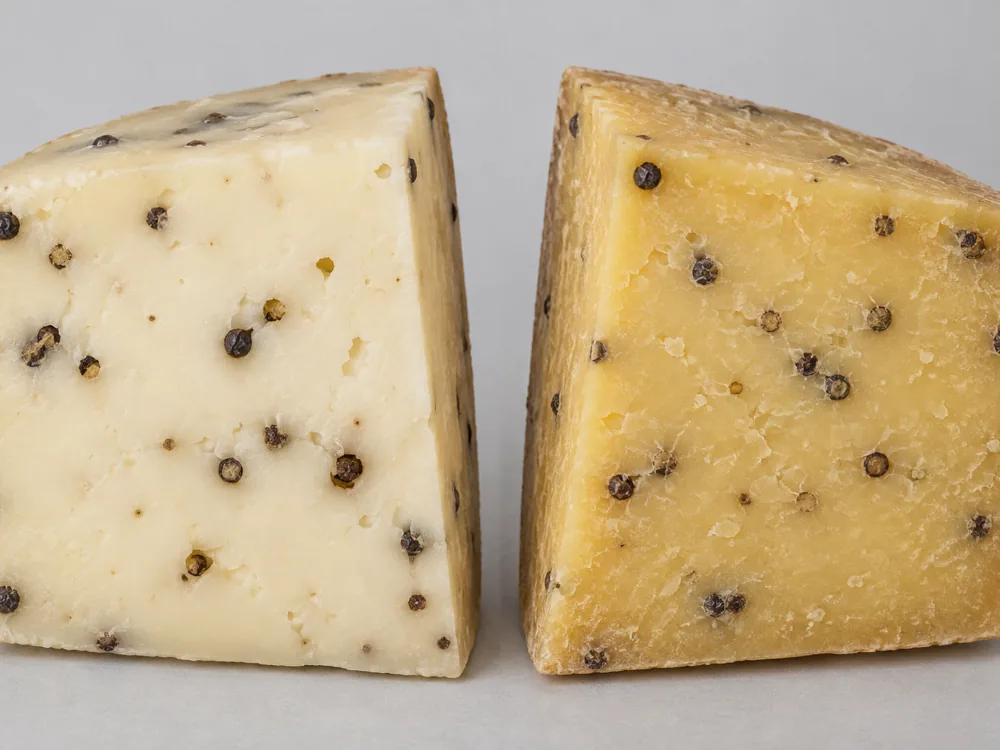
The standard version matures for 2 to 4 months into a firmer, distinctly more piquant cheese. Left closer to a year, it turns denser and crumblier, with a peppery bite considerably more intense than either younger stage.
How Do You Use Pepato?
Traditionally it sits on an antipasti platter alongside olives, cured meats and rustic bread, eaten in slices rather than melted.
Grated, it goes over Sicilian pasta dishes or into baked casseroles, where the peppery bite survives cooking rather than fading into the background.
Which age to buy depends on which of those jobs matters more. A young wedge works better sliced for a platter, where a milder bite lets the olives and cured meat come through too, while an older, firmer wheel is the one worth reaching for specifically to grate.
Where Can You Buy Pepato Cheese?
Outside Italy, specialty importers are the realistic route rather than a general supermarket cheese aisle.
In the US, iGourmet carries a Pecorino Siciliana DOP with pepper, and several pepato listings turn up on Amazon sold by the pound or in pre-packaged portions, most stating a minimum aging around 4 to 5 months. UK and European buyers generally find it through Italian specialty delicatessens rather than mainstream chains.
What to Use Instead of Pepato
Pecorino Romano gives the closest grating intensity and saltiness, though it carries none of pepato's peppercorn heat.
Pecorino Toscano is a gentler substitute, milder and creamier, for anyone who wants the sheep-milk flavour without either the pepper or Romano's sharper edge.
Stirring cracked black pepper by hand into either one is the closest DIY approximation when pepato itself is not available. For a fuller look at how a grating cheese like Parmesan stacks up against pecorino generally, the two are worth reading side by side.


