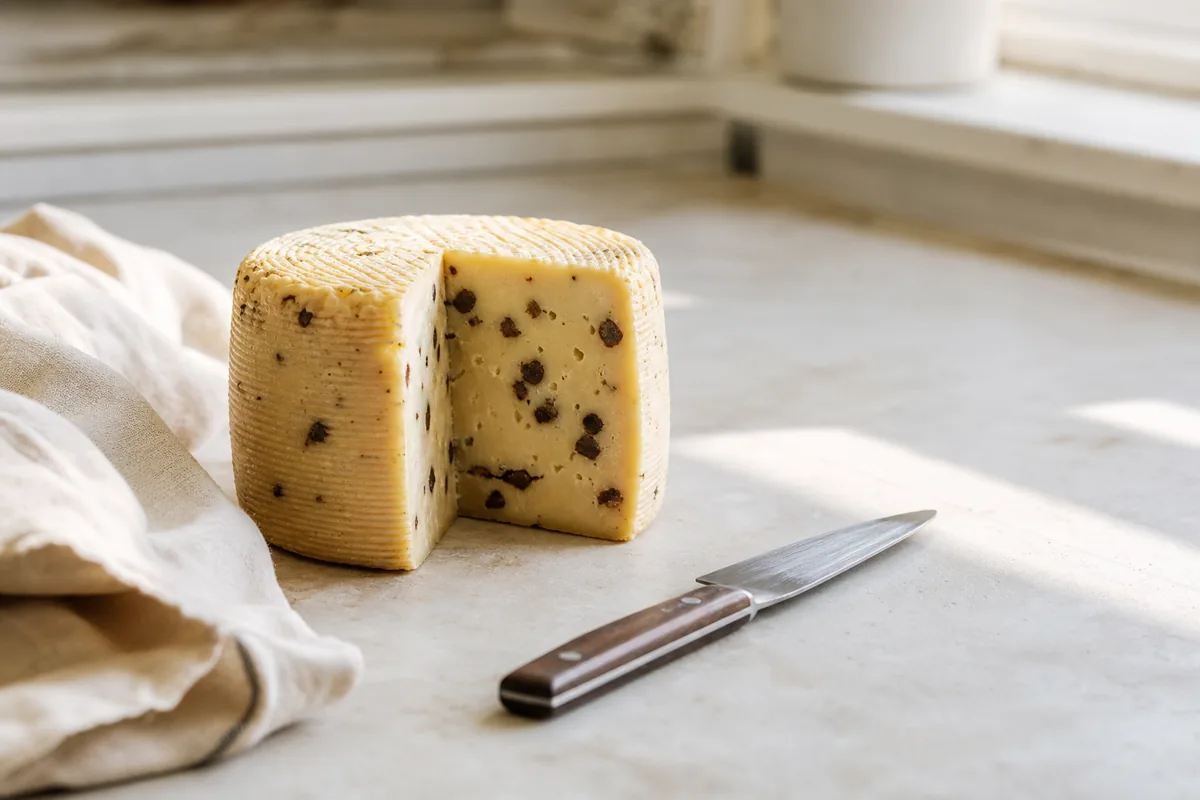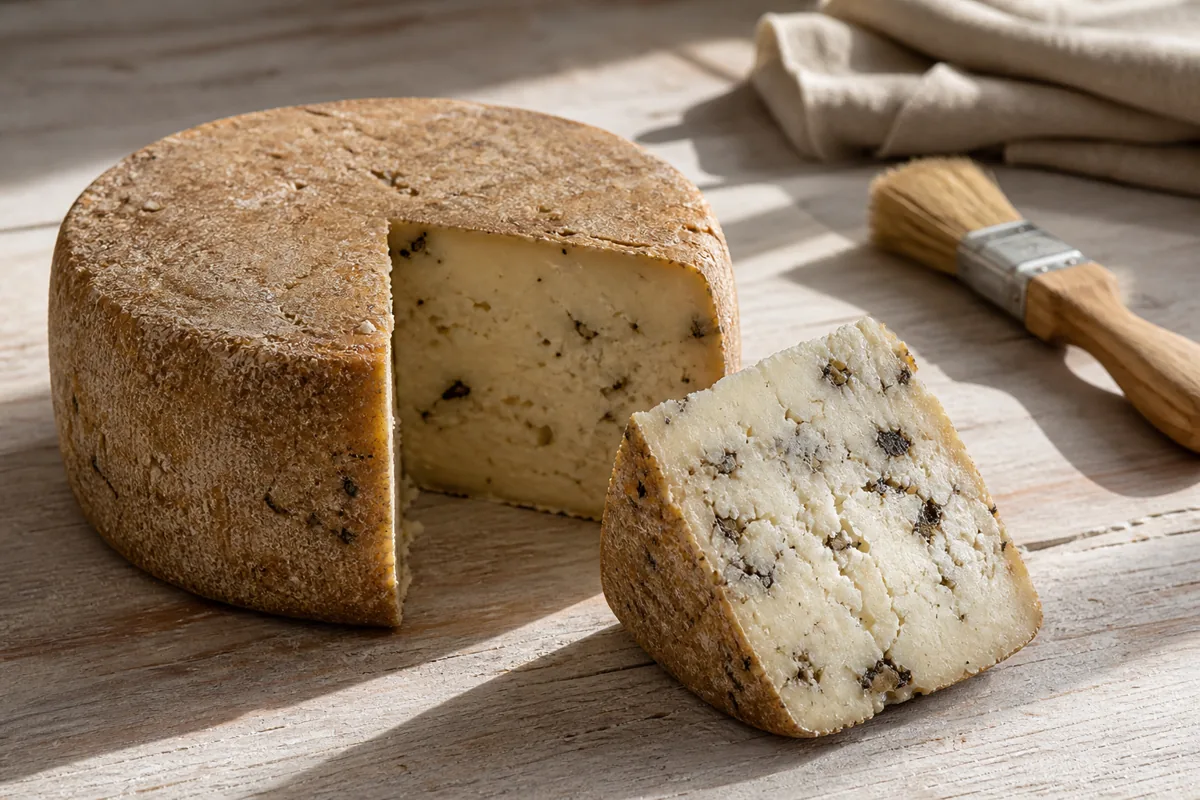
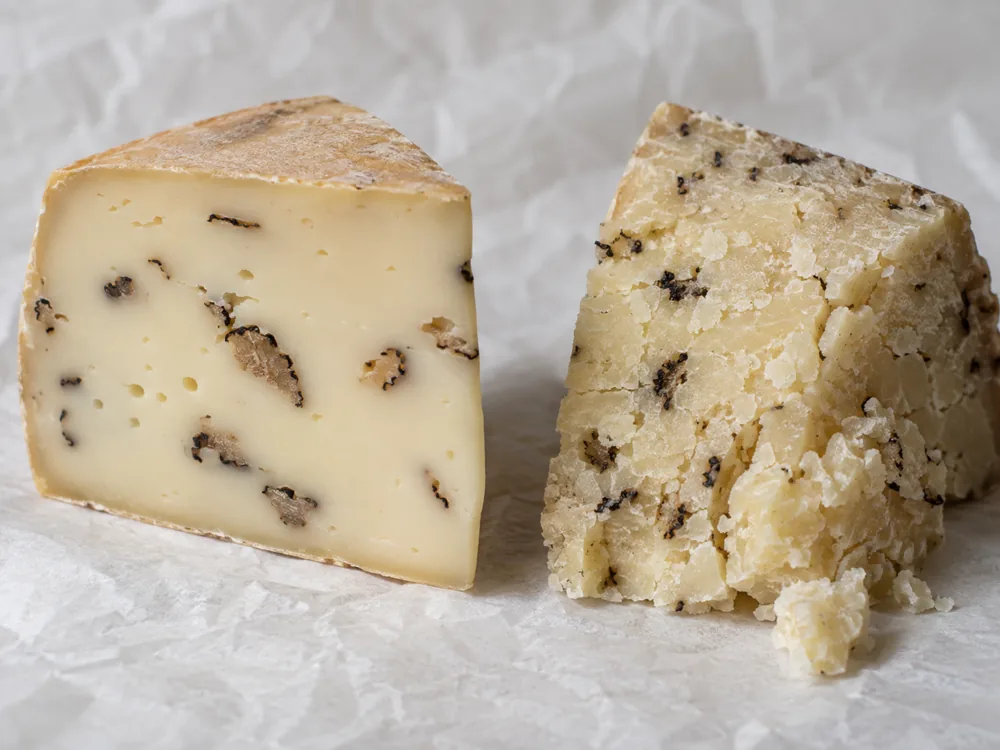
Cacio di Bosco al Tartufo is a sheep's milk cheese from Tuscany with truffle pieces through the paste, made by the Il Forteto cooperative. Most records agree on that and on pasteurized milk, but the age you will see listed runs anywhere from 90 days to 12 months or more.
In This Article
What Is Cacio di Bosco al Tartufo?
Atalanta's 2021 trade catalog, which carries the cheeses of Il Forteto, calls it a premium pecorino studded with truffles. Cheese.com lists Italy as the country and Tuscany as the region.
The records date the cooperative differently. The catalog says Il Forteto was founded in 1977 by 16 young associates who were students at the time, while the Australian retailer Porkewe dates the farm to the early 1980s.
On size, the catalog calls the cooperative one of the largest producers of Pecorino Toscano, and Porkewe says the farm covers 650 acres run on bio and organic principles and credits the brand with more than 20% of all Tuscan DOP Pecorino. Those figures describe the cooperative rather than make a label claim for the wedge you buy.
Cheese Market, a Sydney wholesaler, says the milk for all Il Forteto cheeses is sourced from local farms in the Mugello area of Tuscany and made into cheese within 24 hours of milking.
In these records, a PDO claim for the truffle cheese rests on one table label. The catalog lists two Pecorino Toscano PDO cheeses from the cooperative and gives the PDO label in its product text only to those two, while its price table names the truffle cheese beside them "Cacio Di Bosco, Truffle Pdo".
Cheese.com's header line and the first sentence of its description name cow's and sheep's milk, while its flavor sentence, the catalog, Cheese Market, Cheesy Place and the Florence retailer Arcibold name sheep's milk alone.
How Old Is It, and Which Age Should You Trust?
The age printed on the wedge you buy is the one to trust. Age is the biggest gap between the records, and the table shows what each one lists.
| Source | Age | Wheel | Truffle |
|---|---|---|---|
| Atalanta catalog (2021) | 6 months in the product text, 4 to 6 months in the price table | About 4 lb | Studded with truffles, no amount given |
| Arcibold (Florence retailer) | 90 days | About 1.8 kg | 0.5% bianchetto truffle preparation |
| Cheese Market (Sydney wholesaler) | Matured, no figure | About 2 kg | Shaved truffle throughout |
| Cheesy Place (online retailer) | 12 months or more | Not stated | Large dark flecks, no amount given |
| Woolworths (Australian supermarket) | Not stated | Not stated | At least 0.3% truffle |
Arcibold's 90 days is the shortest age and the only one from an Italian seller, and Cheesy Place's 12 months or more is the longest.
To place those figures, use Il Forteto's plain pecorinos as a yardstick: the catalog lists Pecorino Toscano at 1 month, Pecorino Toscano Stagionato at 4 months and Pecorino Toscano Oro Antico at 8 months. It says the 4-month cheese keeps the milky character of a fresh pecorino with the stronger flavor of aged ones.
On that scale, Cacio di Bosco's 6 months in the catalog text, or 4 to 6 months in its table, sits at or above the 4-month Stagionato and below the 8-month Oro Antico, while Arcibold's 90 days is younger than the Stagionato.
The catalog credits Cacio di Bosco's long maturation with balancing sweet sheep's milk against the truffle aroma. If that balance is what you are buying it for, a 90-day wedge fits the description less well than one aged 6 months.
The catalog's shelf life of 150 days is a separate column from age, and it does not follow age. The same table gives Boschetto 180 days of shelf life at 60 days of age, and the 4-month Stagionato 150 days.
For how long your cut wedge keeps, check its label or ask the seller.
The age on the package settles which record applies. The figures run from 90 days to 12 months or more, and the catalog ties the balance of sweet milk and truffle to a long maturation.
What the Truffle Percentages on the Label Mean
Arcibold's ingredient line lists a bianchetto truffle preparation (Tuber borchii, water, salt and aroma) at 0.5%. That figure is the whole preparation, so it covers more than truffle alone.
Woolworths lists truffle at a minimum of 0.3% in its ingredients, without naming the species. Set side by side, the two labels are not like for like: Arcibold counts a preparation that includes water, salt and aroma, while Woolworths gives a minimum for truffle, so the 0.2-point gap does not show that one cheese carries more truffle.
In the 270 g wedge Arcibold lists for a cut, 0.5% comes to about 1.4 g of the preparation, and the bianchetto is only part of that.
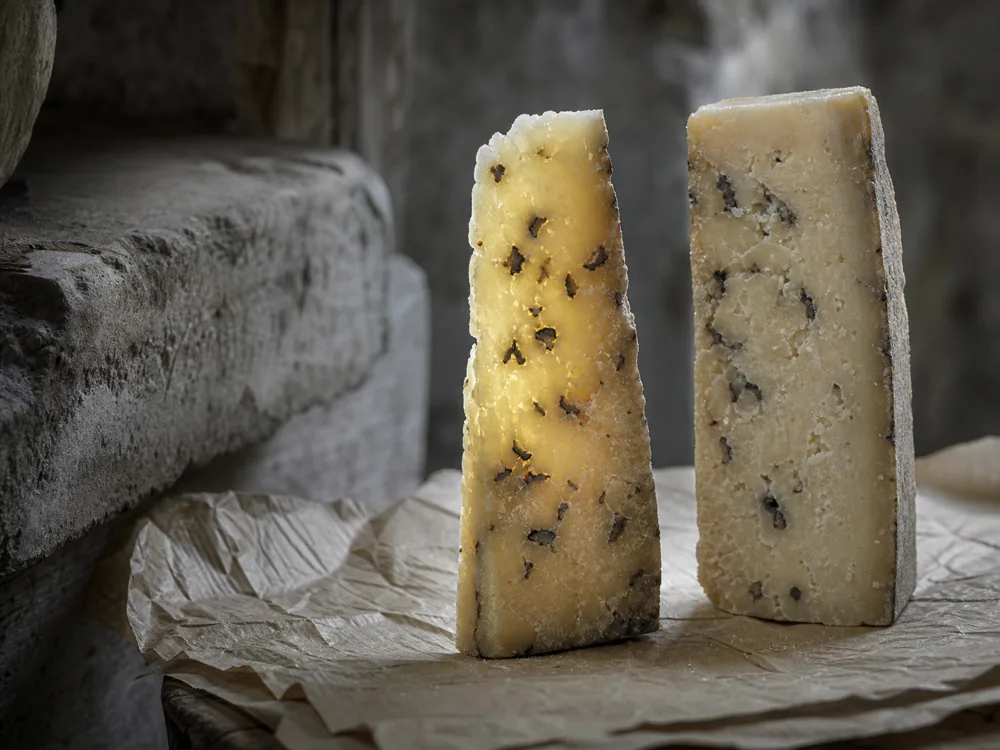
The pieces are described as differently as the amounts: Cheese.com writes of tiny dark specks and Cheesy Place of large flecks. The species is named differently too: the Australian retailer Porkewe writes of fresh black truffle, where Arcibold's label names bianchetto.
Arcibold lists the rind as edible.
The catalog's entry for La Rustichella, another producer's truffle pecorino, shows why timing matters. Its truffle goes in only once the cheese is already semi-aged, which the catalog says lets the cheese develop its own flavor first, unlike most truffled cheeses.
How Does Cacio di Bosco Differ from Il Forteto's Boschetto?
Il Forteto also sells Boschetto with Truffle, and the catalog treats it as a separate cheese. The comparison below uses the catalog's own descriptions of both.
| Attribute | Cacio di Bosco | Boschetto with Truffle |
|---|---|---|
| Age | 6 months (product text) | 2 months (product text) |
| Wheel | About 4 lb | About 1.5 lb |
| Described as | Slightly sour and crumbly, firm enough to grate | Sweet, soft and mild |
| Truffle | Studded with truffles | Shavings of bianchetto truffle, from Umbria per the catalog |
The truffle is not what separates the two in these records: Arcibold's label for Cacio di Bosco names bianchetto, the truffle the catalog names for Boschetto. The differences the catalog documents are age, wheel size and texture.
Texture decides which one you grate. For grating over pasta, risotto or pizza, the catalog points to Cacio di Bosco, because it calls only that cheese firm enough to grate, and it describes Boschetto as soft, mild and sweet.
On milk the records split: Cheese.com lists Boschetto with cow's and sheep's milk and a creamy texture, while the catalog gives sheep's milk for both cheeses.
What Does Cacio di Bosco al Tartufo Taste Like?
The catalog and Cheese.com describe sweet, nutty sheep's milk with a slightly sour edge, and Arcibold calls it sweet but savory. The sources split on how loud the truffle is, and the matrix sets the views side by side.
| Trait | What it says | Source |
|---|---|---|
| Truffle | Over-the-top in flavor | Atalanta catalog |
| Truffle | A strong aroma of truffle | Cheese.com |
| Truffle | A strong, earthy taste and aroma of the truffles | Cheesy Place |
| Truffle | A true, delicate perfume that complements the cheese rather than dominating it | Cheese Market |
| Truffle | Developed, well-balanced aromas and perfumes | Arcibold |
| Sheep's milk | Sweet and nutty with a slightly sour paste; Cheese.com adds nearly caramelized | Atalanta catalog, Cheese.com |
| Sheep's milk | Grassy and slightly nutty, with an even finish that is not salty | Cheese Market |
| Texture | Crumbly and firm; Cheese.com adds smooth and oily | Atalanta catalog, Cheese.com |
| Texture | Firm and slightly flaky but smooth; very firm without being dry | Cheese Market, Porkewe |
On the truffle, the split runs three to two. The catalog, Cheese.com and Cheesy Place call it strong, while Cheese Market and Arcibold call it balanced or delicate.
The two ends of that split come from a trade description and a seller's note: the catalog calls the truffle over-the-top, and Cheese Market's wholesaler tasting note calls it a delicate perfume.
Of the records that give an age, the youngest, Arcibold at 90 days, calls the aromas balanced. The strong wording comes with 6 months in the catalog and 12 months or more at Cheesy Place.
Every record that describes the texture calls the paste firm or compact, though Cheese.com's own entry also calls it crumbly and smooth and oily. For colour, Cheese.com lists ivory, and Arcibold describes a compact paste of pale straw-white.
How Should You Serve Cacio di Bosco al Tartufo?
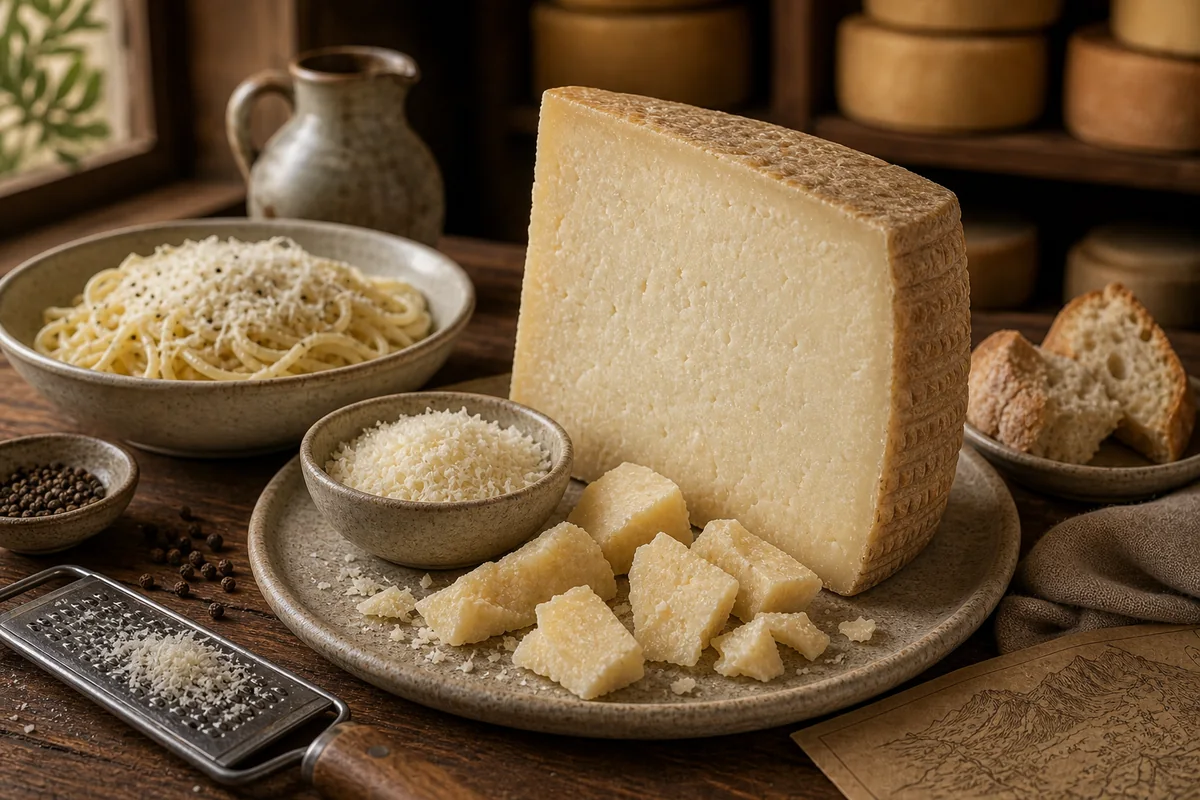
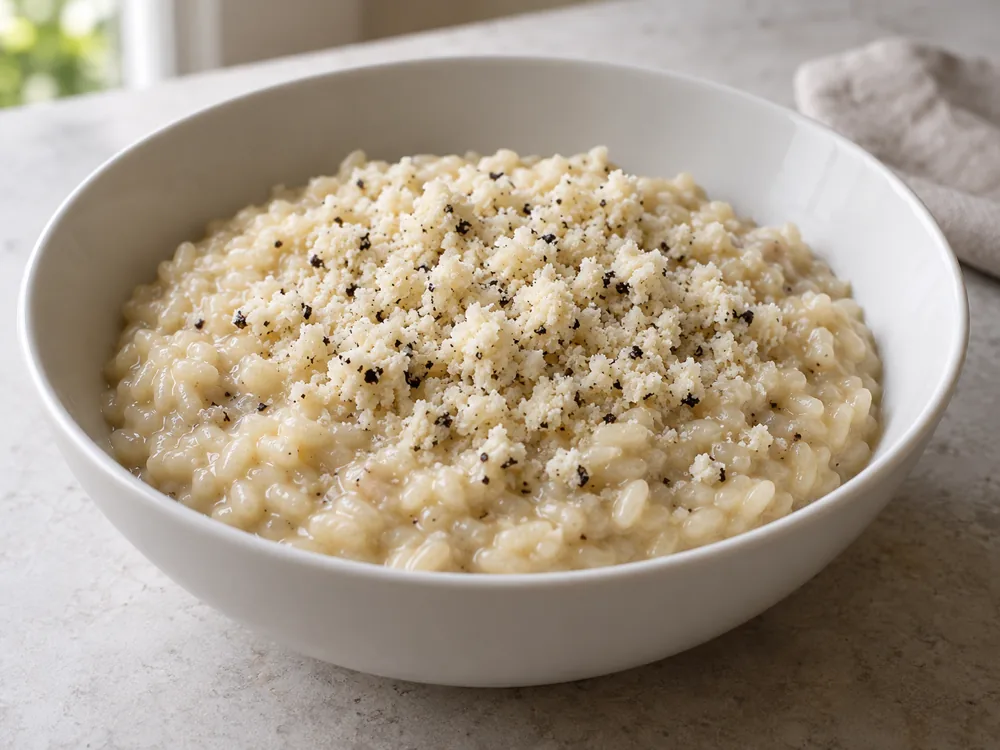
Grating is the use the catalog and Cheese.com share. The catalog describes a slightly sour, crumbly paste that is firm enough to grate over pasta, risotto or even pizza, and Cheese.com says to grate it over pizza, pastas and risottos.
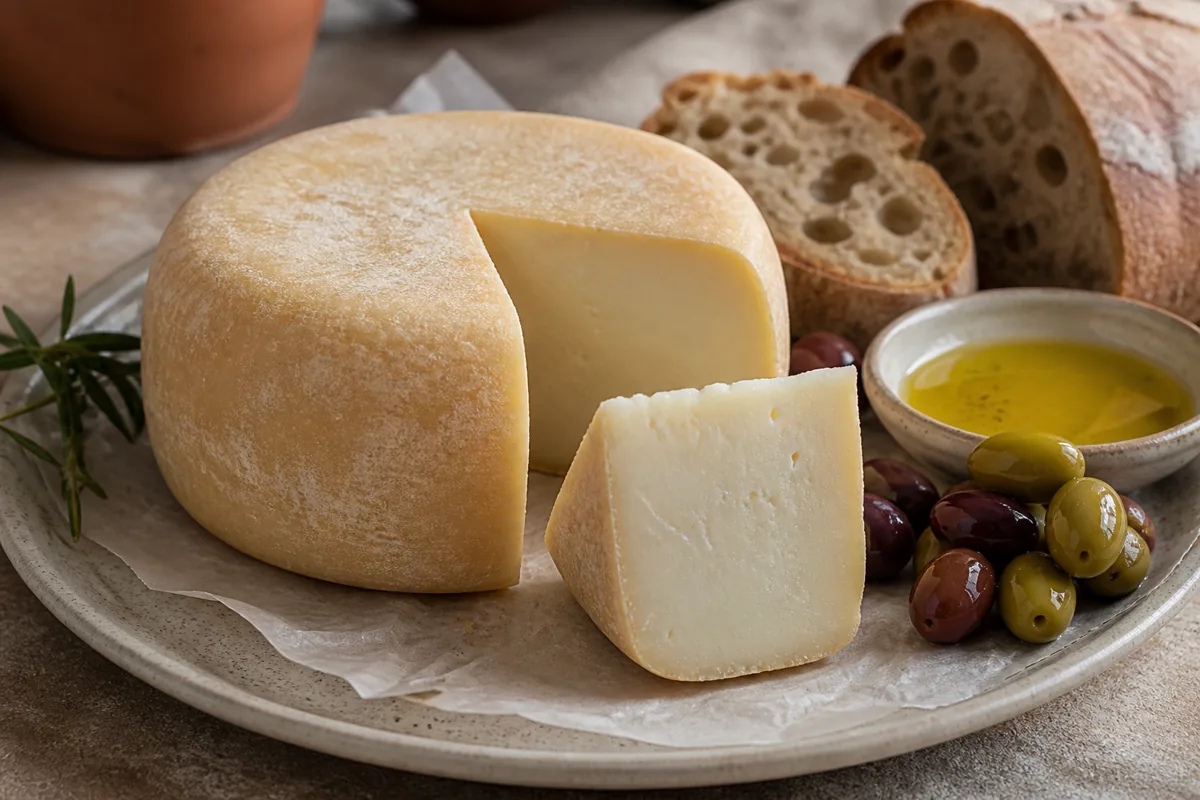
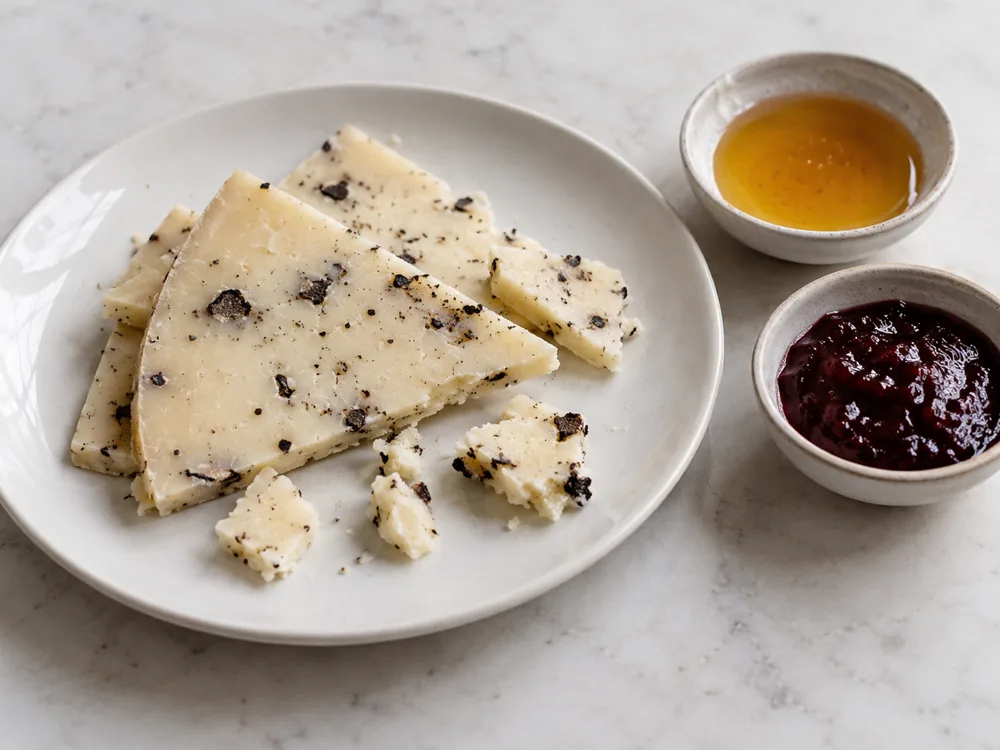
Cheese Market calls it a favorite for parties and suggests serving it on a cheese plate.
Arcibold, the Italian seller, takes a different line: it says the cheese is best eaten on its own, with eggs in a frittata as its one cooking use.
| Pairing | Why It Works |
|---|---|
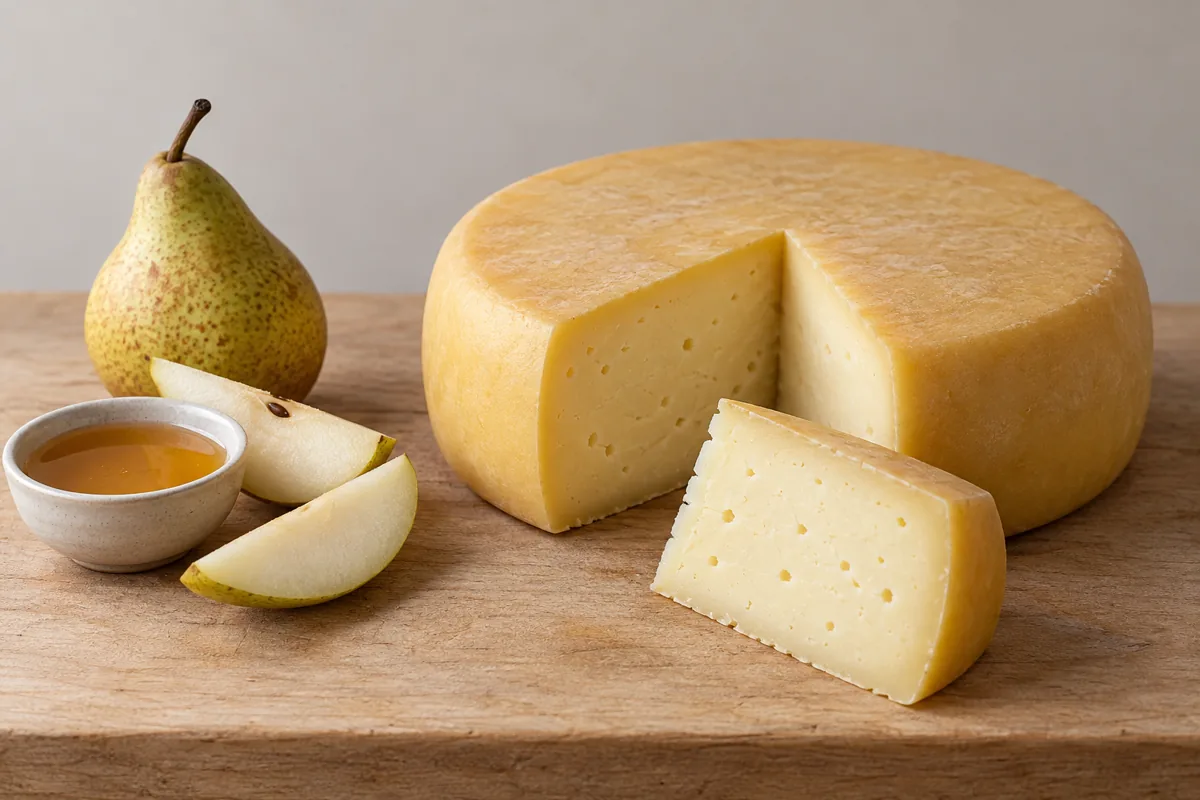
| Honey or fruit jams | Cheese Market suggests either one beside the cheese on a plate. |
| Cacio e pepe | Cheese Market names it as an indulgent pasta to grate the cheese into. |
| Salads | Cheese Market suggests shaving the cheese into them. |
| Eggs in a frittata | Arcibold lists this as the one dish the cheese can accompany. |
| Sliced | Cheesy Place calls the firm, smooth, slightly oily cheese good for grating or for enjoying sliced. |
| Apples, mandarin oranges or a mushroom tart | One customer review on Cheesy Place pairs the cheese with apples or mandarin oranges for dessert and calls it an amazing cheese for a wild mushroom tart. |
For wine, Cheese Market names Pinot Noir and medium-bodied Italian reds such as Sangiovese and Barbera, while Cheesy Place names Chardonnay, so no single wine has the support of both sellers.
Is Cacio di Bosco Safe in Pregnancy?
The catalog's price table, Cheese.com, Cheesy Place and Arcibold all list pasteurized milk. The NHS lists pasteurised or unpasteurised hard cheeses and pasteurised semi-hard cheeses as safe to eat in pregnancy.
The CDC rates hard cheese made with pasteurized milk as a safer choice and soft cheese from unpasteurized milk as riskier. It also says pregnant women are 10 times more likely to get a Listeria infection.
If you are pregnant, the open point is which of those groups this cheese falls in. Cheese.com calls it semi-firm and the catalog calls it firm enough to grate, but neither the NHS nor the CDC names the cheese, so their lists do not settle it.
Where Are the Nutrition Numbers for Cacio di Bosco?
Woolworths is the only record with a nutrition table, and it covers the product that supermarket stocks. The values below are per 100 g.
For a 25 g portion, take a quarter of those figures: about 6 g of protein, 9.7 g of fat and 205 mg of sodium.
In kilocalories, the label's 1,880 kJ converts at 4.184 kJ per kilocalorie to about 450 kcal per 100 g, or about 112 kcal in that 25 g portion.
Cheese.com lists a fat content of 55% without saying what it is measured against. Woolworths' 38.9 g per 100 g is 38.9% of the cheese's weight, so the two figures cannot be compared directly.
Which Sizes Can You Buy Cacio di Bosco In?
Whole wheels are listed at three weights: the catalog sells wheels of about 4 lb packed two to a case, Arcibold lists a whole wheel of about 1.8 kg, and Cheese Market's wheel is listed at 2 kg.
Those weights are closer than they look, because 4 lb is about 1.8 kg: the catalog and Arcibold list wheels of the same weight in different units, and Cheese Market's 2 kg is slightly heavier. Unlike the age column, the wheel column in the age table therefore marks no real disagreement.
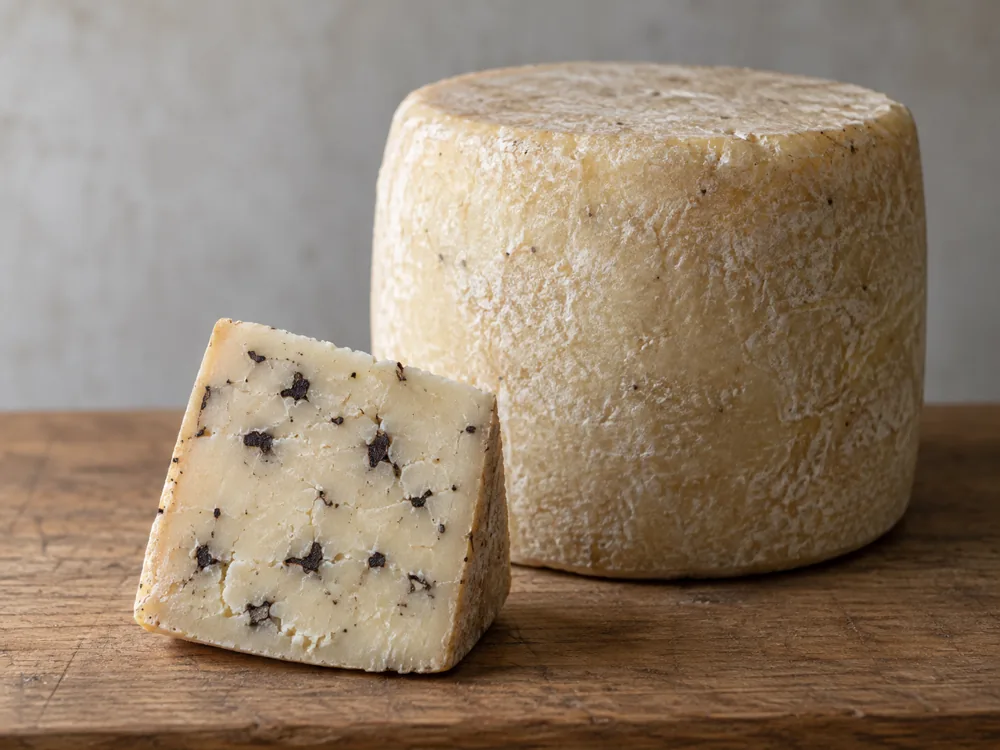
The piece you take home is much smaller. Arcibold lists a wedge of about 270 g, which is about 15% of its 1.8 kg wheel, Cheesy Place sells 250 g, and Porkewe offers 150, 200, 250, 300 and 500 g.
To size your purchase, use the 25 g portion from the label section: a 250 g wedge gives about 10 portions, and Porkewe's smallest cut of 150 g gives 6.
What Can Replace Cacio di Bosco?
The nearest match is another truffle pecorino. The catalog lists two besides Il Forteto's, each different from Cacio di Bosco in ways it states.
If you want slices, Centro Form's Pecorino Truffle Loaf from Sicily is the one the catalog calls perfect for slicing. It is a semi-soft sheep's milk cheese speckled with black truffle and aged 30 days, with a crumbly yet firm texture.
La Rustichella's pecorino from Basilicata, aged 3 months, is the one with the late-added truffle described earlier. Its catalog text calls the milk 100% raw sheep's milk while the price table lists it as pasteurized, so check the package for the milk before you buy it.
Within Il Forteto's own range, Boschetto is the softer option, described as sweet, soft and mild. If you can do without truffle, the same cooperative's Pecorino Toscano Stagionato is a semi-hard 4-month pecorino with a sweet finish and a pleasant texture, per the catalog.
The catalog also sells Pecorino Romano in a 4 oz grated cup.
SOURCES & REFERENCES
It is a sheep's milk cheese from Tuscany, made by the Il Forteto cooperative, with truffle pieces through the paste.
Records differ. The Atalanta catalog says 6 months in its product text and 4 to 6 months in its price table, while the Italian retailer Arcibold lists 90 days and Cheesy Place lists 12 months or more.
Yes. The catalog says the slightly sour, crumbly paste is firm enough to grate over pasta, risotto or even pizza, and Cheese.com names the same dishes.
The catalog's price table, Cheese.com, Cheesy Place and Arcibold list pasteurized milk. Confirm it on the package, because the CDC's safer hard-cheese row and the NHS's semi-hard row both name pasteurized milk.
The sources disagree. The catalog calls the flavor over-the-top, while Cheese Market describes a delicate truffle perfume that does not dominate the cheese.