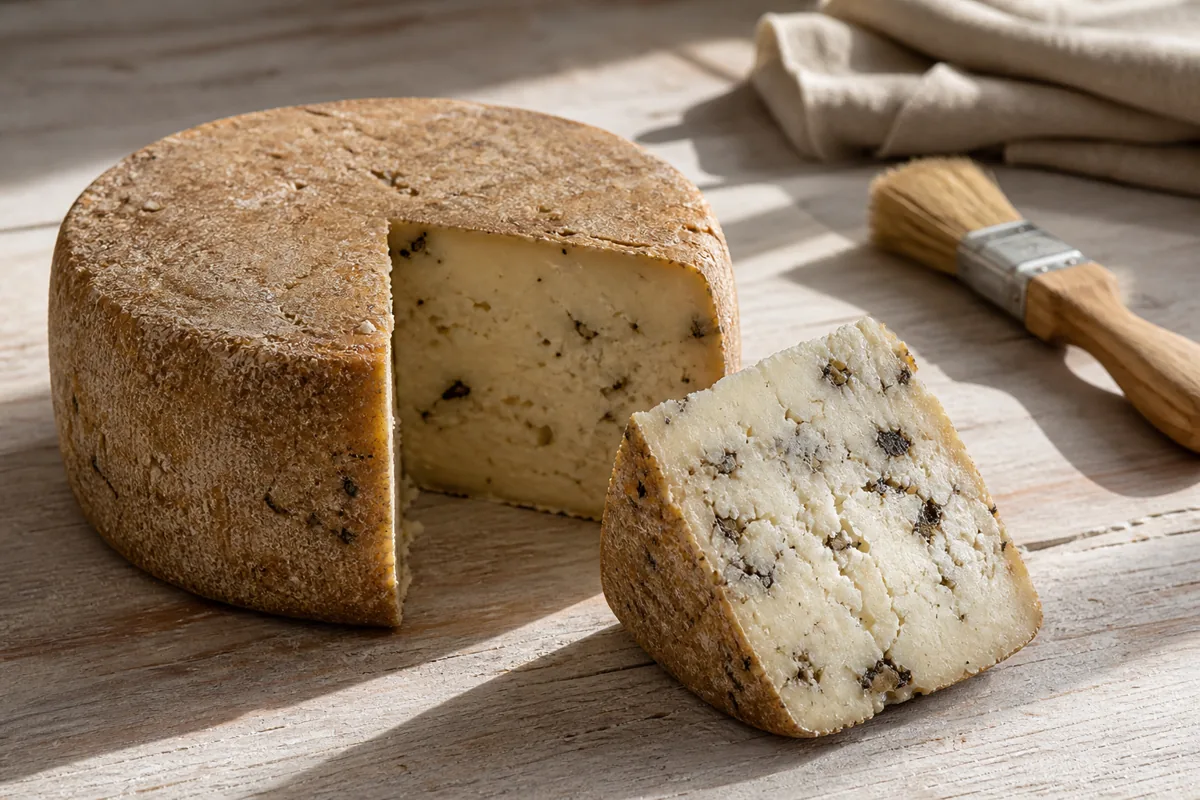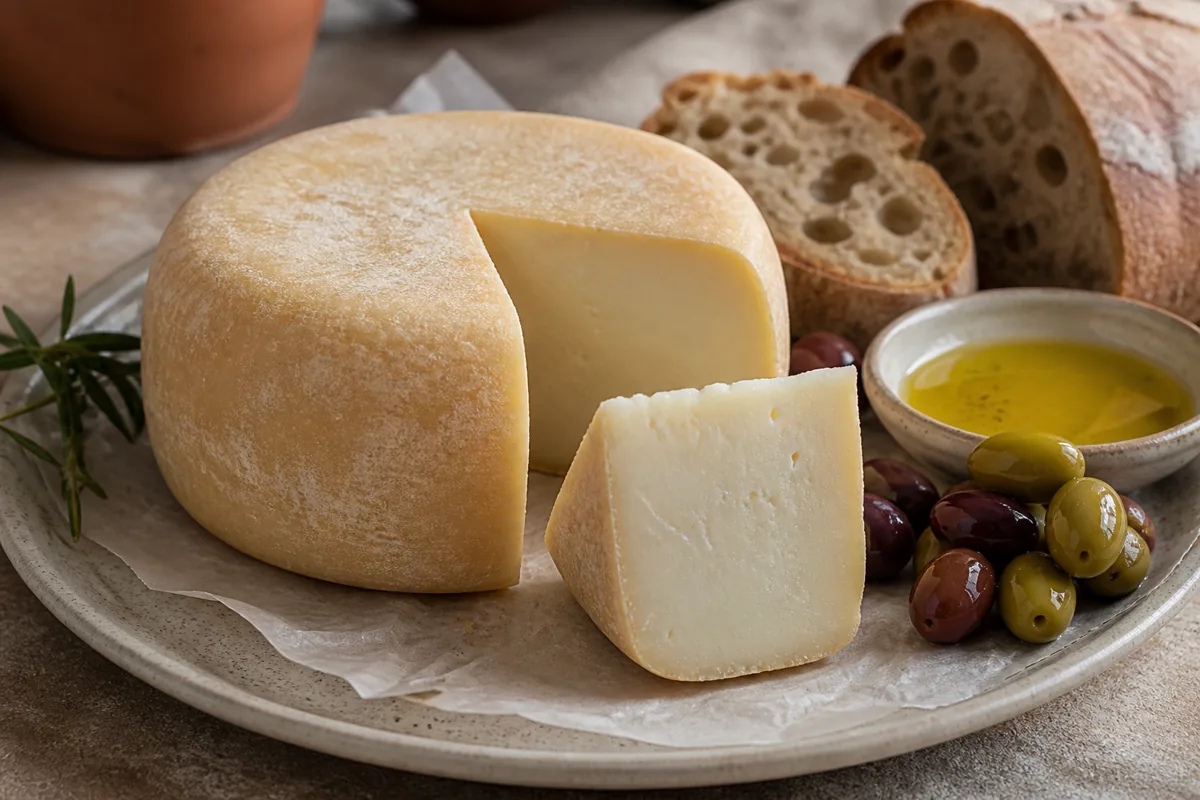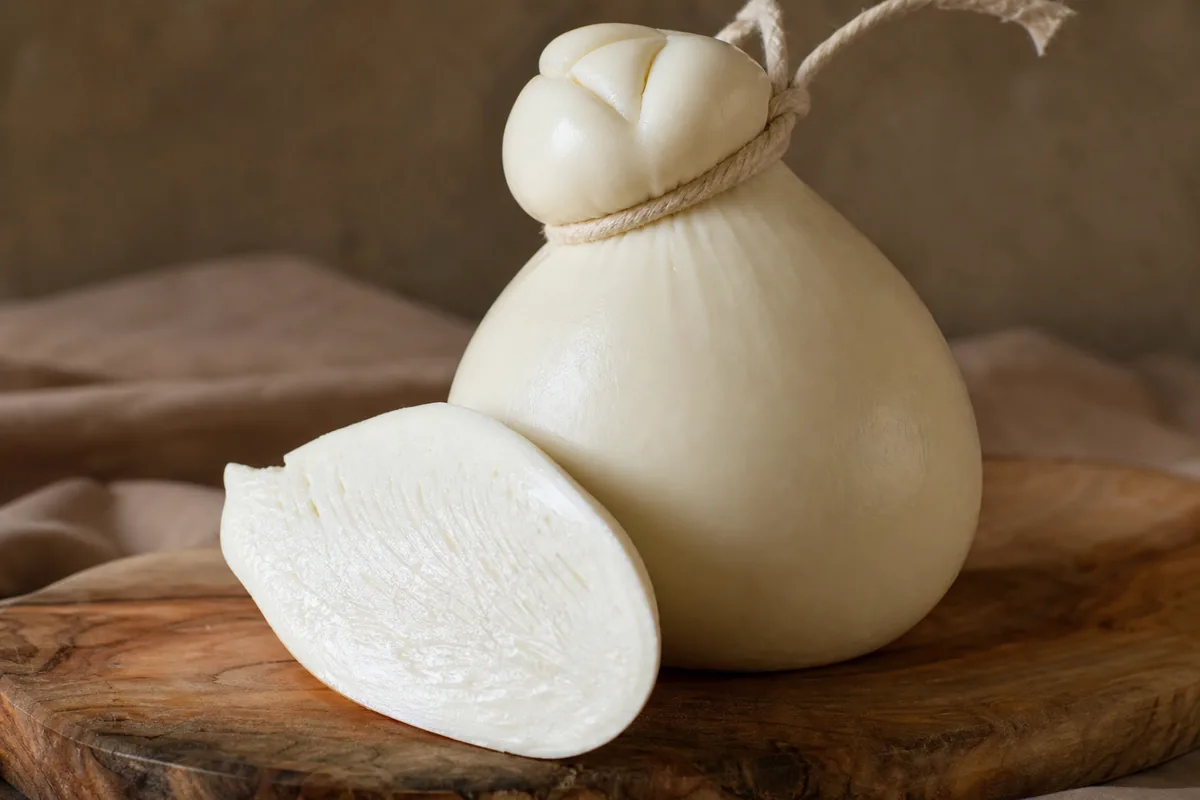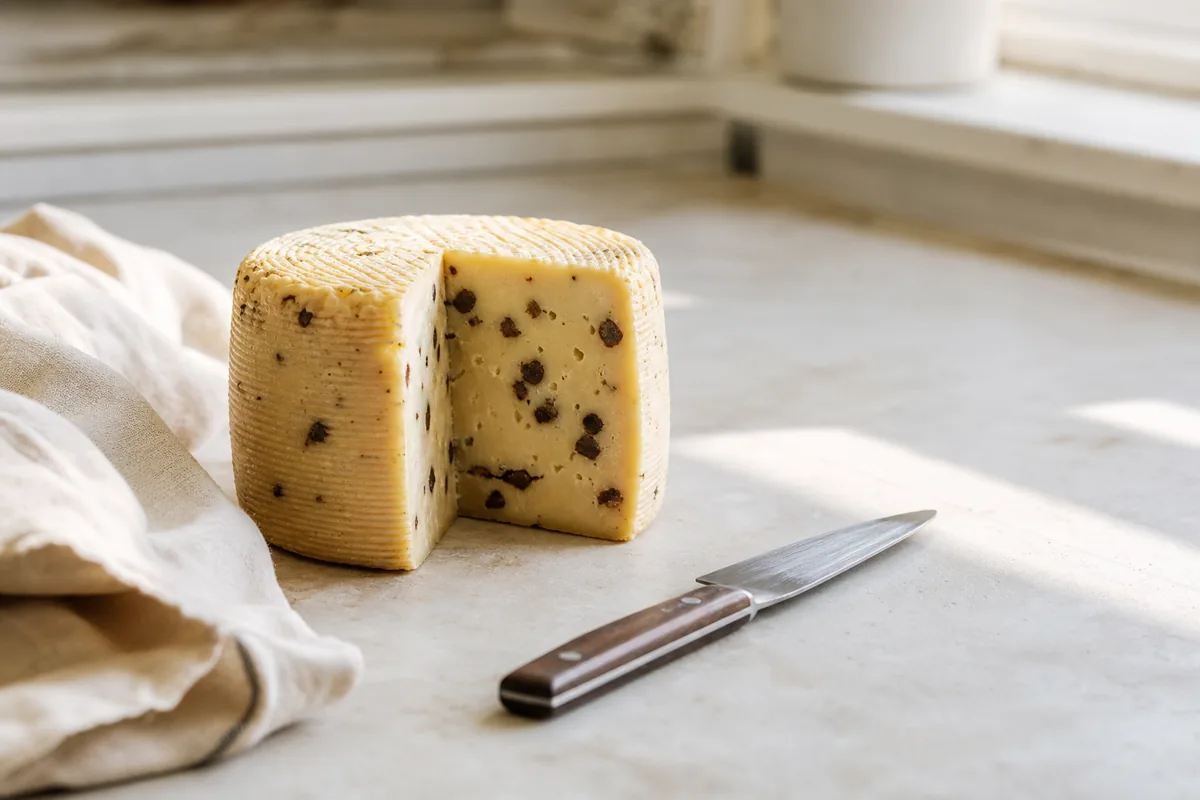
Caciotta al Tartufo is a semi-soft Italian cheese made from pasteurized cow's and sheep's milk, with pieces of black truffle mixed through the paste. Other makers use the same name, so the details here are for the Mitica version that Forever Cheese imports.
The Mitica cheese is aged 60 to 75 days and made in Lazio by Forever Cheese's account, while the retailer Williamson Wines gives one month and Umbria for the Caciotta al Tartufo it sells.
In This Article
What Is Caciotta al Tartufo?
Caciotta is a family of Italian cheeses rather than a single recipe, so the name alone does not tell you which cheese you have.
Forever Cheese files the Mitica wheel as a flavored, semi-soft cheese and gives the pronunciation as kah-CHO-tah al tar-TOO-foe. Cheese.com's alternative name, Caciotta Al Tartufo with Black Truffles, spells out the second half of the name and names the truffle as black.
The Mitica cheese comes from the countryside of Rome, where Forever Cheese says its producer blends pasteurized cow's milk with pasteurized sheep's milk from Sarda and Siciliana sheep.
The region, age and texture you read for this cheese depend on whose description you have in front of you.
| Source | Region | Age | Texture |
|---|---|---|---|
| Forever Cheese (importer) | Lazio | 60 to 75 days in the text; minimum 2 months in the product data | Semi-soft |
| GFI (distributor) | Lazio | Not stated | Semi-soft |
| Cheese.com | Umbria, Lazio | 60 to 75 days | Firm; type listed as semi-soft |
| Williamson Wines (retailer) | Umbria | One month | Semi-firm |
Forever Cheese is the importer, so its figures are the ones to go by, and its two age statements agree: two months is about 60 days, the bottom of the 60 to 75 day range.
Williamson Wines' description follows Cheese.com's closely, from the black truffle shavings to the truffle and milk combination developing the tang, with Umbria in place of Lazio and one month in place of 60 to 75 days. That overlap makes the Umbria and one-month entry look like an edited copy of a shared description rather than separate evidence for a second recipe.
If you buy from Williamson Wines, ask which maker's cheese it sells under the shared name.
How Can You Tell It Uses Real Truffle?
The ingredient list is the better test. Forever Cheese says that "most truffle cheeses are little more than a bland paste dressed up by truffle flavor" and calls this one an exception, but that is the importer's own sales line.
On our reading of label wording, a list that names the species, or plain "truffles", shows truffle as an ingredient, while one saying only "truffle flavor" or "aroma" would suggest flavouring. The two published lists for the Mitica cheese do not read the same way.
| Attribute | Forever Cheese technical sheet | GFI product record |
|---|---|---|
| Milk | Past. cow and sheep's milk | Pasteurized cow's and sheep's milk |
| Coagulant | Rennet | Rennet |
| Cultures | Not listed | Cheese cultures |
| Salt | Salt | Salt |
| Truffle | Truffles | Tuber melanosporum, min 0.5% |
| Rind | Not stated | Inedible rind |
GFI's record names Tuber melanosporum at a minimum of 0.5 percent, while the Forever Cheese technical sheet says only "truffles". Tuber melanosporum is the black truffle, also called the Périgord truffle, which matches the "black truffle" in the seller descriptions.
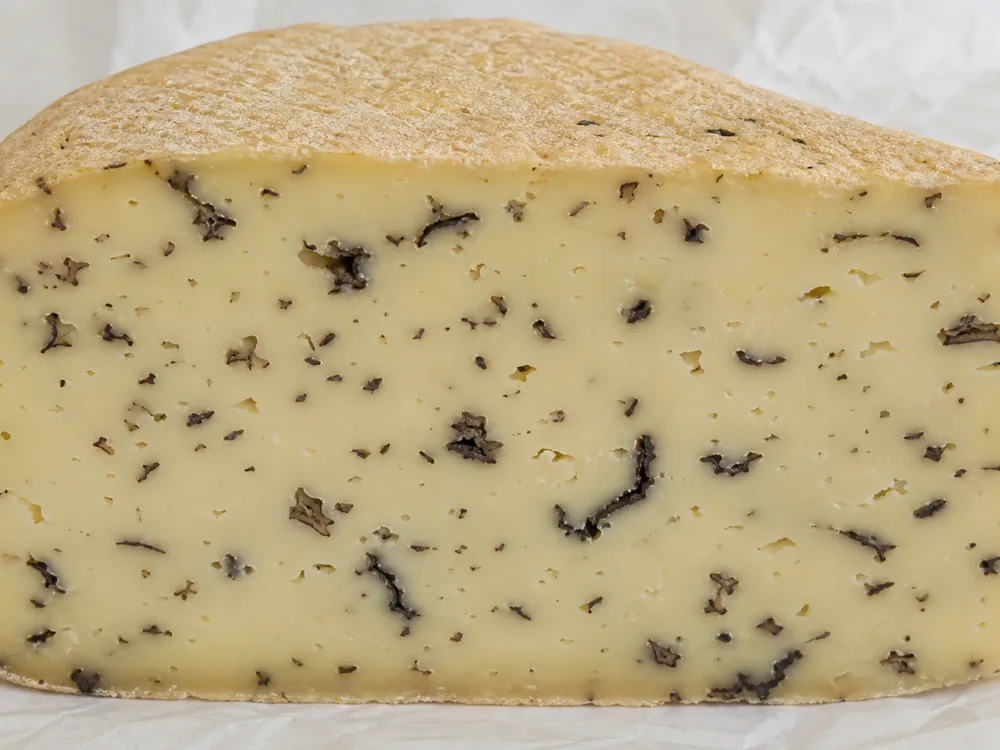
Cheese.com lists the colour as ivory and says the paste is "dotted with speckles of truffle", while Williamson Wines puts the speckles on the rind. Appearance alone does not tell you whether you are looking at real truffle or flavouring.
How Much Truffle Is in Caciotta al Tartufo, and Which Species?
In a 30 g cube like the one on Forever Cheese's panel, our arithmetic puts the 0.5 percent minimum at about 0.15 grams of truffle, and on GFI's 2 lb unit at no less than about 4.5 grams through the whole wheel.
Because the figure is a floor, the wedge you buy can hold more, and the importer's wording points that way: Forever Cheese says its producer mixes in "generous amounts" of black truffles.
The species matters because the black truffle looks very like the commercially less valuable Chinese truffle, Tuber indicum, and a genetic test was developed so that commerce could avoid fraud and misidentification.
A cut face therefore cannot show you which species is in the paste. Only GFI's list names one.
A whole black truffle is round, with a dark brown-black skin covered in small pyramidal cusps, and its flesh is white at first and then dark, crossed by white veins that turn brown with age.
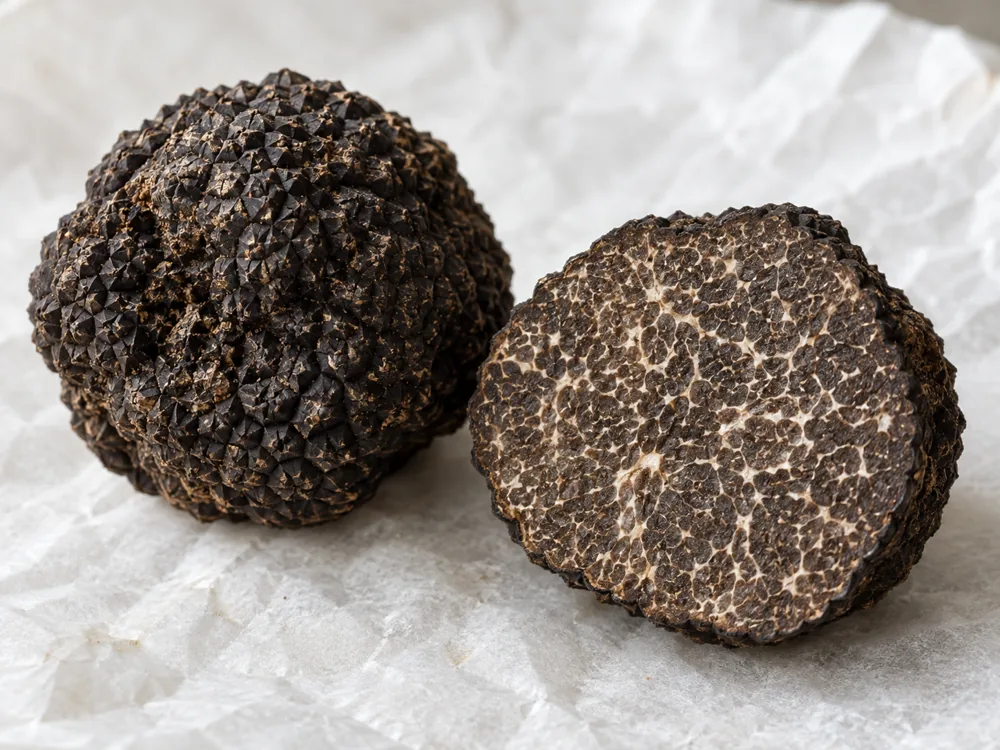
If you want to know where the truffle comes from, GFI's specification line, "with black truffles from Lazio, Italy", can be read as naming the truffles' origin or only the cheese's. Italy accounts for about 20 percent of black-truffle production, behind France at 45 percent and Spain at 35 percent.
What Does Caciotta al Tartufo Taste Like?
Cheese.com describes a spicy, tangy flavour with an earthy aroma, while Williamson Wines goes the other way on strength, calling the paste "mild and gentle" with "earthy flavors".
Both agree on earth, so earthiness is the note you can count on, while the strength of the rest changes from one description to the next.
Wikipedia describes the black truffle's own scent as undergrowth, strawberries, wet earth or dried fruit with a hint of cocoa, which gives one reason sellers reach for "earthy".
Cheese.com and Williamson Wines both credit the tang to the truffle and milk combination developing during maturation.
Texture labels also differ: Forever Cheese and GFI say semi-soft, Williamson Wines says semi-firm, and Cheese.com lists firm.
Cheese.com lists the rind as natural, and GFI's ingredient list ends with "Inedible Rind". Cut the rind away before you eat or grate the cheese.
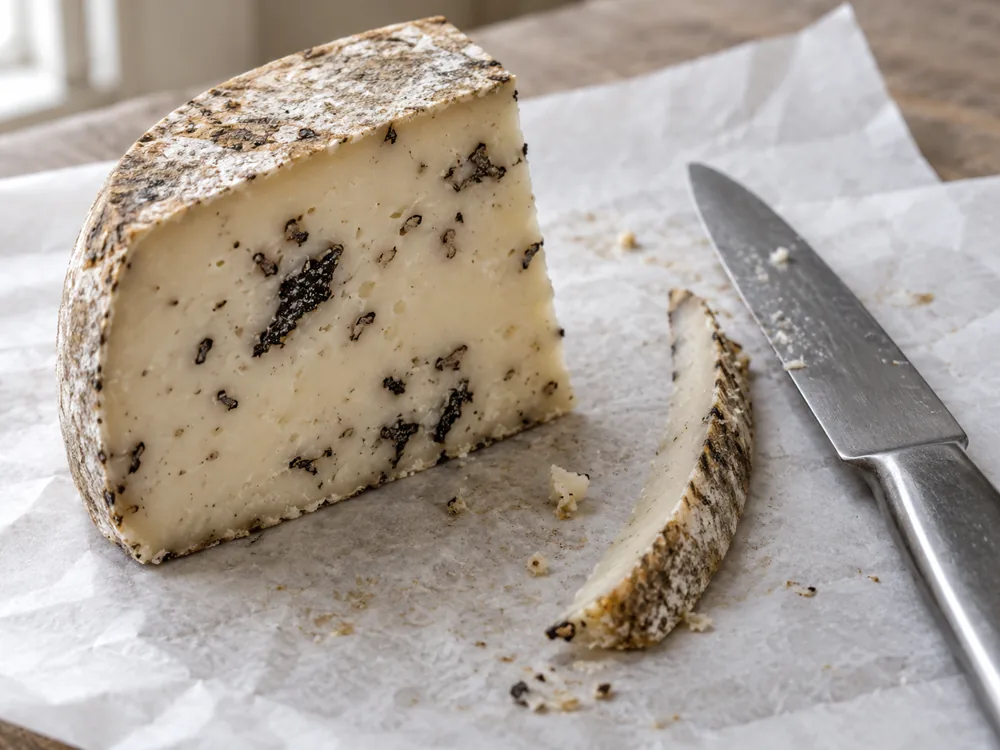
What Should You Pair or Cook with Caciotta al Tartufo?
For a drink, Williamson Wines matches the cheese's "earthy flavors" with a red wine, its own Rapture and Passion Pinot Noir.
Cooking changes black truffles themselves: Wikipedia's entry on Tuber melanosporum says their aroma "does not diminish when they are heated but becomes more intense".
The same entry says black truffles taste slightly peppery and bitter when heated, and that cooks use them to refine meat, fish, soups, cheeses and risotto.
That finding describes the fungus, not this cheese. Add a small amount to hot food and taste before adding more.
Can Cacio di Bosco or Sottocenere Replace Caciotta al Tartufo?
Two other Italian truffle cheeses, Cacio di Bosco al Tartufo and Sottocenere al Tartufo, each differ from Mitica's in milk, texture or rind.
| Cheese | Milk | Texture and rind | Flavour and colour | Truffle and other notes |
|---|---|---|---|---|
| Cacio di Bosco al Tartufo | Pasteurized sheep's and cow's milk | Semi-firm, crumbly and firm; Tuscany | Nutty, sour, sweet with a strong aroma; ivory | Tiny dark truffle specks; suits grating over pizza, pasta and risotto |
| Sottocenere al Tartufo | Pasteurized cow's milk | Semi-soft with a natural rind; Veneto | Creamy, salty, savory with an aromatic, spicy aroma; pale yellow | Black truffles in the paste; aged in ash for three months with spices on the rind |
On our reading of the listed attributes, Cacio di Bosco is closest on milk and truffle and Sottocenere on texture and rind, and neither matches Mitica on every point.
If your dish needs grated truffle cheese, Cheese.com's description points to Cacio di Bosco, and if you want slices eaten alone, it points to Sottocenere.
Tuscan Cacio di Bosco shares the two milks and the dark specks, but Cheese.com calls it crumbly and firm. Its flavour is a sweet, nutty, nearly caramelized sheep's milk set against a strong truffle aroma, a different balance from Mitica's spicy and tangy descriptions.
Cheese.com says its firm, smooth and oily texture suits grating over pizza, pasta and risotto.
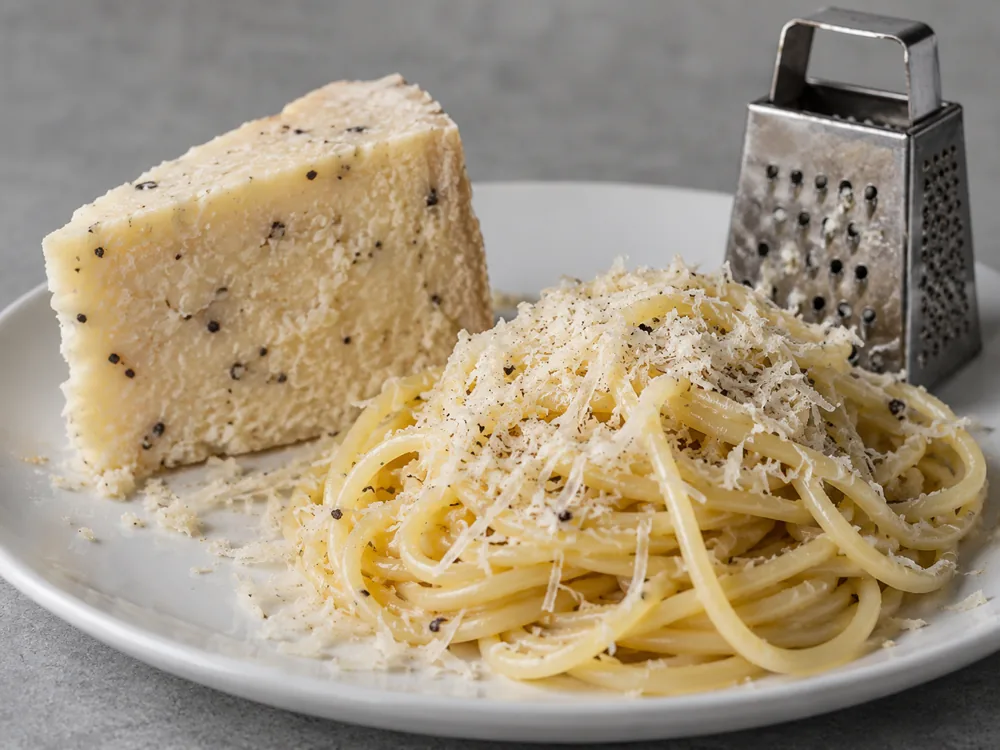
Cheese.com names Cooperativa Agricola Il Forteto as the producer and gives a fat content of 55 percent. Before you set that against Mitica's panels, which give fat in grams per serving, ask the seller what the 55 percent is a share of.
Sottocenere al Tartufo matches the semi-soft texture and natural rind but uses cow's milk alone, and Cheese.com describes it as pale yellow, creamy and salty.
The rind is where it differs most: Cheese.com lists nutmeg, coriander, anise, cinnamon, licorice, cloves and fennel on it, along with a green leaf, and says they retain the cheese's aroma.
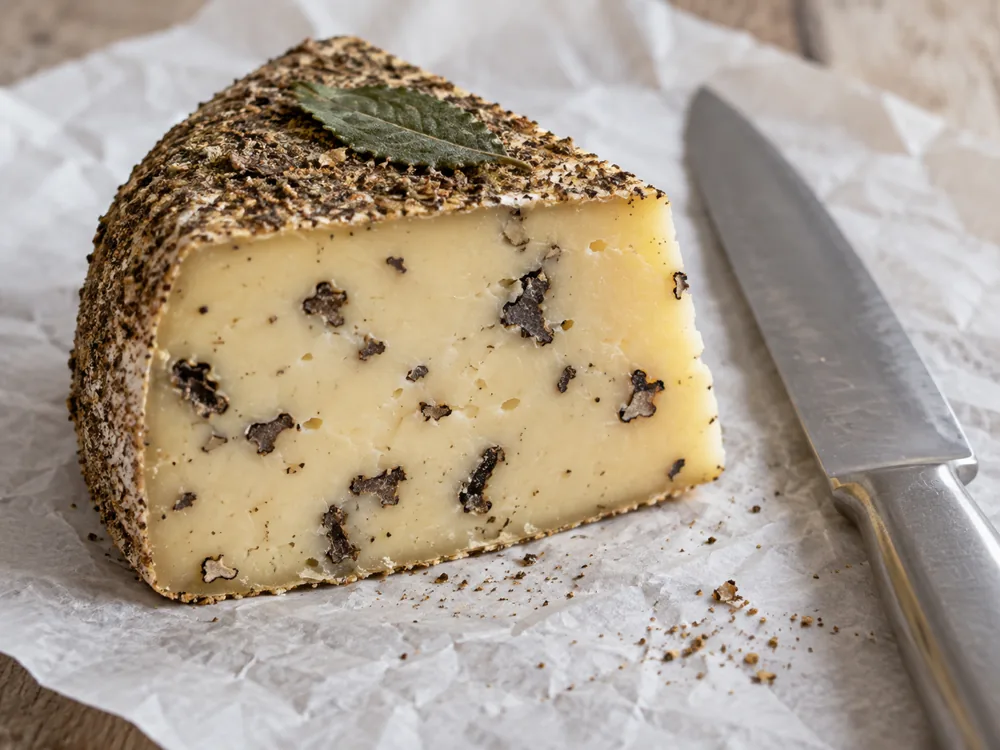
Cheese.com calls Sottocenere best appreciated on its own and names sparkling wine or an Italian Barbera as pairings, where Williamson Wines pairs the Caciotta al Tartufo it sells with a Pinot Noir.
Where Can You Buy Caciotta al Tartufo, and How Do You Store It?
Forever Cheese tags the cheese "Exclusive to Forever Cheese" under the Mitica brand. A wedge sold under another maker's name is therefore a different cheese, even when the name matches.
When you shop, look for the Mitica name, pasteurized cow's and sheep's milk and truffle named on the ingredient list.
Forever Cheese lists a 6/3lb case pack and GFI a 6/2 lb pack. Reading each as six pieces per case, Forever Cheese's piece is 3 lb (about 1.4 kg) and GFI's wheel 2 lb (about 0.9 kg), which fits the 32 one-ounce servings per container on GFI's panel.
For the weight of a retail wedge, check the shop's label, and follow the label and date on your piece for storage and shelf life.
What Do the Caciotta al Tartufo Nutrition and Safety Labels Show?
Forever Cheese's technical sheet and GFI's product record each print a nutrition panel for the Mitica cheese, with different serving sizes and different numbers. Sodium shows the widest gap, at 74 mg per 30 g in one and 200 mg per ounce in the other.
| Nutrient | Forever Cheese technical sheet (30 g cube) | GFI record (1 oz) |
|---|---|---|
| Calories | 111 | 100 |
| Total fat | 9 g | 7 g |
| Saturated fat | 7 g | 4 g |
| Cholesterol | 24 mg | 25 mg |
| Sodium | 74 mg | 200 mg |
| Total carbohydrate | 0 g | 1 g |
| Protein | 7 g | 7 g |
| Calcium | 17% of Daily Value | 0 mg |
Scaling GFI's ounce up to 30 g, our arithmetic gives about 106 calories, 7.4 g of fat, 4.2 g of saturated fat, 26 mg of cholesterol and 212 mg of sodium. Calories, cholesterol and protein then land within about 10 percent of Forever Cheese's figures, while saturated fat differs by roughly 1.7 times and sodium by about 2.9 times, so the different serving sizes do not explain the gap.
Calcium disagrees as well, at 17 percent of the Daily Value on the Forever Cheese sheet and 0 mg on GFI's record. GFI says product formulations can change and nutritional values can vary, and the Forever Cheese sheet was uploaded in 2013 according to its web address, so the age of a panel may be one reason.
GFI's record lists milk as the allergen. Both ingredient lists name rennet; if you need vegetarian rennet, check with the producer.
Switching to Sottocenere al Tartufo does not settle the question either, since Cheese.com marks it as not vegetarian.
Both panels list 0 g of sugars, which is a rounded serving figure rather than a lactose-free claim.
Forever Cheese and GFI both list pasteurized milk, a condition the NHS and the CDC both name in their advice on soft cheese in pregnancy.
The NHS lists pasteurised or unpasteurised hard cheeses, pasteurised semi-hard cheeses and pasteurised soft cheeses as safe to eat. Served cold, Caciotta al Tartufo is described as a pasteurized semi-soft, semi-firm or firm cheese, a type the CDC list does not cover, so ask a midwife or doctor.
SOURCES & REFERENCES
Which Questions Come Up Most About Caciotta al Tartufo?
Forever Cheese and GFI list pasteurized cow's and sheep's milk for the Mitica cheese.
Forever Cheese says 60 to 75 days with a minimum of two months, and Cheese.com also gives 60 to 75 days. Williamson Wines says one month.
GFI's ingredient list names Tuber melanosporum at a minimum of 0.5 percent, and the Forever Cheese technical sheet lists truffles. Neither list includes truffle flavouring.
GFI's ingredient list calls the rind inedible, so cut it away.
GFI's ingredient list gives a minimum of 0.5 percent Tuber melanosporum, which is about 0.15 g in a 30 g piece, and a wedge can hold more.
Forever Cheese gives the pronunciation as kah-CHO-tah al tar-TOO-foe.
No. Williamson Wines lists it in Umbria, while Forever Cheese places the Mitica cheese in Lazio, so check the maker before applying these specifications.
Sellers list pasteurized milk. Follow current NHS, CDC or local guidance for soft cheese.