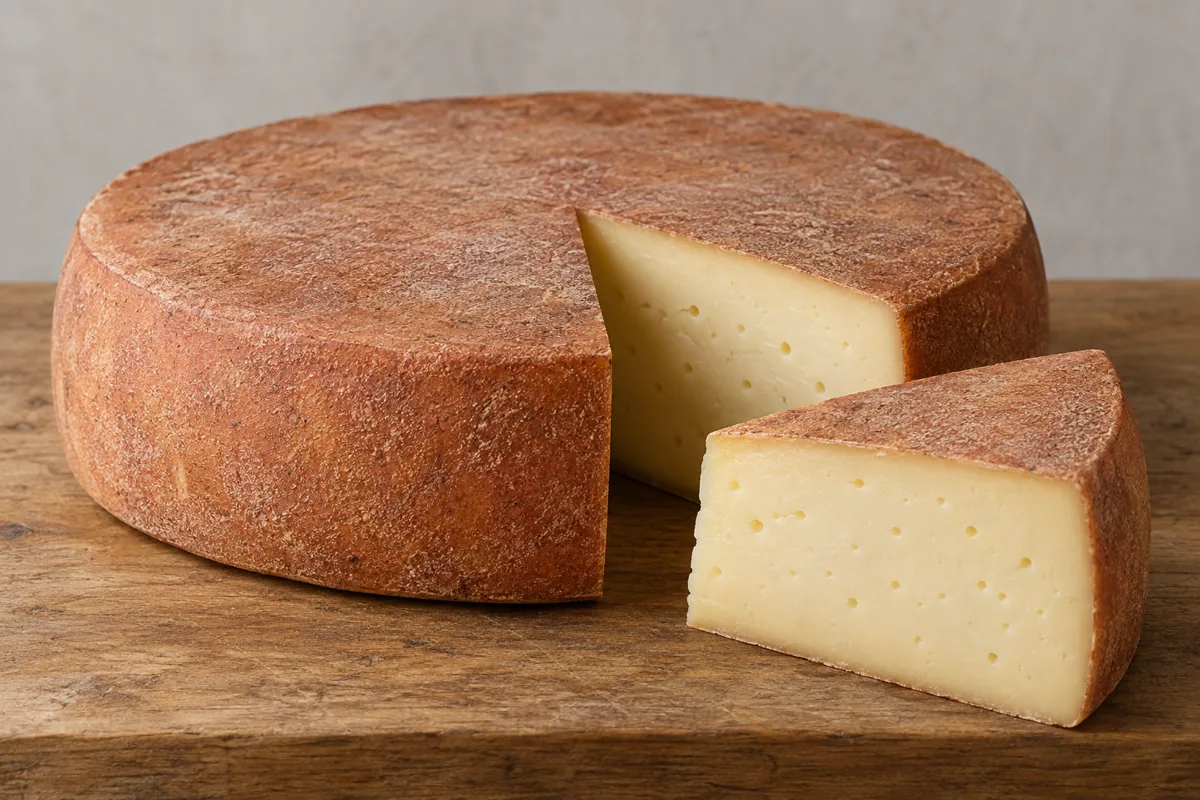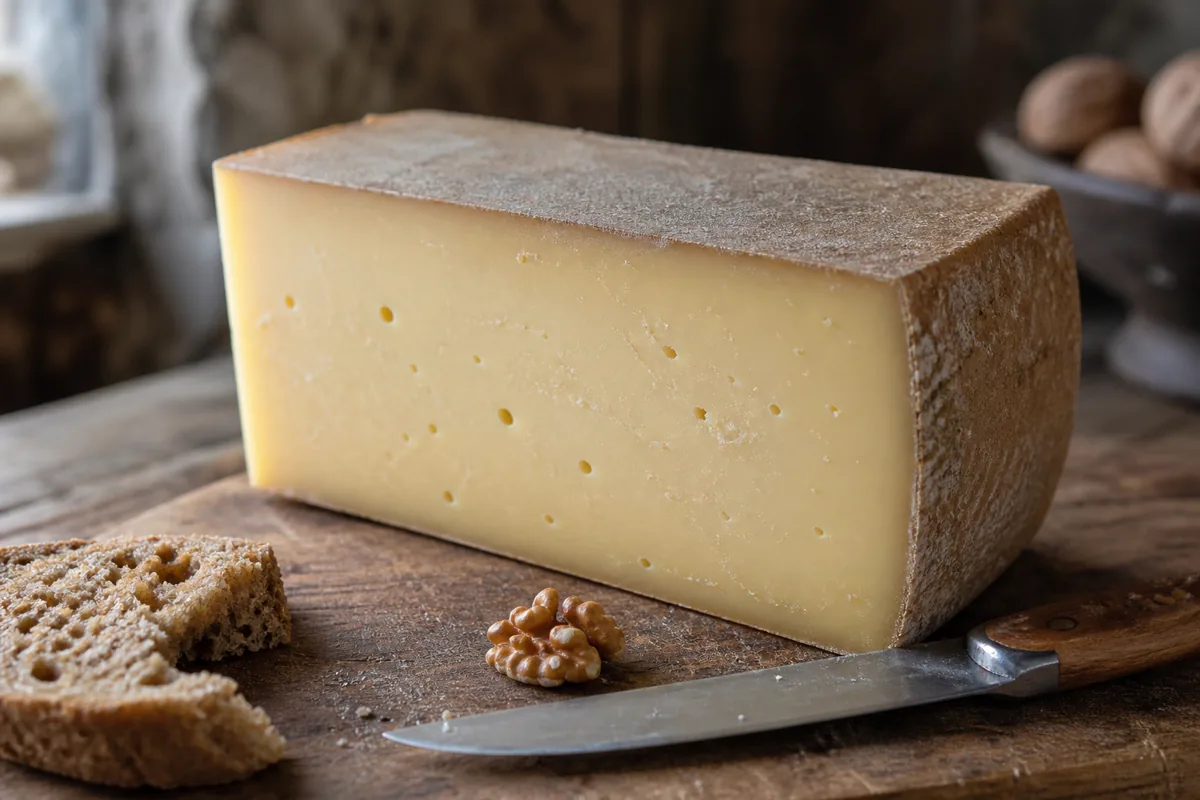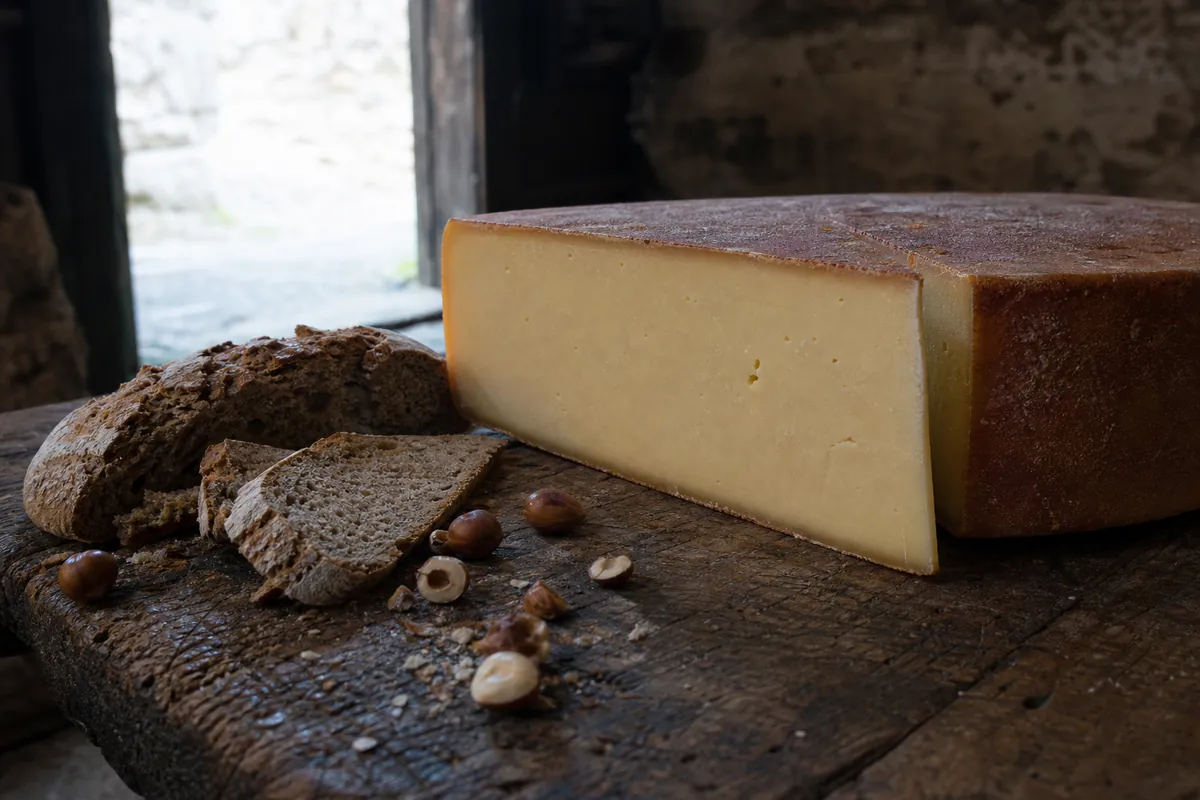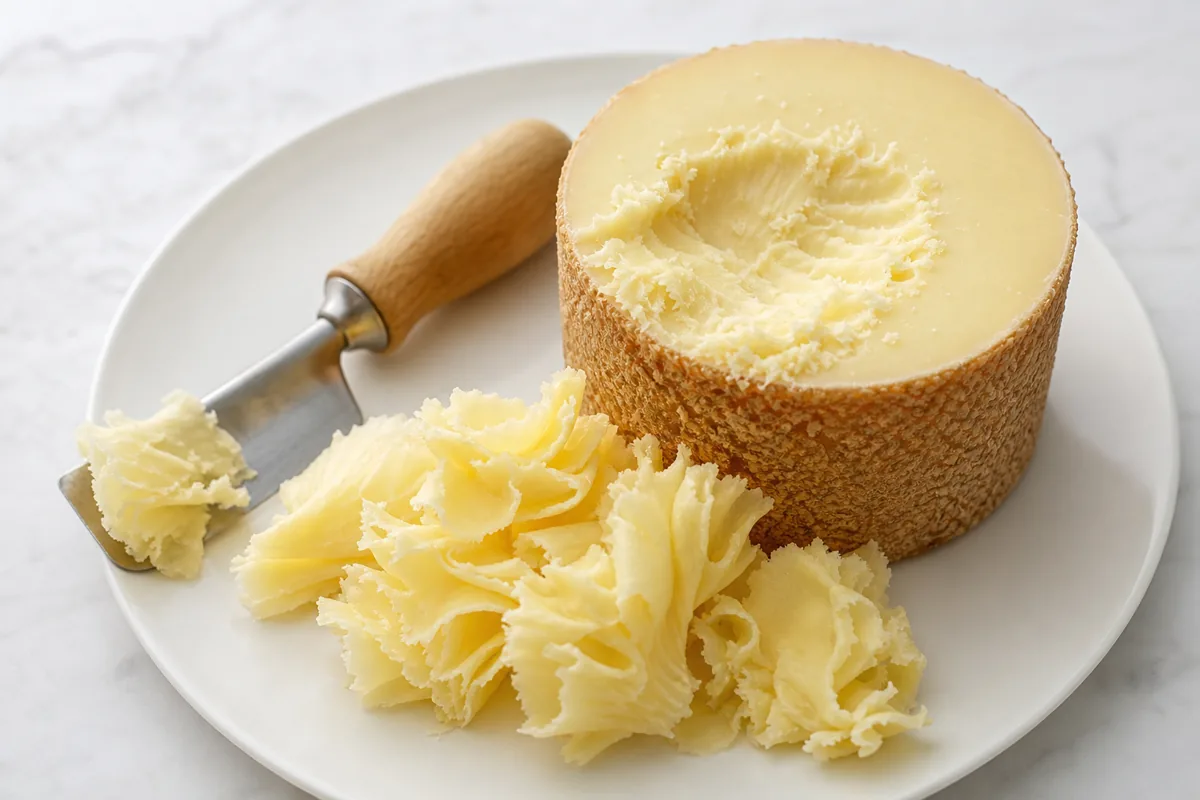
Tete-de-Moine is a cylindrical, semi-hard cheese from the Swiss Jura, and it is made to be shaved into thin rosettes instead of sliced. One reason given is flavour: Cheeses from Switzerland says paring it lets the flavour develop to its fullest.
The Swiss specification calls it a full-fat cheese made from raw milk, and that raw milk is the fact to weigh if you are pregnant.
In This Article
What Is Tete-de-Moine?
Tete-de-Moine AOP, registered as Tete de Moine, Fromage de Bellelay, may only come from the mountain districts of Franches-Montagne, Porrentruy and Moutier, the commune of Saulcy, and the Bernese Jura, minus five named communes.
The Federal Office for Agriculture specification describes a cylinder 10 to 15 cm across, with a height of 70 to 100 percent of its diameter, so a cylinder 12 cm across stands between 8.4 and 12 cm tall. The Cheese Scientist gives 10 to 15 cm for height as well as diameter.
A typical cylinder weighs around 800 grams, about 1.75 pounds, by Cheeses from Switzerland's and the Cheese Scientist's count, toward the bottom of the 0.7 to 2 kg the specification allows, while Williamson Wines says its cylinders weigh one to two pounds, about 0.45 to 0.9 kg.
That retailer range falls partly below the specification's 0.7 kg minimum, and the specification, not the retailer's range, decides what may carry the name.
Bellelay cheese was renamed Tete de Moine towards the end of the 18th century, with the first archive mention from around 1793 to 1799. The producer offers two explanations for the name: a revolutionary-era nickname comparing the shaving to a monk's tonsure, or cheeses being counted per monk's head in the abbey's store.
The older name survives in the registered one, Tete de Moine, Fromage de Bellelay. The abbey's monks were first mentioned in connection with cheese in 1192, when they paid the annual rent on various properties with cheese made in the abbey.
The oldest description of the Bellelay cheese, from 1628, speaks of very fat milk of impeccable quality from the best grasses and herbs of the country. Today's specification still ties the cheese to full-fat raw milk from cows fed on grass and hay.
The abbey did not outlast the French Revolution: the monks were evicted in 1797, yet the cheese kept being made in the dairies of the former abbey. Production later moved from farms to village dairies and rose from 27,000 kg in 1950 to 1,560 tons in 1999.
Fewer than 10 village creameries make it today, and all of them work to the same specification, so whichever dairy made the wheel you buy, the rules in the sections below apply to it.
The girolle used to shave it dates from the early 1980s: the producer's history page says Nicolas Crevoisier invented the Girolle in 1981, while the Cheese Scientist gives 1982 and places the invention in Lajoux in the Swiss Jura.
What Does Tete-de-Moine Taste Like?
Tete-de-Moine tastes of acidified milk with a faint taste of rind and hay, moderately salty and slightly tangy, in the Swiss specification's words, and La Fromagerie SF, Williamson Wines and the Cheese Scientist all call it nutty.
| Source | What it says |
|---|---|
| Swiss specification (2026) | Pure, aromatic smell, with a faint smell of rind and mushrooms; taste of acidified milk with a faint taste of rind and hay, moderately salty and slightly tangy |
| La Fromagerie SF (retailer) | Rich, nutty flavour with notes of butter, fresh cream, hay and a delicate hint of spice |
| Williamson Wines (retailer) | Aromatic, gently nutty flavour |
| The Cheese Scientist (cheese blog) | Earthy, nutty aroma, with savoury and slightly sweet notes and a lingering richness |
Age changes the flavour in two of these descriptions: the specification says the aroma is more pronounced as the cheese matures, and La Fromagerie SF says the nutty flavour develops as it matures.
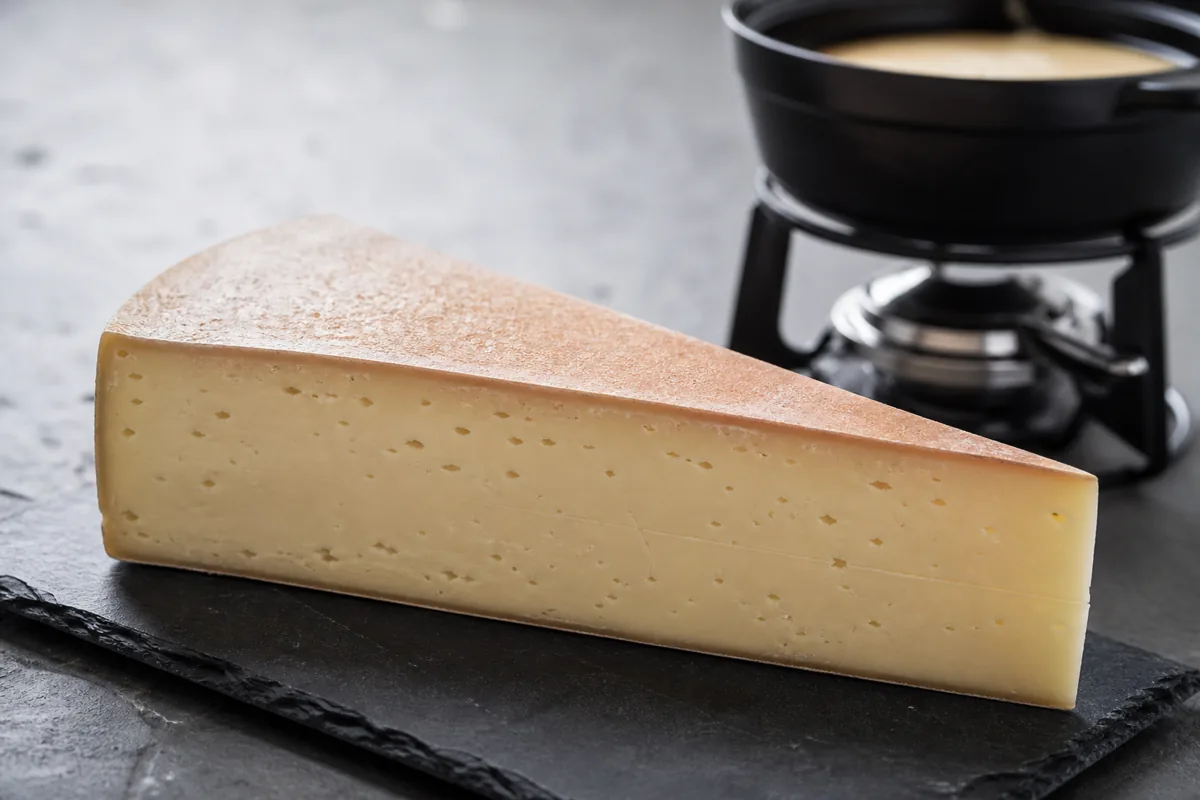
If you see a cut face full of holes, it falls outside the specification's texture description, which calls the paste fine, slightly moist and sticky, with openings of 1 to 8 mm that are rather rare, small and isolated cracks.
Salt is capped at 25 grams per kilo of cheese, which is 2.5 grams per 100 grams.
Why Do Rosettes Change How Tete-de-Moine Tastes?
A girolle pares the cheese instead of cutting it, and Cheeses from Switzerland says that increases the area in contact with the air, which changes the structure of the cheese and lets the flavour develop to its fullest. It adds that the result has a very fine consistency that melts in the mouth.
Williamson Wines makes the same air-contact claim for its pre-cut tray rosettes, which the specification allows to carry the name.
The Cheese Scientist gives a second, mechanical reason, saying the gentle rotation of the blade puts little pressure on the cheese, so it does not crumble or lose its suppleness.
Shaving is part of the product itself: rosettes made with a girolle or a similar device must remain compact.
The specification protects the word 'rosette' when it is used with the designation, and it says Tete-de-Moine is not usually sliced but shaved with a girolle or similar device.
How Do You Use a Girolle?
Shave it cold: Cheeses from Switzerland and the Cheese Scientist, a cheese blog, both say to shave it as soon as you take it out of the refrigerator.
The Cheese Scientist's serving advice points the other way, saying to let the cheese reach room temperature to bring out its full flavour, even though its own steps start with cheese straight from the fridge.
The steps below come from the Cheese Scientist.
- Take the cheese straight from the fridge. A cold cheese is slightly firmer, which helps the blade.
- Cut the wheel in half horizontally. This matches the height of the cheese to the girolle.
- Check the blade. It should be sharp, and the thickness can be set to the rosette you prefer.
- Press the half onto the spike. Hold it with the uncut rind at the bottom and press gently.
- Rotate the blade. Press it gently onto the cheese and turn, and rosettes start to form.
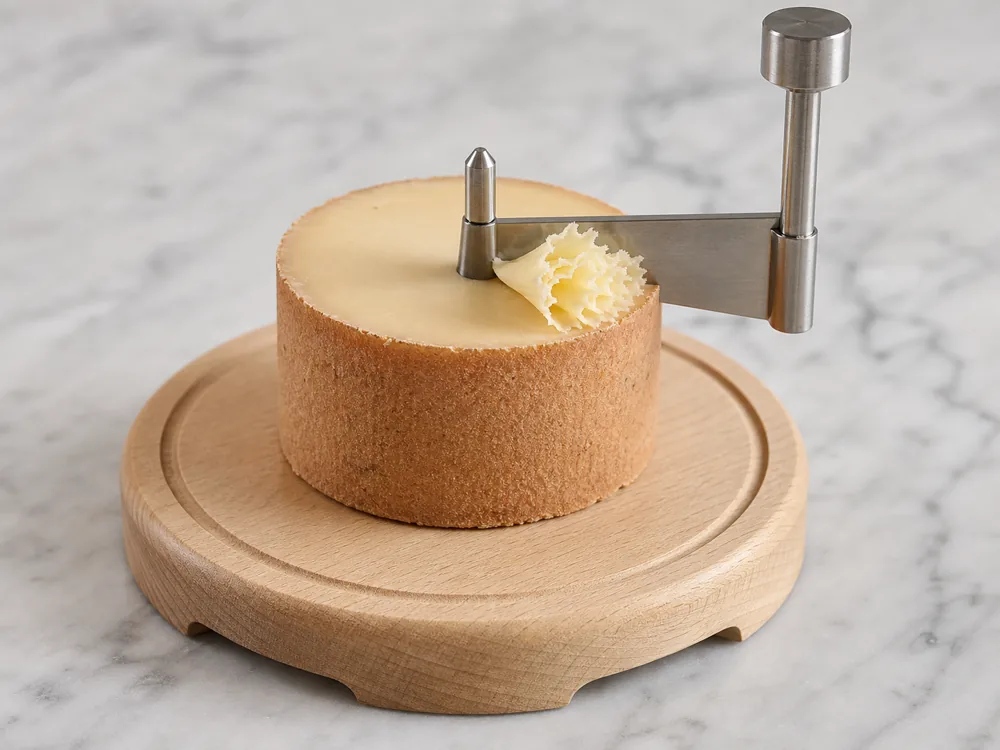
A girolle is a round wooden base carrying a stainless steel knife, and the original maker, Girolle Originale, has sold more than 3 million of them.
You can use a girolle on other cheeses too: the Cheese Scientist says it suits any cylindrical cheese of similar size, naming Tomme de Chèvre, Petit Basque and small Pecorino.
If you have no girolle, the Cheese Scientist suggests a cheese plane or vegetable peeler for thin slices that you curl by hand, or a sharp knife with the slices stacked and rolled into a rosette.
You also do not have to shave it yourself, because the specification lets the name cover rosettes pre-packaged in trays, and Williamson Wines sells them in a 3.5-ounce flower-shaped container as a way to skip the tool.
Which Tete-de-Moine Label Should You Choose?
Choose by the minimum age you want: under the specification, every wheel must mature at least 75 days in the production area, cheeses matured at least four months may be labelled Reserve, and those matured at least six months may be labelled Extra.
| Label | Minimum maturation |
|---|---|
| No banner word | At least 75 days, about 2.5 months (the floor) |
| Reserve | At least 4 months |
| Extra | At least 6 months |
| Fermiere | 100 days minimum |
When a pack carries Reserve, Extra or Fermiere, the word sits in the banner at the bottom of the official logo. Reserve or Extra gives you a minimum age rather than a measured one.
If you want a farm-made cheese, look for Fermiere, which adds farm rules on top of age. The milk must come from the producer's own farm and from cows reared to Swiss organic rules and not dehorned, and a wood-fired copper vat of up to 500 litres makes the cheese between April and October.
Grazing must also supply at least 75 per cent of the dry-matter ration. The make differs from the standard cheese as well: Fermiere uses whole, not skimmed, milk, the vat is used only once every 24 hours, the curd is heated to 44 to 53°C instead of 46 to 53°C, cloths lift the curd out, and brining happens at the place of production.
Age is the only difference the specification sets between the plain cheese, Reserve and Extra: at least 75 days, four months and six months. Fermiere is a separate farm-made label with its own milk, vat and 100-day minimum.
Do Tete-de-Moine Cows Follow Special Feed Rules?
Yes: under the specification, cows must graze at least 120 days during the green feeding period, and silage of any kind, including wrapped bales, is banned all year. Roughage must make up at least 70 percent of the annual ration and come from the AOP area.
The specification also bans somatotropin, urea, animal meal, growth hormones and feed made from genetically modified plants.
In the green feeding period the permitted fodder includes grass, cereals harvested green including maize, vetch mixtures, rape, turnips, cleaned potatoes and healthy pome fruit, and fresh beet leaves fed within 24 hours of harvest.
From 1 December until the next green feeding period begins, that fodder is off the menu apart from potatoes and fruit. The basic ration then is hay and aftercrop that must be healthy and not excessively fermented or mouldy, with cooking salt the only preservative allowed.
Cheeses from Switzerland credits the rich grass the cattle feed on for the cheese's strong, unique flavour, and it describes the milk as silage-free.
How Is Tete-de-Moine Made?
Dairies receive milk once or twice a day from farms a few kilometres away, according to the producer, and a single daily delivery must be stored on the farm at no more than 18°C.
The specification requires processing within 18 hours of the first milking if the milk was cooled to 8 to 18°C, or within 24 hours if it was cooled below 8°C.
Under the specification, the milk is processed in copper vats and may not be heated above 40°C before cheesemaking. Evening and morning milk are mixed in the vat, cultures bring it to the desired acidity, and rennet sets it in about 30 minutes.
The jelly-like curd is cut with a cheese harp into grains to separate the whey, and heating the grains to 46 to 53°C drives out water. The mass is then pressed into moulds about twice the size of the finished cheese, because the curd still holds a lot of water.
The producer says wheels go into a brine bath the next day, where absorbing salt pushes out more water, the rind starts to form and maturing begins. The specification sets at least 12 hours in brine and adapts the time to the desired salt content.
Under the specification, wheels then ripen on spruce boards, ideally in a cellar at 13 to 14°C and about 90 percent humidity.
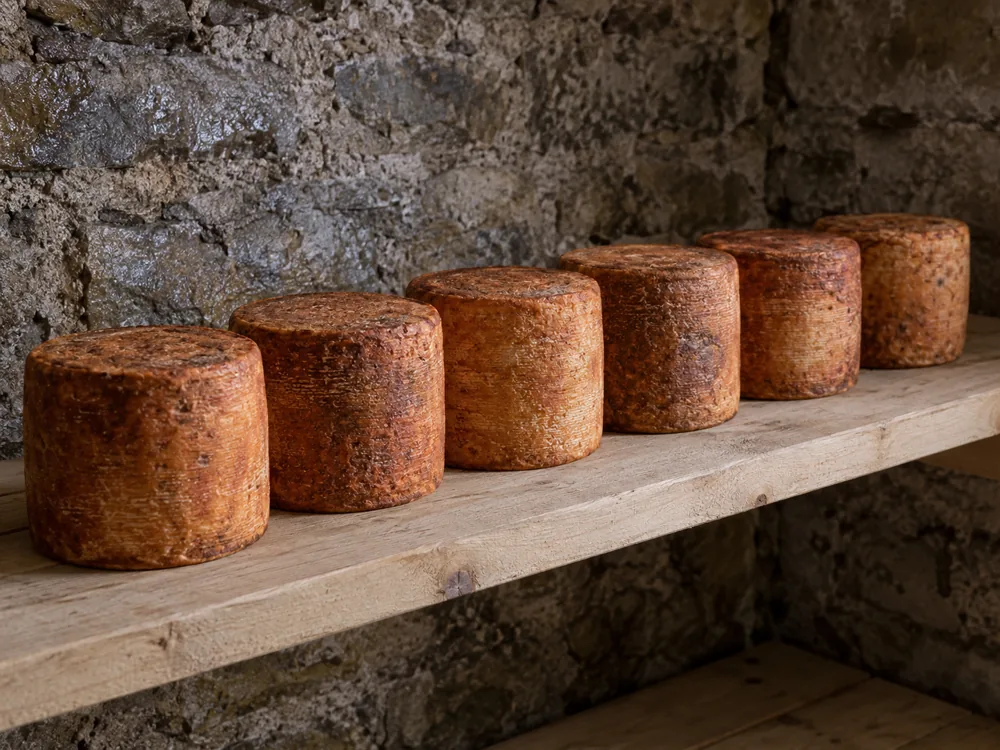
To build the smear on the rind, the specification has the wheels regularly treated during ripening with Brevibacterium linens and water or salt water.
The producer adds that the wheels are turned regularly and that the smear promotes maturing from the outside in, and that no colours or chemical surface treating agents are allowed.
The producer's health page lists the finished cheese's ingredients as silage-free milk, rennet, milk cultures and salt, and the specification bars bactofugation, ultrafiltration and all additives.
Does the Tete-de-Moine Name Come with a Quality Guarantee?
Every wheel made for the name faces two assessments under the specification: grading by an assessment board, then release for sale by the producer or the affineur.
The board grades wheels aged 45 to 75 days on appearance, texture, openings and flavour. Each criterion scores up to five points, and a wheel needs at least 18 points, with no criterion below four, to carry the name.
That makes 20 the top score, and a wheel with three fives and a three has 18 points yet still fails, because one weak criterion cannot be made up by the others.
Experts also repeat an assessment every month in the dairies' cellars, looking at appearance, holes, body (colour and ability to be curled), aroma and taste.
For release, the maker keeps at least half a wheel from each batch, meaning one vat's production, and that control cheese must itself be evaluated and meet the grading criteria before the batch can go on sale.
Wheels that fail cannot carry the name and must be sold so that they can only be eaten processed, such as melted cheese, and only without the rind.
Certification is carried out by the Organisme Intercantonal de Certification, working from a control handbook that applies to every company in the sector.
When you buy, look for the official logo. It must be at least 8 cm across on whole and half cheeses, and at least 2 cm across on pre-packaged rosettes, where it must face you at the point of sale.
How Should You Serve Tete-de-Moine Rosettes?
Cheeses from Switzerland suggests you serve Tete-de-Moine with an aperitif, as a dessert or as a snack, and calls it the crowning glory on a cheeseboard.
For what to put beside the rosettes, two retailers, La Fromagerie SF and Williamson Wines, give the suggestions below.
| Pairing | Type | Why It Works |
|---|---|---|
| Pear | Food | Williamson Wines lists apples or pears as sweet and tart palate cleansers for this cheese. |
| Apple | Food | The same retailer names apples alongside pears; La Fromagerie SF lists fresh fruit. |
| Toasted walnuts | Food | La Fromagerie SF suggests toasted walnuts. |
| Crusty artisan bread | Food | La Fromagerie SF suggests crusty artisan bread. |
| Crisp white wine or Champagne | Wine | La Fromagerie SF names crisp white wines and Champagne; Williamson Wines names full-bodied wines. |
| Dry cider | Drink | La Fromagerie SF suggests dry cider. |
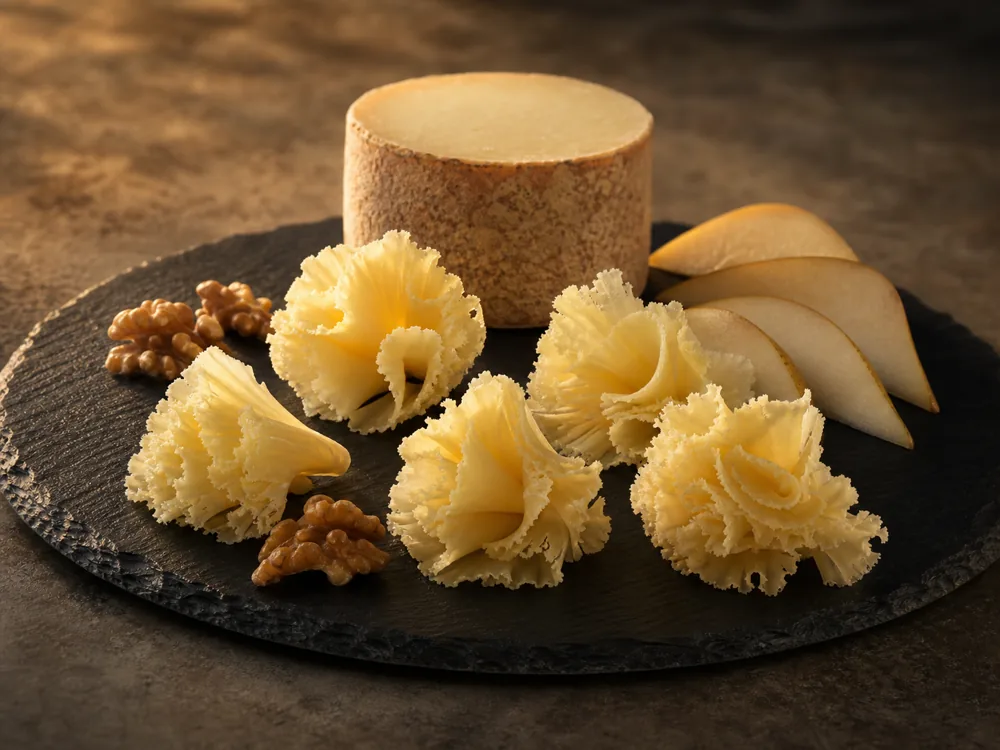
Williamson Wines also names smoked and cured meats, and says the rosettes suit salads, soups and charcuterie boards.
When you choose a wine, two of the three suggestions lean light: the Cheese Scientist suggests crisp Chardonnay or light-bodied Pinot Noir and La Fromagerie SF crisp whites, while Williamson Wines names full-bodied wines. La Fromagerie SF also steps outside wine, with dry cider.
For cooking, a fondue or fondue mix may carry the Tete-de-Moine name only if it contains at least 25 per cent Tete-de-Moine.
Other foods may use the words à la Tete de Moine only if the food's own name comes first, the cheese name is not printed larger, and no other cheese is in the food, so fondue mixes are the one product allowed several cheeses.
Where Can You Buy Tete-de-Moine, and How Should You Store It?
Once you open a cylinder, go by the seller's date and directions.
For leftovers, the Cheese Scientist wraps the cheese snugly in parchment paper and keeps it in an airtight container in the refrigerator. It prefers the cheese or vegetable drawer to the door, where it says coolness and humidity are less consistent.
It says properly stored cheese keeps for a few days and is best eaten fresh, while Williamson Wines says only to keep it refrigerated.
What Are Tete-de-Moine's Nutrition and Raw-Milk Facts?
The producer's health page lists these average values per 100 grams.
A 3.5-ounce tray from Williamson Wines weighs about 99 grams, so these figures give you a rough guide to a whole tray.
Fat is set at 510 to 540 grams per kilo of dry matter, preferably an average of 525 grams, with at least 315 grams per kilo in the cheese itself. The producer's averages of 35 g fat and 35 g water per 100 g leave 65 g of dry matter, which puts fat at about 538 grams per kilo of dry matter, inside that band.
Williamson Wines calls the milk part-skim, while the specification calls the cheese full-fat and lets dairies adjust fat only by natural skimming, centrifuging or returning whey cream from Tete-de-Moine making. That may be what the retailer means, and either way the fat figures above are the ones the specification sets.
The producer's health page also says whatever lactose remains breaks down during maturing. If you have a milk allergy or are lactose intolerant, ask your doctor whether you can eat the cheese.
The same page says the cheese is made from unpasteurised milk from the AOP region. The CDC lists unpasteurized (raw) milk and dairy products made from raw milk as a riskier choice for pregnant women, who it says are 10 times more likely to get a Listeria infection.
The CDC's safer list names hard cheeses made with pasteurized milk, and the NHS lists pasteurised or unpasteurised hard cheeses such as cheddar, gruyère and parmesan as safe. The NHS names only pasteurised semi-hard cheeses, such as edam.
The NHS also lists any cheese that has been cooked until steaming hot as safe, and says foods made from unpasteurised milk, such as soft ripened goats' cheese with a white coating, must be thoroughly cooked. The CDC's heated lines name pasteurized soft cheeses heated to an internal temperature of 165°F or until steaming hot and deli-sliced cheeses heated to 165°F or until steaming hot, and neither covers raw-milk cheese.
Because Tete-de-Moine is semi-hard and always made with raw milk, neither agency lists it as safe uncooked, so if you are pregnant, ask a midwife or doctor about raw-milk cheese in pregnancy.
SOURCES & REFERENCES
What Else Do People Ask About Tete-de-Moine?
The specification gives a taste of acidified milk with a faint taste of rind and hay, moderately salty and slightly tangy. La Fromagerie SF, Williamson Wines and the Cheese Scientist also call it nutty.
Not always. The name also covers rosettes pre-packaged in trays.
Yes. Cheeses from Switzerland and the Cheese Scientist both say to shave it as soon as it comes out of the refrigerator.
Reserve matures at least four months and Extra at least six months.
An assessment board scores four criteria up to five points each, and a wheel needs at least 18 points with no criterion below four.
The specification describes the rind as firm, smeared, grainy, moist and healthy, and every wheel except its cut surfaces must keep it. The producer's health page says the rind crumbles off while the cheese is pared and can be removed from the sides with a vegetable peeler; ask the seller whether to eat it.