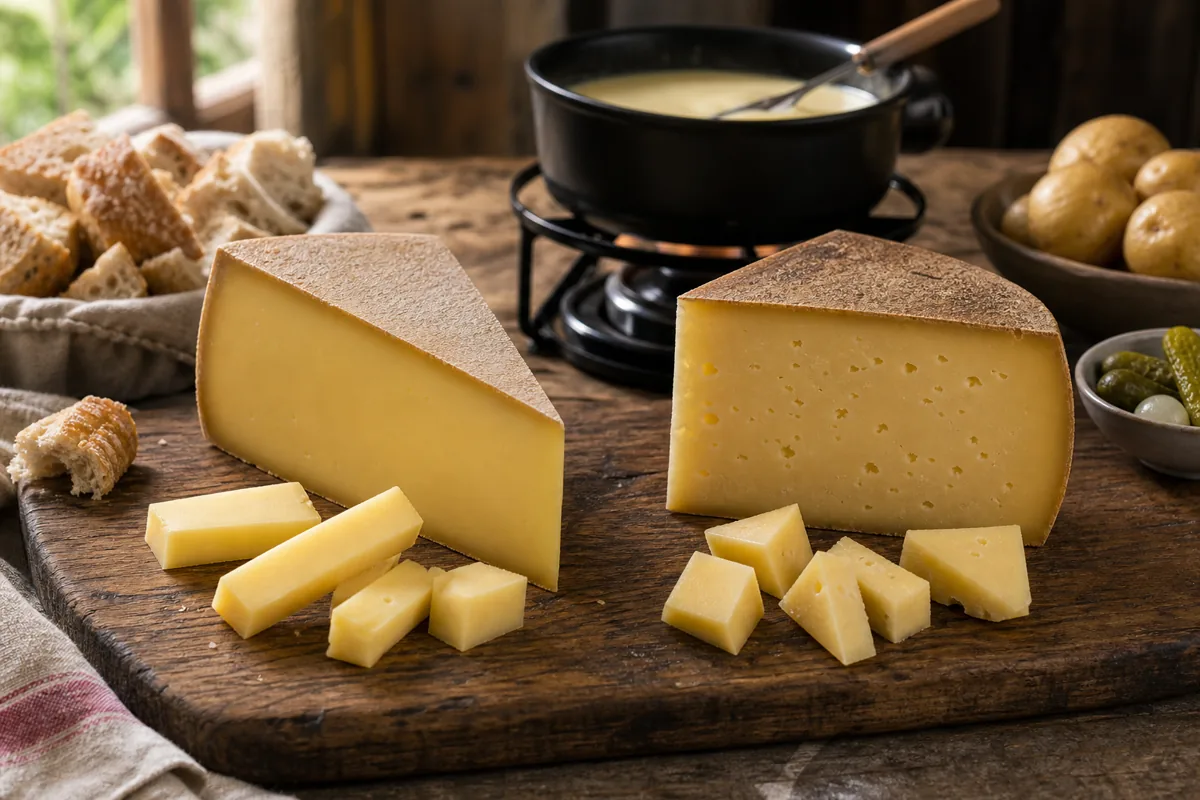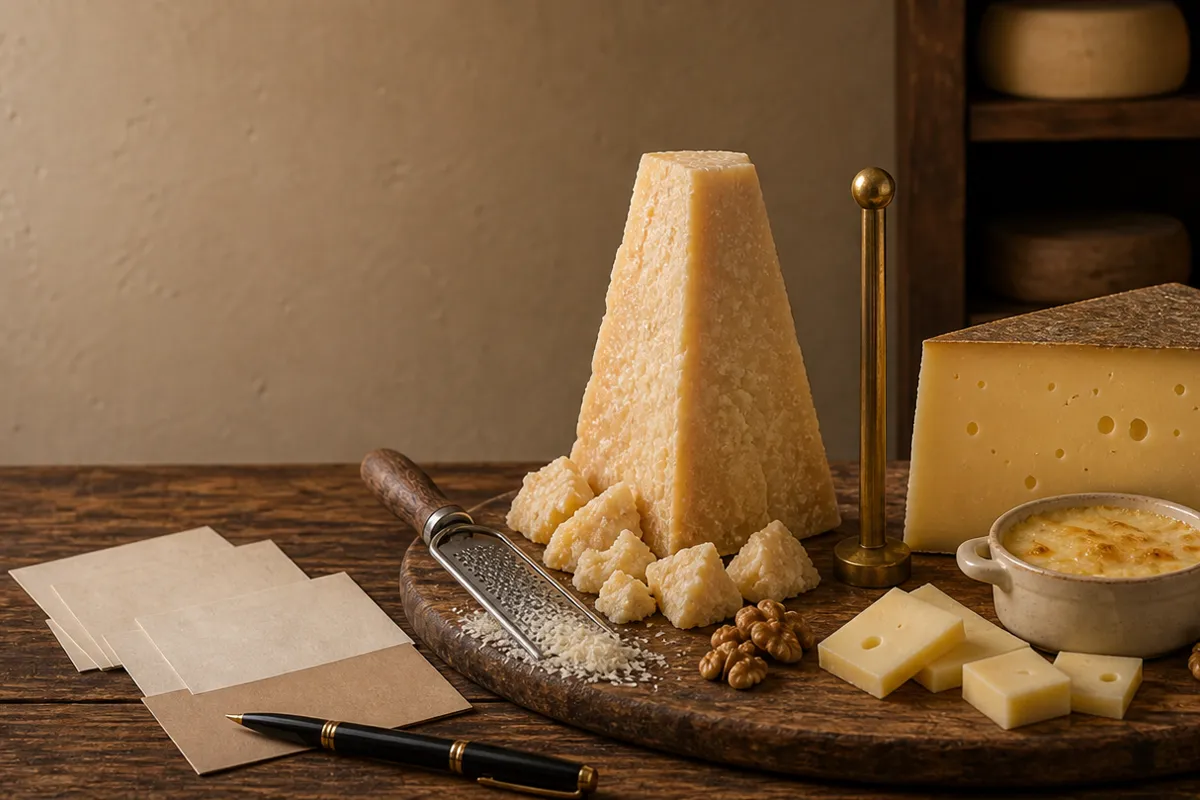
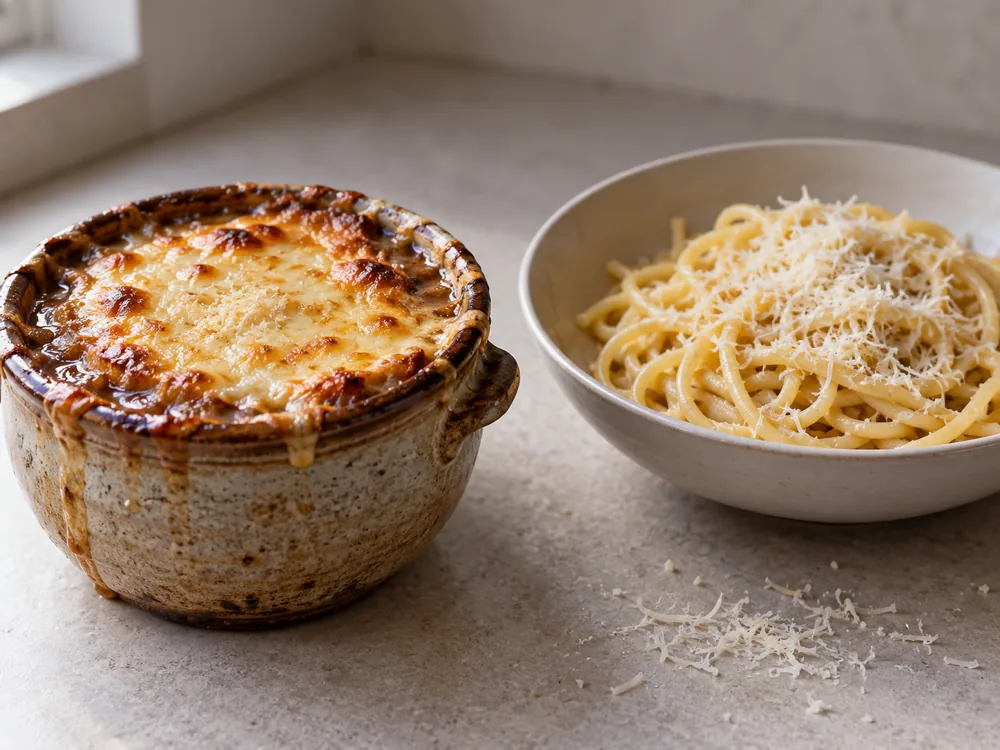
If your dish needs the cheese to melt into a smooth layer, as French onion soup, a gratin or fondue does, buy Gruyère. Heated, Parmesan turns granular instead of melting.
Parmesan here means the cheese style, and Parmigiano Reggiano means the protected Italian wheel.
In This Article
What Is the Difference Between Parmesan and Gruyère?
Parmigiano Reggiano is an Italian protected cheese aged at least 12 months, the longest minimum of any PDO cheese by its Consortium's account. Gruyère AOP is a Swiss protected cheese that can be sold from 5 months.
| Attribute | Parmigiano Reggiano | Gruyère AOP |
|---|---|---|
| Origin | Parma, Reggio Emilia, Modena, part of Bologna and part of Mantua, Italy | Fribourg, Vaud, Neuchâtel, Jura and some communes of Bern, Switzerland |
| Milk and feed | Cattle fed forage; silage, fermented feed and animal flour banned | Raw milk from cows fed grass in summer and hay in winter, no silage |
| Minimum age | 12 months | 5 months |
| Water | About 30% | 34.5 to 36.9% |
| Paste | Light to intense straw yellow, compact or grainy, white crystal dots with age | Solid ivory that varies by season, smooth, slightly damp, moderately firm |
| In heat | Turns granular instead of melting (Wisconsin Cheese) | Smooth melt for gratins, soups and fondues (Wisconsin Cheese) |
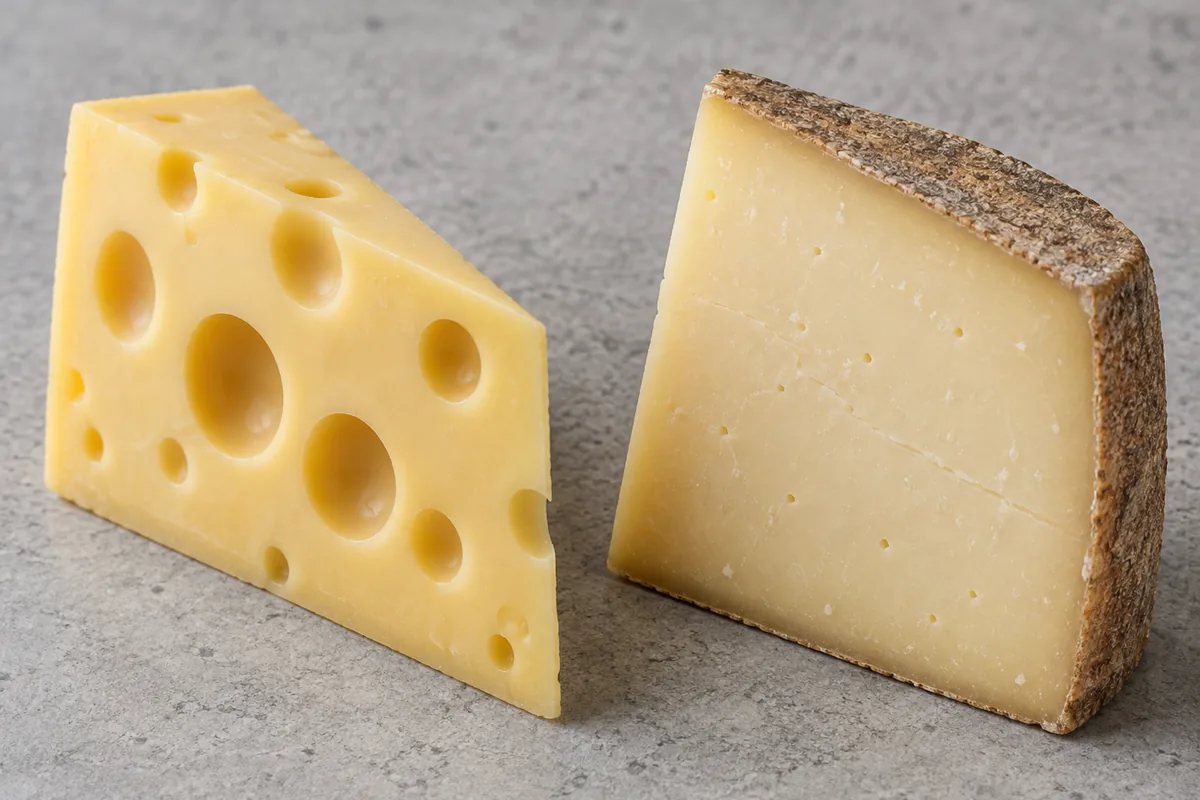
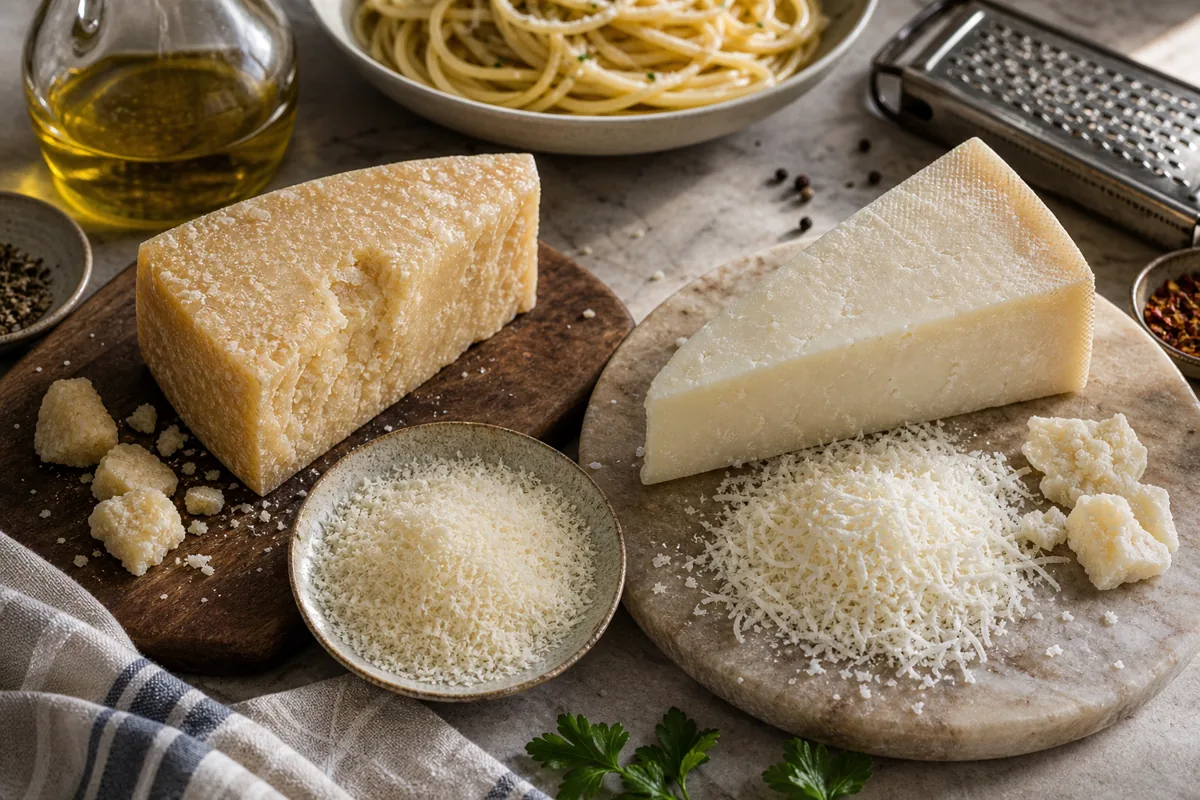
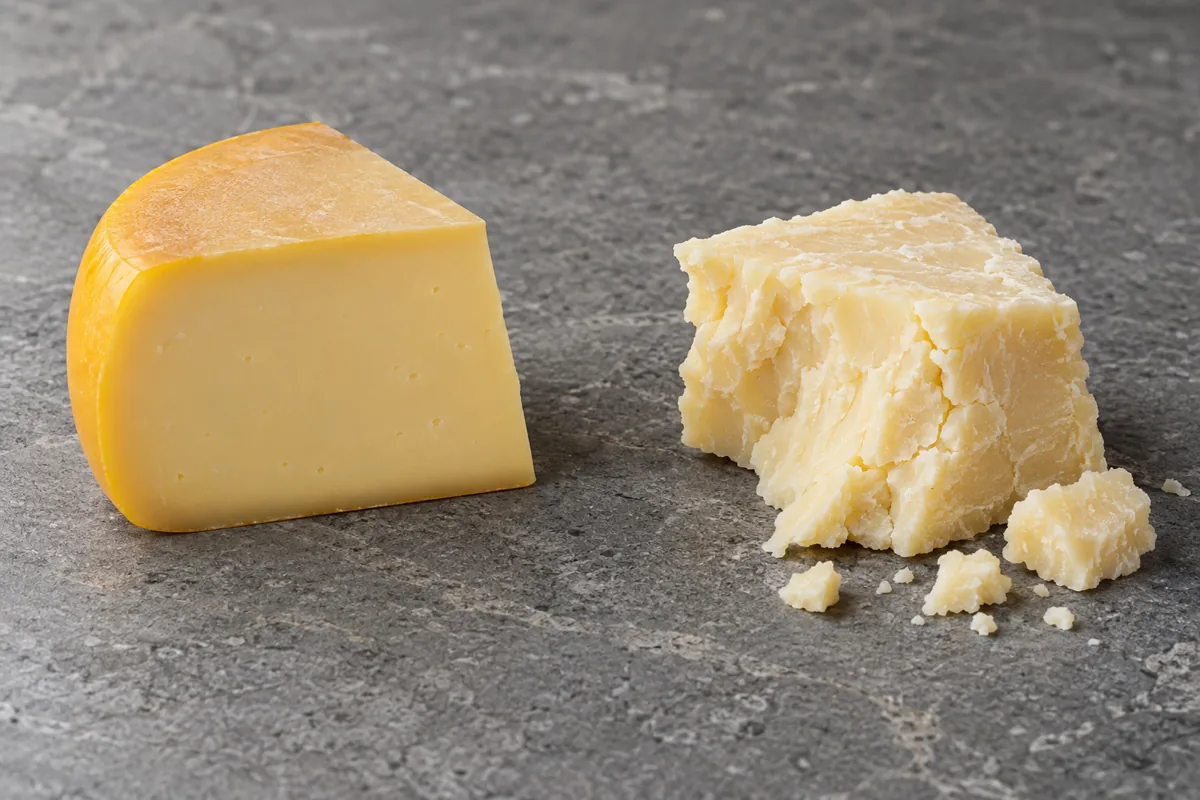
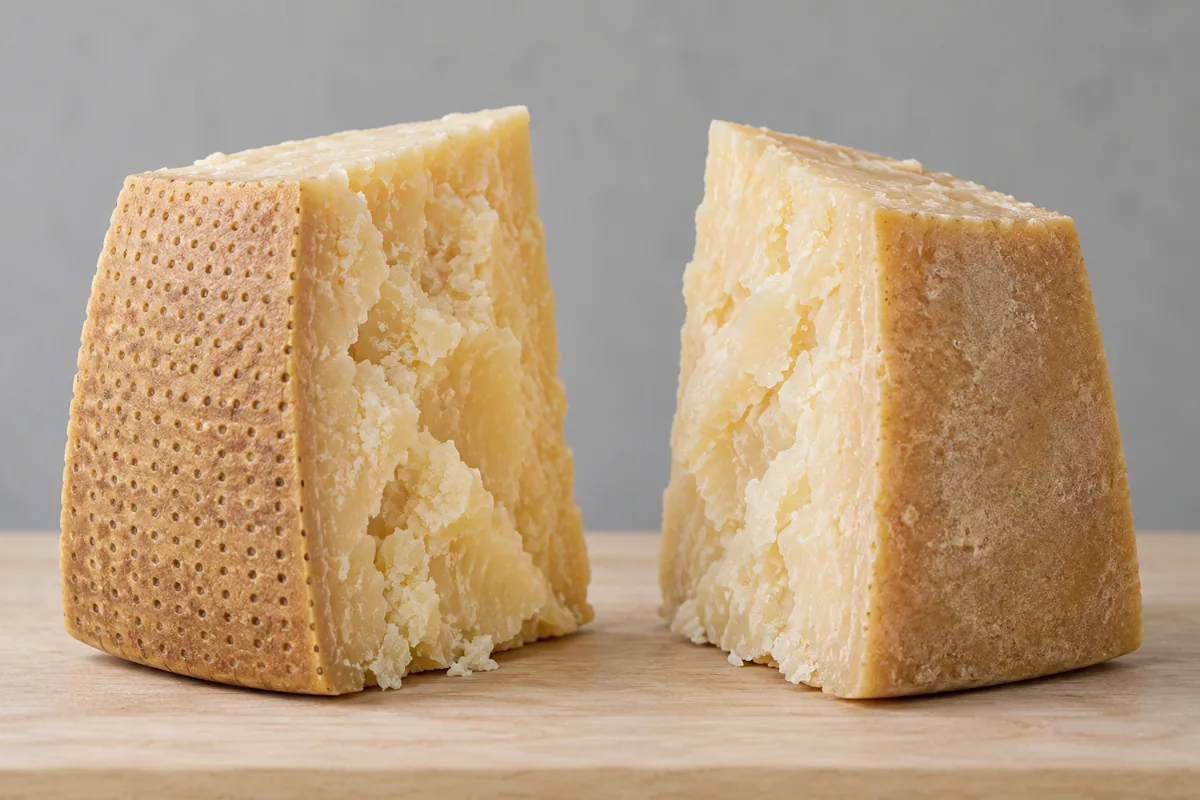
The cut face shows the split. The small white dots in Parmigiano Reggiano's paste are tyrosine crystals that mark how far the cheese has aged, and the cheese is broken into pieces with an almond-shaped knife rather than sliced.
Gruyère AOP looks different at the same cut. Its association describes a smooth, slightly damp paste that is moderately firm and not very crumbly.
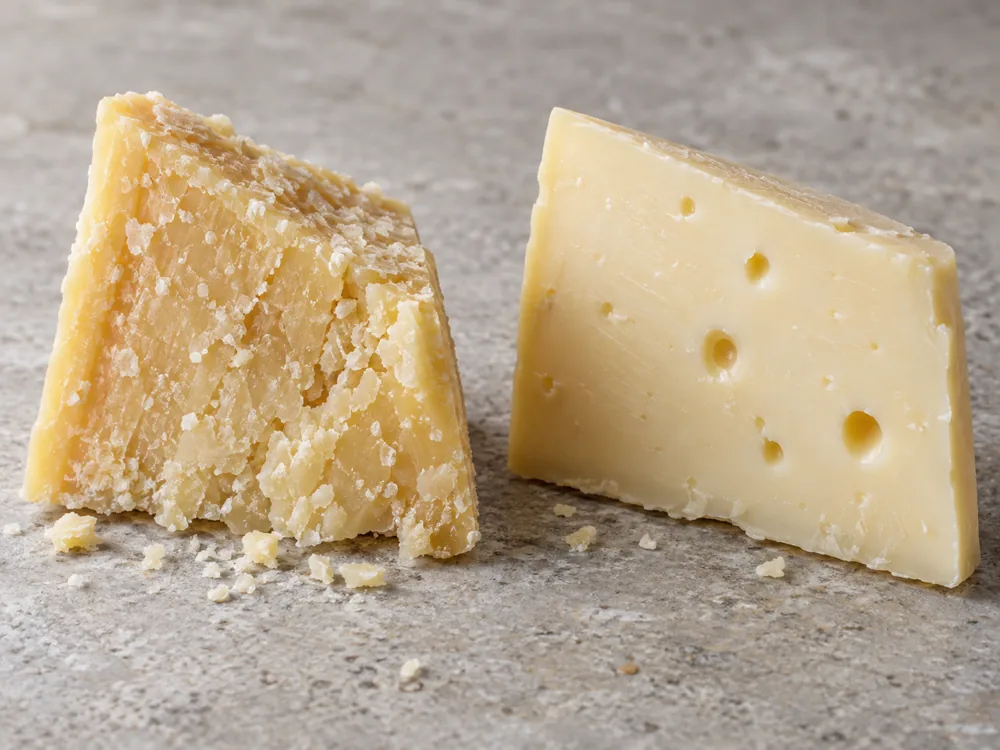
The holes differ as well. The Consortium tolerates a few eyes under 2 mm in Parmigiano Reggiano, while Gruyère AOP may show openings of 4 to 6 mm, which its association calls possible but not essential.
How Do the Two Wheels Differ in Making and Ageing?
A wheel of Parmigiano Reggiano takes about 550 litres of milk, and a Gruyère AOP wheel takes 400 litres.
Both are made by cutting the curd into small grains and cooking it, to 55°C for Parmigiano Reggiano and gradually to 57°C over 40 to 45 minutes for Gruyère AOP. With the cooking that close, the two methods part in salting and ageing.
Gruyère AOP wheels spend 24 hours in a 22% brine and three months in the cheesemaker's cellar, where almost daily care helps a protective rind form. They then move to maturing cellars at about 15°C and 90% humidity, where they are turned and brushed with salt water.
Parmigiano Reggiano wheels go into a saturated salt solution for salting by osmosis and then age. After the 12-month minimum, the Consortium taps every wheel with a hammer to listen for defects inside the cheese.
Gruyère AOP ages 5 to 18 months, with some wheels matured to 24 months. Parmigiano Reggiano can keep ageing to 36, 48 months or longer, and its Consortium says it shows its full character at about 24 months.
Gruyère AOP is made with rennet from the stomach of calves. Rennet is also added in making Parmigiano Reggiano, so if you avoid animal rennet, ask the seller which kind a wedge uses.
Why Doesn't Parmesan Melt Smoothly?
Parmesan is drier and older than Gruyère, and both work against a smooth melt. Cheeses that melt well have more moisture and fat, and the proteins in aged cheese are packed more tightly and are less likely to soften.
Heated, Parmigiano Reggiano is one of the dry, crumbly cheeses that turn granular instead of melting.
In figures, the water gap is a few points. The Consortium gives Parmigiano Reggiano about 30% water in its text and 31.4 g per 100 g in its composition table, against 34.5 to 36.9% for Gruyère AOP.
Fat runs the same way, at 29.7 g per 100 g for Parmigiano Reggiano against 32 g for Gruyère AOP. As a share of the dry matter, the Consortium gives 43.3%, and the Gruyère association's averages work out to about 50% when its 32 g of fat is set against the 64 g that is not water.
Age is the other half of the explanation, and Parmigiano Reggiano is the older cheese, with a 12-month minimum against 5 months for Gruyère AOP.
Which Tastes Stronger, Parmesan or Gruyère?
It depends on the age of the wedge, since both makers describe flavour in age steps.
| Cheese and age | What the maker says |
|---|---|
| Parmigiano Reggiano, 12 to 18 months | Harmonious and delicate, with scents of milk, yoghurt and fresh fruit; the salty and spicy notes grow with ageing |
| Parmigiano Reggiano, 22 to 24 months | Crumbly and grainy, with a balance between mildness and tastiness and notes of fresh fruit, nuts and meat stock |
| Parmigiano Reggiano, 30 to 36 months | Particularly crumbly and grainy, with a pronounced flavour of spices, nuts and meat stock |
| Gruyère AOP Classic, 6 to 9 months | Soft and refined taste |
| Gruyère AOP Réserve, from 10 months | Full-flavoured and aromatic taste |
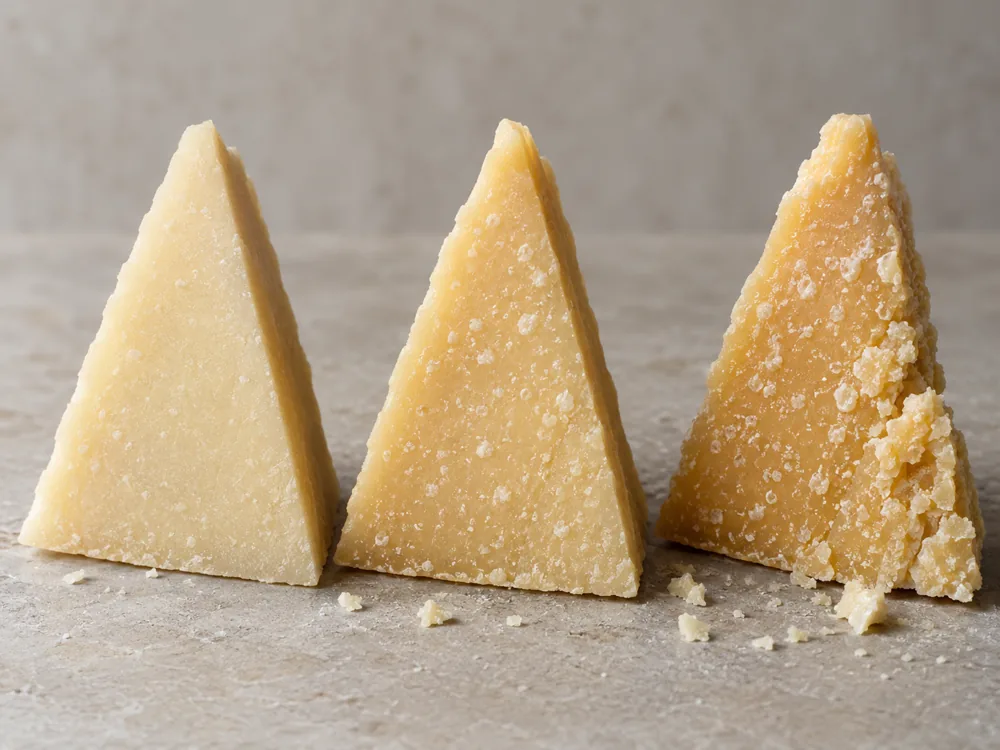
When strength matters, ask for the age. The Consortium says Parmigiano Reggiano's salty and spicy notes grow with ageing, and Gruyère AOP's Réserve class, from 10 months, is the one its association calls full-flavoured.
Nutty is the word the two share. Wisconsin Cheese calls Gruyère's flavour rich and nutty, and the Consortium lists nuts among the notes of Parmigiano Reggiano from 22 months on.
For drinks, the Consortium ties its pairings to the age steps above, and Wisconsin Cheese's pairings are for creamy melted-cheese dishes and melted Gruyère.
| Pairing | Type | Why It Works |
|---|---|---|
| Parmigiano Reggiano, 12 to 18 months | Wine | The Consortium suggests sparkling white wines for aperitifs. |
| Parmigiano Reggiano, 22 to 24 months | Wine | The Consortium suggests medium-body wines and the dishes of the Italian tradition. |
| Parmigiano Reggiano, 30 to 36 months | Food | The Consortium suggests fruit and honey at the end of a meal. |
| Fondue or mac and cheese | Wine | Wisconsin Cheese suggests a crisp, dry white wine such as sauvignon blanc for creamy melted-cheese dishes like these. |
| Melted Gruyère | Drink | Wisconsin Cheese suggests the hoppy bitterness of a pale ale. |
Which Cheese Goes Into Mac and Cheese, Gratin and French Onion Soup?
Gruyère goes into the dishes that need a melted layer. Wisconsin Cheese calls it a great cheese for gratins, soups and fondues, and the classic cheese to melt over French onion soup.
| Dish | Cheese named for it | Named by |
|---|---|---|
| French onion soup | Gruyère, melted on top for a rich, savory finish | Wisconsin Cheese |
| Fondue | Gruyère, which traditional fondue combines with emmentaler | Wisconsin Cheese |
| Gratin | Gruyère | Wisconsin Cheese |
| Mac and cheese | Cheddar is the classic; fontina or Gruyère are alternatives | Wisconsin Cheese |
| Filled and baked pasta | Parmigiano Reggiano aged 30 to 36 months | Parmigiano Reggiano Consortium |
| Salads and cold dishes | Parmigiano Reggiano aged 12 to 18 months | Parmigiano Reggiano Consortium |
Parmigiano Reggiano's rows depend on its age. The Consortium matches it to salads and cold dishes at 12 to 18 months and to filled and baked pasta at 30 to 36 months.
Mac and cheese is the dish where Gruyère is an alternative rather than the first choice, since Wisconsin Cheese calls cheddar the classic and lists fontina and Gruyère as other options.
Can You Substitute Parmesan for Gruyère, or Gruyère for Parmesan?
Parmesan in place of Gruyère will not give you a melted layer, since Parmesan turns granular in heat.
Gruyère in place of Parmesan melts rather than staying as grains, and it changes the salt. Whether the dish gets more or less depends on which Parmesan you compare it with, as the sodium row of the nutrition table below shows.
Wisconsin Cheese names Pecorino Romano beside Parmigiano Reggiano among the dry, crumbly cheeses that turn granular when heated. Among cheeses that melt, it lists fontina with its sauce cheeses and mozzarella and Monterey jack with its good melters.
Is Parmesan or Gruyère Healthier?
Neither wins on every nutrient, and for sodium the answer depends on whose figures you use: USDA's generic entries or the makers' own.
| Per 100 g | Parmesan, hard (USDA) | Gruyère (USDA) | Parmigiano Reggiano (Consortium) | Gruyère AOP (association) |
|---|---|---|---|---|
| Water | 30 g | 33.2 g | 31.4 g | 36 g |
| Energy | 392 kcal | 413 kcal | 402 kcal | 398 kcal |
| Protein | 35.8 g | 29.8 g | 32.4 g | 27 g |
| Fat | 25 g | 32.3 g | 29.7 g | 32 g |
| Sodium | 1,180 mg | 714 mg | 650 mg | Not stated |
| Calcium | 1,180 mg | 1,010 mg | 1,155 mg | Not stated |
Protein and fat run in opposite directions in both pairs of columns, with more protein in Parmesan and more fat in Gruyère. Calories are close: USDA puts Gruyère higher, at 413 against 392 kcal, while the makers' figures put Parmigiano Reggiano higher, at 402 against 398 kcal.
Sodium shows the widest split. USDA's generic hard Parmesan entry carries 1,180 mg per 100 g against 714 mg for Gruyère, but the Consortium's own mean for Parmigiano Reggiano is 650 mg, which is below the USDA figure for Gruyère.
USDA marks its Parmesan sodium figure as a label claim, back-calculated from a label by NDL staff in 2017, and the same entry's calcium value dates from 1976. For the wedge in hand, the sodium line on its own nutrition label is the figure that applies.
The Consortium adds that a 25 g serving of Parmigiano Reggiano covers 36% of an adult's calcium requirement on a 2,000 kcal diet.
Can You Eat Parmesan or Gruyère While Pregnant?
The NHS lists pasteurised or unpasteurised hard cheeses, such as cheddar, gruyère and parmesan, as safe to eat in pregnancy. That line says "pasteurised or unpasteurised", so the raw milk of Gruyère AOP does not change the NHS answer.
The NHS also lists any cheese that's been cooked until steaming hot as safe to eat, which covers Gruyère in a gratin or soup once it has been cooked until steaming hot.
The CDC lists hard cheese, when made with pasteurized milk, such as Asiago, Cheddar, Parmesan, or Swiss/Gruyere/Emmental, as a safer choice, and unpasteurized (raw) milk and dairy products made from raw milk as a riskier choice.
Gruyère AOP is made from raw milk, so the CDC line that applies to it is the riskier one for unpasteurized (raw) milk and dairy products made from raw milk. Parmigiano Reggiano is made from raw milk too, so the same riskier line applies to it.
For other Parmesan, check the label for the milk: made with pasteurized milk, it is in the CDC's safer hard-cheese line, and made with raw milk, in its riskier raw-milk line.
What Do the Rind Marks Tell You When Buying?
A Parmigiano Reggiano wheel carries dotted lettering around the rind, along with the dairy's registration number and the month and year of production, and a casein plate with a unique code identifies each wheel.
At 12 months the Consortium grades every wheel. First-grade wheels get the hot-iron brand, medium-grade wheels get the brand plus parallel grooves around the rind, and wheels with major defects lose their markings and cannot use the name.
From the 18th month a dairy can ask for a Premium or Export mark on first-grade wheels, which the Consortium describes as a further indication of quality.
Each Gruyère AOP wheel carries a casein marking with the wheel's number, the dairy's number and the manufacturing date, and its heel is embossed with the Gruyère AOP name. A wheel can show that name only after experts check it at four months.
Parmesan or Gruyère: Which Should You Buy?
Buy Gruyère when the cheese has to melt into the dish, as in French onion soup, a gratin or fondue, and Parmesan when it can stay as grains.
With Parmigiano Reggiano, pick the age by the dish as well, since its Consortium matches younger and older wheels to different dishes in the table above.
Pick Gruyère when the dish needs a smooth melted layer, such as French onion soup, a gratin or fondue, and Parmigiano Reggiano when the cheese can stay as grains. Then pick the Parmigiano Reggiano's age by the dish.
For a dish that uses both, Wisconsin Cheese advises mixing a gooey cheese with a more flavourful, less melty one, and of these two, Gruyère is the one it names for melting.