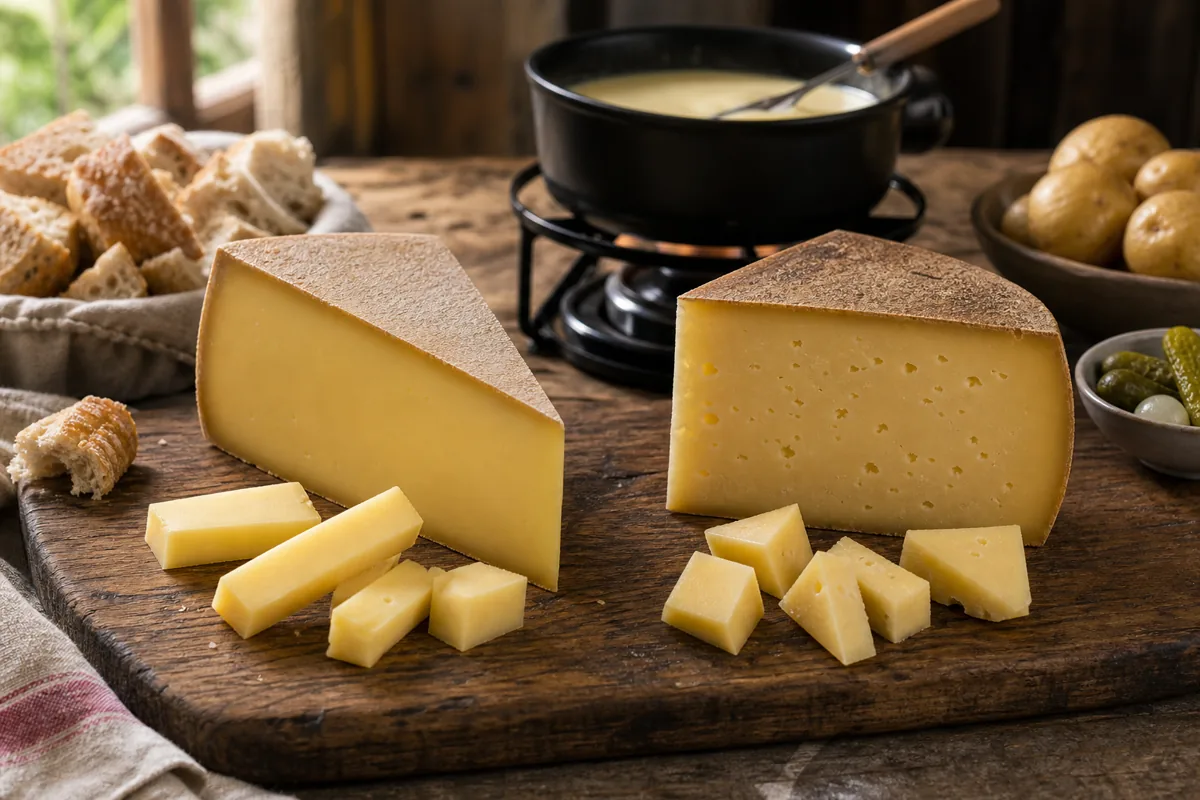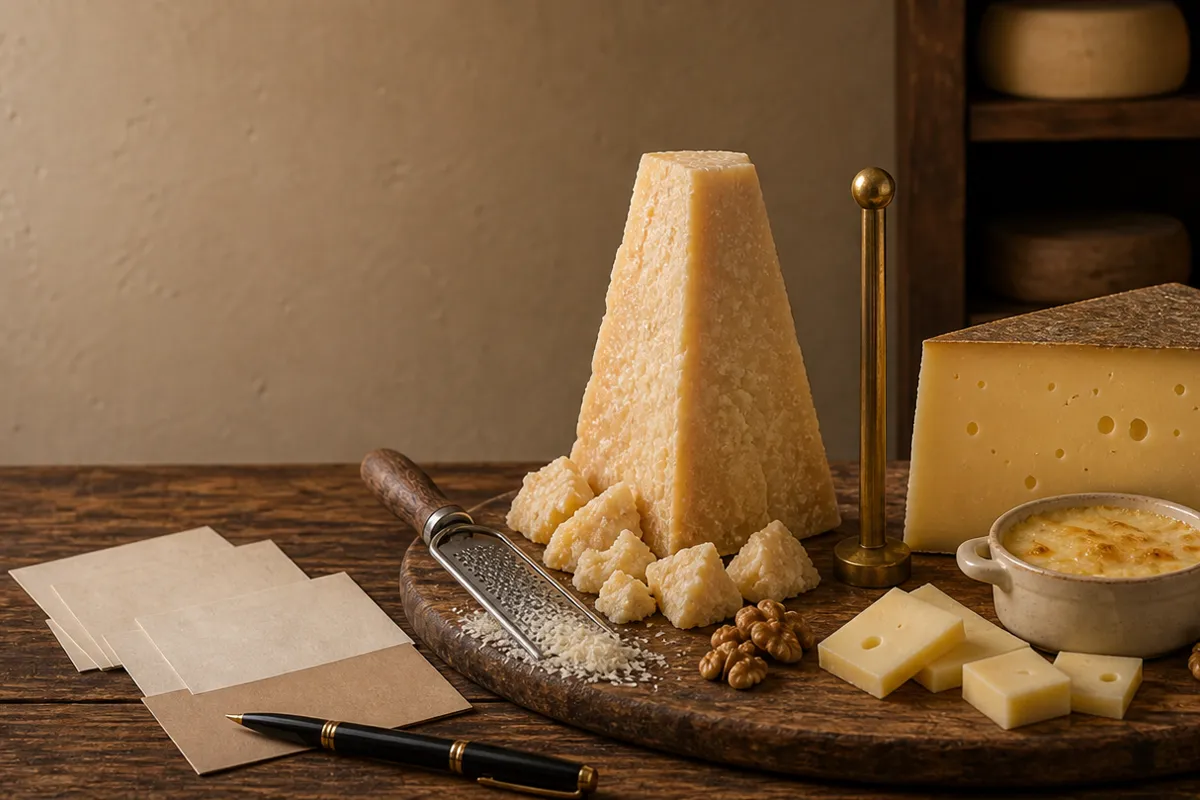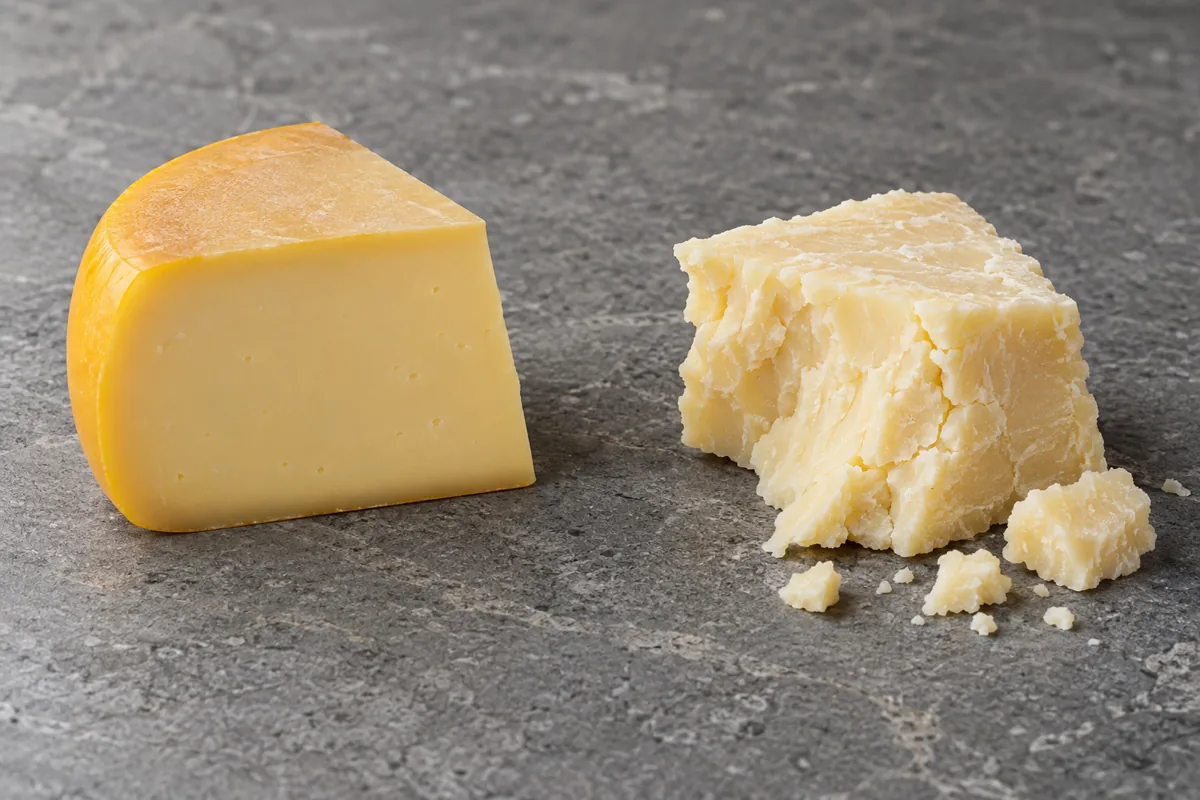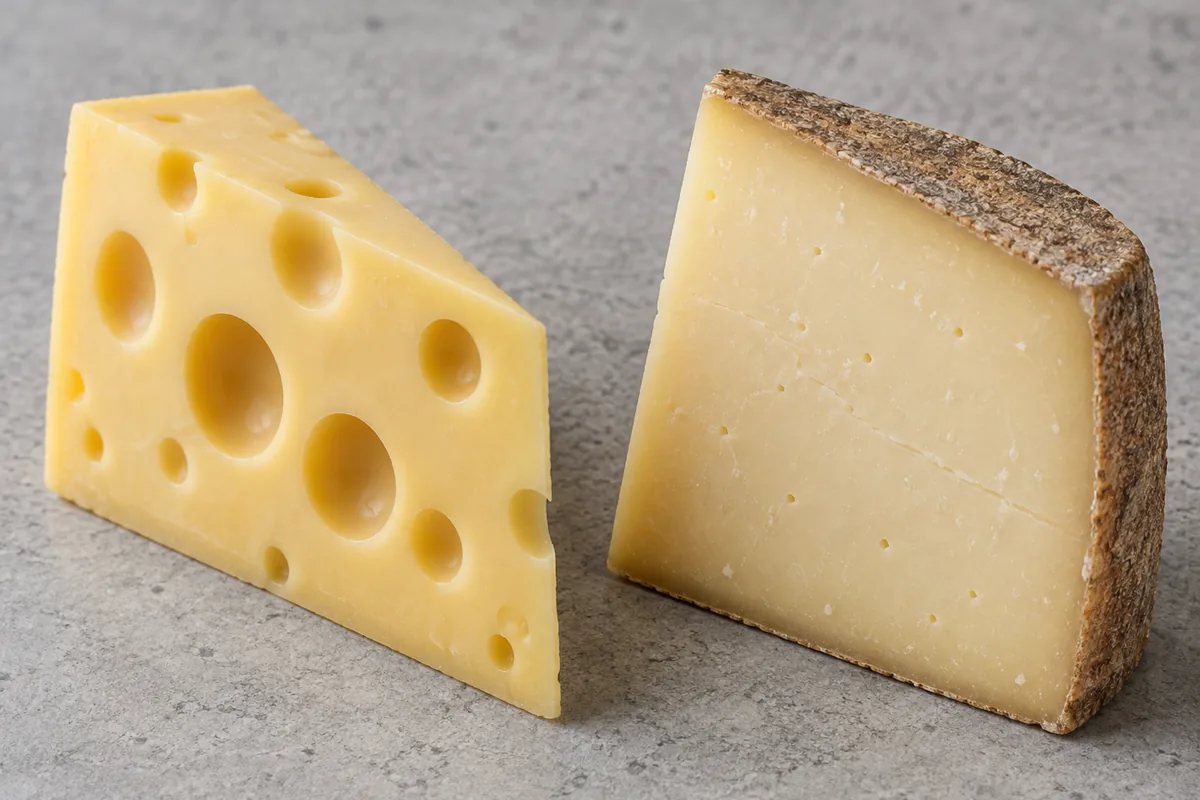
Emmental cheese is the Swiss cheese with the cherry-sized holes, mostly 2 to 4 cm across. Gruyère has a solid ivory paste with few openings.
Le Gruyère AOP is made in the cantons of Fribourg, Vaud, Neuchâtel and Jura and some communes of Bern in Switzerland. Both AOP cheeses start from raw cow's milk.
If your recipe names one of them, buy that one. If it leaves the choice open, check the age in months, which both trade bodies tie to how mild or strong the cheese is, and the mark on the wheel, which shows whether it is the AOP cheese.
In This Article
What Is the Difference Between Emmental and Gruyère?
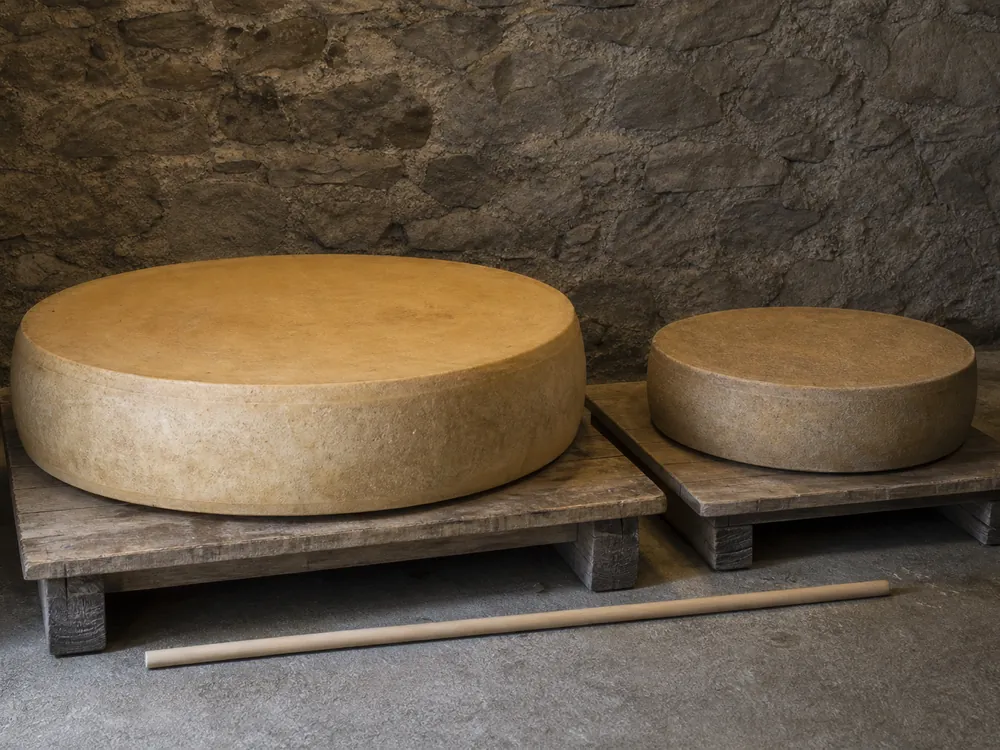
An Emmentaler AOP wheel weighs 75 to 120 kg, more than twice a Le Gruyère AOP wheel of about 35 kg, and Emmental may be sold from 4 months where Gruyère waits until 5.
| Attribute | Emmentaler AOP | Le Gruyère AOP |
|---|---|---|
| Milk | Raw, processed within 24 hours, from farms within 20 km of the dairy; fresh grass and hay, no silage | Raw, delivered to the dairy twice a day; grass in summer and hay in winter, no silage |
| Holes | Cherry-sized, mostly 2 to 4 cm | Possible but not essential, 4 to 6 mm |
| Wheel across | 80 to 100 cm | 55 to 65 cm |
| Wheel height | 16 to 27 cm | 9.5 to 12 cm |
| Wheel weight | 75 to 120 kg, average 90 or 95 kg | 25 to 40 kg, about 35 kg |
| Milk per wheel | About 1,200 litres for a wheel of around 100 kg | 400 litres |
| Minimum age | 4 months | 5 months |
| Energy per 100 g | 395 kcal | 398 kcal (1,645 kJ) |
Per kilo of cheese, the milk is close. A 100 kg Emmental wheel takes about 1,200 litres, roughly 12 litres a kilo, and a 35 kg Gruyère wheel takes 400 litres, roughly 11 litres a kilo, by our arithmetic from the two trade bodies' figures.
The Emmental name is used beyond the AOP. Similar cheeses from France, the Netherlands, Bavaria and Finland are sold under the Emmental name without the Swiss protection.
In many English-speaking countries, Emmentaler and Swiss cheese both name any cheese of the Emmental type, wherever it is made, and the US Department of Agriculture uses the two interchangeably. A pack labelled Swiss can therefore hold any Emmental-type cheese, not only Emmentaler AOP.
Why Does Emmental Have Holes?
Emmental's holes form in a warm cellar. At about 19 to 24 °C, propionic acid fermentation forms carbon dioxide gas that cannot escape the wheel.
The gas collects in pockets within the curd, and after six to eight weeks, once the holes reach the right size, the wheel moves to a storage cellar at about 12 °C that halts their formation.
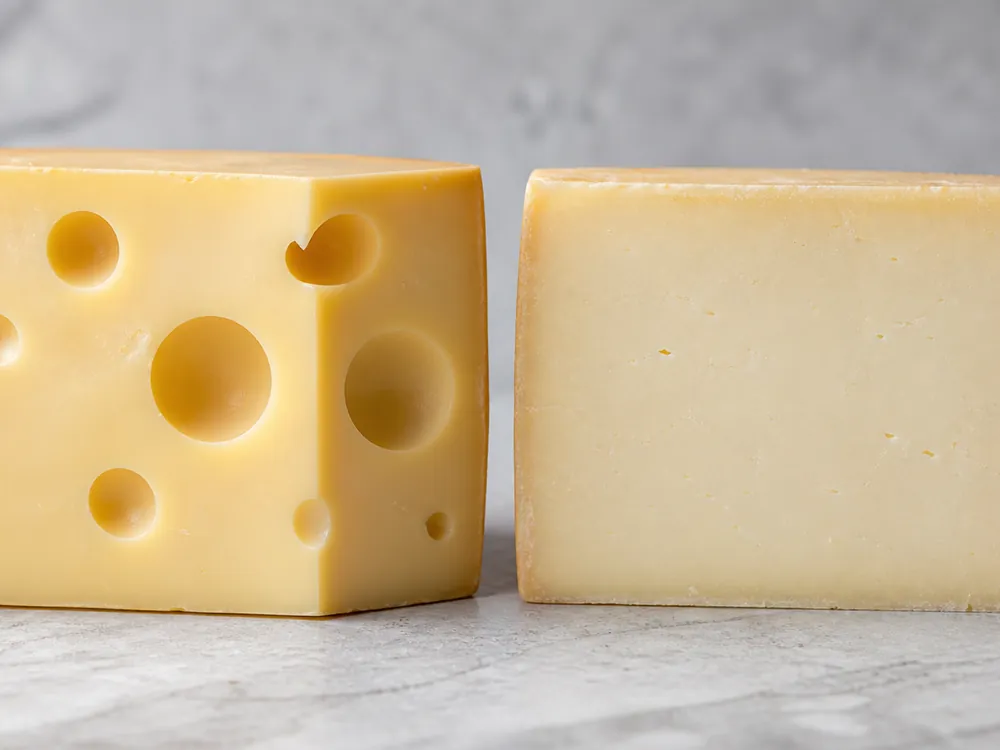
The holes were long thought to come from bacterial activity, and researchers later traced them at least in part to microscopic hay dust in the milk, around which bacteria form and release gas.
That finding is linked to a change in the cheese. Summer milk, from cows eating grass with less dust, once gave smaller holes than winter milk, and modern milking machines let in less hay dust, so 21st-century Swiss cheeses have fewer and smaller holes.
Eyes were once a sign of imperfection that cheesemakers tried to avoid and are now valued as a sign of maturation and quality. Holes that are not too small help prevent gaps and cracks in the block.
Some makers in Germany and France restore the holes with hay flower powder, which Swiss production forbids.
Gruyère's rules make openings optional and allow small cracks only if they are closed and isolated.
Emmental's holes are graded. The specifications assess their number and size, and the four-month assessment of curds, flavour, holes, external appearance and shelf life needs at least 18 of 20 points before a wheel is approved for sale.
Gruyère's check falls at the same age. At four months a neutral commission judges each wheel's opening, texture, outer appearance and taste, and only wheels that pass may carry the name Le Gruyère AOP.
How Do the Wheels and Ageing Differ?
Emmental is pressed under up to 2,000 kg, more than twice Gruyère's 900 kg, and brined for two days against Gruyère's 24 hours.
| Step | Emmental | Gruyère |
|---|---|---|
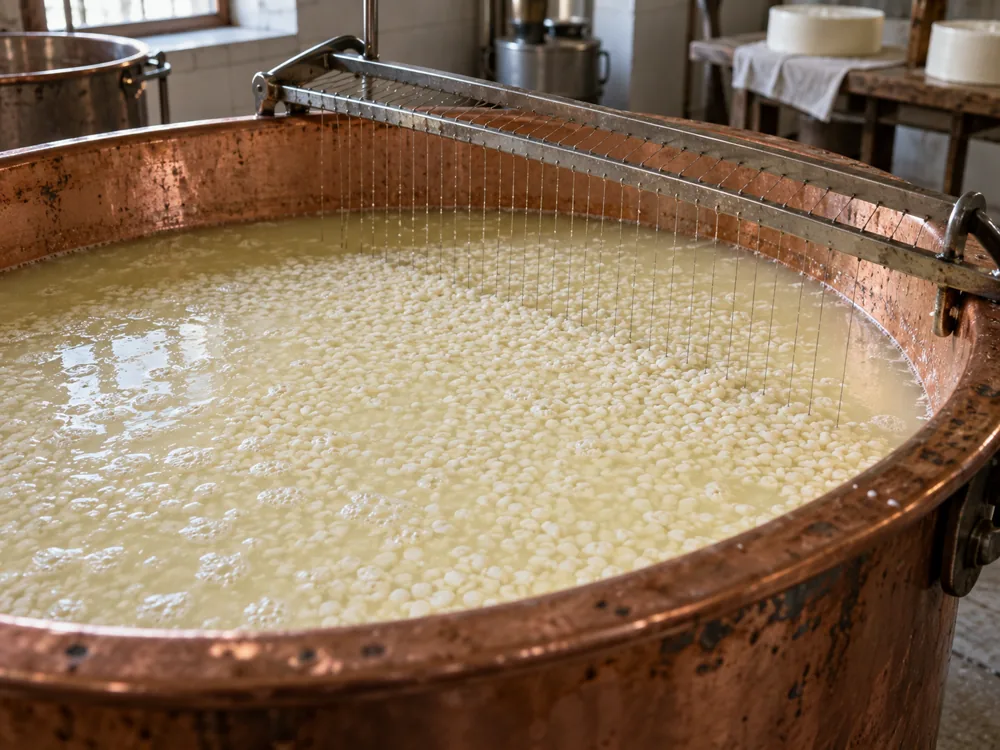
| How is the milk set? | Warmed to about 32 °C first, then thick like yoghurt about 40 minutes after the rennet | A dense mass 35 to 40 minutes after the rennet |
| How small is the curd cut? | 4 to 6 mm, reached within six to ten minutes | To the size of wheat grains |
| How hot is the curd cooked? | Warmed from 31 °C to 52 to 54 °C in 30 to 60 minutes, then stirred for 20 to 60 minutes | Heated to 57 °C (135 °F) for 40 to 45 minutes (producer); a top temperature of 54 °C (Wikipedia) |
| How long is it pressed? | 20 hours under up to 2,000 kg, turned up to five times a day | About 20 hours on the production page and almost 24 hours on the characteristics page, under up to 900 kg |
| How long is it brined? | Two days | 24 hours in a 22% brine |
| Where does it mature? | Warm cellar at 19 to 24 °C for six to eight weeks, then a storage cellar at about 12 °C | Three months in the dairy's cellar, then maturing cellars at about 15 °C (59 °F) and 90% humidity (producer); 13 to 14 °C and 94 to 98% (Wikipedia) |
Gruyère's pressing time and cooking temperature each have two figures. Its trade body gives about 20 hours of pressing on one page and almost 24 on another, and Wikipedia's Gruyère entry puts the top cooking temperature at 54 °C against the producer's 57 °C.
Holding Emmental's warmed curds at 52 to 54 °C removes more water and helps suppress unwanted microbes, while the lactic acid bacteria can also develop.
The Gruyère cellar climate is disputed as well. Its trade body gives about 15 °C and 90% humidity for the maturing cellars, while Wikipedia's Gruyère entry cites 13 to 14 °C and 94 to 98%.
Those figures change the cheese. Lower humidity dries it out, higher humidity leaves it smeary and gluey, and a lower temperature means less maturing and a harder, more crumbly texture.
After the minimum age, each trade body sorts its wheels into named age bands. Emmental's start with Mild/Classic at 4 months, and Gruyère has two, Classic at 6 to 9 months and Réserve from 10 months, with some wheels matured to 18 or 24 months.
Emmental's own pages give three ceilings. The product range lists Extra at up to 36 months, the making page says up to 24 months or sometimes 30, and the FAQ gives 4 to 30 months.
Wikipedia's Emmental entry gives a different span, 2 to 18 months depending on variety, and lists the certification as covering only some varieties. A wheel sold as Emmental outside the AOP can therefore be younger than the 4-month floor in the first table.
Outside the AOC, Swiss Gruyère also carries age labels such as mi-salé at 7 to 8 months, salé at 9 to 10 months and vieux at 14 months, and Premier Cru is a Fribourg variety matured for 14 months. Because those age labels sit outside the AOC, ask for the age in months when you compare two wedges.
What Do the Rind and Paste Look Like?
From the outside, Gruyère's rind is smeared, grainy and uniformly brownish, while Emmental's forms in the brine bath and darkens with age.
| What to look at | Emmental | Gruyère |
|---|---|---|
| What shape is the wheel's edge? | Round, flat to convex (Emmentaler Switzerland) | Round, with a slightly convex heel (Gruyère trade body) |
| What is the rind like? | Forms in the brine bath, darkens and gains a patina with age (Emmentaler Switzerland) | Smeared, grainy and uniformly brownish (Gruyère trade body) |
| What does the paste look like? | Yellow and medium-hard, with natural holes (Wikipedia) | Solid ivory that shifts with the season, smooth and slightly damp, soft and moderately firm, not very crumbly (Gruyère trade body) |
The cheesemaker gives Gruyère wheels almost daily care in the dairy cellar to help a fine protective smear form, and in the maturing cellars they are turned and brushed with salt water.
In a cave or rock cellar, the microflora can turn Emmental's rind nearly black.
At the cut face, a Gruyère aged from five months to a year tends to develop small cracks that give a slightly grainy texture. Its water content is 34.5 to 36.9%.
Which Cheese Tastes Stronger?
Strength follows the age band in both trade bodies' own words. Their youngest cheeses are called mild and slightly sweet (Emmental) or soft, refined and sweet (Gruyère), and their older bands get the stronger words.
| Cheese and band | Age | Flavour words | Who describes it |
|---|---|---|---|
| Emmental Mild/Classic | 4 months | Mild, slightly sweet | Emmentaler Switzerland |
| Emmental Réserve/Surchoix | 8 months | Medium, fine and tart | Emmentaler Switzerland |
| Emmental Cave-Aged | 12 months | Intense | Emmentaler Switzerland |
| Emmental Crown | 14 months | Intense, spicy | Emmentaler Switzerland |
| Emmental Gotthelf Slow Food and URTYP | 12 to 15 months | Very intense (URTYP) | Emmentaler Switzerland |
| Emmental Extra | 12 to 36 months | Intense, extra spicy | Emmentaler Switzerland |
| Gruyère Classic | 6 to 9 months | Soft and refined, sweet | Gruyère trade body |
| Gruyère Réserve | From 10 months | Full-flavoured and aromatic; some wheels to 18 or 24 months for lovers of strong sensations | Gruyère trade body |
| Gruyère, young and mature | Not stated | Sweet but slightly salty, creamy and nutty when young; more assertive, earthy and complex when mature | Wikipedia |
| Emmental | Not stated | Savoury but mild | Wikipedia |
For a mild cheese, those words point to Emmental Mild/Classic at 4 months or Gruyère Classic at 6 to 9 months. For a stronger one, Emmental offers more steps on the way up, from Cave-Aged to Extra, while Gruyère has Réserve and, for some wheels, 18 to 24 months.
Which Cheese Melts Better?
Of the two, Gruyère is the one Wikipedia calls a good melting cheese, while it says Emmental is usually consumed cold, as chunks or slices, and is also used in dishes such as gratins.
For baking, the same Gruyère entry gives a reason: its taste is distinctive but not overpowering, so in a quiche it adds savoriness without overshadowing the other ingredients.
| Use | How It Works |
|---|---|
| Soups and sandwiches | Gruyère is traditionally used in French onion soup and in the croque-monsieur, a toasted ham and cheese sandwich. |
| Cordon bleu | Gruyère goes into chicken and veal cordon bleu. |
| Grated | Grated Gruyère goes on salads and pastas and on top of le tourin, a French garlic soup served on dried bread. |
Which Is Better for Fondue?
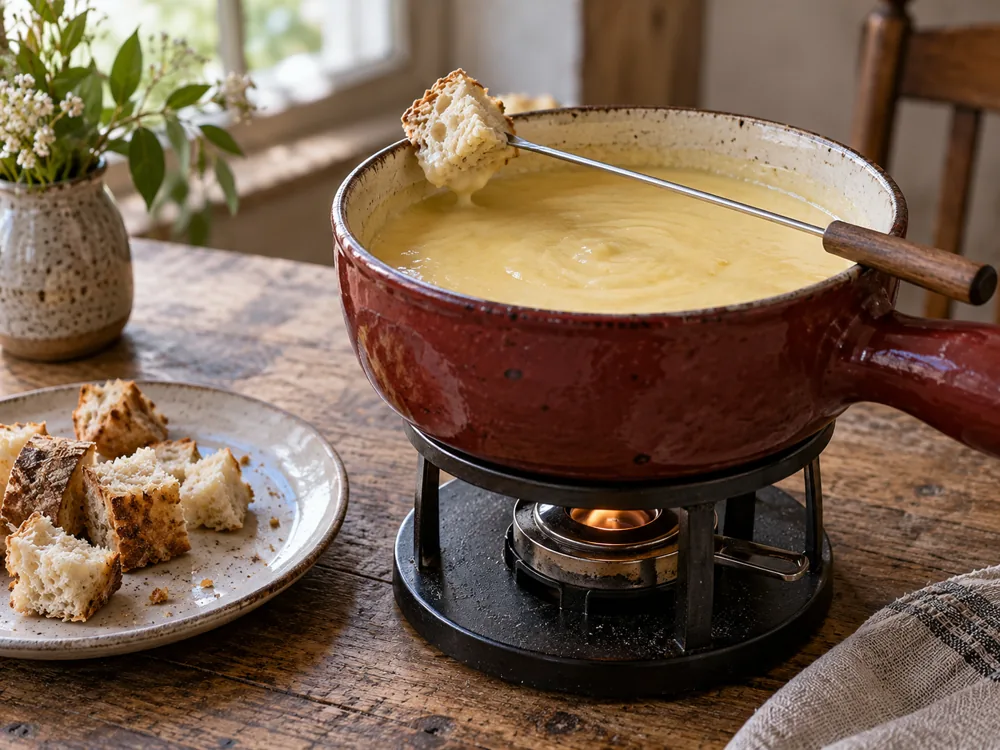
Gruyère appears more often in Wikipedia's list of Swiss cheese fondue recipes. Of the 11 Swiss variants it lists, Gruyère is a named ingredient in nine and Emmental in five.
Emmental never appears alone in that list. Every one of the five variants that names it also names Gruyère, as in the Neuchâteloise (Gruyère and Emmental), the Innerschweiz (with Sbrinz) and the Interlaken (with Appenzeller).
The Vaudoise is Gruyère alone, and moitié-moitié is Gruyère with Vacherin Fribourgeois, which the entry's caption names beside Gruyère as commonly used for fondue.
The entry adds that the regional names of some variants are factitious and do not reflect genuine regional traditions.
The French Savoyarde treats the two Swiss cheeses as one choice, calling for Beaufort, Abondance or a French equivalent of Gruyère or Emmental. The Jurassienne uses mature or mild Comté.
How Do You Spot Real Emmental and Gruyère AOP?
On Emmental, look for the cheese dairy mark with radiating red stripes. The authenticity of an Emmentaler AOP wheel rests on that mark, which carries a four- to eight-digit number identifying the dairy.
On Gruyère, the heel is embossed with Le Gruyère AOP and the dairy's number, and a casein mark gives the wheel number, the dairy number and the date it was made.
In the US the Gruyère name needs more care. A US court ruled in 2021 that gruyere had become a generic term for a type of cheese, the Fourth Circuit affirmed that in 2023, and Swiss Gruyère keeps a protected certification mark in the US as Le Gruyère Switzerland AOC.
Holes do not settle which Gruyère you have. Swiss Gruyère AOP allows openings but does not need them, the FDA standard of identity for Gruyere requires small holes or eyes, and French Gruyère, which has its own PGI and must be labelled French Gruyère, has holes from the size of a pea to a cherry.
Are Emmental and Gruyère Vegetarian or Lactose-Free?
Gruyère AOP is made with rennet extracted from calf stomach, an animal rennet, while for Emmental the answer depends on the dairy.
Some Emmentaler AOP dairies use animal rennet, an enzyme from calf stomachs, and others use microbial rennet made from mould cultures, which Emmentaler Switzerland says vegetarians mostly prefer.
To learn which rennet went into a wedge, Emmentaler Switzerland's FAQ says to read the dairy number on the rind and ask that dairy. The specifications ban genetically modified rennet and cultures.
Both trade bodies describe their cheese as free from lactose, Gruyère's in its composition figures. In Emmental, lactic acid bacteria ferment the milk sugar into lactic acid during pressing, and the lactose is gone within the first 24 hours.
Emmentaler Switzerland gives 0.5 g of salt per 100 g and calls that the lowest salt content of all hard cheeses. Wikipedia calls Gruyère slightly salty, so to compare a Gruyère wedge, check the salt or sodium figure on its nutrition label.
What Can You Substitute for Each One?
For Gruyère, the trade expert Peter Ungphakorn's view is that the French Comté could be a closer match to the Swiss original than French Gruyère is.
Wikipedia calls L'Etivaz, a raw cow's milk cheese from the canton of Vaud, very similar to aged Gruyère in taste, and lists Greek graviera, which it says resembles Gruyère, and Turkish Kars gravyer among the similar cheeses.
For Emmental, Emmental-style cheeses made elsewhere include Norwegian Jarlsberg, Dutch Maasdam, Swedish Grevé and Uruguayan Colonia. Three protected cheeses carry the Emmental name: Allgäuer Emmentaler, Emmental de Savoie and Emmental français est-central.
Can You Eat Emmental and Gruyère When Pregnant?
Both AOP cheeses are made from raw cow's milk, and for raw-milk Gruyère the NHS and CDC lines on cheese in pregnancy point different ways.
The NHS lists pasteurised or unpasteurised hard cheeses, such as cheddar, gruyère and parmesan, as safe to eat, and Gruyère is one of those examples. It also lists pasteurised semi-hard cheeses and pasteurised soft cheeses as safe to eat.
Descriptions of Emmental differ. Its trade body counts it among hard cheeses, while Wikipedia calls its paste medium-hard, a word the NHS lists do not use.
On the medium-hard reading, raw-milk Emmental AOP is covered by the NHS line saying any foods made from unpasteurised milk must be thoroughly cooked. Before eating it cold, ask a midwife or doctor whether Emmental counts as a hard cheese.
The CDC lists hard cheese, when made with pasteurized milk, such as Asiago, Cheddar, Parmesan, or Swiss/Gruyere/Emmental, as a safer choice. It lists unpasteurized (raw) milk and dairy products made from raw milk as a riskier choice.
Emmental AOP and Le Gruyère AOP are both made from raw milk, so they sit on the CDC's riskier line. Its safer line covers Emmental or Gruyere when made with pasteurized milk, so check the label for the milk.
Which One Should You Buy?
Buy by recipe first and by age second.
Choose Gruyère when the recipe names it, as nine of the 11 Swiss fondue variants on Wikipedia's list do, and Emmental when the recipe names it, as the Neuchâteloise does alongside Gruyère. Where the recipe is open, the age band sets the flavour, and a vegetarian eater should ask the Emmental dairy about its rennet because the Gruyère producer names calf rennet.
SOURCES & REFERENCES
What Else Do People Ask About Emmental and Gruyère?
That depends on the band. Emmentaler Switzerland calls its 4-month Mild/Classic mild and slightly sweet and its Extra extra spicy, and the Gruyère trade body calls its Classic soft and refined and its Réserve full-flavoured and aromatic.
In fondue the swap changes the recipe, because each variant on Wikipedia's list names its cheeses, and Emmental never appears there without Gruyère.
Gruyère is in more of the recipes: Wikipedia's list of 11 Swiss fondue variants names it in nine and Emmental in five, and every variant with Emmental also has Gruyère. The Gruyère entry calls it particularly suited to fondue.
In Emmental, propionic acid fermentation in a 19 to 24 °C cellar forms carbon dioxide that stays trapped in the wheel. Gruyère's rules make openings possible but not essential, at 4 to 6 mm.
Gruyère AOP is made with rennet extracted from calf stomach. Emmentaler Switzerland says Emmental's rennet depends on the dairy, either animal or microbial, and that the dairy number on the rind identifies which dairy to ask.